

Biden campaign co-chair admits she’s ‘afraid’ Biden will lose big due to border crisis
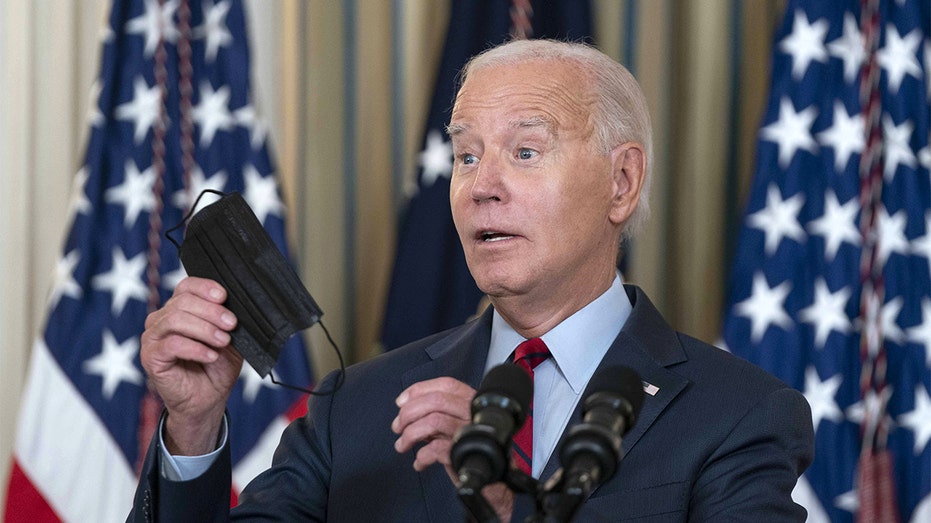
A co-chair of President Biden’s re-election campaign admitted that she is “afraid” of the effect the worsening border crisis could have on Biden’s re-election effort. Rep. Veronica Escobar, D-Texas, argues that Congress, and not the president, is to blame for the steady flow of hundreds of thousands of migrants across the U.S.-Mexico border each month. Immigration has been one of Biden’s least popular issues throughout his administration, but Escobar suggested to Politico that he is only being blamed because he is in the White House. “It is our job,” she said, referring to Congress. “We have failed over and over again.” “I do worry that Democrats will get blamed simply because the president is in the White House,” she added. When pressed about whether she fears Biden will face political consequences for the crisis, she responded, “I hope not, but I’m afraid of that.” IL ALLOCATES $160 MILLION TO AID MIGRANTS IN CHICAGO DURING WINTER MONTHS Escobar’s comments come just after Texas Gov. Greg Abbott signed legislation allowing state law enforcement to arrest migrants who cross the border illegally. CHICAGO RESIDENTS RAIL AGAINST PLANNED MIGRANT SHELTER At the signing ceremony, Abbott said the goal of Senate Bill 4 was to “stop the tidal wave of illegal entry into Texas.” Once in custody, migrants could either agree to a Texas judge’s order to leave the U.S. or be prosecuted on misdemeanor charges of illegal entry. Migrants who do not comply could face arrest again under more serious felony charges. Fiscal Year 2023 has seen an unprecedented spike in illegal immigration, with more than 2.4 million migrant encounters at the border. WHERE NO CONGRESS HAS GONE BEFORE: FACING GALACTIC-SCALE FISCAL CLIFF AND BORDER SECURITY THREATS September saw a record for encounters at the southern border, and the following month saw a record for encounters in October, with more than 240,000 encounters border-wide. Congress remains deadlocked over potential border legislation. Biden and fellow Democrats have refused to negotiate on the issue, leading Republicans to make Ukraine funding contingent on first addressing the crisis at home. Fox News’ Bradford Betz contributed to this report.
‘Wear masks, avoid crowded areas’: Kerala issues advisory after rise in Covid-19 cases

Kerala government has issued an advisory as the cases of Covid-19 rise rapidly in all parts of the country.
INDIA bloc meet: Mamata Banerjee, Arvind Kejriwal propose Congress president Mallikarjun Kharge’s name as PM face

West Bengal Chief Minister Mamata Banerjee and Delhi CM Arvind Kejriwal proposed Congress president Mallikarjun Kharge’s name as the prime ministerial candidate of opposition bloc INDIA.
Ex-Miami Young Republicans director, Rubio intern and DeSantis campaign organizer arrested on Jan. 6 charges

The former director of the Miami Young Republicans, who was allegedly captured on surveillance video breaching the Crypt of the U.S. Capitol, was arrested last week on charges in connection to the Jan. 6 riot, according to newly unsealed court documents Monday. Barbara Balmaseda, 23, of Miami Lakes, Florida, is charged in a criminal complaint filed in the District of Columbia with a felony offense of obstruction of an official proceeding and misdemeanor offenses of entering and remaining in a restricted building or grounds, disorderly and disruptive conduct in a restricted building or grounds, disorderly conduct in a Capitol building or grounds, and parading, demonstrating, or picketing in a Capitol building, the Justice Department announced. According to the Miami New Times, Balmaseda, a Florida International University (FIU) student and South Florida GOP strategist, previously interned for U.S. Sen. Marco Rubio, R-Fla., between 2018 and 2019 and worked as an organizer for Florida Gov. Ron DeSantis’ 2018 gubernatorial campaign. She was arrested on Thursday in Miami Lakes and made her initial appearance in the Southern District of Florida. Balmaseda’s attorney, Aubrey Webb, deemed the 23-year-old’s arrest by a task force of “FBI, Marshals, ATF and Metro-Dade Police” as a “waste of law enforcement resources” for what amounts to “essentially trespassing charges,” according to Politico. SUPREME COURT TAKES CHALLENGE TO JAN. 6 CHARGE THAT COULD HAVE IMPLICATIONS FOR TRUMP “Maybe if the FBI spent less time and resources focusing on J6 trespassers with no criminal history, they might be able to make an arrest of the suspect who left pipe bombs at the DNC and RNC offices on Capitol Hill on January 5, 2021, who currently remains at large,” Webb said in a statement. “We hope, of course, they will rein in the DOJ’s politically-motivated prosecution of January 6 demonstrators.” The attorney further stated that Balmaseda is “relieved this process will finally move toward a final resolution,” stressing that she is not charged with violence or destruction of property. Last week, the Supreme Court notably agreed to hear a case involving three Jan. 6 defendants disputing an obstruction charge that could have implications for one of former President Trump’s criminal cases. Over 300 people have been charged by the Justice Department with obstructing an official proceeding in connection with the Jan. 6 riot. The new complaint takes issue with how Balmaseda and former Proud Boys member Gabriel Garcia, who once sat on the Miami-Dade Republican Party Executive Committee, exchanged hundreds of texts and images from August 2020 through January 2021 and snapped a selfie together leaving the steps of the Capitol on January 6. Garcia was found guilty in November on felony charges of obstruction of an official proceeding and interference with law enforcement during a civil disorder in connection to the riot. His sentencing is scheduled for Mar. 28, 2024. Meanwhile, court documents allege Balmaseda traveled from Florida to Washington, D.C., to protest the result of the 2020 presidential election. Prior to her arrival in Washington, D.C., on Jan. 5, 2021, Balmaseda exchanged messages with several associates in which she participated in communications reflecting her belief that the 2020 presidential election had been stolen and her knowledge about the certification process scheduled to take place on Jan. 6, 2021, prosecutors say. On January 6, court documents say Balmaseda was photographed in Black Lives Matter Plaza – the two-block area in front of the White House renamed by D.C. Mayor Muriel Bowser during the 2020 George Floyd protests and riots. Shortly after, at about 2:00 p.m., Balmaseda approached the Capitol building with another individual and was in position to see the crowd of rioters climbing the scaffolding on the west side of the Capitol and plumes of smoke that billowed into the air, federal prosecutors alleged. By this time, rioters had overwhelmed officers on the west front, bypassed the officer lines, and gained access to the northwest stairs of the Capitol. Around 2:09 p.m., rioters pushed past officers on the middle landing of the stairs and surged toward the Capitol building. JUDGE PAUSES JAN. 6 CASE AGAINST TRUMP AMID FORMER PRESIDENT’S APPEAL TO DISMISS Eventually, U.S. Capitol Police closed-circuit television (CCTV) captured Balmaseda entering the Capitol building via the Senate Wing door at approximately 2:16 p.m., just four minutes after rioters initially breached the building. According to the allegations, when Balmaseda entered the building, broken glass was scattered on the ground, and an alarm blared near the doorway. After entering the Capitol, Balmaseda made her way toward the Crypt and pushed her way to the front of a crowd of rioters who were confronting a police line, federal prosecutors say. The mob eventually overran the police line and proceeded into the Crypt. Balmaseda moved forward, joined a crowd of rioters, and headed towards an area known as the “OAP Corridor,” where another line of officers initially blocked a hallway. The complaint says officers eventually backed away, and the rioters, including Balmaseda, continued to move forward. The Justice Department says Balmaseda then made her way back to the Crypt and eventually entered the Rotunda, where she took photographs and exited the area at approximately 2:53 p.m., Balmaseda returned to the Rotunda and stood nearby as a group of rioters attempted to push through an officer line. At approximately 3:11 p.m., law enforcement officers received additional support in the Rotunda and were able to corral rioters, Balmaseda included, towards the nearest exit, the Rotunda doors. In the 35 months since Jan. 6, 2021, more than 1,230 individuals have been charged in nearly all 50 states for crimes related to the breach of the U.S. Capitol, including more than 440 individuals charged with assaulting or impeding law enforcement, a felony, the DOJ notes. The investigation remains ongoing.
Yemen’s Houthis ‘will not stop’ Red Sea attacks until Israel ends Gaza war
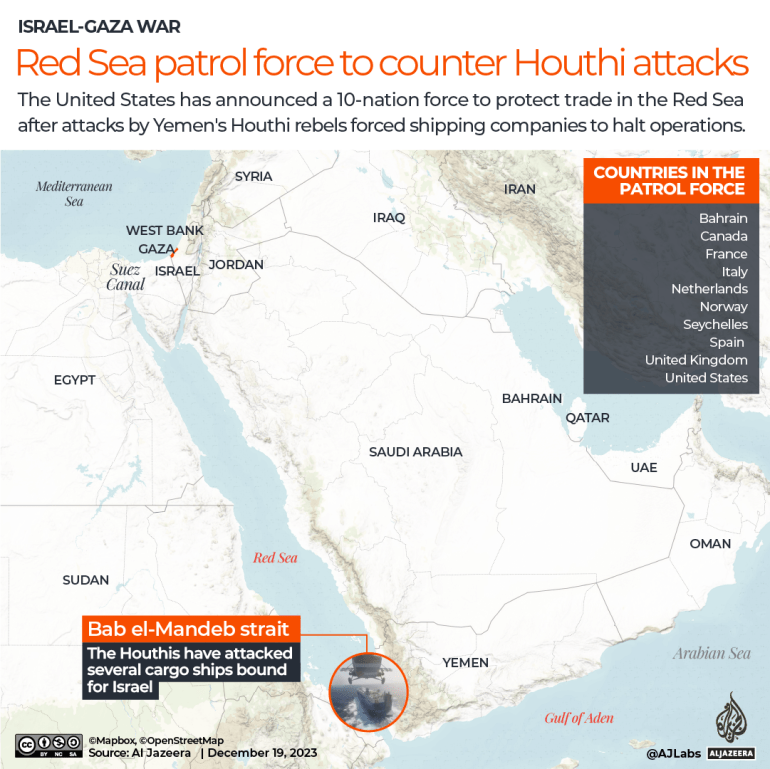
US launches maritime coalition to counter attacks the rebel group says are a response to Israeli ‘crimes’ in Gaza Strip. Yemen’s Houthis will not halt attacks on ships linked to Israel in the Red Sea, despite the United States announcing a new maritime protection force to counter them, a spokesperson for the rebel group said. “Even if America succeeds in mobilising the entire world, our military operations will not stop … no matter the sacrifices it costs us,” Mohammed al-Bukhaiti, a senior Houthi official, said in a post on X on Tuesday. The Houthis would only halt their attacks if Israel’s “crimes in Gaza stop and food, medicines and fuel are allowed to reach its besieged population”, al-Bukhaiti said. He spoke after US Defense Secretary Lloyd Austin announced a coalition on Monday to protect trade in the Red Sea after the attacks forced shipping lines to suspend operations. The Iran-linked Houthis have waged attacks on more than a dozen commercial ships in an attempt to pressure Israel to end its bombardment of the Gaza Strip. “These reckless Houthi attacks are a serious international problem and they demand a firm international response,” Austin said about the new 10-nation coalition. He said the force would operate “with the goal of ensuring freedom of navigation for all countries and bolstering regional security and prosperity”. After the US announcement, Houthi Major General Yusuf al-Madani said in a statement: “Any escalation in Gaza is an escalation in the Red Sea … Any country or party that comes between us and Palestine, we will confront it.” Spokesperson al-Bukhaiti told Al Jazeera on Monday that the group would confront any US-led coalition in the Red Sea. Not an act of ‘defiance’ “You have the military establishment in Yemen, in the areas controlled by the Houthis, warning that they will continue to target ships cruising through the Bab el-Mandeb strait and the Red Sea and they insist they are doing this to protect people in Gaza, in particular,” Al Jazeera’s Hashem Ahelbarra said, reporting from Doha on Tuesday. “A top Houthi official, Mohammed Abdulsalam, who is also a senior negotiator, said the attacks by the Houthis are not an act of defiance but if this new coalition is adamant on launching attacks, then they will have to bear the consequences of what he described as a broader conflict in the region. “But he said at the same time that the Houthis are still adamant on the need for the Israelis to stop the war if they want the Houthis to stop the attacks,” our correspondent added. On Tuesday, Abdulsalam told Reuters news agency that the US-led naval patrol mission is “essentially unnecessary” – as all waters near Yemen are still safe, except for Israel-linked ships or vessels travelling to Israel. The US and British navies said over the weekend that their destroyers had shot down a total of 15 drones in the waterway. In the latest incident on Tuesday, the United Kingdom Maritime Trade Operations, said four small boats, each carrying four to five people, approached a vessel off the coast of Djibouti in a “suspicious” manoeuvre – but that no weapons were seen during the incident. At least 12 shipping companies, including the Italian-Swiss giant Mediterranean Shipping Company, France’s CMA CGM and Denmark’s AP Moller-Maersk, have suspended transit through the Red Sea due to safety concerns. UK oil giant BP on Monday became the latest firm to announce it would avoid the waters. Houthi attacks have effectively rerouted a significant portion of global trade by forcing freight companies to sail around Africa, imposing higher costs and delays for energy, food and consumer goods deliveries. About 12 percent of global trade passes through the Red Sea, which connects to the Mediterranean Sea via the Suez Canal, including 30 percent of container traffic. [embedded content] Adblock test (Why?)
China’s Gansu earthquake kills 118 people: What to know
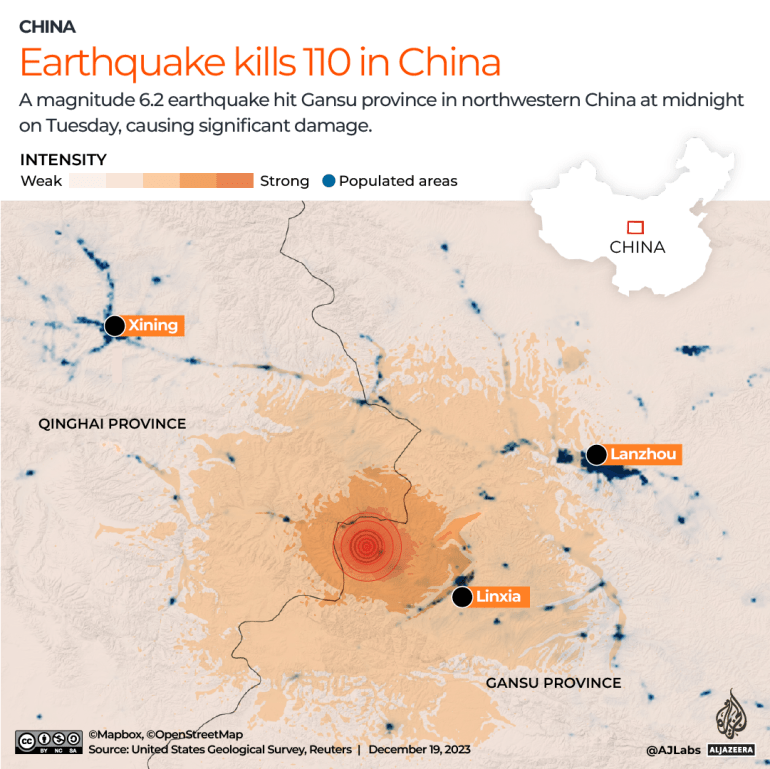
A powerful magnitude 6.2 earthquake hit remote China’s Gansu province, killing 118 people. A powerful magnitude 6.2 earthquake struck China’s remote Gansu province at midnight on Monday, killing at least 118 and injuring more than 500 people. Relief and rescue teams have been facing challenges as roads and public infrastructures have been damaged, with such subzero temperatures further adding to the problem. Here’s what to know about the event and current situation on the ground: When did the quake strike and where? At 23:59pm (15:59 GMT) on Monday, the earthquake hit Jishishan in the northwestern Gansu province, causing people to rush out of their homes out in the cold weather. Initial tremors lasted around 20 seconds. Its tremors were felt as far away as 570km (354 miles) in Xi’an, northern Shaanxi province, while casualties also occurred in Haidong city of neighbouring Qinghai province, some 115km (71 miles) away. The epicentre of the quake Jishishan County and neighbouring areas are still reeling from the aftereffects of the quake. Emergency teams worked through the night to rescue people from the rubble but their efforts were hampered by several aftershocks, Al Jazeera correspondent Katrina Yu, reporting from Beijing, said. Nearly 5,000 houses have been damaged to “varying degrees” while power and water supplies were also disrupted in some villages, according to state media. The magnitude of the quake was 5.9 according to the United States Geological Survey, while the the European Mediterranean Seismological Centre (EMSC) said it was 6.1. But Chinese authorities put it at 6.2. It occurred at a depth of 35km (22 miles). What do we know about the region hit by the earthquake? The earthquake hit the mountainous border region between Gansu and Qinghai provinces, which lies on the east of the Qinghai-Tibetan plateau, a tectonically active area, making earthquakes common in the region. Gansu has a population of about 26 million and in 2022, it ranked 27th out of 31 Chinese provinces and municipalities in terms of GDP size. The rural Jishishan is almost 90km (56 miles) southwest of Gansu’s capital, Lanzhou. What do we know about casualties so far? A total of 105 people were confirmed dead and 397 injured in Jishishan in Gansu province, according to local authorities. An additional 13 people died in Haidong City, about 100km (68 miles) northwest of Jishishan in the neighbouring Qinghai province. More than 180 people were injured and 20 missing remain, according to state broadcaster CCTV. Is Gansu safe now? What is the latest on rescue operations? Rescue efforts are still under way and people have been advised against going to affected areas to prevent traffic jams. Subzero temperatures and roads that are either damaged by the quake or inundated with snow have made it difficult to carry out rescue operations. Overnight temperature on Tuesday dropped to as low as -13 degrees Celsius (8.7 degrees Fahrenheit), according to the China Meteorological Administration. The quake has also wrecked infrastructure and triggered landslides in the mountainous region. People in affected areas have been given essential supplies such as drinking water, blankets, tents, stoves and instant noodles. What are the challenges facing rescue efforts? Emergency vehicles with rescue workers have been driving along snow-lined highways to carry out relief efforts while satellites are monitoring affected areas. Approximately 1,500 firefighters were deployed while another 1,500 are on standby, according to state media. Additionally, 300 officers and soldiers were mobilised for disaster relief. China’s ministries of finance and emergency management have allocated 200 million RMB in emergency relief funds, according to state media. The ministries of finance and emergency management have allocated 200 million yuan ($28m) in emergency relief funds, according to state media. Almost 14,700 students and teachers from all 15 boarding schools in Jishishan County have been evacuated, Chinese state media reported on Tuesday. Reactions Chinese President Xi Jinping called for “all-out efforts” in search and rescue. The country’s arch-foe, Taiwan, expressed condolences and also offered help. “We pray that all those affected receive the aid they need, and we hope for a swift recovery. Taiwan stands ready to offer assistance in the disaster response effort,” said Taiwan President Tsai Ing-wen. The interim prime minister of Pakistan, a Chinese ally, also said he was “deeply saddened” to hear of the quake in a post to X on Tuesday. Deeply saddened to learn about the loss of precious lives due to the earthquake in Gansu province in China. Our sympathies are with our Chinese brothers and sisters in this hour of grief. — Anwaar ul Haq Kakar (@anwaar_kakar) December 19, 2023 Adblock test (Why?)
Israel’s ‘Plan B’ for the Gaza Strip
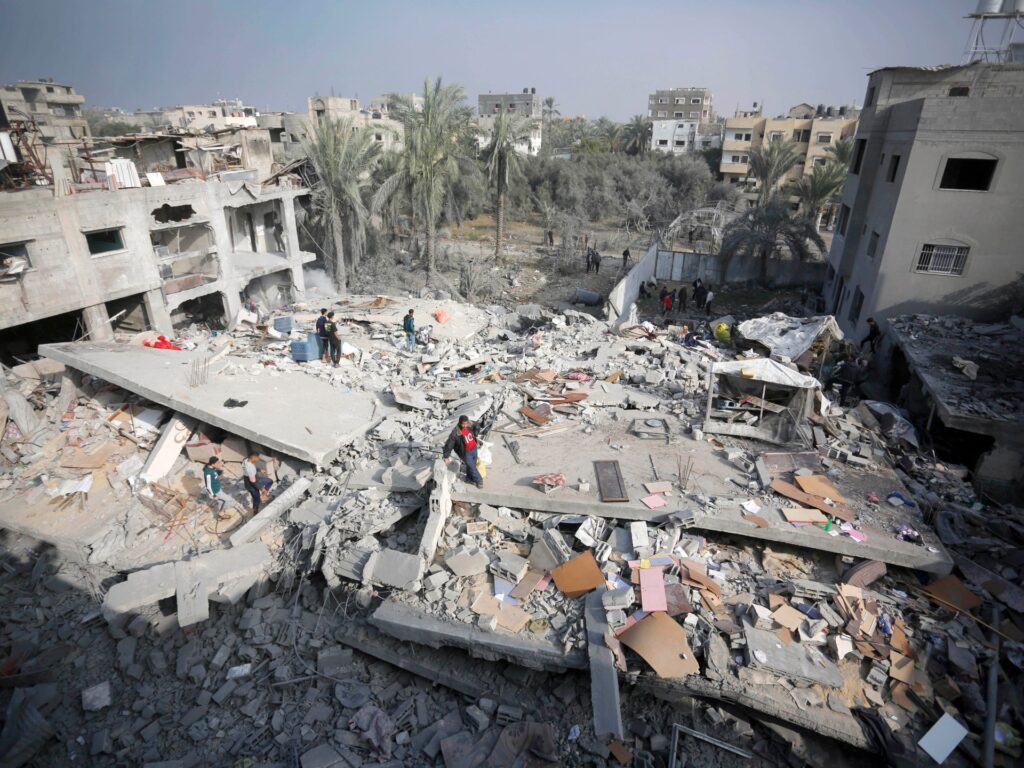
It has been more than two months now since the Israeli authorities launched a war on Gaza in response to Hamas’s attack on its southern territories, which resulted in the killing of about 1,200 people, mostly Israeli civilians. Relentless Israeli bombardment and ground attacks have flattened entire neighbourhoods and killed close to 20,000 Palestinians, more than a third of them children. The declared goal of the Israeli onslaught has been the “eradication” of Hamas from the enclave, but the viability of that being achieved has been increasingly questioned by foreign officials and analysts. Instead, the large-scale destruction wrought on Gaza as well as internal communications point to another aim the Israeli authorities may be pursuing. A document produced by Israel’s Ministry of Intelligence leaked to the Israeli press in late October outlined the forcible and permanent transfer of Gaza’s 2.3 million Palestinian residents to Egypt’s Sinai Peninsula. The document was reportedly created for an organisation called The Unit for Settlement – Gaza Strip, which seeks to recolonise the Gaza Strip 18 years after Israeli troops and settlers withdrew from it. Yet, we are not living in 1948. Today, it is much more difficult to wipe out cities and villages as was done 75 years ago during the expulsion of a large percentage of the Palestinian population from its homeland by Israeli militias, when, among other things, the reach of the media was far less extensive than it is now. The Israeli authorities have therefore turned to what we might term “the plan B”: that is, to make the Gaza Strip unliveable, by dropping tens of thousands of tonnes of bombs. The new strategy is implemented by targeting civilian infrastructure that supports life in the strip, including schools, universities, hospitals, bakeries, shops, farmland and greenhouses, water stations, sewage systems, power stations, solar panels, and generators. This is carried out in parallel with a full siege on Gaza, whereby food, water, electricity and medicine have been cut off. The Israeli army lets in a few trucks a day, if at all, which humanitarian organisations have said does not meet at all the needs of the Palestinian population, 1.8 million of whom have been internally displaced. This has resulted in what has interchangeably been called humanitarian “disaster”, “catastrophe”, “graveyard” and “hell”. The Palestinians of Gaza have been pushed to the brink of survival, while widespread epidemics are perceived by some as a desired goal. As former head of the Israeli National Security Council Giora Eiland has claimed: “Severe epidemics in the south of the Gaza Strip will bring victory closer.” Once the Gaza Strip is rendered unliveable and the population has no choice but to leave voluntarily, the next step is to ensure that neighbouring countries, Egypt first and foremost, are ready to “absorb them”. This has been made clear by several prominent figures in Israel, including former deputy director of its national intelligence agency Mossad, Ram Ben Barak. In a tweet in Hebrew, Ben Barak expressed the need “to build a coalition of countries and international funding that will allow Gazans who want to leave to be absorbed [in those countries] through the acquisition of a citizenship”. Back on November 12, 1914, US President Woodrow Wilson wrote to racial equality advocate William Monroe Trotter that “Segregation is not humiliating but a benefit, and ought to be so regarded by you gentleman”. More than 100 years later, Israel’s plan – which has less to do with segregation and more with ethnic cleansing – is presented in similar terms. The expulsion, in Ben Barak’s words, is an “opportunity [for Gaza residents] to escape the reign of fear of Hamas, which uses them as human shields”. The irony, of course, is that Palestinian civilians are often used as “human shields” by the Israeli army itself. But beyond that, along with the emphasis on “voluntary” departure in this “benevolent approach”, the forced resettlement is also made more palatable for the international community with claims that the Palestinians are really just Arabs, and therefore can easily relocate to other Arab countries. Israel has long called the 156,000 Palestinians (and their descendants) who managed to remain within its borders after 1948 “Arabs”, denying them their Palestinian identity. As Prime Minister Benjamin Netanyahu once claimed, “The Arab citizens [of Israel] have 22 nation states. They don’t need another one.” It is important here to stress that referring to the local populations, from the Strait of Gibraltar to the Strait of Hormuz, as “the Arabs” would be like calling people from South Africa, the United States, Canada, Australia, New Zealand, Ireland and Britain, regardless of their origin, “the English”. They share the language but show very clear peculiar histories, traditions and identities. More than 1,000 years ago, Jerusalemite geographer al-Muqaddasi (946–1000) explained in clear terms that he perceived himself as a Palestinian: “I mentioned to them [workers in Shiraz] about the construction in Palestine and I discussed with them these matters. The master stonecutter asked me: Are you Egyptian? I replied: No, I am Palestinian.” Centuries later, on September 3, 1921, an editorial published in the Arabic-language newspaper Falastin pointed out: “We are Palestinians first, and Arabs second.” These are just two examples, among many others, of written sources where “Palestinian” is clearly used as an identity marker. That Palestinians are not simply “Arabs” appears further evident if we look at the years in which the West Bank was occupied (1948-1967) by Jordan: an occupation which was opposed by the local population at the time, most of all by Fatah fighters, to the point that King Hussein felt obliged to impose martial law. In Gaza, which was under Egyptian control during the same period, Palestinians faced harsh repression, were denied citizenship, and had very little control over local administration. Most of them lived in very poor conditions, largely in refugee camps, having been expelled by Israeli militias from villages around the Gaza Strip, including Huj, Najd, Abu Sitta, Majdal, al-Jura, Yibna, and Bayt Daras. These last three villages, in particular, are the ones from where the
Opposition INDIA bloc meeting commences deliberations in Delhi

A crucial meeting of the Opposition INDIA bloc began in the national capital.
After years of losing battles with GOP leaders, some big city Texas mayors strike friendlier tone
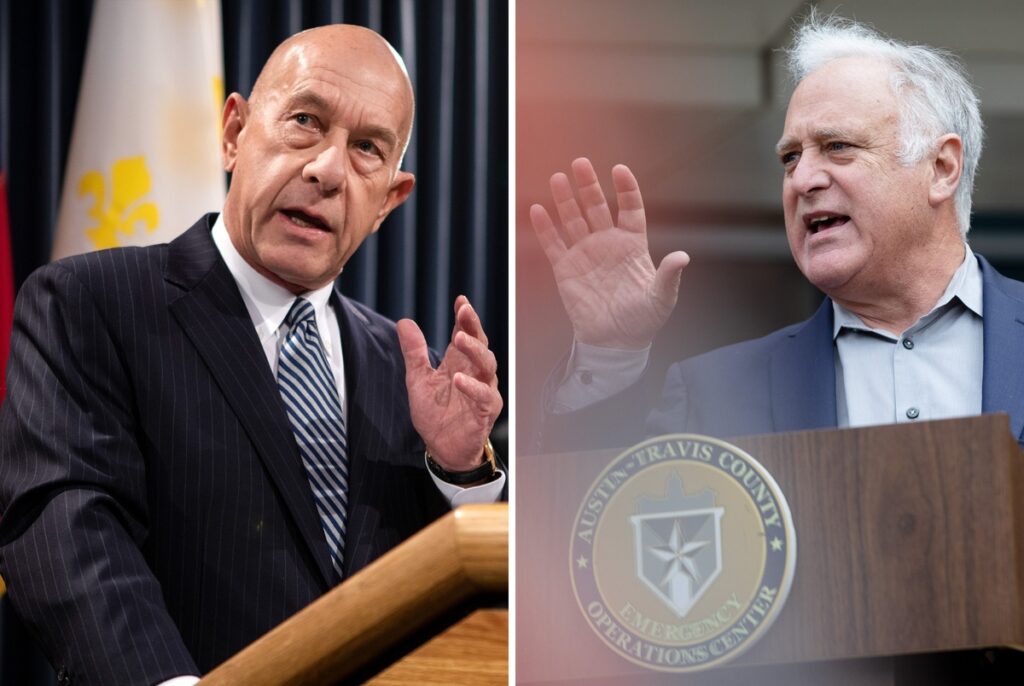
Austin Mayor Kirk Watson and incoming Houston Mayor John Whitmire, two veteran Democratic legislators, are trying to repair their cities’ fraught relationships with the state’s GOP leadership.
A Texas high school is piloting the state’s first-ever Asian American studies course. Could politics stand in its way?

The course highlights Asian Americans’ contributions in U.S. history. It also seeks to offer an honest look at the mistreatment, like the incarceration of Japanese Americans during World War II.