

‘We wanted to eliminate Khamenei’: Israel’s Defence Minister Katz
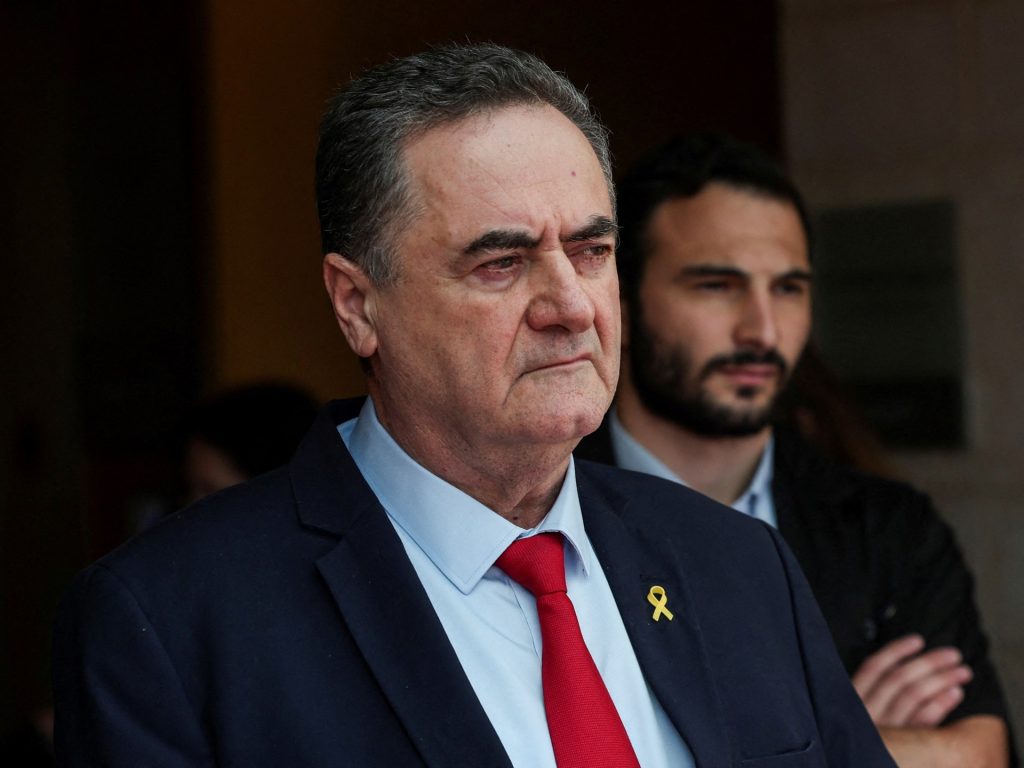
Katz says Israel has ‘green light’ from US to attack Iran again if Tehran makes ‘progress’ with its nuclear programme. Israeli Defence Minister Israel Katz has said that his country wanted to kill Iran’s Supreme Leader Ayatollah Ali Khamenei during the recent 12-day war between the two sides that ended this week with a ceasefire. Katz said on Thursday that Israel would not have needed permission from the United States to kill Khamenei, appearing to refute previous media reports that Washington vetoed the assassination. “We wanted to eliminate Khamenei, but there was no operational opportunity,” said Katz in an interview with Israel’s Channel 13. Katz claimed that Khamenei knew an attempt on his life was on the cards, and went “underground to very great depths”, breaking off contact with commanders who replaced Islamic Revolutionary Guard Corps leaders assassinated in the first wave of Israeli strikes. Khamenei released video messages during the war, and there is no evidence to confirm that he was cut off from his generals. Killing Khamenei would have been a major escalation in the conflict. Besides being the de facto head of state in Iran, the supreme leader is a top spiritual authority for millions of Shia Muslims across the world. Israeli Prime Minister Benjamin Netanyahu and US President Donald Trump had both suggested at various times that the war could spark regime change, the latter posting on social media last Sunday that the conflict could “MAKE IRAN GREAT AGAIN”. Katz’s comments came amid conflicting reports on the extent of destruction wrought on Iran’s nuclear capability, primarily as a result of the US bombing of sites at Fordow, Natanz and Isfahan. Khamenei said on Thursday that the US had “exaggerated” the impact of strikes. Advertisement The Israeli defence minister said that his country has a “green light” from Trump to launch another attack on Iran if it were deemed to be making “progress” with its nuclear programme. “I do not see a situation where Iran will restore the nuclear facilities after the attack,” he said. For his part, Netanyahu said on Thursday that the outcome of the war presented a “window of opportunity” for further formal diplomatic agreements with Arab states. The conflict ended with a US-brokered ceasefire after Iran responded to the US strikes with a missile attack on Qatar’s Al Udeid Air Base, which houses US troops. “We have fought with determination against Iran and achieved a great victory. This victory opens the path to dramatically enlarge the peace accords,” Netanyahu said in a video address, in an apparent reference to the Abraham Accords, which established official ties between Israel and several Arab countries in 2020. Iran also declared victory after the war, saying that it thwarted the Israeli objectives – namely ending Tehran’s nuclear and ballistic missile programmes – and managed to force Netanyahu to end the assault with the missile strikes that left widespread destruction in Israel. Adblock test (Why?)
UN reports uptick in preventable diseases in Gaza due to Israeli blockade
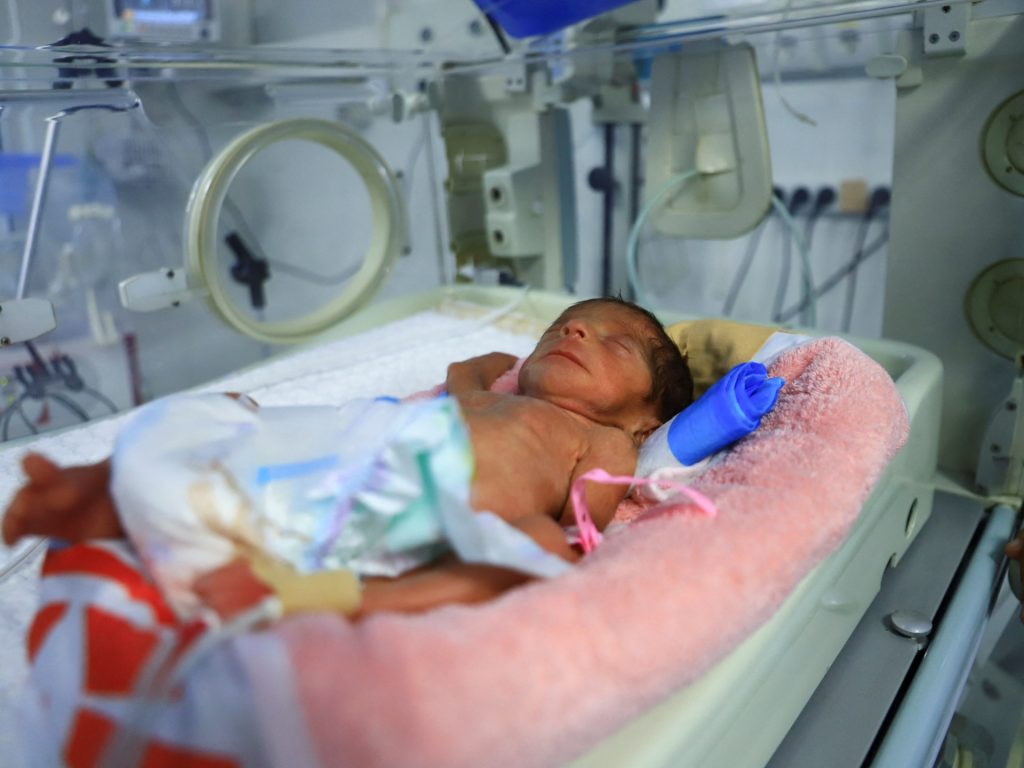
UN humanitarian agency stresses need for fuel, medical supplies and water in Palestinian territory besieged by Israel. The United Nations humanitarian agency (OCHA) has warned that preventable diseases in Gaza are on the rise and killing civilians due to the lack of desperately needed medicine and clean water. OCHA in a statement on Thursday said that in the past two weeks, “more than 19,000 cases of acute watery diarrhoea have been recorded, alongside over 200 cases each of acute jaundice syndrome and bloody diarrhoea “. “These outbreaks are directly linked to the lack of clean water and sanitation in Gaza, underscoring the urgent need for fuel, medical supplies, and water, sanitation and hygiene items to prevent further collapse of the public health system,” the agency added. Israel’s blockade on fuel entry into Gaza has paralysed the territory’s desalination plants and water system. The Israeli military has destroyed much of Gaza, displaced nearly the entire population of the territory and placed a suffocating siege on the enclave. Besides the dire humanitarian conditions, the Israeli military continues to kill dozens of Palestinians in Gaza daily. Leading rights groups and UN experts have described the Israeli campaign as a genocide. OCHA said on Thursday that more than 20 people were killed and about 70 others were injured after a strike on Deir el-Balah, central Gaza. Medical sources told Al Jazeera Arabic that Israeli attacks killed at least 71 people across Gaza on Thursday. Since Israel’s war on Gaza began in October 2023, at least 56,259 people have been killed, and 132,458 others have been wounded, according to Gaza’s Health Ministry. Advertisement After a more than two-month blockade of essential goods entering Gaza, the Israeli government announced it was allowing aid to re-enter the enclave in May. However, due to Israeli restrictions, the amount of aid entering has been minimal, with aid agencies referring to it as a “drop in the ocean”. Much of the aid allowed in has been through the United States and Israeli-backed Gaza Humanitarian Foundation (GHF), which has been condemned by aid agencies as a “weaponisation” of humanitarian goods. On Wednesday, Israeli Prime Minister Benjamin Netanyahu and his Defence Minister Israel Katz said in a video message that the army was being asked to draft a new plan to deliver aid to Gaza after unverified footage showed masked men on top of aid trucks in northern Gaza. While Israel has claimed the men were Hamas members, Palestinian clan leaders with no affiliation with the group said the masked men were protecting the truck from being looted. Multiple UN officials have refuted Israel’s claims that Hamas steals humanitarian aid. Last month, Israeli officials acknowledged arming criminal gangs linked to looting the assistance in order to rival Hamas. Adblock test (Why?)
Brazil announces compensation for dictatorship victim Vladimir Herzog
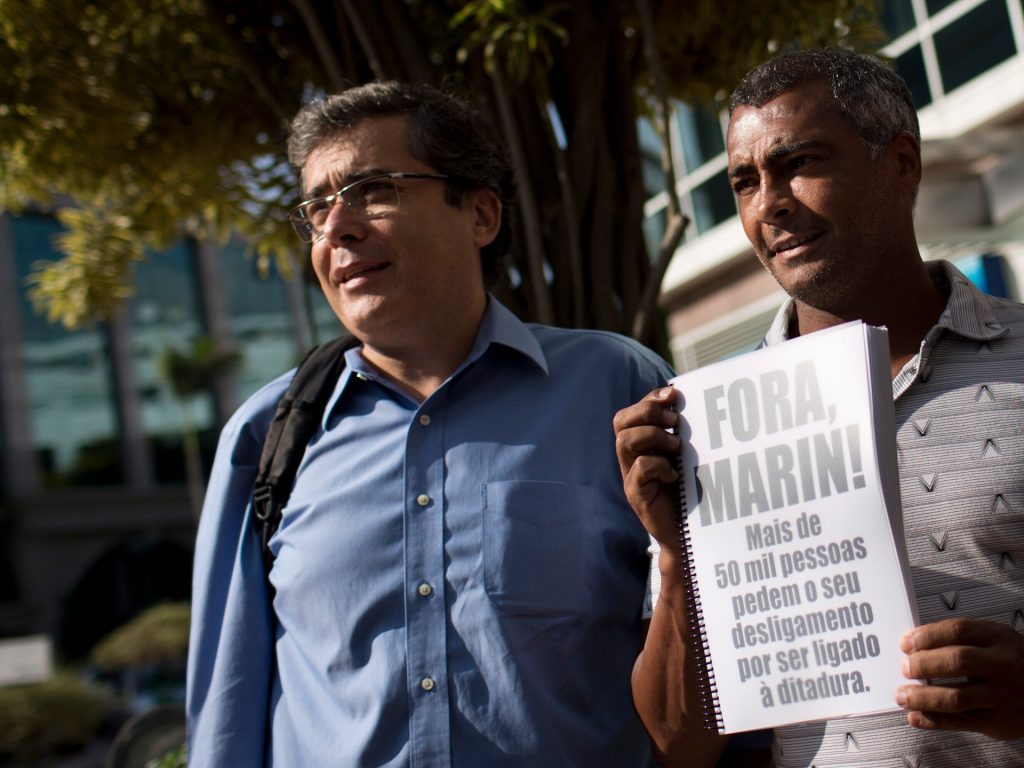
The government of Brazil has announced an agreement to acknowledge its responsibility in the murder of Vladimir Herzog, a journalist and dissident who was killed during the country’s dictatorship period. On Thursday, the government agreed to a statement of liability and a compensation package for Herzog’s family, amounting to 3 million Brazilian reais, or $544,800. The settlement also affirmed the decision of a federal court earlier this year to grant Herzog’s widow, Clarice Herzog, retroactive payments of a pension she should have received after her husband’s death, amounting to about $6,000 per month. In a statement recorded by The Associated Press news agency, Herzog’s son, Ivo Herzog, applauded the government’s decision to accept responsibility. “This apology is not merely symbolic,” Ivo said. “It is an act by the state that makes us believe the current Brazilian state doesn’t think like the Brazilian state of that time.” He added that his family’s story represented hundreds, if not thousands, of others who had their loved ones killed during the dictatorship period from 1964 to 1985. Having the government acknowledge its wrongdoing, he explained, has been a decades-long fight. “This has been a struggle not only of the Herzog family, but of all the families of the murdered and disappeared,” said Ivo, who now runs a human rights nonprofit named for his father, the Vladimir Herzog Institute. Vladimir Herzog was 38 years old at the time of his death in 1975, midway through the dictatorship period. Advertisement The Brazilian army had overthrown left-wing President Joao Goulart a decade earlier and installed a government that became known for human rights abuses, including the arbitrary arrest and torture of dissidents, students, politicians, Indigenous people and anyone else deemed to be a threat. Many went into exile. Some were killed or simply disappeared without a trace. The number of deaths is estimated to be about 500, though some experts place that figure at 10,000 or higher. Herzog was a prominent journalist, and initially, he too went into exile in the United Kingdom. But he returned to Brazil to serve as the news editor for a public television station, TV Cultura. It was in that role that, on October 24, 1975, Herzog was summoned by authorities to an army barrack. There, military officials indicated he would be asked to testify about his political connections. Herzog voluntarily left to offer his statement. But he never returned home. The military later claimed Herzog’s death was a suicide, and it released a staged photo of his body hanging from a rope. But a rabbi who later examined Herzog’s body found signs of torture. Herzog’s funeral, conducted with full religious rites, turned into a moment of reckoning for the Brazilian dictatorship, and the staged photograph became a symbol of its abuses. His son Ivo was only nine years old at the time. Earlier this year, he spoke to Al Jazeera about the release of a film called I’m Still Here that highlighted another murder committed under the dictatorship: that of Rubens Paiva, a politician. Like Herzog, Paiva voluntarily left to give testimony at the request of military officials and was never seen alive again. His body was never found. It took decades for Paiva’s family to receive a death certificate that acknowledged the military’s role in his death. Ivo praised the film I’m Still Here for raising awareness about the injustices of the dictatorship. He also told Al Jazeera that he hoped for the Brazilian government to acknowledge the harm it had done to his family and to amend the 1979 Amnesty Law that shielded many military officials from facing accountability. “What are they waiting for? For everyone connected to that period to die?” Herzog told journalist Eleonore Hughes. “Brazil has a politics of forgetfulness, and we have evolved very, very little.” On Thursday, Jorge Messias, Brazil’s federal legal counsellor, framed the agreement with the Herzog family as a step forward. “Today, we are witnessing something unprecedented: The Brazilian state formally honouring the memory of Vladimir Herzog,” he said. Advertisement He also compared the 1964 coup d’etat with the modern circumstances of Brazilian politics. On January 8, 2023, thousands of supporters of far-right President Jair Bolsonaro stormed government buildings in Brazil’s capital, after the 2022 election saw their candidate defeated. The current president, left-wing leader Luiz Inacio Lula da Silva, has compared that incident to a coup. Bolsonaro testified this month in court over charges he helped orchestrate an effort to overturn the election result. “In the 2022 election, we stood at a crossroads: Either to reaffirm democracy or move toward the closure of the Brazilian state, with all the horrors we lived through for 21 years,” Messias said, referencing the horrors of the dictatorship. Adblock test (Why?)
Did the US and Israel really obliterate Iran’s nuclear facilities?
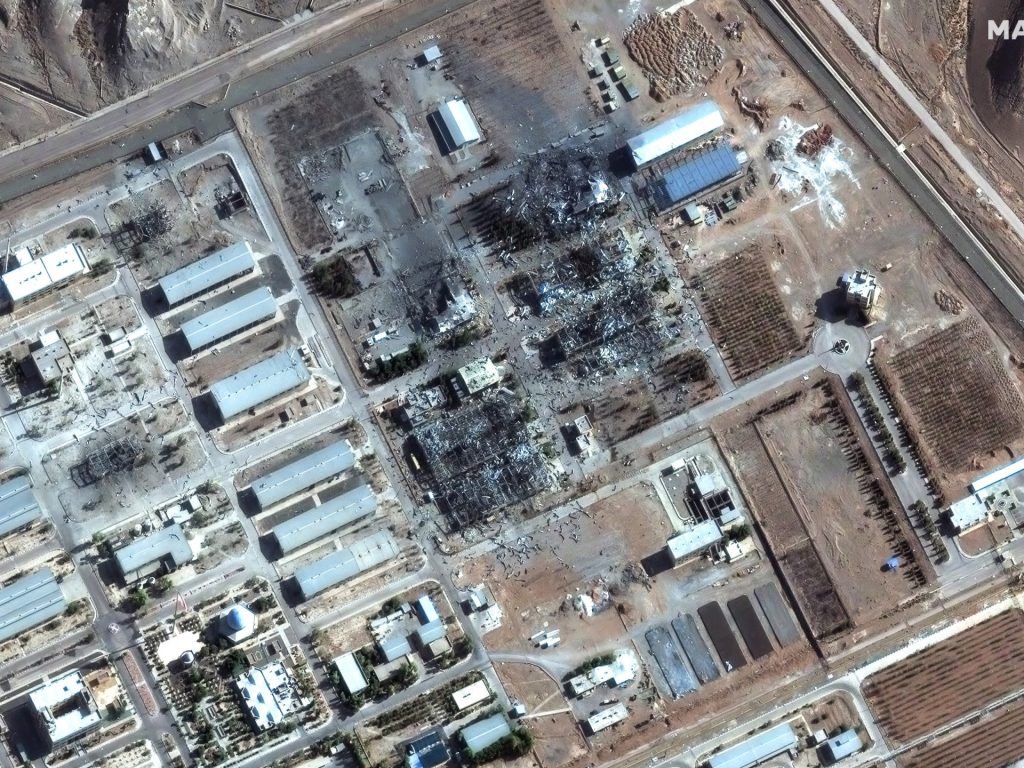
NewsFeed A leaked intelligence report has cast doubt on Trump and Netanyahu’s claims that their attacks on Iran destroyed its nuclear programme. Analysts say some facilities weren’t even hit, while 400kg of uranium is unaccounted for. Soraya Lennie takes a look. Published On 25 Jun 202525 Jun 2025 Adblock test (Why?)
Trump administration sues Maryland court system over deportation rulings
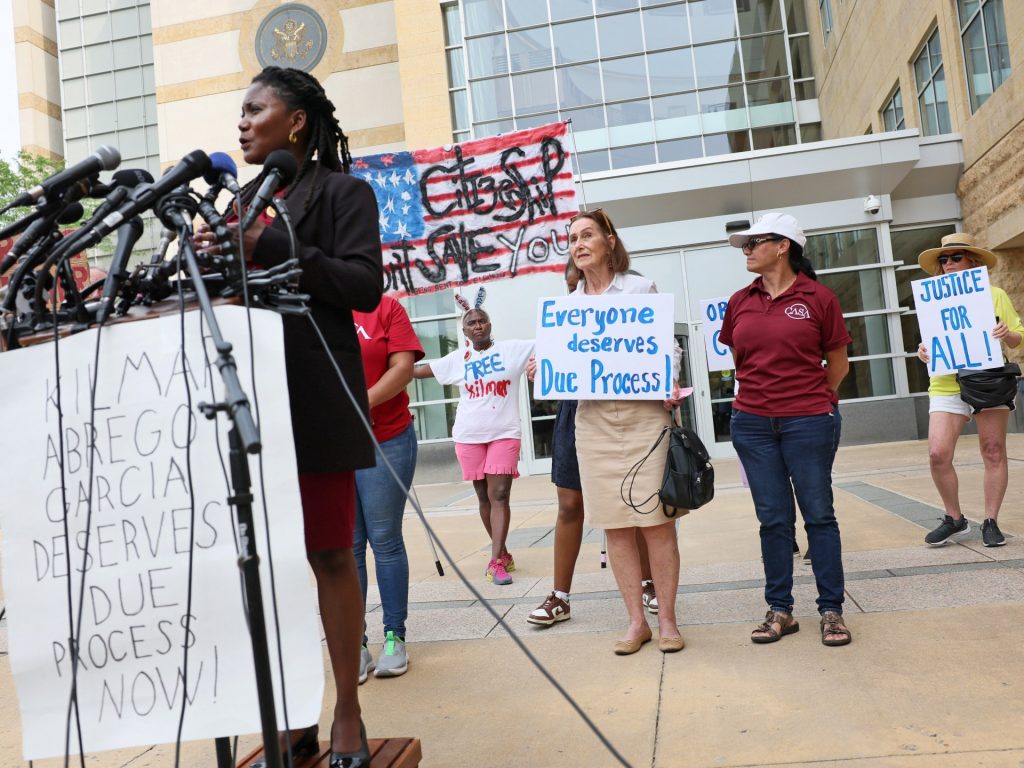
The administration of United States President Donald Trump has filed an extraordinary lawsuit against the Maryland district court system and its federal judges, accusing them of having “used and abused” their powers to stymie deportations. The complaint was lodged late on Tuesday. In its 22 pages, the administration accuses Maryland’s federal courts of “unlawful, anti-democratic” behaviour for placing limits on Trump’s deportation policies. Fifteen district judges are named among the defendants, as is a clerk of court, one of the administrative officials in the court system. The complaint advances an argument that Trump and his allies have long made publicly: that the president has a mandate from voters to carry out his campaign of mass deportation — and that the courts are standing in the way. “Injunctions against the Executive Branch are particularly extraordinary because they interfere with that democratically accountable branch’s exercise of its constitutional powers,” the lawsuit reads. It seeks an immediate injunction against a recent ruling from Chief Judge George Russell III, who was appointed by former President Barack Obama. Russell had issued a standing order that would automatically take effect each time an immigrant files a petition for habeas corpus — in other words, a petition contesting their detention. The chief judge’s order prevents the Trump administration from deporting the immigrant in question for a period of two business days after the petition is filed. That time frame, Russell added, can be extended at the discretion of the court. Advertisement The idea is to protect an immigrant’s right to due process — their right to a fair hearing in the legal system — so that they have the time to appeal their deportation if necessary. But the Trump administration said that Russell’s order, and other orders from federal judges in Maryland, do little more than subvert the president’s power to exercise his authority over immigration policy. “Every unlawful order entered by the district courts robs the Executive Branch of its most scarce resource: time to put its policies into effect,” the lawsuit argued. Trump’s immigration policies have faced hundreds of legal challenges since the president took office for his second term in January. Tuesday’s lawsuit admits as much, citing that fact as evidence of judicial bias against Trump’s immigration agenda. “In the first 100 days of President Trump’s current term, district courts have entered more nationwide injunctions than in the 100 years from 1900 to 2000, requiring the Supreme Court to intervene again and again in recent weeks,” the lawsuit said. The Supreme Court has upheld the right to due process, writing in recent cases like JGG v Trump that immigrants must be able to seek judicial review for their cases. But critics have argued that other recent decisions have undermined that commitment. Earlier this week, for instance, the Supreme Court lifted a lower court’s ruling that barred the US government from deporting immigrants to third-party countries without prior notice. Tuesday’s lawsuit against the Maryland federal court system appears poised to test whether the judicial branch can continue to serve as a check against the executive branch’s powers, at least as far as immigration is concerned. The lawsuit attacks Maryland’s immigration-related court orders on several fronts. For example, it questions whether “immediate and irreparable injury” is likely in the deportation cases. It also asserts that the federal courts are impeding immigration courts — which fall under the authority of the executive branch — from greenlighting deportations. But the complaint also emphasises the need for speed in executing the removals of immigrants from the US. “Removals can take months of sensitive diplomacy to arrange and often do not completely come together until the last minute,” the Trump administration’s lawsuit said. “A delay can undo all of those arrangements and require months of additional work before removal can be attempted again.” Maryland is a reliably Democratic-leaning state, and the Trump administration has been dealt some significant setbacks in its federal courts. Advertisement That, in turn, has led the president and his allies to denounce the courts for “judicial overreach”, a theme reprised in Tuesday’s court filing. One of the most prominent immigration cases unfolding in the US is that of Kilmar Abrego Garcia, a Salvadoran immigrant and resident of Maryland who was deported despite a protection order allowing him to remain in the country. His lawyers have maintained he fled El Salvador to escape gang violence. His deportation was challenged before District Judge Paula Xinis, one of the judges named in Tuesday’s complaint. Xinis ruled in early April that the US must “facilitate and effectuate” Abrego Garcia’s return from the El Salvador prison where he was being held, and the Supreme Court upheld that decision — though it struck the word “effectuate” for being unclear. The Maryland judge then ordered the Trump administration to provide updates about the steps it was taking to return Abrego Garcia to the US. She has since indicated the administration could be held in contempt of court for failing to do so. Abrego Garcia was abruptly returned to the US on June 6, after more than two and a half months imprisoned in El Salvador. The Trump administration said it brought him back to face criminal charges for human trafficking in Tennessee. That case is currently ongoing, and Abrego Garcia has denied the charges against him. That legal proceeding, and Xinis’s orders, were not explicitly named in Tuesday’s lawsuit. But the complaint offered a broad critique of orders like hers. “Defendants’ lawless standing orders are nothing more than a particularly egregious example of judicial overreach interfering with Executive Branch prerogatives,” the lawsuit argued, “and thus undermining the democratic process.” Adblock test (Why?)
NATO countries’ budgets compared: Defence vs healthcare and education
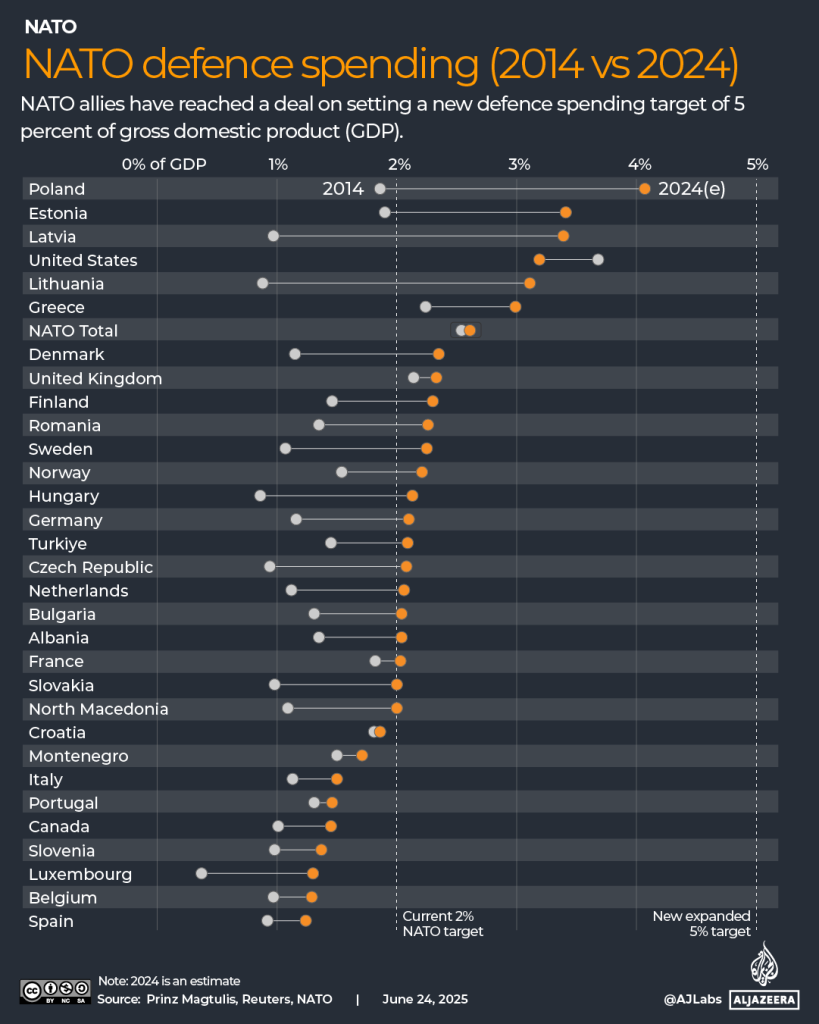
NATO leaders signed a deal to increase defence spending as the annual alliance summit in The Hague drew to a close after two days of meetings on Tuesday and Wednesday. At the top of the agenda was a big new defence spending target demanded by US President Donald Trump, which will see NATO members spend 5 percent of their economic output on core defence and security. The new spending target, which is to be achieved over the next 10 years, is a jump worth hundreds of billions of dollars a year from the current goal of 2 percent of gross domestic product (GDP). Which countries meet the current target of two percent? In 2006, NATO defence ministers agreed to commit at least 2 percent of their GDP to defence spending. However, few did. It wasn’t until Russia’s annexation of Crimea in 2014 that member states agreed to spend 2 percent of GDP on defence by 2024 at the NATO summit in Wales in 2014. Currently, 23 of the 32 member countries have met this target, with the alliance as a whole spending 2.61 percent of its combined GDP on defence last year. Poland leads NATO countries in defence spending, committing 4.1 percent of its GDP, followed by Estonia and the United States at 3.4 percent each, Latvia at 3.2 percent, and Greece at 3.1 percent. NATO countries bordering Russia, such as Estonia and Lithuania, have significantly increased their defence spending — from less than one percent of their GDP just 10 years ago. The only NATO country whose defence spending in 2024 was less, as a percentage of its GDP, than in 2014? The United States. Advertisement How will the new target of 5 percent work? The new target of 5 percent GDP is measured in two parts: 3.5 percent of GDP on pure defence spending, such as troops and weapons 1.5 percent of GDP on broader defence and security investments, such as: upgrading infrastructure including roads, bridges, ports, airfields, military vehicles, cybersecurity and protection for energy pipelines This surge in NATO defence spending comes amid perceived threats from Russia, in the wake of the Russia-Ukraine war. Mark Rutte, NATO’s secretary general and the Netherlands’ former prime minister, described Russia as “the most significant and direct threat” to NATO. Alliance members will be expected to meet the target by 2035, but the target will be reviewed again in 2029. Where will the money come from? NATO members will have to decide on their own where they’ll find the extra cash to allocate to defence. Rutte stated it was “not a difficult thing” for members to agree to raise defence spending to 5 percent of GDP because of the rising threat from Russia. But ministers in the UK, for example, have not made it clear where they will get the extra money to spend on defence. The European Union, meanwhile, is allowing member states to raise defence spending by 1.5 percent of GDP each year for four years without any disciplinary steps that would come into effect once a national deficit is above 3 percent of GDP. Additionally, EU ministers approved the creation of a 150-billion euro ($174bn) arms fund using EU borrowing to give loans to countries for joint defence projects. When asked whether NATO members should commit to the 5 percent target, US President Donald Trump told reporters on Friday, “I think they should. We’ve been supporting NATO so long, in many cases, I believe, paying almost 100 percent of the cost.” How does defence spending compare to other areas? When a country is asked to spend more on defence, that money has to come from somewhere. Unless governments expand their budgets or raise new revenue, increased military spending can strain other sectors that people rely on every day — like healthcare and education. Currently, none of NATO’s 32 members spends more on defence than either healthcare or education. However, if the new 5 percent defence spending target is adopted, then 21 countries that currently invest less than five percent in education would end up allocating more to the military than to schooling. The table below compares NATO countries’ budgets, highlighting how defence spending measures up against healthcare and education expenditures. Advertisement Adblock test (Why?)
Zelenskyy meets Trump on NATO sidelines; Putin will skip BRICS in Brazil

Ukrainian leader steps up diplomatic push, while his Russian counterpart will skip a summit due to ICC arrest warrant. Ukrainian President Volodymyr Zelenskyy and United States President Donald Trump have held talks on the sidelines of the NATO summit in The Hague, with sanctions on Russia over its war in Ukraine, now in its fourth year, and arms procurement for Kyiv on the agenda. Zelenskyy said he discussed how to achieve a “real peace” and “protect our people” with Trump on Wednesday. The meeting, which reportedly lasted 50 minutes, was a second attempt after Zelenskyy failed to meet Trump earlier this month in Canada when the US president abruptly left a G7 summit as the Israel-Iran conflict raged, just days before the US militarily intervened with strikes on Iran’s nuclear sites. Speaking at news conference ending his participation at the NATO summit, Trump said it is possible that Russian President Vladimir Putin has territorial ambitions beyond Ukraine, adding that he plans to speak to Putin soon about ending the war. Zelenskyy noted earlier that Moscow and Kyiv have not moved any closer to a ceasefire, saying, “The Russians once again openly and absolutely cynically declared they are ‘not in the mood’ for a ceasefire. Russia wants to wage war. This means the pressure the world is applying isn’t hurting them enough yet, or they are trying very hard to keep up appearances.” NATO Secretary-General Mark Rutte said the security bloc’s “military edge is being aggressively challenged by a rapidly rearming Russia, backed by Chinese technology and armed with Iranian and North Korean weapons” before the summit. Advertisement On Putin, Rutte was blunt, “I don’t trust the guy,” he said, adding that the Russian leader wouldn’t be happy with the outcome of the NATO summit. NATO endorsed a higher defence spending goal of five percent of gross domestic product (GDP) by 2035 – a response to a demand by Trump and to Europeans’ fears that Russia poses a growing threat to their security. Putin to stay at home In the meantime, Putin will not travel to next week’s BRICS summit in Brazil as an arrest warrant issued against him by the International Criminal Court (ICC) still hangs over him, Kremlin foreign policy aide Yuri Ushakov said on Wednesday. The ICC issued the warrant in 2023, just over a year after Russia launched its full-scale invasion and war against Ukraine. Putin is accused of deporting hundreds of children from Ukraine to Russia, a war crime. Moscow vehemently denies allegations of war crimes, and the Kremlin, which did not sign the ICC’s founding treaty, has dismissed the warrant as null and void. But weighing the risk that he might be arrested if he travels to another country that is a signatory to the ICC treaty, Putin has always erred on the side of caution, only travelling where he is safe from being apprehended. Putin concluded an official visit to Mongolia last September undisturbed as his hosts ignored the arrest warrant, despite Mongolia being an ICC member. The Kremlin on Wednesday also said the US was not yet ready to dismantle obstacles to the work of their respective embassies, as efforts to normalise relations between the two have stalled after initial signs that Trump’s second term as US president would lead to a major thaw after tensions during the administration of former US President Joe Biden. The war grinds on In the latest developments on the ground in the war, Russian missile strikes on southeastern Ukraine killed 17 people in the city of Dnipro and injured more than 200, damaging dozens of buildings and infrastructure facilities on Tuesday. Two people were killed in a Russian attack on the city of Samara. Russia says it intercepted dozens of drones overnight across its territory, including the Voronezh region on the border of eastern Ukraine. Russian forces say they captured the village of Dyliivka in Ukraine’s eastern Donetsk region, a key battleground dating back to the first eruption of conflict in 2014. Adblock test (Why?)
Why Iran conflict has raised new questions about IAEA’s credibility
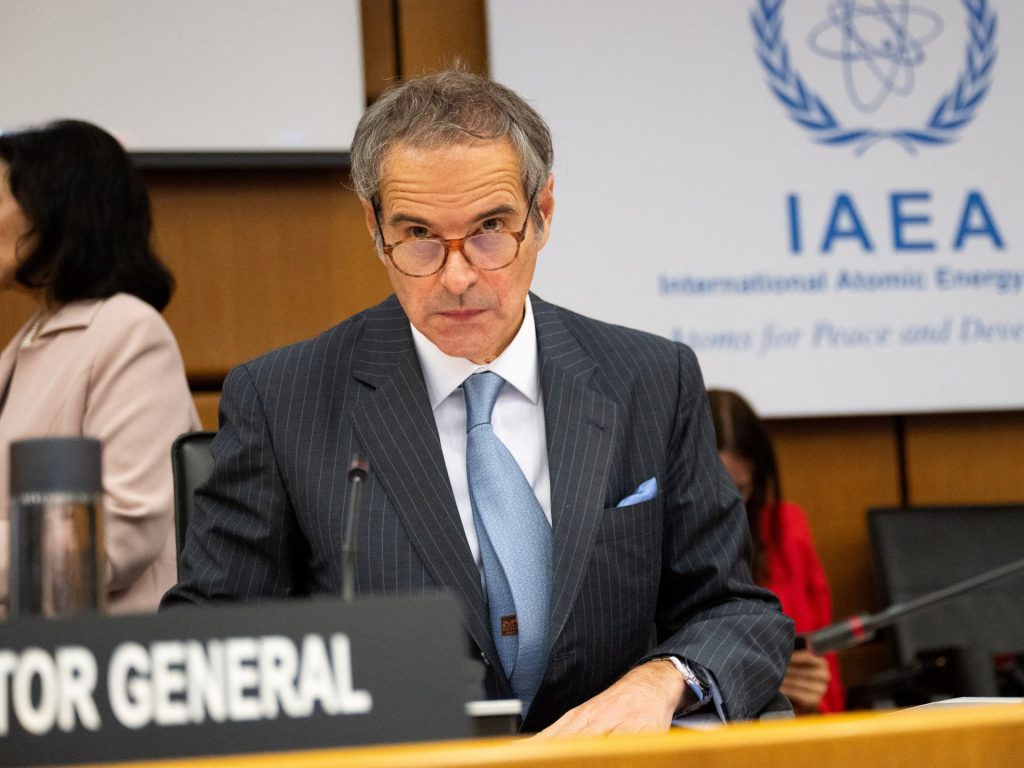
Israel launched an unprecedented strike on Iran’s military and nuclear sites on June 13, a day after the International Atomic Energy Agency (IAEA) board passed a resolution saying Tehran was not complying with its commitment to nuclear safeguards. Though Israel did not use the United Nations nuclear watchdog’s resolution to justify the Iran attack, its Ministry of Foreign Affairs welcomed the IAEA resolution, calling it “a necessary and overdue step” that confirmed Iran’s “systematic clandestine nuclear weapons programme”. Iran’s Ministry of Foreign Affairs and Atomic Energy Organization in a joint statement condemned the resolution, calling it “politically motivated”. The resolution, the joint statement said, “seriously undermines the credibility and integrity of the IAEA”. Tehran insists its nuclear programme is for civilian purposes and that its facilities are monitored by the UN nuclear watchdog. Here’s what the IAEA said about the Iranian nuclear programe earlier this month, and its criticisms against its past actions. Did the IAEA think that Iran was building nuclear weapons? The IAEA cannot fully assess Iran’s nuclear energy programmes, as Tehran halted its implementation of the Additional Protocol in February 2021, which permitted the IAEA enhanced inspection rights – including snap inspections and continuous surveillance. Iran continued to comply with IAEA’s Comprehensive Safeguards Agreement after 2021, which permitted access to Iran’s declared nuclear sites (Natanz, Fordow, Bushehr) and also allowed for routine monitoring and verification of declared nuclear material. Advertisement At a press event in Vienna on June 9, however, IAEA Director-General Rafael Grossi said Iran’s recent failure to comply with reporting obligations had “led to a significant reduction in the agency’s ability to verify whether Iran’s nuclear programme is entirely peaceful”. During the IAEA’s Board of Governors meeting (which took place from June 9-13), Grossi said Iran had “repeatedly either not answered… the agency’s questions” regarding the presence of man-made uranium particles at three locations – Varamin, Marivan and Turquzabad. Grossi also described Iran’s “rapid accumulation of highly-enriched uranium” as a “serious concern”, referring to the 60 percent pure uranium enrichment facilities at Fordow and Natanz. In 2023, the IAEA had discovered 83.7 percent pure uranium particles at Fordow – close to the 90 percent purity required to make an atomic bomb. On June 12, one day before Israel’s attacks on Iran’s nuclear facilities, the IAEA board passed a resolution declaring that Tehran was breaching its non-proliferation obligations. Al Jazeera’s Hashem Ahelbarra, reporting from Vienna on June 12, noted it was the first time in almost 20 years that the IAEA, which monitors Iran’s nuclear programme, had accused Tehran of breaching its non-proliferation obligations. Last week, however, Grossi emphasised that the IAEA had found no evidence of Iranian nuclear weapons production. In an interview with Al Jazeera on June 19, Grossi was emphatic that Iran’s alleged violations of its assurances had not led his agency to conclude that Tehran was building bombs. “We have not seen elements to allow us, as inspectors, to affirm that there was a nuclear weapon that was being manufactured or produced somewhere in Iran,” he said. United States Vice President JD Vance invoked the IAEA resolution to make a case for the military action against Iran. “They’ve been found in violation of their non-proliferation obligations by the International Atomic Energy Agency (IAEA), which is hardly a rightwing organization,” he posted on X on June 17. The US president ordered his military to bomb three Iranian sites on June 22 – a decision welcomed by Israeli Prime Minister Benjamin Netanyahu, who has been making claims for decades that Iran was on the cusp of making nuclear weapons. Trump has claimed that the nuclear sites have been “obliterated” and Iran’s nuclear programme has been set back by decades. How has Iran responded? On June 23, the national security committee of Iran’s parliament approved the outline of a bill designed to suspend Tehran’s cooperation with the UN nuclear watchdog, committee spokesperson Ebrahim Rezaei told the Tasnim news agency. Advertisement Rezaei said that, according to the bill, installing surveillance cameras, allowing inspections, and submitting reports to the IAEA would be suspended as long as the security of nuclear facilities is not guaranteed. Iran joined the IAEA in 1959. In particular, Rezaei said Iran asserts its right, as a 1968 signatory to the UN’s nuclear Non-Proliferation Treaty (NPT), to develop nuclear technology for peaceful purposes, including uranium enrichment. Parliament still has to approve the NPT withdrawal bill in a plenary. Tehran has long complained that the treaty fails to protect it from attack by a country with a nuclear arsenal, the US, and another widely believed to have one, Israel. What’s more, Iranian authorities have claimed Grossi is looking to become the next secretary-general of the UN, and is therefore sacrificing the nuclear watchdog’s integrity by adopting pro-Western rhetoric to gain personal favour. On June 1, the head of Iran’s Atomic Energy Organization, Mohammad Eslami, told state TV: “Rafael Grossi [is] driven by his ambitions and a strong desire to become the UN secretary-general, is seeking to gain the approval of a few specific countries and align himself with their goals.” Did the IAEA skirt controversy over the Fukushima disaster? In June 2023, the Japanese government started releasing treated, but still radioactive, water from the ruined Fukushima Daiichi nuclear power station into the Pacific Ocean. The IAEA gave the controversial plan the green light following a two-year review. At the time, Grossi said the agency’s safety review had concluded the plan was “consistent with relevant international safety standards… [and] the controlled, gradual discharges of the treated water to the sea would have a negligible radiological impact on people and the environment”. More than 1.3 million tonnes of water had built up at the Fukushima plant since a March 2011 tsunami destroyed the power station’s electricity and cooling systems and triggered the world’s worst nuclear disaster since Chornobyl. The release of the water, which began in August 2023, encountered fierce resistance from Japan’s neighbours and Pacific island nations as well as fishing and agricultural communities in and around Fukushima, which fear for
Mapping Israel’s expanding battlefronts across the Middle East
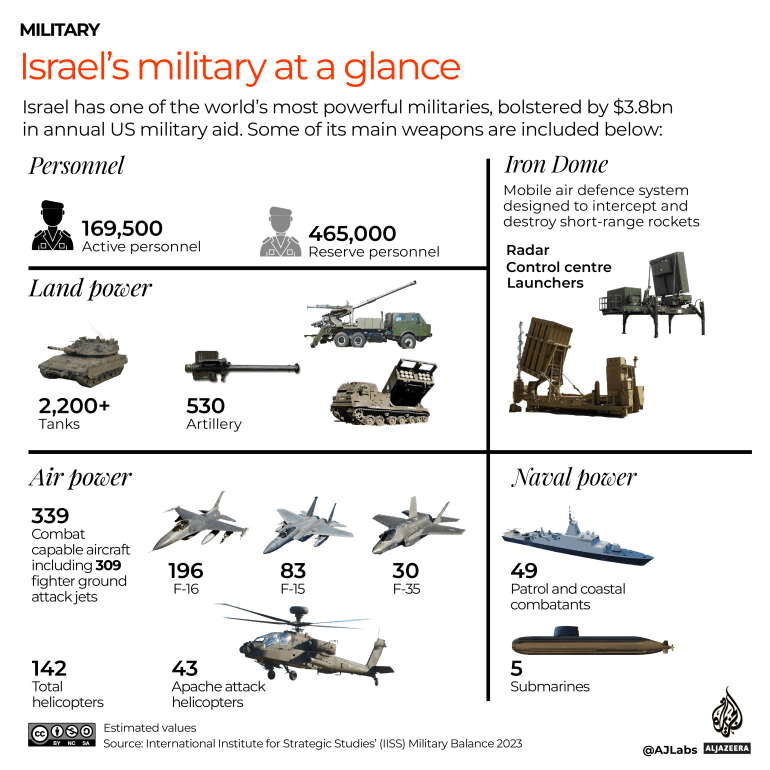
A fragile ceasefire remains in place between Israel and Iran, one day after US President Donald Trump announced a truce, ending 12 days of fighting that erupted following Israeli strikes on Tehran’s nuclear and military sites. An analysis of data from the Armed Conflict Location and Event Data Project (ACLED) shows that between October 7, 2023, and just before Israel attacked Iran on June 13, 2025, Israel carried out nearly 35,000 recorded attacks across five countries: the occupied Palestinian territory, Lebanon, Syria, Yemen, and Iran. These attacks include air and drone strikes, shelling and missile attacks, remote explosives, and property destruction. The majority of attacks have been on Palestinian territory with at least 18,235 recorded incidents, followed by Lebanon (15,520), Syria (616), Iran (58) and Yemen (39). Israel’s long-range air war While the bulk of Israel’s attacks have concentrated on nearby Gaza, the occupied West Bank, and Lebanon, its military operations have also reached far beyond its immediate borders. Israeli fighter jets have extended their reach by hundreds and even thousands of kilometres, striking targets about 550km (roughly 340 miles) away deep inside Syria, as well as approximately 1,500km (900 miles) away in Iran, and Yemen, up to 2,000km (1,200 miles) away. These long-distance strikes have significantly widened the geographic scope of the conflict, marking a shift towards more regionally expansive military engagement. These operations have been made possible by Israel’s fleet of advanced US-supplied aircraft, including F-15 and F-16 fighter jets, as well as the stealth-capable F-35 – the most sophisticated combat aircraft in Israel’s arsenal. The country has also relied heavily on drones for surveillance and targeted strikes. [Al Jazeera] The map below shows the locations and quantity of Israeli attacks carried out between October 7, 2023, and June 13, 2025, in five countries up to 2,000km (1,200 miles) away. Advertisement Attacks on Gaza After more than 628 days of relentless bombardment, blockade, and ground operations, Israel’s devastating assault in Gaza, widely described by many experts, human rights organisations, and international observers as genocide, is continuing. According to the latest casualty figures from the Palestinian Ministry of Health in Gaza, at least 56,077 people have been confirmed killed and 131,848 injured. Thousands more are feared dead, buried under the rubble. [Al Jazeera] Attacks on the occupied West Bank Israel is applying many of the tactics used in its war on Gaza to seize and control territory across the occupied West Bank. On January 21, just one day after a ceasefire took effect in Gaza, Israeli forces launched a large-scale military campaign across several cities in the northern occupied West Bank. The UN agency for Palestinian refugees (UNRWA) described it as “by far the longest and most destructive operation in the occupied West Bank since the second intifada in the 2000s.” According to an analysis by the British research group Forensic Architecture, Israel has used building demolitions, armoured bulldozers, and air strikes to establish a permanent military presence in areas such as Jenin, Nur Shams and Tulkarem refugee camps. Satellite imagery shows widespread destruction, with entire neighbourhoods flattened and roads reconfigured to facilitate troop movements and surveillance. The United Nations estimates that these operations have displaced at least 40,000 Palestinians. Over the past 20 months, Israeli forces and settlers have killed nearly 1,000 Palestinians across the occupied West Bank, including more than 200 children. Israel-Lebanon cross-border attacks On November 27, 2024, a ceasefire between Israel and Hezbollah came into effect, bringing an end to nearly 14 months of cross-border fighting that killed thousands of people. As in Gaza and the occupied West Bank, Israeli attacks left widespread destruction in their wake, damaging numerous villages in southern Lebanon and entire neighbourhoods in Beirut. Between October 7, 2023, and October 18, 2024, Israel, Hezbollah, and other Lebanese groups exchanged more than 13,600 cross-border attacks. Of these, approximately 83 percent (11,238 incidents) were carried out by Israel. [Al Jazeera] Attacks on Syria Since December 10, 2024, just two days after the stunning collapse of more than 53 years of the al-Assad family, Israel has waged a campaign of aerial bombardment that has destroyed much of Syria’s military infrastructure, including major airports, air defence facilities, fighter jets and other strategic infrastructure. Over the past six months, Israeli forces have launched more than 200 air, drone or artillery attacks across Syria, averaging an assault roughly every three to four days, according to ACLED. The map below shows the ACLED-recorded Israeli attacks between December 8 and May 30. Advertisement Attacks on Yemen Israel has also targeted Houthi-controlled infrastructure in Yemen, including Sanaa International Airport, Hodeidah Port, and several power stations. These strikes, which intensified in late 2024 and continued into 2025, are intended to weaken Houthi military capabilities following their missile and drone attacks on Israel in solidarity with Palestinians in Gaza. A satellite image shows the destroyed main terminal and control tower at Sanaa International Airport in the aftermath of an Israeli air strike, in Sanaa, Yemen, on May 7, 2025 [Maxar Technologies/Handout via Reuters] Attacks on Iran On June 13, 2025, Israel initiated a major escalation by launching a large-scale series of air and drone strikes deep into Iranian territory. This marked a significant shift in the conflict, as Israel targeted multiple sites across Iran, including military installations, weapons depots, and infrastructure linked to Iran’s regional influence and missile capabilities. Using open source intelligence, including publicly circulated images and videos on social media, media reports, as well as visual identification of destroyed locations, Al Jazeera’s fact-checking unit, Sanad, has mapped some key Israeli and US strikes on Iran, as well as major Iranian attacks on Israel. These attacks are shown on the maps below. [Al Jazeera] Adblock test (Why?)
Heatwave poses risks to US power grid

As heat related power outages surge, things are expected to worsen, with AI-focused data centres sucking up power. The heatwave currently blanketing two-thirds of the United States with record-setting temperatures is straining the nation’s power system. On Monday, Con Edison, New York City’s power provider, urged residents to conserve electricity. It reduced power voltage to the borough of Brooklyn by 8 percent as it made repairs; it did the same to areas in the boroughs of Staten Island and Queens yesterday. Thousands also lost power as the grid could not handle the strain. Comparable outages have been felt around much of the East Coast and Midwest including in the states of Virginia and New Jersey. In Philadelphia and Cleveland, power went out for thousands of customers after severe thunderstorms late last week, and has yet to be restored as the region faces high temperatures. The national railroad corporation Amtrak reported delays on Tuesday due to speed restrictions caused by the heat on routes that went through Washington, Philadelphia and New York. Power grid woes This heatwave is bringing attention to the vulnerability of the power infrastructure in the US. In the latest annual assessment from the North American Electric Reliability Corporation (NERC), large parts of the US have insufficient power reserves to operate in “above-normal conditions”, including parts of the Midwest, Texas, New England and southern California. Heat-related power grid strains have surged in recent years. According to a report from Climate Central released last year, there have been 60 percent more heat-related power outages between 2014-2023 than in the 10 years prior. Advertisement This comes amid new but growing pressures on the US power grid, including the prevalence of artificial intelligence data centres and the energy needed to power them. In 2022, in northern Virginia, Dominion Energy warned that data centres there used up so much energy that it might be unable to keep up with surging demand. For AI data centres, that strain is only set to get more pressing as generative AI booms. It is expected that AI server farms’ power demand will increase to 12 percent by 2030. There are also more immediate concerns of a cyberthreat from Iranian-backed “hacktivists”, which could target the US power grid at a vulnerable moment to avenge the recent US attack on Iran’s nuclear sites, CNN reported. The US power grid cyberthreat sharing centre has been monitoring the dark web for threats, it said, as the Department of Homeland Security issued a warning on Sunday about potential cyberattacks. “Both hacktivists and Iranian government-affiliated actors routinely target poorly secured US networks and Internet-connected devices for disruptive cyber attacks,” the advisory said. In 2023, Iran-linked hacktivists targeted a water authority in Pennsylvania with minimal success. In 2024, US authorities discovered that Iran-associated hackers were behind cyberattacks on US healthcare facilities. Power grids are particularly at risk, according to a 2024 report by the North American Electric Reliability Corporation (NERC), which said that there are as many as 23,000 to 24,000 susceptible points in the US power grid systems that could be vulnerable to cyberattacks. Adblock test (Why?)