

Tehran is in shock – and we have fled with heavy hearts
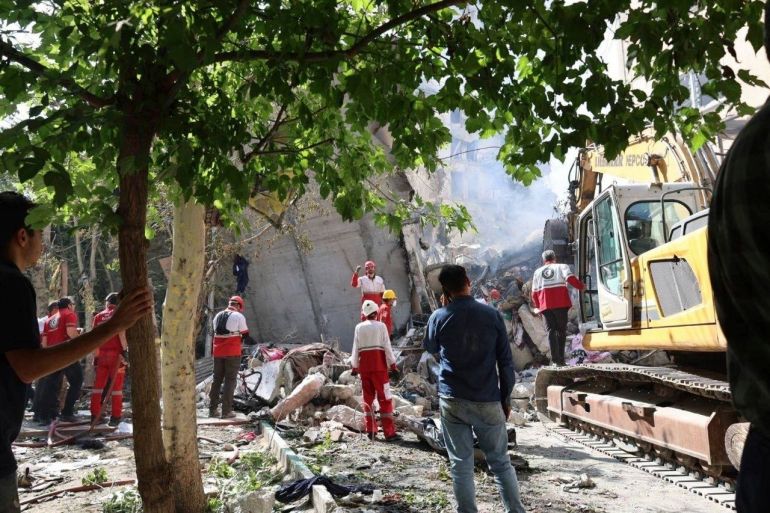
Gilan, Iran – The prospect of war seemed to creep nearer to reality with each passing day, but perhaps few of the millions who have been forced to abandon their homes across Iran in the past week – including myself – could have known this new reality would impose itself so harshly or abruptly. The first explosions jolted people awake in Tehran shortly after 3am on June 13, when a large number of Israeli fighter jets and drones attacked dozens of areas across the country, and explosives-laden quadcopters and anti-fortification Spike guided missiles were launched by Israeli agents from inside Iran. Entire residential buildings were levelled in the capital, military sites and air defence batteries were targeted, and above-ground facilities supporting nuclear enrichment halls buried deep inside mountains in Isfahan province’s Natanz were bombed. Dozens of civilians were killed, as were a large number of top military commanders and nuclear scientists. In this photo released by the Iranian Red Crescent Society, rescuers work at the scene of an explosion after an Israeli strike in Tehran, Iran, on Friday, June 13, 2025 [Iranian Red Crescent Society via AP] Tehran was in shock the first morning after the attacks, as people struggled to process the terrifying news and evaluate their options while the authorities scrambled to mount a concerted response to the surprise hits. As the attacks came on a Friday morning – the last day of the weekend in Iran – most city streets were eerily quiet in the immediate aftermath, except for those where Israeli bombs had made an impact. Soon, however, hours-long queues had formed at almost every single fuel station across the sprawling capital, which has a population of nearly 10 million people and holds more than 15 million during busy workdays, as millions also commute from neighbouring cities like Karaj. Advertisement I went out to visit a few of the targeted sites in western Tehran: Multiple homes had been destroyed in the Patrice Lumumba neighbourhood, several floors of a 15-storey building providing accommodation for university professors had caved in at Saadat Abad and adjacent buildings were damaged, while the top two floors of another residential building had been completely wiped out in Marzdaran. All were successful targeted assassinations – including of several top nuclear scientists – and many civilians were also killed. Debris from an apartment building is seen on top of parked cars after a strike in Tehran, Iran, early on Friday, June 13, 2025 [Vahid Salemi/AP] Later that night, Iran’s armed forces began launching hundreds of missiles and drones at Israel in retaliation. Nearly one week on, at least 16 rounds of Iranian strikes have been launched, with no immediate end in sight as Tehran says it will continue to hit back so long as Israel is attacking. Meanwhile, United States President Donald Trump teases triggering an all-out regional war by directly entering the war alongside Israel, which he and Washington’s Western allies already support with cutting-edge munitions, a massive fleet of refuelling planes and intelligence efforts. For the next few days, the Israeli attacks were ringing out across Tehran and the country during the daytime, terrorising civilians who saw the smoke and heard the explosions get closer to their homes or places of work. Both at home and at Al Jazeera’s Tehran bureau, I heard many explosive impacts, with some of the closer ones only about 2km (1.2 miles) away. Most of Tehran was shut down after the Israeli attacks ramped up, and the streets and petrol stations were more crowded than ever after Israel and Trump told people to evacuate immediately. The government said metro stations and mosques were opened as 24-hour shelters since it has built no dedicated shelters or come up with any clear security protocols, despite the ever-present threat of war. Red Crescent Society rescuers work at the scene of an explosion following an Israeli strike in Tehran, Iran, on Friday, June 13, 2025 [Iranian Red Crescent Society via AP] On Monday, after three days of evaluating the situation, my family and I decided to join the countless others who had already fled Tehran. After hurriedly packing some clothes and a few belongings in a suitcase, I drove from my own place to my girlfriend’s house to pick her up at about 4pm. Her parents, who work in healthcare, needed to stay in Tehran that day but they have since left as well, after Israeli air strikes intensified in their neighbourhood. We then picked up my mother – along with our four cats who have been staying with her – from her home in western Tehran, close to a major road which exits the capital. Israeli bombs were falling on multiple areas across western Tehran as we scurried to grab the cats and put them in their boxes. Advertisement The unmistakable sounds of the explosions, which leave a sickening, sinking sensation in your stomach no matter how many times you hear them, only added to the urgency – especially since the Israeli military had issued a new evacuation threat at about the same time and then bombed the state television headquarters. Smoke rises from the building of Iran’s state-run television channel after an Israeli strike in Tehran, Iran, on Monday, June 16, 2025 [AP] Fleeing north We left Tehran with heavy hearts, not knowing when we might return. The buildings were already mostly empty of residents. The feeling that we may not return to the same intact neighbourhoods was unavoidable, as was the terror we feel for those who wanted to leave but could not, whether because they are nursing a sick family member or because they simply lacked the means to do so. Iran’s ailing economy has been dragged under the weight of years of local mismanagement and US sanctions. The journey north, which usually takes about four hours, took close to 12. The highways were a sea of vehicles filled with families, pets and belongings. Roadside diners and service areas brimmed with people who had no idea
Israel-Iran conflict: List of key events, June 20, 2025
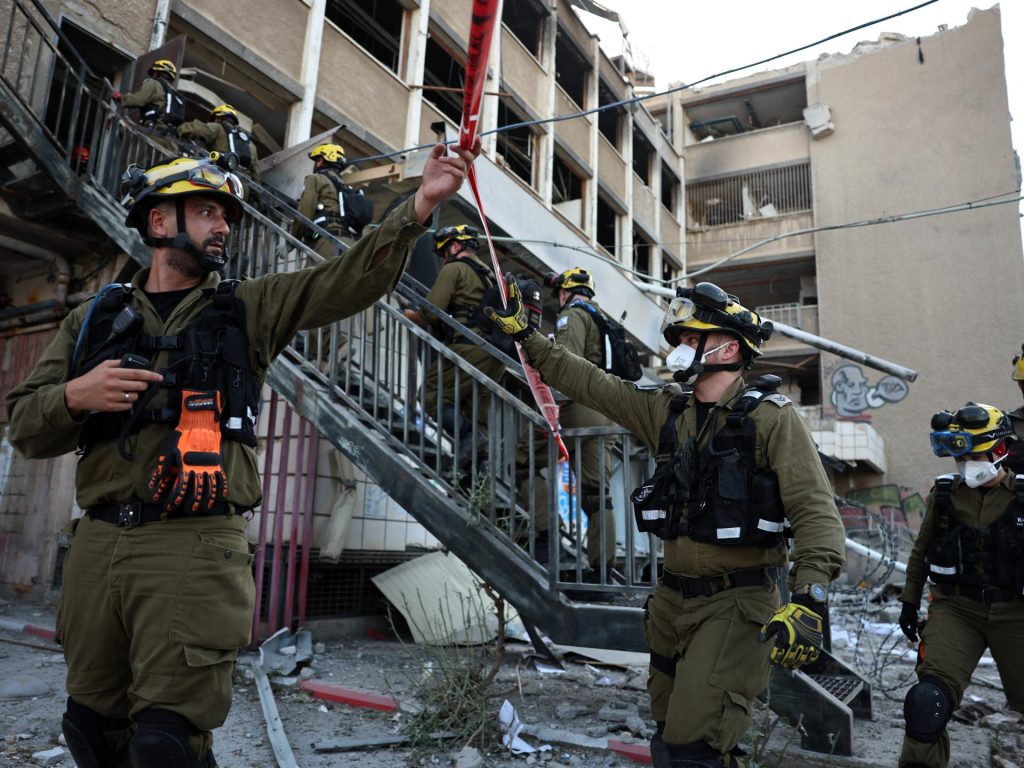
Here are the key events on day eight of the Israel-Iran conflict. Here’s where things stand on Friday, June 20: Fighting Israel said on Friday that it had struck dozens of military targets in Iran overnight, including Tehran’s Organisation of Defensive Innovation and Research, missile production sites and military facilities in western and central Iran. The Israeli military said it struck surface-to-air missile batteries in western Iran, killing a squad of Iranian soldiers on the move during the operation, including a commander of an Islamic Revolutionary Guard Corps (IRGC) base. Israeli Defence Minister Israel Katz said he had instructed the military to intensify attacks on “symbols of the regime” and “mechanisms of oppression” in the Iranian capital, Tehran, aiming to destabilise it. Air defence systems were activated in Bushehr in southern Iran, the location of the country’s only operating nuclear power plant, according to the Young Journalists Club, cited by state broadcaster IRIB. Iran’s IRGC said it had fired its 17th wave of missiles at Israeli military facilities, including the Nevatim and Hatzerim bases. Iran fired missiles at Beersheba in southern Israel, with initial Israeli media reports also pointing to missile impacts in Tel Aviv, the Negev and Haifa. Iran said that the “precise hits” demonstrated “our offensive missile power is growing”. The Fars news agency quoted an Iranian military spokesperson as saying Tehran’s missile and drone attacks on Friday had used long-range and ultra-heavy missiles against Israeli military sites, defence industries and command and control centres. Advertisement Casualties and disruptions Israel’s attack on Tehran’s Organisation of Defensive Innovation and Research, which it says is involved in Iran’s alleged nuclear weapons development, killed a nuclear scientist, according to Israeli media reports. Iranian media reported that an industrial plant involved in the production of carbon fibre in northern Iran was damaged in an attack. Iran’s health ministry said a third hospital in Tehran had been struck by Israeli bombs, according to state news agency IRNA. At least five people were injured when Israel hit a five-storey building in Tehran housing a bakery and a hairdresser’s, Fars news agency reported. Iranian news outlet Asriran said that a drone attacked an apartment in a residential building in the Iranian capital’s central Gisha district. The Human Rights Activists News Agency, a US-based human rights organisation that tracks Iran, said that Israeli air attacks have killed 639 people in the country. Israeli authorities had previously said 24 civilians had been killed in Iranian attacks. Israel’s Magen David Adom rescue service said its teams were providing treatment to 17 people, three in serious condition, after Iran’s strikes. Israeli railway officials told local media that, due to the Iranian missile strike on Beersheba, the city’s north station was temporarily closed. Afghanistan’s agriculture minister said his country was in discussions with Russia to import certain foodstuffs as the conflict between Israel and Iran, one of its largest trading partners, risked cutting off supplies. Protests Tens of thousands of people attended anti-Israel protest marches in Tehran, as well as other major Iranian cities, including Isfahan, Shiraz, Mashhad and Qom. Demonstrators in southern Beirut, Lebanon held a pro-Iran rally after Friday prayers. Thousands of Iraqis gathered for Friday prayers in Baghdad’s Sadr City, a suburb with a large Shia population, chanting against the US and Israel amid the attacks on Iran. Pro-Palestinian activists in the UK broke into the Royal Air Force Brize Norton base in Oxfordshire and damaged two aircraft. Politics US President Donald Trump told reporters on Friday that his director of national intelligence, Tulsi Gabbard, was wrong to suggest there is no evidence Iran is building a nuclear weapon. “Well, my intelligence community is wrong,” he replied when asked about Gabbard’s position. Trump also said that while he “might” support a ceasefire deal between Israel and Iran, “Israel’s doing well in terms of war, and I think you would say that Iran is doing less well”. Iranian President Masoud Pezeshkian said the only way to end the conflict was for Israel to stop its air attacks, warning that “failure to do so would result in a far more forceful and regrettable response from Iran”. Russian President Vladimir Putin said in St Petersburg that Moscow was sharing ideas with “our Israeli and Iranian friends” about how to end the bloodshed and said he believed there was a diplomatic solution. US Treasury Secretary Scott Bessent announced new Iran-related sanctions aiming to disrupt Tehran’s efforts to “procure the sensitive, dual-use technology, components, and machinery that underpin the regime’s ballistic missile, unmanned aerial vehicle, and asymmetric weapons programs”. Qatari Prime Minister Sheikh Mohammed bin Abdulrahman Al Thani said in a phone conversation with Norway’s Foreign Minister Espen Barth Eide that Israel targeting economic facilities in Iran could lead to catastrophic regional and international repercussions. French President Emmanuel Macron said there was “no justification” for strikes on civilians and on civilian infrastructure in the weeklong conflict, adding that Tehran should show its willingness to return to the negotiating table concerning its nuclear programme. Kremlin spokesperson Dmitry Peskov said in comments carried by state news agency TASS that potential use of tactical nuclear weapons by the US in Iran would be a catastrophic development. German Chancellor Friedrich Merz and Turkish President Recep Tayyip Erdogan discussed the ongoing conflict between Israel and Iran over a phone call, a German government spokesperson said. UK Foreign Secretary David Lammy said his country was working with Israeli authorities to arrange charter flights for British nationals from Tel Aviv when Ben Gurion International Airport reopens. Advertisement Diplomacy The United Nations Security Council met at its headquarters in New York to discuss the situation between Iran and Israel. Rafael Grossi, director of the International Agency for Atomic Energy, warned against attacks on nuclear facilities at the meeting, saying a strike on the Bushehr nuclear plant could cause “radioactive releases with great consequences” beyond Iran’s borders. He called for “maximum restraint”. UN Secretary-General Antonio Guterres said at the meeting that expansion of the Israel-Iran conflict could “ignite a fire no one can control”,
Israeli and Iranian diplomats clash at UN meeting over conflict
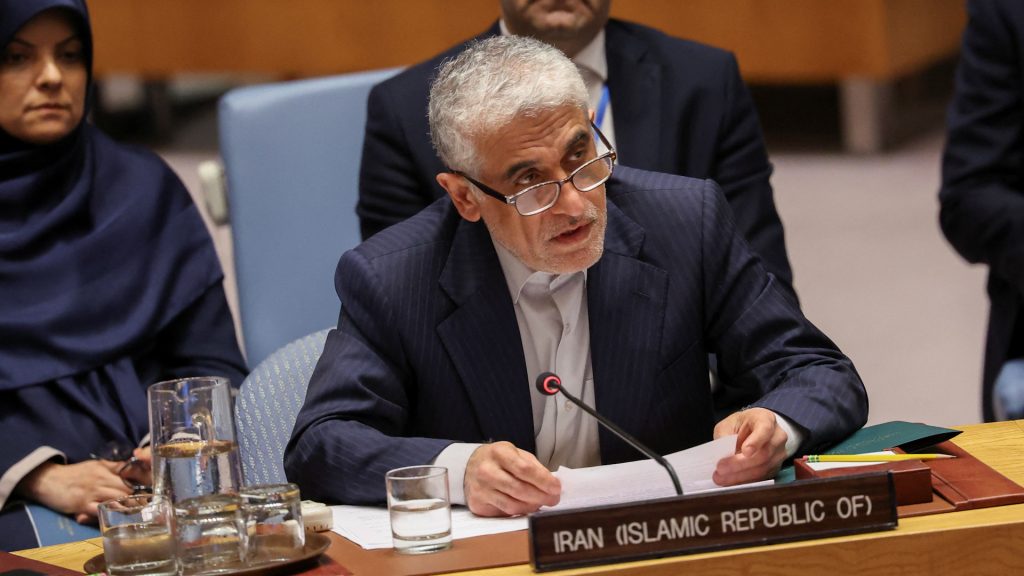
NewsFeed “You’re a wolf pretending to be a diplomat” Iranian and Israeli officials clashed during a heated UN Security Council session. Iran said it would continue to defend itself until Israeli attacks end, while Israel vowed to keep striking until Iran’s “nuclear threat” is dismantled. Published On 20 Jun 202520 Jun 2025 Adblock test (Why?)
Liverpool sign Wirtz shattering club record transfer fee

Liverpool delivered a huge statement of intent after winning the Premier League title by signing Germany star Florian Wirtz from Bayer Leverkusen. The transfer fee could climb to 116 million pounds ($156m), which would make the 22-year-old Wirtz the most expensive player in the history of British football. “I feel very happy and very proud,” Wirtz told the official Liverpool website on Friday. “Finally, it’s done, and I was waiting for a long time. “I’m really excited to have a new adventure in front of me. This was also a big point of my thoughts: That I want to have something completely new, to go out of the Bundesliga and to join the Premier League. “I will see how I can perform there. I hope I can do my best. I spoke also with some players who played there, and they told me that it’s perfect for me and every pitch is perfect, you can enjoy every game. I’m really looking forward to playing my first game.” Florian Wirtz practises his shooting during the warm-up before a Bayer Leverkusen match in February [Fabian Bimmer/Reuters] Liverpool, determined to keep moving forward despite securing a record-tying 20th English top-flight title, splashed out a club record to bring in not only one of the best players from Germany, but one of the top youngsters in the world. Wirtz has been a key first-team player for Leverkusen since he was 17. He was the outstanding attacking player in the team that won the Bundesliga and German Cup in 2023-24 without losing a game, and is a regular in Germany’s national team. Advertisement It is why Liverpool was ready to pay a guaranteed 100 million pounds ($134.4m), plus 16 million pounds ($21.5m) in potential add-ons. Wirtz had two years left on his contract, giving Leverkusen leverage in negotiations. The Premier League record for an initial fee was set when Chelsea signed Enzo Fernandez from Benfica for 106.7 million pounds ($131.4m at the time) in 2023, before the London club agreed to pay up to 115 million pounds ($146m at the time) for midfielder Moises Caicedo from Brighton later that year. Liverpool manager Arne Slot arrived last summer and signed just one outfield player — forward Federico Chiesa — for the 2024-25 season. Chiesa barely played and the Reds won the league by 10 points, after which Slot and some of his players — including Virgil van Dijk — spoke about there being big plans for this transfer window. Having already signed right-wing back Jeremie Frimpong from Leverkusen for a reported 35 to 40 million euros ($39.7 million to $45.4 million), Liverpool has returned to the German club to take Wirtz, who rejected an opportunity to join Bayern Munich — a Bundesliga rival which has long pursued him. One obstacle to that move was the size of the fee Leverkusen wanted. Another was concern over how Wirtz might fit into the same lineup as Jamal Musiala, Germany’s other standout young attacking midfielder. Losing Wirtz leaves Leverkusen and its new coach, Erik ten Hag with an even bigger rebuild following the departure of Xabi Alonso for Real Madrid. Just after his 17th birthday, Wirtz became the youngest player in Leverkusen’s history when he made his debut against Werder Bremen in May 2020, in an empty stadium at the height of the COVID-19 pandemic. A month later, he was the youngest player to score in Bundesliga history, though that record has since been toppled. Wirtz’s versatile attacking midfield play was a vital ingredient in Alonso transforming Leverkusen into a team that could win the Bundesliga and German Cup without losing a game. He and Alonso stayed for another sometimes-disappointing season, which ended with second place to Bayern in the league and a loss to Bayern in the Champions League round of 16. Wirtz showed he can deal with adversity when a cruciate ligament tear in his knee ruled him out for almost all of 2022, including Alonso’s first games as coach, before he returned to power Leverkusen to its league and cup double in 2023-24. France’s Manu Kone in action with Germany’s Florian Wirtz during the 2025 Nations League third-place playoff [Heiko Becker/Reuters] Wirtz has become a vital player for the German national team with 29 caps. He played all five of its matches at Euro 2024 on home soil. Advertisement He has also had to contend with hostility from fans of his boyhood club Cologne, which he left for nearby Leverkusen at 16. Liverpool and Bayern were reportedly interested then, too. Cologne claimed that deal broke an agreement between the clubs not to pursue each other’s youth players. Leverkusen argued Wirtz was so talented that he counted as a first-team player despite his age. Cologne and Leverkusen are barely 10 kilometres (six miles) apart, so going to Liverpool will be the first time that Wirtz has moved away from his roots. His parents, Hans Wirtz and Karin Gross, have played a big role in his career — they were also his agents until last year — and he is close to his older sister Juliane, a professional player for Werder Bremen in the women’s Bundesliga. Wirtz’s decision to turn down Bayern and the Bundesliga for Liverpool has raised some eyebrows in Germany. “I wouldn’t have thought Florian would make this switch so early,” former Germany great Lothar Matthaus told broadcaster n-tv last month. “But he wants to get out of his comfort zone.” Wirtz seems likely to slot in as the No. 10 at Liverpool, a more creative solution in that role compared with the hard-running Dominik Szoboszlai. Whether Slot also now pushes for a new striker as an upgrade to current options Diogo Jota and Darwin Nunez remains to be seen. Szoboszlai could drop back into one of the two deeper midfield positions, competing with Ryan Gravenberch, Alexis Mac Allister and Curtis Jones. Adblock test (Why?)
Iran, Israel trade air attacks as conflict enters second week

Israel has launched strikes on dozens of targets in Iran, including missile production sites, and Iran fired a barrage of missiles that hit near industrial facilities in the southern Israeli city of Beersheba, as the conflict between the two sides entered its second week. An Iranian nuclear scientist was killed on Friday morning following an Israeli strike in Tehran, according to the Israeli public broadcaster Kan. The news followed reports from the Iranian media saying that a residential building in the capital’s central Gisha district was hit by a drone strike. The identity of the scientist was not immediately clear. Israel has killed several nuclear scientists since it started attacking Iran on June 13. A hospital in Tehran was hit in a separate Israeli missile strike, the third such medical facility damaged in the past eight days, Iran’s health ministry was quoted by the Islamic Republic News Agency (IRNA) as saying. There were no immediate reports of casualties from the hospital strike, but six ambulances were damaged, the ministry said. Despite the attacks, thousands of Iranians took to the streets of Tehran following Friday prayers to denounce Israel and the US for the deadly attacks in the country. In the northwestern province of Kermanshah, a medical clinic was also hit, leaving it completely damaged, according to Press TV. Both Iran and Israel have been exchanging allegations of targeting medical facilities, which is prohibited by international humanitarian law. In a statement, Israel’s Defence Minister Israeli Katz said he has instructed the military to intensify attacks on “symbols of the regime” in Tehran, aiming to destabilise it. Advertisement “We must strike at all the symbols of the regime and the mechanisms of oppression of the population, such as the Basij [militia], and the regime’s power base, such as the Revolutionary Guard,” Katz said. Earlier on Friday, at least seven people were lightly injured after Iranian missile strikes hit Beersheba, the largest city in the Negev desert in southern Israel, according to Israeli media. The attack temporarily shut the city’s central rail station and damaged several buildings including the Microsoft office located inside a technology park, which is also near an Israeli army military telecommunications branch. After air raid sirens sounded later on Friday, Israeli media reported there were potential impacts in Tel Aviv, Beersheba and Haifa. At least two wounded people were in a serious condition after they were hit with shrapnel in Haifa, according to local media. “The south of Israel is more sparsely populated, and the one missile that we could see landed before the beginning of business hours, so there were no people in the offices, presumably,” Al Jazeera’s Nour Odeh, reporting from Amman, Jordan said. Iran-Europe meeting Against the backdrop of deadly exchanges, Iranian Foreign Minister Abbas Araghchi arrived in the Swiss capital, Geneva, ahead of a meeting with his French, German, British and European Union counterparts. Ahead of the talks, Iranian President Masoud Pezeshkian said the only way to end the conflict is for Israel to stop its air attacks. “We have always pursued peace and stability,” he said in a statement cited in Iranian media on Friday. Foad Izadi, professor of international relations at the University of Tehran, told Al Jazeera that it was clear that Araghchi was not prepared to hold any negotiations while Israeli strikes were continuing. “When you negotiate, it’s give and take,” he said. “Iran cannot engage in that style of give and take when we have bombs falling” on Tehran and other parts of the country. Still, Araghchi’s presence in Geneva also sends out a message “that they’re not closing the door to the possibility of diplomacy,” said Al Jazeera’s Tohid Asadi, who is reporting from Tehran. Meanwhile, Iran’s Tasnim news agency reported that Ali Shamkhani, a close adviser to Iran’s Supreme Leader Ayatollah Ali Khamenei, who was seriously wounded in an Israeli attack a week ago, was now in stable condition after round-the-clock efforts of doctors. “I am alive and ready to sacrifice myself,” Tasnim quoted Shamkani as saying in a message. Advertisement Adblock test (Why?)
Armenian PM in Turkiye for ‘historic’ visit aimed at normalising ties

Nikol Pashinyan’s visit marks Ankara and Yerevan’s second attempt at reconciliation. Armenian Prime Minister Nikol Pashinyan is on a rare visit to Istanbul to hold talks with Turkish President Recep Tayyip Erdogan, in what Yerevan has described as a “historic” step towards regional peace. The visit forms part of the two countries’ efforts to normalise ties strained over historical disputes and Ankara’s alliance with Azerbaijan, which has been in a long-simmering conflict with Armenia. “This is a historic visit, as it will be the first time a head of the Republic of Armenia visits Turkiye at this level. All regional issues will be discussed,” Armenian parliament speaker Alen Simonyan told reporters on Friday. “The risks of war [with Azerbaijan] are currently minimal, and we must work to neutralise them. Pashinyan’s visit to Turkiye is a step in that direction.” Pashinyan’s visit comes a day after Azerbaijani President Ilham Aliyev held talks in Turkiye with Erdogan, during which he praised the Turkish-Azerbaijani alliance as “a significant factor, not only regionally but also globally”, and Erdogan reiterated his support for “the establishment of peace between Azerbaijan and Armenia”. Baku and Yerevan agreed on the text of a peace deal in March, but Baku has since outlined a host of demands, including changes to Armenia’s constitution, that it wants met before it will sign the document. Pashinyan is scheduled to meet Erdogan at Istanbul’s Dolmabahce Palace at 15:00 GMT, Erdogan’s office said. An Armenian Ministry of Foreign Affairs official told the AFP news agency that the pair will discuss efforts to sign a comprehensive peace treaty. Advertisement The regional fallout from the Israel-Iran conflict, which began last Friday when Israel launched several waves of air strikes targeting Iran’s nuclear facilities and military sites, will also be discussed. Armenia and Turkiye have never established formal diplomatic ties, and their shared border has been closed since 1993. Attempts at normalisation Relations between the two nations have been historically strained over the World War I-era mass killings of Armenians in the Ottoman Empire – atrocities historians and Yerevan say amount to genocide. Turkiye rejects the label, contending that while many people died in that era, the death toll is inflated and the deaths resulted from civil unrest. Ankara has also backed its close ally, Turkic-speaking Azerbaijan, in the long-running Nagorno-Karabakh conflict with Armenia. This region, which had a mostly ethnic Armenian population at the time, broke away from Azerbaijan with support from Armenia in the late 1980s. In 2020, Turkiye backed Azerbaijan in its second war with Armenia, which ended after six weeks with a Russia-brokered peace deal that saw Azerbaijan gain control of a significant part of the region. Pashinyan has actively sought to normalise relations with both Baku and Ankara. Ankara and Yerevan appointed special envoys in late 2021 to lead a normalisation process, and resumed commercial flights in 2022 after a two-year pause. Earlier this year, Pashinyan announced Armenia would halt its campaign for international recognition of the 1915 mass killings of Armenians as genocide – a major concession to Turkiye that sparked widespread criticism at home. Pashinyan’s first visit to Turkiye was to attend Erdogan’s inauguration in 2023. This is Ankara and Yerevan’s second attempt at reconciliation. Turkiye and Armenia reached an agreement in 2009 to establish formal relations and open their shared border, but the deal was never ratified because of strong opposition from Azerbaijan. Adblock test (Why?)
Botafogo upset UCL champs PSG at FIFA Club World Cup

Igor Jesus’ 36th minute goal was enough for Botafago to defeat the Europeans champions PSG at the Rose Bowl in Los Angeles. Paris Saint-Germain (PSG) suffered a shock 1-0 Club World Cup defeat against Brazilian side Botafogo in a hard-fought battle between the reigning champions of Europe and South America. A first-half goal from Brazilian international Igor Jesus proved the difference on Thursday as Botafogo all but sealed a place in the knockout rounds in front of a 53,699 crowd at the Pasadena Rose Bowl. French champions PSG are widely regarded as one of the favourites for FIFA’s 32-team tournament after a dazzling season which culminated with a scintillating 5-0 demolition of Inter Milan in the UEFA Champions League final last month. But their hopes of securing a victory, which would have seen them become the first side to reach the last 16, were stymied by a resilient performance from their opponents from Rio de Janeiro. “A lot of people wondered, but we showed how strong Botafogo is,” goal scorer Jesus said after the win. “It was a difficult game, and we had to defend well, and we did our job and scored a goal. “We’re really happy – we knew how important this game was. One team was the champion of the Champions League, the other team was the champion of South America,” added Jesus, who had been strongly linked with a move to English Premier League side Nottingham Forest earlier this year before opting to stay with the Brazilians to play in the Club World Cup. “I think I made the right choice to stay in Botafogo,” Jesus quipped. Jesus scores the game-winning goal in the 36th minute against PSG at the Rose Bowl in Los Angeles on June 19, 2025 [Yuri Cortez/AFP] Setback for PSG PSG coach Luis Enrique said his team had expected a tough battle. Advertisement “We knew it was going to be a very difficult match – they defended very well,” the Spaniard said. “This Club World Cup is very intense and difficult, and all the teams are highly motivated, especially when they’re playing against us.” The PSG manager, though, was adamant that the European champions still had plenty of time to resurrect their campaign. “If there’s a team that can turn it around, it’s our team,” he said. “We’ve got to analyse this and there’s things we can improve. But I think our performance was good.” PSG picked up where they had left off in Sunday’s 4-0 Group B rout of Atletico Madrid, with Khvicha Kvaratskhelia testing Botafogo goalkeeper John with an early curling effort after just two minutes. But that early effort was as close as PSG came to scoring in a scrappy first half punctuated by a series of niggling fouls that prevented the European champions from settling into their passing game. Botafogo’s midfield trio of Marlon Freitas, Gregore and Allan worked tirelessly to close down Vitinha, denying the skilful PSG playmaker time and space to launch attacks despite dominating possession. Instead, it was Botafogo who took the lead with a goal against the run of play on 36 minutes. Jefferson Savarino’s perfectly weighted through ball split the PSG defence and sent Jesus racing through on goal. The Botafogo striker did brilliantly to wrongfoot the covering Willian Pacho before sweeping a shot that took a slight deflection past PSG goalkeeper Gianluigi Donnarumma on its way into the net. PSG continued to dominate possession through the second half, and spent long periods camped in the final third. But Botafogo’s defence held firm and the result leaves the Brazilians firmly on course for the last 16, with a final group game against Atletico Madrid to come in Pasadena on Monday. Botafogo players celebrate after winning the match 1-0 against PSG [Frederic J Brown/AFP] Adblock test (Why?)
Iran, European officials to hold first meeting since Israel conflict began
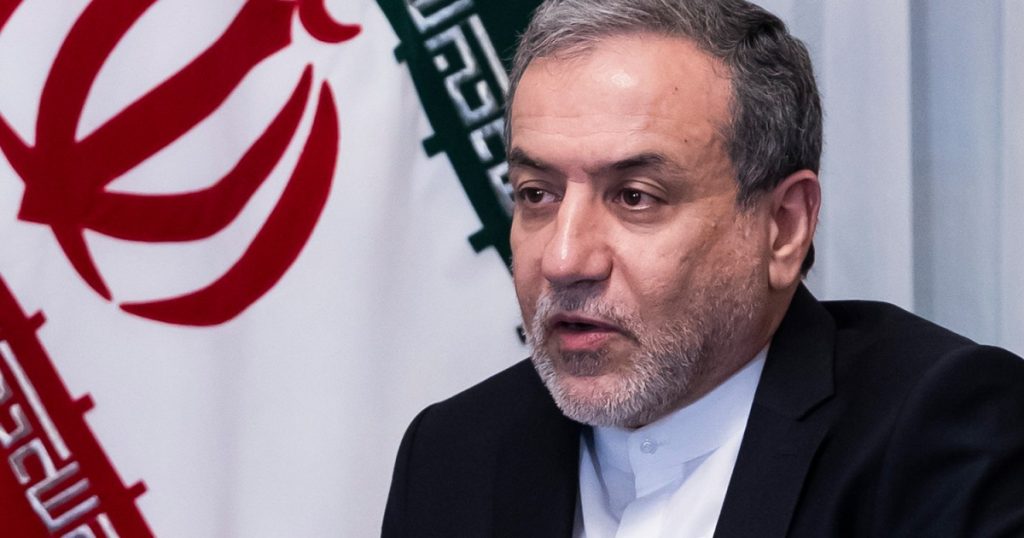
Iran, UK, Germany, France and EU foreign ministers to meet in bid to avoid further escalation between Israel and Iran. Iran will hold talks with the United Kingdom, France and Germany in Geneva on Friday in an attempt to prevent an escalation in its conflict with Israel, after United States President Donald Trump said he would decide within two weeks whether to join the assault on Tehran. “We will meet with the European delegation in Geneva on Friday,” Iran’s Foreign Minister Abbas Araghchi said in a statement, carried by state news agency IRNA. European diplomats confirmed the planned talks in Switzerland, set to involve French Foreign Minister Jean-Noel Barrot, British Foreign Secretary David Lammy, German Foreign Minister Johann Wadephul, and European Union foreign policy chief Kaja Kallas. Kallas and the ministers from the three European countries – known as the E3 – spoke to Araghchi earlier this week and discussed the need to return to the negotiating table and avoid further escalation. At Iran’s suggestion, the two sides agreed to meet face-to-face. French President Emmanuel Macron said European nations were planning to suggest a negotiated solution to end the conflict. On Wednesday, he asked his foreign minister to draw up an initiative with “close partners” to that end. Speaking in Paris after talks on the crisis with the Jordanian Foreign Minister Ayman Safadi on Thursday, Barrot said the three nations “stand ready to bring our competence and experience on this matter”. “We are ready to take part in negotiations aimed at obtaining from Iran a lasting rollback of its nuclear and ballistic missile programmes,” he added. Advertisement The UK’s Lammy was scheduled to travel to Switzerland following his visit to Washington, DC, where he met US Secretary of State Marco Rubio and White House Special Envoy to the Middle East Steve Witkoff. “We are determined that Iran must never have a nuclear weapon … A window now exists within the next two weeks to achieve a diplomatic solution,” Lammy said in a statement. Kallas, in coordination with European countries, has insisted that diplomacy remains the best path towards ensuring that Iran does not develop a nuclear bomb. Israel has repeatedly said its series of strikes is a preemptive move to stop Iran from obtaining nuclear weapons. Iran denies it is building nuclear weapons and insists that its nuclear programme is peaceful. The International Atomic Energy Agency (IAEA) said it has found no evidence that Iran was building such weapons. Trump weighs intervention The ramping up of diplomatic efforts comes as Trump said he is weighing military action against Iran’s nuclear facilities. Trump said on Thursday he would make up his mind within two weeks on whether Washington will get directly involved militarily in the conflict, given the “substantial chance” for renewed diplomatic negotiations over Tehran’s nuclear programme. Iran’s well-defended Fordow uranium enrichment facility, which is buried under a mountain, is widely considered to be out of reach of all but the US’s so-called “bunker-buster” bombs. Israeli Prime Minister Benjamin Netanyahu said he trusted that Trump would “do what’s best for America”. “I can tell you that they’re already helping a lot,” he told reporters in Beersheba. The talks will be held in Geneva, where an initial accord between Iran and world powers to curb its nuclear programme in return for lifting sanctions was struck in 2013, before a comprehensive deal in 2015. Trump left the Iran nuclear deal during his first term as president in 2018, defying last-ditch diplomatic efforts by his European allies to convince him otherwise. Negotiations between Iran and the US had been taking place when Israel launched what it called Operation Rising Lion against Iran’s nuclear facilities and ballistic capabilities on June 12. The conflict erupted with a surprise wave of Israeli attacks targeting Iranian nuclear and military sites and killing top generals and nuclear scientists. At least 639 people, including 263 civilians, have been killed in Iran and more than 1,300 wounded since Israel launched a surprise wave of air raids against Iran a week ago, according to the US-based rights group Human Rights Activists. Advertisement In Israel, at least 24 people have been killed and hundreds of others wounded in Iranian attacks, according to Israeli health authorities. Adblock test (Why?)
A simple visual guide to Iran and its people
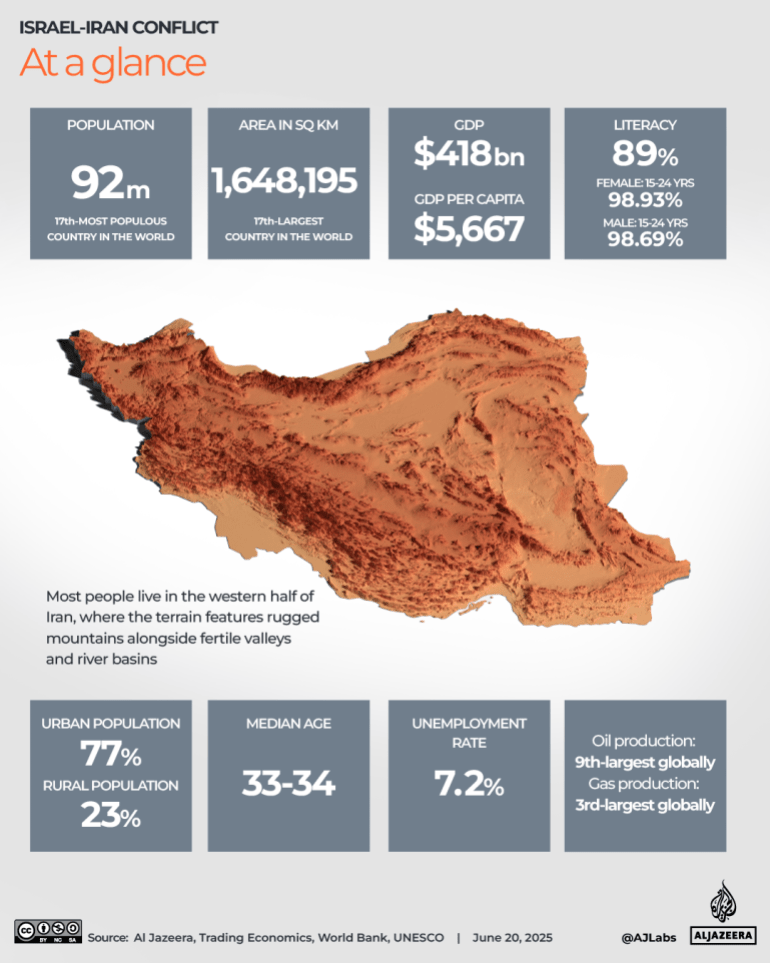
Iran has re-emerged at the centre of international attention, following Israeli attacks on the Middle East’s second-largest country on June 13. Stretching from the Caspian Sea in the north to the Gulf of Oman in the south, Iran’s landscape is as varied as its history, with key access to critical waterways, including the Strait of Hormuz, through which 20 percent of the world’s oil flows. Iran’s history spans millennia, making it one of the world’s most ancient and culturally rich nations, continuously inhabited and influential throughout history. In this visual explainer, Al Jazeera provides a snapshot of Iran’s geography, key cities, population makeup, and ethnic diversity. Iran at a glance With a population of 92 million, Iran is the 17th-largest country in the world by population and land area. Iran’s nominal gross domestic product (GDP) is $418bn, ranking it 36th in terms of the economy size. It has an unemployment rate of about 7.2 percent. The country’s adult literacy rate is 89 percent, with youth literacy nearing 99 percent, though these rates vary between rural and urban areas. The country is rich in oil and gas, ranking as the world’s ninth-largest oil producer and third-largest natural gas producer. How big is Iran? Located in Western Asia, Iran is the second-largest country in the Middle East after Saudi Arabia and the 17th-largest in the world, covering approximately 1.65 million square kilometres (636,000 square miles). Iran shares land borders with seven countries, the longest being Iraq, followed by Turkmenistan, Afghanistan, Pakistan, Azerbaijan, Turkiye and Armenia. Advertisement Iran covers about one-sixth the equivalent land area of the United States, nearly as large as the state of Alaska. It is about one-sixth the size of Europe, about one-fifth the size of Australia, roughly half the size of India and about 80 times larger than Israel. Where are Iran’s main population centres? Most of Iran’s 92 million people live in the western half of the country, where the terrain features rugged mountains alongside fertile valleys and river basins that sustain much of the population. With 9.6 million inhabitants, Tehran has been the capital since 1795 and is the country’s largest city. Situated beneath the Alborz Mountains, Tehran’s history dates back more than 6,000 years. Mashhad, in the northeast, is Iran’s second-largest city with 3.4 million people and a history spanning more than 1,200 years. It is a major religious and cultural centre and is home to the Imam Reza Shrine, which brings in millions of pilgrims from around the world. Isfahan, the third-largest city, is home to some 2.3 million people. More than 2,500 years old, the city was once the capital of the Safavid Empire, which lasted from 1501 to 1722. Isfahan hosts major educational institutions and is a centre for textiles, steel and manufacturing, along with nuclear and aerospace industries. Other populous cities across Iran include: Shiraz (1.7 million), Tabriz (1.7 million), Karaj (1.6 million), Qom (1.4 million) and Ahvaz (1.3 million). Demographic breakdown Nearly 60 percent of Iran’s population is below the age of 39, according to figures from the United Nations Statistics Division. The country’s median age is 33-34 years, and about 77 percent of Iranians live in urban areas. The largest age groups in Iran are those aged 30-34 and 35-39, meaning most of the population was born after the 1979 Islamic Revolution that toppled the Pahlavi Shah regime. However, there has been a significant emigration of Iranian professionals in recent years, largely driven by economic hardship. What are Iran’s ethnicities? Iran is a highly diverse country, both ethnically and culturally. Persians make up approximately 61 percent of the population, while significant minority groups include Azerbaijanis (16 percent), Kurds (10 percent) and others, such as Lurs (6 percent), Arabs (2 percent), Baloch (2 percent) and Turkic groups (2 percent). Iran is predominantly Shia Muslim, making up about 90 percent of the population, while Sunni Muslims and other Muslim sects account for roughly 9 percent. The remaining 1 percent includes roughly 300,000 Baha’i, 300,000 Christians, 35,000 Zoroastrians, 20,000 Jews, and 10,000 Sabean Mandeans according to the Minority Rights Group. Advertisement In border regions such as Kurdistan, Khuzestan and Sistan-Baluchestan, ethnic groups play a key role in shaping the country’s ethnic and religious diversity as well as its regional politics. While Persian (Farsi) is the official national language, many regions across the country speak a variety of other languages. Adblock test (Why?)
Trump presides over Army parade: Celebration or ‘dictator behaviour’?
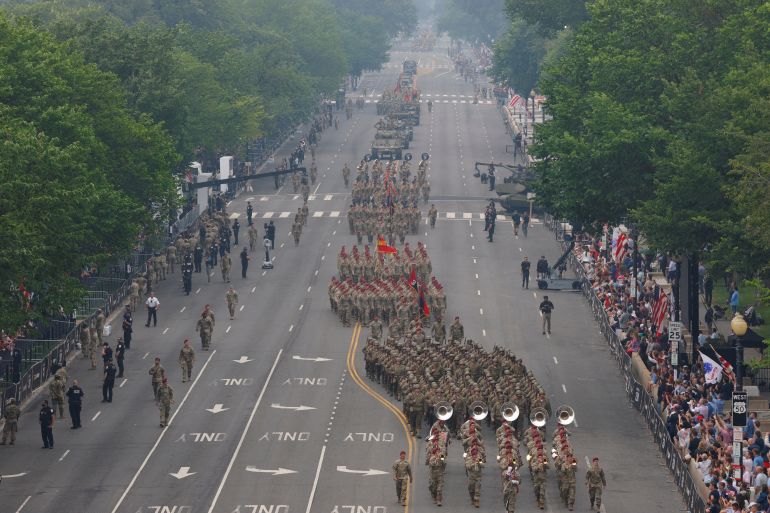
Washington, DC – It was the 250th birthday of the United States Army, and Trump’s 79th. Tanks and other armoured military vehicles rumbled down the streets of Washington, DC, on Saturday, in what Trump had teased as an “unforgettable” event and critics had called a pricey tribute to the “egoist-in-chief”. Speaking after the hour-long procession, which cut through a balmy evening dotted with raindrops, Trump framed the spectacle as a long time coming. “Every other country celebrates their victories. It’s about time America did, too,” he told the crowd, which sprawled sparsely across the National Mall. “That’s what we’re doing tonight,” he said. Vice President JD Vance, who introduced the president at the end of the parade, was the only official to acknowledge the dual birthdays. “June 14th is, of course, the birthday of the army. It is, of course, the birthday of the president of the United States,” he said. “Happy birthday, Mr President.” For critics, the overlapping dates sent a disconcerting message. Advertisement Away from the celebrations, among about 100 protesters at Logan Circle in Washington, DC, Terry Mahoney, a 55-year-old Marine veteran, described the parade as “dictator behaviour”. “If you take everything else he’s done, stomping on the US Constitution, this parade may just be window dressing,” he told Al Jazeera. Soldiers march during a military parade to commemorate the US Army’s 250th Birthday in Washington, DC [Brian Snyder/Reuters] “But it’s the worst kind of window dressing,” said Mahoney, who was among the tens of thousands of protests who took to the streets nationally to oppose Trump’s leadership on Saturday. “So I wanted to make sure that my voice was represented today.” But blocks away, near the entrance to the heavily fortified parade route, Taras Voronyy, who travelled from South Carolina, was less concerned about the blurred lines of the parade than the soldiers it was honouring. “It’s a chance to celebrate the military, and also, Trump will be here,” he told Al Jazeera. “I was actually a little confused if it was supposed to be for the Army’s 250th anniversary or for Trump’s birthday,” he said. “So I guess it’s a twofer.” A birthday celebration Trump had sought a massive military parade ever since attending a Bastille Day celebration in Paris in 2017, but faced pushback from defence officials during his first term. This time around, he sent 28 Abrams tanks, a horde of armoured vehicles, cavalry, military planes and helicopters, both modern and antique, to the US capital, in a show of military hardware without comparison since 1991, when the US marked the end of the Gulf War. Advertisement Spectators gathered along Constitution Avenue – a thoroughfare that connects the White House to the US Capitol – for a pageant that stretched from the Army’s 1775 birth, through World War II, the Vietnam War, and the so-called “war on terror”. Trump’s arrival prompted cheers, and a handful of jeers, from the crowd, which was dotted with red Make America Great Again (MAGA) hats. Attendance appeared to be less than the military’s prediction of about 200,000 people. For Freddie Delacruz, a 63-year-old US Army veteran who travelled from North Carolina for the parade, Trump’s birthday and the Army celebration were distinct phenomena. “It’s a coincidence,” he said. “I got married on June 6, which is the anniversary of D-day [the landing of allied forces on the beaches of Normandy, France].” “So these things happen,” he said. “But we’re here to support the army. I spent 32 years in the army – I want to see the tanks, the planes, the helicopters flying around.” A person holds up a ‘No Kings’ sign in protest against US President Donald Trump’s policies and federal immigration sweeps, during the US Army’s 250th birthday festival in Washington, DC, US, June 14, 2025 [Carlos Barria/Reuters] Delacruz also did not see much significance in Trump’s deployment earlier this week of the US National Guard to California to respond to protests against Immigration and Customs Enforcement (ICE) raids in Los Angeles and other cities. Local officials and rights advocates have said the deployment, which was soon followed by Trump sending Marines to protect federal property and personnel, represented a major escalation and overreach of presidential power. Advertisement A judge on Thursday sided with a lawsuit filed by California Governor Gavin Newsom, ruling that Trump’s deployment without the governor’s approval was unlawful. However, an appeals court paused the ruling just hours later, allowing the deployment to temporarily continue. Delacruz acknowledged that Trump has “got a lot of power… I mean, he’s got the Department of Defense, he’s got the Department of Department of State and now, all the Cabinet members are supporting him 100 percent”. “But he’s still just the president, and he can’t control Congress,” he added. “This is what the people voted for.” Freddie Delacruz attends the US Army parade in Washington, DC [Joseph Stepansky/Al Jazeera] Aaron M, a 57-year-old Army veteran from Miami, Florida, also said he did not see an issue with how Trump has used federal forces in local law enforcement. Trump’s decision was the first time since 1965 that a president had activated the National Guard without a governor’s consent. Both Trump and Defense Secretary Pete Hegseth have indicated that the approach could be replicated across the country. In recent days, Trump has also floated invoking the Insurrection Act of 1807, which would allow US troops to take part in domestic law enforcement, in what critics call a step towards martial law, but has not yet done so. “If governors can’t get their states under control, then Trump should send [the National Guard] in,” said Aaron, who declined to give his last name. “Look, I was born in Nicaragua. I came here when I was 12,” Aaron added. Advertisement “I know what a dictator is. This is not a dictator,” he said, motioning to the grandstand from where Trump watched the parade. Armoured vehicles take part in a military parade to commemorate the US Army’s 250th birthday in