

US begins prosecuting migrants for breaching ‘military zone’ near border

The United States has announced its first criminal prosecutions against migrants and asylum seekers accused of crossing into a newly created military zone along the country’s border with Mexico. Court filings submitted on Monday – and reviewed by US media the following day – show that approximately 28 people have been charged with “violations of security regulations” for breaching the military zone. That charge, though a misdemeanour, carries the possibility of heightened penalties. The US Code stipulates that violations of security regulations can result in a fine of up to $100,000 for individuals or up to a year in prison – or both. Normally, the consequences for unlawful entry into the US are less severe. But as the administration of President Donald Trump ramps up its crackdown on immigration, critics warn of the growing militarisation of the southern border region neighbouring Mexico. The new charges were made possible by the establishment of the “New Mexico National Defence Area” on April 18. Advertisement The Department of Defense ordered that an Army installation called Fort Huachuca be expanded to include 109,651 acres (44,400 hectares) of federal land, previously held by the Department of the Interior. The transfer is effective for three years and turns a strip of border land adjacent to Mexico into a US military zone, where trespassing carries serious consequences. That military zone notably overlaps with routes that migrants and asylum seekers have taken to enter the US irregularly, without official paperwork. Successive presidential administrations, however, have sought to limit asylum applicants from crossing into the US outside of official ports of entry, despite US and international law that protects the right to flee persecution. The threat of increased penalties has been one of the tools used as deterrence. Defense Secretary Pete Hegseth meets with US military personnel in New Mexico on February 3 [Jose Luis Gonzalez/Reuters] Last week, Secretary of Defense Pete Hegseth visited the recently established military zone, where he touted the strip as a new line of defence against what he called an “invasion” of migrants and asylum seekers. “This is Department of Defense property. The National Defense Area, formerly known as the Fort Huachuca annex zone, is federal property. Any illegal attempting to enter that zone is entering a military base – a federal, protected area,” Hegseth said. “You can be detained. You will be detained. You will be interdicted by US troops and border patrol working together.” Advertisement Since January, the Trump administration has surged the number of US troops stationed at the border, bringing the total to an estimated 11,900 soldiers. During his visit, Hegseth revealed that he also plans to expand military zones at other sites along the US border, to add an extra line of defence against irregular migration. He played up the risks of complex criminal prosecutions and lengthy prison sentences. “If you are an illegal crossing, you will be monitored. You will be detained by US troops. You will be detained temporarily and handed over to Customs and Border Patrol,” he said. “If you have cut through a fence or jumped over a fence, that’s destruction of government property. If you have attempted to evade, that’s evading law enforcement, just like you would any other military base. You add up the charges of what you can be charged with – misdemeanours and felonies – you could be looking at up to 10 years in prison when prosecuted.” He added that New Mexico’s attorney general “can’t wait to prosecute” the first group to cross through the military zone. Groups like the American Civil Liberties Union of New Mexico have voiced opposition to the new tactic, saying that human rights are at risk when the military is deployed to address civilian offences. “The expansion of military detention powers in the ‘New Mexico National Defence Area’ – also known as the ‘border buffer zone’ – represents a dangerous erosion of the constitutional principle that the military should not be policing civilians,” said Rebecca Sheff, a senior staff lawyer for the group. Advertisement Sheff added there could be unintended consequences beyond the government’s attempts to restrict irregular migration. “We don’t want militarized zones where border residents – including U.S. citizens – face potential prosecution simply for being in the wrong place.” Adblock test (Why?)
‘Sense of fear’: Harvard reports find anti-Jewish and anti-Muslim bias

Students and staff at Harvard University have faced both anti-Semitism and Islamophobia amid a deeply polarised atmosphere on the campus of one of the top universities in the United States, separate reports have found. The release of the reports on Tuesday follows the establishment of separate task forces on combating anti-Jewish and anti-Muslim sentiment last year amid campus protests over Israel’s war on Gaza. It also comes as Harvard is embroiled in a legal fight with US President Donald Trump over his administration’s decision to freeze more than $2bn in funding for the university, a move Trump claims was taken in response to rampant anti-Semitism on campus. In a statement announcing the findings, Harvard president Alan Garber said that Jewish, Israeli and Zionist community members reported hiding “overt markers of their identities to avoid confrontation”, while Muslim, Arab and Palestinian community members described feeling “judged, misrepresented, and silenced”. “Especially disturbing is the reported willingness of some students to treat each other with disdain rather than sympathy, eager to criticise and ostracize, particularly when afforded the anonymity and distance that social media provides,” Garber said. Advertisement “Some students reported being pushed by their peers to the periphery of campus life because of who they are or what they believe, eroding our shared sense of community in the process.” The task force on combating anti-Semitism and anti-Israeli bias said in its report that bias had been “fomented, practiced, and tolerated” at Harvard and within academia more widely. In an online survey, 26 percent of Jewish students reported feeling physically unsafe, while 39 percent said they did not feel at home at the university, the task force said. Nearly 60 percent of Jewish students reported experiencing “discrimination, stereotyping, or negative bias” due to their opinions, with only 25 percent believing there was no “academic or professional penalty” for expressing their views, the task force said. Among other examples of bias cited in the report, the task force quoted an unnamed Israeli Arab student as saying that Israelis “get used to social discrimination” from their first day on campus. “People refusing to speak to you. Not even pretending to be nice. Some people pretend to be nice and end conversation in [a] polite manner when they find out [I am] Israeli and then don’t talk to [me] again,” the report quoted the student as saying. The task force on combating anti-Muslim, anti-Arab and anti-Palestinian bias found a similar climate of hostility, describing a “deep-seated sense of fear” among students and a state of “uncertainty, abandonment, threat, and isolation” on campus. Advertisement “Muslim women who wear hijab and pro-Palestinian students wearing keffiyehs spoke about facing verbal harassment, being called ‘terrorists,’ and even being spat upon,” the task force said. “The issue of doxxing was particularly highlighted as a significant concern that affects not only physical safety and mental well-being, but also future career prospects,” it added, referring to the practice of disclosing a person’s personal or identifying information online. Nearly half of Muslim students and staff surveyed reported feeling physically unsafe on campus, while 92 percent said they believed they would face professional or academic penalties for expressing political views. “As Muslim students we have been living in constant fear,” the taskforce quoted an unnamed student as saying. “There have been trucks driving around campus for months, displaying the faces of Muslim students… my peers who have lost their jobs simply for being in the leadership of Muslim faith organisations have been left out to dry once they had their offers revoked… If there were antisemitic trucks driving around campus and planes flying over with antisemitic slogans, I cannot help but believe Harvard would have done more to stop it.” Both task forces issued a series of recommendations for combating bias on campus, including expanding access to legal services equipped to combat doxxing and prioritising the admission of students who support open inquiry. Garber said the university would redouble its efforts to ensure it is a place where “ideas are welcomed, entertained, and contested in the spirit of seeking truth” and “mutual respect is the norm”. Advertisement “Especially when tensions are high, we must embrace the challenge of seeing one another as we truly are, unique individuals with complex beliefs and identities, leaving our preconceptions behind and meeting one another with kindness and concern,” he said. Adblock test (Why?)
Indian tourist on zipline inadvertently filmed Kashmir attack
[unable to retrieve full-text content] An Indian tourist unknowingly caught the deadly shooting in Pahalgam on camera as he filmed himself riding a zipline.
What we know about power outage in Spain, Portugal

Spain and Portugal have regained access to electricity after one of Europe’s worst blackouts paralysed transport systems, disrupted mobile communications and postponed medical procedures. For almost a day from Monday to early on Tuesday, tens of millions of people were plunged into darkness. In major cities like Barcelona, Madrid and Lisbon, people were trapped in lifts, stuck on trains and unable to access the internet. Meanwhile, queues snaked outside the few supermarkets running on backup generators as people stocked up on dried goods, water and battery-powered flashlights. The Spanish and Portuguese governments quickly convened emergency meetings after the outage, which hit Spain and Portugal about 12:30 (10:30 GMT) on Monday and also briefly affected southern France. Almost no one in the Iberian Peninsula, which has a population of almost 60 million people, escaped the blackout. Madrid was forced to declare a state of emergency. Although power has been largely restored, transport remains in dire straits, with trains and flights reporting delays. No firm cause for the shutdown has yet emerged. Advertisement With the power back on, attention is turning to what caused such a widespread failure of the region’s networks. What caused the power outage? Portugal’s electricity provider, Redes Energeticas Nacionais (REN), said a “rare atmospheric phenomenon” had caused a severe imbalance in temperatures that led to the widespread shutdowns. REN said: “Due to extreme temperature variations in the interior of Spain, there were anomalous oscillations in the very high voltage lines (400 kV), a phenomenon known as ‘induced atmospheric vibration’.” The Portuguese prime minister, Luis Montenegro, also said the issue originated in Spain. However, in a statement on Tuesday, Spain’s national meteorological office, Aemet, appeared to rule out the weather as a culprit. “During the day of 28 April, no unusual meteorological or atmospheric phenomena were detected, and nor were there sudden variations in the temperature in our network of meteorological stations,” Aemet said. The Spanish government said the cause of the power cut is still unknown and warned against speculation. “My gut feeling is that multiple factors were behind the blackout,” Kang Li, smart energy systems chairman at the University of Leeds, told Al Jazeera. “It usually takes several months for forensic grid data to be properly analysed,” he added, “though an interim report could be done in several weeks.” Bloomberg News reported that Spain has seen a record number of hours with negative power prices in recent months as more wind and solar energy supplies the grid. Until now, however, oversupply hadn’t led to blackouts. Advertisement In 2024, renewable energy sources accounted for 56 percent of all electricity used in Spain, a record high. By 2030, that proportion is expected to reach 81 percent. According to Li, “it’s harder to manage energy output when infrastructure is changing so quickly. A higher penetration of renewables with existing systems creates more fluctuation in the operating system.” For his part, Spanish Prime Minister Pedro Sanchez said, “We have never had a complete collapse of the system,” explaining how Spain’s power grid lost 15 gigawatts, the equivalent of 60 percent of its national demand, in just five seconds. While there’s no evidence yet of a cyberattack, Sanchez said he isn’t ruling anything out. He warned against speculation but said “no cause can be discredited at this point”. Could a cyberattack have caused the blackout? Although investigations into the cause of the outage are ongoing, Portugal’s National Cybersecurity Centre threw cold water on the idea of foul play, saying there was no sign that the outage resulted from a cyberattack. Portuguese Prime Minister Luis Montenegro also said there was “no indication” of a cyberattack. Speaking to reporters in Brussels, Teresa Ribera, an executive vice president of the European Commission, also ruled out sabotage. Nonetheless, the outage “is one of the most serious episodes recorded in Europe in recent times”, she said. For now, the Spanish government said it is waiting for more information on the cause of the blackout. State officials said they hope in the coming days to know what the cause was. Advertisement Which countries were affected? Spain and Portugal were the worst affected, but outages occurred elsewhere too: Spain: Urban centres such as Avila, Madrid, Murcia, Galicia, Alicante, Zaragoza, Barcelona and Seville reported widespread disruptions. The Canary and Balearic islands were not affected. Portugal: Lisbon and Porto experienced comparable challenges. Southern France: Parts of the French Basque Country saw brief power outages. But officials from the French electricity transmission network said the interruptions lasted only a few minutes. Morocco: Some reports suggested internet providers in Morocco struggled briefly to keep their services running because of network connections with France and the outages there. Greenland: Remote regions of Greenland lost access to key satellite services, including internet and telephones. Authorities said they own satellite equipment in Spain although a direct cause has not yet been established. Has power been restored? By mid-afternoon on Monday, Spain’s electricity operator, Red Electrica (REE), said it had started to recover voltage in the north, south and west of the country. The recovery process was carried out gradually to avoid overloading the grid as generators linked up. Power also returned to Portugal bit by bit. By Monday night, REN said 85 of its 89 power substations were back online. By Tuesday morning, power had almost fully returned to Spain and Portugal. At 6:30am (04:30 GMT) more than 99 percent of energy demand in Spain had been restored, REE said. Elsewhere, power was restored overnight to 6.2 million of Portugal’s 6.5 million households. Advertisement At the city level, Madrid’s metro system said service was restored on all but one line by 8am (06:00 GMT), meaning that 80 percent of trains were operating during Tuesday morning’s rush hour. Has Europe suffered from blackouts of this scale before? While outages are not unheard of in Europe, the scale of Iberia’s power failure was one of the largest in recent history. In 2019, England and Wales suffered regional blackouts amid lightning strikes at a gas-fired power plant in Bedfordshire and an
Russia dismisses Ukraine’s proposal to extend brief ceasefire to 30 days
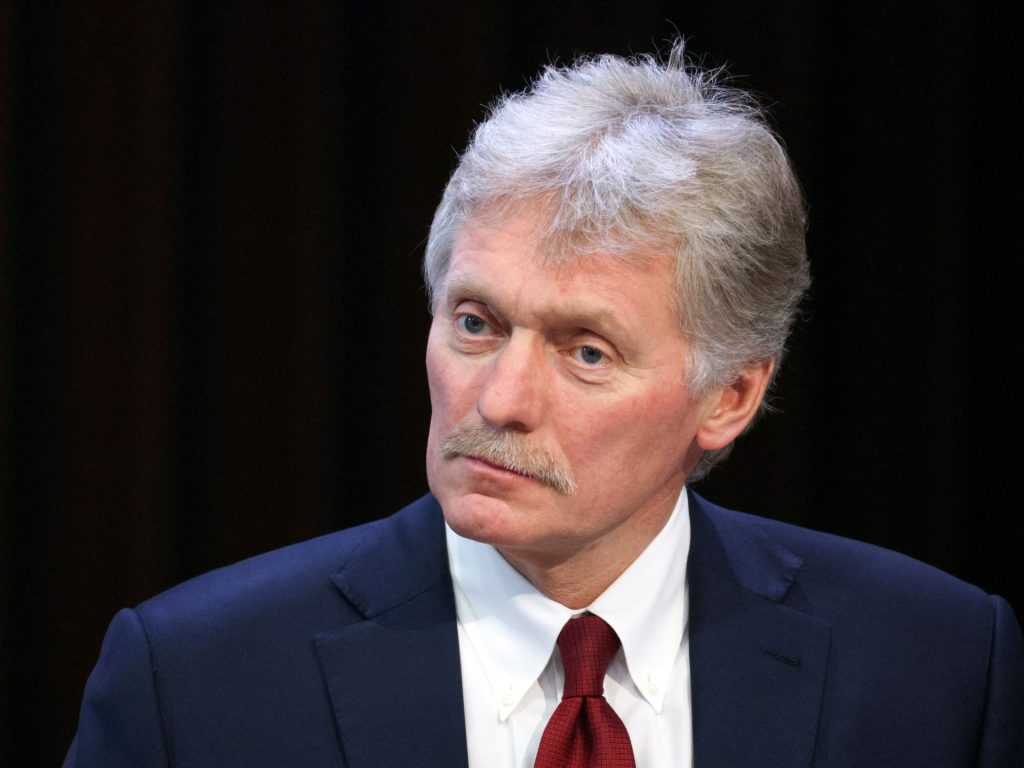
Kremlin spokesman slams Kyiv after Ukraine’s President Volodymyr Zelenskyy says Moscow’s brief unilateral ceasefire is ‘manipulation’. Russia has rejected a proposal from Ukraine to extend Russian President Vladimir Putin’s unilateral three-day ceasefire as the United States grows increasingly impatient with stalled efforts to find a long-term solution to end the war. Kremlin spokesman Dmitry Peskov confirmed on Tuesday that Moscow had seen Ukrainian President Volodymyr Zelenskyy’s offer to extend Putin’s brief early May pause in fighting to 30 days. But Peskov said it would be “difficult to enter into a long-term ceasefire” without first clearing up a number of “questions”. Zelenskyy had branded Putin’s unilateral truce, which will last from May 8 to 10 and coincides with Moscow’s celebrations to mark the 80th anniversary of its victory over Nazi Germany in World War II, as an “attempt at manipulation”. The Ukrainian leader also questioned why Moscow would not agree to Kyiv’s call for a ceasefire lasting at least 30 days and starting immediately. Peskov threw the Ukrainian president’s words back at him, saying that the absence of a “direct response” from Ukraine to Putin’s three-day pause, which the spokesman described as a “gesture of goodwill”, was itself “a manipulation”. The to-and-fro comes amid pressure from an increasingly impatient White House to agree on a deal to end the conflict. Advertisement On Sunday, US President Donald Trump told Putin to “stop shooting” and sign an agreement, after earlier voicing concerns that Putin was “just tapping me along”. Last month, Russia stymied a US proposal for a 30-day halt in fighting by calling for far-reaching conditions, including a ban on Ukraine using the pause to regroup and rearm its forces and on Western arms supplies to Kyiv. It offered no concessions in return for those demands. Ukraine has accepted the US proposal, with Zelenskyy saying late on Monday that the ceasefire “must be immediate, full, and unconditional – for at least 30 days to ensure it is secure and guaranteed”. Deadly drone attacks Meanwhile, Russian and Ukrainian forces carried out dozens of drone attacks early on Tuesday. A Russian attack on Ukraine’s southeastern Dnipropetrovsk region killed a 12-year-old girl and wounded three others, including a six-year-old. Russia also launched 20 drones and 31 powerful guided bombs at Kharkiv, Ukraine’s second-largest city. Debris from an intercepted Russian drone started a fire in a neighbourhood of the capital, Kyiv, according to officials. In total, Russia fired 100 drones at Ukraine between late Monday and early Tuesday, the Ukrainian air force said. In Russia’s Belgorod region, which borders Ukraine, “an enemy drone deliberately struck a moving vehicle carrying five men”, said regional Governor Vyacheslav Gladkov, who reported that two people were killed. The Russian army said it shot down 40 drones over various regions overnight, including four over the Russian-controlled Crimean Peninsula. Advertisement Reporting from Moscow, Al Jazeera’s Yulia Shapovalova said civilians living in Russian border communities have faced regular attacks. “They’ve been suffering since the beginning of this conflict; dozens of towns and villages in Russia’s border regions, in particular in Belgorod … they constantly come under attack,” she said. “Hundreds of thousands of people have been displaced,” Shapovalova added. “And there are also reports that the Ukrainian army is continuing to build up near the border with the Belgorod region.” Adblock test (Why?)
How falsehoods drove Trump’s immigration crackdown in his first 100 days
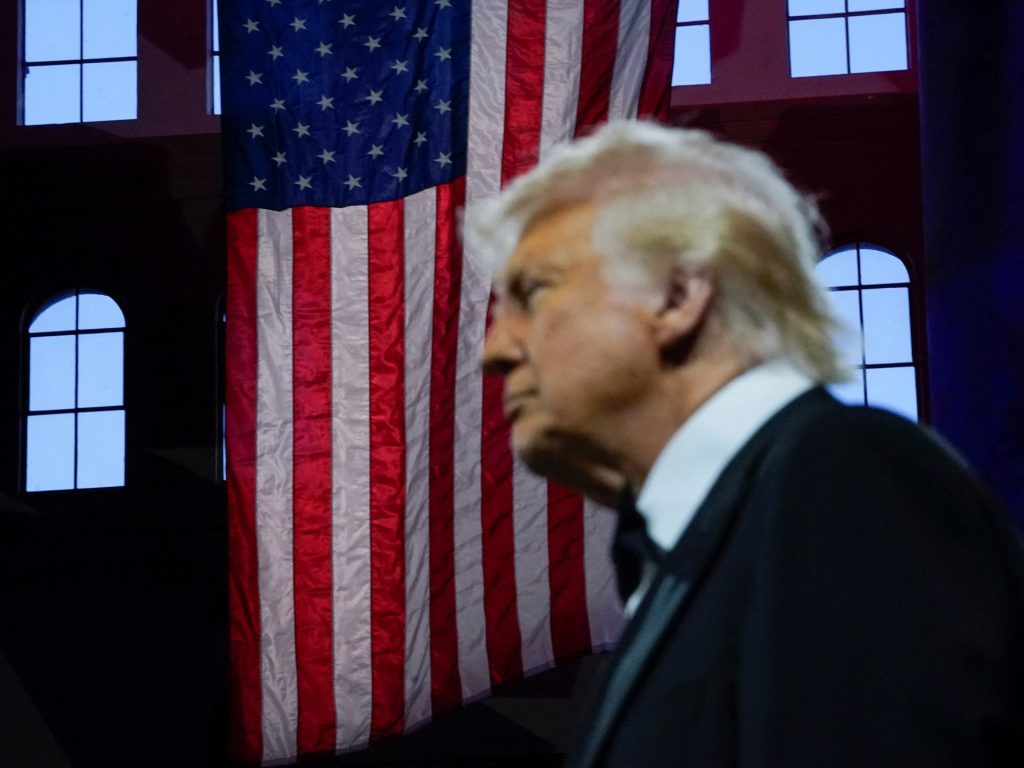
In his first 100 days in office, United States President Donald Trump invoked archaic immigration laws, questioned judges’ power to rule against his decisions and attempted to end several legal immigration pathways. Trump began laying the groundwork for his immigration plans long before his January 20 inauguration. For years, Trump and his allies have said falsely or without evidence that the US is being invaded by immigrants who are driving up crime rates and that foreign countries are sending their prisoners and mentally ill people to the US. Several Trump administration officials also said courts cannot and should not rule on Trump’s immigration actions because they deal with national security and foreign policy issues. In doing so, Trump “is seeking a lack of accountability to do things that the law otherwise prohibits”, said Matthew Lindsay, a University of Baltimore law professor. The Trump administration’s use of national security or foreign policy as a shield against judicial overview is a stark difference from other administrations, Lindsay said. Advertisement We talked to lawyers, historians and criminologists to examine the false narratives and spin propelling Trump’s immigration policies in the first 100 days. Trump’s case for an ‘invasion’ leads to mass deportation efforts In 2018, during his first term, Trump described a caravan of thousands of immigrants walking towards the US southern border as an invasion. Many of them were expected to request asylum in the US. Constitutional law experts say that what legally counts as an invasion is an armed attack by militaries or paramilitaries. Many Gang Members and some very bad people are mixed into the Caravan heading to our Southern Border. Please go back, you will not be admitted into the United States unless you go through the legal process. This is an invasion of our Country and our Military is waiting for you! — Donald J. Trump (@realDonaldTrump) October 29, 2018 During the 2024 presidential campaign, as immigration reached historic highs during Joe Biden’s presidency, Trump began tying the invasion narrative to one of his signature policy promises: Mass deportations. “I will stop the migrant invasion, and we will begin the largest deportation operation in the history of our country,” he said at an October rally. Ten days later, at another rally, he said: “We will not be occupied. We will not be conquered. That’s what they’re doing. This is an invasion into our country of a foreign military.” So Trump upon taking office issued an executive order declaring a national emergency at the southern border. In two other directives, he described immigration as an invasion. Advertisement One of the laws he eventually invoked – the Alien Enemies Act of 1798 – lets the president detain and deport people from a “hostile nation or government” without a hearing when the US is either at war with that country or the country has “perpetrated, attempted, or threatened” an invasion against the US. “This is a time of war because Biden allowed millions of people, many of them criminals, many of them at the highest level,” Trump told reporters on March 16. “That’s an invasion. They invaded our country.” The Alien Enemies Act has been used only three times in US history, each during wartime. In February, the State Department designated Tren de Aragua – a gang that formed between 2013 and 2015 in a Venezuelan prison – as a foreign “terrorist” organisation. In March, Trump invoked the Alien Enemies Act to deport hundreds of Venezuelans whom he said were Tren de Aragua gang members who had “infiltrated” cities across the country. They were sent to the Terrorism Confinement Center, or CECOT, a maximum-security prison in El Salvador. They were deported without due process; the government didn’t present evidence of their gang membership before a judge and the migrants weren’t given the opportunity to defend themselves. CECOT is the largest prison in Latin America and has been decried for human rights abuses, such as torture and lack of medical care. Trump broadly portrays immigrants as criminals, but the data says otherwise Trump has repeatedly said that countries – namely the Democratic Republic of the Congo and Venezuela – send people from prisons and mental hospitals to the US. He has not cited evidence. Advertisement “We were elected to clean up the mess of this country, and we had millions and millions of people come in who were criminals, who were murderers, who were everything you can imagine,” Trump said on April 21. “Drug lords, drug dealers, they came in from prisons and from mental institutions. And I was elected to move them out.” The immigrant crime narrative drove his successful presidential campaign. Vice President JD Vance pointed to Haitian immigration in Springfield, Ohio, cherry-picking from limited statistics to say immigrants raised the number of murders. In addition to targeting Springfield, Trump said Tren de Aragua took over Aurora, Colorado. To support its deportation efforts, the White House said Kilmar Armando Abrego Garcia, a Salvadoran immigrant who the US government said it mistakenly deported to CECOT, is an MS-13 gang member. The administration has exaggerated findings from earlier judges on his case and highlighted tattoos that don’t correspond with MS-13. Criminologists who study potential links between migration and crime say despite some high-profile crimes committed by immigrants, they commit crimes at lower rates than native-born US citizens. The Marshall Project found no link between crime and migrant arrivals from April 2022 to May 2023 in New York, Chicago, Washington, DC and Denver, after Texas Governor Greg Abbott began busing immigrants into those cities. The Marshall Project’s 2024 report looked at policing data in cases involving crimes such as robbery, murders and shootings. Advertisement A 2018 national study by University of Wisconsin and Purdue University sociologists found that increases in the immigrant population in the US are associated with significant decreases in violence. The study analysed violent crime from 1990 to 2014, examining the association between changes in undocumented migration and violent crime at the state level in all 50 states and Washington, DC. A National Institute
Trump’s 100-day scorecard: Executive orders, tariffs and foreign policy
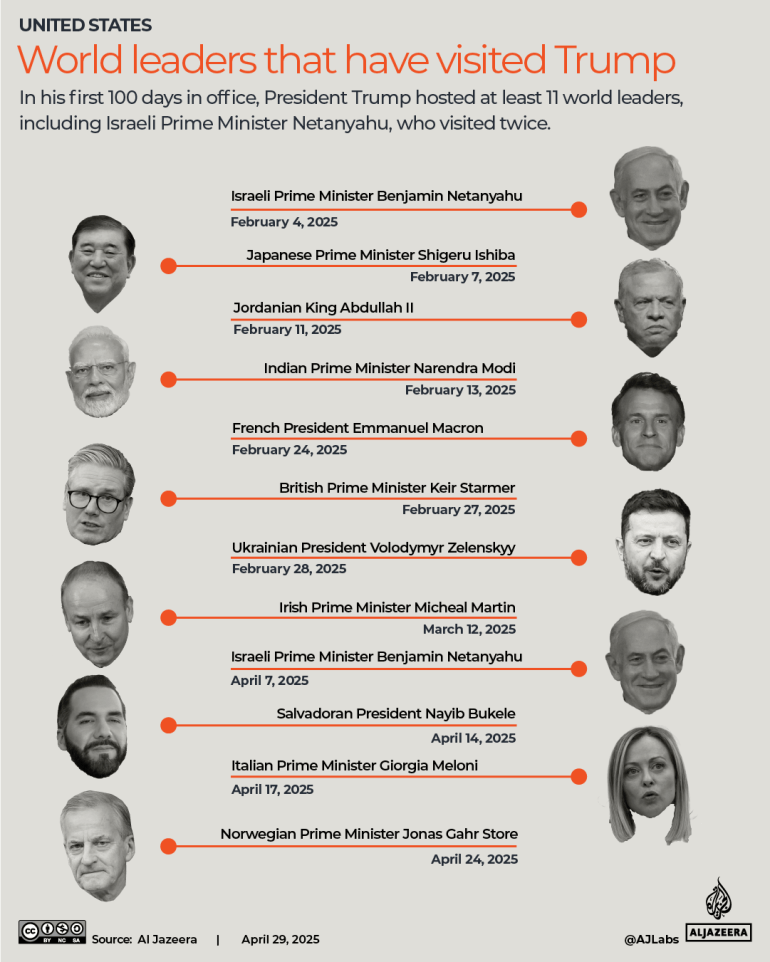
United States President Donald Trump is marking his first 100 days back in office with a rally in Macomb County, Michigan, just north of Detroit, a city renowned for its automotive industry. In the space of just more than three months, he has signed more executive orders than any other president, sent markets spiralling with tariffs and for the most part stuck to his America First policy, except when it comes to Israel. Al Jazeera looks at some of his biggest decisions in numbers: How did he use his executive powers? Trump has signed at least 142 executive orders so far, which, according to the American Presidency Project, is more than any other US president in their first 100 days in office. An executive order is a directive issued by the president to federal agencies that has the force of law but does not require congressional approval. On January 20, his first day in office, Trump signed 26 orders, which included pardoning more than 1,500 people convicted on January 6, 2021, Capitol riot charges; withdrawing from the World Health Organization; and renaming the Gulf of Mexico to the Gulf of America. Advertisement The majority of Trump’s executive orders have focused on immigration and border security as well as energy and trade. How many people were pardoned? Since returning to office, Trump has pardoned more than 1,500 people, including his supporters convicted in connection with the January 6, 2021, US Capitol riot after he lost the 2020 presidential election. Other notable pardons include Ross Ulbricht, founder of the Silk Road dark web marketplace, who was serving a sentence for drug trafficking and money laundering. DOGE cuts and layoffs Tech billionaire Elon Musk’s Department of Government Efficiency (DOGE) was created by Trump through an executive order on January 20, in which he gave DOGE a mandate to slash government spending. According to figures published on DOGE’s website, the organisation is estimating that it has cut $160bn from the federal budget, representing about 8 percent of the $2 trillion Musk had initially pledged to save. DOGE said the biggest cuts have been made to the Department of Health and Human Services ($47.4bn), Agency for International Development ($45.2bn) and Department of State ($2.6bn). These figures have, however, been criticised for lacking sufficient evidence to back them up. According to data collated by CNN, at least 121,000 workers have been fired from federal agencies with about 10,000 employees fired from the Agency for International Development (USAID), where 100 percent of the jobs were culled. USAID was the first agency Trump went after, and it has now been almost dissolved. Advertisement Tariffs and the economy Trump’s administration has implemented a flurry of tariffs to, in his words, reduce the US trade deficit, remedy unfair trade policies against the US, bring manufacturing jobs back to the country and generate income for the US government. Starting on February 1, Trump imposed 25 percent tariffs on Canadian and Mexican goods, including a 10 percent levy on Canadian energy, and hit Chinese goods with a 10 percent tariff. In the weeks that followed, Trump targeted steel and aluminium as well as auto imports with tariffs of 25 percent. By April, Trump had placed a baseline 10 percent tariff on goods imported from the rest of the world. China received the highest tariff rate at 145 percent. However, some exemptions have been applied to technology-related items, such as smartphones. Canada and Mexico are facing tariffs of 25 percent on goods that are noncompliant with the trilateral USMCA trade deal they have with the US, affecting $63.8bn worth of trade, according to Bloomberg News. The European Union is facing what is for now a suspended 20 percent tariff rate. How have the markets reacted? Since coming into office, Trump has sent shockwaves through the markets, largely due to his flip-flopping tariff announcements, which have caused uncertainty and volatility. Since the November election, despite an initial spike, all major indices have fallen: S&P 500 – down about 3.3 percent Nasdaq – down about 4.5 percent Dow Jones – down 5.3 percent Since inauguration day, the markets have fallen even further: Advertisement S&P 500 – down about 7.9 percent Nasdaq – down about 12.1 percent Dow Jones – down 8.9 percent Which world leaders have visited Trump? In his first 100 days in office, Trump has hosted at least 11 world leaders. Unsurprisingly, Israeli Prime Minister Benjamin Netanyahu was the first leader to arrive at the White House on February 4. It was during this visit that Trump said he would turn Gaza into the “Riviera of the Middle East”. (Al Jazeera) World leaders who have visited Trump include: Netanyahu on February 4 Japanese Prime Minister Shigeru Ishiba on February 7 Jordanian King Abdullah II on February 11 Indian Prime Minister Narendra Modi on February 13 French President Emmanuel Macron on February 24 British Prime Minister Keir Starmer on February 27 Ukrainian President Volodymyr Zelenskyy on February 28. This meeting was notable for its war of words between Trump and US Vice President JD Vance on one side and Zelenskyy on the other, which led to the US withdrawing military aid from Ukraine Irish Prime Minister Micheal Martin on March 12 Netanyahu for the second time on April 7 Salvadoran President Nayib Bukele on April 14 Italian Prime Minister Giorgia Meloni on April 17 Norwegian Prime Minister Jonas Gahr Store on April 24 Foreign policy: Stance on Ukraine, Gaza and Yemen Since entering office, Trump has said he maintains an America First policy. On Ukraine, Trump has criticised the scale of US spending under former President Joe Biden, arguing that European countries should shoulder a greater share of the burden. On March 3, Trump ceased all military aid to Ukraine, a move that drew sharp criticism from European allies. The Trump administration has held several meetings with Ukrainian and Russian officials to try to end the fighting. Advertisement In the Middle East, Trump has brandished proposals to take control of Gaza and redevelop
Vaibhav Suryavanshi, 14, hits second-fastest IPL century, breaks T20 record

Rajasthan Royals’ schoolboy prodigy Vaibhav Suryavanshi becomes youngest T20 centurion after scoring a stunning 35-ball 100 against Gujarat Titans in the IPL. Fourteen-year-old Vaibhav Suryavanshi became the youngest centurion in men’s Twenty20 cricket as he guided Rajasthan Royals to an eight-wicket victory over the Gujarat Titans in an Indian Premier League match in Jaipur. Suryavanshi doled out severe punishment to Gujarat’s bowling attack on Monday, hitting 11 sixes and seven fours in his 101 off 38 balls, as the hosts chased down a 209-run target in 15.5 overs. The left-hander reached his 100 in 35 balls to register the second-fastest century in IPL history, while combining with Yashasvi Jaiswal in a 166-run opening partnership. “It is a very good feeling. It’s my first hundred in the IPL and it’s my third innings. The result has shown here after the practice before the tournament,” the player of the match, Suryavanshi, said. “I just see the ball and play. It has been a dream to get a 100 in the IPL, and today, it materialised. There is no fear. I don’t think much, I just focus on playing.” Suryavanshi’s century was also the quickest by an Indian in the IPL, bettering Yusuf Pathan’s 37-ball effort for Rajasthan against the Mumbai Indians in 2010. Advertisement “Many congratulations to young Vaibhav Suryavanshi for breaking my record of the fastest IPL hundred by an Indian,” Pathan wrote on social media. “Even more special to see it happen while playing for Rajasthan Royals, just like I did.” Suryavanshi grabbed headlines when he became the youngest player to earn a contract in the lucrative IPL at the age of 13, before making his debut this month and announcing himself in style with a six off the first ball he faced. He played in the domestic Ranji Trophy red-ball competition aged 12 last year and has represented India’s Under-19 side against Australia, scoring a 58-ball century. Suryavanshi also made a triple hundred in a local tournament in his home state of Bihar. Rajasthan are eighth in the IPL standings, with the win over Gujarat snapping a five-game losing run for the 2008 champions. The Rajasthan Royals’ Vaibhav Suryavanshi in action against the Gujarat Titans at Sawai Mansingh Stadium, Jaipur, India on April 28, 2025 [Abhijit Addya/Reuters] Adblock test (Why?)
Canada’s Liberal Party wins election dominated by Trump’s trade war
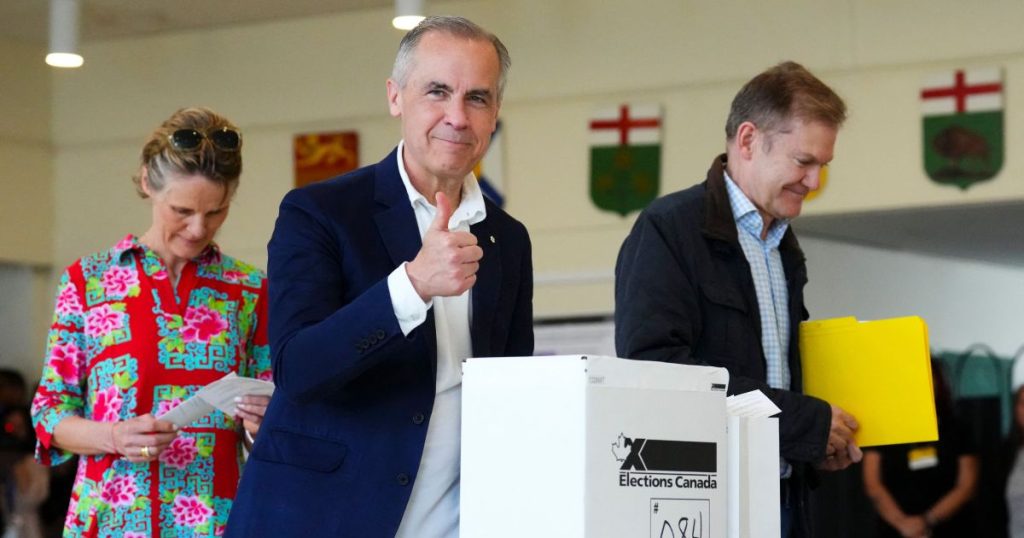
BREAKINGBREAKING, Canadian Prime Minister Mark Carney on course to form next government, projections show. Canada’s governing Liberal Party has won national elections dominated by United States President Donald Trump’s trade war and annexation threats. Prime Minister Mark Carney will keep the top job after projections showed his Liberals on course to win the most seats in the 343-member parliament, national broadcaster CBC and CTV News reported late on Monday. It was not clear if Carney, a career economist who cast himself as a champion for Canada in the face of Trump’s threats, would be able to form a majority government or need to rely on the support of a smaller party. Adblock test (Why?)
‘Traitors’: Hate-filled songs target Indian Muslims after Kashmir attack
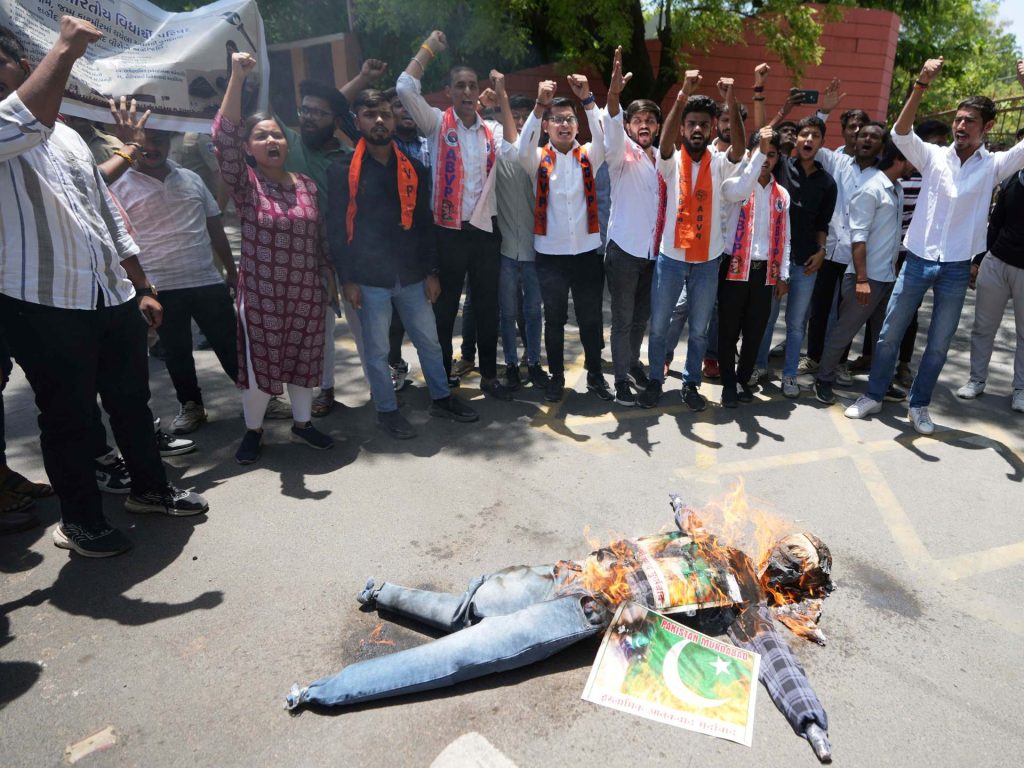
Mumbai, India – Less than 24 hours after news broke of the April 22 attack, in which gunmen killed 25 tourists and a local pony rider in the Indian-administered Kashmir region, a new song surfaced on Indian YouTube. Its message was unmistakable: We made a mistake by allowing you to stay on, You got your own country, why didn’t you leave then? They call us Hindus “kaffirs”, Their hearts are full of conspiracies against us. The song, titled “Pehle Dharam Pocha” (They Asked About Religion First) targeted Indian Muslims, insisted they were conspiring against Hindus and asked them to leave India. In less than a week, the song has garnered more than 140,000 views on YouTube. And it is not the only song. The killings in the picturesque resort town of Pahalgam marked the worst attack against tourists in Kashmir in a quarter of a century. But even as New Delhi hits back against Pakistan, which it accuses of links to the attack – a charge Islamabad denies – a wave of incendiary music tracks, crafted and circulated within hours, has set off an anti-Muslim backlash in India. Set to pulsing beats and catchy rhymes, these songs, part of a genre that has come to be known as Hindutva Pop, are calling for violent retribution for the attack. From songs that label Indian Muslims as “traitors” to songs that advocate their boycott, the country’s smartphones are buzzing. Hindutva is the Hindu majoritarian political ideology of Prime Minister Narendra Modi’s governing Bharatiya Janata Party (BJP) and its allies. Advertisement Al Jazeera found at least 20 songs that carried and amplified such Islamophobic themes at a time when Indians were anxiously scrolling through their digital feeds for more information on the aftermath of the attack. These songs have a chillingly consistent narrative: Since the attackers are believed to have singled out Hindu tourists, Indian Muslims can no longer be trusted – never mind that a Muslim Kashmiri pony rider who tried to stop the gunmen was also killed. Apart from these, a glut of other hyper-nationalist songs has also emerged in the past week, pushing warmongering rhetoric deeper into Indian digital veins. There are songs that call for Pakistan to be nuked or for the Indian government to “wipe Pakistan off the map”, and others that advocate for “Pakistani blood” in exchange for the deaths, These songs have become a part of a broader digital push by Hindutva groups, who are using social media and encrypted platforms like WhatsApp to stoke fear, hatred, and division among Indians – all at a time when tensions with neighbouring Pakistan are ratcheting up. This campaign is mirroring real-world violence, across multiple Indian states. In Uttar Pradesh, Haryana, Maharashtra and Uttarakhand, Muslims have faced brutal attacks and threats. Kashmiri Muslims have been evicted from their homes, street vendors assaulted, and in chilling acts of retribution, Muslim patients have been denied medical care by Hindu doctors. On Friday, a Muslim man was shot dead, with a Hindu supremacist in Agra, Uttar Pradesh, claiming responsibility for the shooting and saying it was retribution for the Pahalgam attack. Advertisement Concerted campaign All the 20 songs that Al Jazeera analysed saw a common theme being pushed: a reiteration of the assertion that tourists were killed for their Hindu identities, and therefore, Hindus across the country must now feel threatened in living around Muslims. Multiple witness and survivor accounts of the Pahalgam attack suggest that the gunmen asked the tourists to recite the Kalimas (sacred Islamic verses) and the men who could not do so were shot. The song Pehle Dharm Poocha (They Asked About Religion First) was released on April 23, the day after the attack. Singer Kavi Singh insists that letting Muslims stay on in India after the country’s partition in 1947 was “a mistake”, and asks them to go to Pakistan. Another song, Ab Ek Nahi Huye Toh Kat Jaaoge (If You Don’t Unite Now You Will be Slaughtered), by singer Chandan Deewana, is addressed entirely to Hindus, asking them to rise up and “save our religion”. The song insists that Hindus, not Indians, are under threat and warns that they will be “slaughtered” if they do not unite. It has garnered more than 60,000 views on YouTube in just two days. Jaago Hindu Jaago (Wake Up, Hindus) is a song that asks Hindus to identify “traitors within the country”, a coded reference to Muslims. The song’s video on YouTube contains an AI-re-enactment of the Pahalgam attack and has more than 128,000 views so far. Another song, Modi Ji Ab Maha Yudh Ho Jaane Do (Modi ji, Let The Great War Begin), refers to Muslims as “snakes” living in India. Another song calls the events in the country a “religious war”, and yet another asks for Hindus in India to be allowed to carry arms. Advertisement These songs provide a background score for social media posts that bear similar themes. From AI-generated videos and memes recreating the attack to Ghibli images, social media timelines have seen a flood of content emerging from the attack. Much of it carries similar undertones: to paint the attack as an assault on Hindus and the Hindu religion, while exhorting Hindus to “unite” against the threat of Muslims. Some posts liken the Pahalgam killings to the October 7, 2023, attacks on Israel by Hamas and other Palestinian armed groups, and exhort the Indian government to “take revenge the Israel way”. Israel launched a war on the Gaza Strip that has, since October 2023, killed more than 52,000 Palestinians and wounded more than 117,000 others. Raqib Hameed Naik, the executive director of the Washington, DC-based Center for the Study of Organized Hate (CSOH), which tracks hate speech in India, said the centre has observed “a sharp spike” in anti-Muslim rhetoric on social media since the Kashmir attack. “The [Muslim] community is frequently portrayed as an existential threat through memes, AI-generated images, videos and misinformation, systematically designed to inflame passions and justify exclusionary rhetoric,” Naik said.