

Kamala Harris departs from Biden capital gains tax plan to widen her reach
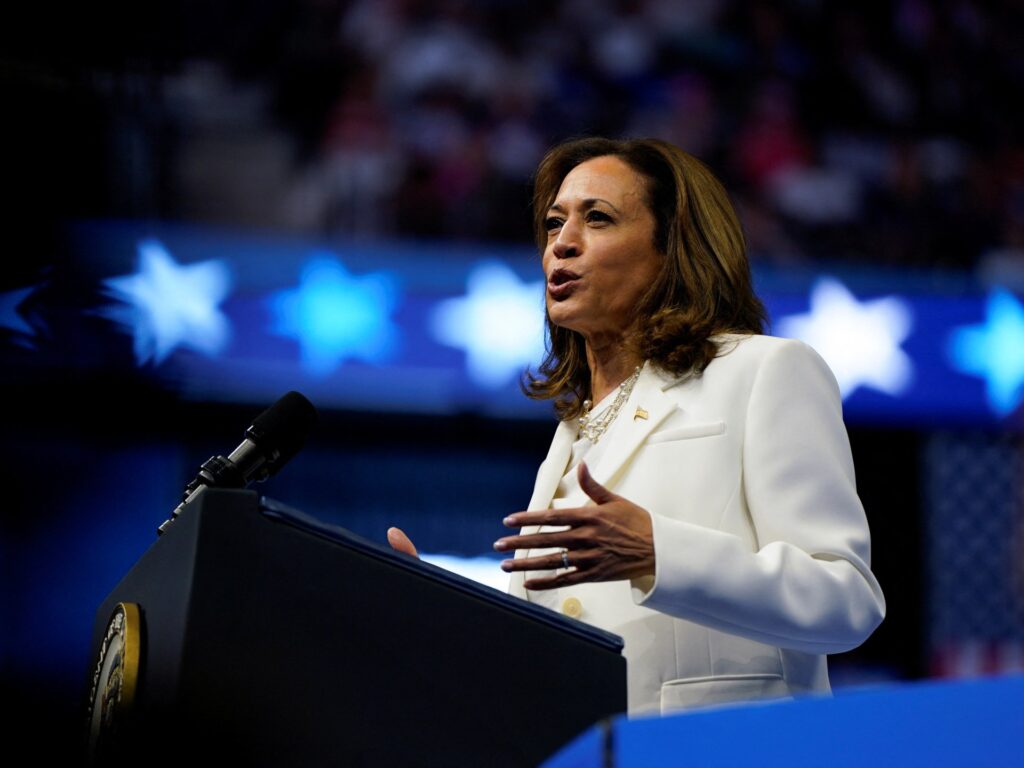
Harris’s proposal for a lower tax rate than the one laid out by Biden suggests she wants to appeal to a broader base of voters. Democratic presidential candidate Kamala Harris has proposed raising the capital gains tax rate for those earning $1m or more to 28 percent, instead of the 39.6 percent rate proposed by President Joe Biden in his fiscal 2025 budget. On Wednesday, Vice President Harris also told cheering supporters at a brewery in North Hampton, New Hampshire, about 10 miles south of Portsmouth, that she would push for a $50,000 tax deduction for new small businesses, 10 times the current tax break. “As president, one of my highest priorities will be to strengthen America’s small businesses,” Harris said, noting that small businesses employ half of all private sector workers in the United States. Harris said lowering the cost of starting a new business – estimated at $40,000 on average – would help the US reach her “very ambitious” goal of having 25 million new small business applications filed by the end of her first term. A record 5.5 million new business applications were filed in 2023, according to the Small Business Administration. Harris’s proposal for a lower top tax rate on capital gains suggests she wants to appeal to a broader base of voters even as she sticks with most of Biden’s plans to strengthen the middle class. Harris became the Democratic nominee after Biden stepped aside on July 21. In his fiscal 2025 budget, Biden had proposed raising the tax rate on long-term capital gains – the profits made from selling or trading an asset held for more than a year – to 39.6 percent for those earning more than $1m annually, from the current rates, which range up to 20 percent, depending on income. Harris said she also plans to offer low- and no-interest loans to small businesses, cut the red tape they face and expand access to venture capital. She said she supported a minimum tax for billionaires proposed by Biden, adding, “It is not right that those who can afford it are often paying a lower tax rate than our teachers and our nurses and our firefighters,” she said. Lead over Trump Harris took aim at her Republican rival, former President Donald Trump, saying his plans would cut off federal programmes that offer loans to small businesses, cut the corporate tax rate and push the US deficit higher. Recent polls show Harris with a four to six percentage point lead in New Hampshire over Trump ahead of the November 5 election. Harris spoke at the woman-owned Throwback Brewery, joined by the state’s two female US senators, other elected officials and a leader of a “Republicans for Harris” group in New Hampshire, where 330,000 registered independents outnumber the 258,000 registered Democrats and 301,000 registered Republicans. New Hampshire has backed a Democratic candidate in every presidential election since 1992, except for former President George W Bush’s 2000 win. Trump spokesperson Karoline Leavitt denied a news report that Republicans had given up on the state and said Trump’s campaign had an on-the-ground presence, office and staff there. Adblock test (Why?)
How Venezuela’s recent history can inform its present-day election crisis

Already, the toll of the current political unrest has been high. Since the July election, at least 23 people have died in Venezuela’s protests, according to Victim Monitor, a human rights group. Foro Penal, meanwhile, has documented 1,581 arrests. Some critics have speculated that, if Maduro continues to lose popular support, the Venezuelan military could turn on him. Even the opposition’s presidential candidate, Edmundo Gonzalez Urrutia, urged the country’s security forces to “fulfil their constitutional duties” and not “repress the people”. Straka, the historian, pointed out that the Venezuelan military has turned its back on leaders in the past, most notably in the case of the dictator Perez Jimenez. That the military played a role in his downfall took “everyone by surprise”, Straka explained. “The armed forces — Perez Jimenez’s main support — were divided.” But that outcome is less likely in Maduro’s case, according to Gunson, the Venezuela expert at the International Crisis Group. He indicated that some military leaders could face prosecution without Maduro’s protection. “If the military were to desert Maduro, his government would fall,” Gunson told Al Jazeera. “But the high command is unlikely to do that in the near future at least because it would threaten their own personal positions.” In recent weeks, the military even reaffirmed its support for Maduro amid the election crisis. On August 25, the Bolivarian Armed Forces (FANB) pledged their “absolute loyalty and subordination to the commander-in-chief of the FANB, President Nicolas Maduro”. Still, Gunson believes the military might not be as unified as it appears. “There is no reason to believe that members of the security forces voted any differently from the rest of the population,” Gunson said, pointing to the widespread support for Venezuela’s opposition coalition. “There are plenty of anecdotes to support the thesis that many members of the National Guard and the police sympathise with demonstrators,” he added. “In recent years, thousands of members of the armed forces have deserted, and many have left the country.” The strength of the opposition has given Tenreiro — the woman who witnessed the fall of Perez Jimenez over 60 years ago — a measure of hope. She said she wishes to see another authoritarian leader topple in her lifetime. “I don’t want to leave this world before seeing the start of change [in Venezuela] once again.” Adblock test (Why?)
Israeli forces using ‘war-like’ tactics in occupied West Bank: OCHA

UN’s humanitarian agency says dozens of people have been killed over the past week in Israeli attacks including air strikes. Israeli forces are using “lethal war-like tactics” in the occupied West Bank, according to the UN’s humanitarian agency. The Office for the Coordination of Humanitarian Affairs (OCHA) said in a statement on Wednesday that Israeli attacks have killed more than two dozen people over the past week or so, including children. The continuing raids, mostly concentrated on the Tulkarem and Jenin refugee camps, constitute Israel’s largest assault on the occupied territory since the second Intifada in the early 2000s. The raids have seen significant violence and numerous arrests, while roads and other infrastructure have been destroyed by Israeli military bulldozers. OCHA said it had mobilised organisations from the UN and beyond to assess the damage and humanitarian needs on the ground. Visiting Tulkarem on Saturday, the teams confirmed the displacement of 120 people, including more than 40 children, whose homes were destroyed, the statement said. “At the time of the assessment, 13,000 people in Nur Shams refugee camp experienced water cut-offs, attributed to damages caused to the water network, and sewage overflow was observed. The teams also noted that the population was traumatized and in need of psychosocial support,” OCHA said. A similar assessment team was denied access to Jenin by the Israeli authorities on Wednesday. “OCHA warns that access impediments are impacting the ability to provide meaningful humanitarian response. The movement of ambulances and medical teams has been impeded and delayed since the onset of the now-week-long operation. Humanitarian access must always be facilitated,” the statement said. Israeli military’s latest assault in Jenin is in its eighth day, and the third day in Tulkarem, where Israeli forces are inflicting “widespread destruction”, according to the Wafa news agency. Citing its correspondents on the ground, the agency said Israeli forces dropped bombs on the refugee camp, sparking fires in al-Shamaliya neighbourhood. Israeli snipers were stationed on tall buildings, while spy drones flew and bulldozers damaged infrastructure, with “no street or alley left without destruction”, Wafa reported. A siege of al-Israa and Thabet school was also continuing, it added. Al Jazeera’s team on the ground also reported an ongoing Israeli raid in the Jalazone refugee camp, north of Ramallah. Sources said that dozens of Palestinians have been detained and questioned in local community centres. At least 20 Palestinians have also been rounded up from Beit Surik. Most returned after they were interrogated. Other raids were reported in Qalqilya, Nablus with a focus on Balata and Askar refugee camps, as well as al-Khader town south of Bethlehem and al-Azza refugee camp north of the city. Israeli security forces have besieged Hebron for a fourth day running and more checkpoints and gates have been erected. Adblock test (Why?)
All deaths ‘avoidable’, finds UK inquiry into Grenfell Tower fire

DEVELOPING STORYDEVELOPING STORY, The 72 deaths in the Grenfell Tower fire in London in 2017 were all “avoidable” a report into the tragedy has concluded. Delivered on Wednesday following a six-year inquiry, the final report highlights decades of failure of the United Kingdom government, indifference to safety by authorities, dishonest and incompetent manufacturers and installers of building materials, and a lack of strategy by firefighters were the main contributors to the shocking death toll. Those in the 24-storey block were “badly failed” over many years, said the inquiry chairman, Martin Moore-Bick. He added that the inquiry took longer than hoped due to its broad scope and because “many more matters of concern” had been discovered than originally expected. The long-awaited report says the elements identified contributed to varying degrees. This was largely due to incompetence, the chairman said, but in some cases due to “dishonesty and greed”. The lapses and mistakes detailed in the report could trigger criminal charges, although police have said charges will not be filed before 2026. This is a developing story. More to come… Adblock test (Why?)
Why are hundreds of thousands of people protesting across Israel?

Israel is being rocked by mass protests as popular pressure mounts on Prime Minister Benjamin Netanyahu and his coalition cabinet to secure a ceasefire deal in Gaza that would see the 90 or so remaining captives thought to remain in Gaza brought home. A general strike, called by the powerful Histadrut union, had to be halted after the government petitioned for an injunction against the action, deeming it “political”. Hundreds of thousands of Israelis have packed streets across the country in the largest demonstrations since the war on Gaza began, calling for the government to strike a deal. Are these the first mass protests under the current government? Not at all. From January 2023 to the Hamas-led attack of October 7 during which 1,139 people were killed and some 240 taken captive, there were widespread demonstrations against Netanyahu’s judicial changes proposal. The proposal, if passed, would have increased his government’s power over the judiciary and, critics said, helped Netanyahu avoid corruption charges. (Al Jazeera) Despite popular opposition, in July Netanyahu’s government succeeded in passing a key reform limiting the Supreme Court’s power to overrule government decisions based on “reasonableness”. Protests by the families of those taken on October 7 have also roiled domestic Israeli politics since the outbreak of the war on Gaza with a consistent campaign to pressure the Israeli government. Are these the same protesters who were against Netanyahu before the war? In the main, yes, but there are many more. “Sure, many of the current demonstrators are the same that turned out to protest against the judicial reforms. However, there are many more this time, and they’re from a much wider group,” Israeli pollster and a former aide to several senior political figures, Mitchell Barak, told Al Jazeera from Jerusalem. “Young people are also demonstrating, because many of those taken on October 7th [from the Nova music festival or the young soldiers taken that day] were around the same age, and the responsibility for defending the country falls on their shoulders,” he said. [embedded content] What prompted these demonstrations? Grief and frustration. Many protesters suspect that Netanyahu and members of his cabinet are deliberately stalling a deal. Frustration over delays reached a tipping point on Saturday when Israeli forces operating in Gaza discovered the bodies of six captives. So far, Israel has killed more than 40,000 Palestinians and levelled much of Gaza during 11 months of war. In November of last year, negotiators succeeded in securing a temporary ceasefire for seven days, giving hope to many of the families now demonstrating. That ceasefire saw the release of 105 Israeli captives by Hamas, in return for 210 Palestinian prisoners, mainly women and children, being held by Israeli forces. (Al Jazeera) Do Palestinians feature in the demonstrators’ demands? Not really. Most of the protests are focused exclusively on having the captives returned. “The issue of returning the hostages is centre stage,” Israeli analyst Nimrod Flaschenberg said. “An understanding that a deal would also mean an end to the conflict is there, but rarely stated,” he continued, adding that while a few voices among the demonstrators were calling for an end to the conflict, “as far as the protests’ leadership goes, no, it’s all about the hostages.” Are all Israelis on the same side in this? No. The numbers protesting are enormous but while demonstrators are passionate about their cause, so, too, are Netanyahu’s supporters. Netanyahu has tried to focus on his pledge that Hamas, which appeared to admit to killing the six captives, would pay a “heavy price”, rather than acknowledge accusations of stalling on a deal. (Al Jazeera) Supporting him are the right wing and Zionist nationalists, represented in the coalition cabinet by the finance and national security ministers, Bezalel Smotrich and Itamar Ben-Gvir. Smotrich opposed the general strike, claiming it helped “the interests of Hamas” and petitioned the attorney general to halt the strike action. Ben-Gvir was also critical of the protesters. Addressing a counterprotest in Jerusalem, by the families of Israeli soldiers killed in active service, he said: “We’re using our power in the government to prevent a reckless deal. “With Hamas you need to speak only between gunsights,” he added. Have the protesters been treated fairly? Alon-Lee Green, president of the group Standing Together, said the police used a “tough hand” with the demonstrators. Members of Standing Together were protesting in Jerusalem, he said, adding: “They arrested around 20 people at last night’s protest, which included many of our members. “It’s Ben-Gvir, pure and simple,” he said. “He doesn’t influence the police any more. Since he was able to appoint his own police chief in August, he controls the police.” [embedded content] Adblock test (Why?)
Why is the UK government limiting some of its arms exports to Israel?

Israel’s Prime Minister Benjamin Netanyahu has attacked a move by its key ally. The United Kingdom’s government says it will stop some of its arms exports to Israel, fearing the use of certain weapons could break international law. Israel’s prime minister called the move “shameful” and said it will help Hamas, the Palestinian group that governs Gaza. But what are the implications of this decision? Presenter: Folly Bah Thibault Guests: Jeremy Corbyn – an independent member of the UK Parliament Francesca Albanese – UN special rapporteur for the occupied Palestinian territories Sam Perlo-Freeman – Research coordinator at the Campaign Against Arms Trade, a UK-based organisation working to end the international arms trade Adblock test (Why?)
Journalist presses State Department for answers on arms sales to Israel

NewsFeed A journalist pressed US State Department spokesperson Matthew Miller on the UK’s decision to suspend some arms sales to Israel, asking how the US has not reached similar conclusions about possible violations of international law. Published On 3 Sep 20243 Sep 2024 Adblock test (Why?)
Why South Africans and Nigerians are fighting online

NewsFeed You may have seen the scandal over South African student Chidimma Adetshina being crowned Miss Nigeria. But did you know rivalry between the two countries has flared as people seek ways to get back at each other? Here’s how a beauty queen, a taxi prank, and xenophobia are all connected. Published On 3 Sep 20243 Sep 2024 Adblock test (Why?)
Former Volkswagen boss faces trial for ‘Dieselgate’ role

Martin Winterkorn in court nine years after German auto giant admitted rigging emissions tests. After several delays, the criminal trial of former Volkswagen CEO Martin Winterkorn for his role in the “dieselgate” scandal has opened in Germany. The trial began on Tuesday, nine years after the German auto giant admitted to cheating emissions tests, triggering global chaos in the industry. Winterkorn, accused of conspiracy to commit fraud, faces up to 10 years in jail. Volkswagen said in 2015 that it had installed software to rig emissions levels readings worldwide. The case against the former CEO relates to about nine million vehicles sold in Europe and the United States, whose buyers faced financial losses running into hundreds of millions of euros, the regional court in Braunschweig city said. Winterkorn resigned as head of the VW group – whose brands range from Porsche and Audi to Skoda and Seat – shortly after the crisis began. The 77-year-old was supposed to stand trial in 2021 alongside four other VW executives, but proceedings against him were split off and postponed due to his poor health. However, the court in Braunschweig announced earlier this year that proceedings against him would finally get under way this month. Since then, there have been renewed concerns about his health, with reports saying he had to undergo an operation in mid-June, and there are now new questions about whether he will be able to endure the long-running trial. About 89 hearings have been scheduled through September 2025. False testimony, market manipulation Winterkorn has also been accused of giving false testimony to a German parliamentary committee in 2017 when it was investigating the scandal. He said he knew of the existence of the defeat devices only in September 2015 but prosecutors claim it was earlier. Winterkorn further faces a charge of market manipulation. He is alleged to have “deliberately failed to inform the capital market in good time” after finding out about the emissions-rigging software in violation of German stock market regulations. Winterkorn already agreed to a settlement with Volkswagen in 2021, under which he would pay the company 11 million euros ($12m) in relation to the controversy. In advance of the trial, Volkswagen noted it was not a party to the proceedings, although it said it would monitor them. The highest-ranking former executive to have been convicted so far in the scandal is former Audi CEO, Rupert Stadler. In June last year, he received a suspended sentence and a fine as part of a deal in exchange for admitting to fraud by negligence. The fraud has already cost VW about 30 billion euros ($33bn) in fines, legal costs and compensation to car owners, mainly in the US. Adblock test (Why?)
Ugandan Olympian hospitalised after being set on fire

Rebecca Cheptegie, who ran in last month’s Olympic marathon, has burns covering 75 percent of her body after a brutal attack by her boyfriend, police allege. A Ugandan Olympic runner has been hospitalised in Kenya after being set on fire by her partner, according to police. Rebecca Cheptegie, who competed last month in the Paris Olympic Games, suffered burns to three-quarters of her body when her partner poured petrol on her and set her ablaze, police reported late on Monday. The attack took place on Sunday afternoon at Cheptegie’s home in Kenya’s western Trans Nzoia County. The 33-year-old athlete is now in critical condition in a hospital in Eldoret, Kenya. Her Kenyan partner and alleged assailant, Dickson Ndiema Marangach, was also injured by the flames, according to police, who said he broke into Cheptegie’s home while she was at church. Cheptegie’s parents, who are reportedly on their way to see her from Uganda, said their daughter bought a home and land in the area to take advantage of its training facilities. Cheptegie, who placed 44th in the women’s marathon at the 2024 Olympics, is not the first high-profile athlete to make headlines as the victim of domestic assault in Kenya. In 2021, record-breaking Kenyan runner Agnes Tirop was found stabbed to death in her home. Tirop’s estranged husband Emmanuel Ibrahim Rotich, who denies involvement, is now being tried for her murder. Tirop’s family and fellow Kenyan athletes launched a foundation in her honour to combat gender-based violence – Tirop’s Angels – which recently opened a centre in Kenya’s western town of Iten. Adblock test (Why?)