

Bangladesh minister on government’s response to deadly anti-quota protests

Bangladesh Information Minister Mohammad Arafat talks to Al Jazeera about deadly anti-quota protests and unrest. Bangladesh has recently seen some of its worst violence in decades – violence sparked by student protests against a government-job quota system that demonstrators say favoured supporters of the ruling Awami League party. The Country’s Supreme Court has now scrapped the quota. Still, with dozens killed and hundreds arrested, serious questions remain over the government’s handling of the crisis, with students demanding meaningful change in a country where they believe democratic values are at risk. Join us over the next half an hour as Mohammad Arafat, Bangladesh’s minister of state for information and broadcasting, talks to Al Jazeera. Adblock test (Why?)
Protesters recreate mini-Gaza scene in Berlin to highlight suffering
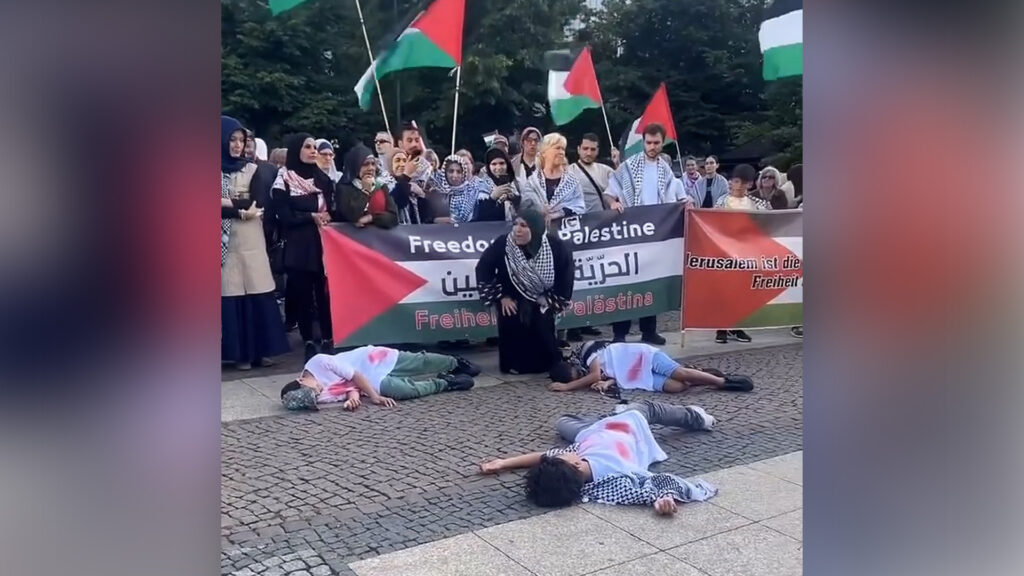
NewsFeed Pro-Palestine protesters in Berlin staged a mini-Gaza scene, acting as victims of an Israeli attack to highlight the suffering Palestinians face in the war. Published On 25 Jul 202425 Jul 2024 Adblock test (Why?)
Bangladesh minister defends gov’t response to protests amid calls for probe
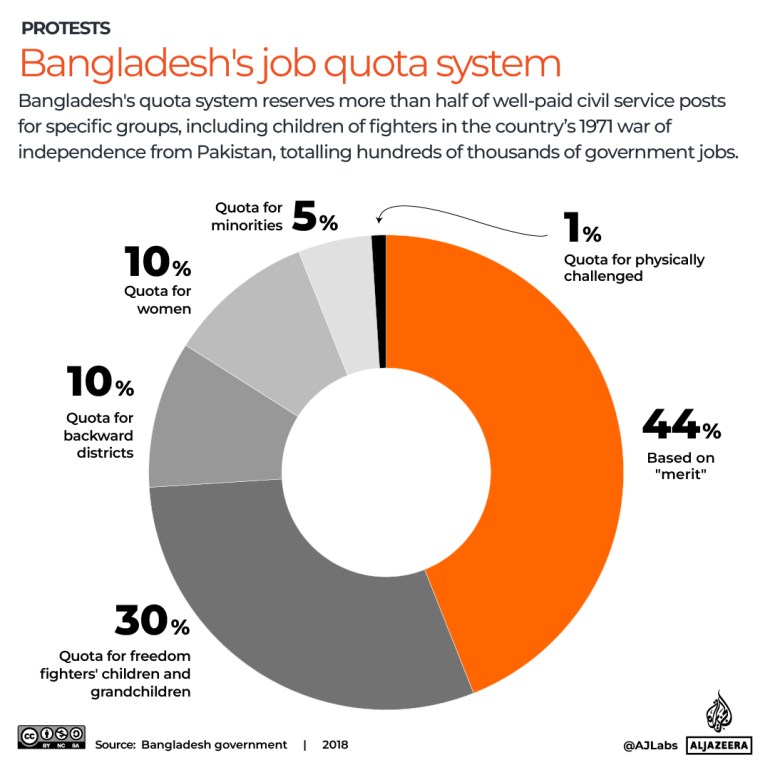
Bangladesh’s minister of state for information and broadcasting has defended the government’s handling of mass protests, as United Nations experts called for an independent investigation into the government’s deadly crackdown on demonstrators. In an exclusive interview with Al Jazeera on Thursday, Mohammad Arafat said the country’s security forces had done everything “to bring back the peace” amid the student protests. He accused “third-party” actors, including “extremists and terrorists”, of fuelling the unrest. “We’re not referring to the students [as] the terrorists and anarchists. It is the third party, those who intruded into this movement and started doing all this,” Arafat said on Talk to Al Jazeera. “We tried our best to de-escalate the tension,” he said, adding that “some people are trying to add fuel to the fire, are trying to create a situation where they can take advantage … and topple the government”. Thousands of Bangladeshi students took to the streets earlier this month to demand reforms to the South Asian country’s quota system, which allocates 30 percent of government jobs to the descendants of veterans who fought for Bangladesh in the 1971 war. More than 150 student protesters have been killed and thousands have been arrested in the crackdown on the demonstrations, according to local media, fuelling tensions across the nation of more than 170 million people. [Al Jazeera] The protests turned violent on July 15 after members of the Bangladesh Chhatra League (BCL) – the student wing of the country’s ruling party – allegedly attacked the protesters. Police then cracked down on the demonstrations and imposed a curfew. Students were asked to vacate universities, which were shut down; businesses were shuttered, and internet access was disrupted nationwide. The Bangladeshi government has come under international scrutiny for its handling of the protests. On Thursday, United Nations Human Rights Chief Volker Turk called for “an impartial, independent and transparent investigation into all alleged human rights violations” that occurred during the crackdown. “We understand that many people were subjected to violent attacks by groups reportedly affiliated with the Government, and no effort was made to protect them,” Turk said. In a separate statement, a group of UN experts also called for an independent probe into what they described as the government’s “violent crackdown on protesters”. “The government is blaming other people, others are blaming the government; we need a full impartial investigation,” one of the experts, Irene Khan, the UN special rapporteur on freedom of expression and opinion, told Al Jazeera. Bangladeshi military forces stand guard on a street in Dhaka, on July 20 [Rajib Dhar/AP Photo] “But since there is no trust in the government, it has to be done with the international community,” Khan said on Thursday. “We are calling on the government to invite the UN to conduct such an investigation to find out what went wrong, to take responsibility, and to hold the perpetrators to account.” Official death toll not yet determined: Minister In his interview with Talk to Al Jazeera, Arafat – the minister – denounced the protesters for storming the headquarters of state broadcaster Bangladesh Television (BTV) in the capital, Dhaka. He said policemen guarding the building were outnumbered, and “because they were not permitted to open fire … those miscreants went inside the BTV, literally invaded, and set fire and started vandalising and destroying all the assets”. Arafat said the government has yet to determine an official death toll from the unrest. “When it comes to the casualties, injuries, and deaths, we’re not willing to discriminate between the police and general people, or the protesters, or the people from the supporters of the government,” he said. The minister told Al Jazeera that an independent judicial committee would ensure a thorough investigation into what happened, “so that everyone responsible for any of these casualties can be brought to book.” Arafat also dismissed any calls for Prime Minister Sheikh Hasina to resign, adding she had only been “protecting the people”. An injured protester is rushed to hospital after a clash with police and Awami League supporters in the Rampura area of Dhaka on July 18 [Anik Rahman/Reuters] On Tuesday, protesters extended the suspension of their protests until Friday, but they were slated to meet on Thursday to discuss whether they would extend the pause further. Among their key demands is a stipulation that Hasina must publicly apologise for the killings of students. They have also called on Home Minister Asaduzzaman Khan, Road Transport and Bridges Minister Obaidul Quader, Education Minister Mohibul Hasan Chowdhury Nowfel, and Law Minister Anisul Haque to resign from the cabinet and the party. Adblock test (Why?)
What issues do Trump and Harris want to fight the election on?

US presidential candidates attack each other in first major speeches since Biden dropped out of race. Donald Trump attacks his likely opponent in the presidential election as a “radical left lunatic”. Kamala Harris points to Trump’s convictions and scandals, saying he offers voters “chaos, fear and hate”. What kind of campaign will it be? Presenter: Sami Zeidan Guests: Eric Ham – Political analyst and co-author of The GOP Civil War: Inside the Battle for the Soul of the Republican Party Thomas Gift – Director of the Centre on US Politics at University College London whose research focuses on comparative politics and the political economy Jennifer Victor – Associate professor of political science at the Schar School of Policy and Government at George Mason University Adblock test (Why?)
‘We try to find life from death’: The volunteer lifesavers of Jenin

Jenin, occupied West Bank, Palestine – On April 4 last year, Ahmad Nobane was trying to reach an injured person in the Jenin refugee camp to administer first aid. He had received messages on his mobile phone giving him the location of the victim and driven as far as he possibly could along the city’s narrow, destroyed streets. He had to get out and walk the final 300 metres (1,000ft) to reach the man lying on the ground. Then he felt the shot. Nobane, 22, had been hit by an Israeli sniper in the right side of his chest. Taking cover, he put pressure on the wound to stop the bleeding – as he had been trained to do for others. His colleagues were able to reach him and help him into an ambulance. But the vehicle was stopped by the Israeli military, and soldiers fired warning shots at the ambulance. When the ambulance was finally allowed to move, Nobane was taken to the Ibn Sina Specialized Hospital, the facility raided by undercover Israeli operatives who targeted and killed three Palestinians inside it in January. He stayed for two days. It took six months of follow-up treatment to recover. Nobane is one of 23 young men and women who have trained as voluntary first responders in Jenin, and that incident was a year and a half ago, before the war on Gaza began and Israeli forces stepped up violent raids on towns and cities in the occupied West Bank. These days, the experience of coming under fire is all in a night’s work. Ahmad Nobane, 22, is a university student and a paramedic volunteer of the Jenin refugee camp’s first responders [Mauricio Morales/Al Jazeera] Using tuk-tuks as makeshift ambulances Nobane was just a newborn when his father was killed during the second Intifada in 2002, fighting the Israeli forces who were attacking their refugee camp in Jenin. Two years ago, he decided to join the volunteers in the camp who are dedicated to trying to save lives by training as first responders. After he recovered from the gunshot wound, he resumed his work as a volunteer as best as he could. “We try to find life from death,” Nobani tells Al Jazeera. A first aid kit used by the paramedic volunteers in the Jenin camp [Mauricio Morales/Al Jazeera] These days in Jenin, it’s hard to know exactly how many people may need their assistance on any given night. About 24,000 people are registered as living in this camp. But the frequent raids by Israeli forces have stepped up since the war in Gaza began in October, destroying homes and forcing many to flee. Since then, Israeli soldiers and settlers have killed 536 Palestinians, including 131 children, in the West Bank and injured more than 5,500, including 800 children – more than one-third of them by live ammunition – according to the United Nations Office for the Coordination of Humanitarian Affairs (OCHA). In Jenin alone, at least 148 Palestinians have been killed, 320 wounded and 540 detained by Israeli forces since October 7, according to local journalist Ali Samoudi, one of those trying to keep count amid the chaos. A bandaging technique is demonstrated at the training centre for first responders in Jenin [Mauricio Morales/Al Jazeera] Our Palestine is making a desperate bid to keep those numbers down. The grassroots organisation was born inside the camp and is led by Nidal Naghnaghiye, 52, a community leader who has spent 17 years in Israeli prisons. It is the group responsible for organising the first aid volunteers. Working closely with the international organisation Doctors Without Borders, known by its French acronym MSF, the first responder volunteer team is headed up by Salah Mansour, 29, a lawyer. He is one of the 15 men and eight women who make up the group – all drawn from different professions and backgrounds and all now trained in first aid and ready to try to reach injured people wherever they might be. It’s important to keep the volunteers equipped and trained, Mansour says, because “we do not limit ourselves to working in the field. We also reach patients’ houses if needed.” “Many times, we have had to stay with a patient for more than two hours until security conditions improve to transport the patient.” One of the tuk-tuks operating as an emergency vehicle to transport patients in the camp [Mauricio Morales/Al Jazeera] Volunteers use MSF-supplied tuk-tuks as makeshift ambulances to transport the wounded, patients and first responders. They have one primary goal: Keep the patients alive for as long as it takes to reach a hospital, such as the Jenin Government Hospital, which is just metres from the Jenin camp but might as well be many kilometres away because of the time it takes to get through Israeli military roadblocks. In December, MSF reported that Israeli forces had shot dead an unarmed 17-year-old inside the hospital compound and were preventing ambulances from leaving it. Paramedics and ambulance drivers were stripped and forced to kneel on the ground, MSF said in a post on X. Ambulance workers, one with a bulletproof vest, wait at the entrance of the Khalil Suleimani Hospital, which is just metres from the refugee camp. But due to Israeli military checkpoints, transport of the injured by first responders is delayed [Mauricio Morales/Al Jazeera] With these sorts of obstacles, it’s all a case of making do inside the Jenin camp. The first aid volunteers work from a large hall that was once used by a civil society organisation but now serves as a training centre where the volunteers receive instruction from MSF on how to stem bleeding, safely move and lift victims and a host of other life-saving techniques. At the moment, all the training centre contains are a few bandages and some other medical supplies while volunteer tradesmen work in the corners carrying out routine repairs. At the moment, the training centre has only a few medical supplies [Mauricio Morales/Al Jazeera] ‘You are
Palestinian teen describes Israeli strike on friends playing in street

NewsFeed Palestinian teenager Radwan al-Baghdadi says he feels alone after an Israeli air strike in Gaza killed his cousin and several of his friends while they played. Published On 25 Jul 202425 Jul 2024 Adblock test (Why?)
Netanyahu’s claims before the US Congress: Facts or falsehoods?

Israeli Prime Minister Benjamin Netanyahu has addressed a joint session of the United States Congress as his country conducts a war on Gaza in which more than 39,000 Palestinians have been killed. Netanyahu on Wednesday presented a defence of Israel’s war, launched on October 7, the day Hamas and other Palestinian armed groups carried out attacks on Israeli territory in which 1,139 people were killed. The prime minister spoke of a plan for what he termed a “de-radicalised post-war Gaza” but offered few details beyond the assertion that Israel would retain security control over the strip. Outside Congress, meanwhile, protesters called for him to be prosecuted for alleged war crimes as families of some Israeli captives held in Gaza were evicted from the building for demanding answers from the Israeli premier. So what were the key claims Netanyahu made in his speech, and how true were they? Al Jazeera fact-checks the prime minister’s address: On Rafah attacks Netanyahu: “Remember what so many people said? If Israel goes into Rafah, there’ll be thousands, maybe even tens of thousands of civilians killed. Well, last week, I went into Rafah. I visited our troops as they finished fighting Hamas’s remaining terrorist battalions. I asked the commander there, “How many terrorists did you take out in Rafah?” He gave me an exact number: 1,203. I asked him, “How many civilians were killed?” He said, “Prime minister, practically none. With the exception of a single incident, where shrapnel from a bomb hit a Hamas weapons depot and unintentionally killed two dozen people, the answer is practically none.” The facts: At least 45 people, including children, were killed in just one attack when Israel fired missiles at a camp housing displaced Palestinians in the southern Gaza city in late May. As horrific scenes from the massacre emerged, drawing worldwide condemnation, the United Nations said Rafah was like “hell on Earth”. By then, a majority of Gaza’s 2.3 million people were crammed into the city and its neighbouring areas after fleeing other parts of the enclave because of the war and Israel’s orders to evacuate. From May 6 to Wednesday, Israel has killed more than 4,300 people in the strip while repeatedly targeting schools and Israeli-designated “safe zones”. Israel also killed dozens, if not hundreds, of people in Rafah in rocket attacks before its forces entered the city. And while Netanyahu said the Israeli military had killed 1,203 Palestinian fighters, there has been no independent verification of the assertion that those described as “terrorists” were indeed individuals belonging to armed groups. An Israeli offensive in #Rafah would mean more civilian suffering & deaths. The consequences would be devastating for 1.4 million people@UNRWA is not evacuating: the Agency will maintain a presence in Rafah as long as possible & will continue providing lifesaving aid to people pic.twitter.com/8anQ8Eq6Gv — UNRWA (@UNRWA) May 6, 2024 On aid trucks to Gaza Netanyahu: “Israel has enabled more than 40,000 aid trucks to enter Gaza. That’s half a million tonnes of food. And that’s more than 3,000 calories for every man, woman and child in Gaza. If there are Palestinians in Gaza who aren’t getting enough food, it’s not because Israel is blocking it. It’s because Hamas is stealing it.” The facts: At the beginning of the war, Israel implemented a full blockade of the already besieged Gaza, which included a ban on food, water, medicines and other essential supplies. While this was somewhat eased later under global pressure, the facts on the ground – as reported by the UN, Al Jazeera’s own coverage and other independent organisations – are far removed from the picture painted by Netanyahu. Before the war started, Gaza received an average of 500 aid trucks per day. Since the war started, the UN has recorded a total of 30,630 aid trucks — not 40,000 as Netanyahu said. That averages out to 104 trucks per day, only a fifth of the pre-war amount. And contrary to the Israeli prime minister’s claim that there was enough food for the people of Gaza, UN experts in July declared that famine had spread throughout Gaza. On anti-Israel protests Netanyahu: “We recently learned from the US director of national intelligence that Iran is funding and promoting anti-Israel protests in America. They want to disrupt America.” “For all we know, Iran is funding the anti-Israel protests that are going on right now outside this building – not that many, but they’re there – and throughout the city. Well, I have a message for these protesters: When the tyrants of Tehran, who hang gays from cranes and murder women for not covering their hair, are praising, promoting and funding you, you have officially become Iran’s useful idiots.” The facts: Netanyahu did not provide any evidence that Iran is funding protesters. On July 10, Avril Haines, the US director of national intelligence, did say that Iran’s government was secretly encouraging American protests in an bid to spark outrage before US elections in November. “Iran is becoming increasingly aggressive in its efforts to influence foreign affairs, aiming to sow discord and undermine confidence in our democratic institutions,” Haines said. But Haines did not mention funding. Antiwar protests erupted on college campuses across the US and around the world in April. Tensions escalated when New York police made mass arrests during protests at Columbia University. On targeting civilians Netanyahu: “The ICC [International Criminal Court] prosecutor accuses Israel of deliberately targeting civilians. What in God’s green earth is he talking about? The [Israeli military] has dropped millions of flyers, sent millions of text messages, made hundreds of thousands of phone calls to get Palestinian civilians out of harm’s way. But at the same time, Hamas does everything in its power to put Palestinian civilians in harm’s way. They fire rockets from schools, from hospitals, from mosques.” The facts: As of Monday, the Israeli military had marked 83 percent of the Gaza Strip as unsafe for Palestinian civilians. This portion of the enclave has either been declared a “no-go
UK police officer filmed kicking man in the face

NewsFeed UK police say they are investigating a video of an officer kicking and stamping on a man’s head while he was laying on the ground at Manchester Airport. Published On 24 Jul 202424 Jul 2024 Adblock test (Why?)
Palestinian weightlifter loses place at Olympics because of Gaza war

NewsFeed A Palestinian weightlifting champion lost his place at the Paris Olympics 2024 because of Israel’s war on Gaza. Published On 24 Jul 202424 Jul 2024 Adblock test (Why?)
As US Congress cheered for Netanyahu, protesters gathered to denounce him

Washington, DC – Hours before Israeli Prime Minister Benjamin Netanyahu arrived at the United States Capitol to deliver a speech to Congress, a woman with a blue scarf concealing her face sat alone on a park bench and waved a Palestinian flag near Union Station in Washington, DC. “We will fight for freedom wherever it’s being denied all over the world. We connect with the Palestinians because we are freedom fighters here in America,” the lone protester, who asked to remain anonymous, told Al Jazeera on Wednesday. She was one of the thousands of protesters who would ultimately gather across the capital city to demonstrate against the Israeli prime minister’s speech. As US legislators clapped for Netanyahu inside the domed edifice, activists outside called for him to be tried for abuses linked to Israel’s war in Gaza. Many argued that Netanyahu is a war criminal who belongs in jail, not in the halls of Congress. The demonstrators held effigies of a blood-stained Netanyahu, waved Palestinian flags and chanted “free Palestine” as the Israeli prime minister spoke. Top Republican and Democratic legislators in both the Senate and House of Representatives invited Netanyahu to speak before the joint session of Congress. But despite the bipartisan show of support, dozens of lawmakers boycotted the address on Wednesday, echoing concerns voiced by the demonstrators. Irene Ippolito, a protester draped in a red keffiyeh, described the congressional leadership as a “bunch of sycophants” for bringing Netanyahu to Congress. “We need to be out here. We need to say, ‘Not in our name’,” Ippolito told Al Jazeera. “As American citizens, we have to realise that this could not be taking place without our taxpayer dollars sending tonnes of weapons to Israel as it slaughters men, women and children in Gaza.” She added that the atrocities in Gaza are the “most documented genocide in human history”. Security measures Protesters like Ippolito braved searing summer heat, blocked roads and a heavy police presence as they descended on the site of the demonstration, just west of the Capitol. Some even arrived from across the country. As the protest continued, organisers led a march east through the Capitol Hill neighbourhood. Law enforcement agents had cordoned off the Capitol with a metal fence earlier this week. But on Wednesday morning, they enlarged the security perimeter, turning away vehicles and pedestrians that approached the building. Clusters of heavily armed officers and security agents in riot gear could be seen all around the area. Capitol Police said they deployed pepper spray towards activists who had “become violent” without providing further details. Al Jazeera did witness exchanges of harsh words between officers and demonstrators, but no clashes or physical violence. Adam Abusalah, an Arab American activist from Dearborn, Michigan, said it is a “shame” that Netanyahu was invited to speak to Congress. “It’s a disgrace that members from both parties have invited him to speak here. It’s a disgrace that Kamala Harris, the presumptive nominee of the Democratic Party, will meet with him,” Abusalah told Al Jazeera at an anti-Netanyahu protest near the Capitol. “We are here to say enough is enough. As Americans, we will not stand for that.” Protesters march through the Capitol Hill neighbourhood in Washington, DC, July 24, 2024 [Ali Harb/Al Jazeera] Harris — who, as vice president, has the ceremonial role of presiding over the Senate — was at an event in Indianapolis and did not attend Netanyahu’s address at the Capitol. But she is set to meet with him later this week. The vice president is now the likely nominee of the Democratic Party after President Joe Biden dropped out of the race. The Biden administration has authorised more than $14bn in military aid to Israel to help fund the war effort while offering the US ally diplomatic cover at international forums. ‘He has no right to be here’ Some of the protesters’ anger on Wednesday was directed at the US president. “Biden, Biden you can’t hide. We charge you with genocide,” they chanted. Karim, a Palestinian American protester who wished to be identified by his first name only, said he would not support Harris for the presidency after she had served as Biden’s vice president. Instead, he said he would vote for Green Party candidate Jill Stein, who spoke at the demonstration. Karim arrived in Washington, DC, on a bus with dozens of demonstrators on Wednesday, and he expressed bewilderment that Netanyahu was invited to speak at the Capitol. “He has no right to be here,” he told Al Jazeera. “We don’t support criminals of war. We don’t support genocidal maniacs.” In his remarks to US lawmakers, Netanyahu defended the Israeli war, which has killed more than 39,000 Palestinians, displaced more than 80 percent of Gaza’s population and brought the territory to the verge of famine. He also pledged to fight until “total victory” despite US-led efforts to secure a ceasefire deal. The Israeli prime minister hit out at antiwar protesters in the US, accusing them of siding with Hamas. “These protesters that stand with them, they should be ashamed of themselves,” Netanyahu said. He also called the protesters outside the Capitol “Iran’s useful idiots”, earning a standing ovation from US legislators. Protesters hold a bloodied effigy of Netanyahu blocks away from the US Capitol on July 24 [Ali Harb/Al Jazeera] ‘Hitler number two’ On the streets of Washington, DC, the demonstrators had nothing but contempt for the Israeli leader. Several posters compared him to Nazi leader Adolf Hitler. Protester Sarah Bowls said the top legislators who invited Netanyahu to the US Capitol should be “ashamed” of themselves. “We should be boycotting him. He should be arrested. He should be at The Hague,” she said, referring to the Dutch city where the International Criminal Court (ICC) is based. ICC prosecutors are seeking arrest warrants for Netanyahu and his Defense Minister Yoav Gallant for alleged war crimes in Gaza. Bowls added that she is “sick” of her government continuing to fund and enable “genocide” against Palestinians. Jenny Bennett, who