

EU agrees five billion euro boost for military aid to Ukraine

The move provides a welcome boost for Kyiv as support from its other major backer, the United States, wavers and its outgunned forces struggle to hold back Russia. European Union countries have agreed to provide five billion euros ($5.48bn) for military aid to Ukraine as part of a revamp of an EU-run assistance fund, handing Kyiv a timely boost as its forces struggle against Russia’s invasion. Ambassadors from the EU’s 27 member countries agreed to the overhaul of the European Peace Facility (EPF) fund at a meeting in Brussels on Wednesday after months of wrangling, with EU heavyweights France and Germany at the centre of much of the debate. “The message is clear: we will support Ukraine with whatever it takes to prevail,” EU foreign policy chief Josep Borrell posted on social media platform X after the decision. The fund operates as a giant cash-back scheme, giving EU members refunds for sending munitions to other countries. France, a strong promoter of European defence industries, had insisted on a strong “buy European” policy for arms eligible for refunds. Other countries argued that such a requirement would inhibit efforts to buy worldwide to get weapons to Ukraine quickly. Germany, by far Europe’s biggest bilateral donor of military aid to Ukraine, had demanded donations be taken into account in determining the size of countries’ financial contributions to the fund. Diplomats said compromise was eventually reached allowing flexibility on the “buy European” rules and taking into account part of the value of bilateral aid when calculating members’ financial contributions. “This is yet another powerful and timely demonstration of European unity and determination in achieving our common victory,” said Ukrainian Foreign Minister Dmytro Kuleba. “We look forward to the final decision being approved at the next EU Foreign Affairs Council meeting.” The final text said the scheme should give priority to the European defence industry while “exceptionally allowing for flexibility in cases where it cannot provide within a timeframe compatible with Ukrainian needs”. The compromise will allow the fund to help finance a Czech initiative to buy hundreds of thousands of desperately needed artillery shells from countries outside Europe, according to diplomats. The EPF has already been used to allocate some 6.1 billion euros ($6.7bn) to military aid for Ukraine, according to the EU. Borrell proposed creating a new cash pot last year specifically for aid to Kyiv – the Ukraine Assistance Fund – inside the EPF, with a budget of up to five billion euros per year for the next four years. That prompted a prolonged debate about rules for future aid, eventually leading to Wednesday’s agreement. The compromise included measures to satisfy Hungary, which has previously blocked payouts from the EPF and said it does not want its contributions to finance arms for Ukraine. Under the deal, its contributions will be used to fund military aid to other countries, according to EU officials. “Ukraine needs more arms and equipment, we will provide them in sufficient quantities and in a coordinated manner,” said Hadja Lahbib, the foreign minister of Belgium, the current holder of the EU’s rotating presidency. “Europe is true to its commitments. Our freedom is at stake.” The announcement of the latest funds for Ukraine has come as Kyiv’s forces are under pressure along the front line in the face of ammunition shortages. The United States on Tuesday announced a new $300m weapons package for Ukraine, but a further $60bn in funding remains stalled by Republicans in Congress. Warnings have grown in Europe that a failure to keep up support for Kyiv could see it ultimately defeated and that an emboldened Kremlin might then attack other countries. The EU is pushing to bolster weapons and ammunition production by its defence industry, but two years into the war, it is still struggling to ramp up output. The bloc is set to fall well short of a promise it made a year ago to supply Ukraine with a million artillery shells by this month. Meanwhile, Russia has stepped up its arms production by putting its economy on a war footing and has received major deliveries of weapons from Iran and North Korea. Adblock test (Why?)
Tax inspectors to poultry boss: Senegal’s presidential candidates
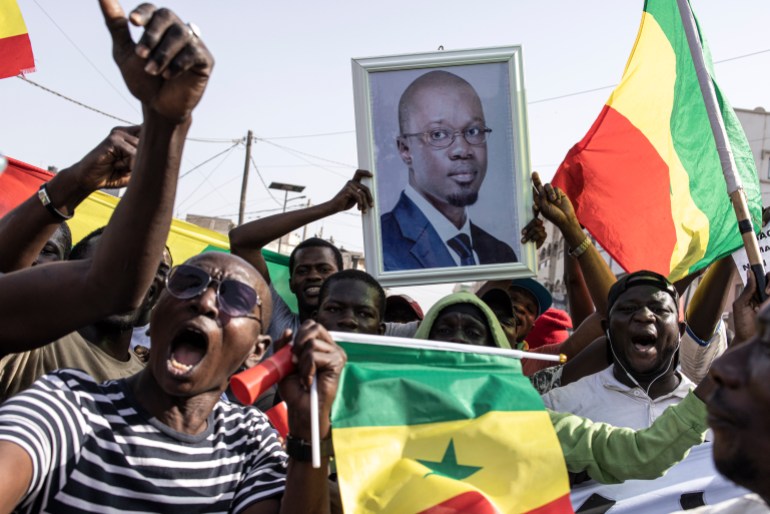
Senegalese voters have a crowded field of 19 candidates to pick from when they vote this month to elect a new leader to replace President Macky Sall in a tight election whose delay sparked concerns for the future of democracy in the West African country. The vote on March 24 will take place after Sall’s attempt to postpone the election, originally planned for February, was overturned by Senegal’s top election authority after weeks of violent protests. The ruling by the Constitutional Council has been welcomed by many in the country – but observers have warned it may not be the last twist in the saga. Already, several politicians have petitioned the courts to postpone the election anew, claiming the application process for the candidates was flawed. “Every week you have a new kind of scandal – this is Senegal,” said Ndongo Samba Sylla, head of research and policy for IDEAs, a network of political and economic analysts. “There could be new developments” in the days ahead, he cautioned. Meanwhile, candidates are left with less than two weeks to win over voters during the month of Ramadan, a period usually dedicated to spiritual reflection and worship rather than politics. Here’s a look at the main candidates — and a common thread that binds some of them: Bassirou Diomaye Faye The 49-year-old tax inspector is the candidate of an opposition coalition that includes members of the dissolved PASTEF party of Ousmane Sonko, a firebrand politician and fierce critic of Sall. Sonko, who came third in the 2019 presidential election, was widely seen as the most popular candidate for this year’s vote. But the opposition leader was detained in July after being convicted of “morally corrupting” the youth and was later barred from running over libel charges. Faye has been nominated by Sonko as his successor. Sonko, like Faye, was a tax inspector. Opposition supporters sing and dance during a meeting two days before the trial of one of Senegal’s opposition leaders, Ousmane Sonko, in Dakar [File: John Wessels/AFP] Faye will seek to capitalise on Sonko’s popularity, especially among Senegal’s unemployed youth. Three out of 10 Senegalese aged 18 to 35 are unemployed. Youth joblessness is an issue further exacerbated by the speed at which the population grows – it doubles every 25 years, according to Afro Barometer data. But Faye has been in preventive detention since April, even while his face adorns T-shirts of opposition supporters, who have chanted his name at campaign rallies. He is expected to be released soon as part of an amnesty law. “Freed or not freed, the majority of Senegalese has already made their choice. Who wants to vote for Faye will vote for him,” said Thiaba Camara, president of the civil society group Demain Senegal. Faye has called for the establishment of a new national currency; the renegotiation of contracts between the government and corporations in sectors ranging from energy and mining to fishing; and a reduction of presidential powers, including the reintroduction of the vice presidency. He has also pledged to equally distribute profits out of a gasfield that is expected to start production this year. Amadou Ba A former prime minister, Ba was also once a tax inspector. Ba is the presidential candidate of Sall’s Alliance for the Republic party. He ran the Ministry of Finance and Economic Planning from 2013 to 2019 and was the country’s top diplomat in 2019 and 2020. A Ba victory would mean policy continuity with the previous government, something that would likely assure foreign investors and guarantee a cohesive fiscal response at a time when Senegal needs the support of the International Monetary Fund, which approved a $1.8bn loan in June. But because the 62-year-old was part of Sall’s government, he faces public dissatisfaction over the rollback of civil liberties under the outgoing president. Dozens of people were killed and more than 1,000 jailed in the political turmoil of the past three years. “Ba is perceived as the candidate who embodies the old system, one which never disconnected from structures established since independence,” said Hawa Ba, the head of the Open Society Initiative for West Africa. Amadou Ba is the presidential candidate for Sall’s party [File: Andrew Caballero-Reynolds/Reuters] Khalifa Sall Another presidential hopeful is Dakar’s two-time mayor (no relation to the president). The widely popular politician was jailed for five years in 2018 on charges of fraud, which his supporters said were politically motivated. The conviction barred him from running in the following year’s presidential election, in which he was seen as a strong competitor to Macky Sall. Following a presidential pardon, the former lawmaker, who trained as a teacher, was freed in 2019. Sustainable development has been central to Khalifa Sall’s electoral campaign. He has said he wants to focus on responsible water management and equitable land distribution. More than 70 percent of Senegal’s population lives off agriculture and the livestock sector. Idrissa Seck Until April, Seck was the head of the Economic, Social and Environmental Council. The 63-year-old won 21 percent of the vote in the 2019 presidential election, finishing second in the race. After the vote, his Rewmi party joined President Sall’s ruling coalition. Reports suggested Seck and Sall fell out after the former declared his opposition to anybody seeking a third term, alluding to the latter’s suspected ambitions. Seck also argued that Sonko should have been allowed to run in the 2024 election. Idrissa Seck finished second in the 2019 presidential election [File: Martin Dixon/EPA] Mahammed Boun Abdallah Dionne Prime minister from 2014 to 2019, Dionne served as the chief of the Central Bank of West African States and the United Nations Industrial Development Organization. The agency’s mandate is to support economic growth in developing countries and economies in transition. He is a computer engineer by training. Dionne has pledged to be a “president of reconciliation” if elected and has pushed for “economic sovereignty” for Senegal. Anta Babacar Ngom Ngom is the only female candidate and would be the first women to serve
UK plans to pay asylum seekers to move to Rwanda
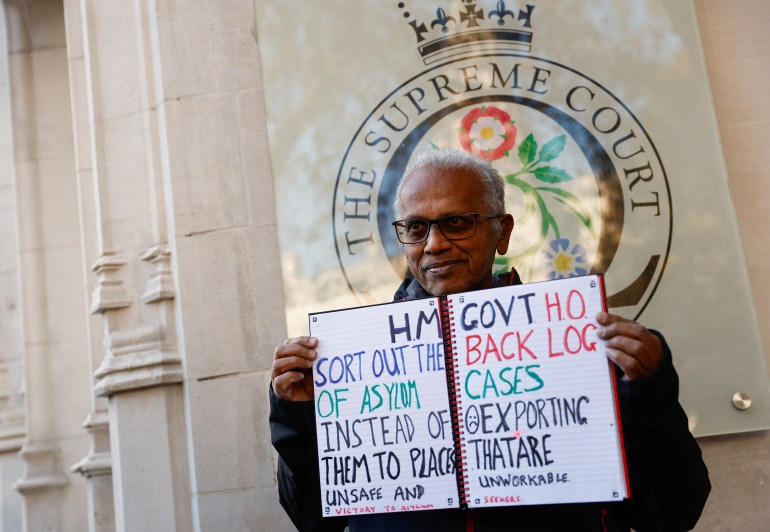
Plans are separate from the ‘Rwanda bill’, a stalled plan to forcibly deport most asylum seekers to the African country. The United Kingdom’s government is considering plans to pay asylum seekers whose applications have failed up to 3,000 British pounds ($3,840) to move to Rwanda. The proposed scheme, part of a deal struck with Rwanda, was drawn up by ministers with the aim of clearing a backlog of tens of thousands of asylum seekers who have been refused the right to stay, but cannot be returned to countries deemed unsafe. The plan is separate from the controversial “Rwanda bill“, an earlier plan to forcibly deport most asylum seekers to Rwanda. Instead, it extends an existing policy in which people are offered financial assistance to return to their home countries. According to the Home Office, 19,000 people were removed voluntarily from the UK in the past year. Under the new extension, people will receive the money if they agree to live in Rwanda, which the UK government considers to be a safe third country despite reports from rights groups on political oppression. “We are exploring voluntary relocations for those who have no right to be here to Rwanda,” a Home Office statement said. Rejected asylum seekers could not work legally in the UK but would apparently be allowed to do so in Rwanda and be eligible for five years of additional support agreed in the 2022 deportation plan. Kevin Hollinrake, a junior business minister, said on Wednesday that the new policy was a good use of public money. “So, 3,000 pounds, of course that’s a lot of money, but nevertheless, it costs a lot of money to keep people in the UK who are failed asylum seekers,” he told LBC Radio. Unlawful plans The scheme was formulated as the government grapples with legal challenges to the “Rwanda bill”, which was last year ruled unlawful by the UK’s Supreme Court as it would violate British and international human rights laws. A protester holds a placard outside of the Supreme Court, on the day the court delivered its ruling on whether the government could go ahead with its plan to deport migrants to Rwanda, in London, the United Kingdom, on November 15, 2023 [Peter Nicholls/Reuters] In an effort to overcome resistance from the courts, Prime Minister Rishi Sunak’s government is passing legislation through Parliament that would block further legal challenges by declaring Rwanda a so-called safe country for asylum seekers. Rwanda currently has the capacity to accept a few hundred asylum seekers a year from the UK, the British government has said, adding the capacity could be increased. Sunak has said he wants the first deportation flights to leave in the next few months – ahead of a national election expected in the second half of this year. Adblock test (Why?)
Protests in India against ‘anti-Muslim’ citizenship law

NewsFeed There have been protests in India after the government implemented a new citizenship law that discriminates against Muslim refugees, weeks before national elections. Published On 13 Mar 202413 Mar 2024 Adblock test (Why?)
How ‘outstanding leader’ Rohit Sharma helped Ashwin in personal adversity
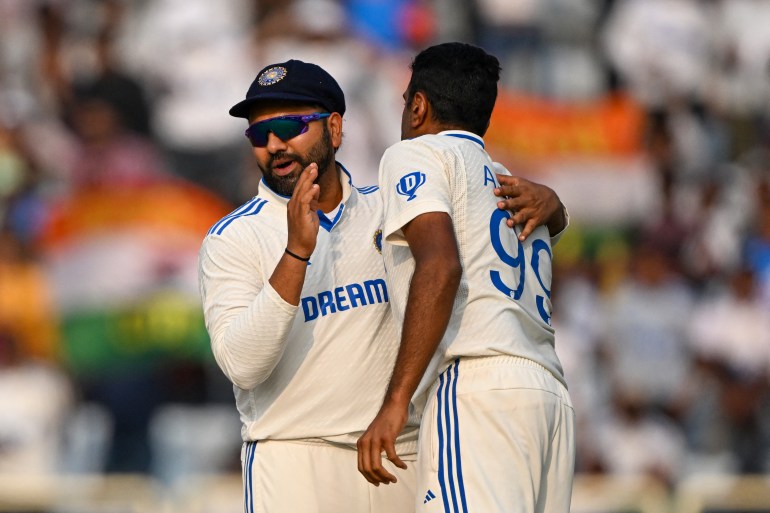
In an emotional video, Ashwin recalled the events that led to his departure and return during the third Test match against England when his mother was ill. Ravichandran Ashwin has hailed India’s cricket captain Rohit Sharma as a man with a “heart of gold” for his help and leadership during India’s third Test match against England last month, which Ashwin left on the second day when his mother fell ill. Three days after helping his team wrap up a 4-1 series win over Ben Stokes’s England, the off-spinner opened up on the personal adversity that led to his departure from the team in the middle of the match, his return on the fourth day and the emotional toll it took on him as a top-level athlete. “Rohit is a special person, an outstanding leader with a golden heart,” Ashwin said in an emotional video posted on his YouTube channel. “I would give my life for him on the field, that’s the kind of captain he is.” The 37-year-old recollected the events from February 16, the day he took his 500th wicket in Test cricket but also the day his mother collapsed and lost consciousness back home in Chennai, India. “Rohit, me and some other players were having a discussion after the match when I realised my parents and wife had not called me to congratulate [on reaching the 500 wicket milestone],” Ashwin recalled in the video titled “the emotional roller coaster.” “When I called my wife at 7pm her voice was shaking. She asked me to move away from the crowd and told me my mother had collapsed after a headache.” Ashwin said he “blanked out” as soon as he heard the news and wasn’t able to think clearly. “I was crying but I didn’t want anyone to see me cry. I just sat alone in my room not knowing what to do.” Ravi Ashwin says Rohit Sharma’s actions in helping him be with his ailing mother left him ‘gobsmacked’ [File: Tauseef Mustafa/AFP] The 100-Test veteran was in a conundrum as at the end of play, England were 207-2 with the series tied at 1-1. “I thought if I leave the team they will be left with 10 players, a bowler short, against a full-strength squad with the game in the balance. At the same time all I could think of was my mother. I wanted to go see her and quickly come back [to Rajkot].” It was then that Rohit and India’s head coach Rahul Dravid stepped in and made the decision to send Ashwin home. “Rohit asked me to stop thinking, leave and be with my family. He was trying to arrange a chartered flight for me.” Ashwin was able to get on a plane, but his captain ensured the emotionally distressed player did not travel alone and sent the team physio along. “When Kamlesh got a call from Rohit at 9:30pm to see how I was doing, I was gobsmacked! I see an outstanding leader in Rohit. “My respect for him grew tremendously after that day.” Ashwin was able to see his mother, who was recovering and insisted that her son join his team. The bowler returned to Rajkot on the morning of the fourth day as England chased a target of 557 runs to win the Test. The visitors were bowled out for 122, with Ashwin taking his 501st Test wicket. Ashwin ended the series as its leading wicket-taker, with 26, and has climbed to the top of the International Cricket Council (ICC) men’s Test bowling rankings this week. For the sixth time in his career, Ravichandran Ashwin is the No.1 bowler in the ICC Men’s Test Player Rankings 👏 ➡️ https://t.co/hLGP7qOqE3 pic.twitter.com/oYLyWzC4ut — ICC (@ICC) March 13, 2024 Adblock test (Why?)
Not just the UNRWA report: Countless accounts of Israeli torture in Gaza

Though it has yet to respond to Al Jazeera’s request for comment, Israel continues to push back against the accusations of torture levelled at its armed forces in an unpublished report by the United Nations Relief and Works Agency (UNRWA). The report details the extensive use of torture against Palestinians taken prisoner by the Israeli military in Gaza, including 21 UNRWA staff members and 15 family members of UNRWA staff, an accusation Israel has denied. Findings in the report tally with testimonies Al Jazeera has gathered from people detained in Gaza and tortured by Israel since the beginning of its war on the besieged enclave. There have also been well-documented cases in which arbitrarily detained Palestinians were subjected to deeply degrading treatment, a circumstance that was also detailed in the UNRWA report. According to the February report, UNRWA had documented the release of 1,002 detainees – ranging in age from six to 82 – by Israel at the Karem Abu Salem crossing (called Kerem Shalom by Israel) between December 18 and February 19. The released detainees included UNRWA staff, women, children, the elderly and vulnerable people living with conditions like Alzheimer’s and cancer – all of whom were taken from Gaza and held at various locations within Israel. To help these individuals, UNRWA set up a reception facility at Karam Abu Salem where they provide food and water to the released persons and help them try to reach their families. [embedded content] “In most instances, the released detainees are extremely disoriented, hungry, physically exhausted and exhibit visible signs of physical and mental trauma, and are wearing dirty clothes, sometimes with visible blood stains. “They are often unaware that war is continuing, on occasion do not realize they have returned to Gaza, and they do not know the whereabouts or fate of their loved ones,” the report stated. However, UNRWA noted, the releases it documented are only part of the overall number of people being detained and mistreated by Israel in Gaza, as there are many more who are taken, tortured and released within Gaza – it provided an estimate of some 4,000 people overall. Torture In detention, the people taken were interrogated, with UNRWA staff being of particular interest to Israeli interrogators who reportedly tried to coerce confessions of complicity with Hamas or the October 7 attack on Israel, which killed 1,139 people and the capture of 253 who were taken back to Gaza. Practices recorded by UNRWA include the use of a nail gun on prisoners’ knees, sexual abuse against both men and women and the insertion of what appears to be an electrified metal stick into prisoners’ rectums. Mahmoud Abd Rabbu in UN-provided clothing at the hospital where he was being treated after his release [Screegrab/Al Jazeera] “They were beating me with an extendable metal bar. There was blood on my trousers and when they saw it, they beat me there. They used a nail gun on my knee. These nails were kept in my knee for about 24 hours until I was transported to Naqab prison,” one 26-year-old male told UNRWA of his 56 days in Israeli custody. Mahmoud Abd Rabbu, 62, from Jabalia, told Al Jazeera he had been displaced to the Indonesian Hospital and, during the last days of the Israeli siege on the hospital, he was told everyone should move to the south. He headed for a checkpoint that had been determined as “safe” by Israeli forces where he and one other man were picked out of a group of 80 people and detained. He recounts being held in a group of more than 100 men who all endured days of “beatings, hunger and cold”, adding that they were kept blindfolded, not allowed to sleep and were forced to spend most of the day kneeling. “If someone lifted the blindfold off their eyes,” he said, “he would be called over by the soldiers and beaten then strung up on the barbed wire fence.” [embedded content] Another detained man told UNRWA: “They made me sit on something like a hot metal stick and it felt like fire – I have burns [in the anus]. The soldiers hit me with their shoes on my chest and used something like a metal stick that had a small nail on the side,” he said. “They asked us to drink from the toilet and made the dogs attack us,” he recalled, before describing how he had seen the bodies of “maybe nine” people who had been detained and killed, including one who had died after they had “put the electric stick up his [anus]. He got so sick, we saw worms coming out of his body and then he died,” he said. Khaled el-Nabreis from the Khan Younis refugee camp told Al Jazeera that he and several other men spent three days with no food or water, “only beatings, and when we slept they would cover us with wet blankets in the bitter cold” after they were detained by Israeli forces, taken to a location he did not recognise. Several of the individuals tortured and then released by Israel told Al Jazeera the soldiers tormenting them were asking the same kinds of questions, including: “Where are the tunnels?”, “Where is [Hamas leader] Sinwar?”, “Where are the captives?” and “Who do you know who is a Hamas fighter?” Rami Abu Daqqa saw his brother shot in front of his eyes and then endured weeks of torment in Israeli detention [Screengrab/Al Jazeera] Rami Abu Daqqa from Bani Suhaila in Gaza told Al Jazeera that he and his family had tried to return to their home from Rafah in late January. As they approached the house, he said, Israeli snipers opened fire, shooting him in the leg. His voice breaking, he added that his brother, Hani, was shot and killed in the same barrage. He went on to describe how Israeli soldiers both administered first aid for the gunshot wound in his leg and beat him to get him to confess
Who is Muhammad Aurangzeb, the man tasked with fixing Pakistan’s economy?
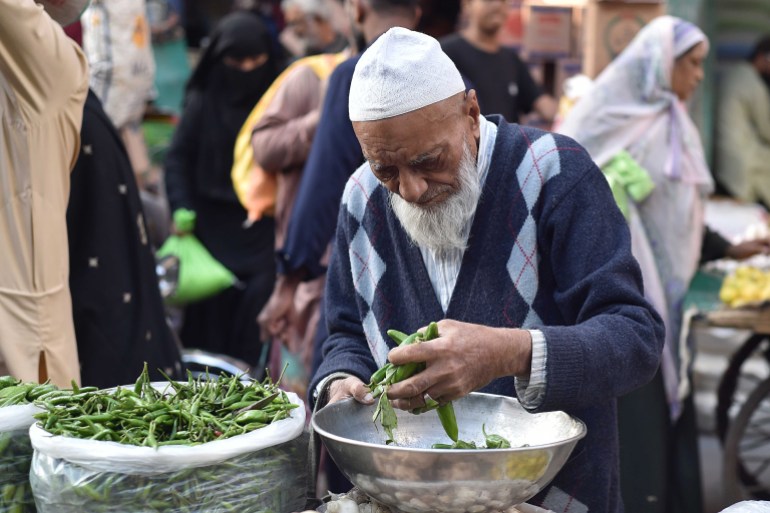
Islamabad, Pakistan — When Pakistan’s 19-member new cabinet took oath on March 11, one man stood out in the lineup: Muhammad Aurangzeb, a political outsider tasked with the challenge of steering the country out of its economic woes. Aurangzeb, a veteran banker who previously headed one of Pakistan’s largest commercial banks, Habib Bank Limited (HBL), has been given the reins of a $350bn economy over several other contenders, including the four-time finance minister Ishaq Dar. A graduate of the Wharton School of Business at the University of Pennsylvania, Aurangzeb also worked in major international banks, such as Citibank and JP Morgan, before his six-year stint at the HBL. A dual national, Aurangzeb had to relinquish his Dutch nationality to hold a public office in Pakistan. While he is not a member of the parliament as yet, according to the country’s rules, he has six months to become a parliamentarian in order to continue as a federal minister. Mr. Muhammad Aurangzeb officially took over the responsibility as Finance Minister of Pakistan after taking oath at the Presidency, today. pic.twitter.com/RSBhulbLwl — Ministry of Finance, Government of Pakistan (@Financegovpk) March 11, 2024 Aurangzeb is not the first banker to become Pakistan’s finance minister. Before him, Shaukat Aziz held the position for eight years (1999-2007) under General Pervez Musharraf’s tenure, before becoming a prime minister. Later, under the government of former prime minister Imran Khan and his Pakistan Tehreek-e-Insaf (PTI), banker Shaukat Tarin was given the portfolio which he held for one year (2021-2022) before the PTI government was removed through a parliamentary vote of no-confidence in April 2022. Aurangzeb’s appointment comes at a critical time when the country faces severe economic challenges, as he works with Prime Minister Shehbaz Sharif and the Pakistan Muslim League-Nawaz (PMLN) government. Sharif and his PMLN came to power after forming a coalition government following the recent February 8 elections, which were marred by allegations of widespread rigging. One of Aurangzeb’s first tasks, say analysts, will be to urgently negotiate a new International Monetary Fund (IMF) loan programme after the expiry of the existing $3bn, nine-month-long agreement in April. A new loan programme with the global lender is necessary for the country which is currently burdened by more than $130bn – at least a third of its gross domestic product – in external debts. Pakistan was scheduled to repay $24bn by June this year but managed to secure some relief from bilateral creditors through rollovers. The country now has to pay nearly $5bn before the end of the fiscal year in June. Meanwhile, Pakistan’s current foreign currency stocks stand at a paltry $7.8bn, enough to cover just about eight weeks of imports. Its currency has devalued by more than 50 percent in the last two years, while inflation, currently at more than 23 percent, shot up to nearly 40 percent in 2023, with a rapid increase in energy tariffs as well as the price of basic food commodities. Inflation in Pakistan hit a record high of nearly 40 percent last year. [Shahzaib Akber/EPA] Many observers believe that Aurangzeb’s experience with global banks and exposure to international financial markets is critical, considering Pakistan’s debt challenges. Sajid Amin Javed, a senior economist associated with the Sustainable Development Policy Institute in Islamabad (SDPI) said Aurangzeb’s appointment is a signal from the government that it is committed to introducing economic reforms – even though they might be politically unpopular. “Partially, this may also be a step to dilute the perception that the PDM government could not deliver in the past,” he told Al Jazeera, referring to a coalition that Sharif led briefly after the removal of Imran Khan’s government, and whose brief tenure coincided with skyrocketing inflation and mounting economic struggles for Pakistanis. But Aurangzeb will need more than his background to succeed in his job, suggested Karachi-based economist Khurram Schehzad. “The key point is not necessarily who the finance minister is, but rather, what would the person do, what their vision is, and what long-term thinking they are bringing to the table,” Schehzad told Al Jazeera. Islamabad-based Javed of the SDPI says these are challenging times for any finance minister but Aurangzeb’s lack of political baggage could work in his favour. “We may see a more reforms-focused engagement with [the] IMF instead of political balancing,” Javed said, referring to pressures from voter lobbies against reforms that traditional politicians often grapple with. Most importantly, he brings fresh thinking on economic policy conduct. Given his global experience, he may go a bit deeper on overhauling of economic policy and country may see a renewed focus on economic growth.” Karachi-based economist Ammar Habib Khan, while acknowledging Aurangzeb’s experience in finance, told Al Jazeera that a macroeconomist might have been better suited for the job than a banker. “Usually, those at the helm [of the government] are unable to understand the long lead time associated with reforms, and the macroeconomic balance that needs to be attained,” he said. “They go for a quick-fix solution, mostly bringing in people that can provide band-aids rather than drive long-tailed reforms.” Adblock test (Why?)
Putin resumes ‘sabre-rattling’ with warning Russia ready for nuclear war
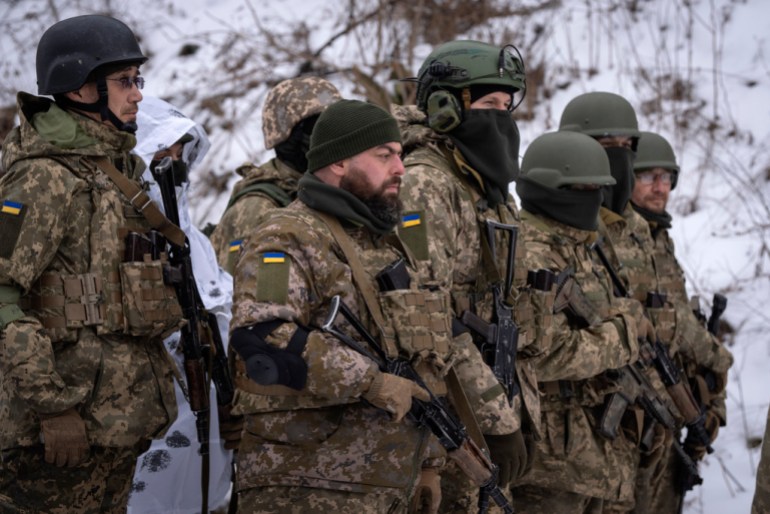
Ahead of weekend elections, Russian president boasts his country’s nuclear capabilities are superior to the West’s. President Vladimir Putin has warned that Russia is “ready” to use nuclear weapons if there is a threat to its statehood. In a recorded interview broadcast by Russian media on Wednesday, the Kremlin chief said his country is ready for a nuclear war from a “military-technical” point of view. His comments signal a resumption of nuclear “sabre-rattling“, as it was branded a year ago, just ahead of this weekend’s presidential election. Two weeks ago, Putin claimed during an annual address to the nation of a “real” risk of nuclear war if Western countries sent troops to fight in Ukraine. On Wednesday, he insisted that Russia’s nuclear arsenal and troops hold the advantage over the West. “From a military-technical point of view, we are, of course, ready. They [Russian forces] are constantly in a state of combat readiness,” Putin said during an interview with the Rossiya-1 state TV channel. “Our triad, the nuclear triad, it is more modern than any other triad,” he continued. “Only we and the Americans actually have such triads. And we have advanced much more here.” Putin and other Russian officials have regularly referenced the country’s nuclear capabilities since the invasion of Ukraine in February 2022 and the West’s response in supporting Kyiv. However, Moscow denies that the reminders are meant to be threatening. Putin was careful to note in his latest comments that the US had sufficient expertise “in the field of Russian-American relations and in the field of strategic restraint” to understand the risks. There was no “rushing” to the nuclear scenario, he said. Interference The Russian president also addressed recent Ukrainian attacks on targets inside Russia, which have surged in recent weeks as Moscow’s forces have made gains on the largely frozen front line in eastern Ukraine. Members of the pro-Ukrainian Russian ethnic Siberian Battalion practice at a military training close to Kyiv, Ukraine, on December 13, 2023. The battalion is made up entirely of Russian citizens who want to fight against Russia’s invasion [Efrem Lukatsky/AP Photo] “The main goal, I have no doubt about it, is to – if not to disrupt the presidential elections in Russia – then at least somehow interfere with the normal process of expressing the will of citizens,” he asserted, referring to the vote scheduled for March 15-17. The election is expected to hand Putin, who has ruled the country since the turn of the century, another six-year term. Ukraine’s military has been reaching deeper into Russian territory, hitting several oil refineries in waves of drone attacks, while anti-Putin Russian volunteer militias claim to have pulled off cross-border incursions into Kursk and Belgorod. On Tuesday, Ukraine launched a sweeping, overnight drone attack on several Russian regions for the second night in a row. Oil refineries in Ryazan, Kstovo and Kirishi, a Russian airbase in Buturlinovka, and a military airfield in Voronezh region, were all hit, according to a Ukrainian source quoted by Reuters. The attack set Rosneft’s biggest oil refinery in Ryazan, just 180km (112 miles) from Moscow, alight. “Judging by the videos online, the consequences were fairly significant,” the source said. Putin also repeated in his interview that Russia is ready for serious talks on Ukraine, although that claim was accompanied by a crude demand that any peace would have to be on his terms. “Russia is ready for negotiations on Ukraine, but they should be based on reality – and not on cravings after the use of psychotropic drugs,” he said. Adblock test (Why?)
US woman rescued from rubble after Israeli air strike in Gaza

NewsFeed A US woman living in Gaza was pulled from the rubble of an Israeli air strike after a two-hour operation to free her. After she was freed, she had a message of solidarity with Palestinians facing Israel’s war. Published On 13 Mar 202413 Mar 2024 Adblock test (Why?)
One person killed and several injured in China restaurant explosion

NewsFeed Dashcam video captured the moment a huge explosion at a restaurant in China caused flying debris to hit people passing in the street. At least one person was killed in the blast, which was caused by a suspected gas leak. Published On 13 Mar 202413 Mar 2024 Adblock test (Why?)