

Deadly blast hits Pakistani city of Peshawar

DEVELOPING STORYDEVELOPING STORY, The blast in Peshawar, the capital of Khyber Pakhtunkhwa province, wounded one person believed to be in a critical condition. At least two people have been killed in a blast in Pakistan’s northwestern city of Peshawar, according to police officials. The blast near the Board Bazaar area of the city, the capital of Khyber Pakhtunkhwa province, wounded one person who has been admitted to Lady Reading Hospital. He is believed to be in a critical condition. Local media reported that explosives were planted on a motorcycle, but it has yet to be confirmed by officials. Counterterrorism officials have arrived at the scene of the blast as an investigation has begun to determine the nature of the explosion. More details to follow. Adblock test (Why?)
US opens criminal probe into Boeing 737 MAX mid-flight blowout

Investigation comes amid heightened scrutiny of Boeing’s safety record following fatal crashes in 2018 and 2019. Prosecutors in the United States have opened a criminal investigation into the mid-flight blowout involving a Boeing 737 MAX operated by Alaska Airlines, according to US media reports. The Department of Justice (DOJ) has interviewed witnesses including aircrew as part of the probe into the January 5 incident in which a portion of the fuselage blew off mid-flight, the Wall Street Journal and The Washington Post reported on Saturday. Alaska Airlines said it was cooperating with authorities. “In an event like this, it’s normal for the DOJ to be conducting an investigation. We are fully cooperating and do not believe we are a target of the investigation,” Alaska Airlines said in a statement to Al Jazeera. Boeing declined to comment. The investigation comes as Boeing is under scrutiny over its safety record following a series of incidents, including two fatal crashes involving the Boeing 737 MAX in 2018 and 2019. The DOJ probe will inform authorities’ assessment of whether Boeing has complied with the terms of a $2.5bn settlement to avoid prosecution in relation to those crashes, the Wall Street Journal reported. On Monday, the US Federal Aviation Administration (FAA) said it had identified “non-compliance issues in Boeing’s manufacturing process control, parts handling and storage, and product control” following an audit of the company that included interviews with employees and a visit to its production line. The FAA said Boeing would have 90 days to come up with a plan to correct the issues. A separate FAA report, released last month but launched before the blowout incident, found serious problems with Boeing’s safety culture, including fears of retaliation among employees with safety concerns. Boeing said in a letter to the US Congress on Friday that it was unable to locate records for work carried out on the door panel that fell off the Alaska Airlines plane. The Seattle-based aircraft manufacturer has said it believes that records about the panel were never created despite company rules requiring such documentation. Adblock test (Why?)
At least 19 killed, 7 missing in flash floods in Indonesia

Disaster management agency says more than 80,000 people have fled to temporary government shelters. Flash floods and a landslide on Indonesia’s Sumatra island have left at least 19 people dead and seven others missing, officials have said. Mud, rocks and uprooted trees rushed down a mountainside and engulfed villages in the Pesisir Selatan district of West Sumatra province late on Friday following torrential rains, Doni Yusrizal, who heads the local disaster management agency, said on Sunday. Yusrizal said rescuers recovered seven bodies in the village of Koto XI Tarusan and three others in two neighbouring villages. “Relief efforts for the dead and missing were hampered by power outages, blocked roads covered in thick mud and debris,” Yusrizal said. Indonesia’s National Disaster Management Agency said six bodies were found in Pesisir Selatan and three bodies were found in the neighbouring district of Padang Pariaman, bringing the death toll so far to 19. The agency said at least two villagers were injured and seven others were still missing, with more than 80,000 people fleeing to temporary government shelters. Flash floods and landslides are a common occurrence in Indonesia, where millions of people live near floodplains, especially during the rainy season. In December, at least two people were killed when a landslide and floods swept away dozens of houses and destroyed a hotel near Lake Toba on Sumatra. Adblock test (Why?)
Biden makes contradictory remarks on ‘red lines’ for Israel in Gaza

US president says Israel’s Netanyahu is ‘hurting Israel’ more than helping in his handling of the war. United States President Joe Biden has warned that there are “red lines” Israel should not cross in its war in Gaza while insisting he would never abandon the US ally. In a contradictory and confusing interview with MSNBC aired on Saturday, Biden said that an Israeli invasion of the city of Rafah would be his “red line” for Prime Minister Benjamin Netanyahu but he would also never “leave Israel”. “The defence of Israel is still critical, so there’s no red line [where] I’m going to cut off all weapons so they don’t have the Iron Dome to protect them,” Biden said, referring to Israel’s missile defence system. “But there’s red lines that if he crosses them…”, Biden said without finishing his chain of thought, adding that his administration “cannot have 30,000 more Palestinians dead”. In some of his most pointed criticism of the Israeli leader yet, Biden also said that Netanyahu was “hurting Israel more than helping Israel” and should “pay more attention to the innocent lives being lost” in Gaza. While Biden has firmly backed Israel in its campaign to destroy Hamas, his administration has been increasingly at odds with Netanyahu over the scale of civilian casualties in Gaza and restrictions on humanitarian aid into the enclave. Biden’s administration has repeatedly urged Netanyahu not to launch a planned offensive in Rafah until Israel can ensure the safe evacuation of some 1.3 million Palestinians sheltering in the city. On Thursday, Biden announced plans to build a temporary port in Gaza to allow the delivery of aid by sea amid severe Israeli restrictions on the transport of supplies by land. Biden last month expressed hope that Israel and Hamas could agree to a temporary pause in fighting before Ramadan, but expectations of a deal by then withered after mediators left Cairo last week without an agreement. Biden said during his interview on Saturday that a deal is “always possible” and that CIA Director Bill Burns was still in the region facilitating negotiations after meeting with David Barnea, his counterpart from Israel’s intelligence agency Mossad, the previous day. Mossad said on Saturday that discussions on a ceasefire were taking place “all the time” despite dimming hopes for a breakthrough. Israel’s war in Gaza has killed more than 30,800 Palestinians, mostly women and children, according to health authorities in the enclave. Hamas’ October 7 attacks on Israel killed 1,139 people, according to Israeli authorities. Adblock test (Why?)
Why can’t Nigeria stop the kidnapping of schoolchildren?

About 300 schoolchildren are missing after the latest mass kidnapping in Nigeria. It is every parent’s nightmare: the kidnapping of their children. It happens all too often in Nigeria. In the second mass abduction within a week, gunmen kidnapped what some reports say are about 300 school children. Many viewers may remember the Chibok schoolgirls abducted by Boko Haram fighters 10 years ago. Kidnappings remain common – with thousands of Nigerians seized in the past few years. The government has promised to improve security, but the army is spread thin. So why are the attacks still happening? And what needs to be done to make them stop? Presenter: Hashem Ahelbarra Guests: Kemi Okenyodo – Founder and executive director, Partners West Africa Bulama Bukarti, Senior fellow, Tony Blair Institute for Global change Sadeeq Garba Shehu – Security and defence consultant Adblock test (Why?)
Verstappen wins F1 Saudi Arabian Grand Prix to extend winning streak

The Dutchman made it nine wins in as many races as he cruised to a comfortable victory at the Saudi Arabian Grand Prix. Max Verstappen won the Saudi Arabian Grand Prix from pole position as Red Bull continued their dominant start to the Formula One season with a second one-two in as many races. Mexican Sergio Perez was runner-up on Saturday under the Jeddah Corniche floodlights, last year’s winner taking the chequered flag 13.643 seconds behind his triple world champion teammate. It was the first time Verstappen, winner of a record 19 of 22 races last year, has won the first two races of a season. Charles Leclerc finished third for Ferrari, taking a bonus point for the fastest lap and earning his first podium of the season. The victory was a ninth in a row for Verstappen, dating back to Japan last September, and the 56th of the 26-year-old Dutch driver’s career. It was also his 100th career podium while Red Bull’s 115th win lifted them ahead of Williams in fourth place on the all-time list. “Overall, a fantastic weekend for the whole team and myself. I felt really good with the car and it was the same in the race,” Verstappen said. The United Kingdom’s Oliver Bearman, making his F1 race debut as Ferrari’s youngest-ever rookie at 18 years and 305 days old after Spaniard Carlos Sainz was sidelined by appendicitis, finished seventh and was voted Driver of the Day. “Today he’s been incredible,” said Leclerc of his temporary teammate. “It’s hugely impressive and I’m sure he’s extremely proud. Everybody has noticed how talented he is and I’m sure it’s just a matter of time before he’s in F1.” Oscar Piastri finished fourth for McLaren ahead of Fernando Alonso of Aston Martin, George Russell of Mercedes and Bearman, with two more Britons, Lando Norris and seven-time champion Lewis Hamilton, taking eighth and ninth for McLaren and Mercedes, with Nico Hulkenberg taking the final point for Haas. Verstappen, Leclerc and Alonso in action with drivers at the start of the race [Hamad I Mohammed/Reuters] ‘One of the more physical races’ After his ninth consecutive victory, Verstappen said it was “one of the more physical races, a tough one”. The safety car was deployed on lap seven after Aston Martin’s Lance Stroll hit the wall and then crashed into the barriers at turn 22. The Canadian walked away unhurt as all but four drivers, including Norris and Hamilton, dived into the pits. Norris, who was later cleared of a suspected jumped start off the grid, led when the new Aston Martin Vantage safety car returned to the pits on lap nine but Verstappen was back in front by lap 13 and pulling away. Perez was handed a five-second penalty for an unsafe release from his first pitstop and Haas’s Kevin Magnussen collected a 10-second penalty for causing a collision with Williams’ Alex Albon. The Dane was later handed another 10-second penalty for leaving the track and gaining an advantage but his main role was to create a sufficient gap behind Hulkenberg for the German to be able to pit and still finish with a precious point. Alpine’s Pierre Gasly was told to pit and park on the opening lap due to a suspected gearbox issue, becoming the first retirement of the season after all 20 cars finished the opener in Bahrain a week earlier. Adblock test (Why?)
India blast their way past Bazball to seal Test series win against England

India win the fifth and final Test in three days to take the series against England 3-1 as Bazball is questioned again. India maintained their aura of invincibility at home after completing a 4-1 series triumph against England on Saturday. The ease of their final win may well subject the visitors’ much-hyped “Bazball” approach to renewed scrutiny. Rohit Sharma and his men clinched the series in the fourth Test in Ranchi but did not take their foot off the pedal in Dharamshala, where they routed England inside three days. The win, which consolidates two-time finalists India’s position at the top of the World Test Championship standings, will have a special place in the memory of Ravichandran Ashwin. The India off-spinner claimed five second-innings wickets to hasten England’s collapse in his 100th test match. 𝙒.𝙄.𝙉.𝙉.𝙀.𝙍.𝙎! 🏆 Congratulations #TeamIndia on winning the @IDFCFIRSTBank #INDvENG Test Series 4⃣-1⃣ 👏👏 pic.twitter.com/IK3TjdapYv — BCCI (@BCCI) March 9, 2024 India’s 17th consecutive home Test series win England seamer James Anderson, meanwhile, became the first pace bowler to claim 700 test wickets, partially lifting the gloom that had settled on England’s travelling “Barmy Army” fans. This was India’s 17th consecutive Test series win at home, where they have not lost a series since Alastair Cook’s England bested them in 2012. And they achieved it without batting stalwart Virat Kohli, who missed the series for personal reasons, and front-line seamer Mohammed Shami who was injured. Batter KL Rahul missed the last four Tests with injury, as well, but India’s formidable bench strength meant their absence was not really felt. Of the five Indian players who made their test debut in the series, stumper Dhruv Jurel, seamer Akash Deep and batters Sarfaraz Khan and Devdutt Padikkal impressed immediately. “I just always really believe that there’s an incredible amount of talent in India and a lot of young people, young players coming through,” India head coach Rahul Dravid said. “And it was a great opportunity for them to step up and show how good they are, and we saw that right throughout the series.” Defeat in Dharamshala. Congratulations to @BCCI on their series victory 👏 Match Centre: https://t.co/jRuoOIp988#INDvENG | #EnglandCricket pic.twitter.com/aJWlyhpFoB — England Cricket (@englandcricket) March 9, 2024 Duckett’s dismal dismissal Under Stokes and head coach Brendon “Baz” McCullum, England have espoused a flamboyant, even if risk-fraught, brand of cricket built around fearless batting. The same approach that largely worked back home appeared somewhat one-dimensional and even reckless. Opener Ben Duckett’s dismissal on Saturday illustrated the limitation of that approach. Having conceded a first-innings lead of 259, England were already far behind and would have benefitted from cautious, safety-first batting to avoid an innings defeat. Instead, whether due to a lack of trust in his own defence or an urge to impose himself early, Duckett charged forward against Ashwin only to miss the ball and lose his off-stump. The opener was so far down the track, he would have been stumped if he had not been bowled. By contrast, Joe Root, who struck 84 in England’s meagre second-innings 195, showed how touring batters can temper their aggression to master spin in India. Stokes stood by his side’s overall approach, however, and was of the view that a good offence was the best defence against the wily home spinners. “When India get on top, especially with the ball, they get a lot of men around the bat and with the quality of their [spin] bowlers … you’ve got to find ways of getting rid of those close fielders,” the all-rounder explained. “You’ve just got to be positive enough to take that risk, accept that it may lead to your downfall. But when the intent is there and you have a clear reason as to why you are playing that shot, you can hold your hands up and accept it.” Adblock test (Why?)
Varadkar concedes defeat in Ireland’s referendum on family, women’s roles
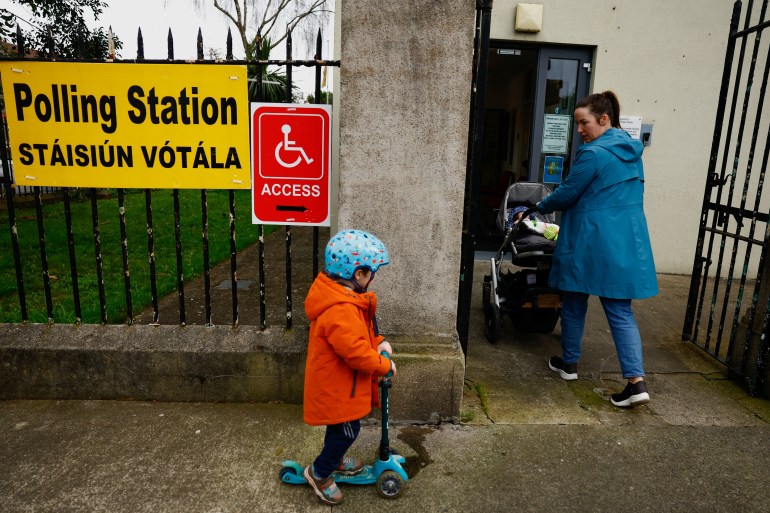
The Irish PM had called the referendum a chance to do away with ‘very old-fashioned, very sexist language about women’. A dual referendum in the Republic of Ireland on redefining family and women’s roles in the constitution has been defeated, Prime Minister Leo Varadkar said. The government supported the proposed changes, which would have widened the definition of the family and clarified the duties of women in society. Varadkar had described Friday’s polls, which deliberately fell on International Women’s Day, as a chance to do away with “very old-fashioned, very sexist language about women”.He said the government would accept the results. “I think it’s clear at this stage that the family amendment and the care amendment referendums have been defeated – defeated comprehensively on a respectable turnout,” Varadkar said at a news conference in Dublin on Saturday. “It was our responsibility to convince the majority of people to vote ‘Yes’ and we clearly failed to do so.” Official results are expected later on Saturday. The two proposals would have made changes to the text of article 41 in the Irish constitution, written in 1937. The first asked citizens to expand the definition of family from those founded on marriage to also include “durable relationships” such as cohabiting couples and their children. The second proposed replacing old-fashioned language around a mother’s “duties in the home” with a clause recognising care provided by family members to one another. In effect, the proposal to spread the burden of care for people with disabilities to the entire family from only the mother became a dispute about the extent or willingness of the state to support carers. A woman arrives with children at a polling station in Dublin, Ireland, March 8, 2024 [Clodagh Kilcoyne/Reuters] Polls had indicated a ‘Yes’ vote All the major political parties had supported a “Yes-Yes” vote, and until recently, polls predicted a smooth passage for both. But “No” campaigners argued the concept of a “durable relationship” was undefined and confusing and that women and mothers are being “cancelled” from the constitution. Meanwhile, ultra-conservative voices argued the changes could constitutionally protect polygamous relationships and increase immigration via migrant family reunions – claims all denied by the government. By 12:00 GMT on Saturday, it was clear that counting was showing a trend towards a “No” on the two questions. The votes are the latest attempt to reflect the changing face of European Union member Ireland and the waning influence of the once-dominant Roman Catholic Church. In recent decades, Ireland has transitioned from a conservative, overwhelmingly Catholic country to an increasingly diverse and socially liberal society. This shift has been encapsulated in changes to an outdated constitution where single women, until 1973, had to resign from their jobs upon getting married, and married women could not apply for vacancies. The constitution, the core legal text of the nation, can only be modified through a national referendum. The country of 5.3 million opted to end constitutional limits on same-sex marriage in 2015 and abortion in 2018. Adblock test (Why?)
This Ramadan, give to Gaza

As we approach the start of the Muslim holy month of Ramadan, the brutal war on Gaza has entered its sixth month. The assault on Gaza has killed more than 30,000 Palestinians, including 13,000 children. Aid delivery to the north of Gaza is being restricted, resulting in the starvation of many more. Worse still is the Israeli threat to launch a ground operation in Rafah during Ramadan, where more than 1.5 million people are crammed in, many displaced from other parts of Gaza. What was previously a “safe zone” declared by the Israeli army, is now a densely populated refugee camp. Rafah has a surface area of around 63 square kilometres (24sq miles). The average population density is now more than 22,200 people per square kilometre (57,276 per square mile). That is twice the density of New York City. Attacking Rafah would be a bloodbath. The entire world – even the United States – has warned against the operation, but, according to rhetoric from Israeli government officials, there seems little chance the attack on Rafah will not be carried out. The start of Ramadan, which would usually be a time of celebration, love and dedication to Allah (SWT), has now been turned into a date to fear for the Palestinians of Gaza. For more than five months, they have been deprived of food, water, medicine, and their homes. Now, they will also be deprived of a peaceful celebration of their holy month. If true to the threat made, the invasion begins during Ramadan, it will be the end of Gaza’s humanitarian crisis and the start of its humanitarian disaster. For us on the outside, watching this catastrophe unfold has been extremely painful. Many have felt helpless in the face of Palestinian suffering, but we can and should do something about it. Giving to charity is a key pillar of Islam all year round, but in Ramadan, we Muslims give even more. This emulates Prophet Mohammad (PBUH) who was especially generous during the holy month and we believe the blessings for those who donate are multiplied significantly. This year, this Ramadan, it is essential that every person – Muslim or non-Muslim – gives every penny they can to help the people of Gaza. Families all across the Gaza Strip, especially in the north, are experiencing famine. The UN’s hunger monitoring agency, the Integrated Food Security Phase Classification, has confirmed, “This is the highest share of people facing high levels of acute food insecurity that the IPC initiative has ever classified for any given area or country.” Muslims are required to fast during Ramadan. However, the conflict means that when the time comes to break fast, many Palestinians in Gaza will have nothing to eat or drink. Since October, parents have routinely been choosing to go without food and water, so their children can eat. Even if the assault on Rafah does not happen – and let us pray that it does not – Ramadan will be a time of great need for the people of Gaza. The death toll is rising by the hundreds every day, the healthcare system is collapsing due to the endless bombardment. The number of children orphaned has exceeded 17,000. Access to clean water is becoming a luxury, creating an environment that is ripe for waterborne diseases. And amid all of this suffering, the United Nations Relief and Works Agency for Palestine Refugees in the Near East (UNRWA), the largest relief agency operating in Gaza, has been smeared and, as a result, defunded by its biggest donors, despite there being not a shred of evidence to support the accusations levelled at it. It is imperative for people of all faiths and none to give to aid organisations working in Gaza today, tomorrow and throughout Ramadan. Your generosity is needed to feed the fasting and the starving. Your charity is needed to give clean water to those who need it to live and to purify themselves before prayer. Your acts of giving will bring hope to those who have had everything taken from them. Despite the many challenges, there are organisations that are doing their utmost to help the people of Gaza. They are actively working to overcome the restrictions imposed on the delivery of aid, pressuring the international community to do whatever it takes to get the lifesaving assistance to the people who need it. Donating to aid organisations won’t address the cause of Palestinian pain and misery, but it can help hold back the tide. It is an act of solidarity. This Ramadan, many are facing difficult economic circumstances and are worried about the cost-of-living crisis. But this is an unprecedented time; the people of Gaza need our help. Amid the greatest suffering being inflicted on a population in most of our lifetimes, we must all give like Muslims. The views expressed in this article are the author’s own and do not necessarily reflect Al Jazeera’s editorial stance. Adblock test (Why?)
Israel hits landmark residential tower in Rafah as Gaza truce talks stall

Israeli forces have struck one of the largest residential towers in Rafah in the southern Gaza Strip, residents said, stepping up pressure on the last area of the enclave it has not yet invaded and where more than a million displaced Palestinians are sheltering. The 12-floor Burj al-Masri building, located some 500 metres (1,640 feet) from the border with Egypt, was damaged in the air raid early on Saturday morning. Dozens of families were made homeless though no casualties were reported, according to residents. The Israeli military did not immediately respond to requests for comment on the incident. One of the tower’s 300 residents told the Reuters news agency that Israel gave them a 30-minute warning to flee the building at night. “People were startled, running down the stairs, some fell, it was chaos. People left their belongings and money,” said Mohammad al-Nabrees, adding that among those who tripped down the stairs during the panicked evacuation was a friend’s pregnant wife. A Rafah-based official with the Fatah party, which dominates the Palestinian Authority that has limited self-rule in the occupied West Bank, said he feared that hitting the Rafah tower was a sign of an imminent Israeli invasion. Five months into Israel’s unrelenting air and ground assault on Gaza, health authorities say nearly 31,000 Palestinians have been killed, more than 72,500 wounded and thousands more are likely under rubble. The offensive has plunged the Palestinian territory, already reeling from a 17-year Israel-led blockade, into a humanitarian catastrophe. Much of it has been reduced to rubble and most of the 2.3 million population have been displaced, with the United Nations warning of disease and starvation. Adblock test (Why?)