

Asif Ali Zardari elected Pakistan’s president for second time

Pakistani lawmakers vote for return of widower of Benazir Bhutto after elections marred by rigging claims. Pakistan Peoples Party’s co-chairperson Asif Ali Zardari has won a second term as Pakistan’s president, supported by the ruling coalition in a vote by parliament and regional assemblies. Zardari secured 411 votes, while his opponent, Mehmood Khan Achakzai, who is backed by the party of imprisoned former Prime Minister Imran Khan, received 181 votes, the Election Commission of Pakistan announced on Saturday after tallying the votes by national MPs, provincial MPs and senators. The widower of Pakistan’s assassinated first female leader, Benazir Bhutto, Zardari was voted into the largely ceremonial post by the PPP, which formed an alliance with the Pakistan Muslim League-Nawaz (PMLN) party after Pakistan’s February 8 elections that were marred with rigging claims. Zardari is expected to be sworn in at a ceremony on Sunday. Under the terms of the coalition pact, which also includes a number of smaller parties, PMLN’s Shehbaz Sharif was sworn-in as prime minister earlier this week on Monday. Khan was jailed and prohibited from contesting in the election, with his Pakistan Tehreek-e-Insaf (PTI) party targeted by arrests and censorship, and its members forced to stand as independents. The PTI said a mobile internet blackout on election day and a delay in results were used to cover up nationwide rigging preventing their victory. The elections were also marred with allegations of vote tampering. The PTI won more seats than any other party last month, but fell far short of the majority needed to govern, which cleared the way for the alliance between PMLN and PPP. PTI chairman, barrister Gohar Ali Khan, said that Zardari’s election was “unconstitutional”. The party is now fighting a case for the allocation of seats reserved for women and minorities in the assembly. Zardari, 68, previously took the presidential office post in 2008 after a sympathy vote following the gun and bomb assassination of Benazir Bhutto when she was campaigning for re-election. While president, a role which he held until 2013, he rolled back the powers of the presidency. Pakistan’s presidency was once powerful, but was reduced to that of a figurehead in 2010 after Zardari made a constitutional amendment. During his tenure, he faced challenges ranging from threats from the Taliban, to tense relations with the military after the United States special forces’ operation in Pakistan to kill al-Qaeda leader Osama Bin Laden in 2011. Zardari has faced corruption allegations and spent more than 11 years in jail, but has bounced back from his various scandals. Back in 2009, the New York Times said he had a knack for “artful dodging” – “manoeuvring himself out of the tight spots he gets himself into”. Adblock test (Why?)
Israel’s ‘anti-Zionists’ brave police beatings, smears to demand end to war

Tel Aviv/West Jerusalem – In 2015, Maya, a Jewish Israeli, travelled to Greece to help Syrian refugees. At the time, she was an exchange student in Germany and she had been deeply moved by the pictures she saw of desperate people arriving there in small boats. That was where she met Palestinians who had been born in Syria after their parents and grandparents fled there during the founding of her own country in 1948. They told her about the Nakba – or “catastrophe” – in which 750,000 Palestinians were expelled from their homes to make way for the newly established Israel. Maya, 33, who had been taught that her country was born through “an independence war” against hostile Arab neighbours, decided that she needed to “unlearn” what she had learned. “I never heard about the right of return, or Palestinian refugees,” she told Al Jazeera. “I had to get out of Israel to start learning about Israel. It was the only way I could puncture holes in what I was taught.” Maya, who asked that her full name not be used for fear of reprisals, is one of a small number of Israeli Jewish activists who identify as “anti-Zionists” or “non-Zionists”. According to the Anti-Defamation League, a pro-Israeli group with a stated mission of fighting anti-Semitism and other forms of racism in the United States, Zionism means supporting a Jewish state established for the protection of Jews worldwide. However, many anti-Zionists like Maya and the people she works with view Zionism as a Jewish supremacist movement which has ethnically cleansed most of historic Palestine and systematically discriminates against the Palestinians who remain, either as citizens of Israel or residents of the occupied territories. But since Hamas’s deadly attack on Israeli civilians and military outposts on October 7, in which 1,139 people were killed and nearly 250 taken captive, Israeli anti-Zionists have been accused of treason for speaking about Palestinian human rights. Many have called for a permanent ceasefire in Gaza to stop what they view as collective punishment and genocide of the Palestinian people. “I think [anti-Zionists] always claim that Jewish supremacy is not the answer and it is not the answer to the [October 7] killings,” Maya said. “Israelis don’t understand how the Palestinian story is all about the Nakba, refugees and the right of return. If we are not able to deal with that then we are not going anywhere.” Perceived as ‘traitors’ Since October 7, Israeli anti-Zionists have described living in a hostile political and social environment. Many say the police have violently cracked down on anti-war protests, while others have received threats from far-right-wing Israelis. Roee, who, like Maya, did not give his last name for fear of reprisals from Israeli society or authorities, is also a Jewish Israeli activist. In October last year, he attended a small demonstration of a couple of dozen people a few days after Israel began bombing Gaza. The demonstrators were calling on Hamas to free all Israeli captives and on Israel to stop the war. “The police pushed all of us [out] violently in just two minutes,” Roee, 28, told Al Jazeera at a cafe in West Jerusalem. Weeks later, Roee and his friend, Noa, who also did not want her full name to be revealed, attended another silent demonstration outside a police station in Nazareth, a mostly Palestinian city in Israel. They put tape over their mouths to denounce the sweeping arrests of Palestinian figures who had also called for an end to the war on Gaza. But again, police chased down the Israeli protesters and beat them with batons. “I think it is very clear that the police recognise us. It doesn’t matter the signs we hold. They know us. They know we are leftists and that we are ‘traitors’ or whatever they call us,” Noa told Al Jazeera. Many Israeli antiwar activists have also been smeared or “doxxed” – a term given to people whose identities and addresses are made known on social media by those hoping to intimidate them into silence. Maya said that a right-wing activist had accused her romantic partner of cooperating with Hamas by informing them of the whereabouts of Israeli positions in Gaza. The activist published photos of her partner on Instagram with captions detailing the fabricated accusations. “We were afraid that our address would be exposed, but luckily it wasn’t. Even before October 7, [these groups of extreme right-wing people] tried to obtain addresses of people to ‘dox’ them and taunt them. Some of our friends had to leave their apartments. That was our main worry,” Maya said. Conscientious objectors While most Israelis are required to enlist in the army after high school, antiwar activists have refused to take part in their country’s continuing occupation of the West Bank, where raids and arrests have been intensified since October, or in the war on Gaza. Two young Israelis who publicly refused to join the army are now serving short sentences in military prison. Einat Gerlitz, a “non-Zionist” and a member of Mesarvot, a non-profit organisation providing social and legal support to Israeli conscientious objectors, said that more people have refused military service since the war on Gaza began. “The army does not release the numbers … because the army’s interest is to make sure [refusing service] is not a topic spoken about in the public sphere. The government and army work really hard to glorify army service, so they want minimal attention on conscientious objectors,” the 20-year-old said. While she, herself, is happy to be public about her views – she spent 87 days in prison in 2022 for refusing to serve in the Israeli army (IDF) – she added that many others do not go public for fear of social backlash or reprisals. Einat Gerlitz is a 20-year-old peace activist and a conscientious objector. She spoke about her peace activism in a cafe in Tel Aviv [Al Jazeera/Mat Nashed] Gerlitz added that the October 7 attack did not make her
Iran condemns UN experts’ report on protest crackdown as ‘false’, ‘biased’

Report by UN fact-finding mission says Iran’s brutal suppression of 2022 protests amounted to crimes against humanity. Iran has condemned a report by United Nations experts who concluded the Islamic republic’s violent crackdown in 2022 on peaceful protests and the specific targeting of women and girls were serious rights violations, with many amounting to crimes against humanity. The report was built on “baseless claims” and “false and biased information, without a legal basis”, Iran’s Ministry of Foreign Affairs spokesperson Nasser Kanaani said on Saturday. Demonstrations swept across Iran following the September 2022 death in custody of Mahsa Amini, a 22-year-old Iranian Kurd who was arrested for allegedly violating the strict Islamic dress code for women. Iranian authorities refused to take part in the experts’ investigation that was mandated by the UN Human Rights Council in November 2022. “Not only did the expert committee not establish the truth, but it also deliberately distorted the facts,” Kanaani said. In its first report, the independent international fact-finding mission said on Friday that many of the violations uncovered “amount to crimes against humanity – specifically those of murder, imprisonment, torture, rape and other forms of sexual violence, persecution, enforced disappearance and other inhumane acts”. This was part of “a widespread and systematic attack directed against the civilian population in Iran, namely against women, girls, boys and men who have demanded freedom, equality, dignity and accountability,” said Sara Hossain, who chairs the three-member mission. The report called on the authorities to “provide justice, truth and reparations to victims of human rights violations in connection with the protests”. Kanaani claimed the report “was prepared by the Zionist regime [Israel], the United States, and some Western countries”, who were “continuing a project of Iranophobia and defamation of Iran”. These countries were “angry at the failure of their interventions during the riots”, Kanaani said, referring to the protests. A special committee tasked by Iran’s President Ebrahim Raisi to investigate the protests had “recently sent its final report to the president”, he added, but didn’t provide details on its findings. The UN experts said “no [fewer] than 551” protesters were killed by security forces, who “used unnecessary and disproportionate force”. Dozens of people were blinded, they said, adding that they also found evidence of extrajudicial killings. Rather than conducting a proper investigation into Amini’s death, Tehran “actively obfuscated the truth”, they said. People “who merely danced” or honked car horns were arrested in the crackdown, while hundreds of children, some as young as 10, were also detained. The report will be presented to the council on March 15. This week, Amnesty International reported that Iranian authorities have launched a mass campaign to enforce the compulsory hijab laws “through widespread surveillance of women and girls in public spaces and mass police checks targeting women drivers”. Adblock test (Why?)
Sweden resumes aid to UN agency for Palestinians

First payment of $20m to be disbursed after Sweden gets assurances of the UNRWA’s checks on spending and personnel. Sweden has said it is resuming aid to the cash-strapped United Nations agency for Palestinians with an initial disbursement of $20m after receiving assurances of extra checks on its spending and personnel. The UN Relief and Works Agency for Palestinian Refugees in the Near East (UNRWA), the main humanitarian agency in Gaza, faced an unprecedented funding crisis after its major international donors led by the United States cut its funding over “terror” allegations. Like several other countries, Sweden suspended aid to the UNRWA after Israel accused about a dozen of its employees of involvement in the October 7 Hamas-led attack before the conflict in Gaza. Sweden said on Saturday that “the government has allocated 400 million kronor to UNRWA for the year 2024. Today’s decision concerns a first payment of 200 million kronor ($19.4)”. To unblock the aid, the UNRWA had agreed to “allow controls, independent audits, to strengthen internal supervision and extra controls of personnel”, the government said. The Swedish move came after the European Commission earlier this month said it would release 50 million euros ($54.7m) in UNRWA funding. On Friday, Canada announced it was lifting a freeze on funding for the UNRWA, after it joined the US, the United Kingdom and other countries in cutting aid in late January. The UNRWA has been at the centre of efforts to providing humanitarian relief in Gaza, where the UN Office for the Coordination of Humanitarian Affairs reported last month that at least half a million – or one in four people – face famine. Israel has severely restricted the entry of humanitarian aid into Gaza by land, prompting the US and other countries to resort to stopgap measures such as airdropping meals into the enclave. Such steps by the US, Jordan, the United Arab Emirates and Egypt have been criticised by aid agencies as a costly and ineffective way of delivering food and medical supplies. The UNRWA has said that Israeli authorities have not allowed it to deliver supplies to the north of the Strip since January 23. Al Jazeera’s Hani Mahmoud reported that in northern Gaza “we are seeing children dying in this enforced starvation and dehydration due to the famine spreading”. He said on Saturday that three more children died at al-Shifa Hospital, as a result of starvation and dehydration, increasing the number of such deaths to 23. At least 30,960 Palestinians have been killed and 72,524 injured in Israeli attacks on Gaza since October 7. The death toll in Israel from Hamas’s October 7 attacks stands at 1,139, and dozens continue to be held captive. Adblock test (Why?)
Analysis: Why are Iranian monarchists backing Israel over its Gaza war?
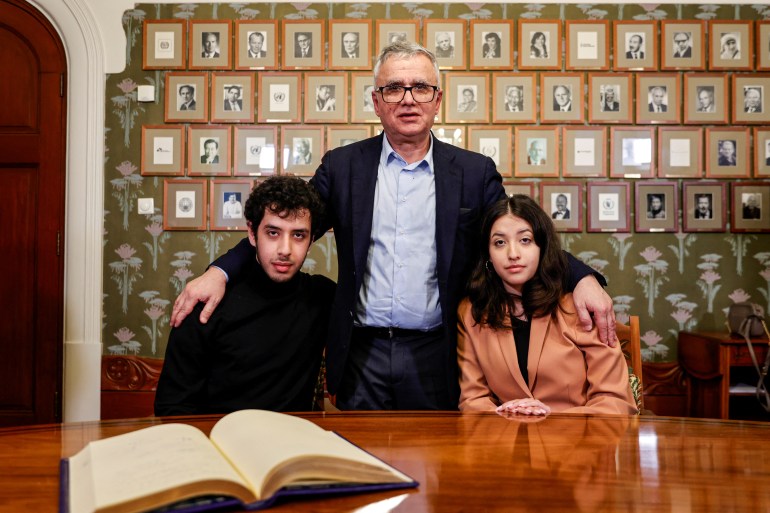
As millions of people took to the streets to denounce Israel’s brutal assault on Gaza that has killed tens of thousands of Palestinians, demanding justice and peace, support for Israel emerged from a surprising quarter: Iranian monarchists. They are supporters of Reza Pahlavi, son of Mohammad Reza Pahlavi, Iran’s last shah who was toppled by the Islamic Revolution of 1979. At pro-Israel rallies, they have waved the old Iranian flag and chanted praise of Israel and its leader, Benjamin Netanyahu. Their confrontations with pro-Palestinian protesters, whom they accuse of being government proxies, reveal their stark divergence from the mainstream Iranian opinion, which has historically supported the Palestinian cause. Yet, the current Gaza war evokes complex reactions in Iran, as many Iranians avoid being associated with the government’s unpopular foreign and domestic policies that have caused widespread discontent. Regardless, many Iranian civil society activists and dissidents try to balance criticism of their government with solidarity with Palestinians. The monarchists’ alignment with Israel, therefore, raises questions about their motives and how big a portion of the opposition they represent. Fractured opposition The Iranian opposition movement comprises various factions, including republicans and monarchists. However, their ideological differences have hindered their unity and led to bitter conflicts and splits among them. [embedded content] In December, many Iranians celebrated the Nobel Peace Prize awarded to Narges Mohammadi, a prominent women’s rights activist and political prisoner in Iran. Her twins, Kiana and Ali, and their father Taghi Rahmani, received the prize on her behalf and met with the king and queen of Sweden, who praised her courage and work. But an online campaign against Mohammadi and her family began from several accounts ostensibly belonging to Iranian monarchists. They cast doubt on Mohammadi’s legitimacy and credibility while insisting that Pahlavi is the only true leader of all Iranians. Their comments included, “Narges Mohammadi is not the representative of Iranians,” and “Our real representative is King Reza Pahlavi.” They flooded the social media pages of the Swedish royal family and the Nobel Peace Committee with such vitriol that comments had to be disabled. This online campaign against Mohammadi reached new heights in December, when Yasmine Pahlavi, Reza Pahlavi’s wife, questioned the credibility of Narges Mohammadi on Instagram, wondering how Mohammadi could give an interview with Angelina Jolie from prison, implying that she was not a real political prisoner, but a puppet of the Islamic republican government. This came as Mohammadi was preparing to receive the Nobel Peace Prize on December 10. Narges mohammadi is a charlatan, and she is not our voice Stop promoting this charlatan Our real representative is king reza Pahlavi@PahlaviReza — mromid2222 (@Mrom2222) December 10, 2023 Mohammadi’s husband responded in a series of tweets outlining the perilous process by which political prisoners in Iran communicate with the outside world – a process that, ironically, the monarchist movement also employs in Iran. The root of this hostility lies in the deep political and ideological rifts between the Iranian monarchists and the Iran-based pro-democracy activists like Mohammadi. The monarchists, who regard Reza Pahlavi as the crown prince and the opposition leader, want the Iranian opposition movement to unite under his leadership. They also support a hardline US approach towards Iran, including increased intervention and harsh sanctions. Mohammadi, however, has a different background and vision. She was part of Iran’s reformist movement, and supported moderate and reformist candidates like Hassan Rouhani and Mir Hossein Mousavi in past elections, along with most of the Iranian civil society and pro-democracy movement. She also rejected sweeping sanctions that hurt Iran’s economy, telling the Washington Post in April 2022 that they “weakened Iranians economically more than they weakened the Iranian regime” and “strengthened the Iranian regime and hardline individuals and groups in the country, including the Islamic Revolutionary Guard Corps. This did not benefit democracy in Iran.” These divergent views on the nature and the future of the Iranian opposition have created a chasm between the monarchists and many other opposition forces, which has been exacerbated by the online attacks against Mohammadi. Taghi Rahmani, centre, with twins Kiana and Ali after signing the guest book at the Nobel Institute in Oslo, Norway, on December 9, 2023 [Frederik Ringnes/NTB/via Reuters] Against this backdrop, Yasmine Pahlavi’s attack on Narges Mohammadi was one of many examples of her hostility towards people with different political views. She has a history of making inflammatory statements on social media and expressing a staunch pro-Israel position. She also publicly demonstrated her support for Israel during the Gaza war, attending a pro-Israel rally in Washington, DC in November and waving an Israeli flag. Indeed, since the outbreak of the Gaza war, the Iranian monarchist movement has shown strong support for Israel online and at pro-Israel rallies in Europe and the United States. Their often-aggressive tactics have concerned many pro-Palestinian activists, with pro-Pahlavi lobbying groups in Washington, DC, such as the National Union for Democracy in Iran (NUFDI), seeking to intimidate pro-Palestinians activists who have been critical of Iranian-American supporters of Israel, labelling them “supporters of Palestinian terrorist groups”. Dubious alliances Shah Mohammad Reza Pahlavi, who ruled until 1979, had a cordial but complex relationship with Israel, trying to balance it with ties to the Arab world. He cooperated with Israel on energy, security, and regional stability, while also at times voicing support for the Palestinian cause and Islamic and non-aligned movements — though he never fully embraced them and was decisively in the US camp in the Cold War. He tried to maximise Iran’s strategic options and leverage in the region while working to position it as the leading Gulf state. NUFDI Statement on Harassment Campaign Against Iranian-American Women pic.twitter.com/lEDtsv8275 — National Union for Democracy in Iran (@NUFDIran) November 28, 2023 His son, Reza Pahlavi, and his supporters, however, have been more and more overly supportive of Israel over the years, seeing it as a critical partner to their cause and ignoring the domestic and regional implications of their stance. Their pro-Israel stance became much more pronounced and vocal after
Why Google’s AI tool was slammed for showing images of people of colour

America’s founding fathers depicted as Black women and Ancient Greek warriors as Asian women and men – this was the world reimagined by Google’s generative AI tool, Gemini, in late February. The launch of the new image generation feature sent social media platforms into a flurry of intrigue and confusion. When users entered any prompts to create AI-generated images of people, Gemini was largely showing them results featuring people of colour – whether appropriate or not. X users shared laughs while repeatedly trying to generate images of white people on Gemini and failing to do so. While some instances were deemed humorous online, others, such as images of brown people wearing World War II Nazi uniforms with swastikas on them, prompted outrage, prompting Google to temporarily disable the tool. America’s Founding Fathers, Vikings, and the Pope according to Google AI: pic.twitter.com/lw4aIKLwkp — End Wokeness (@EndWokeness) February 21, 2024 Here is more about Google Gemini and the recent controversy surrounding it. What is Google Gemini? Google’s first contribution to the AI race was a chatbot named Bard. Bard was announced as a conversational AI programme or “chatbot”, which can simulate conversation with users, by Google CEO Sundar Pichai on February 6, 2023, and it was released for use on March 21, 2023. It was capable of churning out essays or even code when given written prompts by the user, hence being known as “generative AI”. Google said that Gemini would replace Bard and both a free and paid version of Gemini were made available to the public through its website and smartphone application. Google announced that Gemini would work with different types of input and output, including text, images and videos. The image generation aspect of Gemini is the part of the tool which gained the most attention, however, due to the controversy surrounding it. What sort of images did Gemini generate? Images depicting women and people of colour during historical events or in positions historically held by white men were the most controversial. For example, one render displayed a pope who was seemingly a Black woman. In the history of the Catholic Church, there have potentially been three Black popes, with the last Black pope’s service ending in 496 AD. There is no recorded evidence of there being a female pope in the Vatican’s official history but a medieval legend suggests a young woman, Pope Joan, disguised herself and served as pope in the ninth century. Lol the google Gemini AI thinks Greek warriors are Black and Asian. pic.twitter.com/K6RUM1XHM3 — Orion Against Racism Discrimination🌸 (@TheOmeg55211733) February 22, 2024 How does Gemini work? Gemini is a generative AI system which combines the models behind Bard – such as LaMDA, which makes the AI conversational and intuitive, and Imagen, a text-to-image technology – explained Margaret Mitchell, chief ethics scientist at the AI startup, Hugging Face. Generative AI tools are loaded with “training data” from which they draw information to answer questions and prompts input by users. The tool works with “text, images, audio and more at the same time”, explained a blog written by Pichai and Demis Hassabis, the CEO and co-founder of British American AI lab Google DeepMind. “It can take text prompts as inputs to produce likely responses as output, where ‘likely’ here means roughly ‘statistically probable’ given what it’s seen in the training data,” Mitchell explained. The Google Gemini AI interface on an iPhone browser [File: Jaap Arriens/NurPhoto via Getty Images] Does generative AI have a bias problem? Generative AI models have been criticised for what is seen as bias in their algorithms, particularly when they have overlooked people of colour or they have perpetuated stereotypes when generating results. AI, like other technology, runs the risk of amplifying pre-existing societal prejudices, according to Ayo Tometi, co-creator of the US-based anti-racist movement Black Lives Matter. Artist Stephanie Dinkins has been experimenting with AI’s ability to realistically depict Black women for the past seven years. Dinkins found AI tended to distort facial features and hair texture when given prompts to generate images. Other artists who have tried to generate images of Black women using different platforms such as Stability AI, Midjourney or DALL-E have reported similar issues. Critics also say that generative AI models tend to over-sexualise the images of Black and Asian women they generate. Some Black and Asian women have also reported that AI generators lighten their skin colour when they have used AI to generate images of themselves. Instances like these happen when those uploading the training data do not include people of colour or people who are not “the mainstream culture”, said data reporter Lam Thuy Vo in an episode of Al Jazeera’s Digital Dilemma. A lack of diversity among those inputting the training data for image generation AI can result in the AI “learning” biased patterns and similarities within the images, and using that knowledge to generate new images. Furthermore, training data is collected from the internet where a huge range of content and images can found, including that which is racist and misogynistic. Learning from the training data, the AI may replicate that. The people who are the least prioritised in data sets, therefore, are more likely to experience technology that does not account for them – or depict them correctly – which leads to and can perpetuate discrimination. [embedded content] Is this why Gemini generated inappropriate images? In fact, it is the opposite. Gemini was designed to try not to perpetuate these issues. While training data for other generative AI models has often prioritised light-skinned men when it comes to generating images, Gemini has been generating images of people of colour, particularly women, even when it is not appropriate to do so. AI can be programmed to add terms to a user’s prompt after they enter and submit the prompts, Mitchell said. For example, the prompt, “pictures of Nazis”, might be changed to “pictures of racially diverse Nazis” or “pictures of Nazis who are Black women”. So, a strategy which started with good intentions
UN Security Council calls for ceasefire in Sudan during Ramadan

Fighting has forcibly displaced more than eight million people, with millions more in need of food and humanitarian aid. The United Nations Security Council has called for a ceasefire in Sudan to coincide with the Muslim holy month of Ramadan and allow aid to get to 25 million people in desperate need of food with the humanitarian response at breaking point. Fourteen countries on the 15-member council on Friday backed the resolution proposed by the United Kingdom, with only Russia abstaining on the vote that called on “all parties to the conflict to seek a sustainable resolution to the conflict through dialogue”. Fighting has been raging in Sudan since April 15, 2023, pitting the army of General Abdel Fattah al-Burhan against the paramilitary Rapid Support Forces (RSF) of General Mohamed Hamdan “Hemedti” Dagalo. Tens of thousands of people have since been killed, 8.3 million have been forcibly displaced and the fighting has additionally destroyed infrastructure and crippled the economy. Britain’s deputy UN ambassador, James Kariuki, urged the Sudanese Armed Forces and the RSF “to act on this united international call for peace and to silence the guns”. The resolution called on all sides to adopt an immediate “cessation of hostilities” ahead of Ramadan, a time for fasting, prayer and reflection for Muslims worldwide. It urged the warring parties to allow “unhindered” humanitarian access across borders and battlelines. The resolution also expressed “grave concern over the spreading violence and the catastrophic and deteriorating humanitarian situation, including crisis levels, or worse, of acute food insecurity, particularly in Darfur”. UN Secretary-General Antonio Guterres on Thursday said both sides should “honour the values of Ramadan by honouring a Ramadan cessation of hostilities” as he warned that the conflict threatens Sudan’s unity and “could ignite regional instability of dramatic proportions.” The African Union also backed a halt to fighting during Ramadan which is expected to begin on or around Monday, depending on the sighting of the crescent moon. While al-Burhan reportedly welcomed the UN chief’s appeal, the Sudanese Foreign Ministry issued a statement on Friday that set conditions for a ceasefire to be effective which included the RSF withdrawing from provinces they have taken control of. There has been no response from the RSF. ‘Road to famine’ Russia said Britain’s initiative was hypocritical since the UNSC had failed to call for an immediate ceasefire in Israel’s war on Gaza, because of the United States repeatedly wielding its veto to block resolutions. “We have no illusions as to the true intentions of Western countries. However, the double standards look particularly glaring given that those same countries are dragging out the adoption of a document on a ceasefire in the Gaza Strip, where a genuine massacre is taking place,” said Russia’s deputy UN ambassador, Anna Evstigneeva. UN aid chief Martin Griffiths said humanitarian aid access in Sudan needs to be improved whether or not a ceasefire is declared. Half of the country’s 50 million people are in need of aid and “just under 18 million people are on the road to famine,” Griffiths said, adding that 10 million more people “are in the category of food insecure than the same time last year”. The UN’s $2.7bn humanitarian response plan for Sudan in 2024 is currently only 4 percent funded. “We have no money,” Griffiths said, and “we want to put Sudan on the map.” Adblock test (Why?)
‘Most vexing’ test: Can Pakistan’s Sharifs revive talks with India’s Modi?

Islamabad, Pakistan — It was a brief, formal exchange. On March 5, two days after Shehbaz Sharif became Pakistan’s 24th prime minister, his Indian counterpart posted a 13-word message on social media platform X. “Congratulations to @CMShehbaz on being sworn in as the Prime Minister of Pakistan,” the Indian premier wrote. Sharif took two days to respond. “Thank you @narendramodi for felicitations on my election as the Prime Minister of Pakistan,” he wrote on March 7. Modi’s congratulatory message and Sharif’s response set off questions, even in a US State Department briefing, about the prospect of a detente between the nuclear-armed subcontinental neighbours that have barely functional diplomatic relations. The State Department weighed in, saying it hoped for a “productive and peaceful relationship” between New Delhi and Islamabad. But even though the Pakistani prime minister’s elder brother Nawaz Sharif has a long history of seeking breakthroughs with India – including with Modi – analysts on both sides of the border say that the direction of ties can only be gauged after India’s upcoming national elections, scheduled to take place in April and May. Maleeha Lodhi, a retired Pakistani diplomat who has served as ambassador to the United Nations, United States as well as the United Kingdom, said that managing relations with New Delhi will prove the “most vexing” foreign policy test for the current government. “It’s true that previous PMLN were amenable to engage with India but it used to be reciprocal,” she told Al Jazeera, referring to the Pakistan Muslim League Nawaz (PMLN), the party of the Sharif brothers. “But today there are many obstacles to normalising ties which are not easy to overcome. “With India going to the polls this year, any significant engagement will have to wait till after the elections.” Kashmir conundrum Arguably, the biggest obstacle to any movement towards normalcy between the neighbours remains the question of the Kashmir valley, the picturesque, but contentious Himalayan region over which they have fought multiple wars since gaining independence from British rule in 1947. The region is claimed in full by both, but each only governs parts of it. New Delhi has accused Islamabad of backing Kashmiri armed rebels fighting either for independence or for a merger with Pakistan. Islamabad has denied the allegations, saying it only provides diplomatic support to the region’s struggle for the right to self-determination. Relations between India and Pakistan further worsened in 2019 when Modi’s Hindu nationalist government revoked Article 370 of the Indian Constitution, which used to give Indian-administered Jammu and Kashmir partial autonomy. Kashmir is at the heart of the differences between India and Pakistan, and is a subject in which each of the neighbours has set conditions for talks that are unacceptable to the other. India insists that the status of Jammu and Kashmir is an internal matter for the country. Pakistani leaders, on the other hand – including the Sharif brothers – have linked progress in ties with India to a reversal of the 2019 decision by New Delhi. Former Indian high commissioner to Pakistan, Sharat Sabharwal said that if the aim is to improve relations, the ball is in Pakistan’s court, adding that it was Pakistan that suspended trade as well as downgraded diplomatic representation. “Since then, it has made engagement with India contingent upon India reversing its move to end the special status of Jammu and Kashmir under the Indian Constitution. This is just not going to happen,” he told Al Jazeera. “It is for the Pakistan government to take a more pragmatic and constructive view if things are to move forward.” The Sharif touch Yet, despite the tough posturing on both sides, some analysts are cautiously optimistic about the possibility of a renewed attempt by the two governments to improve ties, in large part because of the history that the Sharifs share with Modi and his Bharatiya Janata Party. In February 1999, the then-Indian Prime Minister from the BJP, Atal Bihari Vajpayee, took a bus ride across the border to Lahore to meet Nawaz Sharif, who was then in his second stint as prime minister. Nawaz and Vajpayee signed a treaty that was seen as an historic confidence-building breakthrough between the two countries, less than a year after both of them conducted nuclear tests that had escalated tensions in the region. However, three months after the treaty, the two countries engaged in a war in Kargil in Indian-administered Kashmir. India accused Pakistani soldiers of infiltrating into territory it controlled. Nawaz blamed his then-military chief, General Pervez Musharraf and other top commanders for orchestrating the incursion behind his back. Only a few months later, Musharraf carried out a military coup in October 1999 in which Sharif was removed from power, just two years after assuming charge as the prime minister. A year after Nawaz finally returned to power in 2013, the BJP, too, came back into office after a decade in opposition – this time with Modi as prime minister. Nawaz joined leaders from across South Asia in travelling to New Delhi for Modi’s oath-taking ceremony. Nawaz Sharif became the first Pakistani premier to visit India to attend a prime minister’s oath-taking in 2014 [Harish Tyagi/EPA] Then, on Christmas day in December 2015, Modi stunned both nations with a surprise visit to Lahore to attend the wedding of Nawaz’s granddaughter. The Pakistani government said that the two nations would restart a formal dialogue and announced a meeting of senior diplomats in January 2016. But merely a week later, four attackers targeted an Indian Air Force base which resulted in the deaths of at least eight Indians, including security personnel. India once again blamed Pakistan for the incident and demanded it arrest the perpetrators behind the attack. In September 2016, after armed fighters attacked an Indian Army outpost in Kashmir, Indian soldiers crossed over into Pakistani-administered territory to raid what New Delhi described as “militant launch pads”. Three years later, in February 2019, just before India’s last national elections, tensions soared again, after 46 Indian paramilitary soldiers were killed
Bollywood ‘takeover’: Pro-Modi films swamp Indian voters ahead of election

Mumbai, India – A grimacing police official, staring into the camera, declares her intent to publicly shoot dead “leftists” while attacking “left-liberal, pseudo-intellectuals” as well as students of Jawaharlal Nehru University (JNU), a left-leaning university space in the cross-hairs of the Modi government. Men in skull caps, the visuals intercut with bloody violence, declare that Rohingya Muslims will soon displace Hindus and make for half of India’s population, while a harrowed Hindu woman fighting against these men says she wants to meet Prime Minister Narendra Modi. A biopic on the early 20th century Hindu nationalist ideologue Vinayak Damodar Savarkar has a voiceover that insists that India would have freed itself of British colonial rule over three decades before it did, if not for Mahatma Gandhi. These are scenes from upcoming Hindi films slated for release over the next few weeks. As India’s nearly one billion voters get ready to pick their national government in general elections between March and May, Modi and his ruling Bharatiya Janata Party (BJP) are receiving campaign support from an atypical ally: cinema. A slew of new films, timed with the elections and often helmed by major production houses, are relying on storylines that overtly either promote Modi and his government’s policies or target rival politicians. Not even national icons like Gandhi or top universities like JNU are spared – the institution has long been a left-leaning bastion of liberal education, often antagonistic to the BJP’s Hindu majoritarianism. Many of these stories peddle Islamophobic conspiracies commonly circulated among Hindu right-wing networks that are aligned with the BJP’s political agenda. At least 10 such films have either been released recently or are poised to hit theatres and television in this election season “This is part of a larger attempt to ‘take over’ the Hindi film industry, just as other forms of popular culture have been infiltrated,” said Ira Bhaskar, a retired professor of cinema studies at JNU who also served as a member of the country’s censor board until 2015. Bhaskar was referring to the growing Hindu nationalist narratives found in pop culture forms like music, poetry and books. The latest films include biopics that glorify the controversial legacies of Hindu majoritarian heroes and BJP leaders. Savarkar, a controversial anti-colonial Hindu nationalist, advocated rape against Muslim women as a form of retribution for historical wrongs. Two of the upcoming films, Accident or Conspiracy: Godhra, and The Sabarmati Report, claim to “reveal” the “real story” behind the Godhra train burning of 2002 where 59 Hindu pilgrims died in a fire that was the spark for anti-Muslim riots orchestrated by Hindu right-wing groups that claimed over 1,000 lives, mostly Muslims. The riots happened when Modi was the state’s chief minister. Another film, Aakhir Palaayan Kab Tak? (Until when will we need to flee?), shows a Hindu “exodus” purportedly due to Muslims. Then there’s Razakar, a multilingual release on what it calls the “silent genocide” of Hindus in Hyderabad by Razakars, a paramilitary volunteer force that inflicted mass violence before and after India’s independence in 1947. The film has been produced by a BJP leader. In late February, Modi himself praised Article 370, a newly released film that lauds his government’s contentious decision to strip Indian-administered Jammu and Kashmir of its special status and statehood while placing hundreds under house arrests and imposing lockdowns in the region. Film reviewers have called the movie a “puff piece” and a “thinly veiled propaganda film” in favour of the Modi government while treating its critics and opposition leaders with “derision”. Bhaskar said the new films were “clear propaganda, no doubt about it”. A growing trend The surge in such movies builds on a pattern also seen before the 2019 elections when Modi returned to power for a second time. On the eve of that vote, a clutch of films tried to bolster the BJP’s popularity. Some tried to take down the ruling party’s critics, like the Accidental Prime Minister (PM), a searing take on Modi’s predecessor, Manmohan Singh. Others stoked jingoism, like Uri: The Surgical Strike, which recreated the military strikes that Indian forces made inside Pakistan-controlled Kashmir in retaliation against a terror attack on an Indian military camp in Kashmir’s Uri region in September 2016. The film ended with a scene of a pleased-looking Modi-resembling prime minister. Both films were released in the same week, days before the elections. But Bhaskar said that while the trend isn’t new, it has grown since 2014, when Modi came to power, starting off with the changed way that the Indian film industry dealt with historical representations. “Over the last few years, we have seen a shift in the representation of Muslim rulers who are all, now, portrayed as barbarians and temple-destroyers,” Bhaskar said. “This was also propaganda, though in a not-so-direct way, where the message was: Muslims don’t belong to India, they were invaders.” These positions align with the Hindu right-wing ecosystem’s publicly-stated aims of purging Mughal history from public consciousness. Such films, in the past, have faced allegations of amplifying social divisions and hate speech. Screenings of films like The Kashmir Files, depicting the Kashmiri Pandit exodus of the 1990s, often saw audiences, at the end of the film, rising up and calling for violence against Muslims and advocating their boycott. Another film, The Kerala Story, panned widely for inaccuracies in depicting an alleged ISIL/ISIS conspiracy to lure Christian and Hindu girls to join the group, played a part in igniting societal tensions among communities, leading to violence in the western Indian region of Akola in Maharashtra. Fear and opportunism Film industry insiders attribute this new genre of films to a mix of unease, opportunism and a helpful nudge from the establishment. A number of industry insiders this writer contacted refused to speak on record, for fear of retribution. Bollywood, in the recent few years, has frequently been a victim of high-decibel campaigns, often endorsed by BJP leaders – from boycotting films to calling for bans on them. Hindu right-wing groups have often targeted films and shows for broadcasting “anti-Hindu” content. In 2021, BJP leaders
Canada lifting freeze on UNRWA funding after weeks of protests, criticism

Montreal, Canada – Canada has announced it is lifting a freeze on funding for the United Nations agency for Palestinian refugees (UNRWA), after facing fierce criticism for cutting assistance during Israel’s war in Gaza. In a statement on Friday, Canadian Minister of International Development Ahmed Hussen said the government is “resuming its funding to UNRWA so more can be done to respond to the urgent needs of Palestinian civilians”. Canada had joined the United States and several other countries in cutting funding to UNRWA in late January, after Israel accused about a dozen of the agency’s more than 13,000 employees in Gaza of taking part in a Hamas attack on October 7. UNRWA immediately sacked the employees in question and announced that it was opening a probe into the allegations, which it described as “shocking” and “serious”. UN Secretary-General Antonio Guterres also appointed an independent panel to investigate. Israel, however, did not provide concrete evidence to back up its allegations. Canadian broadcaster CBC News also reported in early February that Canada had not seen any intelligence backing the claim before it decided to cut the funding. The decision to cut funding for UNRWA — which relies on government contributions to fund its operations in the occupied Palestinian territories, Jordan, Syria and Lebanon — drew immediate concern and calls from rights advocates to reconsider. UNRWA also is the key agency providing critical humanitarian supplies to Palestinians in the Gaza Strip, where Israel’s continued bombardment and siege have killed more than 30,000 people and led to widespread hunger and disease. Humanitarian groups had warned that cutting UNRWA funding would have dire repercussions for Palestinians in Gaza and urged donor countries to reverse their decisions. Since then, the situation in the Strip has deteriorated further, as Israeli military attacks continue. About a dozen Palestinian children have died in recent weeks due to a lack of food and water in Gaza, according to health authorities in the coastal enclave. Palestinians gather to inspect a destroyed building following an Israeli attack on Deir el-Balah on March 8 [Ashraf Amra/Anadolu Agency] ‘Reckless political decision’ On Friday afternoon, Canadian human rights advocates welcomed the government’s decision to lift the freeze on UNRWA funding but stressed that the money should not have been cut to begin with. “Resuming aid to UNRWA is a much-needed decision, and it would not have been possible without the important advocacy from across civil society,” said Thomas Woodley, president of the advocacy group Canadians for Justice and Peace in the Middle East. “Minister Hussen’s cancellation of funding was a reckless political decision that never should have been made. Canada’s irresponsible actions threatened to collapse the aid infrastructure in Gaza, putting the lives of millions of people at risk,” Woodley said in a statement. “Canada must significantly increase funding to UNRWA to compensate for the harm its actions have caused to the people of Gaza.” The government contributed $66.5m ($90m Canadian) to UNRWA from 2019 though mid-2023. Last June, Ottawa also announced that it would provide as much as $74m ($100m Canadian) to the agency over four years to help fund education, health care and other services. Canadian media outlets have reported that the next installment of that funding — about $18m ($25m Canadian) — is due in April. Meanwhile, the head of the National Council of Canadian Muslims also noted on Friday that “there are no other agencies that can replicate UNRWA’s central role in the humanitarian response in Gaza”. “While funding should not have been paused in the first place, the government made the right decision today by renewing and increasing funding,” the group’s CEO, Stephen Brown, said in a statement. Pressure on Trudeau Canadian Prime Minister Justin Trudeau’s government had faced pressure from pro-Israel lobby groups to maintain its freeze on funding for UNRWA. Members of Trudeau’s own Liberal Party also had urged him to withhold the funds. Pro-Israel Liberal legislators Anthony Housefather and Marco Mendicino said in a letter on Thursday that they had recommended “that Canada work in lockstep with the United States and other allies”. They urged the government “to leverage alternate partners and to create new vehicles of humanitarian aid that will meaningfully reach the civilians of Gaza in the short term”. But experts and humanitarian groups have said UNRWA is best suited to provide much-needed assistance to Palestinians in Gaza. In a news conference on Friday afternoon, Hussen said the decision to resume funding was “in recognition of the significant and serious processes that the United Nations has undertaken to address the issues in UNRWA”. It also comes in recognition of “the critical role that UNRWA plays in providing much-needed support to over two million Palestinians in Gaza, as well as … millions more in the broader region”, Hussen told reporters. Palestinians in Gaza are being starved amidst catastrophic conditions. The need for life-saving aid has never been more urgent. Today’s announcement by Canada 🇨🇦 on the resumption of funding to United Nations Relief and Works Agency (UNRWA) will save lives. There are no other… pic.twitter.com/lYQalSibi1 — NCCM (@nccm) March 8, 2024 Adblock test (Why?)