

Palestinians displaced by Gaza war prepare for Ramadan

NewsFeed Palestinians in Gaza are making preparations for Ramadan in the midst of Israel’s war on the territory, which poses immense challenges for those observing the holy month. Published On 7 Mar 20247 Mar 2024 Adblock test (Why?)
This is not ‘Netanyahu’s war’, it is Israel’s genocide

I do not blame Benjamin Netanyahu. I do not blame the Israeli prime minister for what is happening to my people. I do not blame him today, as Israeli bombs destroy every corner of Gaza, and children die under the rubble. I did not blame him back in 2013, when I had to watch the slaughter of my people in Gaza on the evening news, either. My mother did not blame him when snipers perched on rooftops shot at her as she tried to make her way to work in the West Bank. My grandfather, God rest his soul, did not blame him as he died without ever returning to the land settlers stole from him in the 1980s, either. For me, for my family, for my people, what we are witnessing in Palestine today is not “Netanyahu’s war”. It is not his occupation. He is nothing but another cog in the relentless war machine that is Israel. Yet if you were to ask senators Bernie Sanders or Elizabeth Warren, the supposed champions of Palestinian rights and progressive humanitarianism in the United States, everything that has happened to us in the past 75 years, and everything that is happening to us today, can be blamed on one man, and one man alone: Netanyahu. Sanders insistently calls the ongoing Israeli assault on Gaza “Netanyahu’s war”, and demands that the US “not give Netanyahu another nickel”. Meanwhile, Warren denounces “Netanyahu’s failed leadership” as she calls for a ceasefire. For these progressive senators, the cause of all the pain and suffering in Palestine is clear: a far-right, hawkish prime minister hell-bent on continuing a conflict that keeps him in power. Sure, Netanyahu is evil. Sure, he committed countless crimes against Palestinians and against humanity, throughout his long career. Sure, he is continuing to fuel the carnage in Gaza today in part for his own political survival. And he should be held accountable for everything he has said and done that caused harm and pain to my people. But the racism, extremism and genocidal intent that is on display in Gaza and across the occupied Palestinian territory today cannot and should not be blamed on Netanyahu alone. Blaming Israel’s blatant human rights abuses, disregard for international law, and open celebration of war crimes on Netanyahu alone is nothing but a coping mechanism for liberals like Sanders and Warren. By blaming Netanyahu for the suffering and oppression of the Palestinian people, past and present, they keep alive the lie that Israel was built on progressive ideals, rather than ethnic cleansing. By blaming Netanyahu, they whitewash their seemingly unconditional support for a state blatantly committing war crimes and crimes against humanity. By blaming Netanyahu, and casting Israel as a progressive, well-meaning state that would respect international humanitarian law but is currently taken over by a bad leader, they are absolving themselves – and the US at large – of complicity in Israel’s many war crimes. Of course, Sanders, Warren and all the others pushing this line know well that the “conflict” in Israel-Palestine would not magically disappear and Palestinians would not immediately achieve liberation and justice if Netanyahu were gone. After all, they’ve seen a similar scenario play out in the US only a few years ago. People had said if only Trump was removed from the White House, problems that he fuelled and provoked would disappear. The American democracy would be saved and everything would be just fine. But did that happen? It has been almost four years since the eventful end of Trump’s presidency, but we can still see rampant racism, inequality, gun violence and poverty across the country. These problems have not been magically fixed after Trump’s presidency, because they were not created by Trump. These were never “Trump” problems, but American ones. Furthermore, there is a very real chance that Trump will return to the White House next year because millions of Americans support him and his agenda. The same is true for Netanyahu and Israel. The suggestion that Netanyahu betrayed Israel’s progressive, democratic foundations and caused the “humanitarian catastrophe” we are witnessing in Gaza today, ignores the systemic oppression that is inherent to Israel as a settler colony. Sanders and others may want to believe the Zionist myth that Israel is an essentially progressive country with socialist foundations, built on a “land without people” by a people without land. But they cannot escape the fact that Palestine has never been a ”land without a people”. Indeed, the founding of Israel required the expulsion of hundreds of thousands of Palestinians who are Indigenous to the land, and the survival of Israel as a “Jewish Nation”, as stated in its Nation State Law, requires the continued oppression, disenfranchisement and abuse of Palestinians. Today, millions of Palestinians continue to live and die under Israeli occupation, and they – alongside Palestinian citizens of Israel – are subjected to what is widely described as an apartheid system. This untenable and unjust dynamic is hardly the creation of Netanyahu and his government. From the very beginning, the state of Israel tied its long-term survival to the ethnic cleansing of Palestine, complete erasure of the Palestinian identity, and the oppression of Palestinians who remained on their lands. Former Israeli Prime Minister Golda Meir wrote in a Washington Post op-ed that “There is no such thing as Palestinians” in 1969, decades before the beginning of Netanyahu’s reign. Sure, the Israeli left promote their agriculture-based communal living situation in “kibbutzim” as a socialist dream, and many Israelis take pride in their country’s “democracy”. But all this is true only if you ignore the humanity of Palestinians who have been ethnically cleansed from their lands to make way for the socialist kibbutzim, and who cannot participate in Israel’s democracy despite living under full Israeli control in illegally occupied territory. Before the beginning of the genocide in Gaza, Israelis protested en masse against what they deemed to be an attack on the country’s legal system and democracy by Netanyahu for months.
Oceans break high-temperature record in warmest February marked globally

Marine high occurs during what was also the hottest February on record, marking ninth straight month with such a milestone for respective month. Ocean temperatures hit a record high last month, which was also the warmest February on record globally, scientists in the European Union have said. The average global sea surface temperature stood at 21.06 degrees Celsius (69.91 degrees Fahrenheit) in February, surpassing the previous record of 20.98C (69.77F) set in August 2023, in a dataset that goes back to 1979, the EU’s Copernicus Climate Change Service (C3S) said on Thursday. Meanwhile, the average air temperature in February was 13.54C (56.4F), 1.77C (3.18F) warmer than the pre-industrial average for the month. It marked the ninth consecutive month that was the warmest on record for the respective month of the year. Earlier, January had also been recorded as the warmest first month of the year, surpassing the previous warmest January in 2020, as per C3S’s records going back to 1950. Last month, after scientists warned of the hottest January on record as the world continued a run of exceptional heat fuelled by climate change, C3S Deputy Director Samantha Burgess said, “Rapid reductions in greenhouse gas emissions are the only way to stop global temperatures increasing.” February 2024 was the warmest February on record according to @CopernicusECMWF⁰1.77°C warmer than pre-industrial⁰9th record breaking month in a row⁰ ⁰Global temperatures for the past 12 months are the highest on record, at 1.56°C above pre-industrial ⁰#ClimateAction pic.twitter.com/bYrcm7nKky — Dr Sam Burgess 🌍🌡🛰 (@OceanTerra) March 7, 2024 The C3S scientists said while the El Nino climate pattern continued to weaken in the equatorial Pacific in February, marine air temperatures remained at an unusually high level. Marine scientists warned this week that a fourth global mass coral bleaching event is likely unfolding in the Southern Hemisphere, driven by warming waters and possibly the worst in the planet’s history. Corals bleach under heat stress, expelling the colourful, helpful algae that live in their tissues, leaving behind a pale skeleton. This makes them vulnerable to starvation and disease, and many die. This can lead to the collapse of fragile reef ecosystems, with coastlines left unprotected from erosion and storms and fisheries falling short. El Nino, borne out of warmer than usual surface waters in the Eastern Pacific, alongside human-caused climate change, is fuelling the extra heat. “What is more surprising is that sea surface temperatures are at record levels over regions far away from the centre of the El Nino action, such as the tropical Atlantic and Indian Ocean,” said climate scientist Richard Allan of the University of Reading. This, he said, pointed to the strong influence of rising greenhouse gas emissions in the atmosphere. While the global average sea surface temperature record excludes the polar oceans, things are in bad shape there, too. Antarctic sea ice reached its annual minimum extent in February, registering its third-lowest extent on record at 28 percent below average. Adblock test (Why?)
Ramadan 2024: Fasting hours and iftar times around the world
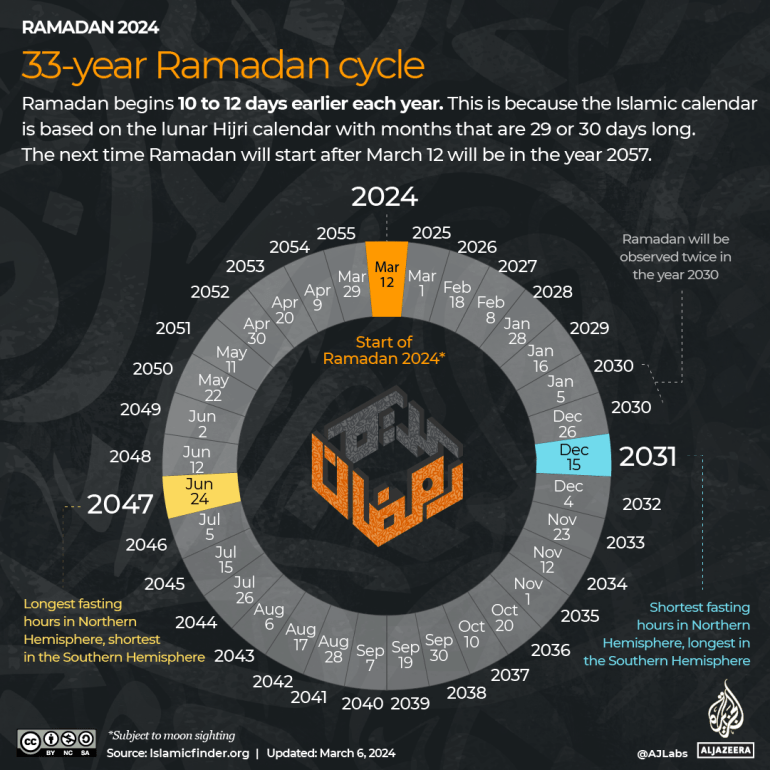
The Muslim holy month of Ramadan will begin on Monday, March 11 or Tuesday, March 12, depending on the sighting of the new moon. The dawn-to-dusk fast lasts anywhere from 12 to 17 hours, depending on which part of the world you are in. Muslims believe that Ramadan is the month when the first verses of the holy book Quran were revealed to the Prophet Muhammad more than 1,400 years ago. The fast entails abstinence from eating, drinking, smoking and sexual relations during daylight hours to achieve greater “taqwa”, or consciousness of God. Why does Ramadan start on different dates every year? Ramadan begins 10 to 12 days earlier each year. This is because the Islamic calendar is based on the lunar Hijri calendar with months that are 29 or 30 days long. Because the lunar year is shorter than the solar year by 11 days, Ramadan will be observed twice in the year 2030 – first beginning on January 5 and then starting on December 26. The next time Ramadan will start after March 12 will be 33 years from now – in the year 2057. Fasting hours around the world The number of daylight hours varies across the world. Muslims living in the world’s southernmost countries, such as Chile or New Zealand, will fast for about 12 hours, while those living in northernmost countries, such as Iceland or Greenland, will have 17-plus hours fasts. For Muslims living in the Northern Hemisphere, the number of fasting hours will be a bit shorter this year and will continue to decrease until 2031, which is the year Ramadan will encompass the winter solstice – the shortest day of the year. After that, fasting hours will increase until the summer solstice – the longest day of the year in the Northern Hemisphere. For fasting Muslims living south of the equator, the opposite will happen. In extreme northernmost cities, such as Longyearbyen in Norway, where the sun does not set from April 20 to August 22, religious rulings have been issued to follow timings in Mecca, Saudi Arabia, or the nearest Muslim country. Cities that share the same iftar times The predawn meal to start the daily fast is called suhoor, while the breaking of one’s fast after sunset is called iftar. Cities situated roughly along the same longitude will have similar iftar times, while those on the opposite side of the globe will be preparing to start their fast with suhoor. The infographic below shows which cities are having suhoor while others are having their iftar. Fasting times around the world The table below shows the suhoor and iftar times on the first and last days of Ramadan 2024. Use the arrows or search box to find your city. Which cities have the longest and shortest fasting hours? Below are the average number of fasting hours in cities around the world. Actual fasting hours and times will vary by day, as well as calculation methods: – Nuuk, Greenland: 16 hours– Reykjavik, Iceland: 16 hours– Helsinki, Finland: 15 hours– Oslo, Norway: 15 hours– Glasgow, Scotland: 15 hours– Berlin, Germany: 15 hours– Dublin, Ireland: 15 hours– Moscow, Russia: 15 hours– Amsterdam, the Netherlands: 15 hours– Warsaw, Poland: 15 hours– Astana, Kazakhstan: 15 hours – Brussels, Belgium: 14 hours– London, UK: 14 hours– Zurich, Switzerland: 14 hours– Stockholm, Sweden: 14 hours– Bucharest, Romania: 14 hours– Sarajevo, Bosnia and Herzegovina: 14 hours– Sofia, Bulgaria: 14 hours– Rome, Italy: 14 hours– Madrid, Spain: 14 hours– Paris, France: 14 hours– Lisbon, Portugal: 14 hours– Ankara, Turkey: 14 hours– Ottawa, Canada: 14 hours– Tokyo, Japan: 14 hours– Beijing, China: 14 hours– Athens, Greece: 14 hours– New York City, US: 14 hours– Washington, DC, US: 14 hours– Los Angeles, US: 14 hours– Tunis, Tunisia: 14 hours– Algiers, Algeria: 14 hours– Tehran, Iran: 14 hours– Kabul, Afghanistan: 14 hours– New Delhi, India: 14 hours– Dhaka, Bangladesh: 14 hours– Rabat, Morocco: 14 hours– Damascus, Syria: 14 hours– Islamabad, Pakistan: 14 hours– Baghdad, Iraq: 14 hours– Beirut, Lebanon: 14 hours– Amman, Jordan: 14 hours– Gaza City, Palestine: 14 hours– Cairo, Egypt: 14 hours– Doha, Qatar: 13 hours– Dubai, UAE: 13 hours– Khartoum, Sudan: 13 hours– Riyadh, Saudi Arabia: 13 hours– Abuja, Nigeria: 13 hours– Aden, Yemen: 13 hours– Dakar, Senegal: 13 hours– Addis Ababa, Ethiopia: 13 hours– Buenos Aires, Argentina: 13 hours– Colombo, Sri Lanka: 13 hours– Kuala Lumpur, Malaysia: 13 hours– Mogadishu, Somalia: 13 hours– Ciudad del Este, Paraguay: 13 hours– Nairobi, Kenya: 13 hours – Harare, Zimbabwe: 13 hours– Jakarta, Indonesia: 13 hours– Luanda, Angola: 13 hours– Bangkok, Thailand: 13 hours– Brasilia, Brazil: 13 hours– Johannesburg, South Africa: 13 hours– Montevideo, Uruguay: 13 hours– Canberra, Australia: 13 hours– Puerto Montt, Chile: 13 hours– Christchurch, New Zealand: 13 hours Ramadan greetings in different languages Various Muslim-majority nations have a personalised greeting in their native languages. “Ramadan Mubarak” and “Ramadan Kareem” are the most common greetings exchanged in this period, wishing the recipient a blessed and generous month, respectively. Adblock test (Why?)
Israel’s blocking of aid creating ‘apocalyptic’ conditions in Gaza

Israel has generated “famine-like conditions” in the Gaza Strip “while obstructing and undermining the humanitarian response”, according to a new report by humanitarian group Refugees International. The group’s research in Egypt, Jordan and Israel revealed that Tel Aviv “consistently and groundlessly impeded aid operations within Gaza, blocked legitimate relief operations and resisted implementing measures that would genuinely enhance the flow of humanitarian aid into Gaza”. The report was based on interviews with dozens of government officials, humanitarian workers, and NGO staff engaged in on-the-ground aid efforts from the three countries. “Our research makes clear that conditions inside of Gaza are apocalyptic,” said the report released on Thursday. “After five months of war, Palestinians are struggling to find adequate food, water, shelter, and basic medicine. Famine-level hunger is already widespread and worsening.” Failing to comply with ICJ ruling Refugees International also said that Israel was “demonstrably failing to comply” with legally binding provisional measures ordered on January 26 by the International Court of Justice (ICJ) to facilitate the flow of aid and lessen humanitarian suffering in Gaza. In its defence to the ICJ, Israel argued it has actively eliminated bottlenecks and improved the entrance and distribution of aid in Gaza. The report revealed that Israeli authorities have “erected unnecessary hurdles, complicated logistical processes, and an unpredictable vetting system, rendering the inspection regime overwhelmingly burdensome with layers of bureaucracy and inspection and limited working hours”. While Israel claimed that it expanded capacity for aid delivery to Gaza, the average number of trucks delivered in February actually fell by 50 percent compared with the previous month, according to United Nations data cited in the report. Critical crossings like the northern Erez and Al-Muntar – known as Karni to Israelis – remain closed, impeding access to the north of Gaza. The report said Israel failed to comply with the terms of a National Security Memorandum (NSM-20) issued in February by United States President Joe Biden’s administration that require countries receiving US security assistance to actively facilitate the delivery of humanitarian assistance in Gaza. Logistical issues Refugees International found that logistical issues within Egypt and Jordan are limiting the distribution of life-saving assistance to people in Gaza. The Rafah crossing between Gaza and Egypt, mainly intended for commercial deliveries, lacks the capacity to process the substantial amount of aid the Strip requires. Egyptian authorities have also sought to deter a large-scale humanitarian response in the northern Sinai, a military zone. The report found that Egypt responded to Israel’s pressure to open its borders to Palestinian refugees by intensifying its oversight and regulation of access to the border area for aid agencies, as well as its monitoring of entry and exit of individuals to and from Gaza. The charities delivering aid to Gaza from Jordan’s capital Amman told Refugees International that Israeli officials put in place “difficult obstacles” that did not exist before and have yet to provide clear standard operating procedures to Jordanian authorities. New barriers, such as new inspection requirements, are also stalling aid at the Allenby Bridge crossing into Israel and the border crossing at Karem Abu Salem (Kerem Shalom). Calls for ceasefire The report called on the warring parties in Gaza to “immediately agree to a mutual ceasefire and release of all hostages” as well as “adhere to international humanitarian law and refrain from any action that threatens the rights, safety, and dignity of both Palestinian and Israeli civilians”. The United States, Qatar and Egypt have spent weeks trying to broker an agreement in which Hamas would release Israeli captives in return for a six-week ceasefire, the release of some Palestinian prisoners and more aid to Gaza. But three days of negotiations with Hamas this week over a ceasefire in Gaza have failed to achieve a breakthrough, less than a week before the start of the Muslim holy month of Ramadan – the informal deadline for a deal. Refugees International also called for an end to attacks on civilians and infrastructure and for allowing the UN and aid agencies access to populations in need. Among other recommendations, it said Israel must refrain from “a military offensive in Rafah, and other actions that could displace Palestinians further or otherwise worsen the humanitarian crisis”. The Israeli military has been preparing for a long-threatened ground invasion in the southern Gaza border city of Rafah, where more than half of the enclave’s 2.3 million population has been forcibly displaced. At least 30,800 Palestinians have been killed and 72,198 wounded in Israeli attacks on Gaza since October 7. The death toll in Israel from the October 7 Hamas attacks stands at 1,139. Adblock test (Why?)
What does the end of Nikki Haley’s campaign mean for the Republican Party?

She raised concerns about his age. His mental state. His capacity for leadership when faced with 91 criminal charges. And yet, former United Nations Ambassador Nikki Haley could not overcome former President Donald Trump in the race for the United States presidency. On Wednesday, she announced she was suspending her campaign, clearing the way for Trump to receive the Republican Party nomination. Analysts, however, say her long-shot bid reflects how ironclad Trump’s hold over the party has become. Nevertheless, her campaign gave voice to the anxieties some Republicans harbour. “There is some angst in elite Republican circles that Trump comes with a lot of baggage and that they could do better with someone else,” Osita Nwanevu, a writer on US politics, told Al Jazeera. “Haley was the candidate who embodied that concern, that sticking with Trump could hurt the party.” But that message failed to resonate beyond pockets of moderate voters. Haley announced her campaign’s suspension in the aftermath of the Super Tuesday primary votes. With 15 states up for grabs, she only managed to secure one: left-leaning Vermont. Haley ultimately finished the race on Wednesday with just 89 party delegates to Trump’s 995. Delegates ultimately decide who receives the party nomination. “In all likelihood, Donald Trump will be the Republican nominee when our party convention meets in July. I congratulate him and wish him well,” Haley said in her announcement on Wednesday. However, Haley stopped short of endorsing Trump, instead calling on him to win over voters who may have doubts about his candidacy. “It is now up to Donald Trump to earn the votes of those in our party and beyond who did not support him,” she said. Last woman standing A former governor of South Carolina, Haley outlasted all other major Republican opponents, including Florida Governor Ron DeSantis, to face Trump one-on-one in the primaries. But even her exit speech reflected the difficult balancing act she was forced to walk. Experts say she tried to appeal to moderates without alienating party voters for whom loyalty to Trump has become an article of faith. Throughout the race, Trump pilloried Haley — a former member of his administration — as a “birdbrain” and a “Republican in name only”, or RINO. He celebrated her Super Tuesday losses with a post on social media, revisiting a frequent accusation that she represented Democratic interests. “Nikki Haley got TROUNCED last night, in record setting fashion, despite the fact that Democrats, for reasons unknown, are allowed to vote in Vermont, and various other Republican Primaries,” Trump wrote. “Much of her money came from Radical Left Democrats.” Experts have observed that Trump’s rhetoric towards Haley has been echoed among his base of supporters, who have questioned her political credentials — and even her citizenship as an American of Indian heritage. Trump, for example, raised doubts about whether she was even born in the United States, a conspiracy theory he also pushed during the presidency of Democrat Barack Obama. “The level of negativity towards her from Trump and his supporters is usually reserved for members of opposing political parties,” Thad Kousser, a professor of political science at the University of California at San Diego, told Al Jazeera. “Her challenge to Trump was met with real vitriol.” Conservative bona fides But while Haley has been able to project herself as a moderate alternative to Trump, she has consistently staked out right-wing positions on issues such as immigration, abortion and foreign policy. During a Republican primary debate earlier this year, Haley leaned into far-right talking points. “You have to deport them,” she said at one point of the roughly 10 million undocumented immigrants in the US. She has also pushed to raise the country’s retirement age and called Democratic legislation addressing climate change a “communist manifesto”. Her unconditional support for Israel — even amid its deadly campaign in Gaza — has also been a hallmark of her campaign. In a recent interview, she said that displaced Palestinians in Gaza should be resettled in Arab countries. Still, she did stake out positions that put her at odds with some members of her party, particularly Trump. Her firm support for Ukraine, for example, drew ire from the party’s right flank, and she has criticised Trump’s actions on January 6, 2021, when his supporters stormed the US Capitol to overturn the 2020 election results. “I think he should have stopped it when it started,” she told NBC’s Meet the Press. But Haley acknowledged the political costs of making those kinds of criticisms. Speaking to reporters in 2015, she addressed the backlash she and others faced from Trump. “Every time someone criticises him, he goes and makes a political attack back,” Haley said. “That’s not who we are as Republicans. That’s not what we do.” What happens to Haley voters? With Haley now out of the presidential race, President Joe Biden, the Democratic incumbent, has already made a play for the moderate voters who backed her campaign. In a statement on Wednesday, Biden praised Haley for being willing to “speak the truth about Donald Trump”. He also courted her supporters, saying there is “a place for them in my campaign”. A recent Quinnipiac poll found that, of the Republicans who voted for Haley, only 37 percent said they would cast their ballot for Biden if she dropped out. Nearly half, however, pledged to back Trump. Nwanevu, the political writer, said that reflected Trump’s steadfast dominance in the Republican field. Since emerging as an outsider candidate in 2016 with no political experience, Trump has exerted increasing dominance over the Republican Party — and voters have rallied behind him. “Trump is tremendously popular among Republican voters, more so than when he ran in 2016 when he won most primaries without a majority of the vote,” Nwanevu told Al Jazeera. Recent poll numbers have also buoyed Trump’s campaign. A March poll from the New York Times and Siena College showed that Trump had a lead over Biden of 48 percent to 43 percent. Biden’s
Climate change pushes Malaysia’s coastal fishermen away from the sea
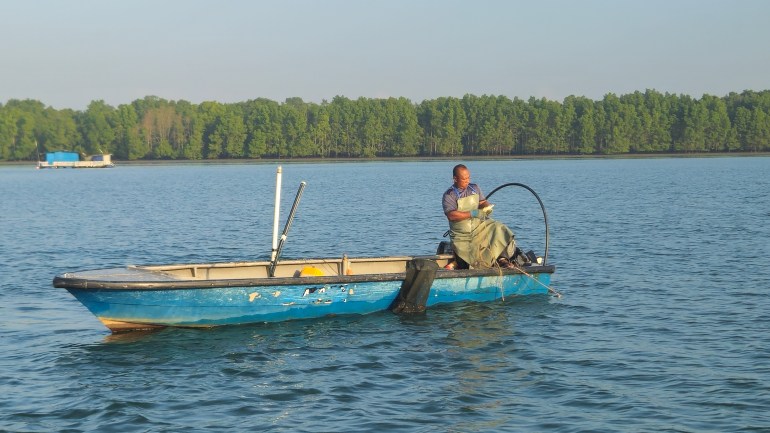
Gelang Patah, Malaysia – On an overcast morning six years ago, Mohammad Ridhwan Mohd Yazid was on his way back to Malaysia’s southern Johor coast when his small fishing boat was caught in a sudden storm. In a matter of minutes, the calm southerly March winds transformed into gales whipping up high seas that slammed into his boat, knocking both him and the day’s catch into the air. Alone and about a kilometre (about half a mile) from Singapore’s northwestern shore, Ridhwan landed back on the boat near its engine and turned quickly for land. “I didn’t care that I lost half of what I caught that day. I just wanted to go home,” the 30-year-old told Al Jazeera in an interview at the coastal jetty in Pendas, a fishing village in Malaysia’s southern state of Johor. Ridhwan’s tale is not an isolated one, but shared by many traditional Malaysian fishermen who have found themselves increasingly affected by the climate crisis, which is changing weather patterns that have long governed when and where they can fish. Such fishermen are estimated to make up about 65 percent of Malaysia’s total fishing community, and are small-scale operators from seaside or river communities and ply waters close to shore or along the river for fish, clams, crabs and other marine animals to meet local demand. They typically use single-engine boats about seven metres (23 feet) long, casting their nets in an area up to five nautical miles from the shore along the country’s more than 4,600km (2,858 miles) of coastline. Malaysian fisherman Mohd Faizan Wahid, 43, checking his equipment after casting his net into the waters of the Johor Strait between Malaysia and Singapore [Patrick Lee/Al Jazeera] But erratic weather, warming seas and declining fish stocks caused by climate change are slowly pushing them away from the seas they and generations before them once depended on. “In the past, we didn’t have to go far to get a good catch. We could just go near the shore,” said Mohd Hafiza Abu Talib. Now, he said, winds could shift direction without warning, treacherous for those who usually work alone or fish at night. “The winds can suddenly change and bring us somewhere else. It’s even worse when we fish in the dark, and we don’t have GPS,” the man in his late 40s added. Warming waters Studies by the United Nations have shown that oceans absorb 25 percent of all carbon dioxide emissions and capture 90 percent of the heat generated by these emissions trapped in the Earth’s atmosphere. The US-based National Oceanic and Atmospheric Administration showed a daily sea surface temperature of 21 degrees Celsius (69.8 Fahrenheit) from early January, one degree more than during the same period 30 years ago. Man-made emissions have pushed the average temperature of oceans higher, leading to the melting of polar ice, rising sea levels, ocean acidification, marine heatwaves and more fiercely unpredictable weather. Mangroves have also been damaged, and coral reefs, where fish breed, have bleached. The small-time fishermen’s catch is sold at a market next to the jetty where they dock their boats in Pendas [Patrick Lee/Al Jazeera] Professor Mohd Fadzil Mohd Akhir, an oceanographer with Universiti Malaysia Terengganu, said marine animals, sensitive to sea temperatures, had been found to migrate to cooler waters as oceans warmed. “It doesn’t mean that when the climate gets warmer, that fish is not available anywhere,” he said. “Most marine organisms in tropical areas will move to cooler areas when these areas get warmer.” A 2022 University of British Columbia study found that climate change would force 45 percent of fish that cross through two or more exclusive economic zones to move away from their natural habitats by the end of the century. An exclusive economic zone (EEZ) refers to an area of ocean or sea that extends some 200 nautical miles beyond a country’s territorial waters. The prospect of a further decline in an already falling harvest is a huge blow for Malaysia’s coastal fishermen who have invested thousands in a back-breaking trade with often poor returns. A single boat can cost about 14,000 Malaysian ringgit ($2,928) with thousands more needed for nets, engines and fuel. A Pendas fisherman can potentially net upwards of about 300 ringgit ($62) of fish or crabs from the sea on a good day, and more during certain seasons. However, fishermen who have fished here for decades complain that there are fewer good days than before. “I used to be able to get 30 to 40kg [66 to 88lbs] of crabs in a day,” said Shafiee Rahmat, 63, who has been fishing for 50 years. “Now I get about 10kg [22lbs] in a day. It’s just not worth it.” ‘Dramatic collapse’ Originally, fishermen in the area blamed the dwindling supply on coastal and industrial developments. Chief among the complaints was the construction of the artificial islands making up the 2,833-hectare (7,000 acres) China-backed Forest City property project, some 20km (12 miles) from Pendas. But Serina Rahman, a conservation scientist working with fishermen in the area for more than 15 years, also noticed a “dramatic collapse” as the world shut down during the COVID-19 pandemic. “We always thought it was development that was affecting the fish catch,” the lecturer from the National University of Singapore said. Fishermen relax before heading out to sea in southern Johor [Patrick Lee/Al Jazeera] However, Serina and the fishermen noticed that fish stocks did not climb back as hoped, even as coastal development, previously blamed for declining catches, came to a halt during the lockdowns. She said that while dredging in the past had been shown to increase the catch of certain species, such as prawns, climate change had no such benefits. “That was when we really saw the fall in catch, because over the COVID period was when we saw the numbers totally decline,” Serina said. Spurred by the diminishing supply and extreme weather, some fishermen from Pendas have banded together with help from a local environmental group to
FM Wang Yi insists China ‘force for peace’; defends Russian ties

China’s Foreign Minister Wang Yi has said China sees itself as a “force for peace” in the world, even as it pursues deeper ties with Russia despite Moscow’s invasion of neighbouring Ukraine. “In the face of complex turmoil in the international environment, China will persist in being a force for peace, a force for stability, and a force for progress in the world,” Wang told reporters at a press conference in Beijing on Thursday, on the sidelines of the country’s annual meeting of its parliament. Wang, who spoke in Mandarin, was also asked about China’s relationship with Russia, which began its full-scale invasion of Ukraine in February 2022. The two countries announced a “no limits” partnership shortly before the invasion, as Russian President Vladimir Putin visited Beijing, and visiting Moscow last year, Chinese President Xi Jinping hailed a “new era” of cooperation. The foreign minister said Beijing and Moscow’s closer relationship was a “strategic choice”, noting that bilateral trade had reached a record $240bn in 2023. “New opportunities” lay ahead, he added, portraying the two countries’ ties as a “new paradigm” in the relations between big powers. “Major countries should not seek conflict and the Cold War should not be allowed to come back,” Wang said. China has positioned itself as a neutral party in the Ukraine war, and on the first anniversary of the conflict, released a 12-point peace plan calling for a ceasefire and talks between the two parties. On Thursday, Wang insisted that Beijing maintained an “objective and impartial position” on Ukraine and called again for peace talks, noting that peace envoy Li Hui was currently in the region. “A conflict, when prolonged, tends to deteriorate and escalate and could lead to an even bigger crisis,” Wang said. During the wide-ranging discussion, which lasted for 90 minutes, 70-year-old Wang was also asked about issues including the conflict in Gaza, China’s relationship with the United States, and the disputed South China Sea. The veteran diplomat called Israel’s five-month-long war in Gaza and the world’s apparent inability to stop the bloodshed, a “tragedy for humanity and a disgrace for civilisation”. Israel sent its forces into the territory after Hamas, which has ruled Gaza since 2006, launched an assault on Israel on October 7, killing 1,139 people and kidnapping some 250 Israelis and foreigners. At least 30,717 Palestinians have been killed in the bombardments since amid a collapse in the health system and a growing risk of starvation. Hamas released some of the captives during a ceasefire in November but is thought to still be holding about 100 people. Urging the release of “all detainees”, Wang called for an immediate ceasefire and peace talks. “The calamity in Gaza is a wakeup call for the world,” he said. Talks brokered by Egypt, Qatar and the US to reach a six-week ceasefire ahead of the Muslim holy month of Ramadan have so far failed to achieve a breakthrough. Wang also reiterated China’s longstanding commitment to a two-state solution, saying it was the only way to achieve an end to the conflict. He also said China supported Palestine’s “full” membership of the United Nations. On relations with the US, which recovered some equilibrium late last year after the countries’ two presidents met in San Francisco, Wang struck a note of optimism even as he lashed out at Washington for sanctions that he said had reached a “bewildering level of unfathomable absurdity”. Noting the US and China were due to mark 45 years of formal bilateral ties this year, Wang said China wanted relations that were “stable and consistent” and that Washington could work with Beijing on the basis of “mutual respect, peaceful coexistence and win-win cooperation.” The two sides have been at odds over a range of issues from Taiwan to trade and an alleged Chinese spy balloon that was shot down after crossing into the US last year. Wang reiterated China’s claim over Taiwan, a self-ruled island that Beijing maintains is part of its territory, and said those who sought independence would be “liquidated by history”. He also had sharp warnings over the disputed South China Sea where China, which claims almost the entire sea despite an international tribunal ruling it without merit, has been involved in multiple confrontations with the Philippines in recent months. In the latest incident on Tuesday, the Philippines said its boat was damaged by a Chinese coast guard ship that tried to block a resupply mission to the disputed Second Thomas Shoal, which lies about 200km (124 miles) from the western Philippine island of Palawan and more than 1,000km (621 miles) from China’s southern Hainan Island. Manila has moved closer to the US amid the growing tension in the strategic waters where China also deploys a maritime militia and its fishing fleet. Brunei, Malaysia and Vietnam also claim the parts of the South China Sea around their coasts. “We resolutely oppose all acts of hegemony and bullying, and will strongly uphold national sovereignty and security as well as development interests,” Wang said. Adblock test (Why?)
North Korea’s Kim Jong Un orders heightened war preparations
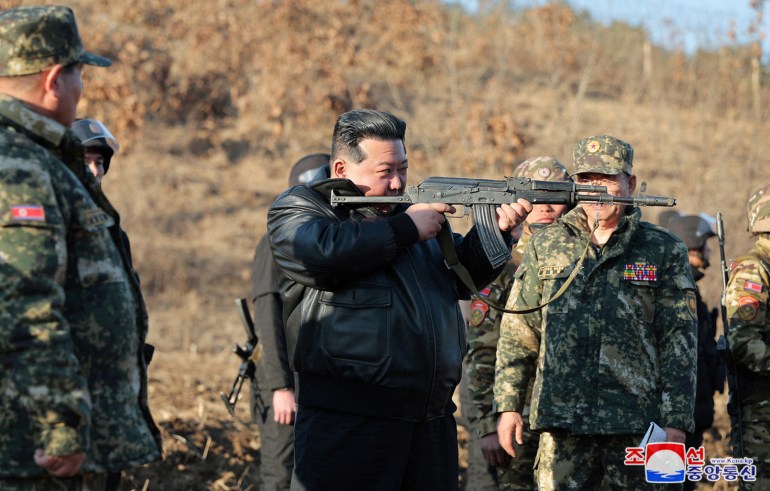
Latest comments come as US and South Korea hold joint military exercises involving thousands of troops. North Korean leader Kim Jong Un has ordered heightened readiness for war after inspecting troops at a major military operations base in the country’s west. The state-run Korean Central News Agency (KCNA) did not reveal the location of the base in its report on Thursday. The North Korean leader said the military must “dynamically usher in a new heyday of intensifying the war preparations in line with the requirements of the prevailing situation”, according to KCNA. “Our army should … steadily intensify the actual war drills aimed at rapidly improving its combat capabilities for perfect war preparedness,” he added. Kim’s visit took place as forces from the United States and South Korea continued their annual Freedom Shield large-scale military exercises. The drills, expected to involve 48 field exercises including missile interception drills, bombing, air assault and live-firing, began on Monday with twice the number of troops participating compared with last year. KCNA did not say whether Kim discussed the US-South Korean drills with the troops he met with [KCNA via Reuters] North Korea has long condemned military drills by the US and South Korea, claiming they are rehearsals for an invasion, and has conducted weapons tests in response to previous exercises. On Monday, KCNA quoted an unnamed spokesperson for North Korea’s Ministry of Defence urging Seoul and Washington to cease their “reckless” and “frantic war drills”. The US and South Korea “will be made to pay a dear price for their false choice”, the spokesperson added. In Thursday’s report, KCNA did not mention whether Kim directly referred to the Freedom Shield drills. It said the troops at the base were conducting manoeuvres under conditions simulating actual war. North Korea has continued to carry out missile tests this year as it modernises its military. Adblock test (Why?)
Why is Pakistan’s PTI fighting for reserved seats in parliament?

Islamabad, Pakistan — It is the latest setback for former Pakistan Prime Minister Imran Khan’s Pakistan Tehreek-e-Insaf (PTI) party. On Monday, the Election Commission of Pakistan (ECP) declared that the PTI-backed Sunni Ittehad Council (SIC) could not claim allocated reserved seats in the national and provincial assemblies. PTI, unable to contest recent elections due to a ban on their electoral symbol, instructed its candidates to join the right-wing fringe religious party in order to extend their numerical strength in the National Assembly. In its 22-page judgment issued on Monday, the five-member electoral body decided 4-1 that the SIC failed to submit a party list for reserved candidates before the ECP’s deadline of February 22, two weeks after the February 8 election. Pakistan’s National Assembly has a total of 70 reserved seats which are distributed among parties based upon their performance in the general elections. Similarly, the four provincial assemblies have a combined total of 149 reserved seats that are similarly distributed. A majority of these reserved seats have already been allocated — around 77 remain vacant, for now. PTI has criticised the ECP judgement, calling it an attack on democracy. “This is the last assault on the heart of democracy,” Senator Ali Zafar of PTI, and a senior party lawyer said during a speech in the Senate, the upper house of the assembly on Monday after the decision was announced. The ECP’s decision opens the door for a prolonged legal battle, as PTI has announced it will challenge the decision in higher courts. However, if the party fails to overturn it, it could further dent its position in the lower house of parliament, potentially allowing the ruling coalition to gain a two-thirds majority in the 336-member National Assembly. What are reserved seats — and why do they matter? Pakistan’s general elections for the National Assembly take place on 266 seats. But there are an additional 70 reserved seats (60 for women and 10 for minorities) which give the body a total size of 336 seats. To achieve a simple majority to form a government, a total of 169 seats is required. However, a two-thirds majority — or 224 votes — is necessary to make any constitutional amendments. Reserved seats are allocated only to political parties that win seats in the National Assembly, and the distribution is done based on their proportional representation after the general elections. Similarly, reserved seats are allocated in provincial assemblies based on the parties’ proportionate performances. According to regulations, any political party contesting the polls must submit a list of their nominations for reserved seats prior to elections, as per the schedule given by the ECP. However, after the polls, if a party has over-performed and needs to submit additional names for reserved candidates, it has two weeks to do so. Independents have three days after their win announcement to declare their affiliation with a party in the assembly. The party they join gets a boost in the number of reserved seats it gets, commensurate with the number of independents that join it. In the National Assembly, the ECP has already allocated at least 40 out of 60 seats to different political parties for their reserved quota for women. Similarly, seven out of 10 seats reserved for the minorities quota have already been allocated in the lower house of the parliament. The rest are currently vacant. What happened in the current elections? Forced to contest the recent general elections on February 8 without its party symbol – the cricket bat – due to violating election rules, PTI fielded candidates as independents. Despite facing a nationwide crackdown for nearly two years, with its leader, former Prime Minister Imran Khan, imprisoned since August last year, and its candidates unable to campaign freely, PTI still emerged as the single largest bloc, with its candidates winning 93 seats. While the party claimed widespread rigging across the country and alleged a “stolen mandate”, its rivals, Pakistan Muslim League-Nawaz (PMLN) and Pakistan People’s Party (PPP), managed to cobble together a ruling alliance, with 75 and 54 seats respectively, in coalition with other smaller parties. Even though they won the most seats, the PTI leadership, under orders from Imran Khan, decided not to form a government with any of the major parties and instead joined hands with a fringe, right-wing religious party, the SIC, to claim reserved seats. Complicating matters further was the fact that the SIC, despite being a registered political party, did not contest the general elections. Its leader, Sahibzada Hamid Raza, chose to contest independently, winning his seat from Faisalabad city in Punjab province. What does the ECP verdict say? In its verdict, the ECP stated that the SIC was not entitled to claim the quota for reserved seats due to a “violation of a mandatory provision of submitting a party list for reserved seats, which is a legal requirement”. It also said that the currently vacant seats in the national assembly — 23 — “will not” remain vacant and will be distributed among other parties based on the elected seats they won. The commission criticised the SIC by reminding them that they were given a specific timeframe to submit a list of nominations, which the party did not. “Every political party, while making any decision regarding crucial steps concerning matters of the political party required under law, should be aware of the potential consequences they may face in the future,” the ECP wrote. What are the consequences of the ECP decision? On March 3, Shehbaz Sharif of the Pakistan Muslim League-Nawaz (PMLN) was elected the country’s new prime minister by the National Assembly, securing 201 votes. Omar Ayub Khan, the PTI leader backed by the SIC, managed to secure 92 votes. The biggest beneficiary of the ECP decision will be Sharif’s PMLN, along with the Pakistan People’s Party (PPP) and the Muttahida Qaumi Movement (MQM), which won the most number of seats in the general elections, with 75, 54 and 17 respectively. In case PTI’s legal challenge fails