

Is the United States misusing its veto at the UN Security Council?

The US has vetoed three resolutions calling for a suspension of hostilities in Gaza since October 7. Nearly five months since Israel launched its war on Gaza, the United Nations has failed to adopt a resolution calling for a pause in the hostilities. Three votes have been held in the Security Council – but the United States has vetoed them all. UN Secretary-General Antonio Guterres has described the veto as an instrument that’s paralysed the council from taking action on Gaza. Palestine’s ambassador to the UN has said US vetoes have cost Palestinians their lives. The US is one of only five permanent members that can veto resolutions, and it’s been accused of misusing its power. So is use of the veto a hindrance to decision-making in the UN Security Council? And does it serve the agenda of only a select group of countries? Presenter: Adrian Finighan Guests: Richard Gowan- UN director at the International Crisis Group Mouin Rabbani – non-resident fellow at the Center for Conflict and Humanitarian Studies Carne Ross – adviser for the UN Summit of the Future Adblock test (Why?)
Medvedev says ‘Ukraine is definitely Russia’, rules out peace talks

The former Russian president says parts of Ukraine should ‘return home’ as he rules out peace talks with Zelenskyy. Dmitry Medvedev, deputy chairman of Russia’s Security Council, says Ukraine is part of Russia as he rules out peace talks with the current Ukrainian leadership. In a bellicose speech on Monday at a youth festival in the southern city of Sochi, Medvedev said Russia would prosecute what it calls its “special military operation” until the other side capitulated. The former president and prime minister said what he called historical parts of Russia should “return home”. Medvedev spoke in front of a map of Ukraine, which showed the country as a much smaller landlocked slice of territory squeezed up against Poland with Russia in complete control of its east, south and Black Sea coast. “One of Ukraine’s former leaders said at some point that Ukraine is not Russia,” Medvedev said. “That concept needs to disappear forever. Ukraine is definitely Russia,” he said to applause from the audience. Medvedev said peace talks would not be possible with the current Ukrainian leadership, led by President Volodymyr Zelenskyy. He said any future Ukrainian government that wants talks would need to recognise what he called the new reality on the ground. Commenting on East-West relations, Medvedev, who accused US special forces and military advisers of waging war against Russia, said ties between Moscow and Washington were worse than during the 1962 Cuban missile crisis. Alexander Graf Lambsdorff, Germany’s ambassador to Russia, leaves the Russian Ministry of Foreign Affairs in Moscow on March 4, 2024 [Maxim Shemetov/Reuters] Accusations against Germany On Sunday, Medvedev joined a chorus of Kremlin voices accusing Western countries of participating in the war in Ukraine after a wiretap recording of German military officials was published on Russian social media. The discussion revolved around the potential impact of Ukraine’s use of German-made Taurus missiles. The conversation included remarks about aiming the missiles at targets such as the Kerch Bridge, which links the Russian mainland to occupied Crimea, which was annexed by Russia in 2014. German Chancellor Olaf Scholz has so far refused to send the missiles to Ukraine, fearing it would escalate the conflict. In a Telegram post on Sunday, Medvedev criticised the German military and claimed the country was preparing to attack Russia. Adblock test (Why?)
What lies behind the Biden administration’s changing ‘ceasefire’ language

A week ago, US President Joe Biden claimed that a “ceasefire” deal in Gaza was imminent and could take effect as soon as March 4. “My national security adviser tells me we are close,” he told reporters while eating ice cream in New York City. But ice cream or not, Biden’s actual position was not nearly that sweet. A subsequent statement by a senior Biden administration official claimed Israel had “basically accepted” a proposal for a temporary pause in fighting. But as of March 4, Israeli Prime Minister Benjamin Netanyahu and his Mossad director were still refusing to send a delegation to Cairo, where talks with Hamas were under way. The Biden administration’s eagerness to claim victory in its search for some kind of temporary truce indicates how much it is feeling the heat of the rising global and domestic pressure demanding an immediate ceasefire, an end to the Israeli genocide, an end to the threat of a new escalation against refugee-packed Rafah, and an end to the siege of Gaza and immediate unhindered provision of massive levels of humanitarian aid. Despite Washington’s vain hopes for March 4 and the unofficial goal of a ceasefire by the beginning of the Muslim holy month of Ramadan on March 10, the deal remains elusive. Media reports indicate Biden is telling the Qatari and Egyptian leaders that he is putting pressure on Israel to agree to a truce and a captives swap. But his claim of pressuring Israel is undermined by the continuing US vetoes of ceasefire resolutions at the United Nations Security Council, most recently on February 20, as well as the continuing flow of United States weapons and money to Israel to enable its assault. The vetoed resolution, introduced by Algeria on behalf of the Arab Group, demanded an immediate humanitarian ceasefire and deplored all attacks against civilians. It specifically rejected the “forced displacement of the Palestinian civilian population, including women and children” and called unconditionally for unhindered humanitarian access to Gaza and the “urgent, continuous and sufficient provision of humanitarian assistance at scale”. Significantly, the text referenced the January order of the International Court of Justice (ICJ) that found Israel to be plausibly committing or preparing to commit genocide in Gaza, and imposed a set of provisional measures requiring Israel to stop its practices. Linda Thomas-Greenfield, Biden’s ambassador to the UN, cast the sole veto against the Algerian resolution, and instead put forward an alternative US text, claiming it also supported a ceasefire. But the proposed US language does not call for an immediate or permanent ceasefire or an end to Israeli genocide; it does not prevent an attack on Rafah or end the Israeli siege. The proposed US resolution is not designed to end the murderous Israeli war against Gaza – nor is the deal that is currently being negotiated in Cairo. To the contrary, the provisions of the US draft resolution reflect the true intentions of the Biden administration vis-a-vis its continuing support of Israel, and reveal the limitations of the truce it is trying to orchestrate. While the US draft resolution does use the dreaded word “ceasefire” – which had been prohibited in the White House for months – it does not call for an immediate halt in the bombing, only “as soon as practicable”, with no indication of when that might be. It does not call for a permanent ceasefire either, leaving Israel free to resume its genocidal bombing – presumably with continuing US support. Virtually everything the US draft calls for is undercut by what is left out. The demand for “lifting all barriers to the provision of humanitarian assistance at scale” in Gaza certainly sounds appropriately robust. But that’s only until you realise that the text’s failure to challenge or even name the principal barrier to aid getting in – Israel’s bombardment – means that this is not a serious plan to end Israel’s deadly siege. It should not surprise anyone that “the Biden administration is not planning to punish Israel if it launches a military campaign in Rafah without ensuring civilian safety” – as Politico reported – despite claiming it wants a credible plan to ensure Palestinian safety. No one in the Biden administration has even hinted at imposing consequences for Israel’s constant rejection of the insipid appeals for restraint – such as conditioning aid on human rights standards (as required by US law) or cutting US military aid altogether. That’s what real pressure would look like. A more accurate picture of Washington’s approach to Israel’s war against Gaza is the continuing US pipeline of weapons to make Israel’s murderous assault on Gaza more effective, more efficient, and more deadly. According to the Wall Street Journal, the “Biden administration is preparing to send bombs and other weapons to Israel that would add to its military arsenal even as the US pushes for a ceasefire in Gaza.” The arms the US intends to hand over to the Israeli army include MK-82 bombs, KMU-572 Joint Direct Attack Munitions and FMU-139 bomb fuses, worth tens of millions of dollars. It is more than likely that the administration will do another end run around US Congress to send the weapons without relying on congressional approval, as it did on at least two occasions last December. Whatever the language of Washington’s proposed UN Security Council resolution and likely the possible temporary truce deal as well, the words of National Security Council spokesperson John Kirby continue to resonate as a better reflection of the Biden administration’s policy: “We’re going to continue to support Israel… and we’re going to continue to make sure they have the tools and the capabilities to do that.” The views expressed in this article are the author’s own and do not necessarily reflect Al Jazeera’s editorial stance. Adblock test (Why?)
In Texas’s Super Tuesday races, a litmus test for Trump’s Republican Party
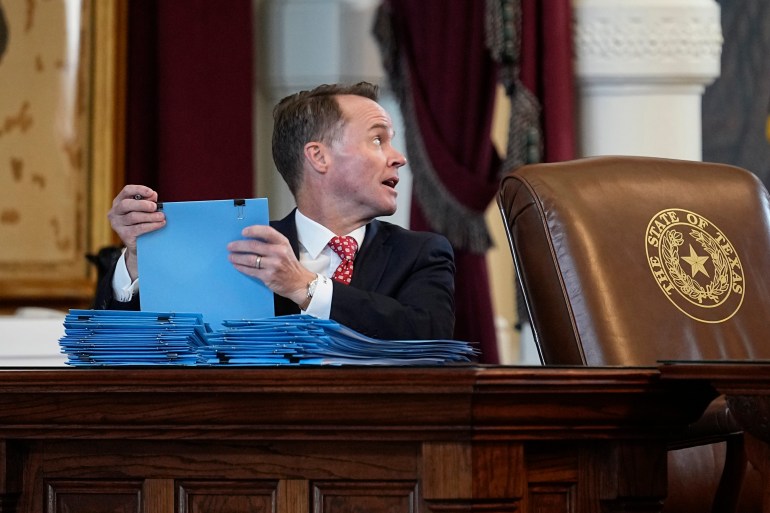
Everything’s bigger in Texas — and that includes this year’s political primary races. The second largest state in the United States — both in terms of population and land mass — Texas is set to hold votes this week for Super Tuesday, a pivotal juncture on the electoral calendar. Fifteen states and one territory take to the polls on that day, which can be a make-or-break moment for presidential candidates. But Texas looms particularly large as a window into the key issues facing candidates. Situated on the southern border, Texas has, in recent years, made headlines for grappling with immigration, gun violence and abortion access. Both Democratic incumbent Joe Biden and Republican frontrunner Donald Trump will be on the ballot for Texas’s presidential primaries. But with their party nominations all but assured, experts are pointing to the down-ballot races as the most interesting of all. Politicians will be vying for seats on the state’s Board of Education and in its legislature. Party nods for high-profile federal positions will be up for grabs, too. And in each case, the victors are expected to serve as weathervanes for the general elections. With a strong tradition of Republican leadership, Texas is also set to be a litmus test for how loudly Trump’s influence over the party resonates. “It’s important to always keep in mind that among the most influential and important red states is Texas,” said Mark Jones, a political science fellow at the Baker Institute for Public Policy in Houston. “No one else really comes close in terms of the number of the Republican House members provided, in terms of electors in the Electoral College, and in terms of leading the opposition to the Biden administration.” ‘Principal official opposition’ With just under 30 million residents, Texas is seen as where the American South meets the West. Spread across 695,660 square kilometres (268,597 square miles), the state stretches from the humid coast of the Gulf of Mexico to the arid grasslands of its panhandle. Its formidable economy is buoyed by fossil fuels, agriculture and aerospace: The state advertises itself as the eighth largest economy in the world. And it has also come to be known as a Republican stronghold. Since the late 1970s, Republicans have dominated the governor’s mansion, only losing twice to single-term Democrats. No Democrat has represented the state in the US Senate since 1993, and the last Democratic presidential candidate to win the state was Jimmy Carter in 1976. Needless to say, Republicans have a tight grip on Texas power. And whenever a Democrat is in the White House, Texas “essentially assumes the role of principal official opposition”, Jones explained. Governor Greg Abbott, for example, has long criticised Biden for his lack of action on immigration. Texas’s Attorney General Ken Paxton has sued the Biden administration for everything from its federal spending package to its policy of removing razor wire at the border. The state, along with Republican-led Florida, has also set the pace in the so-called “culture wars”, with right-wing policies aimed at constricting certain types of education programmes and gender expression. Over the last two years, for example, the Texas legislature has prohibited higher education from establishing diversity, equity and inclusion (DEI) offices; sought to restrict drag performances; and banned puberty blockers and hormone therapy for transgender children. Texas state Speaker of the House Dade Phelan is among the elected officials whose positions are up for grabs this Super Tuesday [Eric Gay/AP Photo] Could Texas turn ‘purple’? But just how far to the right Texas lands has long been a subject of debate. For years, Democrats have eyed Texas’s shifting demographics as evidence that the state could tilt left. In 2022, Texas officially became a minority-majority state, with Hispanic residents surpassing whites. They account for more than 40 percent of the state’s population. Still, Democrats have struggled to land victories in major statewide contests. In 2020’s presidential race, for instance, Biden lost Texas to Trump by five percentage points, in part because Hispanic residents near the border leaned towards the Republican candidate. J Matthew Wilson, a political science professor at Southern Methodist University, said the belief that Texas could imminently become not red or blue but rather a purple swing state has dominated recent political discourse but has yet to fully materialise. “Democrats have been talking about this for over a decade — this ‘purple Texas’ idea,” Wilson said. “And every election cycle, once again, Lucy yanks the football away from Charlie Brown.” That reality, along with a history of drawing electoral maps to separate voters by political predilection, means the primary on Super Tuesday will hold disproportionate sway, according to Jones at the Baker Institute. “Power and politics in Texas are decided in the primary,” Jones said, “especially the Republican primary.” Democrats are eyeing the seat of Republican Senator Ted Cruz as a possible point of weakness in November [Mark Schiefelbein/AP Photo] Choosing a Senate contender Still, Democrats have largely zeroed in on one statewide election they consider vulnerable: the race for the US Senate seat. This year, Senator Ted Cruz is up for re-election, and the Super Tuesday ballot will decide who he faces as his Democratic rival. Cruz, a polarising Republican with a national profile, nearly lost his last re-election bid in 2018 to dark-horse Democrat Beto O’Rourke. A January poll from Emerson College and Nexstar Media put him in a statistical tie with either of this year’s Democratic contenders: Colin Allred and Roland Gutierrez. The Super Tuesday primary will decide whether Allred or Gutierrez advances to the final match-up. Allred, a US representative from north Texas, represents a more centrist strain of Democrat. He has criticised Biden as being too soft on the border and staunchly supports Israel in its war in Gaza. Gutierrez, meanwhile, has hewed progressive. A state senator, he has foregrounded gun control and humane border policies in his campaign. He also supports a ceasefire in Gaza. Whichever candidate emerges as the champion in Super Tuesday’s primary will indicate the
Can Yulia Navalnaya unite Russia’s opposition after Alexey Navalny’s death?

Two days before his death, Alexey Navalny penned a valentine dedicated to his wife and muse Yulia. “Baby, we’re like in the song [Hope] – between us, ‘There are cities, takeoff lights of airports, blue blizzards and thousands of kilometres,’” he wrote on February 14, St Valentine’s Day. “But I feel you near me every second, and I love you more and more,” he wrote next to a photo of him and Yulia Navalnaya, 47, a tall, blonde ex-bank teller he met in 1998 during a vacation in Turkey. Two days after what turned out to be his last social media post, Navalny, also 47, collapsed and died in what his widow and supporters believe was a Kremlin-orchestrated political murder. Navalnaya pledged to take over her husband’s role as head of the Fund to Fight Corruption, an organisation that once sprawled throughout Russia, released muckraking corruption exposes and organised huge rallies. The Kremlin banned it as “extremist”, disbanded it, persecuted dozens of its staffers – some were sentenced to up to nine years in jail – and forced many others out of Russia. Navalny’s death and President Vladimir Putin’s widely expected re-election in a March vote may signal an even tougher crackdown on any sign of dissent or criticism of the war in Ukraine. But opposition figures and analysts say that to become the undisputed head of Russian opposition in exile, Navalnaya would have to overcome deep disagreements among fractured and disunited groups that often criticised her husband. A person throws flowers towards the grave of Russian opposition politician Alexey Navalny while standing in front of a closed entrance to the Borisovskoye cemetery, in Moscow, Russia, March 3, 2024 [Reuters] Just hours after the news of her husband’s death reached her, Navalnaya spoke at a security conference in Germany’s Munich – and did not sound like a vulnerable grieving widow. Clad in a navy blue suit, with her hair pulled back and face convulsed with pain, she did not shed a tear – she sounded more like a Valkyrie pledging revenge. “I want Putin, his coterie, all of his friends [and] his government to know that they will bear responsibility for what they’ve done with our country, my family and husband. And this day will come soon,” Navalnaya said – and received a standing ovation. Three days later, she promised to “continue” Navalny’s work. “I urge you to share my fury. My fury, my anger, my hatred of those who dared to murder our future,” she said in a video that has been viewed more than five million times on YouTube. Her late husband’s associates are confident she can become his perfect successor, and that she would also help fill a gender gap in anti-Kremlin activism. “Will she have enough resources to continue? She’s got more strength than many of us. Will she be a successful politician? Russia has long needed a creative female image in politics, and there’s only going to be more demand for it,” said Aleksander Zykov, who headed a Fund to Fight Corruption branch in the western city of Kostroma before fleeing for the Netherlands. “That’s why yes, I believe in Yulia Navalnaya,” he told Al Jazeera. She has big shoes to fill and needs to walk a tightrope to unite people from other opposition groups that work in exile or clandestinely operate in Russia. Navalny’s work paved the way by organising some of the largest protest rallies in Russia’s post-Soviet history, creating an online “machine of truth” to file complaints about bureaucratic hurdles, potholed roads and leaking roofs, and creating an app to vote for anti-Kremlin politicians. “Navalny’s team created a wider opposition movement that wasn’t tied to the Fund to Fight Corruption or other groups,” said Sergey Biziyukin, an opposition activist who fled the western Russian city of Ryazan. “It was rather different from other parties, funds and organisations that made the opposition movement a noble, but hard-to-get-into crowd,” he told Al Jazeera. “If Navalnaya and her team can do the same, it will be beneficial,” he said. Alexey and Yulia got married in 2000, when Putin was first elected president. Pictured in 2019, Russian opposition leader Alexey Navalny, his wife Yulia, daughter Daria and son Zakhar pose for a picture outside a polling station during the Moscow city parliament election in Moscow, Russia [Tatyana Makeyeva/Reuters] Both joined Yabloko (apple in Russian), Russia’s oldest liberal democratic party that had a presence in the State Duma, Russia’s lower house of parliament. But Navalnaya preferred to focus on their children, Daria and Zakhar, and barely took part in her husband’s work. Meanwhile, he was not happy about Yabloko’s complacency and cautiousness towards Putin’s increasingly hardline policies. In 2007, when Putin’s second term was coming to an end, Navalny was kicked out of Yabloko for taking part in the Russian March, an annual rally of far-right nationalists, monarchists and white supremacists. Navalny also co-founded the National Russian Liberation Movement, a nationalist group, with novelist Zakhar Prilepin who would later fight for Ukrainian separatists and co-chair a pro-Kremlin socialist party. Many Russian liberal democrats cannot forget and forgive Navalny’s nationalism and derogatory remarks about Muslims, whom he once called “cockroaches”. “When he told me that the future in Russia belongs only to the nationalist Russian political process, I said, ‘Okay, lad, we are not talking any more’,” Lev Ponomaryov, who heads the Moscow-based For Human Rights group and is blacklisted by the Kremlin as a “foreign agent”, told Al Jazeera in 2021. Navalny toned down his stance to focus on online and video reports exposing corruption in the Kremlin, but never denounced his nationalist statements. He started the Fund to Fight Corruption whose offices mushroomed throughout Russia. But Navalny’s supporters are often rigid in accepting other Kremlin critics’ opinions. The people Navalnaya will have to work with “are pretty authoritarian guys”, said Boris Bondarev, a veteran Russian diplomat to the United Nations office in Switzerland who quit after Moscow began the full-scale invasion of Ukraine in 2022. “They
Toronto man arrested for attacking pro-Palestinian protesters with nail gun

NewsFeed A man was arrested after using a nail gun to attack pro-Palestinian protesters in Canada. They were demonstrating against an Israeli real estate company event at a Toronto synagogue which only seemed open to Jews. Published On 4 Mar 20244 Mar 2024 Adblock test (Why?)
Ukraine hints at responsibility for Russian bridge attack
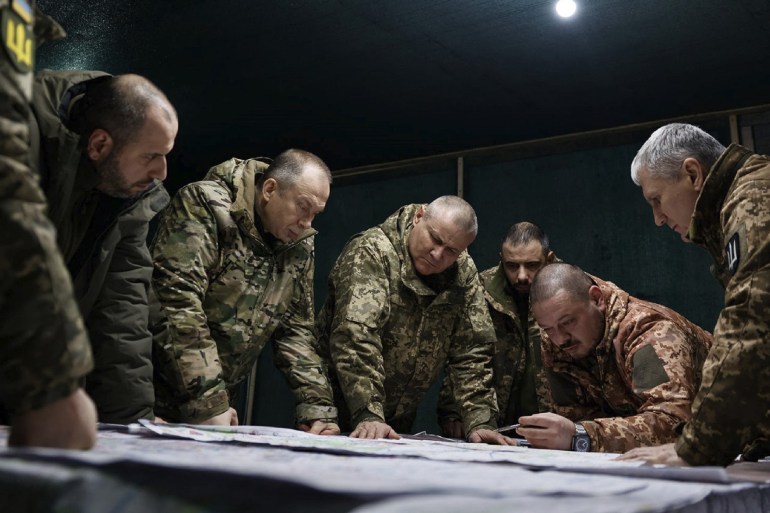
Kyiv publishes pictures of the damaged bridge deep inside Russia that was used to transport weapons. Ukraine has hinted that it was behind an attack on a railway bridge in the Russian region of Samara. Kyiv’s military intelligence agency boasted on Monday that the explosion on the bridge had “paralysed’ traffic in the area. While attacks on infrastructure in Russia have become regular, it is rare for Kyiv to comment. “A railway bridge over the Chapaevka River in Russia’s Samara region was blown up. On 4 March 2024, at around 6:00 am (0200 GMT), the bridge was damaged by blowing up its support structures,” the Defence Intelligence of Ukraine said on messaging site Telegram. It included a photograph of the damaged bridge in its post. Russia was using the railway line to transport ammunition from a plant in the town of Chapayevsk, about 1,000km (621 miles) from the Ukrainian border, military intelligence added. The post stopped short of directly claiming responsibility for the attack, but Ukrainian intelligence rarely comments on attacks in Russia. “Given the nature of the damage to the railway bridge, its use will be impossible for a long time,” the statement read. Commander-in-Chief of the Armed Forces of Ukraine Oleksandr Syrskii (2nd L) and Defence Minister Rustem Umerov (L) visiting the front-line positions at an undisclosed location in eastern Ukraine [Handout/Armed Forces of Ukraine via AFP] The incident was the latest in a string of explosions targeting Russia’s rail network, which Kyiv says Moscow uses to move troops and equipment being used for its invasion of Ukraine. Chapayevsk is home to JSC Polimer, a weapons manufacturer sanctioned by the United States in December. Russia’s railway operator announced earlier that “an intervention by non-authorised persons” had caused the incident but said no one had been injured. “Rail traffic is suspended for the moment at this section,” it added. “There are no deaths or injuries,” the Russian Federal Security Service in the Samara region told the state news agency Tass on Monday, with the area around the bridge cordoned off by security forces. Moscow was yet to comment on the Ukrainian statements. Claims on both sides are hard to verify in the war, which has now entered a third year, with the front line in eastern Ukraine largely bogged down in trench warfare. Illustrating Kyiv’s increased confidence regarding attacks on Russian territory, its military agency said in January that “unseen opponents of the Putin regime” had burned down a railroad, as well as facilities Russian troops allegedly use for logistics in the Russian cities of Saratov, Yaroslavl and Dzerzhinsk. Adblock test (Why?)
South Korea to suspend doctor licences as strike crisis escalates
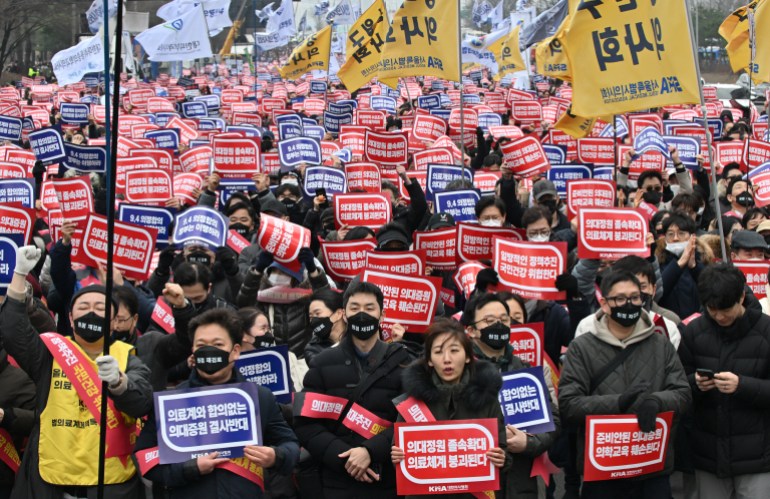
Some 9,000 doctors walked off the job two weeks ago over government plans to increase medical school admissions. South Korea has said it will suspend the licences of trainee doctors who have ignored an ultimatum to end a strike over government plans to increase medical school admissions. About 9,000 junior doctors walked out on February 20, leading to the cancellation of some operations and treatments as well as hampering the operation of hospitals’ emergency units. On Monday, Health Minister Cho Kyoo-hong said the authorities would visit hospitals to find out whether the doctors had returned to work and “take action according to the law and principle without exception”. Speaking in a televised briefing, he said those who had not returned “may experience serious problems in their personal career path”. The doctors taking strike action are a fraction of South Korea’s 140,000 doctors. But they account for as many as 40 percent of the total doctors at some major hospitals. Thousands took to the streets of Seoul on Sunday at a mass rally organised by the Korean Medical Association (KMA), which represents private practitioners, defying a February 29 government deadline for them to return to work or face legal action, including possible arrest. The doctors say the government should first address pay and working conditions before trying to increase the number of physicians. “The government is pushing the reforms unilaterally and that, the doctors cannot accept under any circumstances”, Kim Taek-woo of the Korea Medical Association told the crowd of protesters, who wore black masks. Under South Korean law, doctors are restricted from taking strike action. “The government is very aware of the reasons why all doctors are opposing the increase in the medical school admissions but are exploiting policies to turn doctors into slaves forever.” Thousads of doctors have joined the strike against a government plan to make more places available at medical schools [Jung Yeon-je/AFP] The government says the move to increase the number of students admitted to medical schools by 2,000 from the 2025 academic year is necessary because of the rapidly ageing population and the country’s low number of doctors to patients. At 2.6 doctors per 1,000 people, South Korea’s rate is one of the lowest in the developed world. The plan to boost medical school admissions is popular with the public, with about 76 percent of respondents in favour, regardless of political affiliation, according to a recent Gallup Korea poll. President Yoon Suk-yeol has taken a hard line on the strike and has seen his approval ratings climb as the standoff drags on. With legislative elections in April and Yoon’s party looking to win back a parliamentary majority, the government is unlikely to compromise quickly, analysts said. But doctors have also pledged not to back down, saying the government’s plan did not address the sector’s real problems. “We have nowhere to retreat any more. We will not just sit idly by the government acting undemocratic,” Lee Jeong-geun, the interim head of the KMA, said at Sunday’s protest. Adblock test (Why?)
Japan’s Nikkei stock index passes 40,000 for first time amid AI fanfare

Nikkei 225 gains as much as 1 percent after last month beating 1989 record. Japan’s benchmark stock market index has smashed the 40,000 mark for the first time, continuing its comeback after decades of stagnation. The Nikkei 225 gained 1 percent to 40,308.85 during morning trading on Monday, as investors took an upbeat view of Japanese firms following gains on Wall Street. Tech shares including Tokyo Electron and Advantest were among the biggest gainers. Japanese stocks have become some of the hottest buys over the past year as foreign investors take advantage of the cheap yen and corporate governance reforms that have boosted shareholder returns. The Nikkei rose by more than 28 percent in 2023, beating the S&P 500 in a bumper year for the US stock market. Last month, the benchmark index surpassed its 1989 record of 38,915.8, set as Japan’s economy was on the precipice of an asset crash that kicked off several “lost decades” of economic stagnation. The Japanese stock market’s reviving fortunes come amid a sustained rally in US shares fuelled by excitement surrounding advances in artificial intelligence. US tech companies have soared in value in recent months, with chipmaker Nvidia’s market capitalisation on Friday surpassing $2 trillion. Japan’s overall economy has not matched the fortunes of its stock market, with structural challenges, including a shrinking population and rigid labour force, weighing on growth. Japan’s economy last month officially entered recession, giving up its spot as the world’s third-largest economy to Germany. Adblock test (Why?)
Australia gives $41mn to ASEAN countries for ‘free, open’ South China Sea
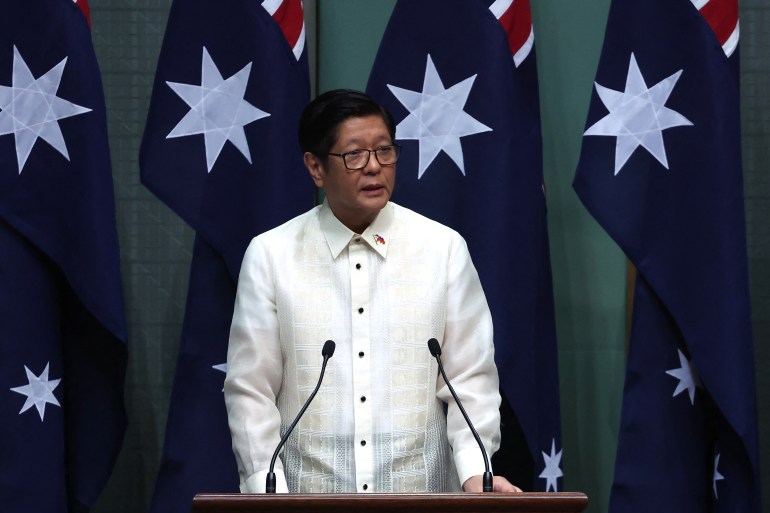
Funds come after Philippine president told Australian parliament he would ‘not yield’ a ‘square inch’ in the South China Sea. Australia’s Foreign Minister Penny Wong has announced 64 million Australian dollars ($41.8m) in funding for maritime security on the first day of a special summit with members of the Association of Southeast Asian Nations (ASEAN) in Melbourne. “The countries of our region rely on oceans, seas and rivers for livelihoods and commerce, including free and open sea lanes in the South China Sea,” Wong said in her address to a forum on maritime cooperation on Monday morning. Wong did not specify which countries the funding would go to but “welcomed efforts” by Indonesia, Malaysia, Vietnam and the Philippines to “delimit their maritime boundaries”. Malaysia, the Philippines and Vietnam claim parts of the South China Sea, which China claims almost in its entirety. “What happens in the South China Sea, in the Taiwan Strait, in the Mekong subregion, across the Indo-Pacific, affects us all,” Wong said. The special summit hosted in Melbourne marks 50 years since Australia became a “dialogue partner” of ASEAN, whose members are countries in Southeast Asia, and comes as its members last year held their first-ever joint military drills. The ruling centre-left Labor party has long aimed to forge closer ties with the region, recognising Australia’s proximity to Southeast Asia. But Australia’s relationship with its regional neighbours and its interests in the South China Sea is also viewed through the lens of Australia’s close ties with the United States and its membership in the Australia, United Kingdom and United States security pact known as AUKUS. In her speech, Wong quoted Indonesian President Joko Widodo as saying, “We also have the responsibility to lower the tension, to melt the ice, to create space for dialogue, to bridge the differences” in the region. Indonesia, along with Malaysia, is among Australia’s allies in the region to have raised concerns that Canberra’s investing tens of billions of dollars in nuclear submarines is potentially contributing to a nuclear arms race in Southeast Asia and the wider Asia Pacific. Philippines ‘will not yield one square inch’ In a speech to Australia’s parliament last week, Philippine President Ferdinand Marcos Jr was resolute on his countries’ position on the South China Sea, amid rising tension with Beijing over their competing claims. “I will not allow any attempt by any foreign power to take even one square inch of our sovereign territory,” Marcos said. The Philippines has reported multiple incidents with China in the South China Sea, accusing its coast guard of dangerous manoeuvres and filing diplomatic protests with Beijing over its actions. “The challenges that we face may be formidable, but equally formidable is our resolve. We will not yield,” he said. Philippine President Ferdinand Marcos Jr addresses the House of Representatives at Parliament House in Canberra on Thursday [David Gray/AFP] But while some Australian representatives reportedly applauded Marcos’s remarks, at least one member of Australia’s parliament, Senator Janet Rice, publicly questioned his legacy and was kicked out for holding up a sign saying, “Stop the Human Rights Abuses”. Marcos Jr is the son of former Philippine hardline leader Ferdinand Marcos who was overthrown in a popular uprising in 1986 and fled into exile. Greens Senator Janet Rice holds a sign as Philippine President Ferdinand Marcos Jr delivers an address to members and senators at Parliament House in Canberra, Australia on Thursday [Mick Tsikas/AAP Image via AP] On the streets outside parliament last week, activists held protests on Australia’s apparent lack of scrutiny of its allies’ human rights records, amid ongoing protests over Australia’s support for Israel’s assault on the Gaza Strip. More protests are planned around this week’s ASEAN summit. Wong’s speech also included a nod to Australian funding for climate change resilience through the Mekong-Australia partnership, as many Australians, and neighbouring Pacific countries, question increasing militarisation in a time of climate crisis. Adblock test (Why?)