

Thousands of inmates escape prison amid deepening Haiti violence

At least 12 people reported dead as gangs pushing for prime minister’s removal attack two prisons. At least 12 people have been killed as thousands of inmates escaped the main prison in Port-au-Prince in deepening gang violence designed to remove Prime Minister Ariel Henry from power. Gangs led by Jimmy Cherizier, a former police officer known as Barbecue, attacked the jail in the country’s capital overnight on Saturday. Pierre Esperance of the National Network for Defense of Human Rights said only about 100 of the National Penitentiary’s estimated 3,800 inmates remained inside after the assault. “We counted many prisoners’ bodies,” he added. A reporter from the AFP news agency who visited the prison on Sunday said they saw about a dozen bodies outside it. The gate was open and there was “hardly anyone” left inside, they added. The Reuters news agency reported that there were no signs of police officers at the prison and its main door was open. “I’m the only one left in my cell,” one unidentified inmate told Reuters. “We were asleep when we heard the sound of bullets. The cell barriers are broken.” In a statement, the Haitian government said police tried to repel the gang attack against that prison and at another facility called Croix des Bouquets. Esperance said it was not immediately clear how many inmates escaped from the second prison, which he said held 1,450 inmates. The government said the attacks left “several wounded” among prison staff and inmates. In a statement, it thanked “the population for their calm, despite these very difficult times.” Violence in Haiti has spiralled in recent days after calls by Cherizier for criminal groups to unite and overthrow Henry. Cherizier heads an alliance of gangs and faces sanctions from the United Nations and the United States. One voluntary prison worker on Sunday said that 99 prisoners had opted to remain in their cells in the main jail for fear of being killed in the crossfire. These included several retired Colombian soldiers who were jailed for their alleged involvement in the assassination of former President Jovenel Moise. Authorities warned people to be careful and “to continue to support the National Police who will do everything possible to track down fleeing prisoners and arrest those responsible for these acts”, the statement read. The prime minister’s exact whereabouts remained unclear on Sunday. Henry had been due to return from a visit to Kenya, where he signed a security deal to tackle gang violence. Nearly 15,000 people have been forced to leave their homes in recent days, with 10 sites hosting internally displaced people emptied over the weekend, according to the United Nations’s International Organization for Migration (IOM). Henry, who became prime minister in 2021 after Moise’s assassination, was supposed to step down by early February, but told a regional summit in Guyana before travelling to Kenya that he would only hold elections by August 2025 once the situation was more stable. The last elections took place in 2016. Adblock test (Why?)
US VP Harris calls for ‘immediate’ Gaza ceasefire in rare rebuke of Israel

Kamala Harris says ‘no excuses’ for Israel not to increase flow of aid to Palestinians in Gaza. United States Vice President Kamala Harris has called for an “immediate ceasefire” in Gaza while issuing a rare rebuke of Israel. “Given the immense scale of suffering in Gaza, there must be an immediate ceasefire for at least the next six weeks, which is what is currently on the table,” Harris said on Sunday. “This will get the hostages out and get a significant amount of aid in.” In some of the strongest criticism of Israel yet by the administration of US President Joe Biden, Harris said Israel must do more to allow the delivery of aid, including opening new border crossings and committing not to impose “unnecessary restrictions”. “People in Gaza are starving. The conditions are inhumane and our common humanity compels us to act,” Harris said during a speech to mark the violent suppression of civil rights protesters by police in Selma, Alabama on March 7, 1965. “The Israeli government must do more to significantly increase the flow of aid. No excuses.” What we are seeing every day in Gaza is devastating, and our common humanity compels us to act. Given the immense scale of suffering in Gaza, there must be an immediate ceasefire for at least the next six weeks. pic.twitter.com/mst8N9HxKa — Kamala Harris (@KamalaHarris) March 3, 2024 Harris also addressed Thursday’s incident during which more than 100 Palestinians were killed as they tried to access food aid in Gaza City, saying that “too many innocent Palestinians have been killed”. “Our hearts break for the victims of that horrific tragedy,” she said. Harris also challenged Hamas to accept the terms of a ceasefire deal that US officials say has been broadly accepted by Israel. “Hamas needs to agree to that deal,” she said. “Let’s get a ceasefire. Let’s reunite the hostages with their families. And let’s provide immediate relief to the people of Gaza.” Harris’s comments come as Biden is facing mounting pressure from left-leaning voters over his support for Israel ahead of November’s presidential election. Democrats are increasingly concerned that Biden’s stance on the war could cost him votes, especially in Michigan, one of a handful of battleground states likely to decide the outcome of the election. During the Democratic primary in Michigan last week, more than 100,000 voters cast a vote for “uncommitted” in a rebuke of the president’s position on Gaza. Biden won Michigan, which has one of the largest Muslim populations in the country, by only about 150,000 votes in 2020. Former President Donald Trump carried Michigan by fewer than 11,000 votes in 2016, becoming the first Republican to win the Midwestern state since 1988. Adblock test (Why?)
Around 170 people executed in Burkina Faso attacks, regional official says
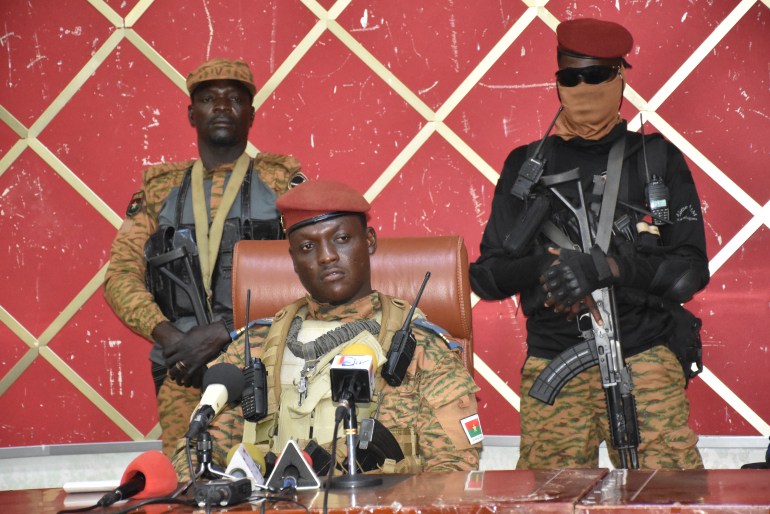
The West African Sahel nation has been struggling to contain armed groups for a decade. Around 170 people were “executed” in attacks on three villages in northern Burkina Faso a week ago, a regional prosecutor has said, as violence flares in the country. Aly Benjamin Coulibaly said in a statement on Sunday that he had received reports of the attacks on the villages of Komsilga, Nodin and Soroe in Yatenga province on February 25, with a provisional toll of “around 170 people executed”. The attacks left others wounded and caused material damage, the prosecutor for the northern town of Ouahigouya said, without apportioning blame to any group. He said his office ordered an investigation and appealed to the public for information. Ongoing violence Survivors of the attacks told news agency AFP that dozens of women and young children were among the victims. Local security sources cited by AFP said the attacks were separate from deadly incidents that happened on the same day at a mosque in the rural community of Natiaboani in eastern Burkina Faso and a church in the northern village of Essakane. Authorities have yet to release an official death toll for those attacks, but a senior church official said at the time that at least 15 civilians were killed in the Natiaboani attack. About half of Burkina Faso is outside government control, as armed groups have ravaged the country for years. The violence has killed almost 20,000 people and displaced more than two million people in one of the world’s poorest countries in a region wracked by instability. Anger at the state’s inability to end the insecurity played a major role in two military coups in 2022. Current head of state Captain Ibrahim Traore has prioritised a strong security response in reclaiming land from the rebel groups. Ali Kabre, an independent journalist based in the capital, Ouagadougou, told Al Jazeera that the attacks were likely an attempt by armed groups to show they are “still relevant in the country” after being put on the back foot by the military who have targeted them with regular air strikes. Ibrahim Traore gives a news conference on October 2, 2022, in Ouagadougou, Burkina Faso [Anadolu Agency] Coordinated attacks There were a number of attacks on February 25, notably against a military detachment in Tankoualou in the east, a rapid response battalion in Kongoussi in the north and soldiers in the northern region of Ouahigouya. In response, the army and members of the Volunteers for the Defence of the Fatherland (VDP), a civilian force that supports the military, launched operations that were able “to neutralise several hundred terrorists”, according to security sources cited by AFP. At the beginning of the week, Security Minister Mahamadou Sana described the wave of attacks as “coordinated”. “This change in the enemy’s tactical approach is because terrorist bases have been destroyed as well as training camps, and actions were carried out to dry up the enemy’s source of financing, as well as its supply corridors,” said Sana. Mosques and imams have in the past been the target of attacks blamed on armed groups. Churches in Burkina Faso have also at times been targeted and Christians have been kidnapped. The Armed Conflict Location & Event Data Project (ACLED) says that 439 people were killed in such violence in January alone. Adblock test (Why?)
Death toll rises to 10 in Russian drone strike on Ukraine’s Odesa

Three children killed in the attack, officials say, as Zelenskyy calls on the West to boost Ukraine’s air defences. The death toll from a Russian drone strike that destroyed an apartment block in Ukraine’s southern port city of Odesa on Saturday has risen to 10. Ukraine’s interior ministry reported that rescue workers on Sunday morning retrieved the remains of an infant and the baby’s mother, raising the number of children killed in the attack to three. “The mother tried to cover the 8-month-old child with her own [body]. She tried to save them. They were found in a firm embrace,” the ministry said in a Telegram post. On Saturday, Ukrainian authorities reported that a baby was among those killed after falling debris from an Iranian-made Shahed drone hit the apartment building – one of eight Russian-launched drones reported by officials. Russia has launched several thousand of these long-range winged drones throughout the war at targets across Ukraine. Later on Saturday, Ukrainian President Volodymyr Zelenskyy said that a second child had also died. “Tymofiy was 4 months old. Mark was about to turn 3 years old. My condolences to all of their close ones,” Zelenskyy wrote on X. He added that a three-year-old girl and seven other people were injured in the attack. A general view shows an apartment building heavily damaged by a Russian drone strike, amid Russia’s attack on Ukraine, in Odesa, Ukraine on March 2, 2024 [Reuters/Stringer] Search for survivors Four more people may be trapped in the rubble in Odesa, the local branch of Ukraine’s main emergency service said in a Facebook update on Sunday. Local Governor Oleh Kiper said that rescue workers continue to comb through the site, and regional authorities announced a day of mourning for the victims. Elsewhere in Ukraine, regional authorities reported that a 58-year-old man died under rubble after Russian forces shelled his village in the southern Kherson province. Another civilian man, aged 38, was killed in a Russian artillery strike on the neighbouring Zaporizhia region, local Governor Ivan Fedorov said. Zelenskyy seeks air defences Zelenskyy called on Western allies to boost Ukraine’s air defences in the wake of the deadly attack. “Delays in the delivery of weapons to Ukraine, as well as air defence to protect our people, unfortunately result in such losses. … Ukraine has never requested anything more than what is necessary to protect lives,” Zelenskyy said. Ukraine is currently struggling for resources as the war grinds into its third year with a $60bn aid package held up in the United States Congress. Adblock test (Why?)
Hamas officials arrive in Cairo for Gaza truce talks, but no sign of Israel

Israel withheld its delegation to Cairo due to Hamas rejecting one of its demands, according to an Israeli media report. Hamas officials have arrived in Cairo, Egypt for talks on securing a truce in the Gaza war after a US official indicated that Israel had endorsed a framework for a temporary ceasefire and exchange of Israeli hostages and Palestinian prisoners. Hamas representatives arrived in Cairo on Sunday, but by early evening there was no delegation from Israel for the talks mediated by envoys from Qatar, Egypt and the United States, with Israeli media reporting that Israel had not sent a team after the Palestinian group declined to share a list of captives who were still alive in the besieged territory. “There is no Israeli delegation in Cairo,” Israeli outlet Ynet quoted unidentified Israeli officials as saying. “Hamas refuses to provide clear answers and therefore there is no reason to dispatch the Israeli delegation.” There was no immediate comment from Israeli officials. A senior Hamas official told Al Jazeera that its delegation was in Cairo “to meet with the Egyptian and Qatari brothers and to present the movement’s vision. Whether or not the occupation delegation arrives in Cairo does not concern us,” he said. One source briefed on the talks told the Reuters news agency a day earlier that Israel could stay away from Cairo unless Hamas first presented the list of captives. A Palestinian source told the agency that Hamas had so far rejected that demand. A US official had earlier said Israel had agreed to the framework for a truce deal up for discussion in Cairo. “There’s a framework deal. The Israelis have more or less accepted it,” a senior US official in the administration of President Joe Biden said on Saturday. The framework proposal includes a six-week ceasefire, as well as the release by Hamas of captives considered vulnerable, which includes the sick, the wounded, the elderly and women, the US official said. Israel and Hamas have made several demands amid growing pressure from the US to close a deal for a truce to come into effect before the start of Ramadan, expected around March 10 or 11. The framework cited by the US official could bring the first extended truce of the war, which has raged since October 7 with just a week-long pause in November. But it would stop short of fulfilling the main Hamas demand for a permanent end to the war. Reporting from Rafah, southern Gaza, Al Jazeera’s Tareq Abu Azzoum said Hamas continues to demand that Israel agree to a “complete military withdrawal from the Gaza Strip, and also a full return for people to the north.” A potential truce deal would also see the release of captives held by Hamas in return for the release of Palestinian detainees. An agreement could also see aid deliveries ramped up at a time when aid agencies have warned that many Palestinians in Gaza are on the verge of famine. The war began on October 7 when Hamas attacked Israel, killing 1,139 people and capturing 253 hostages, according to Israeli officials. Israel responded with a devastating bombardment and ground invasion of Gaza that has killed more than 30,400 people, according to Palestinian officials. The Israeli assault has levelled large parts of the besieged territory and displaced more than 80 percent of the population. Adblock test (Why?)
Several killed in Israeli attack on aid truck in Gaza: Report
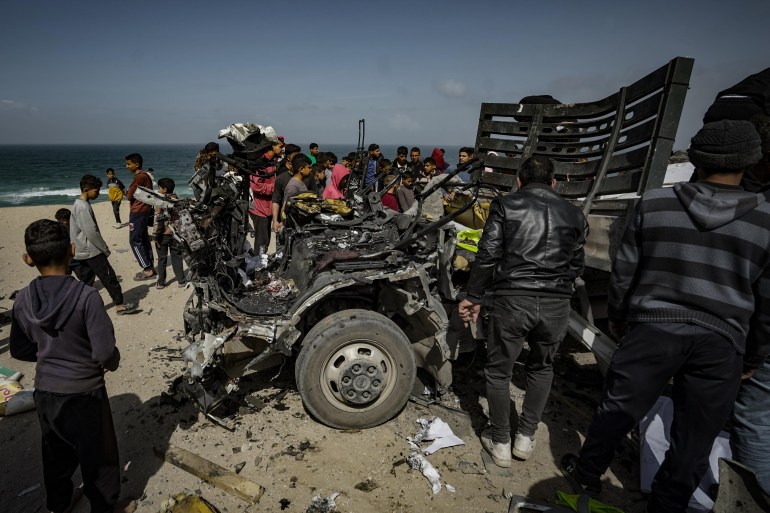
At least nine people killed in attack on aid distribution vehicle, according to Palestinian media. At least nine people have been killed and many others were wounded in an Israeli strike on an aid distribution truck in Deir el-Balah, the Wafa news agency reports. A witness who did not give his name told Al Jazeera that he was on his way to a water well on Sunday when the area was “showered with missiles, shrapnel flying around, body parts in the air”. “This truck was carrying relief aid, with civilian volunteers on board. They were carrying food items to displaced Gaza people. It is alleged that Deir el-Balah is a safe zone,” he said. There was no immediate comment from the Israeli military. ‘Horrific massacre’ Later on Sunday, Gaza’s Health Ministry spokesperson Ashraf al-Qudra said there were “dozens” of casualties in a “horrific massacre” of aid-seekers near the Kuwaiti roundabout on Salah al-Din Street in southern Gaza City. Al Jazeera’s Tareq Abu Azzoum, reporting from Rafah said: “It seems that the Israeli military is right now targeting people who are waiting desperately for food, for anything, to survive”. There was no immediate comment from the Israeli military. Palestinians inspect the heavily damaged aid vehicle, which was hit by an Israeli air attack, killing nine people and injuring dozens more in Deir el-Balah, Gaza, on March 3, 2024 [Belal Khaled/Anadolu Agency] Children die from malnutrition and dehydration The attacks came as Gaza’s Health Ministry said at least 15 children have died in the past few days from malnutrition and dehydration at the Kamal Adwan Hospital in Gaza City. The United Nations children’s agency, UNICEF, warned that many more children in Gaza will die of dehydration and malnutrition unless there is direct intervention to ensure aid. “Now, the child deaths we feared are here and are likely to rapidly increase unless the war ends and obstacles to humanitarian relief are immediately resolved,” Adele Khodr, UNICEF’s regional director for MENA, wrote in a statement. More than 30,400 people, mostly women and children, have been killed in Israel’s war on Gaza since October 7, according to Palestinian authorities. Israel launched its devastating bombardment and ground invasion of the besieged territory after Hamas, which governs Gaza, led an attack on Israel, killing at least 1,139 people, according to an Al Jazeera tally based on official Israeli figures, and seizing about 250 others as captives. Hamas in Cairo for talks Negotiations over a potential truce between Israel and Hamas resumed on Sunday, after a United States official indicated that Israel had endorsed a framework for a temporary ceasefire and exchange of Israeli captives and Palestinian prisoners. Hamas officials arrived in Cairo on Sunday but Israeli media reported that Israel did not send a delegation for the talks, mediated by envoys from Qatar, Egypt and the US. A senior Hamas official told Al Jazeera that its delegation was in Cairo “to meet with the Egyptian and Qatari brothers and to present the movement’s vision. Whether or not the occupation delegation arrives in Cairo does not concern us,” he said. One source briefed on the talks told the Reuters news agency a day earlier that Israel could stay away from Cairo unless Hamas first presented the list of captives. A Palestinian source told the agency that Hamas had so far rejected that demand. A US official had earlier said Israel had agreed to the framework for a truce deal up for discussion in Cairo. “There’s a framework deal. The Israelis have more or less accepted it,” a senior US official in the administration of President Joe Biden said on Saturday. Adblock test (Why?)
Preview: Bangladesh vs Sri Lanka T20 cricket series
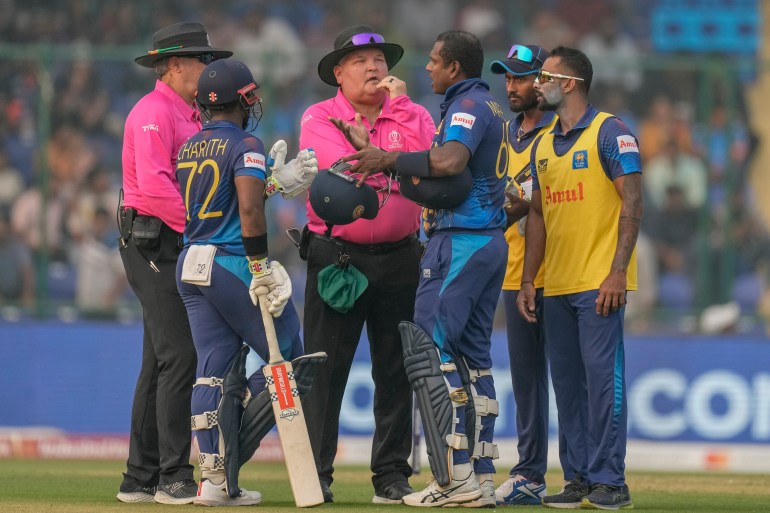
Two South Asian nations are set to resume their heated cricket rivalry with a Twenty20 three-match series as they eye the upcoming ICC T20 World Cup 2024. Bangladesh and Sri Lanka – not India and Pakistan – will play the first match T20 series in Sylhet, Bangladesh on Monday, less than three months ahead of cricket’s showpiece event of the year. Bangladesh captain Najmul Hossain Shanto said on Sunday that he wants his team to use the series to perfect the format ahead of the World Cup in June. The series marks the start of Sri Lanka’s month-long tour of Bangladesh, which also includes three one-day internationals and two Tests. Shanto said it was critical to “play as a team”, noting that they bagged big wins last year when “everyone contributed”. Bangladesh defeated world champions England 3-0 at home in 2023, and also won series against the Republic of Ireland and Afghanistan, before drawing a three-match series 1-1 against New Zealand. Shanto said he wanted to keep the momentum going into the World Cup, hosted this year by the United States and the West Indies. “Last year, we did well in T20s,” he told reporters. “It is very important that we play eight or 11 matches before going to the World Cup. “If we take these matches… and decide how we want to play in the World Cup, then it will be easy to plan.” The World Cup is a key focus of Sri Lanka, too. Sri Lanka coach Chris Silverwood said he was expecting a “very competitive series between two good sides”. “Obviously, we’re now in the build-up to what is an important competition in the World Cup,” he said. “What we have to do … is concentrate on what’s in front of us and remember what we’re aiming for.” Trophy Unveiling 🏆 | T20i Series Dutch-Bangla Bank Bangladesh vs Sri Lanka #BCB | #Cricket | #BANvSL pic.twitter.com/9or37uvkhE — Bangladesh Cricket (@BCBtigers) March 3, 2024 Return of the ‘Nagin dance’ rivalry The teams have developed a hotly-contested rivalry over the past few years, and every time they meet, there is no shortage of provocative words on the field and placards in the stands. Venomous on-field celebrations – which started with the “Nagin dance” in 2018 – are almost a permanent fixture as well. The last time both teams met was in the 50-over World Cup, when Bangladesh won by three wickets, but not without controversial scenes on the ground. Sri Lanka’s Angelo Mathews became the first cricketer to be dismissed “timed out” in an international match as he failed to take guard and declare himself ready to face the bowler within the stipulated time of two minutes since the dismissal of the last batter. Bangladesh captain Shakib Al Hasan appealed for a “timed out” dismissal, which was upheld by the on-field umpire. Bangladesh and Sri Lanka are both in Group D for the World Cup, along with South Africa, Nepal and the Netherlands. The second and third T20 matches will be held on March 6 and 9, both also at Sylhet. Sri Lanka, who arrived in Bangladesh on Thursday, will also play three one-day internationals and two Tests during the month-long tour. Sri Lanka’s Angelo Mathews, third right, talks to umpires after he was declared timed out during the ICC Men’s Cricket World Cup match between Bangladesh and Sri Lanka in New Delhi, India on November 6, 2023 [File: Manish Swarup/AP] Head-to-head record Bangladesh have never defeated Sri Lanka in a Twenty20 series. Both teams have met on 13 occasions and Sri Lanka hold the upper hand with nine wins compared to Bangladesh’s three. Team news: Bangladesh Bangladesh have recalled wicketkeeper-batsman Jaker Ali, replacing injured uncapped spinner Aliss Al Islam. Off-spinner Aliss sustained a finger injury while playing for Comilla Victorians in the recently finished Bangladesh Premier League. Bangladesh squad: Najmul Hossain Shanto (captain), Litton Das, Anamul Haque, Mohammad Naim, Towhid Hridoy, Soumya Sarkar, Mahedi Hasan, Mahmudullah Riyad, Taijul Islam, Rishad Hossain, Taskin Ahmed, Mustafizur Rahman, Shoriful Islam, Tanzim Hasan Sakib, Jaker Ali Anik. Team news: Sri Lanka Sri Lanka’s captain Wanindu Hasaranga will miss the first two matches due to a disciplinary suspension. Meanwhile, Kusal Perera is suffering from a respiratory infection and will be replaced by Niroshan Dickwella. Sri Lanka squad: Avishka Fernando, Kusal Mendis, Sadeera Samarawickrama, Pathum Nissanka, Wanindu Hasaranga (captain), Charith Asalanka, Akila Dananjaya, Dhananjaya de Silva, Angelo Mathews, Kamindu Mendis, Dasun Shanaka, Binura Fernando, Dilshan Madushanka, Matheesha Pathirana, Maheesh Theekshana, Nuwan Thushara, Jeffrey Vandersay Team updates Kusal Janith Perera, who was included in the T20I squad, will not take part in the series as he is suffering from a respiratory infection.Perera did not join the team, which left for Bangladesh yesterday.The Cricket Selection Committee has named Niroshan Dickwella… pic.twitter.com/kXUBzxmv6N — Sri Lanka Cricket 🇱🇰 (@OfficialSLC) March 1, 2024 Adblock test (Why?)
What to expect at China’s ‘Two Sessions’ amid sagging economy, party drama

Taipei, Taiwan – China’s “Two Sessions” kick off in Beijing on Monday with the meeting of the National People’s Congress (NPC) and the Chinese People’s Political Consultative Conference (CPPCC). The event brings together China’s political elite, as well as leaders in business, tech, media, and the arts. Known as lianghui in Chinese, the concurrent meetings are an annual fixture of China’s legislative agenda and run for approximately two weeks. During the period, legislators will approve new laws, political appointments, and government work reports detailing the progress of various departments such as the Ministry of Finance and the National Development and Reform Commission. What are the major developments to watch? During last year’s Two Sessions, delegates officially approved Xi Jinping for an unprecedented third term as president. This year, the event is likely to be dominated by China’s lagging economy, which is grappling with slowing growth, deflation, massive debt and falling exports. One of the most important events to watch will be Premier Li Qiang’s delivery of the annual work report, which will review the government’s accomplishments and set goals for 2024. Li is expected to set an economic growth target of about 5 percent for 2024 and discuss headline issues from China’s falling birth rate to the future of tech and artificial intelligence (AI) regulation. A number of key appointments could also be made. Over the past year, 11 members of the NPC’s Standing Committee – the legislature’s 175-member permanent body – have been removed, including Minister of Foreign Affairs Qin Gang and Minister of Defence Li Shangfu. Those who were removed had ties to the military, including the People’s Liberation Army (PLA) Rocket Force, which oversees China’s nuclear and conventional ballistic missiles. What is the difference between the two sessions? The NPC and the CPPCC are both Chinese state institutions that are technically separate from the Communist Party of China (CCP), but much of their work is dictated by it. On paper, the NPC is officially China’s highest legislative body with nearly 3,000 members representing the country’s provinces, autonomous regions, big cities, the PLA and the People’s Armed Police. The NPC also has delegates representing self-governing Taiwan, which is claimed by the CCP even though Beijing has never exercised control over the island. During the NPC, delegates review progress on policy goals and vote to approve new legislation and senior political appointments, although most delegates in reality have little political power. The NPC Standing Committee is widely viewed as more powerful than the legislature in practice, despite being technically subordinate, as it meets regularly between legislative sessions. “The NPC is not a parliament in the sense of a democratic parliament where the representatives are elected through fair elections. Its deputies are elected by a small portion of the Chinese population under the guidance of the Communist Party,” Adam Ni, co-editor of the China Neican newsletter, told Al Jazeera. “That is to say, the deputies of the NPC are at least acceptable to the party.” The CPPCC, which meets at the same time and brings together 2,000 plus delegates from across China and the diaspora, is a political advisory body that functions as more of a public relations exercise. Delegates are not necessarily members of the CCP, although the meeting is part of its “United Front” efforts to align different actors on common causes and spread China’s influence. CPPCC delegates include leaders in tech, the arts, media, and leaders from semi-autonomous Hong Kong and Macau. “The CPPCC performs several functions, including facilitating elite networking and directing policy advice from outside the party to the party-state. It operates as a means of trade, where the Communist Party provides access to the system and recognition through granting membership, while the elites sitting on the body gain access to policymakers and receive recognition,” Ni said. Is the NPC just a ‘rubber stamp’ parliament? The NPC is often referred to as a “rubber stamp” parliament or legislature, as its main function is to formally approve premade decisions and it features little, if any, overt debate. China watchers say that the NPC is still important to watch. It can incorporate limited popular input on issues that are not considered too sensitive and, on rare occasions, has featured displays of dissent. Most famously, one-third of delegates in 1992 voted against or abstained from approving the Three Gorges Dam, a controversial project to dam the Yangtze River. “People refer to the NPC as a ‘rubber stamp’ because it has never voted down any bill, work report, budget, or nomination presented to it. But that unduly narrow focus on the NPC’s vote outcomes alone, in my view, ignores the important role played by the thousands of NPC delegates in representing citizen interests on a range of politically non-sensitive issues,” Changhao Wei, a fellow at Yale Law School’s Paul Tsai China Center, told Al Jazeera. While you will not hear delegates debating on the floor, individual delegates and bodies such as the NPC Standing Committee can shape legislation as it is being drafted and provide input on issues like the national budget. Delegates can also submit individual bills calling on the NPC to act on important issues of the day. In 2022, delegates submitted multiple bills focusing on women’s rights and domestic violence in response to public outrage over the case of a trafficked woman with mental health issues who was found chained up by her husband. While these bills were not debated publicly, they would not have gone unnoticed within the government either, Wei said. Ni said although the CPP maintains an ironclad grip on power, the party is not a monolith, “but contains a multitude of interest groups and networks”. “There are also non-party groups and personnel involved in the lawmaking process,” Ni said. “We shouldn’t discount their agency, eg, advocates of women’s rights, environmentalists, because they can have an impact. But the influence and power of non-party individuals and groups are constrained by the political structure, where the party monopolises the instruments of state power.”
The two-faced cookie that called out a lying politician in South Africa

Stopping at the Wembley Bakery in Belgravia – a Cape Town suburb designated for “Coloured” people only during apartheid – is best done on an empty stomach. It means you can really tuck into the seemingly endless rows of freshly baked cakes, tarts, cookies and doughnuts. Many of the confections will be familiar to international visitors: red velvet cupcakes, jam swiss rolls and custard doughnuts. But others can only be found in certain parts of Cape Town: fragrant “koesisters” dusted with desiccated coconut, meringue-topped “Hertzoggies” and garish pink-and-brown “tweegevrietjies”. Meringue-topped Hertzoggies and pink-and-brown tweegevrietjies at the Wembley Bakery in Belgravia.[Desmond Louw, DNA Photographers/Al Jazeera] Unlike the man it is named after – the Afrikaner nationalist JBM Hertzog, who first came to power a century ago – the Hertzoggie is a bite-sized delight. A crisp biscuit shell is filled with chunky apricot jam and topped with delicately spiced coconut meringue before being popped in the oven for a final singe. The cookie was invented by Hertzog’s white, female supporters in the 1920s, and continued to be baked at National Party – the party that would go on to implement apartheid in 1948 – events for decades to follow. But the Hertzoggie would also find favour among a different segment of the population. “Hertzog made two promises,” explains chef Cass Abrahams, a legendary Muslim cookbook author and radio personality who was responsible for bringing the centuries-old cuisine of her people to a wider audience from the 1970s onwards. “He said that he would give the women the vote, and hy sal die slawe dieselfde as die wittes maak (he would make the slaves equal to the whites).” Her choice of words is not accidental: Almost two centuries after the abolition of slavery, Abrahams and the Cape Malay (the descendents of enslaved Muslims from Indonesia and elsewhere) community have not forgotten their history of bondage. “Cape Malay women became terribly excited by Hertzog’s promises,” Abrahams continues. “So, they baked their own, spicier version of the Hertzoggie … for a while.” After the events of 1930, when Hertzog broke the second of his promises, by leaving women of colour disenfranchised, Coloured women returned to their ovens to bake a sarcastic version of the Hertzoggie: the crudely iced and sickly sweet pink-and-brown tweegevrietjie, or two-faced cookie, which lacks the delicacy and refinement of the original – deliberately so. “Women would bake them both and put them next to one another and tell their children the story of General Hertzog,” says Abahams. Both versions are still baked today, a familiar sight at Cape Malay teas, weddings and funerals – and “especially at Eid”, Abrahams adds. The Wembley Bakery sells about 1,500 classic Hertzoggies and 800 tweegevrietjies in an average week. Hertzoggies are crisp biscuit shells filled with chunky apricot jam and topped with delicately spiced coconut meringue [Desmond Louw, DNA Photographers/Al Jazeera] Recipe for disaster In the 1920s, South African politics was all about the so-called “native question” – that is, coming up with a workable solution to the inconvenient and incontrovertible truth for the white minority, that people of colour far outnumbered those with white skin. The Union of South Africa had only been established in 1910 – the Anglo-Boer War only concluded in 1902, and thanks to a hastily agreed hodgepodge constitution, different provinces had different voting rules. Men of all races could vote in the Cape Province (providing they met the property and literacy franchise qualifications), but only white males could vote in the three other provinces: Transvaal, Natal and Orange Free State. Prime Minister Jan Smuts declined to tackle the “native question”, preferring, as his biographer Richard Steyn puts it, “to kick the can down the road” in the hopes that the question would answer itself. Smuts’s bitter rival Hertzog, on the other hand, had very clear ideas about how to solve the “native question” – and segregation and disenfranchisement were at the heart of these ideas. From 1919 onwards, Hertzog, as leader of the opposition, made a concerted effort to win the Coloured vote. His “new deal for Coloureds” was simple, wrote Gavin Lewis in his seminal history of Coloured politics in South Africa: “In return for their support of [Hertzog’s] policies, Coloureds would share in the privileges legislated for white workers, and would be exempted from the restrictions applied to Africans.” Thanks in part to this promise, Hertzog – in coalition with the largely English-speaking, but equally racist, Labour Party – was able to topple Smuts at the 1924 election. As an aside, Jan Smuts also had a cookie named after him, a jam-filled pastry shell that is very similar to a British “maid of honour”. Peter Veldsman, one of South Africa’s leading culinary historians, explains, “The Jan Smutsies were an out-and-out political reaction from Smuts’s supporters: ‘They’ve got a cookie and we need one, too,’” before adding: “Personally, I prefer Jan Smuts cookies. And not just because my family were Smuts supporters. But I haven’t seen, let alone eaten, one for years.” JBM Hertzogg and Jan Smuts in front of Parliament in 1938 [Wikipedia] One step forward and three steps backward At the same time, the women’s suffrage movement was belatedly gathering steam in South Africa. While most Western nations granted women the right to vote in the years immediately following World War I, South Africa was slower on the uptake. Its parliament, after all, included men such as TC Visser, who claimed that “it was a scientific fact that the development of a woman’s brain stopped at a stage beyond which a man’s brain went on.” By the end of the 1920s, however, attitudes had changed and men like Visser were in the minority. Even Hertzog accepted that women should be allowed to vote. And when he announced plans to give both white and Coloured women the vote in the Cape – to “make the slaves equal to the whites” – Hertzoggies began to fly out of Cape Malay ovens. This enthusiasm ignored the fact that Hertzog
President Biden, why do you support genocide in Gaza?

Dear President Biden, I am writing to you for the second time. I first wrote to you on November 4 after 47 members of my community, including 36 from my own family, were murdered in a single attack by the Israeli Occupation Forces (IOF). The massacre occurred in Khan Younis refugee camp, located in the southern region of the Gaza Strip, where people were supposed to be safe, as claimed by your ally, Israel. I am uncertain if my first letter reached you or if your media team made you aware of its contents. Either way, you have not changed your position. Your unequivocal support for Israel, including through large weapons transfers, means that many more such massacres have been committed with your help since then. Since writing that letter, I have lost another 220 members of my own family. Just a month ago, on January 31, my father’s cousin, Khaled Ammar, 40, who was displaced in Khan Younis, was killed alongside his entire family when the place they were staying in was shelled by an Israeli tank. Khaled’s wife, Majdoleen, 38, their four daughters, Malak, 17, Sarah, 16, Aya, 9, and Rafeef, 7, and their two sons, Osama, 14, and Anas, 2, all perished in the attack. Among the victims were also Khaled’s disabled brother Mohammed, 42, and their mother Fathiya, 60. Their bodies remained unburied for over a week. Khaled’s surviving brother, Bilal, 35, made repeated calls for assistance to the Palestinian Red Cross Society, but they could not dispatch a rescue team to look for survivors because the IOF did not grant them permission. Majdoleen and her two young daughters, Rafeef and Aya, came to see me last summer when I visited Gaza. I still remember Rafeef trying to ride the bike of my youngest niece, Rasha. I still remember them racing down the street, eating the candy they had bought from the shop of my cousin, Asaad. Their laughter still echoes in my ears. But today, Mr President, there is no Aya, no Rafeef, no Asaad, who was also killed by the IOF along with his wife, children, mom, two sisters, sister-in-law and their children. There are no roads, no homes, no shops, no laughter. Only echoes of devastation and the deafening silence of loss. Today, the residential area of Khan Younis refugee camp I grew up in is reduced to rubble. Tens of thousands of refugees, including all surviving members of my extended family, are now displaced to al Mawasi and Rafah. They are living in tents. They are not faring well, Mr President. I have not heard from them in a while, as Israel has cut off communication. On February 10, my nephew, Aziz, 23, walked three kilometres despite the danger to reach the edge of Rafah to use the internet. He told me that death has passed by them many times but spared them for now. They are hungry, thirsty, and cold. There is no power, no sanitation, no medications, no communications, or any services available to them, despite the International Court of Justice ruling that Israel has to ensure the delivery of aid to Gaza. If people do survive the Israeli bombs, they may not survive wounds sustained in the Israeli bombardment and the explosion of communicable and non-communicable diseases. The health care system has collapsed under the Israeli onslaught. In February, the IOF laid a siege on Nasser Hospital in Khan Younis, the second-largest in the Gaza Strip. There were 300 medical staff trapped in the hospital alongside 450 patients and about 10,000 internally displaced persons seeking refuge within or in the hospital’s vicinity. For days, the IOF would not let a rescue team from the World Health Organization (WHO) evacuate patients and staff or deliver much-needed food, medical supplies and fuel. Throughout this time, the medical staff demonstrated remarkable courage and dedication to their patients, trying to keep them alive in the face of the Israeli attacks. Dr Amira Al Assouli, who rushed under Israeli fire to aid one of the wounded in the hospital courtyard is one bright example. Countless people who sought shelter in the hospital premises were killed or wounded; some of these murders were recorded on camera. On February 13, the IOF sent a young man named Jamal Abu Al Ola, whom Israeli soldiers had detained and tortured, to the hospital to tell the Palestinians sheltering there to leave. Wearing a white PPE garment and with his hands bound, he delivered the message and then – as instructed – headed towards the gate of the hospital, but was shot dead. His execution was documented by a journalist at the hospital and released to the public. Will you order an investigation, Mr President? Will you demand that those responsible for the killing of Jamal and the many others at Nasser Hospital be punished or will you accept the IOF’s version of events again? On February 15, the IOF raided the hospital, expelling thousands of people amid heavy bombardment and forcibly disappearing hundreds – at least 70 of them medical workers. This continues a pattern started in Gaza City. When the IOF raided Al Shifa Hospital, it detained some of its staff, among them, Dr Mohammed Abu Salmiya, the hospital director, who remains in Israeli jail. The excuse then, as now, is that they were hunting for a Hamas command centre – a false narrative, you, Mr President, readily embraced. During the raid of Nasser Hospital, the cutting off of electricity and oxygen resulted in the deaths of at least eight patients. When a WHO team was finally allowed to enter the hospital, its staffers described it as “a place of death”. After the evacuation of hundreds of patients, some 25 medical staffers stayed behind to care for the remaining 120 patients in the hospital without a secured supply of food, water or medications. Among the regular patients of Nasser Hospital was my relative, Inshirah, who suffered from kidney failure and required dialysis every week. She lived in the Al Qararah area,