

Russian troops inch ahead as war in Ukraine barrels into third year

Ukrainian forces in the east struggled to find stable new defences during the past week, as Russian troops continued to advance after capturing Avdiivka – suggesting that artillery and other shortages were affecting Ukraine’s ability to hold the entire 1,000km (620-mile) front line. Ukrainian forces withdrew from Avdiivka on February 17, after a four-month Russian onslaught to take the town. On February 24, Ukrainian defenders also withdrew from the village of Lastochkyne, three kilometres (1.9 miles) west of Avdiivka, never having had a chance to build proper defences under fire. “There were no defences built there, and the fighters had to withdraw from the battles in Avdiivka and gain a foothold in the very process of hostilities,” one Ukrainian military reporter known as DeepStateUA wrote on Telegram to his 700,000 followers, predicting that the same would occur at other points of retreat. Three days later, Ukrainian troops withdrew from the villages of Stepove and Sieverne, north and south of Lastochkyne, after fierce overnight battles. Oleksandr Tarnavskyi, commander of the Tavria Group of Ukrainian forces, which is fighting in this area, said on February 27 that the line of defence had “stabilised” along Tonenke-Orlivka-Berdychi axis, a row of three villages immediately to the west of Lastochkyne, but even that assumption seemed precarious. Geolocated footage the following day showed Russian troops at the southeastern approaches to Orlivka. Tavria spokesman Dmytro Lykhoviy said Russian forces had increased the size of attacking units from squads to platoons or even companies. A squad can be as small as half a dozen troops. Platoons can be as big as 50, and a company can reach 200 troops. [Al Jazeera] Russian troops also claimed on February 26 to have advanced to the outskirts of Ivanivske, a village west of Bakhmut, the last city to fall to Russian forces, in May. And Russian forces reclaimed Robotyne, a village Ukrainian troops recaptured during last summer’s offensive at the western end of the front, in Zaporizhia. Geolocated footage on February 24 showed Russian troops in the centre of Robotyne, where military reporters said they had secured the central fortified positions in the school and recreational centre. Russian troops also continued to assault Ukrainian positions in Krynky, on the left bank of the Dnipro River in Kherson, without success. Control of the air One reason for Russian success in Avdiivka appears to have been the fact that Moscow’s forces secured local air superiority and used it to drop glide bombs – large, inert weapons fitted with fins to fly further and strike more accurately. Ukrainian President Volodymyr Zelenskyy said Russia had dropped more than 3,200 glide bombs since the beginning of the year. Ukraine has targeted Russian bombers and the command planes that coordinate them. On February 27, Ukraine downed two Sukhoi-34 bombers, at least one of them in the east, which are used to drop glide bombs. More consequentially, on February 23 the Ukrainian military shot down a Russian A-50 early warning and control plane over the Sea of Azov coast. The A-50 is an airborne radar used to monitor enemy air activity and air defences. Russia has used them to feed target coordinates to fighters, bombers and long-range missiles. Ukrainian military intelligence chief Kyrylo Budanov said the operation had left Russia with just six A-50 planes in the Ukraine theatre, and that more would be downed. [Al Jazeera] Zelenskyy told allies gathered in Paris that a strategic goal for this year was to deprive Russia of air superiority, just as it had been deprived of its control of the Black Sea and its superiority on land. Ukraine has long-targeted these planes, which are very difficult to replace. Russia only built 40 of them, and crew training takes years. Some reports suggest they will be vital to Russian efforts to shoot down Ukrainian F-16s, once they start flying. Western allies have promised to hand Ukraine at least two dozen. A year ago, fighters bombed the Machulishchi air base in Belarus, where Russia had parked an A-50, damaging it. On January 15, Ukraine downed an A-50 in the Sea of Azov, along with an Ilyushin-22 command plane. Ukraine also continued ranged attacks on Russian energy and defence infrastructure. On February 24, its military intelligence and security service said they had jointly organised a successful drone attack against the Novolipetsk Metallurgical Plant, in Lipetsk, 370km (230 miles) southeast of Moscow. The plant supplies steel for the manufacture of artillery, missiles and drones. Russia, too, continued its aerial campaign against Ukrainian infrastructure using missiles and drones. From February 21-28, Ukraine downed 79 Iranian-designed Shahed drones out of 98 launched, along with a number of missiles. What are Ukraine’s allies doing? Ukraine’s allies continued to pledge military assistance. Denmark announced a $228m military aid package including 15,000 rounds of ammunition. Germany announced a new military aid package that included 14,000 artillery rounds and reconnaissance drones. French President Emmanuel Macron gathered 20 heads of government, including 15 from the EU, in Paris on February 26, to discuss increasing the supply of artillery rounds to Ukraine. The European Union has said it will be in a position to manufacture a million artillery rounds a year by the end of 2024. Macron also called for the formation of a new alliance to supply “missiles and bombs of medium and long range to carry out deep strikes”. France and the UK were the first to supply Ukraine with Storm Shadow/SCALP missiles, with a 140km (87-mile) range, last May. Until then, the longest-range weapon Ukraine had was 80km (50-mile) range HIMARS rockets. The US is now reportedly thinking of supplying 300km range ATACMS missiles, and Ukraine claims it has developed a 700km range (435-mile) missile. [Al Jazeera] While there was “no consensus” on the sending of Western ground troops to Ukraine, “nothing should be excluded. We will do whatever it takes to ensure that Russia cannot win this war,” Macron said. Russian President Vladimir Putin responded with a threat of nuclear war, should NATO members send troops to Ukraine.
Israel strikes Lebanon’s south, raising risks of escalation

Israeli strikes killed at least two people in Lebanon’s south on Wednesday evening, while Hamas fighters earlier fired a volley of rockets towards northern Israel from Lebanon amid escalating cross-border clashes in recent days. Lebanon’s Hezbollah has exchanged near daily fire with the Israeli army since Tel Aviv launched a brutal war on Gaza on October 7. Palestinian groups in Lebanon have also occasionally claimed attacks. They have been demanding a ceasefire in Gaza where more than 30,000 people have been killed in four months of relentless Israeli bombardment. “Enemy warplanes raided the towns of [Seddiqine] and Kafra… killing two people from the town of Kafra and injuring 14,” Lebanon’s state-run national news agency (NNA) said. On Wednesday morning, Hamas’s armed wing, the Qassam Brigades said in a statement it targeted two Israeli military sites with two barrages of Grad rockets. The attack from south Lebanon came in “response to Zionist massacres against civilians in the Gaza Strip and the assassination of martyred leaders and their brothers in the southern suburbs” of Beirut, the statement added. The Israeli military said in a statement that “approximately 10 launches which crossed from Lebanon into northern Israel were identified”, adding that sirens had sounded in north Israel’s Kiryat Shmona area. Air defences “successfully intercepted a number of the launches”, the statement said, adding that the army “struck the sources of the fire in Lebanon”. Israeli police reported property damage in the Kiryat Shmona area but no wounded. A strike in January, which a United States defence official said was carried out by Israel, killed Hamas’s deputy leader Saleh al-Arouri and six others in south Beirut – the most high-profile Hamas figure to be killed during the war. The escalating cross-border exchanges since October 8 have stoked fears of all-out war on Israel’s northern border with Lebanon. The exchanges have killed at least 286 people on the Lebanese side. On the Israeli side, 10 soldiers and six civilians have been killed, according to the Israeli army. Thousands of people from border regions have been displaced due to the exchanges. Adblock test (Why?)
Teacher sets up Gaza tent school to keep Palestinian children learning

NewsFeed This teacher in Gaza has set up a tent school to offer displaced Palestinian children an education that would otherwise have stopped due to Israel’s war. Published On 29 Feb 202429 Feb 2024 Adblock test (Why?)
Al Jazeera’s senior political analyst on Israeli massacre in Gaza

NewsFeed Al Jazeera’s senior political analyst Marwan Bishara said Israel’s massacre of hungry Palestinians waiting for food aid in Gaza was ‘state-sponsored terror’. Published On 29 Feb 202429 Feb 2024 Adblock test (Why?)
The industries profiting off Chinese asylum seekers in the US

101 East investigates alleged human traffickers, scammers and middlemen profiting from the desperation of Chinese asylum seekers in America. Reaching the United States has long been the dream for would-be migrants travelling across Latin America. Thousands of Chinese have embarked on the dangerous route this year. But reaching their final destination is no guarantee that their troubles will be over. In Part 2 of The Route, 101 East heads to the US to explore an industry that has mushroomed around the Chinese citizens desperately seeking asylum. From alleged human traffickers, scam artists and opportunists operating in Los Angeles, to the migrants who have been tricked, cheated and exploited, this undercover investigation explores the price of pursuing the so-called American Dream. Adblock test (Why?)
Chaotic scenes in Gaza hospital after aid delivery massacre

NewsFeed There were desperate scenes at a hospital in north Gaza where dozens of casualties arrived after the massacre of Palestinians waiting for food aid. The hospital’s director described the critical situation staff were facing. Published On 29 Feb 202429 Feb 2024 Adblock test (Why?)
As Texas Panhandle wildfires rage, what we know so far
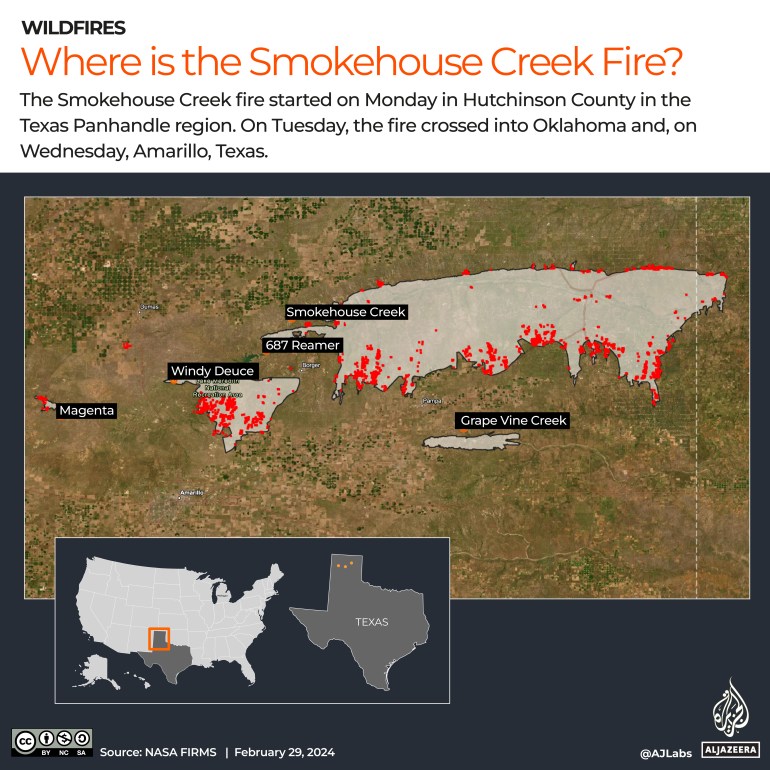
The Texas Panhandle region of the state’s 26 northernmost counties is being ravaged by a series of what may soon become the state’s worst wildfires in recorded history. Here’s what we know so far about the wildfires, which have also spread to parts of Oklahoma, and are destroying homes and forcing residents to evacuate. When did the fires start and how have they spread? Multiple wildfires started on Monday afternoon and spread on Tuesday, raging through the Texas Panhandle region amid unusually warm, dry and windy weather. Despite the efforts of firefighters to contain them, the wildfires persisted and expanded on Wednesday. The worst among them is the Smokehouse Creek fire, which started on Monday at 20:20 GMT. Within 28 hours it had spread across 250,000 acres (101,171 hectares). So far, it has consumed more than 850,000 acres (344,000 hectares) of land. Observers noted that this is more than twice the size of London which is 159,000 hectares. This is more land than all of the state’s 2023 fires combined, and it is closing in on the largest fire on record in Texas: the East Amarillo Complex fire, which burned 907,245 acres (367,149 hectares) in 2006. According to local media reports, homes on the outskirts of Canadian, Texas, were also burned by the Smokehouse Creek fire. On Tuesday, Texas Governor Greg Abbott issued a disaster declaration for 60 counties. He directed the Texas Division of Emergency Management to dispatch more than 95 firefighters and deployed personnel to close roads, control traffic, offer medical aid and provide livestock support. Where are the wildfires? The Smokehouse Creek fire started on Monday in Hutchinson County in the Texas Panhandle region. On Tuesday, the fire crossed into Oklahoma and on Wednesday, Amarillo, Texas. Texas and Oklahoma were at the epicentre of some of the most dangerous conditions. The Texas A&M Forest Service said only about three percent of the flames had been contained. The next largest was the Windy Deuce fire, which, as of Wednesday night, had raged across 142,000 acres (57,465 hectares) and was 30 percent contained. Windy Deuce crept to within a few miles of the US Energy Department’s Pantex Plant, the nation’s primary nuclear weapons assembly facility, located near Amarillo, prompting officials to evacuate non-essential personnel and suspend operations. The Grape Vine Creek fire spread across 30,000 acres (12,140 hectares) southeast of Pampa and was 60 percent contained. The Magenta fire was burning in Oldham County, and it is estimated to have burned 2,500 acres (1,011 hectares), while 65 percent was contained. The 687 Reamer fire burned in Hutchinson County, affecting 2,000 acres (809 hectares) and 10 percent of it has been contained. What happened at the nuclear weapon facility near Amarillo? The Pantex Plant, northeast of Amarillo, evacuated non-essential staff and said operations had “paused until further notice” on Tuesday night when the fire came within a few miles. Pantex added that “all weapons and special materials are safe and unaffected”. By Wednesday the plant had returned to normal operations. “There is no imminent wildfire threat to the plant at this time,” Pantex officials said. Pantex is one of six production facilities in the National Nuclear Security Administration’s Nuclear Security Enterprise. The plant has been the main US site for assembling and disassembling atomic bombs since 1975. It produced its last new bomb in 1991 and has dismantled thousands of weapons retired from military stockpiles. Have there been any casualties? At least one person, an 83-year-old woman in Hutchinson County, was reported by local media to have died as a consequence of the Smokehouse Creek fire. She was identified by family members as Joyce Blankenship, a former substitute teacher. Her grandson, Lee Quesada, said he had posted in a community forum asking if anyone could try and locate her. Quesada said deputies told his uncle on Wednesday that they had found Blankenship’s remains in her burned home. Quesada said she had surprise him at times with funny little stories “about her more ornery days”. “Just talking to her was a joy,” he said, adding that “Joy” was a nickname of hers. Hemphill County Emergency Management Coordinator Bill Kendall described the charred terrain as being “like a moonscape. … It’s just all gone.” An 83-year-old grandmother has died in the massive Smokehouse Creek fire. Joyce Blankenship’s body was found in #Stinnett. She had lived in the Scotts Acres neighborhood & is the first confirmed fatality. 📸 by Nathan Blankenship [grandson]#Panhandle #SmokehouseCreekFire pic.twitter.com/y7jVT8SRSi — Tay Austin (@Jasamsdestiny) February 29, 2024 What has caused these wildfires? On Monday, unusually high temperatures were recorded reaching 100 degrees Fahrenheit (37 Celsius) in Killeen, 93F (33C) in Dallas, and 82F in Amarillo (27C) – more than 20F higher than usual for February. This unprecedented heat is believed to have caused moisture to evaporate, depleting vegetation of humidity and making fuels susceptible to burn, according to local experts. As hot and dry winds swept in from the west, and Amarillo experienced gusts as strong as 62mph (100km/h) during the fires, the relative humidity plummeted to as low as 15 to 20 percent. Lower temperatures and a dip in wind speeds on Wednesday helped to slow the spread of the fires. Rain showers were forecast for Thursday which could help curb the fires further. However, higher temperatures and strong winds are expected to return at the weekend. The fact that we have had 132 February ALL-TIME RECORD HIGHS is just insane. pic.twitter.com/r6rj38FbhR — Jim Cantore (@JimCantore) February 28, 2024 What damage have the fires caused? More than 13,000 Texas homes and businesses were without power as of Wednesday morning, including more than 4,000 of those in the Panhandle region alone, according to data from PowerOutage. Hemphill County Judge Lisa Johnson said: “Homes have burned in almost every direction.” Meanwhile, farmland has been severely affected, with hundreds of dead cattle, a county official told the agricultural news publication, Farm Progress. “We’ve lost a lot of acres, a lot of cattle, and a lot of homes. So far, we
Texas battles its second largest wildfire on record

Wildfires have been raging across the US state of Texas, as firefighters struggled to control one of the largest blazes in state history, which has destroyed property and prompted evacuations. The Smokehouse Creek fire in Texas’s Panhandle, a flat northern area known for its prairies and smattering of small towns, was listed as only 3 percent contained by the Texas A&M Forest Service. An 83-year-old grandmother was confirmed dead, but with flames still menacing a wide area, authorities have yet to conduct a thorough search for victims or tally the numerous homes and other structures damaged or destroyed. The fire has expanded to more than 1,300 square miles (3,370sq km) and jumped into parts of neighbouring Oklahoma. The largest fire recorded in state history was the 2006 East Amarillo Complex fire, which burned about 1,400sq miles (3,630sq km) and resulted in 13 deaths. Walls of flames were pushed by powerful winds while huge plumes of smoke billowed hundreds of feet in the air across the sparsely populated region. The smoke delayed aerial surveillance of the damage in some areas. Authorities have not said what ignited the fires, but strong winds, dry grass and unseasonably warm temperatures fed the blazes. Near Borger, a community of about 13,000 people, emergency officials at one point late on Tuesday answered questions from panicked residents on Facebook and told them to get ready to leave if they had not already. The weather forecast provided some hope for firefighters – cooler temperatures, less wind and possibly rain on Thursday. Sustained winds of up to 45mph (72kmph), with gusts of up to 70mph (113kmph), caused the fires that were spreading east to turn south, threatening new areas, forecasters said. But winds calmed down after a cold front came through Tuesday evening, said Peter Vanden Bosch, a meteorologist at the National Weather Service in Amarillo. Breezy conditions were expected again on Friday, and fire-friendly weather could return by the weekend, Vanden Bosch said on Wednesday. Governor Greg Abbott on Tuesday declared a state of disaster for 60 counties, while blazes near the northern city of Amarillo temporarily caused the shutdown of a nuclear weapons plant. Adblock test (Why?)
Blame Joe Biden for President Trump come November

It is over. I wrote a column a few months ago expressing the sincere hope that Joe Biden would lose the upcoming presidential election. Now, I can confidently predict that this craven, self-anointed “Zionist” will join the roster of presidential has-beens; an unremarkable one-term commander-in-chief who will be remembered chiefly for abetting a genocide instead of stopping it. That will be Biden’s permanent and disgraceful epitaph. Biden’s sorry fate was confirmed earlier this week after more than 100,000 enlightened Americans voted “uncommitted” in Michigan’s Democratic presidential primary. Their act of tangible resistance delivered a blunt rebuke not only of Biden but the whole, decrepit Democratic Party establishment that has enabled, supported, and encouraged a diseased apartheid regime to commit genocide against imprisoned Palestinians in Gaza and beyond. Biden and company will be unable to resuscitate his fast-eroding prospects among enlightened Americans who are motivated by one, defining moral imperative: to repudiate through their suffrage the complicit perpetrators of the deliberate, wholesale destruction of Palestine and its desperate people. It is too late. The deep damage cannot be undone. Gaza is gone. Reduced by methodical and cruel design to a wasteland at the foul hands of a ruthless, occupying army. More than 30,000 innocents, mostly infants and children, have been killed. Blown to scattered bits. Their small, dismembered bodies left hanging like grotesque ornaments on a bloodied wall in Rafah. Families erased. Children orphaned. Parents grieving over the remains of their beloved dead wrapped tight in white shrouds and buried by hand in shallow pits. Thousands more have been maimed or injured – in mind, body, and spirit. Starvation, thirst, and disease run rampant in the makeshift camps where millions of homeless Palestinians have sought – in vain – refuge from Israel’s “killing rage”. All of it, every inhumane measure of it, is a man-made catastrophe engineered by irredeemable sociopaths in tailored suits, like President Biden. So, enlightened Americans in Michigan – many of them Arab and Muslim Americans – did what I knew they would do. No longer content to be ghosted by an administration addicted to empty, performative acts of “solidarity”, they organised. They mobilised. They staffed phone banks. They went door to door. They persuaded other enlightened Americans to join them in their resolve to be heard and counted. Together, they told Biden that his complicity and cowardice will not stand. They translated their anger and disgust into a potent political force while an old, dithering president licked an ice cream cone and donned his aviator sunglasses for an agreeable late-night talk show comic. This was not a “warning” or a “protest”. It was a statement. A verdict. A judgement. Worse, for Biden, it was a commitment. The “uncommitted” are committed to defeating Biden and depriving him of what he values most: power, position, and prestige. Michigan’s “uncommitted” voters will exercise their franchise in November. Biden will have his comeuppance because, without Michigan’s crucial 16 electoral votes, his already precarious bid for re-election will be doomed. In 2020, Biden prevailed in Michigan by a little more than 100,000 votes. Recent polls show the state tipping into Trump’s favour. The math is simple. Subtract the 100,000 “uncommitted” voters and Michigan is lost and likely with it, the presidency. The calculated leaks and rhetorical chicanery aimed at convincing enlightened Americans of Biden’s “frustration” with a recalcitrant Israeli prime minister, Benjamin Netanyahu, and the president’s “determined efforts” at arranging a ceasefire are a choreographed pantomime. Biden is no more interested in a ceasefire than Netanyahu and his rabid, evangelical cabinet which has made it plain that their goal is to obliterate Palestine and plot a second, decisive Nakba. Just as lunatic is the suggestion that a “miffed” Biden is poised to withhold America’s purse and lethal munitions to “pressure” Israel into bending to its phantom will to “protect” Palestinian civilians and enact his “grand” geostrategic plans to establish a “two-state solution”. All of it, every disingenuous ounce of it, is a familiar lie. Biden has not been and never will be a “peacemaker”. He is a 100 percent-proof warmonger practised at backing US invasions of sovereign country after sovereign country and damn the disastrous human consequences. Enlightened Americans won’t be fooled again. Still, Biden and his surrogates believe that money will be their salvation from the genocidal quagmire of their making. After ordering his quislings – my apologies, diplomats – at the United Nations to veto another ceasefire resolution, Biden attended a lucrative fundraiser in Los Angeles co-hosted by the billionaire honorary vice chairman of the Anti-Defamation League, Haim Saban. Prior to the up to $250,000-a-plate fete-a-tete, Biden’s gushing super fan described the president’s steadfast support of Israel as “pristine”. “There’s never been a president as supportive in facts, not only in words, of Israel,” Saban said. “And most specifically, in these dire times for Israel, he’s been pristine.” Saban is right. Biden has long been a “pristine” backer of an apartheid state that the International Court of Justice at the Hague accepted the “plausibility” of having committed genocide as defined by the Genocide Convention. In instructive contrast to Biden’s rich benefactors, the organisers of Michigan’s “uncommitted” campaign reportedly earned their astonishing success on a paltry budget of $200,000. Their principled, people-driven initiative will, no doubt, be a template for enlightened Americans in other toss-up states to follow honourable and necessary suit. The disgust and anger that fuelled Michigan’s “uncommitted” voters to turn out in such extraordinary numbers may soon be replicated throughout the daunting electoral college map that Biden confronts. That is the fatal reality. It’s the genocide, stupid. When he is obliged, by tradition, to leave behind a congratulatory note on the Oval Office desk wishing President Donald Trump every success, one person will be to blame: Joe Biden. The faux “progressive” and “liberal” cognoscenti will wail at the impending demise of America’s sham “democracy”. In their quest for an easy scapegoat, they are bound, of course, to point an accusatory finger at the “short-sighted protest vote” that
Dozens killed, injured by Israeli fire in Gaza while collecting food aid

Desperate residents under Israeli attack while trying to get flour for families as famine stalks the strip. Dozens of Palestinians have been killed or wounded after Israeli troops opened fire on hundreds waiting for food aid southwest of Gaza City, as the besieged enclave faces an unprecedented hunger crisis. The citizens had congregated at al-Rashid Street, where aid trucks carrying flour were believed to be on the way. Al Jazeera verified footage showing the bodies of dozens of killed and wounded Palestinians being carried onto trucks as no ambulances could reach the area. “We went to get flour. The Israeli army shot at us. There are many martyrs on the ground and until this moment we are withdrawing them. There is no first aid,” said one witness. One Palestinian man told the Quds News Network the military attack was a “crime”. “I have been waiting since yesterday. At about 4.30 this morning, trucks started to come through. Once we approached the aid trucks, the Israeli tanks and warplanes started firing at us, as if it was a trap. “To the Arab states I say, if you want to have us killed, why are you sending relief aid? If this continues, we do not want any aid delivered at all. Every convoy coming means another massacre.” The mass shooting was the latest instance of systematic attacks on hungry people waiting for scraps of food. Over the past few days, Palestinians gathered in large groups waiting for aid trucks on Salah al-Din Street near Gaza City have been shot at by Israeli forces, said Al Jazeera’s Hani Mahmoud, reporting from Rafah in the enclave’s south. Recently, a truck that was supposed to deliver aid to people in Gaza tragically turned into the truck carrying those injured and killed, he added. With aid agencies unable to deliver supplies to northern Gaza since January 23, many are taking a long trek towards the south by foot. Famine On Wednesday, Carl Skau, deputy executive director of the World Food Programme (WFP), told the United Nations Security Council more than 500,000, or one in four people, were at risk of famine, with one child in every six below the age of two considered acutely malnourished. Nearly every family in #Gaza needs food assistance to survive. Yesterday, WFP’s Deputy Chief @CarlSkau warned the Security Council of imminent famine in northern Gaza unless conditions change. 🔗Read his full remarks: https://t.co/VnP20iPqEl pic.twitter.com/ZhFUyNIQv7 — World Food Programme (@WFP) February 28, 2024 “The risk of famine is being fuelled by the inability to bring critical food supplies into Gaza in sufficient quantities, and the almost impossible operating conditions faced by our staff on the ground,” he said. He described dangerous conditions for WFP trucks trying to get food to the north earlier this month. “There were delays at checkpoints; they faced gunfire and other violence; food was looted along the way; and at their destination, they were overwhelmed by desperately hungry people,” said Skau. Aid agencies claim that Israel has been delaying deliveries. Israel denies that charge. It submitted a report to the International Court of Justice (ICJ) on the measures taken to avert suffering in the besieged enclave. Rights groups say Israel acted in breach of the ICJ order issued in January. Philippe Lazzarini, the head of UNRWA, the UN agency for Palestinian refugees, said on Sunday on social media that calls to allow food distribution in Gaza amid the ongoing hostilities between Israel and Hamas have been denied or “have fallen on deaf ears”. Warning against “looming famine”, the UN official said the situation is becoming a “man-made disaster”. Israel launched a deadly offensive on the Gaza Strip following a Hamas-led attack on October 7. More than 30,000 people are reported to have been killed to date, mostly women and children. Adblock test (Why?)