

Biden and Trump border visits highlight immigration as election issue

US President Joe Biden to visit border town of Brownsville, Texas as Donald Trump heads to Eagle Pass, Texas. US President Joe Biden and Donald Trump, his likely Republican opponent in the November election, will make separate visits to the US-Mexico border on Thursday as immigration has become a key issue for voters. Biden, who has been on the defensive on the issue in recent months, will use a visit to the border town of Brownsville, Texas, to highlight how Republican lawmakers rejected a bipartisan effort to toughen immigration policies on Trump’s orders. Biden will meet border patrol agents and customs and law enforcement officials and deliver remarks on Thursday. “He is going because it’s important to highlight that Republicans are getting in the way here,” said White House press secretary Karine Jean-Pierre. Biden took office in 2021 promising to reverse the hardline immigration policies of Trump, but has since toughened his own approach. Under pressure from Republicans who accuse him of failing to control the border, Biden called on Congress last year to provide more enforcement funding and said he would “shut down the border” if given new authority to turn back migrants. Biden will be joined by Homeland Security Secretary Alejandro Mayorkas, whom Republican legislators earlier this month narrowly voted to impeach over his handling of the border. The Democratic-led Senate, however, is unlikely to vote to remove Mayorkas from office. A member of the National Guard directs a vehicle at the gate to Shelby Park along the Rio Grande, in Eagle Pass, Texas [Eric Gay/AP Photo] Trump, who as president from 2017 to early 2021 considered a tough border stance to be a signature issue for him, has accused Biden of bungling border issues. He will visit Eagle Pass, Texas, where arrivals have posed a problem for authorities in recent months. Karoline Leavitt, national press secretary for the Trump campaign, called the border a “crime scene” in a statement and said the former president on the visit will outline a plan to “secure the border immediately upon taking office”. A Reuters-Ipsos poll from January 31 found rising concern among Americans about immigration, with 17 percent of respondents listing it as the most important problem facing the US today, up sharply from 11 percent in December. It was the top concern of Republican respondents, with 36 percent citing it as their main worry, above the 29 percent who cited the economy. Trump will be joined by Texas Governor Greg Abbott, whose administration has been building a military “base camp” at Eagle Pass to deter migrants. Eagle Pass remains a flashpoint in a heated partisan debate over border security even though the number of migrants caught crossing without papers into both there and Brownsville dropped sharply in January and February. The number of migrants caught crossing the US-Mexico border without papers hit a monthly record of 250,000 in December, but dropped by half in January, a trend US officials attribute to increased Mexican enforcement and seasonal trends. Abbott, a Republican, has deployed thousands of National Guard troops and laid concertina wire and river buoys to deter illegal immigration through a program called Operation Lone Star. Immigration enforcement historically has been the purview of the federal government, and Abbott’s actions have sparked legal and political standoffs with the Biden administration and immigrant rights activists. Adblock test (Why?)
Far right makes gains in Israeli municipal elections

Occupied East Jerusalem – Far-right and ultra-orthodox Zionist parties made significant gains in Israel’s municipal elections this week, raising fears among secular Israelis and Palestinians in Israel. Analysts believe that liberal freedoms could be threatened in some cities and that discrimination against Palestinians – already having risen acutely following Hamas’s October 7 attack – could grow even more. Jerusalem saw one of the largest victories for Israel’s far right, which captured a majority of local municipal seats. Centrist mayor Moshe Leon won a landslide victory to remain mayor. But Leon will be at the mercy of the far-right bloc in the municipality, which could lead to significant tension with Jerusalem’s roughly 362,000 Palestinian residents. “The municipal results are highly significant in disclosing ongoing trends,” said Daniel Seidmann, an Israeli attorney who specialises in legal and public issues in Jerusalem. “Indeed, the ultra-orthodox or extreme right wing won a majority, but they pretty much ran things [in Jerusalem] already.” The majority of Palestinian residents in Jerusalem live on the east side of the city. The global community has considered East Jerusalem occupied territory ever since Israel annexed the city after capturing Arab lands in 1967. Since then, Palestinians in East Jerusalem have been permitted to participate in local elections, but not in a national vote. However, most Palestinians in East Jerusalem boycotted the municipal elections to protest the occupation, as they have traditionally done in the past. Liberal strongholds In Tel Aviv, residents re-elected Ron Huldai for another term as mayor. Huldai has been the city’s chief executive for more than two decades, indicating that most voters were looking to protect liberal norms and spaces, according to Oren Ziv, an Israeli commentator and journalist. In December 2022, Huldai was one of several mayors who opposed the decision of Prime Minister Benjamin Netanyahu to give far-right politician Avi Maoz authority over Israeli school curriculums. At the time, Huldai vowed not to let homophobia into the school curriculum and warned that Israel was becoming a fascist theocracy. Ziv told Al Jazeera that residents in Tel Aviv previously blamed Huldai for gentrifying the city, which has made it unaffordable for many. However, many people still supported him in this election to thwart the advance of the right-wing candidates. “Many people feel that the government or regime in Israel could affect Tel Aviv, and that Huldai is the only one that will stand up to them and to Netanyahu. People do worry how the right wing could affect issues like the education system and LGBTQ rights,” Ziv told Al Jazeera. The far right has been pushing to build more conservative schools. In Haifa, a northern city where Palestinian-Israeli relations are believed to be better than in other mixed cities, residents are waiting to find out who will be their new mayor. A run-off election between two relatively centrist candidates – former Mayor Yona Yahav and David Etzioni – is ongoing. But the results in Tel Aviv and Haifa appear to be exceptions to the broader gains of right-wing candidates enjoyed across Israel. Ziv said that many secular and left-wing Israelis did not vote because they were distracted by the ongoing war in Gaza, which has killed more than 30,000 people – the vast majority of them Palestinians – since the Palestinian group Hamas’s deadly attack on Israeli communities and military outposts on October 7. Hamas attacked communal villages in southern Israel, which were home to many left-leaning Israelis. Ziv said that the results reflect how right-wing Israelis were trying to advance policy agendas and mobilise supporters in the weeks after the attack, while more left-wing movements were still in shock. “The results reflect who turned out to vote and who didn’t,” Ziv told Al Jazeera. Boiling point? Israeli far-right Mayor Yair Revivo was elected as the mayor of the mixed Palestinian-Israeli city Lydd, or Lod in Hebrew. Palestinian citizens in Lydd say that Revivo has deliberately bulldozed Palestinian homes and overseen the immigration of far-right Jewish Israelis – including settlers from the West Bank. Revivo, in tandem with Israel’s far-right National Security Minister Itamar Ben-Gvir, has also armed Israeli civilians in Lydd with M16 rifles following Hamas’s October 7 attack, arguing that they need weapons for their protection. “There is no support for the Arabs in the city from the mayor. He only supports extreme Israeli settlers,” said Khaled Zabarka, a Palestinian lawyer and human rights activist from Lydd. Zabarka added that Palestinians fear Revivo will deliberately escalate tensions between Palestinian and Israeli residents in order to pressure Palestinians to leave the city, even though most are too poor to resettle elsewhere. Seidmann believes that Jerusalem is also a powder keg that could explode at any moment. He said that the results from the election suggest that Mayor Leon will not be able to stop far-right officials from bulldozing homes, provocatively marching through Palestinian quarters of Jerusalem or inciting hate crimes. “There will be times that the mayor will turn a blind and go along with acts that are absolutely reprehensible,” Seidmann told Al Jazeera. “It’s not because he is evil. It is because he is political. “There is no benefit for him to go out of his way to stop them.” Adblock test (Why?)
Canadian doctors call for world to ‘wake up’

NewsFeed Two Canadian doctors who spent over a week in February treating patients in Gaza say the world needs to wake up and put an end to Israel’s bombardment and blockade. They spoke to Al Jazeera about their time in Rafah and Khan Younis and their plans to use their experiences to pressure governments to call for a permanent ceasefire. Published On 29 Feb 202429 Feb 2024 Adblock test (Why?)
‘A legend for our people’: Inside an Indigenous activist’s death in Brazil

Uruçuca, Brazil – Mukunã Pataxó remembers his aunt began to sing moments before the gunfire rang out. Maria de Fátima Muniz, 52, was a spiritual leader among the Pataxó Hã-Hã-Hãe, an Indigenous group in northeastern Brazil. A short, serious woman with dark, shoulder-length hair, she was known to lead her people in prayer and song, her voice deep and steady. But on January 21, that voice could not quell the violence about to erupt in the rolling green hills outside Potiraguá, a town in the state of Bahia. About 50 members of Maria’s village had gathered there to set up camp one day prior, in an effort to reclaim part of their ancestral homeland. She, her brother Chief Nailton Muniz and the other Pataxó Hã-Hã-Hãe activists had planned to plant traditional crops in the area: beans, cassava and corn, alongside medicinal herbs. But their presence generated backlash among the local landowners. A social media message soon circulated on WhatsApp, calling on merchants, farmers and landholders to “take back” the parcel. More than 30 vehicles arrived the next morning, blocking access to the roads. The Brazilian government later estimated there were 200 non-Indigenous “ruralists” present. Some came armed. Mukuna said police on the scene had assured the Pataxó Hã-Hã-Hãe of their safety. Video showed the group chanting at the top of a dirt path, while officers stood metres away. Law enforcement did nothing, however, as the ruralists raised their guns to shoot, Chief Muniz and his stepson Mukunã allege. The ruralists opened fire and attacked the group, wounding at least five people and setting fire to Pataxó Hã-Hã-Hãe vehicles. Chief Muniz was shot in the kidney. And his sister was fatally injured. She died on the way to the hospital. “The police were watching everything,” said Mukunã, “as if we were nothing to them.” Maria became the second Pataxó Hã-Hã-Hãe leader to be shot dead in southern Bahia in the past three months. Her death has raised lingering questions about the ongoing violence against the Pataxó Hã-Hã-Hãe community — and whether Brazilian President Luiz Inacio Lula da Silva can follow through with his promises to defend Indigenous rights. Pataxó Hã-Hã-Hãe spiritual leader Maria de Fátima Muniz was killed by gunfire in January [Courtesy of Alass Derivas] A cut-off date for Indigenous land claims Lula himself responded to the shooting by pledging federal support to “resolve this situation”. “I want to make the federal government available to help Indigenous peoples find a solution so that we can resolve this peacefully,” he told Radio Metropole after the attack. Lula has publicly sought to expand protections for Brazil’s Indigenous groups, a population of nearly 1.7 million people. Last April, four months into his term, he announced the creation of six new federally recognised Indigenous territories — the first such recognition in years. “We are going to legalise Indigenous lands,” he said in an accompanying address. “I won’t leave a single Indigenous territory unprotected.” The number of land demarcations was lower than expected, however, falling short of the 14 territories his government had pledged to recognise — one of which was Pataxó territory in the south of Bahia. Critics say the president has also failed to defend Indigenous groups from an onslaught of recent court cases and legislation, designed to weaken their claims over their ancestral lands. Mukunã Pataxó, centre, has denounced police inaction in the January attack [Courtesy of Alass Derivas] One of the most recent efforts has been to implement a “marco temporal” or “time marker” to cut off Indigenous land claims. Any land they did not inhabit on October 5, 1988 — the date of Brazil’s most recent constitution — would not be recognised as Indigenous territory under the policy. Advocacy groups have blasted the policy as a dangerous rollback of Indigenous rights, one that ignores the legacy of displacement many tribes have endured. A United Nations human rights expert warned the legislation could “legitimize violence against indigenous peoples”, and the Climate Observatory, a Brazil-based advocacy network, nicknamed it the “Indigenous genocide law”. But the “marco temporal” enjoys strong support from Brazil’s agricultural lobby, which seeks access to natural resources on Indigenous lands. The lobby is powerful, and its reach extends to Brazil’s Congress. A majority of lawmakers in both congressional chambers identify as part of the “Bancada Ruralista”, a voting bloc that advocates for farming interests. That broad base of support allowed Congress to ultimately pass the “marco temporal” in December, sidestepping a Supreme Court decision that previously declared the policy unconstitutional — and even overriding a partial veto from Lula himself. Joelson Ferreira — who works with Chief Muniz as co-founder of Teia dos Povos, a national alliance of Black, Indigenous and working-class Brazilians — believes that part of the blame for the bill’s passage lies with leftist leaders. Ferreira accused them of making too many concessions to the agricultural lobby. “The left likes to negotiate with agribusiness to keep itself in power,” he said. Protesters block a roadway to demand justice for the late Pataxó leader Maria de Fátima Muniz [Sara van Horn/Al Jazeera] A ‘militia’ to fight for farmers’ rights For Ferreira, there is a direct line between Maria’s death and the lobby’s sway in Congress. The ranchers accused of shooting Maria were allegedly part of an armed militia called Invasion Zero, founded in April last year by Luiz Uaquim, a politician and landowner in southern Bahia. Invasion Zero boasts ties with other conservative legislators in Brazil’s Congress. An eponymous legislative coalition was formed in October to promote legislation like the “marco temporal” and counter Indigenous land claims. “If you mess with these militias, you mess with agribusiness,” Ferreira said. In response to Al Jazeera’s request for comment, Invasion Zero denied responsibility for Maria’s death. In a public statement, Invasion Zero also said it “deeply laments the confrontation” and “has never incentivised acts of violence”, instead prioritising the “peaceful resolution of land disputes”. According to an interview Uaquim gave Al Jazeera, there is “no connection between this
Celebrating Black history while killing the Black body

With United States Vice President Kamala Harris standing by his side, President Joe Biden hosted the annual Black History Month reception in the White House’s chandeliered East Room on February 6. Addressing a throng of Black politicians, civil servants and corporate leaders, he said: “That’s the very idea of America – that we’re all created equal in the image of God” and “deserve to be treated equally throughout our lives”. Twelve days later, family and friends of 27-year-old Niani Finlayson gathered at a memorial service for her inside the spare chapel of Funeraria Del Angel, 5,000km (3,000 miles) from Washington, DC. Even for those accustomed to grief, the service in Anaheim, California, was especially wrenching. The single mother of two and home healthcare worker was fatally shot by a Los Angeles sheriff’s deputy after she called the 911 emergency number for help in a domestic dispute with her ex-boyfriend. Among those sitting in the chapel’s honey-coloured pews was her father, Lamont Finlayson, “a Black man of a certain generation who you can imagine doesn’t cry often”, said the activist and scholar Melina Abdullah, who attended the service. “But he was wailing and wailing for his daughter,” she told Al Jazeera, “and for what she meant to her daughters”. The stark contrast between the White House gala and Finlayson’s killing shines a light on the yawning gap between the glossy, performative quality of Black History Month, which concludes on Thursday, and the bleak reality faced on the ground by 47 million African Americans. Since a white Minneapolis police officer murdered an unarmed Black man, George Floyd, in May 2020, law enforcement officers in the US have slain more than 4,500 people, according to the research organisation Mapping Police Violence. That includes 1,353 people killed by police in 2023, the highest total since Mapping Police Violence first began compiling data in 2014. And while African Americans account for 13 percent of the US population, they are nearly three times more likely to be killed by police officers than are whites, according to Mapping Police Violence. For every one million people, 77 Blacks are killed by police compared with 27 whites, 36 Hispanics and nine Asians. Niani Finlayson [Screengrab/YouTube] Video from Finlayson’s fatal shooting showed Los Angeles Sheriff’s Deputy Ty Shelton firing on the woman four times within a few seconds of entering her home in the Anaheim suburb of Lancaster on December 8. Police and their defenders online argued that she was wielding a knife when she answered the door, but Finlayson’s family and supporters countered that the officers never appeared to be in imminent danger and it seems clear from the footage that she was only seeking to protect herself from her ex-boyfriend when she was gunned down in front of her nine-year-old daughter, who Shelton reportedly ordered to “clean up” her mother’s blood. Finlayson’s killing is merely the latest in a string of African Americans brutalised by police in Los Angeles. The 1965 Watts riots began when an officer struck a 21-year-old motorist in the head with a police baton, and the 1992 riots followed a jury’s acquittal of four white police officers who were videotaped beating another African American motorist, Rodney King, with police batons. Years of bad blood between law enforcement and Black Angelenos undergirded jurors’ 1995 decision to acquit the American football Hall of Famer OJ Simpson of murdering his wife, Nicole Brown Simpson, and Ronald Goldman. More recent cases include 31-year-old Keenan Anderson, an African American schoolteacher who was Tasered to death by police on a West Los Angeles street corner in January 2023, and Ryan Twyman, who was sitting unarmed in a parked car outside a South Los Angeles apartment complex in 2019 when police opened fire on him. “When you talk about horrific cases, there are lots and lots of horrific cases,” said Abdullah, a professor of Pan-African studies at California State University in Los Angeles and director of Black Lives Matter Grassroots. ‘What does it mean to briefly choke someone?’ In the Black History Month proclamation issued by the White House this month, Biden seemed to acknowledge the ineffectiveness of his administration’s laissez-faire approach to criminal justice reform centred on retraining police to use nonlethal force and “shoot ’em in the leg”. Despite Democrats holding a slim majority in Congress in Biden’s first two years in the White House, his administration failed to pass even the watered-down George Floyd Justice in Policing Act of 2021. Instead, he signed an executive order “instituting key elements” of the act, including “banning chokeholds, restricting no-knock warrants by Federal law enforcement, and creating a national database of officer misconduct”. Activists’ key demand to either modify or abolish the qualified immunity extended to police who abuse their authority was not included in Biden’s executive order, leaving 18,000 police agencies nationwide without much clarity. In Washington, DC, many African Americans said that the contradictions inherent in celebrating Black history while continuing to spill Black blood imbues the month of February with a sense of foreboding or of being both “at the table and on the menu”, to repurpose a phrase spoken at a recent webinar by Washington, DC-based activist and scholar Maha Hilal, director of the Muslim CounterPublics Lab. Similar to Los Angeles, which for decades has had a troubled relationship with its Black and Latino communities, Washington, DC, is also a tough nut for activists to crack, in part because of the byzantine maze of 32 independent law enforcement agencies in the US capital region. Each department, African American activists said, is a bit like its own puzzle that must be unlocked. On February 6, the same day of the White House Black History Month commemoration, the Washington city council approved an omnibus crime bill that had permitted police to place “a brief hold” on the neck of a detainee, but that language was deleted after community pressure. “What does it mean to briefly choke someone?” Frankie Seabron, lead organiser for the advocacy group Harriet’s Wildest Dreams,
Zambia declares national disaster after drought devastates agriculture

Drought crisis brought on by El Nino and climate change will affect more than a million households, President Hakainde Hichilema says. Zambia has declared the drought the country is currently going through a national disaster, with President Hakainde Hichilema saying the lack of rain has devastated the agricultural sector, affecting more than one million families. The southern African country has gone without rain for five weeks at a time when farmers need it the most, Hichilema said in a televised national address from the capital, Lusaka, on Thursday. This compounded the effects of another dry spell and flooding that hit the nation last year, he added. “The destruction caused by the prolonged drought spell is immense,” he said. The dry spell has already affected 84 of the country’s 116 districts. Exacerbated by climate change and the El Nino weather phenomenon, the crisis threatens national food security, as well as water and energy supply, Hichilema said. Zambia is highly reliant on hydroelectric power. “In view of these challenges … we hereby declare a prolonged drought as a national disaster,” the president said. The measure allows for more resources to address the crisis, with the drought expected to last well into March. With heavy hearts, we’ve declared a national disaster & emergency as our country faces severe drought, caused by the el Niño weather phenomenon, influenced by climate change. The prolonged dry spell has impacted both Zambia’s food & energy security that are our key priorities. pic.twitter.com/OKu8Zx62At — Hakainde Hichilema (@HHichilema) February 29, 2024 Due to influence of El Nino on the 2023-2024 rainy season, Zambia has lost one million hectares (2.5 million acres) from 2.2 million planted crops. Almost half of the nation’s “planted area” has been “destroyed”, Hichilema said. He said humanitarian aid would be made available to ensure people do not go hungry, and he urged cooperating partners to provide relief beyond grain. The president said Zambia had also drawn up plans to import and ration electricity to keep the economy and industries running, especially the heavily power-dependent mines. Zambia is Africa’s second-largest copper producer. Hichilema said the energy sector this year was expected to have a deficit close to 450 megawatts or even above 500 megawatts. The 2024 national budget will be re-aligned so that more resources could be channelled towards addressing the impact of the drought, he added. “The current projections are that over a million farming households will be affected,” he said. Zambia defaulted three years ago and is trying to rework its debt under the G20 Common Framework, a programme designed to ensure swift and smooth debt overhauls for low-income nations. Hichilema said Zambia’s situation was dire and called on its official and private creditors to quickly conclude its debt restructuring process. “If this process does not close, it’s not just an indictment on Zambia but the global system,” he said. The naturally occurring El Nino climate pattern, which emerged in mid-2023, usually increases global temperatures for one year afterwards. It is currently fuelling fires and record heat across the world. Adblock test (Why?)
France and Juventus midfielder Paul Pogba banned for four years for doping

Former Manchester United star Paul Pogba was provisionally suspended in September for testing positive for testosterone. France and Juventus midfielder Paul Pogba has been banned for four years for a doping offence earlier this season, Italian media reported on Thursday. Sky Sport Italy and La Repubblica reported the sport prosecutor’s request for a four-year ban was granted. Pogba was provisionally suspended by Italy’s national anti-doping (NADO Italia) tribunal in September after testing positive for testosterone – a banned substance. The test, performed after Juve’s 3-0 Serie A season-opening victory at Udinese on August 20, detected testosterone, a hormone that increases athletes’ endurance. The 30-year-old was an unused substitute in that game. Pogba’s positive doping test was also confirmed in a counter-analysis on a second sample in October. Juventus did not comment but a source confirmed that the club had been notified about the decision of a four-year ban and would assess the next steps. The Frenchman has had a torrid second spell with the Turin-based outfit due to injuries following his departure from Manchester United on a free transfer in 2022. The 2018 World Cup winner barely played last season due to knee and hamstring injuries, as well as knee surgery, which prevented him playing for France at the World Cup in Qatar. Adblock test (Why?)
Price crisis in Gaza, where an onion can cost $2

NewsFeed Palestinians in Gaza say the dramatic rise in prices of what little food is available to buy has made surviving the war much harder. Published On 29 Feb 202429 Feb 2024 Adblock test (Why?)
What to expect as Iran votes to elect parliament, religious leaders
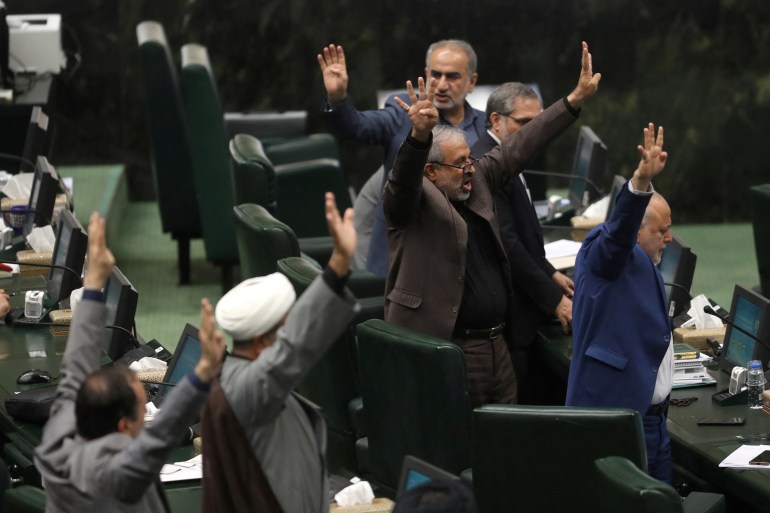
Tehran, Iran – Iranians will head to voting stations on Friday for parliamentary elections and to vote for the political and religious leaders who will choose the next supreme leader. Tens of millions of people are eligible to vote, but voter apathy remains high in Iran as the country faces a multitude of challenges following a tumultuous period since the last parliamentary elections in 2020. Here are the essentials you need to know in advance of the polls. Who can vote and when does voting start? Voters must be at least 18 years old. More than 61.2 million people are eligible to vote in a country of roughly 85 million. Polls will open across Iran at 8am local time (04:30 GMT) and will remain open for 10 hours as per the law. In the past, time for voting has always been extended, sometimes going past midnight when there is demand. Authorities have said 59,000 voting stations will be operational across the country, with 5,000 in the capital, Tehran, and 6,800 in the wider province of Tehran, which includes several other cities as well. In 1,700 voting stations, voting will be carried out “completely electronically” with polling devices prepared to accommodate voters. The Interior Ministry has dispatched 250,000 security force personnel to oversee voting and make sure the elections are held safely. Law enforcement will be supported by the Islamic Revolutionary Guard Corps (IRGC) and its Basij forces, along with the army. More than 90 people were killed in early January in a twin bombing in Kerman that was claimed by ISIL (ISIS), so security is expected to be tight. Who is being elected? The votes cast on Friday will determine the 290 lawmakers who will make up the parliament for the next four years. Votes will also be cast for 88 clerics who will each take a seat for eight years at the Assembly of Experts, which is tasked with selecting the country’s supreme leader. All candidates have been vetted by the powerful constitutional body known as the Guardian Council before being deemed eligible to run. The council, half of whose members are directly selected by Supreme Leader Ayatollah Ali Khamenei, also has to greenlight any law passed by parliament before it can move to the government for implementation. Will many people turn out to vote? The incumbent lawmakers – comprising mostly conservatives and hardliners – were elected to parliament in a February 2020 election that saw a 42-percent turnout, the lowest since the establishment of the Islamic republic after Iran’s 1979 revolution. While Iranian elections regularly saw turnouts of over 60 percent or even 70 percent in previous decades, a trend of apathy has persisted in more recent years. Only 48 percent of the electorate cast their votes in the 2021 presidential elections. Iranian Parliamentarians attend a parliament session in Tehran, Iran on August 13, 2023 [ISNA/WANA via Reuters] Why did voter turnout drop? Quite a few factors are believed to have combined to cause low turnout at the last parliamentary elections in 2020. Those elections came just more than a month after the United States assassinated Iran’s top general, IRGC Quds Force commander Qassem Soleimani, in a drone strike in Iraq. In the aftermath, at a time when war with the US seemed to be looming on the horizon, the IRGC downed a Ukraine National Airlines passenger flight with two missiles, killing all 176 on board in an incident it said was caused by a “human error”. Voting also came two days after Iran confirmed its first COVID-19 death after weeks of speculation that the virus was spreading across the country. The supreme leader in part blamed publicity surrounding the virus as a reason for lower-than-usual turnout. By 2020, it had also been two years since the US had reneged on Iran’s 2015 nuclear deal with world powers, imposing harsh unilateral sanctions on Iran. Those sanctions remain in place and have continued to squeeze the country’s troubled economy, which continues to be dogged by its decades-long malaise of consistently high inflation – now at about 40 percent – and high unemployment. Iran’s national currency, the rial, has also been slipping since the start of 2024, and was trading at approximately 585,000 to the US dollar on Thursday, having lost more than 15 percent of its value this year. Moreover, the previous election came after major public protests that started in November 2019, while this year’s election is coming in the aftermath of the deadly September 2022 nationwide protests, which lasted for months and reverberated across the globe. The elections for the 12th parliament and the sixth Assembly of Experts on Friday are also taking place as Israel’s war on Gaza has openly pitted the “axis of resistance” of political and military groups across the region backed by Tehran against the US and its allies. Who is up for election? Parliament speaker Mohammad Bagher Ghalibaf is expected to be re-elected. He has urged people to vote for his 30-strong list of allied candidates for Tehran, which includes a range of conservative and hardline candidates, including six women. The overwhelming majority of the rest of the seats in parliament are also expected to be won by such candidates, with all branches of power now dominated by these factions since the nuclear deal unravelled under former centrist President Hassan Rouhani in 2015 and pressures mounted on Iran. The Reformist Front, a coalition of groups that acts as the closest thing there can be to an opposition party in Iran, has said it refuses to take part in a “meaningless and non-competitive” election. But some reformist and centrist candidates have joined forces with others in an apparent effort to form at least a non-conservative minority in the parliament. Iran’s parliament has little say in the formulation of the country’s foreign policy and is mostly tasked with rules affecting local affairs, with issues related to the economy regularly at the top of the agenda. In recent months, it has also made headlines
Chadian opposition leader dies in gun exchange, state prosecutor says

The announcement comes a day after heavy gunfire erupts in N’Djamena near the headquarters of Yaya Dillo’s party. Chadian opposition politician Yaya Dillo has been killed during an exchange of fire with security forces, state prosecutor Oumar Mahamat Kedelaye says at a news conference. Heavy gunfire was heard on Wednesday in the capital, N’Djamena, near the headquarters of Dillo’s party, a witness told the Reuters news agency said. The shooting erupted after several people were killed in earlier clashes near the National Security Agency building. “He didn’t want to surrender and fired on law enforcement,” Abderaman Koulamallah, the Chadian communications minister also told the Agence France-Presse news agency. On Thursday, there was heavy military presence in the capital and access to the presidential palace was blocked. Internet access, which was blocked a day earlier, had still not been restored, the Reuters witness said. The violence flared amid tensions ahead of a presidential election set for May and June that could return the Central African state to constitutional rule three years after military authorities seized power. Dillo, leader of the Socialist Party Without Borders (PSF) and a cousin of transitional President Idriss Deby, had denied any involvement in the attack on the security agency. Speaking to the AFP, Dillo, who was planning to run in the coming election, dismissed the allegation as a “lie” and said it was politically motivated. Dillo also condemned accusations by the government of a PSF-coordinated “assassination attempt against the president of the Supreme Court”, which Dillo called “staged”. Adblock test (Why?)