

Kenya, Haiti sign ‘reciprocal’ agreement on police deployment: Ruto

The agreement would allow Kenyan police to lead a UN-backed mission in the gang-riven Caribbean nation. Kenya and Haiti have signed a “reciprocal” agreement to deploy police from the East African country to lead a United Nations-backed law and order mission in the gang-riven Caribbean nation, Kenyan President William Ruto has said. Ruto said on Friday that he and Haitian Prime Minister Ariel Henry had “discussed the next steps to enable the fast-tracking of the deployment”, but it was not immediately clear whether the agreement would counter a court ruling in January that branded the deployment “unconstitutional”. The deal was signed as the Haitian capital Port-au-Prince was racked by deadly gang-related violence, forcing businesses and schools to close and flight cancellations. Kenya had previously said that it was ready to provide up to 1,000 personnel, an offer welcomed by the United States and other nations that had ruled out putting their own forces on the ground. But a Nairobi court said the decision was unconstitutional, in part because the two countries had not signed a reciprocal agreement on the issue. On Friday, Ruto said he and Henry had “witnessed the signing” of a reciprocal agreement in Kenya’s capital Nairobi. “I take this opportunity to reiterate Kenya’s commitment to contribute to the success of this multi-national mission. We believe this is a historic duty because peace in Haiti is good for the world as a whole,” Ruto said in a statement. The UN Security Council approved the mission in early October but concerns in Kenya over Nairobi’s involvement prompted a court challenge. The ruling threw into doubt the future of a multinational force long sought by Haiti’s government, which has pleaded for international help to confront violence that has left nearly 5,000 dead. Opposition politician Ekuru Aukot, who had filed the petition against the deployment, told AFP on Friday that he would lodge a case “for contempt of court”. “We will question the validity of this secretive agreement,” he said. Haiti, the Western hemisphere’s poorest nation, has been in turmoil for years, with armed gangs taking over parts of the country and unleashing brutal violence, leaving the economy and public health system in tatters. A prominent gang leader said multiple factions were parlaying to launch attacks on state security forces in a bid to remove Prime Minister Henry. Known as “Barbecue”, gang leader Jimmy Cherisier publicised the attack in a social media video just before the battles began. “With our guns and with the Haitian people, we will free the country,” he said. There are currently no elected officials in Haiti, with Henry sworn in as prime minister with the backing of the international community shortly after the July 2021 assassination of President Jovenel Moise. Under a political deal, the prime minister was supposed to hand over power to elected officials by February 7 this year, but this is yet to happen. Adblock test (Why?)
Flour massacre: How Gaza food killings unfolded, and Israel’s story changed
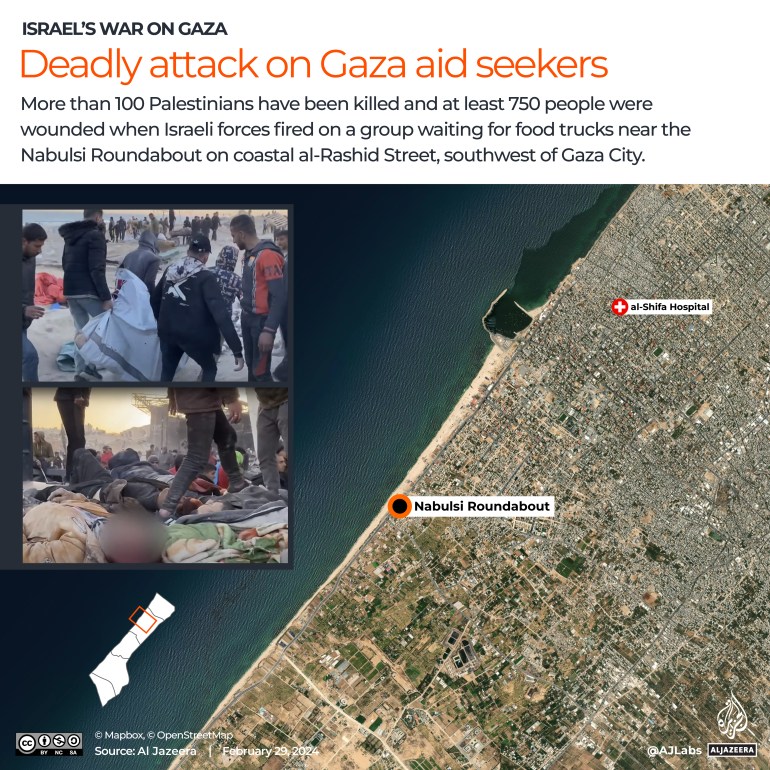
At least 112 Palestinians have been killed and more than 750 wounded after Israeli troops opened fire on hundreds waiting for food aid southwest of Gaza City. Here is what we know: What happened and when? The incident unfolded at about 04:30 local time (02:30 GMT) on Thursday, when people congregated at Harun al-Rashid Street in Gaza, where aid trucks carrying flour were believed to be on the way. A convoy of aid trucks passed through the checkpoint, heading north, as people started gathering in large groups. According to the Israeli military, a convoy of 31 trucks entered Gaza but nearly 20 entered the north on Monday and Tuesday. As people gathered in large groups waiting for much-needed aid, they were shot at by all kinds of military equipment, Al Jazeera’s Hani Mahmoud, reported from Rafah. According to a report by the Associated Press, people pulled boxes of flour and canned goods off the trucks. After the first round of shooting stopped, people returned to the trucks, only for the soldiers to open fire once more. “After opening fire, Israeli tanks advanced and ran over many of the dead and injured bodies,” Al Jazeera’s Ismail al-Ghoul said, reporting from the scene. Where did the shooting take place? Palestinian authorities said the incident took place on al-Rashid Street at the Nabulsi Roundabout on the southwestern side of Gaza City. This is in northern Gaza, where food deliveries have been scarce. The first deliveries in over a month arrived this week. This happened one day after Carl Skau, deputy executive director of the World Food Programme (WFP), told the United Nations Security Council more than 500,000, or one in four people, were at risk of famine, with one in every six children below the age of two considered acutely malnourished. How do Palestinian witnesses describe what happened? Palestinians in Gaza said that Israeli forces conducted a massacre by firing on a crowd of people who were waiting to collect desperately needed food aid. According to Al Jazeera’s Mahmoud, the more he spoke to people, “the clearer it became they felt it was a trap, an ambush”. “We had come here to get our hands on some aid. I have waiting since noon yesterday. At about 4:30 in the early morning trucks started to trickle in. The Israelis just opened random fire on us as if it was a trap. Once we approached the aid trucks, the Israeli tanks and warplanes started firing on us,” a witness at the scene told Al Jazeera. Witnesses said that the stampede happened as a result of Israeli firing and that the trucks also rolled over wounded people, adding to the death toll. Al Jazeera has verified that donkey carts were used to take people to hospital because no ambulances could reach the area. “We were going to bring flour … then Israeli snipers shot at us,” another person in the area told Al Jazeera. “They shot me in the leg. I’m unable to stand up,” he added. What did Israel say? The Israeli military said the trucks were managed by private contractors as part of an aid operation overseen by them for the past four nights. But the Israeli version of events changed over the course of the day. Reporting from occupied East Jerusalem, Al Jazeera’s Bernard Smith said the Israeli military “initially tried to pin the blame on the crowd”, saying that dozens were hurt as a consequence of being crushed and trampled in a stampede when aid trucks arrived. “And then, after some pushing, the Israelis went on to say that their troops felt threatened, that hundreds of troops approached their troops in a way they posed a threat to them so they responded by opening fire,” Smith added. But they didn’t explain how those people posed a threat. Witnesses insisted that the stampede happened only after Israeli troops started firing at people looking for food. What is the current situation with aid in Gaza? Since the war started, aid agencies claim that Israel has been delaying deliveries. Israel denies the allegation. “The risk of famine is being fuelled by the inability to bring critical food supplies into Gaza in sufficient quantities, and the almost impossible operating conditions faced by our staff on the ground,” Skau said. He described dangerous conditions for WFP trucks trying to get food to the north earlier this month. “There were delays at checkpoints; they faced gunfire and other violence; food was looted along the way; and at their destination, they were overwhelmed by desperately hungry people,” he added. A month ago, the International Court of Justice (ICJ) in The Hague said Israel must do everything to prevent genocidal acts in the territory. But according to human rights groups, including Amnesty International and Human Rights Watch, Israel “failed to take even the bare minimum steps to comply”. The number of trucks decreased by 40 percent since the ICJ ruling, according to the United Nations Office for the Coordination of Humanitarian Affairs (OCHA). What have been the reactions? The office of Palestinian Authority President Mahmoud Abbas condemned what it described as an “ugly massacre conducted by the Israeli occupation army”. UN’s chief Antonio Guterres also condemned the incident. “I condemn Thursday’s incident in Gaza in which more than 100 people were reportedly killed or injured while seeking life-saving aid,” he said. “The desperate civilians in Gaza need urgent help, including those in the north where the UN has not been able to deliver aid in more than a week.” I condemn Thursday’s incident in Gaza in which more than 100 people were reportedly killed or injured while seeking life-saving aid. The desperate civilians in Gaza need urgent help, including those in the north where the @UN has not been able to deliver aid in more than a week. — António Guterres (@antonioguterres) March 1, 2024 The US government said it was seeking answers from Israel- though it refused to condemn the killings directly. “Far too many innocent Palestinians have been
At least 45 killed in Bangladesh after fire breaks out at shopping mall

People dining out and shopping suffocated or jumped to their deaths as firefighters battled for hours to douse the flames. A massive blaze in a six-storey shopping mall in the Bangladeshi capital, Dhaka, has killed at least 45 people and wounded dozens. The fire, which struck Green Cozy Cottage Shopping Mall late on Thursday, started in a biryani restaurant on the first floor, with 13 units of firefighters battling for two hours to douse the flames. Doctors said most of the dead suffocated, with others dying as they jumped off the building. Dozens of people are being treated for burn wounds in two state-run hospitals. Brigadier General Main Uddin, a top fire service official, said that the fire could have originated from a gas leak or stove. “It was a dangerous building with gas cylinders on every floor, even on the staircases,” he told reporters. Relatives gathered at the hospital early on Friday to receive the bodies of the dead, with some mourning outside the emergency department. Health Minister Samanta Lal Sen told reporters that he expected the death toll to rise. People watch as firefighters work to contain a blaze that broke out at a commercial complex in Dhaka, Bangladesh, on Thursday, February 29, 2024 [Mahmud Hossain Opu/AP Photo] Survivor Mohammad Altaf recounted his narrow escape. “I went to the kitchen, broke a window and jumped to save myself,” he told reporters, adding that a cashier and server who urged people to leave during the first moments had died later. Prime Minister Sheikh Hasina expressed shock and sorrow over the incident, ordering officials to provide swift treatment for the injured. The government has set up a five-member panel to investigate the incident. Inadequate safety measures Fires are common in densely populated Dhaka, where many new buildings have sprung up, many without adequate safety measures. Fires and explosions have resulted from faulty gas cylinders, air conditioners and poor electrical wiring. In July 2021, many children were among 54 people killed at a food processing factory outside Dhaka, while at least 70 were killed in a February 2019 fire that engulfed a centuries-old precinct. Relatives attend prayers to pay homage to workers killed during the first anniversary of the Rana Plaza building collapse at Savar in Dhaka, Bangladesh, on April 24, 2014. The disaster highlighted unsafe conditions for many of the four million workers in the South Asian country’s garment industry [Abir Abdullah/EPA] The garment sector has been subject to intense scrutiny since a fire in 2012 and a building collapse in 2013 that together killed more than 1,200 workers. But in other industries, mainly catering to Bangladesh‘s booming domestic economy and lacking equal emphasis on safety, hundreds of people have died in fires. Adblock test (Why?)
George Galloway who campaigned against Gaza war wins UK by-election

George Galloway wins Rochdale seat by 12,335 votes after running on pro-Palestine campaign. A left-wing United Kingdom politician has registered a landslide win in a parliamentary by-election on a platform promising to advocate for Gaza. George Galloway won the seat in the northern English town of Rochdale after a fractious campaign, which saw the Labour Party withdraw support from its candidate over his anti-Israel comments. Galloway won 12,335 votes compared with 6,638 for second-placed David Tully, an independent candidate. The former Labour candidate, Azhar Ali, came fourth after the opposition party pulled its support after he was recorded espousing conspiracy theories about Israel. Turnout was low at 39.7 percent. “Keir Starmer, this is for Gaza,” Galloway said on Friday, referring to the Labour leader who initially refused to call for a ceasefire in Gaza where more than 30,000 people have been killed in the past five months of Israeli bombardment. “You have paid and you will pay a high price for the role you have played in enabling, encouraging and covering for the catastrophe presently going on in … in the Gaza Strip,” he said. Galloway, who represents the Workers Party of Britain, accused both Labour and the Conservatives of backing Israel as he ran a pro-Palestinian campaign in the constituency with a substantial Muslim population. Israel’s devastating war on Gaza was a key issue in the elections during which local concerns usually dominate. Divisions over Israel’s war on Gaza Galloway, who has now been a British MP seven times, has been critical of Labour, a party he once belonged to before being ejected for criticising then-Prime Minister Tony Blair over the Iraq war. His victory underlines the divisions in Britain over Israel’s war on Gaza, which has brought protesters onto British streets in support of both sides. It will be the first time Galloway’s left-wing Workers Party of Britain has been represented in parliament. For some in Rochdale, a former cotton mill town near Manchester, the by-election, triggered by the death of Labour lawmaker Tony Lloyd last month, had failed to offer them a clear choice of someone determined to help their town, ranked in the top 5 percent most deprived English local authorities in 2019. Galloway also campaigned to reinstate maternity services in Rochdale but it was his message on Gaza that rang loudest. He has promised to speak out on Gaza in Parliament, challenging Labour, which initially gave full backing to Israel following the October 7 attack led by the Palestinian group Hamas. The Labour party has since shifted its position to call for an immediate humanitarian ceasefire. Galloway will try to exploit Labour’s divisions. “I want to tell Mr Starmer above all, that the plates have shifted tonight,” he said. “This is going to spark a movement, a landslide, a shifting of the tectonic plates.” Adblock test (Why?)
US Senate approves spending stopgap to avert government shutdown

Short-term spending bill averts shutdown of agencies that would have kicked in on Saturday. The United States Congress has approved a short-term spending package to avoid a government shutdown, the fourth such stopgap measure in several months. The bill, which passed the Senate in a bipartisan 77-13 vote, provides funding for some federal government agencies to keep running through March 8 and others through March 22, preventing a shutdown that would have kicked in on Saturday. The funding will avert disruption to numerous government functions, including food safety inspections and air traffic controllers’ pay. US President Joe Biden must now sign the bill for it to become law. “I am happy to inform the American people that there will be no government shutdown on Friday. When we pass this bill, we will have, thank God, avoided a shutdown with all its harmful effects on the American people,” Senate Democratic leader Chuck Schumer said on the Senate floor. The Senate vote came after the Republican-controlled House of Representatives earlier voted to approve the stopgap funding. While the fiscal year began on October 1, Congress has yet to approve 12 annual spending bills that make up the federal budget. House Speaker Mike Johnson said negotiators had reached an agreement on six of the spending bills and were close to an agreement on the others. “We’ll get the job done,” Johnson said as he exited a closed-door meeting with Republican colleagues. Congress faces further battles in the coming weeks over funding levels for many programmes that Republicans want to see scaled back. Johnson had been pressed by hardline Republicans to use a shutdown as a bargaining chip to force Democrats to accept conservative policy priorities, including measures to reduce the flow of undocumented migrants across the US-Mexico border. Chip Roy, a House representative from Texas, said that Republicans in his faction hope to convince Johnson to push a new spending bill that would fund the government until the end of September but cut non-defence spending. “We believe that we could do that. We believe that actually presents a good alternative,” Roy told reporters. Adblock test (Why?)
Facebook owner Meta to stop funding news in Australia

Canberra blasts Meta’s decision as a ‘dereliction of its commitment to the sustainability’ of the media industry. Facebook partner company Meta has announced that it will not enter into any new deals to pay news publishers in Australia. To ensure that Meta can “continue to invest in products and services that drive user engagement”, the company will not renew its funding deals with traditional news content and “will not offer new Facebook products specifically for news publishers in the future”, the tech giant said in a blog post on Friday. Meta said the move would not affect existing agreements with publishers until they expire. Meta said it will also shut down its news tab in Australia and the United States in April, following the retirement of the feature last year in the UK, France and Germany. The California-based company said it was making the changes to “better align our investments to our products and services people value the most”. “As a company, we have to focus our time and resources on things people tell us they want to see more of on the platform, including short form video,” it said. “The number of people using Facebook News in Australia and the US has dropped by over 80 percent last year. We know that people don’t come to Facebook for news and political content – they come to connect with people and discover new opportunities, passions and interests.” Meta signed deals with numerous traditional media outlets after Australia passed landmark legislation in 2021 requiring tech platforms to pay for the news content shared on their platforms. The introduction of the News Media Bargaining Code, which has been emulated in other jurisdictions including Canada, followed accusations that platforms such as Facebook and Google exploited free news content to hoover precious advertising revenues away from struggling news organisations. Meta’s announcement was immediately criticised by the Australian government. Australian Communications Minister Michelle Rowland and Assistant Treasurer and Financial Services Minister Stephen Jones called Meta’s decision a “dereliction of its commitment to the sustainability of Australian news media”. “The Government has made its expectations clear. The decision removes a significant source of revenue for Australian news media businesses. Australian news publishers deserve fair compensation for the content they provide,” Rowland and Jones said in a joint statement. Rowland and Jones said they would seek advice on the next steps from the treasury and Australia’s competition watchdog. “We will now work through all available options under the News Media Bargaining Code. The government will continue to engage with news publishers and platforms through this process,” Rowland and Jones said. Does @Meta care about journalism at all? Facebook should compensate news organisations for making money from their journalism – if it won’t do it voluntarily, the govt should use the powers it has to force it to. https://t.co/LtlY74vwpi #MEAAmedia — MEAA (@withMEAA) March 1, 2024 The Media, Entertainment & Arts Alliance, Australia’s biggest union for journalists, questioned whether Meta cares about journalism. “Facebook should compensate news organisations for making money from their journalism – if it won’t do it voluntarily, the govt should use the powers it has to force it to,” the union said in a post on X. Adblock test (Why?)
How India’s Urban Company has soured gig work for women

Bengaluru, India — After years of working at a salon in Bengaluru, Shakeela Banu made a major life change in 2018 and joined Urban Company (UC), an app-based home services platform that has more than 52,000 workers across Indian cities, one-third of whom are women. At first, Banu was happy with the working conditions. Her manager treated her well, she said, and she got plenty of work as a beautician on call. She estimates that she’s worked with 3,000 customers since she joined the company and has turned down many requests from those who would ask for her services privately. It was her way of staying loyal to her employers. However, things have soured since then. Last year, the platform rolled out new rules including that workers maintain ratings of 4.7 or higher out of 5 and accept 70 percent of the job leads, with only four cancellations allowed in a month to avoid getting blocked. Banu was one of many UC workers whose profile was blocked due to “low” ratings. On its blog, the company said that these measures are meant to raise the operating standards for workers and improve customer experience. (There are also plans afoot for stricter rules under which workers will need to accept at least 80 percent of the jobs and only three cancellations will be allowed.) If workers miss these criteria, they receive a warning and need to attend either online or offline sessions to retrain in services where they have received poor ratings. If their metrics don’t improve after that, their profiles are blocked. Retraining online is free, but the workers have to pay a fee, ranging between 6,000 rupees and 15,000 rupees (between about $72 and $180), if they have to train at the UC office. Urban Company relies on a pay-to-work model which asserts that workers are “independent partners” who are being provided with a customer base and professional training they would not otherwise have. The workers incur multiple costs before they qualify for jobs with UC, including training fees, onboarding fees, product fees, and a monthly subscription fee to get a guaranteed quota of jobs, averaging about 50,000 rupees (about $600). Additionally, for every job, UC also takes a commission fee of up to 25 percent in service charges and taxes. Workers are not compensated for travel costs or vehicle rents. Urban Company did not respond to Al Jazeera’s request for comments. Bad reviews, blockings When UC launched in 2014, workers were attracted to the flexible schedule it offered. In Ghaziabad, Maya Pal, who used to run her own salon, joined UC to get some extra work in 2018. An Urban Company protest in Gurugram, India in July 2023 [Courtesy of AIGWU] “Before, we used to get 60 to 70 jobs every month. Now we get job leads once every two days if we are lucky,” said Pal, who has been working with UC for four years. “Then they ask us to maintain our acceptance rates. If you don’t give us jobs, how do we maintain the rate?” Even after being available on the app for 12 hours, the leads aren’t enough, workers say. “On the app, we have to keep our location turned on. If we move away from our marked location, they stop sending job leads,” said Pal, adding the system requires her to be housebound all day. During the lockdown, Pal had to close her salon. Then she met with a couple of accidents and had to cancel UC jobs. Her ID was blocked for four months. With no other income to support her family, Pal, a single mother of two, pulled her kids out of school. She says that only when UC workers consistently receive five-star reviews on 10 jobs do their ratings improve. It takes one bad review to make it fall again. UC partnered with the Ministry of Finance’s National Skill Development Corporation (NSDC) to provide training and digital certification to skilled professionals to help them become micro-entrepreneurs. At the same time, workers have been warned against sharing their phone numbers with their clients and all orders have to be via the UC app. Violations can lead to termination or blocking. “There are seasonal blockings, too,” said Spandan Pratyush, secretary for the All India Gig Workers’ Union (AIGWU)-NCR, a trade union of all app-based workers in India. “You wouldn’t have seen a lot of blocking … when there was a huge demand around the period of [the Hindu festival] Diwali.” But since then, the blockings increased, workers said. The workers think that the ongoing mass blockings since May 2023 are a step to extract money from new inductees while pruning older workers. “The new workers won’t question the new policies, new rates and whatever conditions have been applied. But older workers who have been working for years under certain conditions, they would obviously object to changes way more,” Pratyush said. All is not going well for the new trainees, either. In Gurugram on the outskirts of capital New Delhi, Deepali Khare interviewed with UC and joined as a trainee beautician in late August. The beautician training at UC costs around 45,000 rupees (about $540), which includes the training fee and money to buy products used during training sessions. Khare agreed to pay this amount in instalments. The training sessions, which started about 9:30am, were supposed to end by 6pm but would go till 9pm. Trainees also had to bring models to practise salon services on and pay for their food and transport. The company did not mention “that we need to get 45 models for 45 days of training”, Khare told Al Jazeera. Then, abruptly, in September, Khare received a message from her trainer that she need not attend more sessions. She was baffled. She had been dropped from training midway without any sort of performance review. Upon repeatedly asking why she’d been dropped, the company said that there were quality issues. “If there are quality issues, why couldn’t they give us more
New Zealand lobbied French on Solomon Islands-China pact, cables show
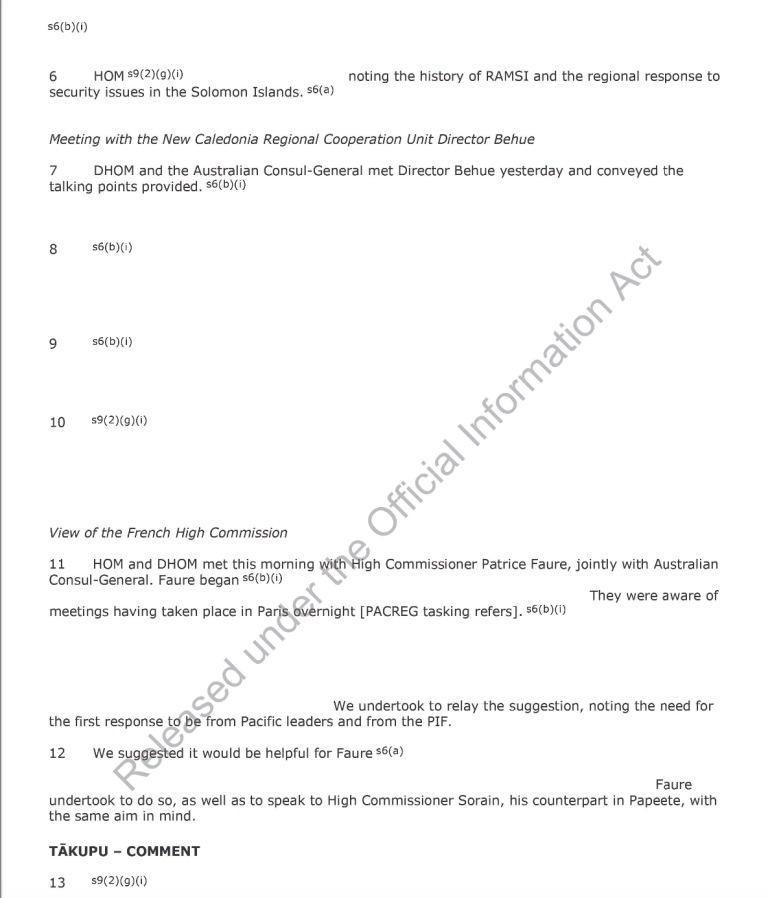
Taipei, Taiwan – New Zealand lobbied France’s territories in the Pacific to respond to news of a controversial security pact between China and the Solomon Islands that set off alarm in Western capitals, newly released documents reveal. Within days of a draft version of the security pact leaking online in March 2022, representatives of New Zealand, Australia and France were meeting to discuss the implications for the region, the diplomatic cables obtained by Al Jazeera show. While the precise nature of the discussions is unclear due to redactions in the documents, the cables suggest Wellington hoped officials in French Polynesia and New Caledonia would take a position on the China-Solomon Island agreement. New Zealand diplomats in New Caledonia’s capital Noumea noted in their reports to Wellington that neither French Polynesia nor New Caledonia “is likely to take a public position” on the deal. After a meeting with New Caledonia’s High Commissioner Patrice Faure on March 30, New Zealand officials reported that they had relayed an unspecified “suggestion” to their French counterpart, “noting the need for the first response to be from Pacific leaders and from the [Pacific Islands Forum]”. “We suggested it would be helpful for Faure…”, the New Zealand diplomats said, referring to suggested action whose details are redacted in the documents. “Faure undertook to do so, as well as to speak to High Commissioner Sorain, his counterpart in Papeete, with the same aim in mind,” the diplomats said, referring to High Commissioner of French Polynesia Dominique Sorain. New Zealand officials held three meetings in total with officials from the French overseas territories between March 29 and March 30, the documents show, including discussions with President of French Polynesia Édouard Fritch and Francois Behue, the head of the regional cooperation and external relations department in New Caledonia. Australia’s then Consul General in New Caledonia, Alison Carrington, joined the Kiwi diplomats in their meetings with Faure and Behue, according to the documents. [New Zealand Ministry of Foreign Affairs and Trade] “The Pacific Islands Forum serves as the pre-eminent regional organisation for Pacific Leaders to discuss, build consensus, and act on shared challenges. Pacific Islands Forum members have the collective capacity — and a strong commitment — to support each other to meet the broader ambitions for the region’s security, as set out in the Biketawa and Boe Declarations,” a spokeswoman for New Zealand’s Ministry of Foreign Affairs and Trade said in a statement provided after publication. “For example, New Zealand has a long-term security partnership with Solomon Islands, most recently demonstrated in New Zealand’s participation (with Australia and Fiji) in the Solomon Islands International Assistance Force (SIAF) and the security support we provided to the Solomon Islands’ hosting of the Pacific Games late last year.” Asked about perceptions that New Caledonia and French Polynesia were reluctant to comment publicly on the China-Solomon Islands security pact, the spokeswoman said “it is not for New Zealand to comment on the perspectives of other countries.” “However, security and defence issues are competencies of the French state,” she said. Australia’s foreign ministry, and France’s high commissioners in New Caledonia and French Polynesia, did not respond to Al Jazeera’s requests for comment. News of the Solomon Islands-China security pact in 2022 prompted alarm in the United States, Australia and New Zealand, which have long regarded Pacific Island nations as their geopolitical back yard. Western officials have raised concerns that China could use the pact to establish a military foothold in the Solomon Islands – which lie about 2,000km (1,242 miles) from Australia and 3,000km (1,864 miles) from major US military installations on Guam – which both Beijing and Honiara have denied. Then-New Zealand Prime Minister Jacinda Arden called the deal “gravely concerning” and warned it could lead to the “militarization” of the Pacific, echoing similar warnings from the US and Australia. France was comparatively muted in its response to the pact despite the presence of more than half a million French citizens and 2,800 military personnel spread out across the Pacific. While New Caledonia and French Polynesia have elected legislatures that handle domestic issues, Paris handles the territories’ security and defence. New Caledonia, home to a French military base, lies less than 1,400km (870 miles) south of Solomon Islands and its native Kanak people share ethnic ties with Solomon Islanders. Anna Powles, a senior lecturer at the Centre for Defence and Security Studies at Massey University, said the diplomatic cables suggested that Wellington wanted to send a “clear message to Paris that any response needed to be Pacific-led”. Powles said that neither France nor its overseas territories have been very active at the Pacific Islands Forum (PIF), although French President Emmanuel Macron has made the Asia Pacific a central part of his foreign policy strategy since 2018. France is not a member of the forum but it indirectly has a seat at the table through its overseas territories. French President Emmanuel Macron has sought to boost his country’s influence in the Pacific [Ludovic Marin/EPA-EFE] Macron’s attempts to work more closely with members of the Five Eyes intelligence alliance – made up of Australia, Canada, New Zealand, the United Kingdom and the US – in the region took a hit after a submarine deal with Canberra fell apart in 2021, leading to the formation of the AUKUS security alliance between Australia, the UK and the US, although relations have improved since then. In December, France hosted the South Pacific Defence Ministers Meeting in Nouméa, joined by Australia, Chile, Fiji, New Zealand, Papua New Guinea and Tonga, with Japan, the UK and US attending as observers. France’s bid to expand its influence in the Pacific also comes as pro-independence movements are under way in New Caledonia and French Polynesia, where Paris fears growing Chinese influence. Macron warned last year about a “new imperialism” in the Pacific in remarks believed to have been aimed at China, although he did not mention Beijing by name. Cleo Paskal, a non-resident senior fellow at the Foundation for Defense of Democracies,
Israel’s killing rage

Another day, another outrage. That is the inevitable lot of Palestinians in the grim, dystopian wasteland that is Gaza. It is inevitable because it does not matter the scale, nature or manner of the outrages, Palestinians have been, and always will be, considered disposable human fodder by Israel’s army of unrepentant enablers and apologists. They are, of course, hard at work trying, as they are conditioned to do, to find an explanation, an excuse, a rationale to absolve Israel of responsibility for the crimes against humanity that it has committed with impunity in Gaza and beyond. In their myopic calculus, Israel is never to blame, never responsible, never the perpetrator, never guilty. To admit that Israel is to blame, responsible, the perpetrator or guilty, would mean, in effect, admitting their guilt too. The usual pallet of lies, distortions, and obfuscations is being deployed, on cue, by the usual suspects in the usual capitals and newsrooms to deny or obscure the obvious. Blindness is a necessary extension of their complicity. They refuse to see what the rest of us can see. Their evangelical allegiance to Israel trumps the truth and decency. It always has. It always will. This, by now, familiar pantomime is playing out in the shocking residue of a massacre of more than 100 desperate Palestinians who surged at aid trucks carrying the stuff of life denied to them by a fanatical regime intent on killing them quickly or slowly. This time, the terror took place on al-Rashid Street in the southwest outskirts of what remains of Gaza City, where thousands of homeless Palestinians had gathered in the open night air. Cold. Sick. Thirsty. Starving. What happened in that place and at that time was not an “incident” or a “chaotic scene”. It was, instead, more lethal evidence of the genocide that is being committed by a ruthless, occupying power against an imprisoned, powerless people with deliberate and malignant efficiency. We know what happened in that place at that time because Al Jazeera’s Ismail al-Ghoul was there. He was not in Tel Aviv or occupied East Jerusalem. He was not in a television studio in Washington, DC, New York, London or Paris, relying on an account from a preening Israeli spokesperson. He was there. This is what al-Ghoul reports he witnessed. Dozens of Palestinians heard that trucks carrying precious flour were about to arrive. While they waited in anxious anticipation early Thursday morning, Israeli soldiers began shooting. You can hear the crackle of gunfire on video that captured the murderous madness. “We went to get flour. The Israeli army shot at us. There are many martyrs on the ground and until this moment we are withdrawing them. There is no first aid,” one witness told Al Jazeera. Another witness added that: “The Israelis just opened random fire on us as if it were a trap.” Then, after strafing Palestinians, Israeli tanks moved forward and ran over the dead and injured, al-Ghoul said. What witnesses appear to be describing is the military tactic known as the “double tap”. The initial strike hits the intended target. A second strike is aimed at bystanders drawn to help the dead and injured. In any event, when the carnage was over, the breathtaking tally of dead and injured Palestinians had grown as it has every day for the past five months with unrelenting ferocity. When daylight arrived, the true measure of the appalling slaughter had become apparent. Ambulances could not reach the dozens of dead and disfigured since roads, like much of Gaza, had been destroyed. The dead were loaded onto the flatbed portion of one of the aid trucks turned mobile mortuary, their limp, lifeless bodies intertwined in a grotesque heap of humanity. The deluge of injured Palestinians who survived the attack descended on overwhelmed hospitals and the caregivers who still populate them. “Hospitals are no longer able to accommodate the huge number of patients because they lack fuel, let alone medicine. Hospitals have also run out of blood,” al-Ghoul said. A Palestinian physician preparing to help the wounded amid the bloody bedlam admitted that there was little he could do. “The majority of cases need surgery and operation rooms,” he said. “To be honest, I don’t know what we can do. The situation is … horrendous.” The situation has been “horrendous” for a long time. But the so-called “international community” dithers. Worse, it spouts meaningless platitudes “calling on” Israel to stop killing civilians. Clearly, the dithering and platitudes are not working. The crimes against humanity go on and on and on. At first, Israel said that Palestinians were responsible for killing and harming Palestinians. The Palestinians were crushed and trampled, Israel said, when they rushed towards the aid trucks. It’s not our fault. Predictably, this sick line of “reasoning” fails to address why hordes of Palestinians are having to charge aid trucks. Israel’s stated goal is to force Palestinians to capitulate by depriving them of food, water, fuel and medicine. Then, Israel tacked. We didn’t mean to start shooting unarmed civilians. We only started shooting because our heavily armed soldiers felt “threatened” by unarmed civilians. Israel knows these blatant absurdities will work. They have worked before. They will work again. Israel knows it has the license to kill as many Palestinians as it wants to, whenever it wants to, for as long as it wants to, by whatever means it wants to, and “the international community” is not going to do a tangible thing to stop it. Instead, it will nod in approval and agreement. It will accept Israel’s stock, exculpatory version of what happened. The “outrage” will last a day or two and then the “international community” will go on its merry, delusional way. Meanwhile, Palestinians will have to bury more of their dead in open pits by hand while they wait for Israel’s insatiable “killing rage” to end. The views expressed in this article are the author’s own and do not necessarily reflect Al Jazeera’s editorial stance. Adblock test
Canada’s former PM Mulroney, who led North American free trade, dies at 84

Canadian Prime Minister Justin Trudeau hails Mulroney’s role in creating ‘modern, dynamic, and prosperous country’. Canada’s former Prime Minister Brian Mulroney, who led his country into a sweeping free trade deal with the United States, has died. He was 84. Mulroney, who governed Canada from 1984 to 1993, died peacefully surrounded by family, his daughter, Caroline Mulroney, said on Thursday. “On behalf of my mother and our family, it is with great sadness we announce the passing of my father, The Right Honourable Brian Mulroney, Canada’s 18th Prime Minister,” she said in a post on X. Born in the French-speaking province of Quebec, Mulroney worked as a lawyer and then business executive before successfully challenging for the leadership of the centre-right Progressive Conservatives in 1983 and entering parliament later that year. Mulroney led the Conservatives to a historic win over the Liberals of Pierre Trudeau the following year and retained power in the 1988 election. During his nine-year tenure, Mulroney emulated the liberal economic policies that were ascendent in the US and the UK during the 1980s under Ronald Reagan and Margaret Thatcher. In one of his most consequential achievements, he signed the Canada-United States Free Trade Agreement with Reagan in 1988. The deal, which later expanded to include Mexico as the North American Free Trade Agreement (NAFTA), helped boost Canadian exports, but was criticised in subsequent years for encouraging the outsourcing of jobs to cheaper locales. “Generally speaking, it’s been a success,” Mulroney said in an interview with CBC in 2012. “It hasn’t been a panacea, but I never viewed it as that.” Canada’s last Cold War leader, Mulroney also opposed apartheid in South Africa, forged a landmark treaty on acid rain with Washington and led efforts to respond to the 1984 Ethiopian famine. Mulroney resigned in 1993 with the lowest approval rating in Canadian history amid growing separatist sentiment in Quebec. At the next election, the Progressive Conservative party suffered one of the worst wipeouts in modern political history, losing 154 of 156 seats in parliament. Brian Mulroney loved Canada. I’m devastated to learn of his passing. He never stopped working for Canadians, and he always sought to make this country an even better place to call home. I’ll never forget the insights he shared with me over the years – he was generous, tireless,… — Justin Trudeau (@JustinTrudeau) February 29, 2024 Canadian Prime Minister Justin Trudeau said on Thursday he was “devastated” to hear of Mulroney’s death. “He never stopped working for Canadians, and he always sought to make this country an even better place to call home. I’ll never forget the insights he shared with me over the years – he was generous, tireless, and incredibly passionate,” Trudeau said on X. “As we mourn his passing and keep his family and friends in our thoughts, let us also acknowledge – and celebrate – Mr Mulroney’s role in building the modern, dynamic, and prosperous country we all know today.” After leaving politics, Mulroney faced scrutiny over a leaked letter that revealed he had been accused by police of taking bribes from a German-Canadian arms dealer, Karlheinz Schreiber. Mulroney sued the Liberal government and won an apology and damages over the claims in 1997. Mulroney later apologised for taking payments from Schreiber while denying illegal conduct, saying that agreeing to be introduced to Schreiber was the “biggest mistake in life, by far”. Adblock test (Why?)