

Hungary parliament elects new president following scandal

Parliament approves appointment of Tamas Sulyok, 67, a Constitutional Court chief, to replace Katalin Novak. Hungary’s parliament has elected a political novice as president after the resignation of his predecessor, who caused outrage by pardoning a man convicted in a child abuse case. The affair has turned into the biggest political crisis that nationalist Prime Minister Viktor Orban has faced since his return to power in 2010. Orban ally Katalin Novak resigned as president this month after it was revealed she had pardoned a convicted child abuser’s accomplice. Last week, ruling party Fidesz nominated Constitutional Court head Tamas Sulyok, 67, to replace Novak, Hungary’s first female president. On Monday, parliament, where Fidesz’s ruling coalition with the Christian Democratic People’s Party holds a two-thirds majority, approved his appointment, after which he took the oath of office. He will become president on March 5. Little known to the broader public, Sulyok became a Constitutional Court judge in 2014 and, two years later, the court’s head. The opposition has criticised the nomination of politically inexperienced Sulyok. About 3,000 people attended a Sunday protest by four opposition parties, calling for direct presidential elections. The post is largely ceremonial. ‘Duller presidency’ The Novak scandal broke this month when the news site 444 revealed that she had pardoned the former deputy director of a children’s home last year. The man was sentenced in 2022 to three years and four months in prison for helping to cover up his boss’s sexual abuse of children and adolescents there. Tens of thousands of people have protested against the presidential pardon in Hungary, whose government has long campaigned on a pledge to protect children. Orban has likened the resignation of Novak to a “nightmare” but stressed it was the right decision. When opening the parliament session on Monday, he described Sulyok as someone with “vast experience, respected knowledge and undisputed authority”. “I believe that Hungary needs such a president now,” he said. Under Sulyok, the Constitutional Court made several controversial rulings, including on teachers’ rights to strike. To calm anger over the pardon scandal, Orban has promised to tighten existing laws to bar convicted child abusers from receiving clemency. He also wants to vet those working with children to make sure they have passed the “appropriate suitability test”, covering “lifestyle, sexual deviance and psychological fitness”. Adblock test (Why?)
Suicide vs genocide: Rest in power, Aaron Bushnell

On Sunday, February 25, 25-year-old active duty member of the United States Air Force Aaron Bushnell set himself on fire outside the Israeli embassy in the US capital of Washington, DC, in a one-airman revolt against the US-backed slaughter currently being perpetrated by the Israeli military in the Gaza Strip. Over the past 143 days, Israel has killed nearly 30,000 Palestinians in the besieged coastal enclave. In video footage recorded prior to and during his self-immolation, Bushnell states that he will “no longer be complicit in genocide” and that he is “about to engage in an extreme act of protest – but compared to what people have been experiencing in Palestine at the hands of their colonisers is not extreme at all”. To be sure, Palestinians have long been accustomed to, well, burning to death at the hands of Israeli weaponry, ever since the state of Israel undertook to lethally invent itself on Palestinian land in 1948. The Israeli military’s use of skin-incinerating white phosphorus munitions in more recent years has no doubt contributed to the whole Palestinian “experience”. After pertinently observing that US complicity in the genocide of Palestinians is “what our ruling class has decided will be normal”, Bushnell plants himself directly in front of the Israeli embassy gate – in full US military fatigues – and proceeds to douse himself with flammable liquid. As he rapidly burns to death, he repeatedly shouts: “Free Palestine”, while security personnel order him to get “on the ground”. One particularly helpful individual points a gun at the blaze. In the aftermath of Bushnell’s self-immolation, the New York Times announced: “Man Dies After Setting Himself on Fire Outside Israeli Embassy in Washington, Police Say” – a rather strong contender, perhaps, for the most diluted and decontextualised headline ever. One wonders what folks would have said in 1965 had the US newspaper of record run headlines like: “Octogenarian Detroit Woman Dies After Setting Herself on Fire, Police Say – An Event Having Nothing Potentially To Do With Said Woman’s Opposition To The Vietnam War Or Anything Like That”. Speaking of Vietnam War-related self-immolations, recall renowned US historian and journalist David Halberstam’s account of the 1963 demise in Saigon, South Vietnam, of the Vietnamese monk Thich Quang Duc: “Flames were coming from a human being; his body was slowly withering and shriveling up, his head blackening and charring. In the air was the smell of burning flesh; human beings burn surprisingly quickly… I was too shocked to cry, too confused to take notes or ask questions, too bewildered even to think”. And while such an intense and passionate form of suicide is no doubt bewildering to many, genocide should be all the more appalling; as Bushnell himself said, self-immolation is nothing “compared to what people have been experiencing in Palestine”, where people know all too well how quickly human beings burn. In Bushnell’s case, the US political-media establishment appears to be doing its best to not only decontextualise but also posthumously discredit him. Time Magazine’s write-up, for example, admonishes that the US “Defence Department policy states that service members on active duty should ‘not engage in partisan political activity’” – as though actively abetting a genocide weren’t politically “partisan”. Furthermore, the magazine specifies, US military regulations “prohibit wearing the uniform during ‘unofficial public speeches, interviews’”, and other activities. Perhaps Bushnell’s ashes can be tried in military court. At the bottom of the Time article, readers are charitably given the following instructions: “If you or someone you know may be experiencing a mental-health crisis or contemplating suicide, call or text 988” – which naturally implies that Bushnell was simply the victim of a “mental-health crisis” rather than someone making a most cogent and defiant political point in response to an extremely mentally disturbing political reality. At the end of the day, anyone who is not experiencing a serious “mental-health crisis” over the genocide going down in Gaza with full US backing can be safely filed under the category of psychologically disturbed. Of course, the US also perpetrated its very own genocide against Native Americans – another bloody phenomenon that has not been deemed worthy of diagnosis as a severe collective mental disturbance or anything of the sort. As per the official narrative, if you think it’s crazy for the US or its Israeli partner in crime to commit genocide, you’re the crazy one. Coming from a family of US Air Force veterans myself – both of my grandfathers participated in the carnage in Vietnam – I have personally witnessed the psychological fallout that can attend service as empire’s executioners. Aaron Bushnell was meant to be a cog in the killing machine, but his principles cost him his life. Indeed, according to a former colleague of Bushnell’s who worked with him to support the homeless community in San Antonio, Texas, he was “one of the most principled comrades I’ve ever known”. And while we journalists are supposed to be the ones speaking truth to power, suffice it to say that Bushnell has put Western corporate media to shame. Rest in power, Aaron Bushnell. The views expressed in this article are the author’s own and do not necessarily reflect Al Jazeera’s editorial stance. Adblock test (Why?)
Macron holds meeting in Paris to rally European support for Ukraine

The French president said Ukraine’s allies needed to ‘jump-start’ their support for Kyiv as the war enters its third year. French President Emmanuel Macron has told European allies that they must provide rapid support to strengthen Ukraine amid tougher Russian attacks on the battlefield as the war in Ukraine stretches into its third year. “We are in the process of ensuring our collective security, for today and tomorrow,” Macron said as he hosted 20 European heads of state and government and other Western officials in Paris for a show of unity for Ukraine, three years after Russia launched its full-scale invasion. “Russia cannot and must not win that war,” Macron said at the meeting at the presidential palace, which included German Chancellor Olaf Scholz and Polish President Andrzej Duda as well as leaders from the Baltic nations. “In recent months particularly, we have seen Russia getting tougher,” Macron said. “We also know that Russia is preparing new attacks, in particular to shock Ukrainian public opinion.” The conference also signals Macron’s eagerness to present himself as a European champion of Ukraine’s cause, amid growing fears that United States support could wane in the coming years. Ukraine’s allies needed to “jump-start” their support, Macron said. We are talking about our support for Ukraine and our collective security. A collective leap is necessary from all of us. pic.twitter.com/NViI9ntaVY — Emmanuel Macron (@EmmanuelMacron) February 26, 2024 For Macron, the conference is also a chance to show European autonomy in security matters, which he called for even before Russia’s invasion. Scholz and Duda were among some 25 European heads of state and government present at the conference, while Ukrainian President Volodymyr Zelenskyy joined virtually. After initial successes in pushing back the Russian army, Ukraine has suffered setbacks on eastern battlefields, with its generals complaining of shortages of arms and soldiers. Speaking to reporters on Sunday, Zelenskyy said that leaders in Europe had realised “how dangerous” the war is for “the whole of Europe”. “I think they have realised that [Russian President Vladimir] Putin will continue this war,” he said. But officials say Macron’s meeting is not an occasion to announce new weapons deliveries to Ukraine but more to brainstorm about how to be more efficient on the ground, as well as increase coordination between Ukraine and its allies. Ammunition supplies have become a critical issue for Kyiv. The European Union, though, is falling short of its target of sending Ukraine a million rounds of artillery shells by March. “We must be able to deliver more shells. The principle is that shells will be purchased where they are available,” said an adviser to the French president. “There is no dogmatic [French] position.” Ukrainian Defence Minister Rustem Umerov said on Sunday that half of Western military aid pledged to Kyiv is delivered late, lamenting that “commitment does not constitute delivery”. Without offering details, Slovak Prime Minister Robert Fico, who has long opposed military supplies to Ukraine and has taken a position seen by some critics as pro-Russian, said ahead of travelling to Paris that several NATO and EU members were considering sending soldiers to Ukraine on a bilateral basis. Adblock test (Why?)
Arabic calligraphy on dress design causes chaos in Pakistan

NewsFeed A Pakistani police officer is being hailed as a hero for negotiating the safe escort of a woman accused of blasphemy by a mob in Lahore. The woman was wearing a dress with Arabic calligraphy that the crowd mistook for verses from the Quran. Published On 26 Feb 202426 Feb 2024 Adblock test (Why?)
Democratic Republic of Congo is facing a humanitarian crisis

Heavy fighting between Congolese army and M23 rebels is fuelling displacement and regional tensions. M23 rebels have closed in on the capital of North Kivu as fighting with government forces escalates in northeastern Democratic Republic of the Congo. Hundreds of thousands of people are arriving in Goma in the hope of finding food, water and shelter. This situation is expected to worsen when United Nations peacekeepers withdraw from the country at the end of this year. What is driving this conflict? Can a lasting peace be achieved? Presenter: Adrian Finighan Guests: Patrick Muyaya Katembwe – Minister of Communication and Media and spokesperson for the government of the Democratic Republic of Congo Lawrence Kanyuka – Political spokesperson, M23 rebel group Crystal Orderson – Journalist at The Africa Report Fred Bauma – Executive director, senior fellow at the NYU Center on International Cooperation Adblock test (Why?)
Two years in, left and right united in opposing more US aid for Ukraine
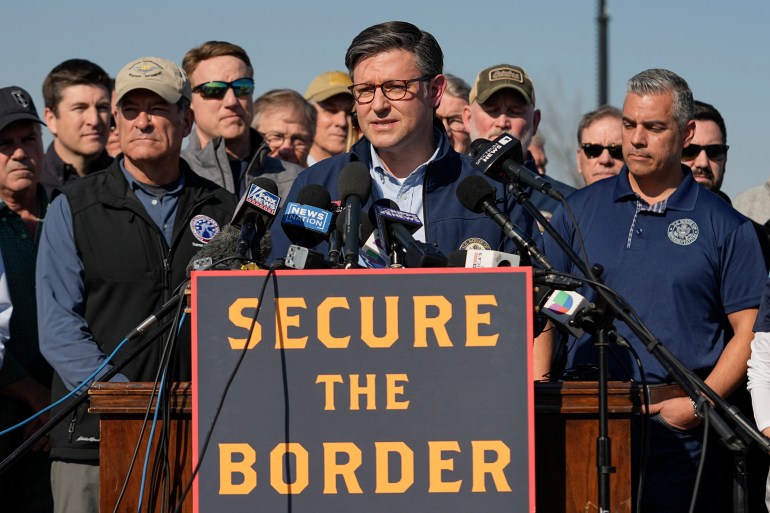
Two years after Russia invaded Ukraine, Americans’ support for the war is waning, creating a surprising alliance between the political left and right. Forty-one percent of Americans told Gallup pollsters three months ago that the United States is spending too much to support Ukraine on the battlefield. That compares with 24 percent of Americans who felt similarly in August 2022, six months after the start of the war. Perhaps most surprising, though, is that the shift is most pronounced among Republicans, the political party that has historically been known for its hawkishness. In March 2022, 9 percent of Republicans believed the US was supplying Ukraine with too much military aid; by December last year, 48 percent of Republicans said their government was spending too much on Ukraine, according to Pew Research Centre surveys. The percentage of Democrats who view the Biden administration’s spending on Ukraine as excessive is only 16 percent, according to the same December poll. To be sure, partisan politics shapes the rift in Washington with Republicans in the House of Representatives refusing to pass legislation that includes $60bn in military aid for Ukraine. Republican House Speaker Mike Johnson has said the bill passed by the Democratic-controlled Senate doesn’t do enough to protect the southern border from immigration, a stance that bolsters Donald Trump’s presidential campaign against incumbent Joe Biden. US House Speaker Mike Johnson opposes a bill providing more aid to Ukraine, saying it does not go far enough to impose restrictions on the US border with Mexico [File: Eric Gay/The Associated Press] And Representative Marjorie Taylor Green leads a group of staunch conservatives in Congress who have consistently opposed US funding for Ukraine. Still, a number of liberals, such as the writer Glen Greenwald and the podcaster Jimmy Dore, have joined conservatives, such as media presenter Tucker Carlson, in questioning the federal government’s priorities in spending billions on a distant war while the US has so many pressing needs, including immigration, affordable housing, healthcare and student debt relief. “The motivations for the far left and the far right are very different, but what unites them is where they arrive on Ukraine and also this anti-establishment populist strain,” said Dominik Stecula, assistant professor of political science at Colorado State University Republicans divided on Ukraine spending While some in the Republican Party — like presidential candidate Nikki Haley and Senate Minority Leader Mitch McConnell — have a traditional national security focus reminiscent of the Cold War, the faction of the party that identifies with former President Trump’s political movement – MAGA, short for his campaign slogan Make America Great Again – is increasingly rejecting Ukraine spending. Isolationism has been a feature of Trump’s political message since 2016, explained Rachel Blum, an assistant professor in the University of Oklahoma’s Department of Political Science. “That is a really core thread of the MAGA movement.” The white working-class voters who make up the bulk of Trump’s supporters are animated by the sense that they are being left behind in a shape-shifting economy and money that would be better spent on their families is going to people of colour, the LGBTQ community and big business, including defence contractors. These sentiments often converge with racist, homophobic and transphobic beliefs. Blum told Al Jazeera that Trump’s isolationism is of a particular type that does not necessarily transfer to other conflicts. “Trump is much warmer toward Israel than he is toward Ukraine,” she explained. “So I think a lot of it has to do with Trump’s very personal animosity toward Ukraine and [Ukrainian President Volodymyr] Zelenskyy and his past problems there and his affinity for [Russian President Vladimir] Putin.” Ukrainian President Volodymyr Zelenskyy, centre, visits Washington, DC, in December 2023 and meets with US congressional leaders, Senate Majority Leader Chuck Schumer, right, and Senate Minority Leader Mitch McConnell [Elizabeth Frantz/Reuters] As the MAGA movement has strengthened its hold on the Republican Party, she said, “it’s not surprising that those sentiments are starting to spill over.” Republicans are divided between those who remember Cold War policy and view Putin, a former Soviet intelligence officer, as a threat and those who are inclined to blindly follow Trump, she said. In a Venn diagram, those two groups do not overlap. “It’s hard for me to think of an example of a Republican who is pro-Ukraine aid and super supportive of Trump,” Blum said. As the November election draws closer, Blum said Trump’s position as the presumptive nominee gives Republicans an incentive to oppose aid to Ukraine to win favour with Trump if he returns to the White House. Foreign policy and the culture wars A number of factors played pivotal roles in the Republicans’ shift against Ukrainian aid, said David Hopkins, associate professor of political science at Boston College. A generational divide is part of the story. Older conservatives remember the Cold War alliance between the US and Western Europe against the Soviet Union while younger conservatives don’t have memories of the tensions between the West and the Soviet bloc, he said. Generally, Americans’ foreign policy worldview is likely to be influenced by authority figures they trust, including politicians and media personalities, he said. And conservatives are reflexively sceptical of policies favoured by Democrats, such as Biden’s support for Ukraine. Moreover, Trump supporters’ sense of American exceptionalism extends to unfavourable views on Europe – which is seen as not wholly sharing the same values as the US – and, consequently, NATO. “They are open, just on the merits, to the argument that the US should be looking for ways to remove itself from involvement with European politics and alliances with international allies and organisations like NATO and the UN,” Hopkins said. Trump supporters are also open to viewing Putin as a traditionalist with similar values to theirs. “Under Putin, Russia has advertised itself internationally as a bulwark of traditional Christianity,” Hopkins said. “I think there are elements of the populist right in the United States that respond very positively to that message and indeed see figures like
Hind Rajab: Were Israeli troops around where the six-year-old was killed?

An Al Jazeera investigation has shown three Israeli tanks around the car where a six-year-old girl was killed after hours of pleading for help. However, Israel’s army denied this on Saturday, saying its troops were not in the area on January 29, the day Hind Rajab and her family were killed. Here’s the whole story, what Israel claims and how Al Jazeera investigators put Israeli tanks at the scene of the killing: What happened to Hind? Hind’s story travelled around the world when a phone recording of what’s now understood to be her and her family’s final moments went viral on social media. On the call, which lasted for about three hours, Hind begged rescue workers to come save her after the family’s car came under fire and she became the sole survivor, stranded inside with her dead relatives. Two dispatchers with the Palestine Red Crescent Society (PRCS) sent to save her were also killed. The PRCS has accused Israel of deliberately targeting the medical team despite back and forth between the organisation and the army as the medics tried to get permission to evacuate Hind. Hind and her cousins are just some of the thousands of children killed in Israel’s relentless war on Gaza in violation of international law. Nearly 30,000 people have died in Gaza since October 7. Six-year-old Hind Rajab [Courtesy of Ghada Ageel] What has Israel said? According to a report by the Times of Israel, Israeli officials said an initial investigation showed that troops were not present in the Tal al-Hawa suburb of Gaza City on January 29 when Hind and five other family members were killed. “It appears that … troops were not present near the vehicle or within firing range of the described vehicle in which the girl was found,” a statement from the Israeli army read. The statement directly contradicts the evidence as recorded in the circulating phone call between the PRCS and Hind. “Also, given the lack of forces in the area, there was no need for individual coordination of the movement of the ambulance or another vehicle to pick up the girl,” the statement said, which goes counter to PRCS’s statement that it had been working to coordinate with the Israeli army. The statement went on to claim that medics are moving without restriction throughout the Gaza Strip, which goes against multiple accounts out of Gaza. What did Al Jazeera find? Sanad, Al Jazeera’s investigations unit, analysed phone records and satellite imagery to prove that there were Israeli troops near the car belonging to Hind’s family that day. The vehicle, the investigation found, had been stopped by the Israeli military near a petrol station in Tal al-Hawa around early afternoon on January 29. A phone call from Hind’s uncle to a relative in Germany triggered the PRCS intervention. Al Jazeera obtained messages between the relatives, time-stamping the last few hours of the deadly ordeal when Hind and one of her cousins, 15-year-old Layan, were still alive. Layan, who was the first on the call with the PRCS, identified Israeli tanks near the car, saying: “They are firing at us; the tank is beside me.” Within minutes, a round of what sounded like gunfire went off and a screaming Layan went quiet. When Hind picked up the phone and spoke to the PRCS, she also identified Israeli military vehicles near the family car. “The tank is next to me. [It’s] coming from the front of the car,” she said. Around three hours later, the connection with Hind was cut off. Al Jazeera’s analysis of satellite images taken at midday on January 29 corroborated Hind and Layan’s accounts, and put at least three Israeli tanks just 270m (886 feet) from the family’s car, with their guns pointed at it. When rescuers found the remains of Hind and her family on February 10, the car was riddled with bullet holes likely coming from more than one direction. What happened to the ambulance? Medics Yusuf Zeino and Ahmed al-Madhoun arrived at the scene around 6pm on January 29, after hours of the PRCS trying to get permission from the Israeli army. “I’m nearly there,” Zeino told his colleagues as the ambulance edged closer to Hind. But the two rescue workers never got to her.“We heard gunfire, we couldn’t imagine [they] would fire at them,” Rana Faqih, the PRCS official who held the line with Hind, told Al Jazeera. After the gunfire, there was complete silence. It was only 12 days later on February 10 that the remains of the two men were found, following the Israeli military’s withdrawal. The ambulance was destroyed and appeared to have been run over by a tank, according to Sanad’s analysis. What next? The United States, Israel’s number-one ally, has called for probes into the killing of Hind, her family, and the medics. US Department of State spokesperson Matthew Miller told reporters: “We have asked the Israeli authorities to investigate this incident on an urgent basis.” After the initial finding into Hind’s case was released on Saturday, Israeli officials told local reporters the investigation has been transferred to the General Staff Fact-Finding Assessment Mechanism for further analysis. Similar Israeli investigations have not been straightforward. Authorities denied the May 2022 killing of Al Jazeera journalist Shireen Abu Akleh for several months before admitting that Israeli gunfire had killed the veteran journalist, claiming it was “not intentional”. Adblock test (Why?)
US serviceman dies after setting himself on fire in Gaza protest

NewsFeed US serviceman Aaron Bushnell, who set fire to himself outside the Israeli embassy in Washington DC saying he was protesting against the genocide of Palestinians, has died in hospital from his injuries. Published On 26 Feb 202426 Feb 2024 Adblock test (Why?)
Photos: Farmers clash with police near the European Union headquarters

Farmers have clashed with police in Belgium, spraying officers with liquid manure and setting fire to piles of tyres in a fresh show of force as European Union agriculture ministers met in search of ways to address their concerns. Brussels police said that 900 tractors had entered the city of Brussels, many bearing down on the European Council building where the ministers were meeting. Smoke drifted through the air near where police in riot gear used water cannons to defend the EU’s headquarters from behind concrete barriers and barbed wire. The farmers are protesting against red tape and competition from cheap imports from countries where the EU’s relatively high standards do not have to be met. They lined up scores of tractors down main roads leading to the city’s European Quarter, snarling traffic and blocking public transport. A few tractors forced their way through one barrier, sending officers scurrying. Some are lamenting what they see as the slow death of working the land. “Agriculture. As a child you dream of it, as an adult you die of it,” said one. At the start of the month, a similar demonstration turned violent as farmers torched hay bales and threw eggs and firecrackers at police near a summit of EU leaders. The protests are the latest in a series of rallies and demonstrations by farmers across Europe. On Saturday, French President Emmanuel Macron was greeted with boos and whistles at the opening of the Paris Agricultural Show by farmers who claim that he’s not doing enough to support them. Spain, the Netherlands and Bulgaria have been hit by protests in recent weeks. The movement has gathered pace as political parties campaign for Europe-wide elections on June 6-9. It’s already had results. Earlier this month, the EU’s executive branch shelved an anti-pesticide proposal in a concession to the farmers, who comprise an important voting constituency. On the other side of the barriers in Brussels, the ministers were keen to show they’re listening. The EU presidency, currently held by Belgium, acknowledged that the farmers’ concerns include the burden of respecting environmental policies, a drop in assistance from the bloc’s agricultural subsidy system and the impact of Russia’s attacks on Ukraine’s grain supplies. “We hear, clearly, their complaints,” said David Clarinval, Belgium’s agriculture minister. Still, he urged the protesters to refrain from violence. “We can understand that some are in difficult circumstances, but aggression has never been a source for solutions.” Adblock test (Why?)
It is time to articulate a Muslim approach to justice and liberation

Millions of non-Palestinians have marched through the streets of the Americas, Europe and other continents demonstrating against Israel’s war on Gaza. Thousands of students throughout the world have also voiced their anger at the brutal occupation and mass killing. Recent outbursts of dissent against politicians at public events throughout the United States and other places also show the amount of disdain the world is feeling. These voices and protests against the war have certainly changed global public opinion, and Israel has lost whatever semblance of a good image it previously had. And yet those who are in a position to stop the killing in Gaza remain stubbornly attached to the claim: “Israel has a right to defend itself.” So what can or should be done to cause a major change or shift in policy? What can the Muslim community do for its part? Civic action and standing up against oppression are no doubt necessary to engage in. But they are short-term tactics and far from a comprehensive strategy. What I propose is a serious look into a long-term approach towards liberation that is based on ayaat (verses) of the Quran that give us, Muslims, clear guidance. The first important guidance to consider is that the Quran does not condone the art of the artist if it has no bearing on society and community affairs. Surah Ash-Shu’ara in verses 225-226 speaks about poets who “wander in all valleys” of the imagination and “say what they do not do”. In today’s context, the equivalent of such poets or artists in general are the “ivory tower” academics, whose art and intellectual effort do not come to terms with reality and civic engagement. The Quran makes an exception and “commends” those poets who believe, do good deeds and thus translate their art into real action. They also remember Allah plenty and thus live with the Real and seek vindication when the oppressed are wronged. The second guidance we find in the Quran is the idea of establishing and promoting academic engagement even in the face of civic struggle. Verse 122 at the end of Surah Taubah (9) says: “It is not proper for believers to go out and fight (in the path of Allah) all together. If only a group from each group (stay behind) and exert themselves to understand the religion (through studying and research) so that they may advise their people (who go out and fight) as they return to them, so that they (the activists) may be well advised and take precautions.” This is an obvious call for a dual duty of the Muslim community that reflects division of communal labour and activity. One department can be in charge of preserving peace and justice in the land, and the other can engage in learning and research – that is, writing, researching and formulating policy through educational institutions, think tanks and NGOs. These researchers and academics would then advise policymakers and lawmakers to reform and change laws that are subject to ijtihad and politics (siyasah). As we call for Muslims to join in direct action in the short term, the Quran calls us to fund and support academic and research institutions for the sake of Muslim longevity. This is a model that has yet to be tested and tried in our modern global community. But there is historical precedent for it. The great Indian freedom fighter Mawlana Mahmud Hasan was imprisoned in Malta during World War I by the British for resisting their occupation in India. Yet while he was in prison, he continued engaging in his academic writings. Following his release after the war, he continued his revolutionary work at the Islamic Institute of Darul Uloom Deoband in both the political and intellectual realms, seeing them as mirror images of each other. Due to his work, he was honoured with the title “Shaykh al-Hind”, a recognition for his incessant efforts at resisting British imperialism and oppression in the Indian subcontinent. The effects of his work, both in the realms of political activism and intellectual engagement are still felt today through the institutions and movements he was integral to. His followers did not see academic engagement as being entirely separate from direct action to liberate the oppressed. Mawlana Mahmud Hasan’s efforts were contextual to his time and the unique circumstances of early 20th century British imperialism. The modern sociopolitical context requires new efforts that are similarly rooted in authentically Islamic content. The secularised language of decolonisation has proven to be a failure at actual and total liberation. Even as colonised countries have thrown off the yoke of imperialism in name, much of the world remains economically, socially, and culturally within the grasp of imperial powers. The need of the hour is to formulate new notions of sovereignty and articulate what an authentically Muslim form of justice would look like in the modern world. Muslims must not shy away from being creative in how they explore new possibilities of political and social theory at the local, national and international levels, even (and especially) in contrast to prevailing Western notions of modernity, sovereignty and justice. Muslim activism that is still rooted in the framework of Western imperial ideology and political theory is not sufficient. We must authentically articulate our approach on a theoretical and practical level. If modern Muslims are to once again lead the world community in resisting oppression and standing up for justice, there is no alternative to a twofold approach that recognises the political and the intellectual struggles that are necessary prerequisites to the manifestation of true liberation. The views expressed in this article are the author’s own and do not necessarily reflect Al Jazeera’s editorial stance. Adblock test (Why?)