

Navalny was close to being freed from prison before his death, says ally

Maria Pevchikh says Alexey Navalny was due to be freed in exchange for a Russian FSB assassin imprisoned in Germany. Russian opposition politician Alexey Navalny was close to being freed in a prisoner swap before his sudden death, according to his ally Maria Pevchikh. In a video posted to YouTube on Monday, Pevchikh claimed the planned swap involved exchanging Navalny and two unnamed US nationals for Vadim Krasikov, a Russian Federal Security Service (FSB) assassin in Germany. Navalny, an outspoken critic of Russian President Vladimir Putin, died at 47 in an Artic penal colony, where he was serving a 19-year sentence on extremism charges when he reportedly collapsed after a walk on the prison grounds. “Alexey Navalny could be sitting in this seat right now, right today. That’s not a figure of speech, it could and should have happened,” said Pevchikh. “Navalny should have been out in the next few days because we got a decision about his exchange. In early February, Putin was offered to exchange the killer, FSB officer Vadim Krasikov, who’s serving time for a murder in Berlin, for two American citizens and Alexey Navalny.” A German spokesperson told a press conference on Monday that the government was aware of the reports of an alleged swap, but could not comment on them. The Russian hitman Krasikov, who was part of the alleged deal, was jailed for life in Germany after being convicted of killing an exiled Chechen-Georgian dissident in Berlin’s Tiergarten Park in 2019 – an assassination that German authorities say was ordered by Russian intelligence services. In an interview with US journalist Tucker Carlson earlier in February, Putin signalled that he wanted to get Krasikov back. While Pevchikh did not name who the US nationals were, Washington said previously that it was trying to return Wall Street Journal reporter Evan Gershkovich and Paul Whelan, a former US Marine, back to the United States. Pevchikh claimed that the potential deal was in its final stages on the evening of February 15. She said Navalny was killed a day later because Putin could not tolerate the thought of him being free. World leaders, including in the US, have placed blame for Navalny’s death at the hands of Putin and issued sanctions in response. However, the Kremlin has denied the allegation that Moscow had anything to do with his sudden death and slammed those making allegations without providing proof. Adblock test (Why?)
US airman who set himself on fire outside Israeli embassy dies

BREAKINGBREAKING, Aaron Bushnell yelled “Free Palestine!” after he lit himself on fire and fell to the ground. A US military service member who had set himself on fire outside the Israeli Embassy in Washington, in an apparent act of protest against Israel’s war in Gaza, has died, the Pentagon said. The 25-year-old airman, Aaron Bushnell, of San Antonio, Texas, died from his injuries, the Metropolitan Police Department said on Monday. Representatives for the police in Washington did not immediately return a call requesting comment on the reports. Over the weekend, US media reports said Bushnell live streamed himself on Twitch, wearing fatigues and declaring he would “not be complicit in genocide” before dousing himself in liquid. He then lit himself on fire while yelling “Free Palestine!” until he fell to the ground. The footage has since been removed from Twitch. Local police said they are investigating the incident. The latest incident comes amid ongoing pro-Palestinian and pro-Israeli protests in the United States following the Hamas October 7 attack on Israel, which has killed 1,200 Israelis and seized 253 hostages in a cross-border attack. Since then, Israel’s embassy has been the target of continued protest against the Israeli war on Gaza. In December, a protester set herself on fire outside the Israeli Consulate in Atlanta. A Palestinian flag was found at the scene, and the act was believed to be one of “extreme political protest”. Adblock test (Why?)
Ex-PM Nawaz’s daughter is Pakistan’s first female provincial chief minister

Maryam, Nawaz Sharif’s eldest daughter and apparent political heir, becomes the first female chief minister of Punjab province. Islamabad, Pakistan – Maryam Nawaz, the daughter of three-time former Pakistani Prime Minister Nawaz Sharif, has been elected the chief minister of the key province of Punjab – the country’s first woman to hold the post. Maryam’s Pakistan Muslim League-Nawaz (PMLN) and its allies on Monday received 220 votes in the 371-member Punjab Assembly in an election boycotted by the opposition Sunni Ittehad Council party, backed by jailed former Prime Minister Imran Khan. Khan alleges the February 8 parliamentary and provincial elections were rigged – an allegation denied by the Election Commission of Pakistan (ECP). “I am disappointed the opposition is not here to be part of this democratic process,” Maryam, 50, said on the opposition’s boycott of her election. Maryam is the fourth member of her family to become Punjab chief minister after her father, Nawaz Sharif, his brother, Shehbaz, and Shehbaz’s son Hamza who held the post for a few months last year. Maryam is seen as the political heir of her father, three-time PM Nawaz Sharif [File: Rahat Dar/EPA] Shehbaz could return as prime minister for a second term when the parliament meets later this week. Born in 1973, Maryam is the eldest among four siblings and was not into politics until 2013 when Nawaz became the prime minister for the third time. Soon, she emerged as the family’s apparent political heir while her brothers handled the business. After Nawaz was disqualified from the post of prime minister in 2017 for lying in his assets declarations before the ECP, Maryam assumed a more prominent role in the party. However, days before the 2018 election, which she planned to contest, a court in capital Islamabad convicted her of corruption, along with her father and her husband. The conviction disqualified her from contesting elections for a decade. A year later, she was relieved in the case while Nawaz, suffering ill health, went into self-imposed exile in the United Kingdom, from where he returned in October last year. ‘Landmark event’ Nida Kirmani, associate professor of sociology at Lahore University of Management Science, told Al Jazeera Maryam’s election as Punjab chief minister “may not necessarily be a victory for women’s empowerment, it is certainly a landmark event” in Pakistan’s political history. “One hopes that she will use her position to further the cause of gender equality in her province and set an example for the rest of the country to follow,” Kirmani said. Maryam became the face of the PMLN party after her father went into exile in the UK [File: Shahzaib Akber/EPA] Pakistan was the first Muslim-majority country to elect a female prime minister when Benazir Bhutto took over in 1988. She won for a second time in 1993. Both Maryam and Bhutto belong to Pakistan’s prominent political dynasties who have been ruling over the country for decades. Bhutto’s son Bilawal Bhutto Zardari is currently the head of the Pakistan People’s Party, the second-largest party in parliament and a dominating player in the Sindh province. Kirmani said Maryam’s appointment follows a trend of dynastic politics not only in Pakistan but across the region. “It is a reality that many women who occupy powerful positions do so partially because of their familial backgrounds. Changing this would require a change in the structure of the political system and the structure of patriarchy itself,” she said. “Like other women in powerful positions, Maryam will have to work twice as hard to prove herself as a worthy political leader in her own right.” However, with questions over the legitimacy of the election and faced with reviving her party, other observers say Maryam’s tenure will not be an easy one. Political commentator Asma Shirazi told Al Jazeera the biggest challenge for her would be to revive the PMLN’s popularity in a province considered the party’s bastion. “She has to focus on performance, but also how she behaves with her rivals. She must keep the house [provincial assembly] together,” she said. But Afiya Shehrbano Zia, scholar and gender rights activist, thinks Maryam should reach out to those committed to fighting the larger challenges in the province. “If [her] office shows a compassionate but strong female face, much can be achieved and she will gain legitimacy. But it cannot be performative. She must carve out her own identity which will require angering and crossing the old Punjabi men and holding her own,” she told Al Jazeera. Adblock test (Why?)
‘Deepening occupation’: Turkey condemns Israel on last day of ICJ hearing

As the UN’s top court holds its final day of hearings, more countries assert Israel’s decades-old, illegal occupation of Palestine must end. Turkey has joined a large number of countries that have condemned Israel’s decades-long occupation of Palestinian territories at the International Court of Justice (ICJ). Turkey’s Deputy Foreign Minister Ahmet Yildiz was the first representative to speak on the last day of the hearings on Monday, capping a weeklong event that saw 52 countries and several international organisations testify to Israel’s occupation of Palestine. He said the long-running conflict could have been settled by now if international and human rights laws were upheld by Israel and its Western allies, and emphasised how the United Nations Security Council has failed to protect the unalienable rights of the Palestinians. He said the “deepening occupation by Israel of the Palestinian territories” and the failure of its allies to commit to implementing a two-state solution were the main underlying issues. Reporting from outside the court in The Hague, Al Jazeera’s Bernard Smith said Turkey echoed many of the arguments that have been made by dozens of countries since last week. “Turkey said Palestinians were subject to practices from the Middle Ages under occupation, it said that Palestinians only need emancipation with dignity,” he said. “And there was particular focus from the Turks on the Haram al-Sharif as it is called by Muslims, or the Temple Mount as the Jews call it, which is supposed to be administered by the Jordanians in a longstanding principle dating to before the creation of the state of Israel. Turkey accuses the Israelis of frequently abusing the independence of Haram al-Sharif.” This case is separate from the genocide case by South Africa against Israel for its ongoing war on Gaza, which has killed nearly 30,000 Palestinians since October 7, mostly women and children. The Israeli army has killed about 400 Palestinians in the occupied West Bank in the same period. The Israeli military continued to shell various parts of the Gaza Strip during the ICJ hearing, killing more than 90 Palestinians and wounding 164 in the 24 hours leading to the final hearing. Tamer Qarmout, assistant professor of public policy at Doha Institute for Graduate Studies, said Turkey had taken more drastic measures in the past when dealing with Israel, including the severing of diplomatic and economic ties. “But in this war, we have seen a different stand,” he told Al Jazeera, adding that the Turkish government is still critical of Israel but does not take similar positions like the ones in the past. “I think [this] has to do with Turkey’s internal policies and politics,” he said, citing Turkey’s recovery from a serious economic crisis as a cause. “They [Turkish officials] don’t want to antagonise other key partners in the West by taking drastic positions.” ‘Racial domination’ The unprecedented scrutiny at the world’s highest court of Israel’s ongoing occupation and the system of apartheid it imposes on Palestinians comes after the UN General Assembly in December 2022 passed a resolution calling for an ICJ opinion. The United States defended Israel at the hearings, which itself had refused to attend, claiming its presence would jeopardise a future settlement with Palestinians. “Under the established framework, any movement towards Israel’s withdrawal from the West Bank and Gaza requires consideration of Israel’s very real security needs,” Richard Visek, a US State Department legal adviser, told the court last week. Arab nations on Monday reiterated their diverging views from Washington on the issue, with the group of 22 countries telling the court it condemns violations of international law arising out of Israel’s “racial domination and apartheid perpetrated against the Palestinian people”. “Palestinian people have been denied the exercise of their legal right to self-determination through the more than century-long, violent, colonial racist effort to establish a nation-state exclusively for the Jewish people in the land of Mandatory Palestine,” representative Ralph Wilde said. Adblock test (Why?)
Ukraine demands Poland punish protesting farmers for dumping grain

Ukraine has called on Poland to punish those responsible for destroying 160 tonnes of Ukrainian grain in an attack at a Polish railway station. Kyiv sent a note to Warsaw demanding that the Polish authorities find and punish the guilty, Ukraine’s Deputy Prime Minister Oleksandr Kubrakov said on X on Monday. The official said the destruction of the grain at the railway station amid protests was an act of “impunity and irresponsibility”. “Those who have damaged Ukrainian grain must be found, neutralized, and punished. Two friendly civilized European states are interested in this,” Kubrakov wrote. Earlier, the official had reported that 160 tonnes of grain, en route to other countries via the port of Gdansk, had been dumped at the railway station near Bydgoszcz, in eastern Poland. It was reportedly the fourth instance of Ukrainian grain being spilled by protesting Polish farmers in recent weeks. Those who have damaged Ukrainian grain must be found, neutralized, and punished. Two friendly civilized European states are interested in this. Such planned demonstration videos and comments have similarities with the russian hybrid war. The @minfrastucture and the @UKRinPL… pic.twitter.com/O0corRKY2T — Oleksandr Kubrakov (@OlKubrakov) February 26, 2024 Polish farmers have been at the forefront of the widespread protests by European farmers over recent weeks. However, they have been protesting against “unfair competition” from Ukraine for over a year. The European Union suspended import duties, quotas and trade defence measures for imports from Ukraine in June 2022, after Russia’s war closed down many of the country’s usual grain export routes. However, the flow of cheap grain from the east quickly sparked protests by farmers and truckers in neighbouring countries. Encouraged by the former nationalist government, which ruled until last year, Poland’s farmers and truckers have blocked border crossings and motorways. Like peers across Europe, the new government in Warsaw has been wary of confronting farmers, apparently eyeing significant public support and the risk that a strong response to the protests could prove a boon for the far right at European Parliament elections in June. On Friday, a Ukrainian government delegation visited the border with Poland to discuss the protests. Prime Minister Denys Shmyhal said Kyiv had developed a five-step plan “of mutual understanding” to find a compromise for both countries. “The blockade hits the entire Polish-Ukrainian trade and the economy of our countries. Not only Ukraine is losing from it, but Polish entrepreneurs who export goods worth $12bn annually to our market are losing from it.” The plan outlines Ukraine’s agreement with a European Commission proposal to restrict poultry, eggs and sugar exports, including an appeal to the EU to ban Russian agrarian exports. He added that Kyiv is also ready to apply a verification mechanism to grain, corn, sunflower and rapeseed exports. Ukrainian President Volodymyr Zelenskyy said on Sunday that it was important for Kyiv to maintain close relations with Poland. Still, he added that his country is ready to defend businesses that had been hurt by the border blockades. Ukrainian border service spokesperson Andriy Demchenko said on television, “Unfortunately, the blockage continues.” “In total, 2,200 lorries are queueing on Polish territory and [Polish] farmers are letting several vehicles through per hour in both directions. More blocked are those lorries coming from Ukraine,” he said. Burning tyres Beyond Poland, farmers from across Europe, including France, Germany and Belgium, have been blocking roads and protesting against foreign competition, as well as environmental regulations, raised costs, and low prices for produce. Ukraine has said blockades on its grain exports have caused severe economic losses and affected its war effort. On Monday, tractors surrounded the EU’s headquarters in Brussels as ministers met to seek ways to streamline farming rules and red tape fuelling the protests around the bloc. Farmers burned tyres and set off fireworks in the street. Police used water cannon to douse the flames as the ministers discussed concessions. Adblock test (Why?)
UN agency warns of ‘looming famine’ in Gaza

Famine is stalking Gaza as aid agencies struggle to deliver food to the north of the enclave, the head of the United Nations agency for Palestinian refugees (UNRWA) has warned. Humanitarian aid has not reached people in northern Gaza for more than a month, Philippe Lazzarini said on Sunday. “The last time UNRWA was able to deliver food aid to northern Gaza was on January 23,” Lazzarini wrote on social media. Aid agencies claim that Israel has been delaying deliveries. Tel Aviv denies that charge as it prepares to report to the International Court of Justice (ICJ) on the measures it has taken to avert suffering in the besieged enclave. Lazzarini said calls to allow food distribution in Gaza amid the ongoing hostilities between Israel and Hamas have been denied or “have fallen on deaf ears”. Warning against “looming famine”, the UN official said the situation is becoming a “man-made disaster”. The last time @UNRWA was able to deliver food aid to northern #Gaza was on 23 January. Since then, together with other @UN agencies, we have: 🛑 Warned against looming famine.🛑 Appealed for regular humanitarian access.🛑 Stated that famine can be averted if more food… — Philippe Lazzarini (@UNLazzarini) February 25, 2024 At least 500,000 people are facing famine while nearly the entire population of Gaza, 2.3 million people, is experiencing acute food shortage, figures from the UN Office for the Coordination of Humanitarian Affairs (OCHA) show. On Sunday, a two-month-old Palestinian boy died of starvation, according to reports. Obstacles Israel – which controls Gaza’s border crossings – has opened just one entry point into the enclave since the start of the war and imposed “endless checking procedures” for trucks to pass through, UN agencies say. Right-wing Israeli protesters have also blocked aid convoys at the Karem Abu Salem entry point – known as Kerem Shalom by Israelis – into southern Gaza, saying the Palestinian people should not be given aid. Since February 9, the average number of trucks that entered Gaza daily was about 55, compared with 500 that used to enter before the start of the conflict, according to OCHA. The agency reports that the flow has sharply reduced further in recent days. Palestinian police officers have stopped providing escorts after at least eight of them were killed in Israeli attacks in southern Rafah, according to UNRWA and US officials. This has prompted others to leave their posts, paving the way for a breakdown in civilian order. Last week, the World Food Programme (WFP) announced the suspension of aid deliveries to northern Gaza after crowds of hungry people stripped goods and beat a driver. Convoys also faced gunfire, with verified video on social media showing Palestinians fleeing to take cover amid the sound of gunshots and clouds of fumes from smoke bombs. Palestinian children are also seen scooping up spilled flour from the ground. The lack of Israeli assistance is further complicating deliveries, UN agencies say. According to OCHA, the majority of aid missions between January 1 and February 15 for northern Gaza – 39 out of 77 – were denied by Israel and less than 20 percent were facilitated by Israeli authorities. ‘No limit’ However, Israel denies that it is obstructing aid deliveries. “There is no limit to the amount of humanitarian aid that can be sent to the civilian population of Gaza and northern Gaza,” Israel’s coordination office for its activities in Palestine (COGAT) wrote in a post on X. Israel is due on Monday to report to the ICJ what it has done to open the way to increased deliveries of humanitarian aid – one of the measures Israel was ordered to comply with by the UN’s top court last month to prevent genocide in Gaza. But Human Rights Watch said on Monday that Israel was not adhering to the court’s order, citing a 30 percent drop in the average number of aid trucks entering Gaza daily over the weeks since. “The Israeli government has simply ignored the court’s ruling, and in some ways even intensified its repression, including further blocking lifesaving aid,” said Omar Shakir, the agency’s Israel and Palestine director. Meanwhile, UN chief Antonio Guterres warned that a full-scale Israeli military operation in the southern city of Rafah would “put the final nail in the coffin” of aid programmes in Gaza. Adblock test (Why?)
Nigerians suffer along border with Niger as economic sanctions bite

Under the midday sun in northern Nigeria, three sisters trek across the border on their way to a wedding in Niger, carrying their babies on their backs. The 1,600km (1,000-mile) frontier has officially been closed since August last year, when West African leaders imposed sanctions on Niger following a military coup that overthrew President Mohamed Bazoum. The closure has taken a heavy toll on both sides. In Nigeria, it has sharpened the effects of an economic crisis and exposed already vulnerable communities to an increase in violent crime. The hardship has been immense, hitting traders especially hard – but for many, the border is still porous. The three women, who have family on either side, passed by the post at Jibia town in Nigeria freely on their way from northwestern Katsina state to Dan Issa village in Niger. Authorities tend to turn a blind eye to pedestrians, and motorists have also found other routes to skirt round checks. The women said the 800 naira ($0.50) fee for a motorbike taxi to their destination was too expensive. “We can’t afford it, which is why we decided to trek,” said 30-year-old Saadatu Sani. Women walk by the closed Niger-Nigeria border in Jibia [Kola Sulaimon/AFP] Hit twice Nigeria used to be one of Niger’s main trading partners, exporting $193m worth of goods to Niger in 2022, according to the United Nations, including electricity, tobacco and cement. Niger’s exports to its neighbour totalled $67.84m in the same year, including cattle, fruit and refined fuel. It is tougher for traders to cross the border, and they say the closure has had a severe effect. Truck driver Hamza Lawal said his business had ground to a halt. He said food had become so expensive people could “hardly eat three meals in a day”. Locals say they have been struck by a double catastrophe, with food prices soaring since the border closure as well as reforms brought in by Nigeria’s new president which have plunged the country into a wider economic crisis. After coming to office last year, President Bola Ahmed Tinubu ended a fuel subsidy and currency controls, leading to a tripling of petrol prices and a spike in living costs as the naira has slid against the dollar. The country’s inflation rate reached almost 30 percent in January, according to the National Bureau of Statistics. In Jibia, 100kg (220 pounds) of millet now costs about 60,000 naira ($40) – double the last year’s price. Hassan Issa, Doctors Without Borders (known by its French initials MSF) coordinator in Katsina, fears malnutrition rates will reach new highs this year. With Ramadan starting next month, he worries families in the predominantly Muslim state will “quickly exhaust their reserves during the festive period and find themselves with nothing very early in the year”. Musa Abdullah, 67, the head of the herders in Jibia [Kola Sulaimon/AFP] Bribes and banditry The border closure has also worsened insecurity in the region. Over the years, old tensions between herders and farmers have morphed into a deadly conflict involving criminal gangs. Armed “bandit” groups kill, loot and terrorise the population. They have stepped up attacks despite Nigerian military operations in the vast Rugu forest, one of their hideouts. The conflict has driven farmers from their land, and bandits also steal livestock. “We and the people of Niger are brethren, we are kith and kin,” said 67-year-old herder Musa Abdullahu. “They bring these livestock to us to buy. Since the border is closed they cannot bring the livestock to us … and the local livestock have all been rustled by these evil people [bandits],” he said. The economic fallout from the border closure has also led some Nigerians to turn to banditry. “Poverty can lead to theft and murder … anything for survival,” said Jibia’s traditional leader Sade Rabiu. But it is not just bandits that locals have to contend with. Philip Ikita, project director for the Mercy Corps NGO in Katsina, said insecurity has risen since the closure thanks to the actions of “government security agencies as well as the bandits”. At checkpoints along the road from Katsina city to Jibia, police, soldiers, local security groups, and self-appointed inspectors take money from road users. Ikita said officials were stopping traders “not really to enforce the law but … to negotiate heavy bribes”. “The bandits are underground, they can’t come out in the open,” he said. “The people that are supposed to enforce the law and protect us from bandits are the biggest burden to our free trade.” Adblock test (Why?)
Israel’s war on Gaza: List of key events, day 143

As it continues with its offensive, Israel is expected to submit a report to the ICJ regarding its actions in Gaza. Here’s how things stand on Monday, February 26, 2024: Fighting and humanitarian crisis The Israeli military shelled and fired on crowds of Palestinians waiting for food aid trucks to arrive in Gaza City, killing 10 people, the Wafa news agency reported. At least 15 people were injured in the attack, which occurred on the coastal road in northern Gaza City on Sunday evening. They have been transferred to the nearby al-Shifa Hospital. “Reports that a two-month-old baby died of hunger in Gaza are horrific,” said UNRWA, the UN agency for Palestinian refugees, in a post on social media. Photos and testimonies have documented the Israeli army targeting two Palestinian sisters, killing one of them, as they searched for food on farmland in Beit Lahiya in the northern Gaza Strip. The Israeli war cabinet has approved a military plan for “providing humanitarian assistance” in the Gaza Strip. Meanwhile, an Israeli military offensive in Gaza’s southernmost city of Rafah could be “delayed somewhat” if a deal is reached for a weeks-long truce between Israel and Hamas, Prime Minister Benjamin Netanyahu said on Sunday. Regional tensions and diplomacy On January 26, the International Court of Justice (ICJ) gave Israel one month to “submit a report to the Court on all measures taken to give effect” to its order in the genocide case brought by South Africa. Israel is expected to submit that report today, Monday, February 26. Meanwhile, the final day of public hearings has begun in a separate ICJ case on Israel’s occupation of the Palestinian territories since 1967. In the United States, an active US military service member set himself on fire, in an apparent act of protest against the war in Gaza, outside the Israeli embassy in Washington, authorities said. US media reports said Aaron Bushnell, 25, livestreamed himself on Twitch, wearing fatigues and declaring he would “not be complicit in genocide” before dousing himself in liquid. He then lit himself on fire while yelling “Free Palestine!” until he fell to the ground. Violence in the occupied West Bank Israeli forces have erected a tower and placed surveillance cameras on it at the western wall of Al-Aqsa Mosque in occupied East Jerusalem, the Wafa news agency reports. The report comes as the Israeli government is expected to place restrictions on worshippers trying to pray at Islam’s third-holiest site during the Muslim holy month of Ramadan, which will likely start on March 10. Israel plans to build more than 3,300 new homes in settlements in the Israeli-occupied West Bank in response to a fatal Palestinian shooting attack, a senior cabinet minister said. The decision drew an angry response from the US at a time of growing tensions over the course of Israel’s war on Hamas in the Gaza Strip. Adblock test (Why?)
Hamas to halal: How anti-Muslim hate speech is spreading in India
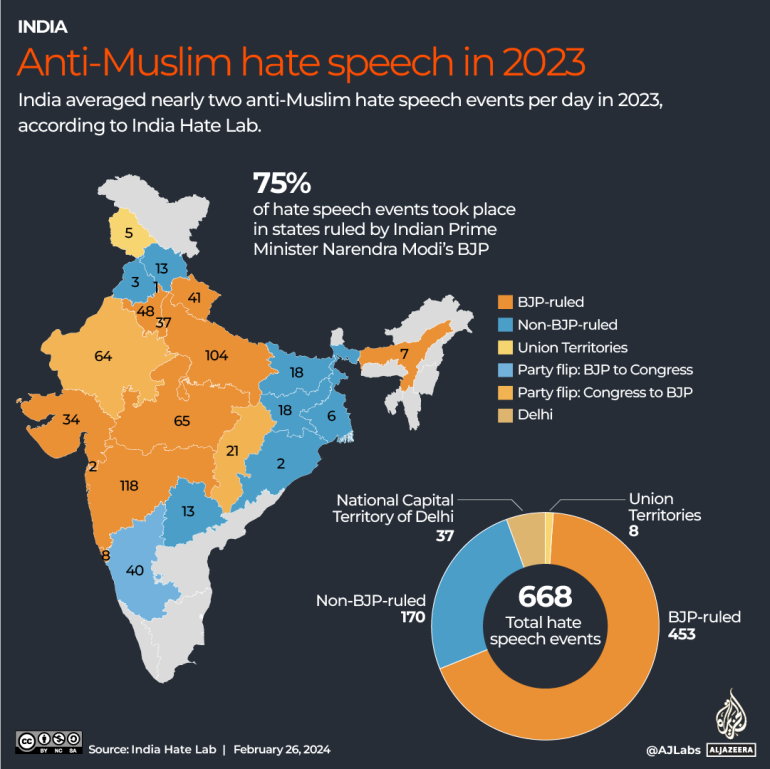
New Delhi, India – India averaged nearly two anti-Muslim hate speech events per day in 2023 and three in every four of those events – or 75 percent – took place in states ruled by Indian Prime Minister Narendra Modi’s Bharatiya Janata Party, revealed a report released Monday. In 2023, the hate speech events peaked between August and November, the period of political campaigning and polling in four major states, according to a report released by India Hate Lab (IHL), a Washington, DC-based research group. As India heads for a national vote in the upcoming months, a first-of-its-kind report by the IHL maps the spread of anti-Muslim hate speech across the country. The group documented a total of 668 hate speech events. Last month, the website of India Hate Lab was rendered inaccessible in India after the government blocked it under the controversial Information Technology (IT) Act, 2000. The government also blocked the website of Hindutva Watch, an independent hate-crime tracker also run by the IHL’s founder. The new report – the first time a research group has tracked hate speech events in India over a year – tracks how these events spread geographically across India, the triggers behind these events, and when they occur. Which are India’s hate speech hotbeds? The group documented a total of 668 hate speech events across 18 states and three federally governed territories. The top-ranking Indian states for these events were: Maharashtra in the west with 118 incidents, Uttar Pradesh in the north with 104 incidents, and Madhya Pradesh in central India with 65 incidents. These three states are among the biggest voter bases, are currently ruled by the BJP, and collectively account for 43 percent of the total hate speech events recorded in 2023. But relatively smaller states, like Haryana and Uttarakhand in northern India, weren’t immune either. While Haryana witnessed 48 hate speech events, or about 7.2 percent, events in Uttarakhand made up 6 percent – both states are among the emerging hotbeds for anti-Muslim violence as well. Seven people died and over 70 were injured in violence in the Nuh region of Haryana in August 2023; earlier this month, five Muslims were killed in Haldwani, Uttarakhand, while protesting against the demolition of a mosque and a religious school in the town. Prem Shukla, a national spokesperson of the BJP, told Al Jazeera that the party has been opposing the “Islamic fundamentalist forces” and alleged that the IHL data represented a “biased picture of the situation”. “The other so-called secular states are targeting the Hindu majority community by hate speeches, but no one will talk about it,” Shukla said in a phone interview. He also dismissed the IHL report, alleging that those behind it “have sworn to destroy the BJP”. Who rules states with the most hate speech? As per the report, 498 hate speech events, which make up 75 percent, took place in the states ruled by the BJP or in territories that it effectively governs through the central government. Among the 10 states with the most hate speech events, six were ruled by the BJP throughout the year. The other three states, Rajasthan, Karnataka, and Chhattisgarh had legislative elections in 2023, in which power changed hands: Rajasthan and Chhattisgarh moved from the opposition Congress party to the BJP, and Karnataka from the BJP to the Congress. Bihar, the last of the 10 states with the most hate-speech events, was ruled by an opposition coalition until last month, when its chief minister switched sides to join a BJP-led alliance. More than 77 percent of speeches that included a direct call of violence against Muslims were also delivered in states and territories governed by the BJP. A third of all hate speech events documented by the IHL were organised by two far-right organisations, the Vishwa Hindu Parishad (VHP) and the Bajrang Dal, which are associated with the Rashtriya Swayamsevak Sangh (RSS), the ideological mentor of the BJP. In 2018, the United States Central Intelligence Agency tagged the VHP and Bajrang Dal as “religious militant organisations”. “Our analysis shows that anti-Muslim hate speech has been normalised and become part of India’s socio-political sphere,” said Raqib Hameed Naik, founder of the IHL. “We foresee rampant use of anti-Muslim hate during the upcoming general elections to polarise voters.” What are the provocations used for hate speech events? The report documented that 63 percent of the total 668 hate speech events referenced Islamophobic conspiracy theories. The theories included “love jihad”, an alleged phenomenon where Muslim men lure Hindu women into marrying them and converting to Islam; “land jihad”, which alleges Muslims are occupying public lands by building religious structures or holding prayers; “halal jihad”, which views Islamic practices as the economic exclusion of non-Muslim traders; and “population jihad”, which alleges that Muslims reproduce with the intention of eventually outnumbering and dominating other populations. All of these conspiracy theories have been debunked: The government’s own data, for instance, shows that Muslim fertility rates are dropping faster than those of any other major community in India. Over 48 percent of the events occurred between August and November, a period that saw state elections in four major states. Reacting to the IHL report, Amnesty International called on Indian authorities to put an end to the rise in speeches calling for violence and hatred against religious minorities. “[The authorities] must take concrete measures to counter stereotypes, eradicate discrimination, and foster greater equality,” Aakar Patel, chair of the board at Amnesty International India, told Al Jazeera. Activists from various leftist organisations shout slogans during a protest against hate speech in New Delhi on December 27, 2021. [Manish Swarup/AP Photo] What’s the latest hate weapon being used against Indian Muslims? Since October 7, Indian far-right groups have been weaponising the Hamas attack on southern Israel, and Israel’s ongoing war on Gaza to stoke anti-Indian Muslim fears and hate. From October 7 to December 31, 2023, one in every five hate-speech events invoked Israel’s war, a phenomenon that peaked in November, according
South Korea sets deadline for striking doctors to return to work

Officials say striking young doctors have until the end of February to return to work or risk being punished. South Korea’s government has given striking young doctors four days to report back to work, warning they will face indictment and suspension of medical licences if they do not return by the deadline. The ultimatum on Monday came as about 9,000 medical interns and residents stayed off the job to protest against a government plan to increase medical school admissions by about 65 percent. The work stoppages, which began last week, have severely hurt the operations of their hospitals, with numerous cancellations of surgeries and other treatments. Safety Minister Lee Sang-min said chaos was mounting in hospitals and emergency services had reached a “dangerous situation” due to the strikes. “Considering the gravity of the situation, the government issues the last plea,” he said. “If you return to the hospital you left behind by February 29, you won’t be held responsible for what has already happened,” he said. “We urge you to remember your voice will be heard loudly and most effectively when you are by the side of patients.” Government officials say adding more doctors is necessary to deal with South Korea’s rapidly ageing population. The country’s current doctor-to-patient ratio is among the lowest in the developed world. The young protesting doctors say the government should first address pay and working conditions before trying to increase the number of physicians. Vice Health Minister Park Min-soo said those who do not return to work by the end of February will be punished with a minimum three-month suspension of their medical licences. He said they may also face further legal steps such as investigations and possible indictments. Under South Korea’s medical law, the government can issue back-to-work orders to doctors and other medical personnel when it sees grave risks to public health. Refusing to abide by such an order can bring up to three years in prison or 30 million won ($22,480) in fines, along with revocation of medical licences. There are about 13,000 medical interns and residents in South Korea, most working and training at 100 hospitals. They typically assist senior doctors during surgeries and deal with inpatients. They represent about 30 to 40 percent of total doctors at some leading hospitals. The Korea Medical Association, which represents about 140,000 doctors in South Korea, has said it supports the striking doctors but has not determined whether to join the trainee doctors’ walkouts. Senior doctors have held a series of rallies voicing opposition to the government’s plan. Earlier this month, the government announced universities would admit 2,000 more medical students starting next year from the current 3,058. The government says it aims to add up to 10,000 doctors by 2035. A public survey said about 80 percent of South Koreans back the government plan. Critics suspect doctors, among the best-paid professionals in South Korea, oppose the recruitment plan because they worry they would face greater competition and lower income. Striking doctors have said they worry doctors faced with increased competition would engage in overtreatment, burdening public medical expenses. Adblock test (Why?)