

Pakistan government deal agreed despite opposition from Imran Khan’s PTI

Pakistan People’s Party and Pakistan Muslim League-Nawaz to form a coalition with Shehbaz Sharif selected as candidate for PM. Two of Pakistan’s leading political parties have reached a formal agreement to form a coalition government, they say, days after inconclusive national elections did not return a clear majority. The Pakistan Peoples Party (PPP) and the Pakistan Muslim League-Nawaz (PMLN) now have the “required numbers” to form a government, PMLN President and former Prime Minister Shehbaz Sharif said on Tuesday. Sitting beside Sharif at a news conference in Islamabad, Bilawal Bhutto Zardari, former foreign minister and chairperson of the PPP, confirmed that Sharif would be their coalition’s candidate for prime minister. He added that his father, Asif Ali Zardari, would be the alliance’s candidate for president. Sharif, who is the younger brother of another former prime minister, Nawaz Sharif, said the PMLN-PPP coalition also had the support of other smaller parties. The announcement comes after 10 days of intense negotiations following the February 8 elections, which resulted in a hung National Assembly when no party secured the 134 seats needed for a simple majority and to form government on its own. Independent candidates aligned with another leading political party – jailed former Prime Minister Imran Khan’s Pakistan Tehreek-e-Insaf (PTI) – won the most seats at 93 but did not have the numbers or a political party or coalition that would enable them to govern. PTI-aligned candidates were forced to run as independents in the face of state restrictions against the party. The PMLN is the largest party with 79 seats, and the PPP is second with 54. They along with four other smaller parties have a comfortable majority in the legislature of 264 seats. Vote rigging In response to the announcement by the two parties, the PTI, which had also been trying to form coalitions with smaller parties, branded their rivals “mandate thieves” in a post on the social media platform X. PDM 2.0 = #MandateThieves pic.twitter.com/9ukk4oJZvF — PTI (@PTIofficial) February 20, 2024 The PTI has alleged there was widespread vote rigging in the elections, a claim that was seemingly backed up when a senior bureaucrat on Saturday admitted to his involvement in changing election results. The PTI faced a severe crackdown from government agencies and security forces in the weeks before the elections. In January, the party was even denied the use of its election symbol, the cricket bat, which resulted in its candidates running as independents instead of as members of the party itself. Meanwhile, the social media platform X has been disrupted across Pakistan since Saturday when the vote manipulation admission was made public and people went out into the streets to protest. “X has been inaccessible in Pakistan [since Saturday] because it is used by the public to protest,” Usama Khilji, a digital rights activist told the Agence France-Presse news agency. However, Pakistan’s government has not acknowledged the outage. The delay in forming a government in Pakistan – a nuclear-armed nation of 241 million people – has caused concern as the country grapples with an economic crisis amid slow growth and record inflation and rising violence by armed groups. It needs a stable administration with the authority to take tough decisions. Bhutto Zardari said on Tuesday that the PPP and PMLN would push to form a government as soon as possible. According to the country’s constitution, a session of parliament has to be called by February 29, after which a vote for a new prime minister will take place. Adblock test (Why?)
Who is Julian Assange and why does the United States want him so badly?

NewsFeed WikiLeaks founder Julian Assange has been fighting for years against being sent to the United States – where he could be jailed for life if convicted on spying charges. Virginia Pietromarchi explains who the whistleblower is and why he’s wanted in the US. Published On 20 Feb 202420 Feb 2024 Adblock test (Why?)
US vetoes UN resolution calling for immediate Gaza ceasefire

NewsFeed The United States has vetoed an Arab-backed United Nations Security Council draft resolution calling for an immediate ceasefire between Israel and Hamas. The US ambassador to the UN said proceeding with the vote was ‘wishful and irresponsible’ and proposed a rival draft instead. Published On 20 Feb 202420 Feb 2024 Adblock test (Why?)
All you need to know about Major League Soccer 2024 and its Messi mania

The new Major League Soccer season is set to get under way in North America with the spotlight shining brightly on one man: Lionel Messi. Argentina’s World Cup-winning captain joined David Beckham’s MLS club, Inter Miami, in the middle of the US’s regular football season last year and delivered instant results. The club won the first match Messi played after a streak of 10 winless games and, what’s more, the eight-time Ballon d’Or winner landed the side its first trophy – the Leagues Cup. Messi and his former Barcelona teammates Luis Suarez, Sergio Busquets and Jordi Alba, have transformed the team in a matter of months. Now, with Messi fully established as the centrepiece and playing his first full campaign for the club’s fourth year of existence, Miami will be eyeing the big prize: a first MLS Cup. The 29-team championship gets under way on February 22, when Miami host Salt Lake City at the DRK PNV Stadium in Fort Lauderdale. Two. More. Days. ⏳ Messi & @InterMiamiCF take on @realsaltlake to kickoff the season! 📺 #MLSSeasonPass on @AppleTV: https://t.co/D7skJOK7bn pic.twitter.com/xoe19Wm6jQ — Major League Soccer (@MLS) February 19, 2024 Here’s what you need to know about the upcoming MLS season: Who are the biggest names in MLS? Inter Miami: Inter Miami brought Messi mania to the MLS for the end of their last season and the Qatar World Cup 2022 winner arrived in a media whirlwind. Soon, Messi’s good friend Suarez was signed in the off-season to bolster the team’s ranks. The Uruguayan has set out his motive for joining the club: “to try to win [the] MLS”. Busquets, Alba and Paraguayan midfielder Diego Gomez complete Miami’s star-studded lineup. Columbus Crew: The defending champions are led in attack by Columbian star Cucho Hernandez. He scored 16 goals and produced seven assists last season. Atlanta United: Thiago Almada, who was part of Messi’s World Cup-winning team in 2022, is central to Atlanta United’s hopes. The midfielder scored 13 goals in his 35 appearances last season. Chicago Fire: Belgian striker Hugo Cuypers was a club-record $12m signing for the Eastern Conference side, where Switzerland international and former Liverpool forward Xherdan Shaqiri netted seven goals last season. Toronto FC: Lorenzo Insigne is the Canadian club’s star name. The winger won the last of his 54 caps for Italy in their failed World Cup qualification bid in 2022 and moved to Canada the same year following a 15-year career with Napoli. Los Angeles FC: French goalkeeper Hugo Lloris moved to the West Coast from Tottenham Hotspur in January, ending an 11-year association with the London club. New year, new signings, new stars. ✨ pic.twitter.com/UR6h1XjIj7 — Major League Soccer (@MLS) February 19, 2024 How has Messi transformed the MLS? Inter Miami’s managing owner Jorge Mas termed the player’s arrival a “seminal moment” for the sport in the US last year. Meanwhile, MLS Commissioner Don Garber believes Messi’s presence will “put MLS on a different trajectory.” “And who knows what that’s going to look like years from now? But certainly, we’re in a different position today than we had been, with Messi in our league.” If numbers provided by Garber are anything to go by this season, MLS season ticket sales have seen a 15 percent increase, league sponsorship revenue is up by 17 percent, club revenue has received a 15 percent boost and merchandise sales have shot up by 44 percent. Shirts of Inter Miami’s Lionel Messi and Luis Suarez are displayed for sale outside the Cuscatlan stadium prior to a friendly match between El Salvador’s national team and Inter Miami in San Salvador, El Salvador on January 19, 2024 [File: Moises Castillo/AP] What are conferences? The 29 teams are broken into two conferences to reduce travel. The Eastern Conference features 15 teams, and 14 are in the Western Conference. Which teams are in the conferences? Eastern Conference: Atlatana FC, CF Montreal, Charlotte FC, Chicago Fire FC, Columbus Crew, DC United, FC Cincinnati, FC Inter Miami, Nashville SC, New England Revolution, New York City FC, New York Red Bulls, Orlando City SC, Philadelphia Union, Toronto FC. Western Conference: Austin FC, Colorado Rapids, FC Dallas, Houston Dynamos FC, LA Galaxy, Los Angeles FC, Minnesota United FC, Portland Timbers, Real Salt Lake, San Jose Earthquakes, Seattle Sounders, Sporting Kansas City, St Louis City SC, Vancouver Whitecaps FC. What is up for grabs in the North American season? The Eastern and Western Conferences will primarily play for two titles in the MLS. The overall leader from the two groups is awarded the Supporters’ Shield, while the winners of the end-of-season playoffs will lift the MLS Cup. The Leagues Cup, which is a knockout competition also available to clubs from Mexico’s Liga MX, offers teams another route to the continental club competition CONCACAF Champions Cup. This has already been a happy hunting ground for Messi and Miami, as the Argentinian helped the Florida-based team to lift the revamped tournament last season to qualify for the prestigious Champions Cup. Miami will enter that tournament in the last-16 stage in March and will vie for a place at the expanded FIFA 2025 Club World Cup set to be hosted in the US. The US Open Cup is the fifth crown that Messi can challenge for with Miami this season and is another knockout competition but this one is open to clubs outside the MLS conferences in both the US and Canada. Houston beat Miami in the final last season. FC Cincinnati were winners of the Eastern Conference, as well as the Supporters Shield, while St Louis City finished atop the Western Conference in the team’s first season. Lionel Messi guided Inter Miami to the Leagues Cup Championship win last year [File: Christopher Hanewinckel/USA Today Sports] Who are the favourites? Inter Miami’s spending spree and the capture of Messi will mount pressure on them to challenge in all competition this season, but they have their work cut out having finished 27th out of 29 teams last season. With the late addition of Rossi to
South Africa to hold general election on May 29

Ruling ANC faces a tough challenge to retain its majority in the seventh election since the end of the apartheid system. South Africa will hold national and provincial elections on May 29, President Cyril Ramaphosa’s office has said. Ramaphosa’s ruling African National Congress (ANC) party is expected to face a tough challenge to retain its parliamentary majority in the country’s seventh democratic election since the end of the apartheid system in 1994. “The 2024 elections coincide with South Africa’s celebration of 30 years of freedom and democracy,” the presidency said in a statement posted on X on Tuesday. In 1994, the country held its first democratic elections after the fall of the racially segregationist system of apartheid that had brutally oppressed Black and other non-white South Africans since 1948. “Beyond the fulfilment of our constitutional obligation, these upcoming elections are also a celebration of our democratic journey and a determination of the future that we all desire,” Ramaphosa said. PRESIDENT RAMAPHOSA ANNOUNCES 2024 GENERAL ELECTION DATE President @CyrilRamaphosa has in accordance with section 49(2) of the Constitution of the Republic of South Africa, read with section 17 of the Electoral act of 1998, determined 29 May 2024, as the date for the 2024… — #SONA2024 | Presidency 🇿🇦 (@PresidencyZA) February 20, 2024 The statement echoed sentiments he shared in his State of the Nation Address earlier this month, where he used much of his speech to highlight how far the country has come in three decades and what role his governing party has played. Ramaphosa, 71, is seeking a second term as president in a vote that may prove historic, with opinion polls showing opposition parties gaining ground over his African National Congress (ANC) in some areas. The ANC has led the country since 1994. But the party is now struggling in the polls, and many analysts say this year it will for the first time get less than the 50 percent parliamentary majority it has won in past elections. Power cuts and employment crisis The Democratic Alliance (DA) and Economic Freedom Fighters (EFF) are the main opposition parties. Former President Jacob Zuma has backed the newly formed uMkhonto we Sizwe (MK) or Spear of the Nation party, in a move that could potentially attract some traditional ANC voters. Zuma – who still enjoys huge popularity despite ongoing court cases and allegations of corruption against him – was part of the ANC until he was suspended in January. Political analysts also say record power cuts, poor service delivery and high levels of unemployment are likely to hurt the ANC at the polls in May. Daily blackouts, known locally as “load shedding”, have plagued the country for years, showing no sign of ending despite the president’s recent remarks that “the worst is behind us”. The power crisis has affected local businesses and the economy. The country’s unemployment rate reached 32.1 percent in December, the national statistics agency StatsSA said on Tuesday. On the foreign policy front, South Africa has put its weight behind securing an end to Israel’s ongoing war on Gaza and an end to the Israeli occupation of Palestine more broadly. It has filed a case at the International Court of Justice (ICJ), accusing Israel of genocide, and also contributed to another case on the legality of the Israeli occupation. Even though there is overwhelming support for South Africa’s actions on the domestic front – as South Africa and Palestine have long enjoyed close ties – Ramaphosa’s intentions are also being scrutinised, with some accusing the president of being “opportunistic” in a key election year. On May 29, South Africans will elect a new National Assembly as well as the provincial legislature in each of the country’s nine provinces before the National Assembly elects the president. Adblock test (Why?)
US vetoes another UN Security Council resolution urging Gaza war ceasefire

Majority of members voted to call for an immediate ceasefire in Israel’s war on Gaza that has killed more than 29,000 people. The United States has vetoed another United Nations Security Council draft resolution on Israel’s war on Gaza, blocking a demand for an immediate ceasefire between Israel and Hamas. Arab nations, led by Algeria, put the draft resolution to a vote on Tuesday with the expectation that it would not pass after the US – Israel’s key ally – had warned it would not back the text and proposed a rival draft instead. The US was the only country to vote against the draft text while the United Kingdom abstained. The UN Security Council’s 13 other member countries voted in favour of the text demanding a halt to the war that has killed more than 29,000 people in Gaza, according to Palestinian authorities, and displaced more than 80 percent of the population. For a UN Security Council resolution to be adopted, it requires at least nine votes in favour and no vetoes by any of the five permanent members: the US, UK, France, Russia or China. Linda Thomas-Greenfield, the US ambassador to the UN, said her country was vetoing the resolution over concerns it would jeopardise talks between the US, Egypt, Israel and Qatar that seek to broker a pause in the war and the release of hostages held by Hamas. She rejected claims that the veto was a US effort to cover for an imminent Israeli ground invasion into the southernmost Gazan city of Rafah, where some 1.4 million displaced people are sheltering. In introducing the resolution on Tuesday, Amar Bendjama, Algeria’s ambassador to the UN, said the Council “cannot afford passivity” in the face of what is unfolding in Gaza, and that silence is “not a viable option”. “This resolution is a stance for truth and humanity, standing against the advocates for murder and hatred,” he said. “Voting against it implies an endorsement of the brutal violence and collective punishment inflicted upon them [the Palestinians].” Algeria, the current Arab member of the Security Council, put forward an initial draft resolution more than two weeks ago. The US said on Monday that it had proposed a rival draft resolution calling for a temporary ceasefire and opposing a major ground offensive by Israel in Rafah. Palestinians gather near the ruins of houses and buildings destroyed in Israeli strikes, in Nuseirat refugee camp in the central Gaza Strip, in November 2023 [File: Ibraheem Abu Mustafa/Reuters] ‘Softening’ of language “The Algerian draft had been negotiated for weeks,” said Al Jazeera’s James Bays, reporting from the UN headquarters in New York. “So people were rather surprised that the US came up with its own draft.” Bays said the US draft had not yet been formally presented to Council members, and it was unclear if or when it would be put to a vote. However, he added that in the draft text, seen by Al Jazeera, “there is a softening of the US language … and for the first time the US is using that word ‘ceasefire’, [previously] controversial for the US”. Until now, Washington has been averse to the word “ceasefire” in any UN action on the war, but the draft resolution text echoes language that US President Joe Biden said he used last week in conversations with Israeli Prime Minister Benjamin Netanyahu. The US draft resolution would see the Security Council “underscore its support for a temporary ceasefire in Gaza as soon as practicable, based on the formula of all hostages being released, and calls for lifting all barriers to the provision of humanitarian assistance at scale”. The US draft also warns Israel not to launch a ground offensive in Rafah, saying: “The Security Council should underscore that such a major ground offensive should not proceed, under the current circumstances.” The Algerian-drafted resolution, vetoed by the US, meanwhile called for an “immediate” humanitarian ceasefire, based on last month’s interim order by the International Court of Justice, which obliges Israel to take measures to prevent acts of genocide in the territory. It also separately demanded the immediate and unconditional release of all hostages. Washington traditionally shields Israel from UN action and has previously vetoed two other Security Council resolutions since the war began on October 7. Adblock test (Why?)
Why does an archipelago off the coast of Argentina belong to the UK?

The British foreign secretary arrived in the Falkland Islands on Monday to “reiterate the UK’s commitment to uphold the Islanders’ right of self-determination” in the face of Argentinian claims of sovereignty over the archipelago. Lord David Cameron, who was prime minister of the UK from 2010 to 2016 when he resigned following the Brexit referendum, is the first UK foreign secretary to visit the British Overseas Territory in the South Atlantic in 30 years. He was visiting ahead of his participation in the G20 Foreign Ministers meeting in Brazil on Wednesday. Cameron’s visit included a helicopter tour of the islands and the 1982 Falklands War battle sites. Despite being very nearly 13,000 kilometres (8,000 miles) from UK shores, with a population of only 3,200 people, the Falklands have occupied a weighty place in the British psyche ever since the islands became a 10-week battleground between British and Argentinian troops 42 years ago. Before his trip to the territory, Cameron made clear that British jurisdiction over the Falklands, the two major islands of which are East Falkland and West Falkland, is non-negotiable, “The Falkland Islands are a valued part of the British family, and we are clear that as long as they want to remain part of the family, the issue of sovereignty will not be up for discussion.” So why are the Falklands a British Overseas Territory and could they ever be handed over to Argentina? David Cameron, UK foreign secretary, right, on the opening day of the Munich Security Conference in Munich, Germany, on Friday, February 16, 2024, days before visiting the Falkland Islands where he stated that British sovereignty of the archipelago is ‘not up for discussion’ [Alex Kraus/Bloomberg via Getty Images] How did the Falklands become a British Overseas Territory? Several powers have laid claim to the islands since Englishman Captain John Strong made his landing there in 1690, naming the territory after his patron, Viscount Falkland. Over the centuries since then, the United Kingdom, Argentina, France and Spain have all established settlements on this nearly treeless group of islands where some one million penguins nest each summer. The UK has governed since 1833 and bases its claim to the islands on its longstanding presence there, as well as on the political will of the overwhelmingly pro-British islanders themselves. What is the basis of Argentina’s claim to the Falklands? Argentina has long disputed the UK’s right of sovereignty over the islands. The South American state maintains that it inherited the islands, known in Argentina as Las Malvinas, from the Spanish crown in the early 1800s, and that their close proximity to the Argentinian mainland is reason enough for its claim. Alasdair Pinkerton, associate professor in geopolitics at Royal Holloway, University of London, told Al Jazeera that Argentinian claims of sovereignty over the Falklands remain “deeply ingrained within Argentine politics and society, inculcated through the education system, street signage, banknotes and the Argentina constitution”. The dispute between Argentina and the UK reached a crisis point on April 2, 1982, when Argentina invaded the islands in a bid to take control of the archipelago. After a UK military task force was dispatched by then-British Prime Minister Margaret Thatcher to win back the territory, 74 days of conflict ensued. The UK prevailed, but 655 Argentinian and 255 British servicemen were killed in the conflict. A sign for the Malvinas Argentinas stands in the Los Cardales National Park in Valles Calchaquies, Salta, Argentina on March 22, 2023 [Ricardo Ceppi/Getty Images] What do the islanders want? In a bid to push back against intensifying Argentinian claims over the territory, Falklanders went to the polls on March 10 and 11, 2013 to vote on the following question, “Do you wish the Falkland Islands to retain their current political status as an Overseas Territory of the United Kingdom?” More than 90 percent of those eligible to vote turned out. Out of the 1,517 votes cast, 1,513 voted in favour of remaining a British territory. But Alicia Castro, the then-Argentinian ambassador to London, dismissed the referendum as “a ploy that has no legal value”. “Negotiations are in the islanders’ best interests,” she told an Argentinian radio station following the result. “We don’t want to deny them their identity. They’re British, we respect their identity and their way of life and that they want to continue to be British. But the territory they occupy is not British.” Could there be another war over the Falklands? During a TV election debate last year, Argentina’s far-right populist President Javier Milei, elected in November 2023, dismissed any notion of a future war, “It is clear that the war option is not a solution. We had a war – that we lost – and now we have to make every effort to recover the islands through diplomatic channels.” However, Pinkerton said, “In reality, I suspect that Milei is not hugely motivated by the Falklands/Malvinas as an issue – it’s a distraction from his economic libertarian project – but feels the political need to perform an interest to assuage public demand.” But, while Pinkerton could not “envisage another 1982-style conflict any time in the foreseeable future” either, he added, “You can’t fully eliminate the possibility of some kind of confrontation if the conditions were right and there was a distinct trigger event, especially as the world becomes increasingly multipolar.” Pinkerton explained that issues such as the “growing challenge of overfishing” in the so-called Blue Hole – a disputed area of water close to the Falklands, and the uncertain future of the Antarctic Treaty’s Environmental Protocol when it comes up for review in 2048, “all bring challenges for diplomacy and security in the South Atlantic in coming decades”. Adblock test (Why?)
‘Israel’s apartheid must end,’ South Africa says at ICJ hearing

The International Court of Justice will hear from 52 countries on the legality of Israel’s occupation of Palestinian territories. South Africa told the International Court of Justice (ICJ) in The Hague that Israel is responsible for apartheid against the Palestinians and its occupation is “inherently and fundamentally illegal”. South African representatives opened the second day of hearings at the ICJ on Tuesday and spoke on a request by the United Nations General Assembly for a nonbinding advisory opinion on the legality of Israel’s policies in the occupied Palestinian territories. “We as South Africans sense, see, hear and feel to our core the inhumane discriminatory policies and practices of the Israeli regime as an even more extreme form of the apartheid that was institutionalised against Black people in my country,” said Vusimuzi Madonsela, South Africa’s ambassador to the Netherlands, where the ICJ is based. “It is clear that Israel’s illegal occupation is also being administered in breach of the crime of apartheid. … It is indistinguishable from settler colonialism. Israel’s apartheid must end,” Madonsela said. He added that South Africa had a “special obligation” to call out apartheid wherever it occurs and ensure it is “brought to an immediate end”. South Africa, which has a long history of support for the Palestinians and has compared their struggle with its history under an apartheid system, has launched a separate case at the ICJ accusing Israel of “‘genocide” in its bombardment of Gaza. More than 50 countries are to present arguments to the ICJ on the legal implications of Israel’s occupation. On Tuesday, representatives from Algeria, Saudi Arabia, the Netherlands, Bangladesh, Belgium, Belize, Bolivia, Brazil and Chile presented their positions. The 15-judge panel has been asked to review Israel’s “occupation, settlement and annexation, … including measures aimed at altering the demographic composition, character and status of the Holy City of Jerusalem, and from its adoption of related discriminatory legislation and measures”. Israel has pushed on with building illegal settlements across the occupied West Bank, now home to more than 500,000 Jewish settlers and three million Palestinians. Israeli settlers have become increasingly more violent. Their actions have been condemned by world leaders, especially in the past few months, as Israel attacks Gaza. But South African representative Pieter Andreas Stemmet told the court that the settlements have extended the “temporary nature of the occupation into a permanent situation in violation of the Palestinian right to self-determination”. (Al Jazeera) On Monday, Palestinian representatives asked the UN’s highest court to declare the occupation illegal. They said such an advisory opinion could contribute to a two-state solution and lasting peace. Palestinian Foreign Minister Riad Malki called on the court in an emotional speech to treat Palestinian children as children, adding that “the identity of the group to which we belong does not diminish the human rights to which we are all entitled”. Israel has declined to attend the hearings and said in a written statement that an advisory opinion would be harmful to achieving a negotiated settlement with the Palestinians – even as Israeli Prime Minister Benjamin Netanyahu repeatedly rejects the idea of a Palestinian state. On Monday, Netanyahu said Israel does not recognise the legitimacy of discussions at the ICJ, calling the case “part of the Palestinian attempt to dictate the results of the political agreement without negotiations”. While judges are expected to take about six months to deliver an opinion in the case, political analyst Gideon Levy told Al Jazeera he’s “afraid” that the ICJ case will have little impact on Israeli policies but it “depends a lot on the international community”. “The only question is if the world will be able to move from recrimination and condemnation into actions,” he said. Adblock test (Why?)
Four Egyptian officials back on trial in Italy over death of Giulio Regeni
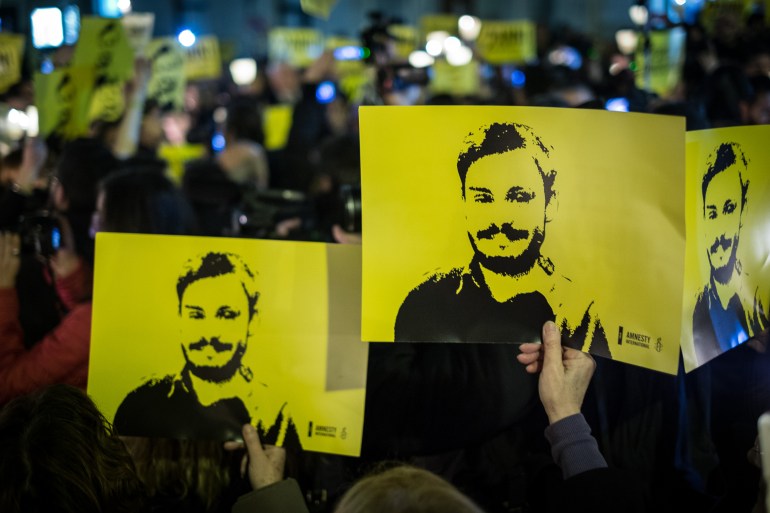
Italy’s top court decided last year to proceed with the trial against the four officials, who will be tried in absentia. The trial of four Egyptian security agents accused of kidnapping and murdering an Italian student in Cario opened in Italy on Tuesday following a prolonged delay in the proceedings over its legality. Giulio Regeni, a postgraduate student at the United Kingdom’s Cambridge University, disappeared in the Egyptian capital in January 2016, where he was researching union activities among street vendors as part of his doctoral thesis. A month after his disappearance, the body of the 28-year-old was found on the side of a highway on the edge of Cairo, bearing cigarette burns, broken teeth, and fractured bones. A post-mortem examination showed he had been tortured before his death. Human rights activists also said the marks on his body were reminiscent of those resulting from widespread torture in Egyptian security agency facilities. Regeni’s parents, Paola and Giulio Regeni, attended the opening court session on Tuesday and posed outside the court with the banner “Truth for Giulio Regeni”. The Regeni family lawyer, Alessandra Ballerini, said after the short hearing, “We have been waiting for eight years this moment.” “We finally hope to have a trial against those who perpetrated all the possible pain in the world on Giulio.” People during a march and torchlight procession in memory of the Italian researcher Giulio Regeni, in Rome, Italy, January 25, 2018 [File: Andrea Ronchini/NurPhoto via Getty Images] Italian prosecutors believe four Egyptian officials were involved in the killing, but have not been able to track them down to issue summons, so they are being tried in absentia. Tuesday’s hearing marks the second time the four Egyptian officials have gone on trial on charges related to Regeni’s death, after proceedings originally opened in October 2021 but were immediately suspended after the judge questioned whether the prosecution would be legitimate if it were not clear that the accused even knew they had been charged. But Italy’s top court dismissed the decision in September last year, saying Egypt’s failure to cooperate should not impede the trial. Tranquillino Sarno, a public defender for one of the accused, asked for continued efforts to contact the four officials on Tuesday. He asked that the court ensure Egyptian authorities “can be officially informed of this trial in Italy, as today, we don’t even know if they are still alive”. Egypt has denied claims that it refused to help the investigation into Regeni’s death, saying its authorities cooperated with Italian officials and that its investigations concluded that Regeni’s killers are unknown. Officials also said that the Italian investigation was not based on consistent evidence, denying any responsibility from the country’s security apparatus. Egyptian police earlier claimed that Regeni was killed by gangsters who specialised in impersonating police officials, kidnapping foreigners, and stealing their money and that they were killed during an exchange of fire with the police. But Egyptian judges ruled that the men were not Regeni’s killers. The trial represents the first time Egyptian officials have been prosecuted abroad for alleged crimes that human rights groups have said have been committed on a larger scale in the North African country. After Tuesday’s preliminary motions, the president of the jury adjourned the proceedings until March 18. Adblock test (Why?)
How is Israel’s arms industry profiting from the war on Gaza?

Made in Israel, tested in Palestine. The war on Gaza seems to be a testing ground for Israel’s new weaponry, with devastating effect. Despite the country’s relatively small size, Israel is one of the world’s largest weapons exporters. In 2022, its arms sales reached $12.5bn, a 20 percent increase over the previous year. Praised for their innovation, Israeli manufacturers proudly advertise their “battle-tested” products but what is the cost to the test subjects, the Palestinians, especially in the context of the current bloodshed in Gaza? We look at how this brutal business is profiting from the destruction of Gaza as well as how technology, money and the lack of accountability are fueling the flames of war. Presenter: Anelise Borges Guests:Antony Loewenstein – Author, The Palestine Laboratory: How Israel Exports the Technology of Occupation Around the WorldSophia Goodfriend – JournalistMarwa Fatafta – Access Now, MENA Policy and Advocacy DirectorSaleh Hijazi – BDS Movement activist Adblock test (Why?)