

‘Let me finally see my son’: Navalny’s mother demands body from Putin

Kremlin says widow Yulia’s accusations that Navalny was poisoned by a nerve agent are ‘unfounded and vulgar’. The mother of dead Russian opposition leader Alexey Navalny has demanded that President Vladimir Putin hand over his body so that she could bury him. “I appeal to you, Vladimir Putin. Resolving this issue depends on you alone. Let me finally see my son,” said Lyudmila Navalnaya in a video message on Tuesday, making her plea as the Kremlin denied any involvement in the death of Navalny on February 16 while serving a sentence at the “Polar Wolf” penal colony above the Arctic Circle. In a video filmed in front of the prison, Navalny’s mother said she did not even know where her son’s corpse was. “For a fifth day I cannot see him, they aren’t giving me his body and don’t even tell me where he is,” she said, adding that she demanded his body be “released immediately so that I can bury him humanely”. On Tuesday, Kremlin spokesperson Dmitry Peskov hit back at accusations made by Yulia Navalnaya, Navalny’s widow, that her 47-year-old husband had been poisoned by a nerve agent, calling her claims “unfounded and vulgar”. Peskov, who said he was “not familiar” with Navalnaya’s statement made in a video address broadcast on Monday, declined to comment further, saying that he was “taking into account that Yulia Navalnaya was widowed just days ago”. The Kremlin said Putin had not watched her video statement. In her video three days after her husband’s death and less than a month before Russia’s presidential election, Navalnaya signalled her determination to fight for a “free Russia”. She said the authorities had not yet handed over Navalny’s body to his elderly mother because they were waiting for traces of a Novichok nerve agent to leave his corpse. Navalny’s allies have quoted a Russian investigator as saying the authorities need at least 14 days to conduct various chemical tests on his body and cannot therefore hand his body over yet. Navalnaya also called on the European Union not to recognise the results of the presidential election, slated for March 15-17, which is almost certain to give Putin another six-year term. “A president who assassinated his main political opponent cannot be legitimate by definition,” Navalnaya said in her speech. Putin has warned that there will be a strong response if foreign powers try to meddle in the election. Calls for investigation rejected Peskov rejected the EU’s call on Monday for an “international investigation” into Navalny’s death following talks in Brussels with Navalnaya hosted by EU foreign policy chief Josep Borrell. “We do not accept such demands in general – all the more so from Mr Borrell,” Peskov said. The West and Navalny’s supporters say Putin is responsible for Navalny’s death. The Kremlin has denied involvement and said that Western claims that Putin was responsible were unacceptable. Putin has made no public comment on Navalny’s death but it has further deepened a schism in relations between Moscow and the West caused by Russia’s invasion of Ukraine. Asked about the hundreds of detentions of Russians at events mourning Navalny’s death in recent days, Peskov said: “Law-enforcement agencies are acting in accordance with the law”. Russian authorities say that Navalny fell unconscious and died suddenly after a walk at the penal colony. Adblock test (Why?)
What’s fuelling the deadly cholera outbreak in Southern Africa?

A severe cholera outbreak is currently ravaging communities in Southern Africa, spreading across borders in what experts say is the worst such crisis involving the illness that the region has seen in a decade. Thousands of people have died, and thousands of others have been infected with the acute diarrheal disease in at least seven countries. In some of the hardest-hit countries, the outbreak forced millions of students to stay back home in January. Across the region, emergency response centres have sprung up in school fields and stadiums, and are teeming with groaning patients in pain. Fears are mounting that if the outbreak is not tackled soon, healthcare staff could be overwhelmed. In an emergency summoning to address the outbreak earlier this month, leaders of the Southern African Development Community (SADC) said they were working to stop the spread, but a lack of clean water, weak cross-border checks, and a global shortage of vaccines could test that resolve. Here’s a breakdown of what’s causing the spread and how many people have been affected: How widespread is the outbreak? Caused by the vibrio cholerae bacteria, cholera infects the small intestine, producing toxins that the body works hard to expel by secreting large amounts of vomit or watery diarrhoea, leading to rapid dehydration. Mild cases can disappear after a few days of oral rehydration treatment, but in severe cases – approximately one in 10 – it could lead to death within a day if left untreated. Since January 2022, at least 188,000 people have been infected with cholera across seven countries in Southern Africa: Zambia, Zimbabwe, Malawi, Mozambique, Tanzania, South Africa and the Democratic Republic of Congo. More than 4,100 people have died, according to the UN humanitarian agency, OCHA. The disease has been spreading since 2022. Although badly hit Zambia only reported its first case in October 2023, more than 18,804 people were infected by Thursday, in what authorities say is the country’s worst outbreak ever. At least 658 people have died since October. Malawi, with at least 59,000 cases since early 2022, is also reporting its largest cholera outbreak ever. In Zimbabwe, 21,000 cases since February 2023 make this epidemic the second-worst on record. DRC, which is also a member of the SADC, has the highest number of infections at 71,000, while South Africa has recorded the lowest number of cases, at 1,076 people. Monthly cases across the affected countries hovered around 2,000 infections since January 2023, but then peaked in January 2024 at 3,400 cases, suggesting higher transmission levels going into February. What’s fuelling this outbreak? Cholera typically spreads when people ingest water or food that’s contaminated. The disease is common in areas with poor sanitation, or in conflict zones where drinking water sources might be contaminated with faecal matter or wastewater from sewers. Although endemic to Africa and parts of Asia, experts say it’s rare for several countries to experience outbreaks simultaneously, as is the case in southern Africa. The outbreak was likely triggered by a cocktail of issues, rather than a single event. Regular, unchecked cross-border movement, for example, means infections can be transported: One 2023 study found that two sisters who had travelled from South Africa to a cholera hot spot in Malawi infected a third person on their return and that the strain that is currently spreading is originally from South Asia. While it’s rare for people to transfer the infection through casual contact, poor hygiene can lead to faecal matter from an infected person contaminating food meant for others. Poor sewage systems, alongside inadequate clean water sources for drinking, cooking and hygiene are also a persistent problem in the region. More than half of the population in rural communities in Southern African countries — except for South Africa and Eswatini, formerly known as Swaziland — have no access to sanitation facilities like toilets (PDF). In South Africa, researchers say 80 percent of wastewater systems need upgrading. Increasingly frequent and more severe flooding linked to climate change has an impact too, experts have said. Anja du Plessis of the University of South Africa (UNISA) told Al Jazeera that cholera occurs more in the rainy season, which the region is currently experiencing. Flooding “results in more run-off containing more pathogens, increasing the risk of contamination,” she said. Cyclone Kenneth tore through Madagascar, Mozambique, Malawi, and Zimbabwe, in March 2023, and likely worsened cholera transmission. At the moment, cholera vaccines used both preventively and reactively are scarce, forcing the World Health Organization (WHO) to abandon the usual two-dose oral application for a single dose. Some 29 countries reported cholera outbreaks in 2022, an increase from the average of 20 reporting countries annually. That uptick has stretched the estimated 36 million doses available yearly. There’s only one available manufacturer of the dose at the moment – South Korean firm EuBiologics — and it’s already producing at maximum capacity, according to WHO. While two doses of the vaccine can stop cholera for about three years, one dose reduces the immunity period to between six months and two years. How are SADC countries responding? At an emergency summit on February 2, SADC leaders promised to increase funding for water systems and to work on a cross-country response plan to monitor cholera spread, especially after climate change-linked natural disasters. The leaders also aim to start manufacturing cholera vaccines regionally, although they acknowledged they don’t have enough resources to buy medical supplies like test kits. But some are sceptical and say community-based campaigns in the short term might be more effective than SADC’s plans. “The response so far has been poor [and] we will have to see if their words are transformed into action,” du Plessis of UNISA said. “We can however not depend and wait on the governments to take action. Communities should be properly informed on WASH [water and sanitation hygiene] facilities and practices so that the rate of the outbreak can be curbed.” In Zambia, authorities delayed January school resumption for four million students by about a month
Who is Julian Assange? Will the WikiLeaks founder be extradited to the US?

WikiLeaks founder Julian Assange is making a last-ditch attempt to prevent his extradition to the United States to face criminal charges over espionage and the publication of classified information. WikiLeaks caused a diplomatic storm after it published a huge cache of secret military files in 2010 and 2011. Washington wants to try him for the leaks that it says damaged its national security. Here is what we know about Assange and his legal battle: What is the trial about? Two senior judges will hear arguments from Assange’s legal team over two days starting on Tuesday. A UK High Court in 2021 ordered Assange’s extradition, which was upheld by the Supreme Court a year later. Former home secretary Priti Patel cleared Assange’s extradition order in April 2022. The Australian-born Assange, who has been in prison since 2019, wants a review of former home secretary’s extradition order and to challenge the 2021 court order in the two-day hearing. What is WikiLeaks? In 2006, Assange launched WikiLeaks, an online platform where people can anonymously submit classified leaks such as documents and videos. In April 2010, WikiLeaks released footage showing a US Apache helicopter attack which killed a dozen people, including two Reuters journalists, in the Iraqi capital, Baghdad. This caused the platform to gain prominence. Also in 2010, it released more than 90,000 classified US military documents on the Afghanistan war, and almost 400,000 secret US files on the Iraq war. The leaks represented the largest security breaches of their kind in US military history. WikiLeaks also released 250,000 secret diplomatic cables from US embassies around the world, with some of the information published by newspapers such as The New York Times and Britain’s The Guardian. US politicians and military officials, angered by the leaks, argued the unauthorised publication of information put lives at risk. In 2013, Chelsea Manning, a former army intelligence analyst, was sentenced for leaking thousands of secret messages to WikiLeaks. She served seven years in a military prison before being released on an order of President Barack Obama. What is Assange charged with? Assange has been indicted in the US on 18 charges over the publication of hundreds of thousands of classified documents in 2010 by WikiLeaks. Seventeen of these counts are for espionage while one is for computer misuse. US lawyers say Assange is guilty of conspiring with Manning and attempting to hack into a Pentagon computer. The prosecution against Assange is made under the 1917 Espionage Act, which has never before been used for publishing classified information. Supporters of Assange argue he should be protected under the press freedoms granted by the First Amendment to the US Constitution and he had acted as a journalist to expose US military wrongdoing. Amnesty has released a statement appealing to the US authorities to drop the charges, deeming the government’s pursuit of Assange a “full-scale assault on the right to freedom of expression”. “Julian has been indicted for receiving, possessing and communicating information to the public of evidence of war crimes committed by the US government,” Assange’s wife Stella said. “Reporting a crime is never a crime.” Who is Julian Assange? Assange, now 52, was born Townsville, Australia, in July 1971. Assange is married to Stella Assange, a lawyer who met him in 2011 when she was hired as part of his legal team. Stella, originally called Sara Gonzalez Devant, changed her name to Stella Moris in 2012 to protect herself and her family while working with Assange. “His life is at risk every single day he stays in prison, and if he’s extradited, he will die,” Stella has said. Assange’s wife has been very vocal in defence of her husband. The couple has two children and married in March 2022. Arrest and Assange’s legal battle While the US only officially unsealed criminal charges against Assange in 2019, his legal battle spans 13 years. On November 18, 2010, a Swedish court ordered Assange’s arrest over rape allegations made by two female Swedish WikiLeaks volunteers. Assange denied the allegations and claimed the Swedish case was a pretext to extradite him, or hand him over, to the US to face charges over the WikiLeaks releases. In December 2010, Assange was arrested in the UK on a European Arrest Warrant but was released on bail. London’s Westminster Magistrates Court in 2011 ordered Assange to be extradited to Sweden, a decision he appealed. In 2012, his final appeal was rejected by the UK Supreme Court, after which he sought asylum in the Ecuadorean Embassy in London. The asylum was granted, but revoked in April 2019, after which a screaming Assange was carried out of the embassy. Throughout his asylum, UK police patrolled the embassy, saying Assange would be arrested if he left the building over his failure to surrender to bail earlier. His two children were born while he was holed up inside the embassy. In June 2019, the US Department of Justice formally asked UK authorities to hand Assange over to the US, where he would face charges. Swedish authorities dropped the rape investigation against Assange in 2019, saying the evidence was not strong enough to bring charges, partly due to the passage of time. The extradition hearings began in February 2020, but were adjourned after a week. In January 2021, in London, Judge Vanessa Baraitser concluded that Assange should not be sent to the US due to his frail mental health, adding there was a risk he would attempt suicide. Besides his mental health, Assange’s physical health has also declined in prison. In October 2021, he experienced a mini-stroke. He also broke a rib coughing. His wife has said he has aged prematurely. However, the US authorities won an appeal in December 2021 at London’s High Court against this decision, after giving a package of assurances about the conditions of Assange’s detention if convicted, including a pledge he could be transferred to Australia to serve any sentence. What are the possible outcomes of the hearing? If Assange and his legal team
Ten years ago Russia annexed Crimea, paving the way for war in Ukraine
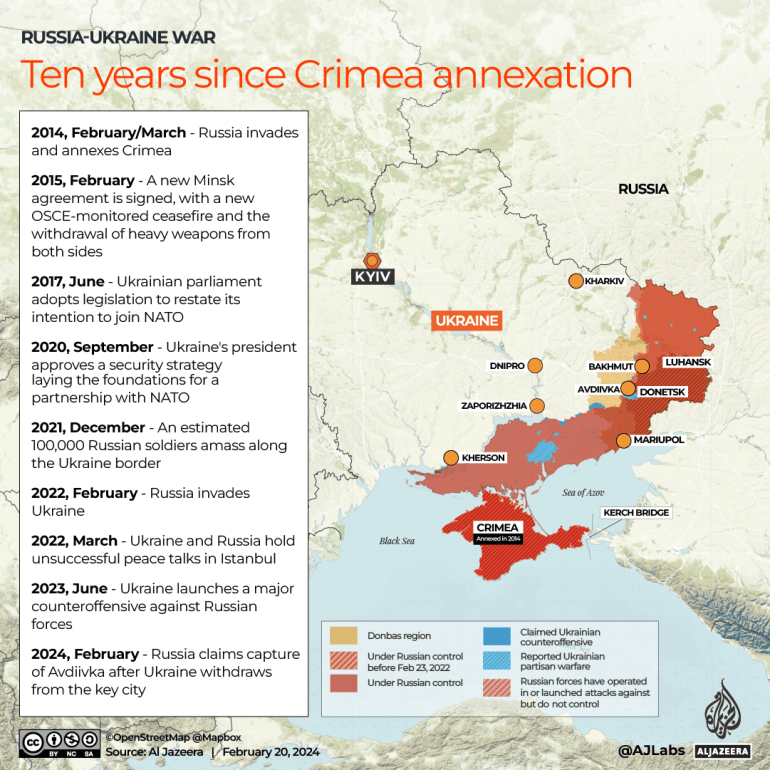
On March 7, 2014, a husky man in his late 30s with closely cropped hair addressed an uneven line of four dozen “volunteers”. Next to him were three men in body armour and green uniforms, with no insignia. The crowd of men, aged 20 to 50, were gathered outside a white Stalinist-era government building in Sevastopol, a port in Ukraine’s Crimea. They were uphill from the seashore, next to huge sequoias, blossoming cherry trees and elderly ladies holding hand-written posters that read, “In Russia through a referendum” and “I want to go home to Russia.” Eight days later, Moscow would hold a “referendum” on the Black Sea peninsula’s “return” to Russia, and the men were a nascent “self-defence unit” that would “prevent provocations,” the man said. I approached them with a notebook and a dictaphone – and was immediately seized by two “volunteers”. “Got a spy here!” they yelled, twisting my arms and ready to beat me to a pulp. But the instructor told them and me to wait. He kept on talking for half an hour, telling the crowd that they would train at a military base outside Sevastopol and should arrive in “comfy clothes” and sneakers. One of the volunteers asked him whether they should bring firearms. Many others nodded approvingly. (Al Jazeera) “When you take up arms, we become an armed criminal group. But if something happens, each unit will be backed by fire,” the instructor said. After the meeting, he checked my press ID and told me he was a retired intelligence officer who had served in Russia’s volatile North Caucasus region and arrived in Crimea as a “volunteer”. “Our groups will have to respond to challenges, provocations because there is a shortage of policemen in town,” he told me. “There’s NATO propaganda at work. “Our aim is to prevent the first shot. If the first shot happens, you won’t stop the mess,” he said. He politely declined to say what his name was. ‘Little green men’ The first shot didn’t happen, but what took place in Crimea 10 years ago paved the way for today’s war between Ukraine and Russia. On February 20, 2014, Vladimir Konstantinov, speaker of Crimea’s regional parliament and a Russian politician, said he “didn’t rule out” the peninsula’s “return” to Russia. On the same day, thousands of gun-toting men in unmarked uniforms appeared throughout Ukraine’s Crimea. They responded to the victory of pro-Western protests in Kyiv that would within days remove pro-Russian Ukrainian President Viktor Yanukovych. Dubbed “little green men” or “polite people,” the servicemen didn’t interact with locals or reporters, while Russian President Vladimir Putin said in Moscow that “they are not there”. They appeared next to Ukrainian military, naval and air bases, and the interim government in Kyiv ordered Ukrainian servicemen in Crimea to leave without firing a single shot. Many servicemen – along with thousands of police officers and government officials – joined the pro-Russian “government” formed by Sergey Aksyonov, a minor political figure and former mafia boss nicknamed “Goblin.” Some servicemen were detained, including Ihor Voronchenko, deputy head of Crimea’s coastal defence at the time. “There was a solitary cell, without a window, when you lose the sense of time, space. It affects one psychologically,” Voronchenko told me in 2018 when he was head of Ukraine’s navy. No shots were fired, but blood was spilled. On March 4, a “self-defence” unit abducted a Crimean Tatar protester, Reshat Ametov. He was held with other hostages in Simferopol, Crimea’s administrative capital, and tortured for a week. His naked, bruised body was found on March 15, head wrapped in plastic, eyes poked out. A day later, the “referendum” took place. Only a handful of schools and government buildings were used as “polling stations” so that the jubilant pro-Russian “voters,” mostly the elderly nostalgic about their Soviet youth, would throng and fill them, creating an illusion of mass vote. Moscow said 90 percent of Crimeans voted to join Russia, but the “referendum” was not recognised by Ukraine or any other nation. On March 21, Russian President Vladimir Putin made Crimea part of Russia. The annexation propelled his sagging approval ratings to an atmospheric 88 percent, and some Russians saw it as a first step to restoring the USSR. In response to the Arab Spring, a series of mass protests in the Middle East, the Kremlin came up with the idea of a “Russian Spring,” stoking protests in Russian-speaking Ukrainian regions in the east and south. Why Crimea? Ancient Greeks, Romans, Mongols and Turks contested Crimea, the westernmost end of the Great Silk Road. It became a jewel in the crown of Russian czars, who annexed it in 1783 from the Crimean Tatars, whose Muslim state was ruled by the descendants of Genghis Khan and allied with Ottoman Turkey. The czars and communists understood Crimea’s utmost strategic importance in controlling the Black Sea, and Nazi Germany occupied it during World War II. Soviet dictator Joseph Stalin accused Tatars of “collaborating” with the Nazis and ordered their entire community of 200,000 deported to Central Asia. “Early in the morning, there was a loud bang on the door. I yelled, ‘Mum, Dad is back from the war! But there were two soldiers who told us to start packing,’” historian Nuri Emirvaliyev, who was 10 at the time, told me about the May 18, 1944 deportation. More than half of them died en route, including his younger sister. “During stops, soldiers yelled, ‘Got any dead? Bring them out!’” Emirvaliyev recalled. The rare survivors and their descendants were allowed to return to Crimea in the late 1980s only to see their homes occupied by ethnic Russians and Ukrainians and become a distrusted and vilified minority. Crimea was made part of Soviet Ukraine in 1954 during the construction of the North Crimean Canal which made agriculture in arid interior areas possible and triggered the growth of urban centres. Moscow turned Crimea into a Soviet Riviera, and millions of former Soviet citizens still reminisce about their holidays
The Day Before October 7

For decades, Gaza has been gripped by a chokehold. Life in the enclave has often been described as an open air prison. No one leaves without the express permission of its neighbour. This is nothing new. But in the weeks and days leading up to October 7, the feeling on the ground was changing. Dareen Abughaida presents this new digital series.Pinch Point, where geography and politics collide. Adblock test (Why?)
Israeli police push back protesters demanding deal on Gaza captives

NewsFeed Israeli police grappled with protesters marching to the house of Prime Minister Benjamin Netanyahu to demand a deal to free 134 captives held in Gaza. Published On 20 Feb 202420 Feb 2024 Adblock test (Why?)
Haiti President Moise’s widow, ex-PM among 50 charged in his assassination

Leaked document claims first lady allegedly conspired with former PM to kill the president and replace him herself. A Haitian judge investigating the 2021 assassination of President Jovenel Moise has charged his widow, the former prime minister and an ex-chief of police with complicity in the killing. The 122-page leaked document, published by local media outlet AyiboPost on Monday, detailed how the president’s widow, Martine Moise, allegedly conspired with former Prime Minister Claude Joseph to kill the president, intending to replace him herself. In the document, Judge Walther Wesser Voltaire ordered the arrest and trial of some 50 people involved in the gunning down of Moise at his private residence in July 2021. A group of about 20 assailants, most of them Colombian mercenaries, were on the scene. All the accused were referred to the criminal court “to be judged on the facts of criminal conspiracy, armed robbery, terrorism, assassination and complicity in assassination”. Justifying the indictment of the former first lady, who was wounded during the attack, the document described her statements as “so tainted by contradictions that they leave something to be desired and discredit her”. Joseph and the former director-general of the national police, Leon Charles, were also found to have “sufficient indications” of involvement in the killing. AyiboPost specified that the document did not clearly identify the masterminds of the assassination, nor their financiers. Moise has criticised what she calls unjust arrests on social media. Joseph previously told the Miami Herald newspaper that the president’s de facto successor, Prime Minister Ariel Henry, was “weaponizing the Haitian justice system” to persecute opponents in “a classic coup d’etat”. Martine Moise grieves during the funeral for her husband, slain Haitian President Jovenel Moïse, on July 23, 2021, in Cap-Haitien, Haiti, the main city in his native northern region [Valerie Baeriswyl/AFP] A spokesperson for Henry’s office said the judge was independent and “free to issue his order in accordance with the law and his conscience”. Miami trial A separate case on Moise’s killing is being tried in Miami. The United States found the case fell within its jurisdiction because part of the assassination plot was hatched in South Florida. Prosecutions were launched against 11 people over their alleged involvement in the murder. Six of 11 defendants have pleaded guilty to a plot to send Colombian mercenaries to kidnap Moise, a plan which was at the eleventh hour changed to a plot to murder him. The conspirators had, according to US charges, sought to replace Moise with Haitian-American pastor Christian Emmanuel Sanon. Chaos Since Moise’s death, Haiti has only spiralled deeper into chaos. No election has been held and Moise has not been succeeded as president. Henry, who now leads an opposition party, postponed elections indefinitely, citing a devastating earthquake and the growing power of heavily armed criminal gangs, for which he has sought foreign aid. Gangs run rampant in large swaths of the country, now estimated to control most of the capital, and homicides more than doubled last year to nearly 4,800, according to a United Nations report released this month. Kenya is preparing to lead a UN-ratified international force to support Haitian police, though prior abuses by foreign missions and allegations against Henry’s government have left countries wary of volunteering support. Adblock test (Why?)
Australia plans to build biggest navy since World War II

Defence minister says the $7.25bn plan will increase Australian navy’s surface combatant fleet to 26 from 11. Australia has announced a decade-long plan to double its fleet of warships and boost its defence spending by an additional 11.1 billion Australian dollars ($7.25bn). Defence Minister Richard Marles said on Tuesday that the government’s plan would eventually increase the navy’s surface combatant fleet to 26 from 11, the largest since the end of World War II. He cited concerns over rising geopolitical tensions as competition between the United States, its allies and China heats up in the Asia Pacific region. Under the new plan, Marles said Australia will get six Hunter class frigates, 11 general-purpose frigates, three air warfare destroyers and six state-of-the-art surface warships that do not need to be crewed. At least some of the fleet will be armed with Tomahawk missiles capable of long-range strikes on targets deep inside enemy territory – a major deterrent capability. “It is the largest fleet that we will have since the end of the second world war,” Marles told reporters. “What is critically important to understand is that as we look forward, with an uncertain world in terms of great power contest, we’ll have a dramatically different capability in the mid-2030s to what we have now,” he added. “That is what we are planning for and that is what we are building.” The minister said the large optionally crewed surface vessels (LSOV), which can be operated remotely and are being developed by the US, will significantly boost the navy’s long-range strike capacity. The vessels could be inducted by the mid-2030s. Australia will also take steps to accelerate the procurement of 11 general-purpose frigates to replace the ageing ANZAC-class ships, with the first three to be built overseas and expected to enter service before 2030. “This decision we are making right now sees a significant increase in defence spending … and it is needed, given the complexity of the strategic circumstances that our country faces,” Marles said. The announcement – which comes amid Australian plans to procure at least three US-designed nuclear-powered submarines – would see Canberra increase its defence spending to 2.4 percent of gross domestic product (GDP), above the 2 percent target set by its NATO allies. Experts say that taken together, Australia is poised to develop significant naval capability. But the country’s major defence projects have long been beset by cost overruns, government U-turns, policy changes and project plans that make more sense for local job creation than defence. Michael Shoebridge, a former senior security official, told the AFP news agency that the government must overcome past errors and had “no more time to waste” as competition in the region heats up. Shoebridge said there must be a trimmed-down procurement process, otherwise, it will be a “familiar path that leads to delays, construction troubles, cost blowouts – and at the end, ships that get into service too late with systems that are overtaken by events and technological change”. Wooing specific electorates with the promise of “continuous naval shipbuilding” cannot be the priority, he said. “This will just get in the way of the actual priority: reversing the collapse of our navy’s fleet.” Adblock test (Why?)
Deepfake democracy: Behind the AI trickery shaping India’s 2024 election

New Delhi, India — As voters queued up early morning on November 30 last year to vote in legislative elections to choose the next government of the southern Indian state of Telangana, a seven-second clip started going viral on social media. Posted on X by the Congress party, which is in opposition nationally, and was in the state at the time, it showed KT Rama Rao, a leader of the Bharat Rashtra Samiti that was ruling the state, calling on people to vote in favour of the Congress. The Congress shared it widely on a range of WhatsApp groups “operated unofficially by the Congress party” according to a senior party leader who requested anonymity, it eventually ended up on the official X account of the party, viewed more than 500,000 times. It was fake. “Of course, it was AI-generated though it looks completely real,” the Congress party leader told Al Jazeera. “But a normal voter would not be able to distinguish; voting had started [when the video was posted] and there was no time for [the opposition campaign] to control the damage.” The astutely timed deepfake was a marker of the flood of AI-generated, or manipulated, media that marred a series of elections in India’s states in recent months, and that’s now threatening to fundamentally shape the country’s coming general elections. Between March and May, India’s nearly one billion voters will pick their next national government in the world’s, and history’s, biggest elections. The threats posed by deceptive AI-generated media caught the world’s attention when faked sexually explicit images of the artist Taylor Swift appeared on social media platforms in January. In November, Ashwini Vaishnaw, India’s information technology minister, called deepfakes a “threat to democracy” and Prime Minister Narendra Modi has echoed those concerns. But with the increased availability of handy artificial intelligence tools, teams across India’s political parties, including Modi’s Bharatiya Janata Party and the Congress, are deploying deepfakes to influence voters, managers of nearly 40 recent campaigns told Al Jazeera. While several AI tools used to generate deepfakes are free, others are available on subscription for as little as 10 cents per video. ‘Creating perception’ The BJP, arguably India’s most technologically sophisticated party, has been at the forefront of using illusions for campaigning. As far back as 2012, the party used 3D hologram projections of Modi so that he could simultaneously “campaign” in dozens of places at the same time. The strategy was deployed widely during the 2014 general elections that brought Modi to power. There was little deception involved there, but in February 2020, Manoj Tiwari, a BJP member of parliament, became among the world’s first to use deepfakes for campaigning. In three videos, Tiwari addressed voters in Delhi ahead of the capital’s legislative assembly elections in Hindi, Haryanvi and English – reaching three distinct audiences in the multicultural city. Only the Hindi video was authentic: The other two were deepfakes, where AI was used to generate his voice and words and alter his expressions and lip movement to make it almost impossible to detect, just on viewing, that they were not genuine. In recent months, the Dravida Munnetra Kazhagam (DMK), which rules the southern state of Tamil Nadu, has used AI to resurrect its iconic leader M Karunanidhi from the dead, using lifelike videos of the former movie writer and veteran politician at campaign events. Now, consultants and campaign managers say the 2024 elections could turbocharge the use of deepfakes even further. “Politics is about creating perception; with AI tools [of voice and video modulation] and a click, you can turn the perception on its head in a minute,” said Arun Reddy, the national coordinator for social media at the Congress, who oversaw the party’s tech-savvy Telangana election. He added that the team was bursting with ideas to incorporate AI in campaigning, but that they didn’t have enough “trained people” to execute them all. Reddy is strengthening his team – as are other parties. “AI will have a resounding effect in creating the narrative,” Reddy told Al Jazeera. “The political AI-manipulated content will increase multifold, much more than what it ever was.” ‘Campaigns are getting weirder’ Living in the desert town of Pushkar in western India, 30-year-old Divyendra Singh Jadoun runs an AI startup, The Indian Deepfaker. Launched in October 2020, his company cloned the voice of Rajasthan state’s Congress chief ministerial candidate Ashok Gehlot for his team to send personalised messages on WhatsApp, addressing each voter by their name, during November assembly elections. The Indian Deepfaker is currently working with the team of Sikkim’s chief minister Prem Singh Tamang for holograms during upcoming campaigns. Sikkim is one of India’s smallest states in the northeast, perched on the Himalayas between India, Bhutan and China. That’s the clean, official work, he said. But in recent months, he has been swamped by what he describes as “unethical requests” from political campaigns. “The political parties reach out indirectly via international numbers on WhatsApp, burner handles on Instagram, or connect on Telegram,” Jadoun told Al Jazeera in a phone interview. In the November election, his company denied more than 50 such requests, he said, where potential clients wanted videos and audio altered to target political opponents, including with pornography. As a startup, Jadoun said his company is particularly careful to avoid any legal trouble. “And it is a very unethical use of AI,” he added. “But I know many people who are doing it for very low prices and are readily available now.” During the election campaigns for the state legislatures of Madhya Pradesh in central India and Rajasthan in the west last November, police registered multiple cases for deepfake videos targeting senior politicians including Modi, Shivraj Singh Chauhan, Kailash Vijayvargia (all BJP) and Kamal Nath (Congress). The deepfake content production is often outsourced to private consulting firms, which rely on social media networks for distribution, spearheaded by WhatsApp. A political consultant who requested anonymity told Al Jazeera that numbers of ordinary citizens with no public profile are registered
China’s C919 jetliner showcased at Singapore Airshow

Biennial air show opens to the public for the first time since the onset of the COVID-pandemic in 2020. China’s C919 jetliner is being showcased at Asia’s biggest airshow, as its Beijing-backed manufacturer seeks buyers for the country’s first homegrown passenger jet. Chinese state-run aerospace firm COMAC has touted the C919 as a challenger to the A320 and the 737 MAX, manufactured, respectively, by long-standing industry leaders Airbus and Boeing. The C919 made its inaugural flight outside China on Sunday at a media event ahead of the Singapore Airshow, which opened to the public for the first time since the onset of the COVID-19 pandemic in 2020. China’s Tibet Airlines said on the sidelines of the show on Tuesday that it had finalised an order for 40 of the narrow-body jets, which are designed to carry up to 192 passengers and travel up to 3,500 miles (5,644km). The C919, which has been flying commercially in China since May, has so far only been authorised to fly in its home country. The biennial air show, which has more than 1,000 companies from some 50 countries in attendance this year, comes as Asia’s aviation sector is bouncing back from several years of dire business conditions due to the pandemic. International air traffic recovered to nearly 89 percent of pre-pandemic levels in 2023, with the remaining gap mostly the result of China’s slow exit from pandemic curbs, according to International Air Transport Association (IATA) data. Asia-Pacific airlines saw the biggest rise among regions, posting a 126 percent rise in traffic compared to 2022, according to the IATA. Other aircraft expected to be displayed in Singapore include Airbus’s A350-1000 and the US Air Force’s B-52 Stratofortress. US-based Boeing is not presenting any commercial aircraft as it grapples with the fallout of January’s near-catastrophe in which a 737 MAX 9 Alaska Airlines jet lost a door-sized section of the fuselage in mid-flight. Russian companies that attended previous shows, including Russian Helicopters and Irkut, are not participating this year amid the war in Ukraine. Adblock test (Why?)