

Brazil’s Lula compares Israel’s war on Gaza with the Holocaust
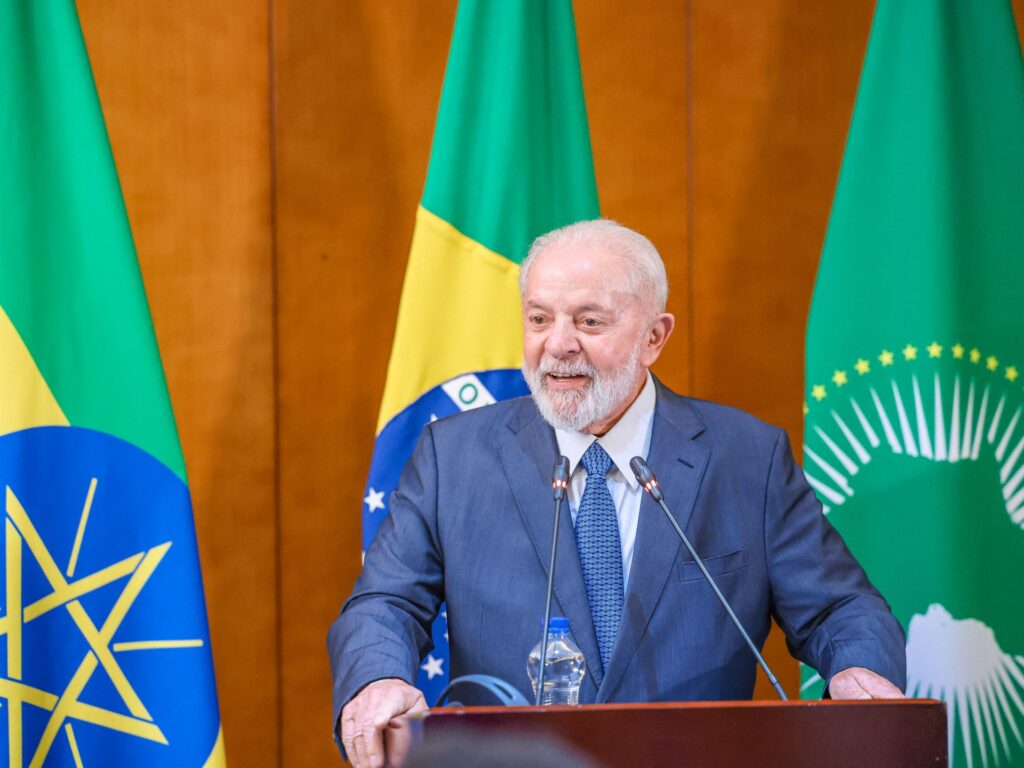
Israeli foreign minister says he will summon Brazil’s ambassador for a reprimand over the remarks which Prime Minister Benjamin Netanyahu described as ‘disgraceful’. Brazilian President Luiz Inacio Lula da Silva has accused Israel of committing “genocide” against Palestinians in the Gaza Strip and compared its war on Gaza with Adolf Hitler’s campaign to exterminate Jewish people. “What’s happening in the Gaza Strip isn’t a war, it’s a genocide,” Lula told reporters in Addis Ababa where he was attending an African Union summit on Sunday. “It’s not a war of soldiers against soldiers. It’s a war between a highly prepared army and women and children,” added the Brazilian president. “What’s happening in the Gaza Strip with the Palestinian people hasn’t happened at any other moment in history. Actually, it has happened: when Hitler decided to kill the Jews.” Led by Hitler, the Nazis systematically killed six million Jews during World War II. Israeli Foreign Minister Israel Katz said he would summon Brazil’s ambassador for a reprimand over the remarks. “No one will compromise Israel’s right to defend itself,” Katz said on X, adding that the envoy would be summoned on Monday. Israeli Prime Minister Benjamin Netanyahu described the comments as “disgraceful and grave”. “This is a trivialisation of the Holocaust and an attempt to attack the Jewish people and the right of Israel to self-defence. Drawing comparisons between Israel and the Nazis and Hitler is to cross a red line,” Netanyahu said in a statement. Lula, 78, had condemned the Hamas-led October 7 attack on southern Israel as a “terrorist” act the day it happened. But he has since grown vocally critical of Israel’s retaliatory military campaign in Gaza. At least 1,139 people were killed in the Hamas-led attack on southern Israel, mostly civilians, according to an Al Jazeera tally of Israeli official figures. Hamas members also took about 250 people captive, 130 of whom are still in Gaza, including 30 who are presumed dead, according to Israeli authorities. Israel’s retaliatory assault on Gaza has killed at least 28,858 people, mostly women and children, according to Palestinian authorities. Lula criticised Western countries’ recent decisions to halt aid to the UN agency for Palestinian refugees, UNRWA, after Israel accused some of its employees of involvement in the Hamas-led attack. Lula, who met with Palestinian Prime Minister Mohammad Shtayyeh Saturday on the sidelines of the summit, has said Brazil will increase its own contribution to the agency and urged other countries to do the same. “When I see the rich world announce that it’s halting its contributions to humanitarian aid for the Palestinians, I just imagine how big these people’s political awareness is and how big the spirit of solidarity in their hearts is,” Lula said. “We need to stop being small when we need to be big.” He reiterated his call for a two-state solution to the conflict, with Palestine “definitively recognised as a full and sovereign state”. Adblock test (Why?)
How bleak is the outlook for Israel’s economy?

Moody’s has lowered Israel’s credit rating for the first time and forecast a negative outlook for the economy. Massive military spending and a drop in revenues. Israel is borrowing heavily to fund its war on Gaza. And it is now on track to run one of its widest budget deficits this century. Worried about the fiscal and political risks, Moody’s has lowered Israel’s credit rating for the first time. The agency has also forecast a negative outlook for the economy. Israel’s finance minister has slammed the decision as a “political manifesto”. But is it? Commercial real estate in the United States is faltering, and banks as far away as Germany are feeling the pain. Plus, the four-day workweek. Adblock test (Why?)
Gaza’s Nasser Hospital ‘completely out of service’ as Israeli attacks mount

The strip’s second-largest hospital in the southern Khan Younis city has many patients and other Palestinians sheltering. Ground and air assaults by the Israeli forces have now rendered Gaza’s second-largest hospital nonoperational. The besieged enclave’s Ministry of Health and the World Health Organization (WHO) on Sunday said the Nasser Hospital in southern Gaza’s Khan Younis is no longer functioning after a weeks-long siege that intensified this week, followed by deadly raids. “There are only four medical staffers currently caring for patients” inside the hospital, ministry spokesperson Ashraf al-Qudra told Reuters news agency on Sunday. In a post on X, WHO chief Tedros Adhanom Ghebreysus said the organisation’s team has not been permitted by the Israeli military to enter the hospital since Friday to assess the condition of critical patients and medical needs, even though they reached the hospital along with partners to deliver fuel. “There are still about 200 patients in the hospital. At least 20 need to be urgently referred to other hospitals to receive health care; medical referral is every patient’s right,” he said, adding that “the cost of delays will be paid by patients’ lives”. Nasser hospital in #Gaza is not functional anymore, after a weeklong siege followed by the ongoing raid. Both yesterday and the day before, the @WHO team was not permitted to enter the hospital to assess the conditions of the patients and critical medical needs, despite… — Tedros Adhanom Ghebreyesus (@DrTedros) February 18, 2024 In the past few days, Israeli soldiers had raided the hospital, where displaced Palestinians were also sheltering. The Health Ministry on Saturday said Israeli forces “arrested a large number of the directors and staff” of the hospital while they were tending to the wounded. On Friday, the ministry said an aid convoy led by the United Nations was detained for seven hours and prevented from reaching the hospital. Meanwhile, al-Amal Hospital, the only other major medical facility still operational in Khan Younis, continues to be a target of Israeli attacks. The Palestine Red Crescent Society (PRCS) on Sunday said Israeli forces targeted the third floor of the hospital with artillery fire. The Israeli military has expanded its siege on Khan Younis and its medical facilities as it pushed further south into Rafah on the border with Egypt. Israeli Prime Minister Benjamin Netanyahu has remained adamant about an imminent ground attack on Rafah, where more than 1.4 million displaced Palestinians have been sheltering, creating a humanitarian crisis. “In the overnight [air] attacks on Rafah, we’ve seen the horror of displaced Palestinians trying to find shelters in the city where they were ordered to evacuate and told it would be a ‘safe zone’ only to find themselves targeted and killed inside their homes,” Al Jazeera’s Hani Mahmoud, reporting from Rafah, said on Sunday. “On top of that, there is a lack of available medical staff and a shortage of medical supplies, which literally leaves people lying on the floors of hospitals for hours, waiting for help. Israel has put restrictions on the delivery of aid worsening the shortage.” The UN, along with the United States and other Israel allies, have said they would not accept an invasion of Rafah but have not discussed what they would do if Israel proceeds with its “total victory” approach. Adblock test (Why?)
Israel’s Netanyahu dismisses calls for early election as thousands protest

Netanyahu has seen his popularity plummet in opinion polls since October 7 attack that sparked the devastating war on Gaza. Israeli Prime Minister Benjamin Netanyahu has rejected calls for an early election as thousands of protesters take to the streets in Tel Aviv and Jerusalem, demanding he step down. Netanyahu has seen his popularity plummet in opinion polls since the October 7 attack that sparked the devastating war on Gaza. Calls for an early vote have been mounting since October when the Palestinian group Hamas launched a rare attack inside Israeli territory, killing some 1,100 people and taking more than 200 others captive, nearly half of whom were released during a brief truce in November. In response, the Israeli military launched unprecedented air and ground strikes on the besieged Gaza Strip, killing nearly 29,000 Palestinians so far and displacing more than 1.4 million people in a campaign many governments have termed a genocide. Antigovernment protests that shook Israel for much of 2023 had largely subsided during the war. Still, demonstrators again took to the streets on Saturday night, calling for new polls, which are not scheduled until 2026. Thousands defied a police ban on large rallies in Tel Aviv as they hit the streets, according to local media, though the crowd was much smaller than last year’s mass protests. “I’d like to say to the government that you’ve had your time, you ruined everything that you can ruin. Now is the time for the people to correct all the things, all the bad things that you’ve done,” said one protester, his head wrapped in an Israeli flag. Calls for early elections have been mounting in Israel since the start of the Gaza war [Leo Correa/AP] A similar protest was held in Jerusalem outside Netanyahu’s official residence, reports said, as anger over the fate of more than 100 captives held by Hamas rises. The protesters said they were furious over Netanyahu declining to send a representative to Egypt’s capital Cairo for talks over ending the Gaza conflict. The United States, Qatar and Egypt have spent weeks trying to broker a ceasefire and captive release, but the talks have been hit by a wide gap between Israel’s and Hamas’s demands. Qatar on Saturday said the talks “have not been progressing as expected”. Hamas has said it would not release all of the remaining captives without Israel ending the war and “lifting the unjust siege” on Gaza. It is also demanding the release of hundreds of Palestinians imprisoned by Israel. Netanyahu has publicly rejected the demands, calling Hamas’s ceasefire call “delusional” and rejecting US and international calls for a pathway to Palestinian statehood. He said he sent a delegation to the talks in Cairo last week at US President Joe Biden’s request but did not see the point in sending them again. “Don’t abandon them to die!” screamed people into giant loudspeakers in Tel Aviv’s so-called Hostage Square. “Look us in the eyes, send Israeli representatives to the Cairo conference and bring the hostages home now,” read a statement from the families of the captives. Netanyahu was asked at a press briefing about calls within his own ruling Likud party to hold an early election after the Gaza war ends. “The last thing we need right now are elections and dealing with elections, since it will immediately divide us,” he said. “We need unity right now.” However, according to a poll by the Israel Democracy Institute, more than two-thirds of Israelis believe the elections, which are not scheduled before 2026, should be held as soon as the war is over. Adblock test (Why?)
Displaced, bombed by Israel, Rafah’s kids seek warmth in hospital coveralls

Rafah, Gaze Strip – Running out of options and solutions, parents in Gaza have resorted to putting their children in the white medical coveralls that were part of COVID-19 PPE kits, in a desperate bid to keep them warm and dry. Gaza’s displaced – many of them having been forced to move multiple times – are suffering in the severe winter cold with little to protect them from the elements other than thin tents at best. For many of the 1.4 million people crammed into Rafah after fleeing other parts of Gaza, the only clothes they own are the ones they are wearing. If these get wet, there is little chance of them drying again in the cold. In some areas, teams are distributing white coveralls left over from the pandemic – they are plastic-lined and hold at least some of the damp at bay. ‘Like an astronaut’ Nour al-Bayouk, 11, in his coveralls, explains that he, his parents and sisters came here from Maan to escape the bombing. “We came here to the [European] hospital to stay in a tent. The tent is very cold and does not protect us from the heavy rain.” When trucks arrived loaded with the white coveralls, he and his sisters rushed to get some. Now, they live in them – day and night. “I’m warm and the water doesn’t get into my clothes,” says Nour. “I have no alternative clothes at all. If my clothes get wet I won’t find anything else to wear. “At first I looked funny and scary. I felt like I looked like a person undergoing an operation, or an astronaut. “I laugh every time I see myself in the car windows.” Now, it has become a familiar sight, as more children do the same. “The hospital is full of cold tents,” says Nour. “I used to have a room with a warm mattress but we left and came here looking for safety. Every day we hear bombing. The tanks haven’t stopped for a single moment.” The tanks briefly seemed to have withdrawn from Maan at one point and Nour’s father tried to go to their house for more clothes. “But the quadcopters shot at them and he was unable to reach the house. That’s why we found these suits as an opportunity to save us from the cold and the rain.” A child in medical coveralls in a bid to survive the severe cold in Gaza [Ruwaida Amer/Al Jazeera] Raeda al-Khair, 35, who is originally from Gaza City in the north, managed to find space for her family in the European Hospital in Rafah in December. They had fled from Khan Younis, where they had been sheltering until the tanks rolled in at the start of December. She says: “We came here with nothing. We thought we would return to our homes. I slept in the hospital corridors on the tiles; the extreme cold exhausted my body and the bodies of my children.” Her husband put up a makeshift tent of plastic sheeting and some hospital blankets in the yard outside the hospital. But the cold has got worse and the family is struggling. “When it is raining, I feel like crying because children are getting sick from the cold. Since the beginning of the displacement, my children have never recovered.” Al-Khair saw one of the nearby families dressing their children in the coveralls and decided to do the same. “She told me it’s lined from the inside and prevents water from entering. It’s a good idea for us as mothers because the children do not have alternative clothes and there is no place to wash or dry them.” Life in the tents is becoming unbearable, she says. “Two mornings ago, my five-year-old daughter, Salma, woke up wet from the rain falling on her. She was shivering so much from the cold. She was very sick and her temperature was high. “I went out to look for this for her as well because there are many sizes and anyone can wear it.” Many children only have one set of clothes and, if they get wet, can take days to dry out. Medical overalls from hospitals help keep them dry [Ruwaida Amer/Al Jazeera] ‘I hope this nightmare will end’ Salem Baris, 55, fled to al-Mawasi with his children and grandchildren, including a total of 10 smaller children who are all in white coveralls. He came to this part of Rafah from Khan Younis when it became too dangerous to remain, he told Al Jazeera. “Suddenly, tanks entered behind Al-Khair Hospital and Al-Aqsa University [in Khan Younis]. I left with my children and grandchildren, more than 10 children with me. “I hadn’t left my house since the beginning of the war, but I was forced to leave because tank shells reached our homes. Clashes were continuing between the army and the resistance and I feared that one of my sons would be injured. “We stood at the checkpoint waiting for permission until the army allowed us to enter. I was holding my grandson as he looked at the tank and was very afraid. All my grandchildren were afraid because, for the first time, they were seeing tanks and soldiers.” Baris took his family to join his cousin who had two tents in Rafah. “We arrived and the children were wet from the rain and very sick. They had such severe colds. I found my cousin had many white uniforms and I made the children wear them. They didn’t like it.” Before the coveralls, Baris said, he had to sit in the sun with the children for hours so their clothes could dry. The nylon coveralls have made things better, he says. “We’re trying to live with the war conditions, but they are very difficult. I hope this nightmare ends and I can go home soon.” Adblock test (Why?)
Hundreds detained at Navalny memorials in Russia

NewsFeed Police in Russia have detained more than 400 people at memorials honouring Alexey Navalny, the staunch Putin critic who authorities say fell unconscious and died on Friday. Published On 18 Feb 202418 Feb 2024 Adblock test (Why?)
Qatar PM: Hamas-Israel talks ‘not very promising’, truce efforts to go on

Talks involving officials from Qatar, Egypt, Israel and the US have so far not yielded a deal for a pause in the Israeli attacks. Qatar’s Prime Minister Sheikh Mohammed bin Abdulrahman Al Thani says his country’s mediation efforts will continue despite an agreement between Israel and Hamas appearing unlikely at the moment as Israel prepares to mount an invasion of Rafah in southern Gaza. The talks, which involved officials from the United States and Egypt, have so far failed to produce results as Hamas and Israel have highly diverging views. “The pattern in the last few days is not really very promising but … we will always remain optimistic and will always remain pushing,” Sheikh Mohammed, who is also the foreign minister of Qatar, playing a key mediator, said at the Munich Security Conference on Saturday. He added that since the scale of this proposed agreement is much larger than the one reached last year, which included a temporary ceasefire and exchange of prisoners, challenges are expected. Al Thani also cited a lag in the “humanitarian part” of the negotiations: Hamas wants Israel to withdraw from Gaza and allow more humanitarian aid into the enclave, but officials in Tel Aviv have called those “delusional demands”. Osama Hamdan, a senior spokesperson for Hamas, told Al Jazeera: “The main point of disagreement is Netanyahu and his games. He is trying not to have any arrangements or agreements. That is clear.” Hamdan added that Hamas chief Ismail Haniyeh had shown a “positive position” towards negotiations and “willingness” to achieve a ceasefire in a statement on Saturday that said the group wants a complete cessation of Israeli attacks on Gaza. Israeli Prime Minister Benjamin Netanyahu on Saturday said a new deal “does not appear very close” while again opposing a two-state solution backed by Tel Aviv’s allies in the West, along with countries in the region. “How can we give recognition to such a state after the massacre of October 7? This would be a reward for terrorism,” he said during a televised address in reference to the Hamas attack that Israel has been retaliating for since. Israeli leaders have remained adamant on their plans to launch a ground invasion of Rafah, the southernmost area in Gaza where more than 1.4 million of the total 2.3 million population has been forcibly displaced, despite international pressure. Israeli attacks continue Israeli forces killed dozens of people on Saturday and Sunday in intense bombings and ground assaults on southern Gaza, according to Al Jazeera journalists reporting from the ground. The Ministry of Health in Gaza has put the death toll since the start of the war at about 29,000 people, with thousands still missing and many injured. However, the US has indicated that it will veto a ceasefire resolution proposed by Algeria in the United Nations Security Council, as US Ambassador to the UN Linda Thomas-Greenfield said in a statement late on Saturday. “Should it come up for a vote as drafted, it will not be adopted,” Thomas-Greenfield said, adding that it “may run counter” to talks between Hamas and Israel. The US has previously used its veto to prevent the UNSC from passing resolutions calling for a ceasefire in Gaza. The International Court of Justice (ICJ) will begin public hearings on the legal consequences of Israel’s occupation of Palestine on Monday. Fifty-two states, a record number, will present their arguments. The UN General Assembly voted to ask the ICJ for an advisory opinion on the occupation in December 2022. This is separate from South Africa’s recent filing against Israel under the genocide convention. Adblock test (Why?)
‘Systematic torture’: To be Palestinian in an Israeli prison

Bethlehem, occupied West Bank – Palestinian organisations are documenting abuses by Israel and its forces in hopes that one day it will be held accountable. Among them is the Palestinian Prisoner’s Society (PPS), which works to support Palestinians in Israeli prisons. Abdullah al-Zaghari, head of PPS, told Al Jazeera there have been even more serious violations of human rights and international standards on the treatment of prisoners these past months. He feels, he added, that the Israeli forces’ transgressions are driven by vengeance against Palestinians since the October 7 attack by the Qassam Brigades – the armed wing of Gaza governing party Hamas – and other armed Palestinian factions on Israeli territory. Since then, Israel has launched a relentless assault on the Gaza Strip, killing more than 28,000 people. In the occupied West Bank and East Jerusalem, it arrested about 7,000 people, sometimes without charges, making the total number of Palestinian prisoners nearly 10,000, adding serious overcrowding to the challenges they face. At least 250 of those taken are children. More than half of these detainees are in administrative detention, meaning Israel will hold them for months without due process or charges. The torture starts right away Hanin al-Masaeed from Bethlehem’s Aida refugee camp was arrested in October 2023 and released as part of the prisoner exchange deals in November. Hanin al-Masaeed, shown here with her mother, was released on November 28 [Courtesy: Ahmad Jabran] She told Al Jazeera that on October 11, Israeli forces raided her home, gathered her family in one room, confiscated her mobile phone, and told her there was a warrant for her. She had assumed the raid was a routine search, an everyday occurrence in Aida. She was taken, blindfolded, in an Israeli police car, accompanied by a female soldier playing Hebrew songs loudly, putting the speaker up next to al-Masaeed’s ear to goad her. Her hands were tightly bound for four hours. After four days at the detention centre at Sharon prison, where female guards beat the prisoners, took away their blankets and mattresses at 6am, and gave them only one meal a day, she was transferred to Damon Prison. Al-Zaghari told Al Jazeera that testimonies from released prisoners reveal beatings, insults, and threats of rape. He added that the arrest of Palestinian women and girls has increased and that they face torture, ill-treatment, and intentional neglect. Beaten brutally Jaafar Obayat, who recently left Megiddo Prison after 17 years, told Al Jazeera that in the days after October 7, prisoners were assaulted and clothes, necessities, food, blankets, TVs, radios, tables and chairs were confiscated. That prisoners had such items in their cells in the first place was the fruit of struggles by prisoners over decades. [embedded content] In Negev Prison, prisoner Thaer Abu Asab was killed simply for asking a guard if there was a ceasefire, a released prisoner, who requested anonymity, told Al Jazeera. He added that prisoners were beaten in their cells near-daily. When Abu Asab asked his question, the response was an ominous “I’ll show you,” then the guard called a whole unit into Abu Asab’s cell. They beat him with iron rods all over, including his face, and left him lying there. The prisoners were afraid to ask for medical attention, but eventually, unable to watch him suffer, they shouted until a nurse came to examine him. Two days later, they were told he had died. Everyone in Abu Asab’s cell, the anonymous prisoner said, was beaten with iron rods after that. The PPS has recorded thousands of injuries – fractures, bruises and worse – among imprisoned Palestinians who get no treatment. Eight prisoners have died in the last four months after being beaten and not treated, like Mohammed al-Sabar, who died in Ofer prison on February 8. Catastrophic conditions, humiliation The significant overcrowding, lack of hygiene, hunger, and cold have led to diseases spreading among prisoners. Jameel al-Draawi from al-Obeidiyah east of Bethlehem, who was released on January 11 after 18 years of detention, said the assaults, deprivations, and denial of medical care have made life unbearable for the prisoners. Prisoners with chronic diseases, he added, were already neglected before the war but prison authorities then stopped their medications and treatment. Mobility aids and other medical devices were also taken away. In prison, prisoners cannot shower and often have to wash their clothes and put them on wet because their other clothes have been confiscated, which spreads disease. Their cells are overcrowded, prisoners sleep on the floor without blankets. PPS has also pointed out that Israeli prison authorities give prisoners nethier enough nor properly prepared food. Israeli authorities have also started making Palestinians strip for transport and assign them numbers instead of names in an attempt to humiliate them – Israeli soldiers even circulate videos of themselves assaulting prisoners. A placard placed in front of the ICRC office by Palestinian protesters, who accuse the ICRC of ‘not standing to its responsibility toward … Palestinian prisoners and the severe aggression against them’, Ramallah, October 26, 2023 [Nasser Nasser/AP Photo] PPS also documented attacks in which special units entered prisoner’s cells to assault prisoners and trample on their heads. In one instance, prisoners were forced to the ground and female recruits were told to step on their heads. Former prisoner Kamal Abu Arab said, “The occupation does not respect our humanity, and the prisoners feel forgotten. No one mentions them; no visits from lawyers, no visits from the Red Cross. “News is prohibited, prayers and the call to prayer are prohibited, medical treatments are prohibited, and requests are prohibited. According to the administration of the prison service, we have no rights as humans. “Does anyone remember us in this world?” Since October 7, prison visits by the Red Cross to prisons in Israel have been stopped, suspending accountability. The organisation would visit each prison at least once a month, and used to be officially notified by Israel’s prison service of all arrests. This allowed the Red Cross to inform the
Sebastiao Salgado: From stark realities to vivid conversation

A look inside the acclaimed photographer’s black and white journey from human resilience to natural conservation. Sebastiao Salgado’s photography, initially rooted in news, evolved into a profound documentary-style work that captures human and environmental narratives. His work spans from the raw realities of Brazil’s Mina Pelada goldmines, African famines, and the Rwandan genocide to the beauty and urgency of conservation and the lives of indigenous communities. Salgado’s lens reveals the depth of human resilience, fragility, and the natural world, transforming his images into more than documentation but a testament to the human soul and Earth’s imperative beauty. We explore his journey as photographer Sebastiao Salgado talks to Al Jazeera. Adblock test (Why?)
US ‘strongly condemns’ violence in DR Congo after alleged drone attack

State Department says escalating violence poses risk to millions of people facing displacement and deprivation. The United States has condemned growing violence in the Democratic Republic of the Congo (DRC), blaming an armed group it says is backed by neighbouring Rwanda. Fighting has flared in recent days in the eastern part of the DRC between the M23 rebel group and government forces, resulting in dozens of soldiers and civilians being killed or wounded. The fighting has also pushed tens of thousands of civilians to flee towards the eastern city of Goma, which is located between Lake Kivu and the border with Rwanda. “This escalation has increased the risk to millions of people already exposed to human rights abuses including displacement, deprivation, and attacks,” US State Department spokesman Matthew Miller said in a statement. “The United States condemns Rwanda’s support for the M23 armed group and calls on Rwanda to immediately withdraw all Rwanda Defense Force personnel from the DRC and remove its surface-to-air missile systems, which threaten the lives of civilians, UN and other regional peacekeepers, humanitarian actors, and commercial flights in eastern DRC,” Miller added. On Saturday, the DRC accused Rwanda of carrying out a drone attack which damaged a civilian aircraft at the airport in Goma. “It had obviously come from the Rwandan territory, violating the territorial integrity of the Democratic Republic of the Congo,” Lieutenant-Colonel Guillaume Ndjike Kaito said in a video broadcast. The DRC, the United Nations and Western countries have accused Rwanda of backing the rebels in a bid to control vast mineral resources, which Kigali has denied. South Africa said on Wednesday it would send 2,900 troops to support the DRC’s forces against the armed group. The DRC has for decades been at war with many rebel groups that emerged in its resource-rich eastern region in the aftermath of the Rwandan genocide. M23, which broke away from the DRC army in 2012, says it is fighting in defence of ethnic Congolese Tutsis who face tribal discrimination in the DRC. Adblock test (Why?)