

Could a Southern African military force help bring stability to DRC?

South Africa is deploying thousands of troops to the Democratic Republic of Congo (DRC) to help the country resist rebel attacks which are driving one of Africa’s most serious humanitarian crises. On Thursday, the South African military said two of its soldiers had been killed and three wounded by a mortar bomb that landed inside a military base. “As a result of this indirect fire, the SANDF [South African National Defence Force] suffered two fatalities and three members sustained injuries. The injured were taken to the nearest hospital in Goma for medical attention,” it said in a statement. In the past week, fighting between DRC armed forces and the M23 rebel group has forced thousands of people to pack up what belongings they can carry and flee – often on foot – to safer areas such as the regional capital, Goma, even though the rebels are closing in on the city. On Wednesday, the South African government said that 2,900 SANDF soldiers were being mobilised for its part in a regional push by the South African Development Community (SADC) to support DRC’s forces against the armed group. The new effort comes after a separate regional military mission to combat the M23 by East African countries, which the DRC government perceived as a failure and which ended last year. However, speculation remains as to whether the South African soldiers will be able to make any more progress than their East African counterparts did. People fleeing the ongoing conflict between DRC government forces and M23 rebels reach the outskirts of the eastern city of Goma on February 7, 2024 [Moses Sawasawa/AP] Here’s a breakdown of what’s happening in DRC and how SADC might perform. What is the conflict in the DRC over? The DRC has been fighting a host of rebel groups in its resource-rich eastern region – around 100 of them in all – for decades, following regional wars in the 1990s that erupted as Rwanda pursued genocidaires responsible for the 1994 mass killings of Tutsis into Congolese territory. Most of the groups are seeking control over natural resources like cobalt and copper, both of which are materials crucial for manufacturing electronics. Among them is the fearsome M23 group – or the March 23 Movement, named after a March 23, 2009 peace treaty that integrated a precursor armed group (the National Congress for the Defense of the People, or CNDP) into the Congolese army. M23 rebels broke away from the army in 2012. It operates in the hills close to the Rwandan border and says it is fighting in defence of ethnic Congolese Tutsis who, it claims, face tribal discrimination in the DRC. The United Nations and the DRC, however, say the group is being funded by Rwanda to control Kinshasa’s minerals, causing a serious diplomatic rift in the region. The armed group went quiet after it was pushed out of DRC in 2013, but resurfaced again in 2021, possibly because of renewed Rwandan support. In March 2022, M23 launched a major bombing and heavy artillery offensive against army forces and any civilians caught in their way. Since then, the violence in the volatile eastern DRC has only worsened, with fighting continuing through general elections in December which saw President Felix Tshisekedi sworn in for a second term. M23 fighters have also seized at least four towns in the eastern North Kivu province, and are advancing towards Goma, the provincial capital which is home to two million people. Last week, M23 fighters attempted to take Sake, a strategic town 25km (16 miles) from Goma. On Tuesday, a local official told AFP that the rebels are now occupying a part of Sake, while government forces remain in the other areas of the town. The humanitarian toll of the fighting has been severe: Dozens have died and thousands have been displaced by the violence this year alone, adding to a previously displaced population of 2.4 million in North Kivu, and a combined seven million uprooted during various conflicts across the DRC. Many of the displaced are living in informal, makeshift camps where there is little food or protection. Many say they suffer from hunger and aid organisations are struggling to reach those in need. “Just getting sufficient food to eat is a major challenge for people with all roads to Goma having been cut off by the fighting,” Eric Batonon of the Norwegian Refugee Council told reporters on Thursday. Why have military interventions failed to reign in the rebels? Two separate military missions have attempted to support the Congolese forces, but have now pulled out of the country or are in the process of doing so, seen as failures by the government and the Congolese people. Troops from the regional economic bloc, the East African Community (EAC) which the DRC is part of, were deployed in July 2022. The aim of the 12,000-strong force, led by Kenya, was to see a 2022 ceasefire arrangement through and ensure the withdrawal of multiple rebel groups from eastern DRC, including M23. However, the mandate was interpreted differently by both sides. While the Congolese government pressed for more offensive action from the troops, and demanded that EAC troops attack and push back M23 rebels, the soldiers mostly operated defensively. In the early days of their deployment, the troops did force some militia groups out of the area, but new offensives since then by M23 fighters have seen those gains reversed. When the EAC forces mandate expired in December 2023, Kinshasa refused to renew it. Separately, a UN peacekeeping force, MONUSCO (the United Nations Organization Stabilization Mission in the Democratic Republic of the Congo), has been present in the DRC for more than 25 years. Its 13,500-strong force was supposed to help quell insecurity in the region but has become deeply unpopular in recent years due to its inability to hold back rebel groups. Congolese have questioned why the force has not protected them from the M23 and other violent rebel groups, and those frustrations have spurred
‘He was nameless’: Orphaned children lose family, identity in Gaza

Khan Younis, Gaza – Lying on a bed at the European Hospital in southern Gaza, hidden behind bandages that enveloped his disfigured face, five-year-old Ahmed Abu Zariaan remained unidentified for more than a week. The injured boy was one of a growing number of children in the war-torn enclave to be registered as “unknown”, or under the acronym WCNSF – wounded child, no surviving family. Ahmed’s family was wiped out in an Israeli air raid as they travelled southwards along Salah al-Din Street, a route Israel designated for safe passage from northern Gaza, in early November. Heeding the Israeli army’s order for residents in the northern part of the enclave to evacuate to the south, the family of five left Beit Hanoon on a donkey cart and headed for Rafah, on the border with Egypt. A strike targeting a nearby house along the way killed the whole family but spared the five-year-old. Nour Lafi, a 28-year-old nurse at the European Hospital, said the boy was in intensive care for two weeks after sustaining severe injuries and burns. “His face was not visible at all and no one recognised him. He was nameless,” she said. “None of his family were there. I could hear him moaning in pain. We tried to talk to him, but he wouldn’t say a word.” Doctors examine an injured child brought to Al-Aqsa Martyrs Hospital after an Israeli attack on the Maghazi refugee camp in Deir el-Balah on December 6, 2023 [Doaa Albaz/Anadolu via Getty Images] The boy was recognised 10 days later by his grandmother. UNICEF, the UN agency for the protection of children, estimates that at least 17,000 children in the Gaza Strip are unaccompanied or have been separated from their immediate relatives since the beginning of the conflict on October 7 – about 1 percent of the overall displaced population of 1.7 million people. In Gaza, where Israel’s brutal war has passed the four-month mark, parents have long resorted to writing their children’s names on their bodies so they can be identified if killed or injured. When no indication of their identity is immediately available, hospitals send out alerts on social media networks in the hope that relatives come forward. Yet, sometimes a child’s injuries are so severe that their own families would struggle to recognise them. In the course of the conflict, NGO Save the Children found, more than 10 children a day lose one or both of their legs. ‘Missiles destroy people outside and inside’ Samira Abu Zariaan, 60, is still in shock that her daughter was killed but she has taken on caring for her grandson, whose physical and psychological wounds are life-altering. [embedded content] “His emotional state is still very difficult,” Samira told Al Jazeera. “He hasn’t talked much. His voice trembles with fear. He’s scared of any sounds near him.” Ahmed has asked about his mother, but Samira could not bring herself to tell him the truth. “He doesn’t know she was killed. I told him she’s injured and needs to rest.” “I don’t know how Ahmed will overcome his shock. These missiles destroy people outside and inside,” she said. “He turned from a cheerful, impish, chattering child to a silent, still child.” The UN estimates that some 40 percent of the people in Gaza have lost their identification cards and other documents, making it harder to identify unaccompanied children and reunite them with their families. “Forced separation exposes children to various dangers and heightened risks of exploitation, neglect, and abuse,” Ammar Ammar, spokesperson for UNICEF, told Al Jazeera. A 2022 assessment by Save the Children found that the psychosocial well-being of children in Gaza had reached alarming levels due to protracted conflicts, a global pandemic and a crippling blockade. The needs are now “unimaginable”, Soraya Ali, a regional spokesperson at Save the Children, told Al Jazeera. “Children have an increased sense of anxiety and depression after going through conflict and this leads to long-term consequences.” Injured children often have to deal with the loss of their families as well as the pain of their wounds. Pictured here is a child at the Kuwaiti Hospital after an Israeli attack on al-Ghoul family home in Tal as-Sultan, Rafah on January 25, 2024 [Doaa Albaz/Anadolu] By UNICEF’s estimate, about 500,000 children were already in need of mental health and psychosocial support in Gaza before the assault began. Today, it estimates that the number has doubled to more than one million children – as a result of what it describes as “a war on children” that has made the Gaza Strip is the most dangerous place in the world to be a child. More than 28,000 people have been killed, including more than 12,000 children, during Israel’s war on Gaza. Life-threatening shortages As children face a mental health crisis, critical medical and food supplies remain largely unable to enter Gaza. Aid convoys carrying lifesaving supplies have come under fire from Israeli forces, despite being clearly labelled. According to the latest UN assessments, 13 out of Gaza’s 36 hospitals remain partially functional, operating at several times their capacity while facing critical shortages of basic supplies and fuel. Humanitarian organisations have called for an end to the hostilities to allow the humanitarian aid trickling in to be scaled up. “UNICEF can scale up its support, but we urgently need full access to communities and families to properly identify, register, provide temporary care arrangements and conduct family tracing and reunification services for children,” Ammar said. “An immediate and long-lasting ceasefire is the only way to end the killing, injuring and separation of children and their families.” Save the Children has also been calling for a permanent ceasefire, Ali said, “so that we can go into Gaza and start providing the mental and psychosocial support that is desperately needed”. (Federica Marsi reported from Italy for this article.) [embedded content] Adblock test (Why?)
One person killed in shooting at Kansas City Super Bowl victory parade

One person was killed and children were among the 21 injured after a mass shooting at the Kansas City Chiefs’ Super Bowl victory parade triggered panic among huge crowds of fans. Shots rang out on Wednesday in Kansas City in the United States moments after jubilant Chiefs players addressed a vast, cheering crowd, sending shocked fans fleeing in a tragic end to what had been a joyous morning of celebrating the NFL champions. Police said three people had been taken into custody after the attack near Union Station, but the motive behind the shooting was still under investigation. Fire department chief Ross Grundyson told a news conference that many of the victims had suffered “life-threatening injuries”. A local DJ, Lisa Lopez, was killed in the assault, her radio station said. The authorities said more than one million people were expected for the parade, which was held in unseasonably sunny, warm conditions in central Kansas City. Mass shootings are common in the US, where there are more guns than people and about a third of adults own a firearm. The attack in Kansas City was not the only shooting to grab national headlines on Wednesday. Four students were also shot outside a high school in Atlanta, while three police officers were shot during a standoff in the national capital Washington, DC. All are expected to survive, according to media reports. The shootings came six years to the day after 17 people were killed in an attack at a high school in Parkland, Florida. Polls show a majority of Americans favour stricter gun regulations, but the powerful firearms lobby and mobilised voters supporting the country’s culture of strong gun rights have repeatedly stymied lawmakers from acting. The Chiefs were celebrating their third Super Bowl title in five seasons after beating the San Francisco 49ers in Las Vegas on Sunday. Adblock test (Why?)
UK economy slips into recession, official data shows

Britain’s gross domestic product shrank by 0.3 percent in the last three months of 2023, after contracting 0.1 percent in the third quarter. The United Kingdom slipped into a technical recession in the second half of last year after its economy registered two consecutive quarters of negative economic growth, official figures have shown. The Office for National Statistics (ONS) said in a statement on Thursday that Britain’s gross domestic product (GDP) shrank by 0.3 percent in the last three months of 2023, after contracting 0.1 percent in the third quarter. A technical recession is commonly defined as back-to-back quarters of contracting GDP. Sterling weakened moderately against the United States dollar and the euro shortly after the GDP data release. The ONS said the fall in GDP in the fourth quarter of 2023 was the biggest since the first three months of 2021. A Reuters poll of economists had pointed to a smaller 0.1 percent fall in the October-to-December period. Economic output dropped by 0.1 percent in monthly terms in December, after 0.2 percent growth in November, the ONS said. The Reuters poll had pointed to a 0.2 percent fall in December. Britain’s economy has been stagnating for nearly two years. The Bank of England has said it expects it to pick up slightly in 2024, but slow growth this year would still represent a difficult backdrop for Prime Minister Rishi Sunak’s attempts to woo voters ahead of a national election expected later in 2024. “Businesses were already under no illusion about the difficulties they face, and this news will no doubt ring alarm bells for government,” said Alex Veitch, director of policy and insight at the British Chambers of Commerce. “The chancellor must use his budget in just under three weeks’ time to set out a clear pathway for firms and the economy to grow.” Finance Minister Jeremy Hunt said there were “signs the British economy is turning a corner” and “we must stick to the plan – cutting taxes on work and business to build a stronger economy”. Media reports said Hunt was seeking to cut billions of pounds from public spending plans to fund pre-election tax cuts in his March 6 budget, if penned in by tight finances. Adblock test (Why?)
North Korea’s Kim Jong Un oversees test of new surface-to-sea missiles
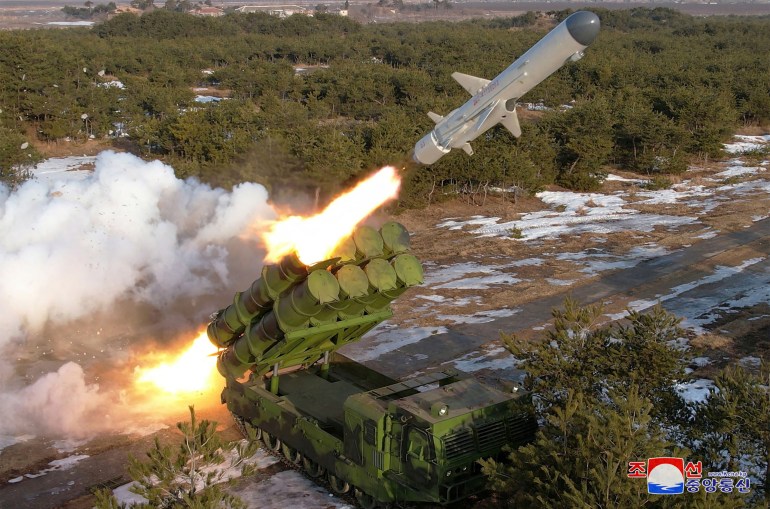
Kim also ordered the North Korean military to boost its readiness near the western maritime border with South Korea. North Korean leader Kim Jong Un has overseen the test of new surface-to-sea missiles, according to state media, while ordering his military to strengthen its readiness in disputed waters north of the South Korean border island of Yeonpyeong. The report on the launches by the Korean Central News Agency (KCNA) on Thursday came a day after South Korea’s military said North Korea had fired multiple cruise missiles in waters off its eastern port of Wonsan. The test was Pyongyang’s sixth missile launch event of the year. The KCNA report said Kim supervised the “evaluation test-fire of new-type surface-to-sea missile Padasuri-6 to be equipped by the navy”, and expressed “great satisfaction over the results of the test-fire”. The missiles hit their intended targets after flying over the East Sea for 1,400 seconds, it said. The East Sea is known as the Sea of Japan internationally. Kim also accused South Korea of frequently violating his country’s sovereignty by insisting on a “Northern Limit Line” (NLL), the maritime demarcation line between the two Koreas, and conducting maritime patrols and inter-diction of third-party ships, according to the KCNA. The North Korean leader also gave orders to his military to strengthen its readiness in the waters north of Yeonpyeong Island and to the west of the Korean peninsula, in the region of the NLL. Waters near the NLL, which was drawn up by the United States-led United Nations Command at the end of the Korean War in 1953, have been the site of previous clashes between the two Koreas. In 2010, North Korea torpedoed a South Korean warship in the Yellow Sea, killing 46 Sailors, and fired a barrage of artillery shells at Yeonpyeong Island, killing four others. According to the KCNA, Kim referred to the de facto border as a “ghost one without any ground in the light of international law”. “It doesn’t matter how many lines exist in [North Korea’s] western sea, and what’s clear is that if the enemy violates what we consider as our maritime border lines, we will take that as a violation of our sovereignty and an armed provocation,” he was quoted as saying. Kim also pledged that Pyongyang would “thoroughly defend our maritime sovereignty by force of arms and actions, not by any rhetoric”. The Padasuri-6 missile being fired towards the Sea of Japan [KCNA via KNS and AFP] Earlier this year, the North Korean leader told his country’s rubber-stamp parliament that he would no longer recognise the NLL, and declared that Pyongyang was abandoning its longstanding goal of reconciliation with Seoul. He also said that if South Korea “violates even 0.001 millimetre of our territorial land, air and waters, it will be considered a war provocation”. In a separate report, KCNA said Kim also inspected a “major” munitions factory and learned in detail about the modernisation of production. During the visit, he stressed the factory’s role in bolstering North Korea’s armed forces and laid out tasks to improve the quality of munitions and increase production as “required by the prevailing situation and the developing revolution”, KCNA said. Kim’s visit to the munitions factory comes as the US and its allies have accused North Korea of trading arms with Russia. The White House said last month that Russia had recently used short-range ballistic missiles (SRBMs) sourced from North Korea to conduct strikes against Ukraine, citing newly declassified intelligence. Adblock test (Why?)
Russia-Ukraine war: List of key events, day 723
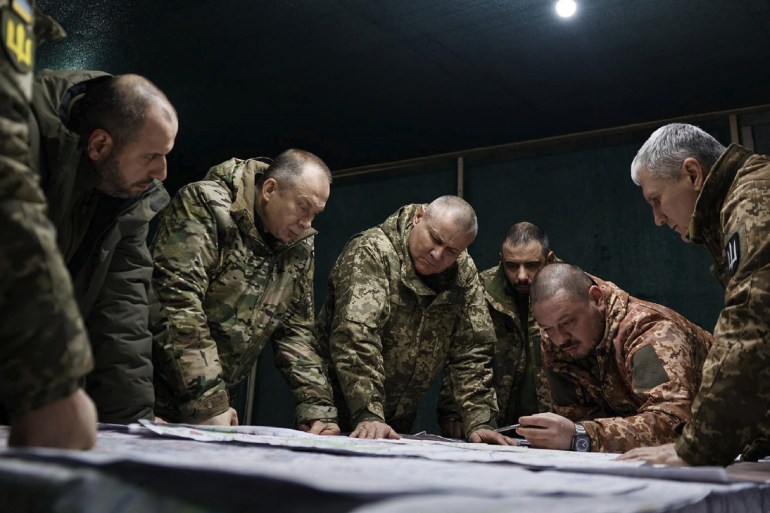
As the war enters its 723rd day, these are the main developments. Here is the situation on Thursday, February 15, 2024. Fighting Ukraine said it critically damaged the Caesar Kunikov, a Russian landing warship, off occupied Crimea, in a drone attack, the latest blow to the Russian navy’s Black Sea Fleet. Ukraine said the ship, one of Russia’s newest vessels, had a crew of 87 and had taken part in wars in Georgia and Syria as well as Ukraine. There was no official comment from Russia on the attack. Newly-appointed Ukrainian armed forces chief Oleksandr Syrskyii visited troops fighting around the key flashpoint of Avdiivka on the eastern front line, and described the situation as “extremely complex and stressful”. Syrskyii, who was accompanied by Defence Minister Rustem Umerov, said Russian forces had “a numerical advantage in personnel”. At least three people, including a child, were killed and a dozen injured in a wave of Russian missile attacks on the town of Selydove in Ukraine’s eastern Donetsk region. Officials said a hospital and several apartments were damaged. At least two people were killed and four injured after a Russian S-300 missile hit an apartment block in a village in the northeastern Kharkiv region, police said. One woman was injured after a Ukrainian drone attack on Russia’s Belgorod and Voronezh regions and over the Black Sea. Russia’s Ministry of Defence said air defence systems destroyed nine drones, six of them over the Black Sea. Politics and diplomacy US President Joe Biden and top officials urged Republican House Speaker Mike Johnson for a vote on a bill that would provide $61bn in crucial assistance to Ukraine but is opposed by Donald Trump, the likely Republican candidate in November’s election in the United States. The Senate backed the bill, which also includes assistance for Israel and Taiwan, earlier this week. NATO Secretary-General Jens Stoltenberg also urged US lawmakers to pass the bill. “This is not charity. This is an investment in our own security,” Stoltenberg said. Commander-in-Chief of the Armed Forces of Ukraine Oleksandr Syrskyii, second from left, and Ukraine’s Defence Minister Rustem Umerov, left, on a visit to front-line positions in eastern Ukraine [Armed Forces of Ukraine/Handout via AFP] British Foreign Secretary David Cameron also urged members of the US Congress to “do the right thing” and approve a Ukraine aid package. Russian President Vladimir Putin signed a law allowing authorities to confiscate the assets of people convicted of spreading “deliberately false information” about the military. A Russian military court sentenced Zhumagul Kurbanova, a woman in her 60s, to 10 years in a penal colony after finding her guilty of setting fire to a military recruitment centre in St Petersburg in August 2023. Estonia, Latvia and Lithuania issued diplomatic protests to Moscow after Russian police put leading Baltic politicians, including Estonian Prime Minister Kaja Kallas, on a wanted list over the destruction of Soviet-era monuments. The three Baltic states were once part of the Soviet Union but are now members of the European Union and NATO. Weapons Dutch Defence Minister Kajsa Ollongren told the Reuters news agency the Netherlands was joining a military coalition with allies including the United Kingdom to supply Ukraine with advanced drone technology and bolster its offensive capabilities. Canadian Defence Minister Bill Blair said Canada would donate $44m to Ukraine to help in its war with Russia. Adblock test (Why?)
What are electoral bonds, the secret donations powering Modi’s BJP?

A mysterious source of electoral funding, which has generated hundreds of millions of dollars in revenues for the ruling Bharatiya Janata Party (BJP), is under scrutiny in India after the country’s top court found in November that they “put a premium on opacity” and can be “misused for money laundering”. On Thursday, the Supreme Court will announce its verdict on an ongoing petition calling for electoral bonds, which have become a major source of funding for political parties in India – and especially the BJP – to be banned. What the court rules could fundamentally determine how India’s coming general elections, between March and May, are fought; how much of a role untraced money plays in it; and who has the resources to dominate the political landscape. Under the electoral bond system introduced by Prime Minister Narendra Modi’s government in 2018, these bonds must be bought from the State Bank of India but can be donated to parties anonymously. While donors using electoral bonds are technically anonymous, however, the State Bank of India is publicly owned, meaning the ruling party has access to its data. This is likely to dissuade large donors from using electoral bonds to donate to opposition parties, critics have said. Furthermore, in 2017, India’s central bank, the Reserve Bank of India, cautioned the Modi government that the bonds could be misused by shell companies to “facilitate money laundering”. In 2019, the country’s Election Commission described the system as “a retrograde step as far as transparency of donations is concerned”. Since 2018, secret donors have given nearly 16,000 crore Indian rupees (more than $1.9bn) to political parties through these bonds. Between 2018 and March 2022 – the period analysed by the Association for Democratic Reforms (ADR), a nongovernment organisation – 57 percent of donations via electoral bonds (about $600m) went to Modi’s BJP. As India prepares for more than 900 million voters to go to the polls to elect a new government between March and May, these funds have allowed the BJP to transform itself into a dominant electoral machine. From financing tens of thousands of WhatsApp groups promoting its agenda to paying for the block-booking of private jets, electoral bonds have provided the BJP with a massive injection of resources, which give it a clear edge over its rivals. How do electoral bonds work and why are they being criticised as “undemocratic”? What are electoral bonds? Electoral bonds (EBs) are “bearer” instruments, like currency notes. They are sold in denominations of 1,000 rupees ($12), 10,000 rupees ($120), 100,000 rupees ($1,200), one million rupees ($12,000) and 10 million rupees ($120,000). They can be purchased by individuals, groups or corporate organisations and donated to the political party of their choice, which can then redeem them, free of interest, after 15 days. While political parties are required to reveal the identities of all donors who donate more than 20,000 rupees ($240) in cash, the names of those donating via electoral bonds never have to be revealed, no matter how large the sum. Since their introduction, EBs have become the primary method of political funding – 56 percent of all funding in Indian politics comes from EBs, according to a report by the ADR. The ability to donate money anonymously has made them extremely popular but is also shrouded in secrecy, which many argue is undemocratic and could provide cover for corruption. When it brought in the new law allowing this type of funding, the Modi government also did away with a number of requirements meant to improve transparency in political funding: A previous law capping corporate donations was abolished, companies were no longer required to disclose their donations in their statements, and foreign companies, hitherto not allowed to fund Indian parties, could now do so through their Indian subsidiaries. “The EB legalises backroom lobbying and unlimited anonymous donations,” said Major General Anil Verma (retired), head of the ADR. The secrecy around the donors’ identity, Verma said, was problematic. “It could be big-time corporations or it could be players funnelling illicit money through shell companies – we don’t know who is donating. This has become what many call legalised and institutionalised corruption.” How do electoral bonds benefit the BJP? The BJP is the single biggest beneficiary of electoral bond donations. Data from the Election Commission of India show that 57 percent of total donations between 2018 and March 2022 through EBs went to the BJP, amounting to 5,271 crore rupees (about $635m). By comparison, the next largest party, the Indian National Congress, received 952 crore rupees (about $115m). EB rules specify that only the publicly owned State Bank of India can sell these bonds. This, many argue, ultimately gives the government of the day unchecked power. “Since the bond is issued by a public sector bank, an unprincipled government might get to know the list of donors and recipients,” former Reserve Bank of India governor and economist Raghuram Rajan wrote in an article for the Times of India last year. “Given the carrots and sticks at the government’s disposal, few individuals or corporations would chance donating large sums to the opposition through these bonds,” Rajan added. EBs have also contributed to the BJP’s electoral dominance. “They might be called electoral bonds, but the rules don’t say that the money must be used only for elections,” said retired Indian Navy commodore Lokesh Batra, who has been spearheading a campaign calling for greater transparency in electoral funding. “So, whoever gets more money, the money can be used to buy up media space, boost advertising. Once you have the money, you can use it anywhere,” he added. The mismatch between the funds received by the BJP and its nearest rival, the Congress, serves to illustrate the unequal playing field that EBs have created, critics say. For instance, in May 2023, the Congress and the BJP squared off against each other in state assembly polls in the southern state of Karnataka. Affidavits filed by both parties with the Election Commission show that the
Sara Duterte-Carpio: Feud puts spotlight on Philippines’ vice president

Manila, Philippines – Sara Duterte-Carpio, the Philippine vice president and the odds-on favourite to succeed President Ferdinand Marcos Jr, has found herself navigating an impossible feud – between the president and her own father. Former President Rodrigo Duterte accused Marcos last month of using drugs and publicly floated the idea of a military coup to unseat the president. Last week, he proposed the secession of Mindanao, a southern island and the base of his political power. Marcos initially responded by saying his predecessor’s judgement had been impaired by his use of the synthetic opioid fentanyl, which he previously admitted to using to recover from a motorcycle accident. He also said the call for a separate Mindanao was “doomed to fail”, and his national security adviser threatened to use force to quell any secession attempts. The ongoing political spat has put Duterte-Carpio in a bind, threatening to unravel the alliance crafted by her and Marcos before they were elected in 2022. She has recently split with the president on several issues, including the government reopening peace talks with communist rebels and an ongoing investigation of her father’s deadly drug war by the International Criminal Court. But the Marcos administration’s effort to change the Philippine constitution has created the biggest cleavage between the country’s two most prominent political families. Marcos says he wants to remove existing constitutional restrictions that limit foreign investment. Critics in the Duterte political camp, however, accuse Marcos of plotting to switch the country to a parliamentary system and install House Speaker Martin Romualdez, Marcos’s cousin and a close ally, as his successor before the next presidential election in 2028. Sara Duterte-Carpio and Marcos Jr during their inauguration ceremony in June 2022 [File: Eloisa Lopez/Reuters] Duterte-Carpio has tried to remain neutral, even as her father’s attacks on the president have continued. She was the only member of the Duterte family to appear with Marcos last week when the president visited flood-hit areas of Mindanao. “She wants to keep the Marcos-Duterte alliance together,” said Walden Bello, an adjunct professor of sociology at the State University of New York at Binghamton and former member of the Philippine House of Representatives. “That sort of political arithmetic was the key in 2022, and that’s going to be key in 2028.” ‘Not just her father’s daughter’ The Marcos-Duterte alliance was formed after Duterte-Carpio shocked the country by opting not to run for president in 2022, even though she was the odds-on favourite. Instead, she defied her father’s wishes and opted to run for vice president and support Marcos’s presidential bid – in the Philippines, the president and vice president are elected separately. Her decision all but ensured the pair would win and prevented an upset victory by opposition candidate Leni Robredo, the former vice president and a vociferous critic of Duterte’s drug war. “It was a perfect marriage for the 2022 election,” said Cleve Arguelles, chief executive of the polling firm WR Numero Research. It was also an early sign of Duterte-Carpio’s autonomy from her father, whom she succeeded as mayor of Davao, the largest city in Mindanao. During her time as mayor, she replaced staffers loyal to her father and forged her own set of alliances, including a bond with Imee Marcos, the current president’s sister. The two remain politically aligned. “She’s not just her father’s daughter,” Arguelles said. Duterte-Carpio also cuts a figure different from many of the country’s past prominent female politicians, who have often cast themselves as maternal figures. As Davao mayor, she made headlines for punching a court sheriff. She often wears military fatigues and has joked about cutting her hair short when she wants to appear tough. After their election win, Duterte-Carpio publicly said she wanted to be named defence secretary – in the Philippines, it is common for the vice president to also take a cabinet position – but Marcos named her education secretary, which was widely seen as a snub. “That was a very quick lesson that, oh, you’re not president,” Arguelles said. “There’s no such thing as sharing presidential powers.” Last year, Duterte-Carpio was heavily criticised for requesting about $11.6m in “confidential funds”, which would be used without oversight, in the 2024 national budget. The controversy pulled down her public approval rating from 84 percent in June 2023 to 73 percent in September – still higher than that of Marcos, who registered 65 percent approval. It also created a perception that Marcos’s allies, especially Speaker Romualdez, were plotting against her. “She’s kind of stuck in this alliance,” Arguelles said. “She can’t totally abandon the administration because she knows it’s going to be fatal.” ‘Double game’ Duterte-Carpio’s father and her younger brother, current Davao Mayor Sebastian Duterte, have continued to pressure the president during speeches in Mindanao – and the country’s economic realities could help their cause. Inflation fell to 2.8 percent in January, down from 3.9 percent in December. Rice inflation, however, hit its highest level since 2009, reaching 22.6 percent and threatening a Marcos campaign promise to stabilise prices of the staple food. The Dutertes “are going to really play that up”, Bello said, using furore over rice prices to give energy to their opposition to changing the constitution, which many presidents – including Duterte – have tried unsuccessfully since it was ratified in 1987. Marcos insists his motivations are economic in nature, aimed at removing limits on foreign ownership in companies operating in the Philippines. But that has not quelled speculation that it is a ploy to block a Duterte-Carpio campaign by switching to a parliamentary system, under which elected representatives would build a coalition and choose a prime minister. “There’s [already] a great deal of foreign investment coming in,” Bello said. While companies have learned to work around the current restrictions, “it’s the corruption and instability that worries them”. “And [constitutional change] is going to create such instability at this point in time,” he said. “It’s really roiled the political scene and focused people on the fight between the Marcoses and Dutertes.” Filipino activists
For foreign firms in Hong Kong, national security plans bring fresh chill

Taipei, Taiwan – As Hong Kong moves forward with controversial new national security legislation, its foreign business community is expressing reservations – albeit quietly – about how new rules concerning “state secrets” could affect the international financial hub’s competitiveness and ease of doing business. Until February 28, the Hong Kong government is canvassing views on its plans to implement “Article 23” of the Chinese territory’s mini constitution, which stipulates the need to ban crimes including treason, secession, sedition, subversion and theft of state secrets. After meeting foreign diplomats and business representatives last week, Justice Secretary Paul Lam reported that “everyone is on the same page” on the need to pass the legislation. Lam said that while some members of the public had “concerns” and “questions,” it would be going too far to say they expressed “worries”. It was not long before Lam’s upbeat characterisation of sentiment began to look misplaced. Hong Kong’s Secretary for Justice Paul Lam has downplayed concerns about the proposed national security law [File: Tyrone Siu/Reuters] In interviews with local media, the heads of the Indonesian and German chambers of commerce said businesses were concerned about how the law would be enforced and whether it would bring the former British colony into further alignment with the Chinese mainland. Speaking anonymously to Bloomberg News, several attendees of the consultation session said officials only answered about four questions and left some of those present unsatisfied. Hong Kong’s proposal, which faces little prospect of opposition in the city’s legislature after an electoral overhaul that effectively barred pro-democracy candidates, builds on sweeping national security legislation imposed by Beijing in 2020, following mass pro-democracy protests that turned violent. Under the Beijing-drafted national security law, Hong Kong’s political opposition, pro-democracy civil society, and independent media have been all but wiped out. “Many senior executives already concerned about the tightening atmosphere in Hong Kong will see the new laws as merely heightening their fears,” Andrew Collier, the founder and managing director of Orient Capital Research in Hong Kong, told Al Jazeera. “Article 23 also is a signal that the Hong Kong domestic politicians, and not just the mainland officials through the NSL, are now focusing on security in order to please Beijing.” Hong Kong’s government appears to be sending the message that political control trumps all else, including the economy – much like in mainland China, Collier said. Hong Kong’s image has suffered successive blows in recent years [Dale DeLa Rey/AFP] For more than two decades after its return to Chinese sovereignty, Hong Kong’s reputation as a business hub was buttressed by a trusted legal system inherited from the British and Western-style civil liberties. That image has suffered successive blows in recent years, from mass unrest and property destruction during the 2019 pro-democracy protests, to Beijing’s security crackdowns and some of the world’s longest-lasting COVID curbs during the pandemic. Even voices known for their bullish views on China have lamented the city’s decline. In an opinion piece in the Financial Times this week, Stephen Roach, the former chairman of Morgan Stanley Asia, declared that “Hong Kong is now over”. “In the spring of 2019 at the onset of the democracy protests, the Hang Seng Index was trading at nearly 30,000,” Roach said, referring to the benchmark index of the city’s stock market. “It is now more than 45 per cent below that level at 15,750. Milton Friedman’s favourite free market has been shackled by the deadweight of autocracy.” A Hong Kong government spokesperson told Al Jazeera that enacting national security legislation is the “inherent right of every sovereign state” and that the government’s proposed definition of state secrets is “in line with international practices”. The spokesperson also said the provisions related to state secrets would “only cover acts committed without lawful authority” and the introduction of a “public interest” defence was under consideration. Hong Kong’s stock market has barely risen from where it was when the city was returned to Chinese sovereignty [File: Anthony Kwan/Getty Images] When Hong Kong was once known for a culture of vigorous protest, public demonstrations against Beijing or city officials were practically unheard of in the post-NSL era. The muted opposition to enacting Article 23 is a sign of the times. In 2003, when Hong Kong’s government last attempted to pass legislation related to Article 23, half a million people took to the streets in the largest protests the city had ever seen. When pro-government broadcaster TVB recently asked members of the public for their opinions on the proposed legislation in a series of street interviews, person after person demurred. Kevin Yam, a senior fellow at Georgetown’s Center for Asian Law and former Hong Kong lawyer who is wanted by city authorities for alleged national security offences, said Article 23 may do to Hong Kong’s economy what the NSL did to civil society. “With the NSL to the extent it affected business, it was more about creating a climate of fear. It was more a vibe. It was more the loss of qualified personnel who chose to leave Hong Kong. It’s more indirect,” Yam told Al Jazeera from Australia, where he lives in exile. “Whereas this time around, if we look at the sorts of things that businesses might need to worry about in terms of implications of these changes, it impacts them much more directly,” Yam said. State secrets Of particular concern for businesses is Article 23’s provisions about state secrets, which some fear will be used to adopt mainland China’s expansive definitions of espionage and hamper companies’ ability to gather and share information as part of routine operations. Observers have noted that the definition of state secrets in Hong Kong’s proposed legislation is nearly identical to the wording in China’s Law on Guarding State Secrets. In mainland China, foreign consulting firms Capvision Partners, Mintz Group and Bain & Company were raided last year as part of a campaign targeting alleged espionage. Beijing has also demonstrated that even the most seemingly minor infractions can have serious consequences,
Experts say billions in US Senate bill would be better spent at home

A number of scholars, politicians and advocates have condemned the United States Senate’s passage this week of a foreign funding bill that would provide billions of dollars in military aid to Ukraine, Israel and Taiwan while American social programmes are in need of funding. It is unclear when – or even if – the House of Representatives will vote on the measure, which includes $9bn in international humanitarian assistance, some of which could go to besieged Palestinians in Gaza. But in passing the $95bn emergency aid package on Tuesday by a margin of 70 to 29, analysts say the Senate articulated Capitol Hill’s longstanding prioritisation of guns over needs for housing, healthcare, education and debt relief. Lindsay Koshgarian, programme director of the National Priorities Project at the Institute for Policy Studies, told Al Jazeera that she had “extreme concerns” about the total amount of the Senate legislation. “At $95bn, it’s a significant increase to the US federal budget and a significant devotion of resources to war,” she said. “There’s huge discrepancies in where the resources are going.” Across social media this week, some observers also denounced the foreign aid bill by invoking a lyric from the late rapper Tupac Shakur: “Got money for war, but can’t feed the poor.” ‘Skewed priorities’ The Senate bill (PDF) provides $60bn in military and economic aid to Ukraine and $14.1bn in security assistance to Israel, among other things. Money for munitions is tantamount to “throwing good money after bad”, according to critics of the legislation. House Speaker Mike Johnson has suggested he won’t allow the aid package to reach the House floor for a vote, as he had demanded immigration reform as part of the legislative package. Since former President Lyndon B Johnson’s administration in the 1960s escalated the war in Vietnam and derailed the War on Poverty programme, the federal government has increasingly squeezed out social spending while devoting larger and larger proportions of its overall budget to militarised programmes. According to a May report by the National Priorities Project, 62 percent of the federal discretionary budget – $1.1 trillion – went to these programmes in the 2023 fiscal year. In contrast, “less than $2 out of every $5 in federal discretionary spending was available to fund investment in people and communities”, including public education, housing, and childcare, among other social programmes. “We must invest in humanity, both at home and abroad. Congress must stop funneling taxpayer dollars into endless wars and invest in the housing, health, education, and social programs our communities need,” Democratic Congresswoman Cori Bush tweeted on Tuesday after the Senate bill was passed. We must invest in humanity, both at home and abroad. Congress must stop funneling taxpayer dollars into endless wars and invest in the housing, health, education, and social programs our communities need. pic.twitter.com/3Fdy9cs4Sc — Congresswoman Cori Bush (@RepCori) February 13, 2024 In particular, the Senate’s decision to funnel more military aid to Israel while it continues to bombard the Gaza Strip has fuelled widespread criticism and raised questions about priorities on Capitol Hill. “In a situation where the International Court of Justice has said that it’s plausible that a genocide could be occurring [in Gaza], the decision by the Senate to approve sending $14bn in weapons to Israel makes the US more directly complicit,” said Mike Merryman-Lotze, Just Peace Global Policy director at the American Friends Service Committee. William Hartung, a senior research fellow at the Quincy Institute for Responsible Statecraft and expert on US military budgets, also said that, overall, “even by Washington standards, $95 billion is a lot of money”. The Senate bill’s passage, Hartung wrote in Forbes on Wednesday, “lays bare the skewed priorities of the federal government”. “Despite deep divisions, it is possible to get bipartisan support for a package that mostly involves funding weapons exports. Don’t expect any such emergency measure to address record levels of homelessness, or aid the one in six American children living in poverty, or accelerate investments in curbing the climate crisis,” he said. A jobs boost? Biden has argued that the bipartisan legislation is critical to US national security interests and sends a clear message that his administration continues to stand by its allies. The bill also will bolster the US economy by creating jobs, according to the president. “While this bill sends military equipment to Ukraine, it spends the money right here in the United States of America in places like Arizona, where the Patriot missiles are built; and Alabama, where the Javelin missiles are built; and Pennsylvania, Ohio and Texas, where artillery shells are made,” Biden said in a White House address on Tuesday. “And the way it works is we supply Ukraine with military equipment from our stockpiles, and then we spend our money replenishing those stockpiles so our military has access to them – stockpiles that are made right here in America by American workers,” he said. “That not only supports American jobs and American communities, it allows us to invest in maintaining and strengthening our own defence manufacturing capacity.” But research has shown that other types of government spending would do more to boost jobs than what one researcher described (PDF) as Washington’s pattern of “feeding one wolf – the militarized economy – to the detriment of others”. Heidi Peltier, senior researcher at the Watson Institute for International and Public Affairs at Brown University and programmes director at the Costs of War project, wrote in a June report that military spending supports 6.1 jobs per $1m spent. By comparison, the report found that healthcare creates 11.6 jobs per $1m – nearly double – while a $1m investment in primary and secondary education creates 21 jobs, more than three times as many. The same investment in wind and solar also would create nine to 14 percent more jobs. Better uses for $95bn According to Koshgarian of the Institute for Policy Studies, there are a multitude of ways $95bn could be better used to support Americans, from funding programmes that tackle child