

Hungarian president resigns after pardoning child sex abuse accomplice

NewsFeed Hungary’s President Katalin Novak bowed to public pressure to resign after it was revealed she pardoned the deputy director of a state-run children’s school who was convicted for covering up the sexual abuse of its director. Published On 11 Feb 202411 Feb 2024 Adblock test (Why?)
Al-Shabab claims attack on UAE military in Somalia

The group claimed the attack as it considers the UAE an ‘enemy’ for backing the Somali government. Three Emirati troops and a Bahraini military officer have been killed in an attack in Somalia. Al-Qaeda-linked armed group Al-Shabab has claimed responsibility for the attack on a training mission at a military base in the Somali capital, Mogadishu, the United Arab Emirates (UAE) authorities said on Sunday. The attack on Saturday targeted troops at the General Gordon military base. Details about the attack and casualties remain scarce. Somali President Hassan Sheikh Mohamud offered his condolences to the UAE. The UAE’s Ministry of Defence announced the death of three of its troops and a Bahraini soldier in a “terrorist act”, adding only that two others were wounded. Anwar Gargash, a senior Emirati diplomat, offered condolences to those killed and a quick recovery for those wounded. “No treacherous act will prevent us from continuing the message of security and safety and combating extremism and terrorism in all its forms,” Gargash wrote on X. Bahrain, an island nation in the Gulf off the coast of Saudi Arabia, did not immediately acknowledge the attack. Al-Shabab claimed the attack in a statement online, alleging it killed multiple people involved in the Emirati military effort. It described the UAE, a federation of seven sheikhdoms on the Arabian Peninsula, as an “enemy” of Islamic law for its backing of the Somali government in battling the armed group. Al-Shabab, or “the youth” in Arabic, was born out of Somalia’s many years of anarchy following a 1991 civil war. The affiliate of al-Qaeda once held Mogadishu. Over time, an African Union (AU)-led force, with the backing of the United States and other countries, pushed the group out of the capital. Since then, al-Shabab has been battling the country’s federal government and the AU-mandated peacekeeping mission as it seeks to establish a new government based on its interpretation of Islamic law. The group routinely carries out bombings in highly densely populated areas across the country. On Tuesday, at least 10 people were killed and about 20 were injured in multiple attacks in a crowded market in Mogadishu. Al-Shabab has carried out attacks in neighbouring Kenya as well since Nairobi provides troops and materiel to the AU force in the country. The UAE in recent years has increasingly invested in ports in East Africa, including in Somalia’s breakaway Somaliland region. Securing Somalia fits into the Emirates’ wider concerns about security in the Gulf of Aden and the Arabian Sea. Somali piracy has recently resumed after several years amid the attacks by Yemen’s Houthi rebels on shipping in the Red Sea. In 2019, al-Shabab claimed an attack that killed a man working for Dubai’s P&O Ports. Adblock test (Why?)
Why is the US economy so resilient?

The US economy is on a tear, and it has pulled far ahead of the rest of the world. Geopolitical tensions, the pandemic’s lingering aftershocks, high inflation and steep borrowing costs. Countries across the globe have faced multiple crises for months. And just last year, the world’s biggest economy, the United States, was at risk of recession. Today, its gross domestic product is growing faster than expected. Stocks are soaring. And the job market is hot. The US economy is not just strong. It has also powered ahead of the European Union, the United Kingdom, Japan and other advanced economies. Why are farmers across Europe protesting? Plus, North Korea looks to false eyelashes to shore up its economy. Adblock test (Why?)
White House condemns Trump’s ‘unhinged’ NATO comments

The frontrunner for the Republican nomination shows no signs of easing hostile stance towards military alliance. The White House has condemned Donald Trump’s comments suggesting the United States should not help NATO protect allies from a potential Russian attack as “unhinged”. The former United States president, who appeared to be talking about a previous meeting with NATO leaders during his latest political rally in South Carolina on Saturday, claimed he had spoken with the president of “a big country” about allies rushing to defend each other. “Well sir if we don’t pay, and we’re attacked by Russia – will you protect us?” he recounted the leader as saying. “I said: ‘You didn’t pay? You’re delinquent?’ He said: ‘Yes, let’s say that happened.’ No, I would not protect you. In fact, I would encourage them to do whatever the hell they want. You gotta pay.” “Encouraging invasions of our closest allies by murderous regimes is appalling and unhinged – and it endangers American national security, global stability and our economy at home,” said White House spokesperson Andrew Bates. President Joe Biden, who is seeking re-election in November, has empowered the alliance since taking office in 2021, making sure NATO is now “the largest and most vital it has ever been”, Bates added. “Rather than calling for wars and promoting deranged chaos, President Biden will continue to bolster American leadership and stand up for our national security interests – not against them,” he said in a statement. The North Atlantic Treaty Organization (NATO), a military alliance of 29 European and two North American countries, has a provision in its statute that says it must defend any member that is attacked. This is not the first time the frontrunner for the Republican nomination in the upcoming presidential elections has criticised the alliance. When president, Trump threatened to pull the US out of NATO. He also suggested he could cut Washington’s funding of the organisation, and repeatedly complained that the US pays more than it should. With the war in Ukraine showing no signs of stopping, concerns have mounted over the ramifications of a potential Trump victory in November. Kyiv is desperately seeking funding to drive its war effort. The European Union agreed earlier this month to dedicate an additional 50-billion-euro ($54bn) aid package to Ukraine, however, Biden’s bid to win approval for a US aid package is bogged down amid domestic political spats. NATO Secretary-General Jens Stoltenberg last month said he did not believe a second Trump presidency would jeopardise US membership in the military bloc. The official, who has been pushing member states to boost military spending, said European allies were increasing their military contributions and “moving in the right direction”. Since the start of the Ukraine war in February 2022, US aid to Ukraine has totalled around $75bn, according to Stoltenberg, who said other NATO members and partner states combined have provided more than $100bn. Adblock test (Why?)
Q&A: Indonesia’s Prabowo Subianto ‘confident’ of election victory
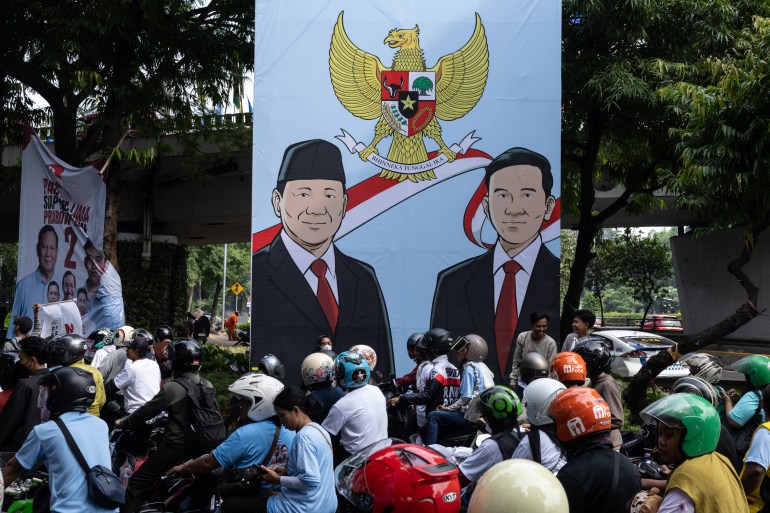
Jakarta, Indonesia – On February 14, more than 204 million Indonesians will have the chance to vote for their new president. Incumbent Joko Widodo is in his second and final term, and is constitutionally barred from seeking re-election. Voters have a choice between three presidential candidates – Anies Baswedan, the former Governor of Jakarta, Ganjar Pranowo, the former Governor of Central Java, and Defence Minister Prabowo Subianto. Multiple polls indicate Prabowo has a comfortable lead over his competitors. Prabowo has tried twice to become Indonesia’s president – and lost both times to Widodo. Since 2019, he has served as defence minister in Widodo’s cabinet. Indonesia’s Defence Minister Prabowo Subianto and vice presidential candidate Gibran Rakabuming Raka are the favourites in Wednesday’s elections [File:Yasuyoshi Chiba/AFP] His running mate is 36-year-old Gibran Raka Bumingraka, the president’s eldest son. But victory is still not a certainty. If no candidate can secure at least 50 percent of the vote, a second round of voting will be held in June. While Prabowo is the most popular candidate, he is also polarising. Decades-old allegations of human rights abuses during his time in the military have been raised by rivals and rights organisations. On the final day of campaigning on Saturday, Prabowo held a rally in the Gelora Bung Karno Stadium in Jakarta, where he addressed thousands of supporters. Backstage, the 72-year-old met with Al Jazeera Asia Correspondent Jessica Washington for an exclusive interview, sharing his thoughts on why young voters have been drawn to his campaign and how he plans to win over critics. Al Jazeera: It’s the last day of campaigning. Are you feeling confident that you can win this election in one round? Prabowo Subianto: All the figures show that way…the grassroots enthusiasm. All the figures show that we will go in one round. Al Jazeera: The enthusiasm of young people has been a key part of the campaign. What is your message to your young supporters? Prabowo Subianto: The young today, they are more rational, they are more critical, they are smarter, they sense what is genuine and what is not genuine. I think they are very concerned about their future, so those that have a good program and good strategy, those that have good commitments, they are the ones that the young can identify with they can support. Al Jazeera: Is there something specific about your campaign that appeals to young people? Because your opponents might say it’s because of the Tiktok dances, the cartoon posters. Is there a specific policy that appeals to young people? Prabowo Subianto: My policies are very rational, logical, with a common-sense approach that is actually building on all the work of our predecessors. Nation-building is not a two year thing, a five-year thing. It’s a period of one generation or two generations. We have to make use and build on everything that has been built by our predecessors. That’s why people of all strata the majority of them get my message and support us. They realise to build something, you must do it based on strong foundation and then build upon success. Brick by brick, stone by stone. Al Jazeera: You obviously have very many supporters but there are also some strong critics. If you win this election, you will be their president too. How will you navigate this? Prabowo Subianto: I will work for the good of Indonesia. Not for a certain segment. I proved this, when the last election, I lost badly in East Nusa Tenggara (NTT) province. But when I became Minister of Defence, I built one of the biggest and best polytechnics there. In the province where I lost. Do you understand? I don’t believe in thinking short-term, thinking small. I like to think big and long-term. Al Jazeera: Thinking big picture, how do you perceive Indonesia’s role on the global stage, if you do become president? Prabowo Subianto: The good luck we inherited from our founding fathers is the philosophy of non-alignment. Indonesia respects all countries, respects all great powers. We want to have great relationships with everybody. We don’t want to be joining one bloc against another bloc. Our position is quite unique. We are friends with everybody. In any conflict or competition, we are the ones who can be accepted by all sides. Al Jazeera: What does Gibran bring to this partnership, in terms of skills and experience? Prabowo Subianto: More than 50 percent of our voters are below the age of 50. The young, are dynamic, savvy, and they are critical. If you notice, the fact there is a vice-president under the age of 40, that’s is normal in many countries in the west. In Indonesia it has become some sort of issue, not because he is under 40 but because he is the son of President Joko Widodo, that makes some circles feel bad. But that’s politics. You cannot please everyone all the time. Al Jazeera: What will Indonesia look like under your presidency? Prabowo Subianto: I hope Indonesia will be dynamic, economically better-off. But most importantly, I want to alleviate poverty. I want to get rid of hunger. I want to get rid of stunting for Indonesian children. The figures are not so good, at least 25 percent of children are stunted, in the outlying areas. But even in West Java, there are children who do not eat well. Al Jazeera: It’s one thing to say they will support you in polls, and to show up at campaign events. It’s a different matter when it comes to actually showing up on February 14 and voting. Do you have any concern about the reliability of your supporters? Prabowo Subianto: From the fervour of my supporters, I think they feel that our team the real hope for them. I am confident they will turn up, they feel they need leaders who can understand their needs, who want to fight for them. I would tell them, use your power, once every five years you have the power in
Qatar defends AFC Asian Cup in historic win against Jordan

Qatar successfully defended their Asian Cup crown after beating Jordan 3-1 on Saturday at Lusail Stadium where Akram Afif converted three penalties as the hosts won their second continental title. Jordan were playing in their first Asian Cup final and seeking their first major trophy, but it was Qatar who prevailed in front of 86,492 fans including Qatar’s ruler Sheikh Tamim bin Hamad Al Thani and FIFA President Gianni Infantino. After Afif opened the score in the 22nd minute with a penalty kick, Jordan’s attack pressed but could not break through until the second half, when in the 67th minute, Yazan Al-Naimat scored the equaliser. Jordan’s relief was short-lived; only a few minutes later, Afif scored his second penalty and eventually sealed things for Qatar when he completed his hat-trick with a third goal from the penalty spot. Afif, who was tossed into the air by his teammates after the final whistle, also picked up the award for player of the match and most valuable player of the tournament. “Scoring penalties is because of the confidence my teammates had in me. It’s not about technique or choosing the angle, it’s the feeling of having my team behind me,” Afif said. Meanwhile, Jordan coach Hussein Ammouta said, “We weren’t focused in the first half and we made mistakes. There were easy opportunities to score but we didn’t. The timing of the two penalties [in the second half] was harsh. “But I want to congratulate the players. They’ve gained confidence and opened horizons for the future. Maybe we can win in future tournaments.” Adblock test (Why?)
Naples, Florida plane crash kills two on US highway; officials investigate

The Bombardier Challenger 600 series jet has crashed on the I-75 highway in US state of Florida. A private passenger jet crash-landed on a busy highway in Florida in the United States and collided with two vehicles on the ground in a fiery accident that killed two people, authorities and witnesses said. Moments before the jet with five people on board slammed into the highway on Friday, the pilot calmly told an airport controller that the aircraft “was not going to make the runway” since it had lost both engines. The jet was bound for the airport in Naples when it tried to make an emergency landing on Interstate 75. But witnesses say it collided with a vehicle – the wing of the plane dragging a car before slamming into a wall. An explosion followed, with flames and black smoke rising from the scene. Two people were killed, according to the Collier County Sheriff’s Office, but it was not immediately known whether the victims had been passengers on the plane or were on the ground. Federal authorities have launched an investigation into the crash near Naples, just north of where the interstate heads east towards Fort Lauderdale along what is known as Alligator Alley. The plane had taken off from an airport at The Ohio State University in Columbus, Ohio, at about 1pm. It was scheduled to land in Naples around the time of the crash, Naples Airport Authority spokesperson Robin King said, when pilot contacted the tower requesting an emergency landing. “Got that. Emergency. Clear to land. Runway. Two. Three,” the air traffic controller responded to the pilot, in audio obtained by The Associated Press. “We’re clear to land, but we’re not gonna make the runway. We’ve lost both engines,” the pilot calmly replied. ‘The wing pulverised a car’ The tower lost contact, and then airport workers saw the smoke from the interstate just a few miles away, King said. King said they sent fire trucks with special foam to the scene, and three of the five people on board were taken from the wreckage alive. Brianna Walker saw the wing of the plane drag the car in front of hers and slam into the wall. “It’s seconds that separated us from the car in front of us,” she said. “The wing pulverised this one car.” Walker and her friend spotted the plane moments before it hit the highway, allowing her friend to pull over before the crash. “The plane was over our heads by inches,” she said. “It took a hard right and skid across the highway.” According to the FlightAware aircraft tracker, the plane was operated by Hop-a-Jet Worldwide Charter based in Fort Lauderdale, Florida. The aircraft had been scheduled to fly back to Fort Lauderdale on Friday afternoon. Federal authorities said a preliminary report about the cause of the crash can be expected in 30 days. Adblock test (Why?)
Who’s going to lead Pakistan’s next government after inconclusive election?

Imran Khan-linked independents win most seats after PTI party banned. The results of Pakistan’s general election are inconclusive – with rival former prime ministers, Imran Khan and Nawaz Sharif, claiming victory. Horsetrading between different parties will now follow to form the next government. So who is likely to lead Pakistan next? And what does the outcome mean for a country with deep political divisions and serious economic problems? Presenter: Adrian Finighan Guests: Zulfi Bukhari – Sdviser on international media and relations to Imran Khan, chairman of the Pakistan Tehreek-e-Insaf Party (PTI) Farzana Shaikh – Associate fellow at the Asia Pacific Programme at the Chatham House think tank Haider Zaman Qureshi – Member of the Central Executive Committee of the Pakistan Peoples Party (PPP) Adblock test (Why?)
Black power and ‘edutainment’: The political roots of hip-hop music
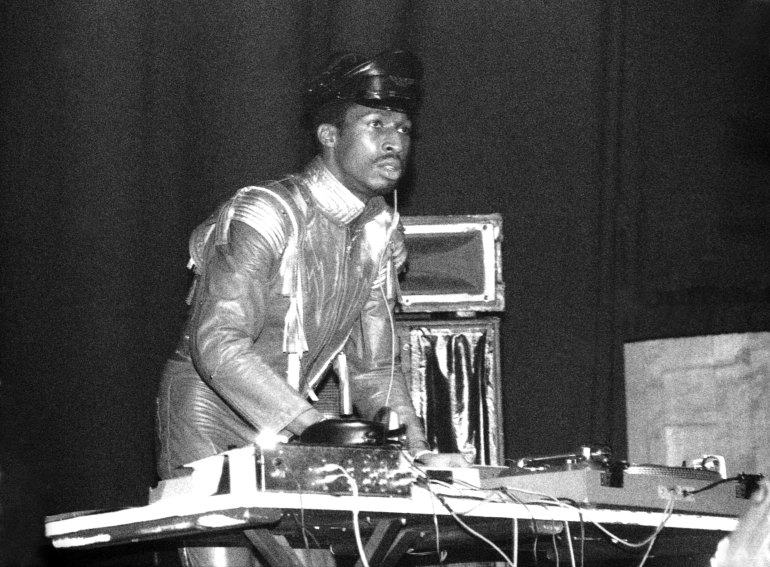
Rats in the front room, roaches in the back Junkies in the alley with a baseball bat I tried to get away but I couldn’t get far ‘Cause the man with the tow truck repossessed my car. It was 1982, and as New York was emerging from one of the worst financial crises in its history, these lyrics by Grandmaster Flash and the Furious Five struck a chord with listeners. The Message, a gritty indictment of the city’s failed institutions, is broadly viewed as the origin of political hip-hop in the US. “You are into the blowback against the civil rights and Black power movements, where people are trying to roll back the gains that were made during that time frame,” political scientist Adolphus Belk, co-author of For the Culture: Hip-Hop and the Fight for Social Justice, told Al Jazeera. The song’s success was intertwined with the rise of Ronald Reagan, who served as US president for most of the 1980s, Belk noted. Reaganomics, the term applied to his neoliberal economic policies, rewarded the managerial class while neglecting society’s most vulnerable communities – disproportionately African Americans and Latinos. The newly created “marginalised class” in the inner cities would be plagued by poverty, bad schools, drugs and gang violence, while arts programmes suffered massive cuts. “So we went from good times to hard times, and the music changed to reflect what was happening in the society,” Belk said. Grandmaster Flash around 1980. His lyrics in The Message resonated strongly during the rise of Reaganomics [David Corio/Michael Ochs Archives via Getty Images] The seeds of hip-hop’s countercultural movement had begun to sprout a decade earlier, in August 1973, when Clive Campbell, better known as DJ Kool Herc, threw a back-to-school party with his sister in the Bronx borough of New York. They needed a musical act, but hiring one would have been prohibitively expensive. Instead, Kool Herc brought out his own sound system and did what he did best, jumping from one record’s break to another with expert timing. “He revolted. He did not want to play the disco music we heard on the radio,” rapper Kurtis Blow said in the Netflix series, Hip-Hop Evolution. “He wanted to give us the music that we grew up on – the soul music. And it was incredible, because in a world of disco, here is this DJ coming out playing this special kind of music. And this was so important to the birth of hip-hop, that we’re going to be playing funk music.” Hip-hop has since grown into a culturally impactful form of artistic expression, gaining millions of fans while tapping into global phenomena. Its addictive beats and powerful political messaging, experts say, have propelled the genre’s broad appeal, from the US to the Global South. This momentum began to build when Rapper’s Delight, released by The Sugarhill Gang in 1979, was credited with introducing hip-hop to an audience outside the five boroughs of New York. Borrowing from the glitzy and fun-filled themes of mainstream music, the song appealed to a wide cross section of music fans, eventually planting itself on popular shows such as American Bandstand and Soul Train. The Sugarhill Gang (L-R: Wonder Mike, Master G and Big Bank Hank), credited with introducing hip-hop to an audience beyond New York, perform live in 1979 [Michael Ochs Archives via Getty Images] Sending a message In the years that followed, spurred on by The Message, a budding movement grew alongside the glamorous world of party hip-hop. Through the late 1980s and early 90s, Afrocentricity and Black consciousness started to permeate the culture, Belk noted. In 1989, artist KRS-One – who popularised the term “edutainment” to describe the use of social commentary via hip-hop music – co-founded a movement called Stop the Violence. Its goal was to address the pervasive violence in Black communities. The movement released a single titled Self Destruction, accompanied by a music video that delivered anti-violence messaging. It was an unprecedented moment in the industry, spurring other artists to follow suit by tackling issues such as gang violence in their lyrics. Notably, while Self-Destruction focused on artists from the US East Coast scene, a group of artists on the West Coast were inspired to release a complementary track the following year titled We’re All in the Same Gang. In this era, the political lane of hip-hop functioned like an unofficial advocacy group to combat social ills, experts say. One of the many pioneers of political hip-hop was Public Enemy, whose very name refers to the marginalisation and targeting of Black people in the US. The group’s work evokes the messaging of organisations such as the Black Panthers and the Nation of Islam, which advocate for African-American rights. Lakim Shabazz, perhaps best known for his 1988 single Black is Back, was heavily influenced by the Nation of Islam and its offshoot, the Five-Percent Nation. He espoused the importance of Black nationalism and community self-determination in his lyrics:We got to struggle and fight against apartheid Who are these people tellin’ us where to live and die? Left to right: Lakim Shabazz (aka Larry Walsh), Grandmaster Flash (aka Joseph Saddler) and Q-Tip (aka Kamaal Ibn John Fareed) attend an album release party for A Tribe Called Quest’s The Low End Theory, on September 16, 1991, in New York City [Al Pereira/Michael Ochs Archives via Getty Images] Such influences can be found in intros and songs across the genre, with terms such as “knowledge of self” and “dropping jewels” – attributed to the Five-Percent Nation – becoming hip-hop staples. “Early hip-hop pioneers talk about the influence of the Nation of Islam in particular, and the messages of community empowerment, self-determination and upliftment,” Su’ad Abdul Khabeer, a professor of Arab and Muslim American studies and author of Muslim Cool: Race, Religion, and Hip Hop in the United States, told Al Jazeera. Many hip-hop songs and skits are peppered with language and speeches that pay tribute to Black Islam. Big Daddy Kane’s 1988 song Ain’t No Half-Steppin’
The positive stories Afghanistan needs

These days, Afghanistan makes international headlines more and more rarely and when it does, it is always about yet another tragedy. A humanitarian crisis, an earthquake, a deadly attack, a drought, expelled and suffering refugees. I used to work for Daily Outlook Afghanistan, the first English-language media outlet in the country. In our small newsroom, we recognised the negative psychological impact that the constant stream of bad news had. So we set out to look for positive stories to print side-by-side with our regular coverage and try to counter this decades-old tendency to paint Afghanistan in all-dark colours. Daily Outlook Afghanistan is no more. The newspaper, like many other media outlets, had to shut down shortly after the Taliban takeover of Kabul in 2021. Most of my colleagues fled to neighbouring Iran and Pakistan; one of them, Alireza Ahmadi, tragically died in the bombing of Kabul airport on August 26 that year. So now there are even fewer journalists in the world looking for the positive Afghan story. I, myself, fell into the dark trap of fatalism. From a writer, who always viewed and analysed political issues from the positive side and tried to give hope to the readers amid two decades of war and violence, I turned into a man full of chagrin. Life became extremely hard overnight. I was unemployed, struggling to provide for my family. Everything seemed meaningless to me. I often heard complaints from female relatives about their struggles under the Taliban regime and the ban on secondary and university education. This saddened me and just added to my anguish. As the months passed, I slowly started to realise that I could offer a lot more than words of consolation. As a Chinese proverb goes: “It is better to light a candle than curse the darkness”. So I decided to light the candle of literacy and education. I had years of experience as an English-language teacher, having worked with various educational institutions and initiatives throughout Afghanistan. It was time to put it into use. I found like-minded people who had also decided to start playing a positive role for the younger generation in these hard times. Together, we founded a private academy to teach English in Dasht-e-Barchi, a western neighbourhood of Kabul. None of us had any extra money, so we had to borrow from friends to cover the expenses of renting a space and equipping it with chairs and desks, whiteboards, solar panels, MP3 players and screens. We put together a syllabus ourselves and passed the registration process with the Ministry of Education. Despite the ban on secondary and university education, girls are still allowed to study in private education centres. So we have welcomed them as our students, along with boys. We abide by the legal requirements and keep the girls and boys in separate rooms; we also ensure all female students wear the Islamic hijab in the class as prescribed by the authorities. We have set a low tuition fee that is relatively affordable and we also offer waivers. Of the 200 students currently studying with us, 15 are not paying and 40 are paying half of the fee. The payments we collect are just about enough to cover the rent. We teach for free, but we are still rewarded. The daily encounter with so many young girls and boys who want to study and achieve is inspiring. We have one male student, for example, who recently got into a road accident. A rickshaw hit his motorbike and hurt his fingers seriously. He sent us a message, saying, “I had an accident and going to have a surgical operation. Please pray for me so that my fingers do not be chopped off.” To our surprise, he showed up for class right after he had the surgery. Another student who inspires us with her determination is a 16-year-old girl who works at a tailor shop where she receives little pay to support her family. She is highly keen on learning English but cannot afford to study, so we gave her the opportunity to join our academy without payment. To cover the cost of books and stationery, she sets aside 10 Afghanis ($0.14) every day from her pay. I look back at the past few months in which the academy has been open and I feel regret for losing the previous two years to depression and hopelessness. If we had started earlier, we would have helped many boys and girls pursue their education dreams. Some of the students I taught a few years ago are now studying in foreign countries such as India, Bangladesh, Kyrgyzstan, France and the United States. But I am also happy that I have left behind the paralysis of despair and embraced hope. I try to help my students fight depression and despair, as well. I try to inspire enthusiasm and optimism and motivate them to be active in their communities and create the positive stories Afghanistan so dearly needs. The views expressed in this article are the author’s own and do not necessarily reflect Al Jazeera’s editorial stance. Adblock test (Why?)