

Carnival extravaganza kicks off in Brazil

To thunderous applause, Rio de Janeiro’s mayor coronated King Momo, marking the beginning of the symbolic Carnival monarch’s five-day reign over the revelry which began on Friday. “I officially declare Carnival 2024 open!” King Momo said after Mayor Eduardo Paes bestowed upon him a gigantic, silver and gold key. Confetti flew in a hall of the Palace of the City in the Botafogo neighbourhood where the ceremony took place. Looking on were the usual suspects of Rio’s Carnival scene: revellers dressed as folkloric characters, jaguars and “bate-bolas” – exuberant clowns in identical, elaborate outfits who travel in packs. Festivities will last through to February 14. Paes on Thursday issued a decree making the key ceremony an annual official event, obliging his successors to participate. In 2017, former Mayor Marcelo Crivella broke with tradition and did not hand over the key. Momo, played this year by Caio Cesar Dutra, is charged with “presiding over Carnival festivities, participating in the parades and costume competitions, and promoting the joy of partygoers”, City Hall said in its official gazette on Friday. Brazil Tourism Minister Celso Sabino, also present at the ceremony, said 49 million people across Brazil will take part in festivities, 6.5 percent more than last year. Approximately 200,000 foreigners are set to pour into the country and many of them – scantily dressed and covered in glitter – will join the street parties that occupy and dominate public spaces across Rio, Sao Paulo and other cities. Adblock test (Why?)
Body of missing Palestinian girl Hind Rajab found in destroyed car

NewsFeed The body of six-year-old Hind Rajab has been found decomposing in the car where her family were killed by Israeli gunfire in Gaza City. A few metres away, the ambulance sent to rescue Hind was burnt out with the remains of two medics inside. Published On 10 Feb 202410 Feb 2024 Adblock test (Why?)
Student killed in Senegal protests over election delay

Violent protests erupt after President Macky Sall postponed presidential elections by several months. A student has been killed in the Senegalese city of Saint-Louis during violent protests against the postponement of the presidential election. Clashes between security forces and protesters gripped Senegal’s capital and other cities on Friday, the first widespread unrest over the delay of a vote that many fear could lead to protracted instability. In a statement on Saturday, the Ministry of Interior and Public Security said it had been informed of the death of student Alpha Yero Tounkara and that it would be investigated, but denied its forces were to blame. “The Defence and Security Forces did not intervene to maintain order on the university campus where the death occurred,” it said. It was not immediately clear if protests continued on Saturday. Further violent standoffs with security forces will add to fears of democratic retreat. Less than three weeks before the February 25 presidential vote, parliament voted to push it back to December, sealing an extension of President Macky Sall’s mandate, which has raised concerns that one of the remaining democracies in coup-hit West Africa is under threat. Sall has reached his constitutional limit of two terms. The vote in parliament took place after opposition lawmakers were forcibly removed from the chamber as the debate was ongoing. After parliament voted, 39 lawmakers in the opposition coalition, Yewwi Askan Wi, and several opposition presidential candidates filed legal challenges against the delay with the Constitutional Court. In an attempt to quell the anger, Sall said he had postponed the election to restore trust in the electoral process after the list of candidates was put into question. But anger remained high, with critics denouncing the move as an “institutional coup”. “We are fed with Macky Sall, he already had two terms what else does he want?” a protester told Al Jazeera. Adblock test (Why?)
Can Pakistan form a new government on split election results?

Lahore, Pakistan – Two days after Pakistan’s general elections were held, a split mandate has emerged among the big three parties and there is little clarity about who will be able to form a government. According to the latest tally by the Election Commission of Pakistan (ECP), results from 253 National Assembly constituencies had been announced as of Saturday afternoon, out of a total of 266. In a shock result, the largest number of seats have gone to independent candidates, of which at least 93 are backed by Pakistan Tehreek-e-Insaf (PTI). In December last year, the party was stripped of its electoral symbol, the cricket bat, accused of violating laws about holding internal party elections, forcing it to field its candidates as independents. The Pakistan Muslim League-Nawaz (PMLN), which entered the election as the expected frontrunner, has emerged with the second-largest mandate, with only 71 seats. In third place is the Pakistan Peoples Party (PPP), which managed to secure 54 seats, 11 more than it gained in the 2018 elections. With such a split, the big question now rests on who will be able to form a government in Pakistan, a country of 241 million people which has suffered a turbulent two years with political instability, an economy on the verge of default and rising internal security challenges. The Parliament building in Islamabad, Pakistan, on Wednesday, February 7, 2024, one day before polling began [Asad Zaidi/Bloomberg via Getty Images] How is a majority determined? With 266 seats up for grabs in the general elections, a simple majority of 134 is required for any one political party to be able to form a government. Theoretically, however, members of parliament can form a government regardless of their party affiliation. In the PTI’s case, their affiliated candidates can choose to avoid joining other parties and, instead, band together as independents. This would allow them to form a government if they collectively cross the required threshold of 134 seats. However, doing this could result in a weak government, perpetually vulnerable to the whims of individuals who can choose to desert the governing coalition – something which is much harder when tied to a formally organised political party. Another downside of remaining independent is that they would be unable to benefit from the reserved seat quota kept for women and minority candidates. In Pakistan’s lower house, 266 seats are directly elected, with an additional 60 seats reserved for women and 10 for minorities. Those seats are distributed among parties according to the ratio of seats they have won. If PTI-backed candidates do decide to join other parties to form a government, they must announce their decision within three days of the official notification issued by the ECP after the completion of the vote counting, expected by late Saturday. How have other parties reacted? Leaders of the other two parties with the largest number of votes – the PMLN and the PPP – held a meeting late on Friday night in Lahore, after PMLN leader Nawaz Sharif declared his party “victors” in the parliamentary election. Sharif’s claim that his PMLN had emerged as the party with the largest mandate is technically correct since the PTI-backed legislators are independent. However, he also acknowledged that his party had failed in its objective to achieve a simple majority, and is therefore now reaching out to other parties to discuss forming a coalition to be able to form a government. Speaking to Al Jazeera, Abdul Basit, a research fellow at S Rajaratnam School of International Studies in Singapore, noted that provincial results show that the PMLN and independent candidates are neck and neck in Punjab’s provincial assembly, which is considered vital to form a government due to its large number of seats. “What is emerging is that two main parties will have control of two provinces, with PTI getting Khyber Pakhtunkhwa, and PPP getting Sindh. Whoever controls Punjab will always have a sword of Damocles hanging on their head, due to the divided result,” he added. Why are there allegations of manipulation? While the parties have commenced discussions to form a new government, the PTI has alleged widespread manipulation of the results to steal its majority. Where it could have been in a position to form a government on its own, it now requires coalition support to do so. The party’s leader, Imran Khan, who has been imprisoned after being found guilty of corruption charges, has stated multiple times that the PTI will refuse to be part of a coalition government. The election results came in unusually late despite a deadline set by the country’s poll body. Results started to emerge nearly 10 hours after the voting ended. The PTI has alleged that results from many seats were tampered with to deny it a victory. Some candidates have already started legal action, demanding that the courts issue a stay order on the final results. The international community, including the United States, United Kingdom and the European Union, have also demanded an investigation into claims made by the PTI. What will PTI candidates do now? The PTI, unwilling to enter into any formal alliance with another party, is considering joining the opposition benches “under the banner” of another party to gain access to the government. In the meantime, it will also pursue legal avenues to overturn seats it alleges have been stolen from its candidates. “We’ll be merging with a small party so that we go into parliament under a symbol, and that means our candidates will not be independents any more. We will join a political party of the choice of our leader, Imran Khan,” Syed Zulfikar Bukhari, a senior PTI member, told Al Jazeera. However, another prominent PTI member, Gohar Ali Khan, who is heading the party following Khan’s imprisonment, said in a news conference on Saturday that the party will continue to try to form a government since it won the most seats. Election officials begin counting votes at a polling station in Peshawar, Pakistan, on February
Body of 6-year-old killed in ‘deliberate’ Israeli fire found after 12 days

Relatives find body of Hind Rajab who had begged rescuers to send help after being trapped by Israeli military fire. The body of a six-year-old Palestinian girl, missing for 12 days after an Israeli tank targeted their family car in Gaza, has been found along with the bodies of two medics dispatched to look for them. The Palestine Red Crescent Society (PRCS) and the family of the girl, Hind Rajab, confirmed on Saturday that all seven people inside the car were killed, with the Palestinian relief organisation saying it lost crew members Yusuf Zeino and Ahmed al-Madhoun in the Israeli attack on civilians in Gaza City. Family members found Hind’s body along with those of her uncle and aunt and their three children near a roundabout in the city’s Tal al-Hawa suburb, the Palestinian news agency Wafa reported. Another of Hind’s uncles, Sameeh Hamadeh, said the car was peppered with bullet holes. “The occupation deliberately targeted the ambulance upon its arrival at the scene, where it was found just metres away from the vehicle containing the trapped child Hind,” said the PRCS statement. “Despite prior coordination to allow the ambulance to reach the location to rescue the child, Hind, the occupation deliberately targeted the Palestine Red Crescent ambulance crew.” 🚨 Urgent: The Palestine Red Crescent ambulance was discovered bombed the Tal al-Hawa area of #Gaza City, resulting in the killing of crew members Yusuf Zeino and Ahmed Al-Madhoun, who had been missing since a rescue mission for the child Hind Rajab 12 days ago.#NotATarget❌… pic.twitter.com/dCgfeevTd8 — PRCS (@PalestineRCS) February 10, 2024 Earlier this month, the PRCS published an audio file in which Hind could be heard pleading on the phone with a member of the rescue team. All members of her family are believed to have been killed before her, leaving her terrified in the car with the dead bodies of her loved ones. “I’m so scared, please come. Please call someone to come and take me,” she was heard crying desperately in the call that PRCS said lasted three hours in an effort to calm the frightened child. The Israeli army had earlier said it was not aware of the incident. The PRCS had started a count of the number of hours since it lost contact with Hind and the crew in trying to attract attention to the plight of Palestinian healthcare workers, who persist under constant attacks by the Israeli army. In an interview with Al Jazeera Arabic shortly after the family was targeted, Hind’s mother said she had managed to speak to her and an older cousin, 15-year-old Layan Hamadeh, who was with Hind in the car. “They are shooting at us. The tank is next to us,” Layan said in a recording released at the time. Then a barrage of shooting was heard, followed by screams, before the line cut out. The plight of Hind, revealed in the harrowing audio clips, underlined the impossible conditions for civilians in the face of Israel’s four-month assault on Gaza, which many governments have termed a “genocide”. Israel’s military has killed nearly 28,000 people – mostly women and children – since October 7 when Hamas fighters attacked Israel, killing more than 1,100 people and taking 253 captives, according to Israeli tallies. Adblock test (Why?)
Israeli military kills 28 after Netanyahu signals Rafah invasion plan

At least 10 children among the dead as fears of an Israeli ground assault intensify in southern Gaza. The Israeli military has killed at least 28 Palestinians in strikes on Rafah immediately after Prime Minister Benjamin Netanyahu signalled that an invasion of the city in southern Gaza may be close. Three air raids on residential homes in the Rafah area killed at least 28 people overnight into Saturday, according to a health official and The Associated Press journalists who saw the bodies arriving at hospitals. As with many previous Israeli air raids, each attack reportedly killed multiple members of three families, including a total of 10 children, the youngest of whom was only three months old. This came hours after Netanyahu said he had ordered the military to plan for the evacuation of hundreds of thousands of forcibly displaced Palestinians from Rafah in preparation for a ground invasion to accompany the air attacks. Netanyahu did not provide details or a timeline, but his announcement only exacerbated widespread panic among over half of the Gaza Strip’s 2.3 million population who are now packed into Rafah. Many of them had been displaced several times before as a result of Israel’s war on Gaza. The Israeli leader has said clearing Rafah of the purported four Hamas battalions who are in the area would be necessary on his path to “total victory” over the group. Reporting from occupied East Jerusalem, Al Jazeera’s Rory Challands said, “At the same time, he said any massive army operation in Rafah can’t take place without the evacuation of civilians from the combat zone. He’s told the military and security establishment to come up with plans that do both.” “This is causing immense concern around the world. We’ve had the United States saying it can’t condone any operation there that doesn’t put in place a proper humanitarian plan. We’ve got the United Nations saying any forced displacement of the 1.4 million people there is out of line,” he said. Washington and other allies, as well as rights organisations, have warned Israel that invading Rafah would lead to “disaster” and the United Nations has continued to express concern over devastating consequences for civilians. “Where are they supposed to go? How are they supposed to stay safe?” asked the UN’s humanitarian affairs and relief chief Martin Griffiths on Saturday. Many of the well over 1 million people who make up Rafah’s population today have endured unthinkable suffering. Where are they supposed to go? How are they supposed to stay safe? pic.twitter.com/5dK4TB243S — Martin Griffiths (@UNReliefChief) February 9, 2024 Meanwhile, intense fighting continues to rage in areas across Gaza, with Khan Younis in the south still a main focus of Israeli ground and air attacks. The area’s largest medical facility, Nasser Hospital, is still under siege by Israeli forces who have killed dozens in the surrounding areas using among other things sniper fire and attack drones. About 300 overexerted medical personnel, 450 patients and some 10,000 displaced people are believed to be sheltering in the hospital, unable to leave because of Israeli fire and lack of safety elsewhere. Israel’s invasion of Gaza has killed at least about 28,000 Palestinians, most of them women and children, with thousands more missing, likely remaining under rubble. Adblock test (Why?)
Big election rallies in Indonesia on final day of campaign
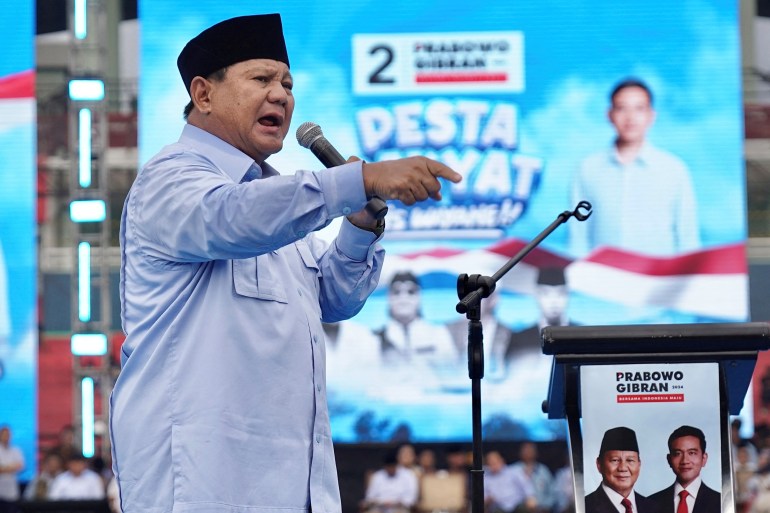
Hundreds of thousands of supporters of presidential contenders pack rallies in capital Jakarta and other cities. Tens of thousands of supporters of Indonesia’s presidential candidates have poured onto its streets as they hold final campaigns before heading to the polls in the world’s biggest single-day election. The contenders to lead the world’s third-largest democracy are popular former governors, Ganjar Pranowo and Anies Baswedan, and ex-special forces commander Prabowo Subianto, who has soared in opinion polls with the tacit backing of the president, and with the incumbent’s son as his running mate. The elections on Wednesday will elect a new president and vice president, in addition to parliamentary and local representatives. Nearly 100,000 people filled capital Jakarta’s main stadium for a rally in support of frontrunner Subianto, while more than 80,000 turned out for rival Baswedan at another stadium in the megalopolis on Saturday. Subianto, the 72-year-old former military strongman and Indonesia’s current defence minister, is trying to reshape his reputation as a hardened army figure with a history of accusations of rights abuses. Subianto, who leads the right-wing Gerindra political party, is backed by a coalition of other parties and has selected controversial 36-year-old Gibran Rakambuming Raka as his running mate. Defence Minister and presidential candidate Prabowo Subianto [Antara Foto/Dhemas Reviyanto via Reuters] Thousands of Subianto’s supporters, clad in his signature light blue, gathered at a stadium in Jakarta. Subianto is running with 66-year-old Mahfud MD, the former coordinating minister for political, legal and security affairs, with the two men having pitched themselves as people of humble origins who understand the people of Indonesia. High-schooler Alfiatnan, 18, said she would vote for Subianto because this was his third attempt at the presidency. “I think there’s no harm [in] giving opportunity to someone who is trying. His optimistic spirit influenced me to choose him.” Also in the running is Baswedan, the former governor of Jakarta who is running as an independent candidate. The 54-year-old was educated in the United States, entered academia and later went into politics as education minister. He is running with 57-year-old Muhaimin Iskander, the leader of the National Awakening Party, the largest Muslim political party in Indonesia. Supporters of Baswedan filled an 82,000-capacity stadium in Jakarta for a grand final rally on Saturday, chanting Islamic prayers. Some stayed overnight to secure a spot to see the politician. Presidential candidate Anies Baswedan [Achmad Ibrahim/AP] The streets of Jakarta were brought to a standstill by hoards of scooters and cars heading to the back-to-back rallies. “We want to witness change,” said Endang Pujiati, a retired teacher who drove hours to attend Baswedan’s rally. “Anies is a trustworthy person, that’s why he could be a good leader.” A cooling-off period will begin from Sunday until election day, when contestants and their running mates will try to secure their succession to popular President Joko Widodo, who led Indonesia for two five-year terms and cannot run again. Voting is not compulsory but the country’s election commission said the turnout was 81 percent in 2019, and more than 204 million of Indonesia’s 270 million people are registered to vote. There are 18 national political parties across Indonesia, and 575 parliamentary seats can be taken by candidates. More than 20,000 legislative and administrative posts will also be contested by 259,000 candidates on Wednesday. If no candidate wins a majority, a run-off between the top two will be held in June. At stake is the leadership for the next five years of a mineral-rich Group of 20 economy of 270 million people positioning itself as a future destination for multinational firms in the electric vehicle supply chain. Adblock test (Why?)
What 100,000-year-old footprints in Morocco tell us about early humans
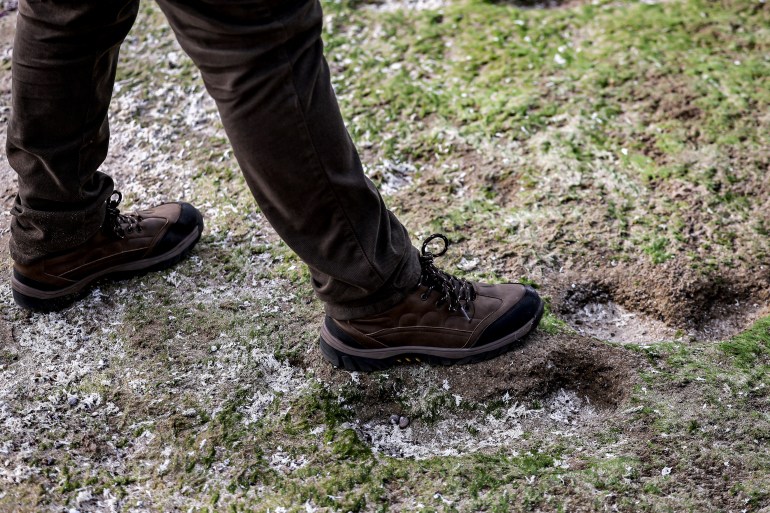
What can indentations in the ground from ages ago tell us about our early ancestors? A lot, it turns out. In January, an international team of scientists from Morocco, France, Germany and Spain published details of a fascinating discovery: a set of well-preserved human footprints believed to be 100,000 years old. The footprints are thought to be from a group of five individuals and were found on a rocky beach in a northern Moroccan town. The research, published in the science journal Nature, adds to a growing body of work that’s helping scientists piece together the evasive, true origins of the human race. But while their discovery is an archaeological feat, coastal erosion threatens the existence of these ancient tracks. Here’s what we know about this latest find and about other ancient human traces that scientists have discovered so far. A team of Moroccan and European scientists found a set of about 85 footprints made by five ancestors of human beings [Fadel Senna/AFP] What did scientists find in Morocco? In June 2022, archaeologist Mouncef Sedrati was leading field research focused on boulders close to the Moroccan shoreline in an area south of Tangier when his team stumbled on indentations in the ground at the city of Larache. On closer look, they discovered the indentations were footprints of varying sizes. To Sedrati, a coastal dynamics and marine geology expert at France’s University of Southern Brittany, it was an “exceptional” sight. “We weren’t 100 percent sure at first with the first print, but little by little, we found a second, third, then a very clear trackway and more and more,” Sedrati told Al Jazeera.”That’s when the doubt disappeared. The initial traces were left by healthy Homo [sapiens] on a sandy beach sediment around 100,000 years ago.” About 85 footprints were found in total, likely made by a group of five humans who were walking towards the water, using the site as a path. These are the first early human tracks to have been discovered in North Africa and the Southern Mediterranean. The arch of the indentations, rounded heels and the marks of short toes confirmed that they were tracks from Homo sapiens or modern humans like us. Their varying foot sizes suggested there were adults and children of different ages. The scientists, though, still do not know what the group was doing at the location. Were they trying to gather food from the sea? Or were they simply navigating through the area and came across the beach route by chance? Sedrati’s team studied sediment in the location and the footprints themselves to determine how long they might have been there. Optically stimulated luminescence dating, a research technique that helps archaeologists determine when the minerals or carbon surrounding discovered artefacts were last exposed to heat or sunlight, allowed the researchers to estimate how old the prints might be. They pegged the origins of the marks to the Late Pleistocene era, the period during which the last Ice Age happened. The preceding Middle to Late Pleistocene, encompassing the periods from 770,000 to 120,000 years ago, is broadly believed to be the age when ancient humans – separate from modern humans – roamed the earth. Using a drone to take 461 photographs of the prints, the team processed the images using specialised software and extracted 3D models to accurately measure the depression and width of each print, and to gauge the ages of the group’s members. The Larache footprints likely remained intact because of a combination of factors, the researchers wrote in the study, including their location, the soil type and the sea waves. The position of the beach on a rocky platform allowed the tides to bury the clay sediments forming the tracks, keeping them preserved until a recent erosion exposed them again. For Sedrati, who is of North African descent, the discovery is personal. “You can imagine how proud I am to lead the research team that made this discovery, even more so in a Moroccan city that is close to my heart,” he said, adding that he relished working with colleagues from other fields like geology to complete the study. But there’s more work for the team to do. Only part of the prints have been processed, and the team has questions. “What were the climatic and meteorological conditions of the time? Where was the coastline, the sea level?” Sedrati asked. Archaeologist Mouncef Sedrati examines a set of ancient footprints, believed to have been left by Homo sapiens more than 100,000 years ago, about 90km (55 miles) south of Tangier in northern Morocco [Fadel Senna/AFP] Where else have ancient human tracks been found? Finding footprints that are thousands of years old is rare but not unheard of. The oldest known human tracks were discovered in 1995. These were a set of three imprints belonging to a hypothetical “Eve” and called “Eve’s footprints”. They were discovered in Langebaan, a coastal town in South Africa’s West Cape province. “Eve” was thought to have lived about 117,000 years ago. David Roberts, who formed part of the team that discovered those prints, said at the time that they were likely made on a steep dune during a storm before dry sand filled the indentation and hardened. The prints measured 22cm (8.7 inches), about the same size as a modern woman wearing a US size 7.5. “Eve” was probably about 122cm (4ft) tall. In 2022, another team of researchers found two human tracks on the roof of a cave in the same area. They were not well-preserved. The sediment the imprints had been made in had eroded, but the outlines of the footprints were still visible. The distance between the two tracks – 49cm (19 inches), consistent with the distance between an average human’s legs while striding – suggested to the team that it was from one of our direct ancestors, rather than Hominini – another species of the modern human that is now extinct. Beyond the African continent, ancient tracks have also been discovered in the
Who are the Islamic Resistance in Iraq?

At 9:30pm on Wednesday, a United States drone strike hit a car in the al-Mashtal neighbourhood of east Baghdad. US Central Command claimed responsibility for the attack in a statement on X, saying it was a “unilateral strike” in retaliation for attacks on US soldiers at a base in Jordan in late January. Three men from Kataib Hezbollah, part of a coalition of militias-turned-state apparatus called the Popular Mobilisation Forces (PMF), were killed in the US strike, including Wissam Mohammed, the commander in charge of Kataib Hezbollah’s operations in Syria, who went by the nom de guerre Abu Bakr al-Saadi. On January 28, a drone had struck a Jordanian-US outpost called Tower 22 and killed three US soldiers. The Islamic Resistance in Iraq (IRI), an umbrella group of Iran-backed armed groups in the region, claimed responsibility for the attack, saying it was carried out in response to US support for Israel’s war on Gaza. But Pentagon spokesperson Sabrina Singh said the drone attack bore the “footprints” of Kataib Hezbollah, adding, “We know Iran is behind it” but not presenting evidence. Iran has denied any involvement in the assault. In recent months, Iranian-backed groups in Iraq and Syria operating under the banner of the IRI have launched about 170 attacks on US bases. But the attack on Tower 22 was the first to result in the deaths of US military personnel since October 18, the Pentagon said, adding that 143 Americans have been injured overall. The situation has led to what analysts described as a tit-for-tat exchange of fire between the US and Iran-backed groups in the region. On January 4, a US air strike in Baghdad killed Mushtaq Jawad Kazim al-Jawari, aka Abu Taqwa, a commander in Harakat Hizballah al-Nujaba, another PMF militia. The US said he had been involved in attacks on American personnel. “There has been an escalation in frequency but also in casualties,” Renad Mansour, a senior research fellow at the Chatham House think tank’s Middle East and North Africa Programme, told Al Jazeera. “And at the same time, this is not new. There have been moments in the past where this tit-for-tat has occurred.” President Joe Biden, right, meets the bodies of three US soldiers who were killed in a drone attack in Jordan on January 28, 2024, as they are returned to the United States on February 2, 2024 [Matt Rourke/AP] A scramble for influence Over the years since the 2003 US invasion of Iraq, a battle has played out in the country between Iran and the US for government influence. Among those working in alignment with Iran are a number of members of the PMF, a coalition of paramilitary groups that emerged in 2014 to fight ISIL (ISIS). In 2017, the PMF’s legitimacy was codified into law against the wishes of the Iraqi Ministries of Interior and Defence, and they were brought under the oversight of Iraq’s national security adviser. The main targets of US-led assassinations have been commanders in various Iraqi government-linked PMF groups. These many paramilitaries include pro-Iranian militias and some nationalist militias although in recent years the pro-Iranian faction has diluted the nationalist influence. The PMF’s leader, Faleh al-Fayyad, recently demanded that the US-led coalition withdraw from Iraq and warned that “targeting the PMF is playing with fire”. Despite the PMF’s anti-American delineation, recent attacks on the US have been credited to the Islamic Resistance in Iraq instead. The IRI is a vanguard group of armed actors from within the PMF that operates in Iraq and Syria but does not necessarily fall under the PMF’s chain of command. Despite being closely aligned with Iran, it at times act in its own interests and with its own agency. “The real objective of these attacks is to force the Americans to withdraw from Iraq and Syria,” Randa Slim, a senior fellow at the Middle East Institute, told Al Jazeera. The banner of the IRI is useful for both the PMF and the US, analysts said. This way, actors from the PMF and the US can trade attacks without directly implicating their partners in the Iraqi government. Members of the IRI “are on the front line and at times perform the violence on behalf of the wider networks connected to the PMF or Iran, which often prefer deniability”, Mansour said. “Therefore, when something goes wrong, the PMF is not necessarily implicated, even though they fall under the same umbrella group.” Faleh al-Fayyad, leader of the PMF – speaking here on the first anniversary of the US assassination of, from left in mural, Iranian General Qassem Soleimani and Kataib Hezbollah founder Abu Mahdi al-Muhandis – has demanded the US-led coalition pull out of Iraq [File: Murtadha Al-Sudani/Anadolu Agency via Getty Images] Saving face for Iraq After the attack on Tower 22, Kataib Hezbollah released a statement saying it would cease attacks on US interests in the region to keep from embarrassing the Iraqi government, of which the PMF is now officially an extension. But “it was an embarrassment to the Iraqi government to put that in the public statement in itself,” Slim said. Whether Kataib Hezbollah resumes operations in response to Wednesday night’s assault by the US remains to be seen. The US has repeatedly stated it is trying to avoid a wider regional war despite many actors in the region declaring that their actions are connected to US backing of Israel’s war on Gaza. Analysts said the recent US actions amount to an intensification but were also to be expected after the killing of US military personnel. “The red line for the American presidents, including [Donald] Trump, has always been the death [of US soldiers],” Slim said. But the US government may be strategically backing itself into a corner. Domestically, President Joe Biden has come under pressure from parts of the Washington establishment to respond with strength against these attacks. Some have even called for direct attacks on Iran, such as Senator Lindsey Graham who, after the Tower 22 attack, said: “Hit Iran
Football fever grips Jordan before historic AFC Asian Cup 2023 final

Amman, Jordan – For Mohammad Trakhan, a cafe owner in Amman, tennis has always been the sport of choice despite living in a football-mad country. He demonstrates his passion for the game by swinging an imaginary racquet before squeezing a glass of fresh orange juice at his colourful rustic cafe perched upon a hill in the Jordanian capital. This week, however, the 37-year-old has shifted his focus to football. Jordan are in the Asian Cup final for the first time in their history and Trakhan, the reluctant football fan, predicts a 3-1 win for his side over favourites Qatar. Football fever has truly gripped the country of 11 million people. On Tuesday night, when the referee’s full-time whistle confirmed Jordan’s semifinal victory over the mighty South Korea in the AFC Asian Cup 2023, thousands of people poured into the streets to celebrate. Traffic ground to a standstill as fans draped in Jordanian keffiyehs waved flags, belted out football chants and burst into impromptu performances of the traditional dabke dance. In a central thoroughfare located by a quiet residential area, teenagers fired makeshift flares by lighting the spray from aerosol cans, while others climbed on each other, causing the crowd to sway as they lost balance. Stern-faced police officers blared their sirens as they attempted to move the joyous throngs of fans along, but drowned out by the raucous crowds, they soon conceded defeat and stood aside. Jordanian fans climb on a car as they celebrate their semifinal win [Nils Adler/Al Jazeera] ‘Are we France or Argentina now?’ Jordan are ranked 78th in FIFA’s team rankings and their historic footballing achievement has captivated the nation. The fervent atmosphere has sparked an interest in the game for the uninitiated, including Mohammad al-Khayyat, a gregarious marketing manager, who admittedly does not watch a lot of football. “It’s the first time we have reached the final of this tournament, and we are all in shock,” he tells Al Jazeera. “We are asking ourselves: Wait, are we France or Argentina now?” The reference to the Qatar World Cup 2022 finalists is not the only hyperbole. For many Jordanians, including 23-year-old shop assistant Anas Awad, Tuesday evening was the “best night for Jordan”. Looking out at a bustling street in downtown Amman, Awad says the party will be much bigger on Saturday night if Jordan win the final. The men in white celebrate a goal during the AFC Asian Cup semifinal [Sorin Furcoi/Al Jazeera] While most fans of the an-Nashama (the gentlemen) are betting on a win for their team, the more serious ones predict a difficult game. Waseem Mustafa, a sales assistant and avid kickboxer, draws on his own experience in sports and urges caution against predicting an easy win. “Qatar are a strong team,” he says, as he looks at the floor with furrowed brows before going with a 2-1 win to Jordan anyway. Awad, the shop assistant, says he has been impressed with tournament hosts Qatar. He says he would have flown out to see the game at Lusail Stadium if he “had been wealthier”. Thousands of Jordanians have been happy to splash out on the final, be it with last-minute flights to Doha or buying the football team’s shirts in local markets. Sales of replica Jordan football shirts have gone through the roof at Mustafa’s shop. His store manager desperately orders new batches over WhatsApp to meet the demand as a proud father places an order for his three children. A local travel agency told Al Jazeera they had been inundated with requests by football fans desperate to fly to Qatar. A new CHAMPION? Or a REPEAT? 🏆#AsianCup2023 #HayyaAsia pic.twitter.com/1TYHONOxNy — AFC Asian Cup Qatar 2023 (@Qatar2023en) February 9, 2024 Israel’s war on Gaza overshadows celebrations An-Nashama’s success is the talk of the town, but not everyone celebrated the win on Tuesday. Mohammed al-Barghuti, a soft-spoken customer at a popular clothes store in central Amman, chose to watch the game at home out of respect for the Palestinians facing the wrath of Israel’s war on Gaza. “I felt [we] couldn’t celebrate in public when humans are being killed,” he said solemnly. “If not for the war, you would have seen 10 times more celebrations on the streets than you saw on Tuesday.” Jordan is home to more than two million registered Palestinian refugees, according to UNRWA. Yahya Nasser, a 21-year-old trainee barber and pastry chef, has no intention of celebrating if Jordan wins. Football, he says, is the last thing on his mind. Being a Jordanian of Palestinian origin, he cannot enjoy anything when he sees his people “fighting for their land and their lives”. Trakhan, the cafe owner, is originally from Palestine and says that although he does not mind other people celebrating, he will watch the final in a subdued atmosphere, perhaps on his phone with a few friends. Adblock test (Why?)