

Overnight Russian drone attack kills at least seven in Ukraine’s Kharkiv

Three children among the dead, says official, as the Russian attack triggers fire and damages homes. An overnight Russian drone attack has killed at least seven people, including three children, in Ukraine’s eastern city of Kharkiv, officials say. Regional Governor Oleg Synegubov said on Telegram on Saturday three children, aged seven, four, and six months, were among the victims after the strikes hit at least 15 houses, causing large-scale fires. Kharkiv, about 30km (18 miles) from the Russia-Ukraine border, has often felt the brunt of Russia’s winter campaign of long-range strikes that commonly hit civilian areas. On January 23, a barrage of missiles struck Kharkiv and two other Ukrainian cities in one of the heaviest bombardments since the start of the year. At least 11 people were killed as about 5,000 windows in 222 buildings were broken by the blasts and shockwaves throughout the region, officials said. It marked what the United Nations called “an alarming reversal” of a trend last year that saw a drop in civilian casualties from Moscow’s attacks. The city with a pre-war population of 1.5 million is Ukraine’s most vulnerable urban centre. Russia lies north and east of it, and the border of Moscow-annexed Luhansk region is about 150km (90 miles) to the southeast. Since day one of the full-scale invasion in February 2022, Russian forces have tried to seize Kharkiv, dispatching armed personnel carriers almost to the city centre. Moscow has deployed strategic bombers, ballistic or cruise missiles, and Iranian or Russian-made drones that take just minutes to reach the city from across the border. Unlike the capital, Kyiv, which received advanced Western air defence systems within months, Kharkiv remains almost defenceless. Residents and authorities have had to adapt quickly as any delays mean lost lives. Russian strikes keep Ukrainians on edge while the 1,500-km (930-mile) front line has barely budged. Both sides’ inability to deliver major gains on the battlefield has pushed the fighting towards trench and artillery warfare. Ukraine’s struggles with ammunition and personnel come on the heels of a failed counteroffensive last summer and as European allies try to bump up their military production. To shake things up, Ukrainian President Volodymyr Zelenskyy on Thursday appointed Oleksandr Syrsky as the new head of Ukraine’s armed forces. The move amounted to the most serious change of the top military brass since the start of the war. Adblock test (Why?)
How Taiwan’s elections challenge the power of China’s Communist Party

If free and fair national elections are considered the hallmark of a democratic state, Taiwan has much to boast about. In January, the self-ruled island held its eighth presidential election concurrently with a parliamentary vote. Just 160km (100 miles) away on the other side of the narrow Taiwan Strait, the Communist Party of China (CPC) has ruled China since 1949, and though the party often claims that it governs a democratic state, there is no electoral process comparable with Taiwan’s. China’s President Xi Jinping has referred to “whole-process people’s democracy” to describe the Chinese political system where the “people are the masters” but the party-state apparatus runs the people’s affairs on their behalf. Ken Cai*, a 35-year-old entrepreneur from Shanghai, does not subscribe to Xi’s definition of democracy. “The truth is that [mainland] Chinese people have never been allowed to choose their own leaders,” Ken told Al Jazeera. “That is just propaganda.” Ken’s critical assessment stands in sharp contrast to an assertion often presented by the CPC that their one-party rule is considered satisfactory by Chinese people. President Xi has long said that China is following a unique development path under the guidance of its distinctive system of governance. Chinese officials have also presented criticism of Beijing’s record on human rights and democracy as being based on a lack of understanding of China and the Chinese people. President Xi takes his oath during the third plenary session of the National People’s Congress at the Great Hall of the People, in Beijing in March 2023 [File: Mark R Cristino/Pool via Reuters] That is why Taiwan’s hosting of successful multiparty elections challenges Beijing’s argument that liberal democracy is incompatible with Chinese culture. At the same time, Taiwan’s liberal democratic system clashes with Xi’s vision of a rejuvenated Chinese nation firmly under the CPC’s control and a wayward Taiwan eventually unified with the Chinese mainland. “The Taiwanese experience is a clear affront to the CPC narrative,” said Chong Ja Ian, associate professor of China’s foreign policy at the National University of Singapore. Taiwanese elections are a far more sensitive topic for Beijing than elections in other democracies as the democratic example being set by Taipei can be a more direct source of inspiration for people in mainland China, said Yaqiu Wang, research director for China, Hong Kong and Taiwan at the United States-based advocacy group Freedom House. “When you see that people from your own in-group have democracy and can elect their leaders, it can cause particular frustration with your own non-elected leaders,” Wang said. “That makes Taiwanese elections a threat to the CPC,” she added. China censoring Taiwanese elections It was perhaps not surprising that while leaders from countries such as Japan, the Philippines and the US congratulated Taiwan on the successful conclusion of its elections, the Chinese government did not. Relations between China and Taiwan have been in a downward spiral ever since the outgoing president, Tsai Ing-wen, was elected in 2016. The CPC views Tsai, her replacement President-elect William Lai Ching-te, and other members of the Democratic Progressive Party (DPP) as foreign-backed separatists and has not ruled out the use of force in its future plans to unify Taiwan with China. Chen Binhua, spokesperson for Beijing’s Taiwan Affairs Office (TAO), reacted to the election results by saying that Lai’s 40 percent vote share and the DPP’s loss of its parliamentary majority revealed that the party “cannot represent mainstream public opinion on the island”, and the outcome “will not impede the inevitable trend of China’s reunification”. On social media in China, many reacted to Chen’s comments by focusing on Beijing’s own democratic credentials. “Enough, already – how can you criticise others’ elections when you don’t even allow elections at home,” one user wrote on the Chinese social media platform Weibo. “So a general election doesn’t represent mainstream public opinion? What new sort of understanding is this?” read another comment, while a third even attacked Beijing’s Taiwan Affairs Office directly: “[TAO is] the most shameless, useless, piece-of-trash government department.” All three comments have since been removed by censors. Ailene Long*, a 31-year-old translator from the Chinese city of Shenzhen, told Al Jazeera that she found comments criticising Taiwan’s election ridiculous when measured against the shortcomings in China’s political system. “You can’t ask questions about public opinion in Taiwan when people in China have never been allowed to choose anything other than the Communist Party,” Ailene said. Freedom House’s Wang observed a lot of similar Chinese responses popping up across Chinese social media platforms as the Taiwanese election results came in. “But a lot of them were quickly removed – even within a couple of minutes many were gone,” she told Al Jazeera. Hashtags, comments and news about the Taiwanese election were repeatedly removed from Chinese social media by the state’s vast censorship network. Along with the tight censorship, there were also signs that the Chinese authorities on Taiwan’s election day had tried to drown the interest on Chinese social media by inflating other hashtags. Such actions were a way for the authorities to remove displays of public criticism, according to Wang, but the underlying sentiment remained one of discontent with the Beijing government. China’s democratic deficit in tough economic times Ken Cai from Shanghai thinks that a lot of the online commentary about Taiwan’s election was really about airing dissatisfaction with the situation in China. “The economy is not good for a lot of people, many are struggling so they take the opportunity to release their frustration with the government,” he explained. For Ken, Taiwan’s elections also demonstrate how far Beijing and Taipei have diverged. Ken recounted how his grandparents told him how they used to be afraid of Taiwan’s Nationalists attacking China, and that they heard stories from Taiwan about crackdowns on Taiwanese people. After the Kuomintang (KMT), known as the Chinese Nationalists, were defeated by the Communists in the Chinese Civil War, they fled to Taiwan in 1949 where they initially held ambitions about reconquering mainland China. To cement
‘He needs our votes’: In Karachi, Pakistan election tests old loyalties
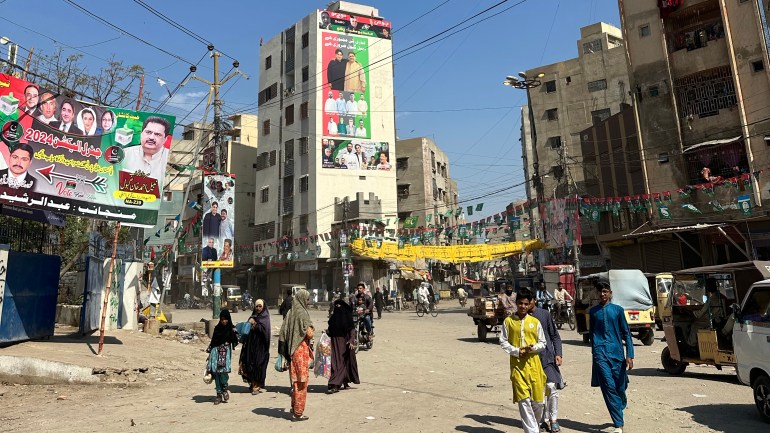
Karachi, Pakistan – These are the fourth general elections I’m covering in Pakistan over the past 16 years. In a city where colours, music and ethnicities change from neighbourhood to neighbourhood, every one of those previous elections has been confusing. This one has been the same: chaotic and confusing. I started the day by voting at my neighbourhood polling station. It’s something I’ve always struggled with: Should journalists vote? Then, as I reported from Pakistan’s largest city – home to 22 seats, more than the entire province of Balochistan – on Thursday, I realised that not only was Pakistan’s democracy on trial but so too were the city’s loyalties. Former Prime Minister Imran Khan’s Pakistan Tehreek-e-Insaf (PTI) party had won 14 National Assembly seats in the 2018 election from Karachi, breaking voters away from the Muttahida Qaumi Movement (MQM), which has traditionally dominated the city’s political landscape. With the MQM split into multiple factions since 2016, its disenchanted voters found solace in Khan’s party, from the affluent southern areas of Karachi all the way to the city’s north. I was standing outside my polling station in Clifton, barely 1km (0.6 miles) away from Bilawal House, which is the Karachi home of the Bhutto-Zardari family, which leads the Pakistan People’s Party. The PPP has historically been the most dominant political force in the province of Sindh, whose capital is Karachi. Yet, on Thursday, most people streaming out to vote in this upscale part of Karachi were PTI supporters, many of them women who had stepped out at 8am to be among the first to cast their ballot. N Tariq, a 50-year-old who did not want to share her full name, said she came first in the morning to ensure she caught the polling staff in a good mood and in the hope the voting process would be smooth and without long queues. “I’m voting for the person who is in trouble right now. He needs our votes”, said Tariq. She laughed as she said this, referring to Khan, who received multiple sentences in a range of cases last week. My next stop was one of the largest polling stations in Defence Phase 4, a cantonment housing area, run by Pakistan’s powerful military, which Khan’s supporters blame for derailing the party – its leaders are in jail, and candidates can’t even use the party symbol. An upscale neighbourhood, the polling station was already getting busy – but it was missing the celebratory atmosphere of the 2018 election, when I had spent a few hours outside this venue. By this time, my cellular and data connection had been cut and I could no longer contact anyone. As a native Karachite, losing cellular connectivity isn’t new to me but this was a day when law and order could be compromised and it was very unnerving. Lyari, a stronghold of the Pakistan People’s Party, was eerily quiet on Thursday, February 8, 2024 [Alia Chughtai/Al Jazeera] I headed towards Lyari, a PPP stronghold. As I drove through Lyari’s Cheel Chowk – the usually very noisy and congested area, home to decades-long gang wars, was eerily calm. It was so quiet that it made me uncomfortable. The flags and banners were up but there was no music, no dancing, no blaring of Dilan Teer Bija – the PPP’s viral anthem. As I began going through different polling stations, I came across many elderly women voters. Rehmat, 75, and Kulsom, 60, came together to the polling station – where I wasn’t allowed in despite having accreditation. Kulsom said she was only voting for the PPP because it was the party of former Prime Minister Benazir Bhutto, who was assassinated in 2007. Left: Kulsom, right, Rehmat, residents of Lyari [Alia Chughtai/Al Jazeera] “Bilawal is her son and they have given us everything. Water, gas, and brought peace to this area, PPP has given us everything. What else do we need? I will always stand by PPP till my last breath,” said Kulsom. She was referring to Bilawal Bhutto-Zardari, the 36-year-old leader of the PPP. Rehmat said her children don’t have jobs but the PPP is her choice too. She voted for Bilawal’s grandfather – former Prime Minister Zulfikar Ali Bhutto – in 1970, and then for Benazir, and now she is determined to vote for Bilawal. “They work for us and they take care of us – how can we not love the Bhuttos?”, she said. This wasn’t the sentiment shared by everyone in Lyari. A first-time voter, 18-year-old Mohammed Yazdan said promises are made before elections but never fulfilled. First-time voter Mohammed Yazdan [Alia Chughtai/Al Jazeera] “I’m voting for Imran Khan, PTI, because those who do work are always pulled down by them. Look at what they’ve done to him. I will continue supporting him.” I went into the heart of the city, in the old Golimar area, a working-class neighbourhood. There were small pockets of Tehreek-e-Labbaik, MQM and Jamaat-e-Islami supporters in the streets helping voters. Tehreek-e-Labbaik, a far-right party formed in 2017, rallies support by focusing its politics around religion. Jamaat-e-Islami, also a religious right-wing party, is among Pakistan’s most organised political forces, with a charity wing, the Al Khidmat Foundation. I found that voters were hesitant to admit they were going to be voting for PTI-affiliated candidates who have had to contest as independents. One female voter who wished to remain anonymous said: “I’m sitting in the MQM tent to get my polling numbers sorted but my vote is always for the leader of the nation I can’t name. I wanted to come today to be a polling agent but we were told there would be security issues for those affiliated with PTI candidates.” In the Pakistan Employees Cooperative Housing Society, an old neighbourhood known locally by its acronym PECHS, one of the larger polling stations is a college campus that has an unpaved dirt entrance and steps that go down into the main courtyard. After crossing it, voters had to climb up to the first
PTI-linked independents take Pakistan election lead as counting nears end

Candidates linked to jailed former Prime Minister Imran Khan’s political party are in the lead in Pakistan’s election, ahead of two dynastic parties believed to be favoured by the military, as vote counting enters its final leg. In an AI-generated “victory speech” posted on the social media platform X on Friday, Khan described the vote as an “unprecedented fightback from the nation” that resulted in Pakistan Tehreek-e-Insaf’s (PTI) “landslide victory”, despite what he calls a crackdown on his party. Khan’s PTI candidates were forced to run as independents after they were barred from using the party symbol – a cricket bat – to help illiterate voters find them on ballots. Election results started to trickle in nearly 12 hours after polling for national and provincial assemblies ended on Thursday, showing PTI-affiliated candidates taking a narrow lead, followed by Pakistan Muslim League (PMLN) and Pakistan People’s Party (PPP) contenders. Independent candidates, most backed by the PTI, have won 99 seats so far out of 266 total in the National Assembly. The PMLN has won 71 and the PPP 53. Results are still due for more than a dozen seats. Meanwhile, another former Prime Minister Nawaz Sharif, who heads the PMLN, said he would seek to form a coalition government after his party trailed the independent candidates backed by Khan. Pakistan’s Former Prime Minister Nawaz Sharif, centre, his brother Shehbaz Sharif, right, and daughter Maryam Nawaz wave to their supporters following initial results of the country’s parliamentary election, in Lahore, Pakistan [KM Chaudary/AP] Earlier, Sharif had claimed victory in the elections while the votes were still being counted. But he later backtracked, saying, “We don’t have enough of a majority to form a government without the support of others and we invite allies to join the coalition so we can make joint efforts to pull Pakistan out of its problems.” Sharif said he would approach the PPP of Bilawal Bhutto-Zardari, the son of assassinated former Prime Minister Benazir Bhutto, as a coalition partner. He also added that he wants to sit together in harmony with other parties to “change” Pakistan. ‘Made history’ In his AI address, Khan decried the PMLN leader as a “petty man”, adding, “No Pakistani will accept him” or his claim of victory. Speaking to voters, he said, “My fellow Pakistanis, you have made history. I am proud of you, and I give thanks to God for uniting the nation”. Chairman Imran Khan’s victory speech (AI version) after an unprecedented fightback from the nation that resulted in PTI’s landslide victory in General Elections 2024. pic.twitter.com/Z6GiLwCVCR — Imran Khan (@ImranKhanPTI) February 9, 2024 Pakistan’s vote happened just more than a week after Khan, who has been in jail since August, faced back-to-back sentences in several cases he has said were politically motivated. Last month, the 71-year-old former leader was handed his longest sentence yet: 14 years for corruption in a case related to the selling of state gifts he received as prime minister. A day earlier, he was sentenced to 10 years in prison for leaking state secrets. With Khan in jail and PTI members facing a crackdown, their election lead came as a surprise to many. Maya Tudor, associate professor at the Blavatnik School of Government, University of Oxford, told Al Jazeera that a win for PTI-backed candidates in the elections would be remarkable but the road ahead is rocky. “A shaky economy, conflict on almost every border, and soaring inflation, which is being felt every day by ordinary Pakistanis,” Tudor said. ‘Political engineering’ Thursday’s elections were marred by violence by armed groups and a widely criticised suspension of mobile phone services also prompted accusations of “political engineering”. The delay in election results on Friday also raised eyebrows, with PTI spokesperson Raoof Hasan accusing authorities of tampering with the results, saying votes had been “stolen”. Reporting from the city of Lahore earlier on Friday, Al Jazeera’s Assed Baig said that on the streets, people had been openly saying that votes had been rigged. “Some of the forms coming out from those polling stations show that there are in fact discrepancies and there is a real fear among people that if their votes are not respected, in terms of reflecting who they voted for, then that frustration could boil over into the streets, like we’ve already seen in some places,” Baig said. He added that two people have been reportedly killed and 20 injured, because of violence over the election results in northwestern Pakistan. Meanwhile, The Pashtoonkhuwa Mili Awami Party (PKMAP) announced protests across the Balochistan province against the election results, and party chairman Mehmood Khan Achakzai called the 2024 polls rigged, Al Jazeera’s Saadullah Akhter reported. Lengthy delays to the start of polling also put people off. Muhammad Hussain, 67, said polling at a particular station in Karachi’s Malir area did not start until 3pm, seven hours after the scheduled start time. “We voted for change. But the way it’s going, it doesn’t seem that would be the case,” he told Al Jazeera. Elsewhere, several countries, including the United States and the United Kingdom, have called for authorities to investigate reported irregularities in Pakistan’s general elections as the final vote count is still under way. The final tally is due early Saturday morning. Adblock test (Why?)
Demands for Canada to stop supplying weapons to Israel grow louder

Montreal, Canada – Human rights advocates are accusing Canadian Prime Minister Justin Trudeau’s government of misleading the public over weapons sales to Israel, which have come under greater scrutiny amid the deadly Israeli bombardment of Gaza. At issue is legislation that prohibits the government from exporting military equipment to foreign actors if there is a risk it can be used in human rights abuses. But regulatory loopholes, combined with a lack of clarity over what Canada sends to Israel, have complicated efforts to end the transfers. Dozens of Canadian civil society groups this month urged Trudeau to end arms exports to Israel, arguing they violate Canadian and international law because the weapons could be used in the Gaza Strip. But in the face of mounting pressure since Israel’s war on Gaza began on October 7, Canada’s foreign affairs ministry has tried to downplay the state’s role in helping Israel build its arsenal. “Global Affairs Canada can confirm that Canada has not received any requests, and therefore not issued any permits, for full weapon systems for major conventional arms or light weapons to Israel for over 30 years,” the department told Al Jazeera in an email on Friday. “The permits which have been granted since October 7, 2023, are for the export of non-lethal equipment.” But advocates say this misrepresents the total volume of Canada’s military exports to Israel, which totalled more than $15m ($21.3m Canadian) in 2022, according to the government’s own figures. It also shines a spotlight on the nation’s longstanding lack of transparency around these transfers. “Canadian companies have exported over [$84m, $114m Canadian] in military goods to Israel since 2015 when the Trudeau government was elected,” said Michael Bueckert, vice president of Canadians for Justice and Peace in the Middle East, an advocacy group. “And they have continued to approve arms exports since October 7 despite the clear risk of genocide in Gaza,” Bueckert told Al Jazeera. “Unable to defend its own policy, this government is misleading Canadians into thinking that we aren’t exporting weapons to Israel at all. As Canadians increasingly demand that their government impose an arms embargo on Israel, politicians are trying to pretend that the arms trade doesn’t exist.” Lack of information While Canada may not transfer full weapons systems to Israel, the two countries enjoy “a consistent arms trade relationship”, said Kelsey Gallagher, a researcher at Project Ploughshares, a peace research institute. The vast majority of Canada’s military exports to Israel come in the form of parts and components. These typically fall into three categories, Gallagher explained: electronics and space equipment; military aerospace exports and components; and finally, bombs, missiles, rockets and general military explosives and components. But beyond these broad categories, which were gleaned by examining Canada’s own domestic and international reports on weapons exports, Gallagher said it remains unclear “what these actual pieces of technology are”. “We don’t know what companies are exporting them. We don’t know exactly what their end use is,” he told Al Jazeera. Global Affairs Canada did not immediately respond to Al Jazeera’s question about what “non-lethal equipment” the government has approved for export to Israel since October 7. “What does this mean? No one knows because there’s no definition of that and it really could be quite a number of things,” said Henry Off, a Toronto-based lawyer and board member of the group Canadian Lawyers for International Human Rights (CLAIHR). Human rights lawyers and activists also suspect that Canadian military components are reaching Israel via the United States, including for installation in fighter jets such as the F-35 aircraft. But these transfers are difficult to track because a decades-old deal between Canada and the US – 1956’s Defence Production Sharing Agreement – has created “a unique and comprehensive set of loopholes that are afforded to Canadian arms transfers to the US”, said Gallagher. “These exports are treated with zero transparency. There is no regulation of, or reporting of, the transfer of Canadian-made military components to the US, including those that could be re-transferred to Israel,” he said. The result, he added, is that “it is very difficult to challenge what are problematic transfers if we do not have the information with which to do so”. Domestic, international law Despite these hurdles, Canadian human rights advocates are pressuring the government to end its weapons sales to Israel, particularly in light of the Israeli military’s continued assault on Gaza. Nearly 28,000 Palestinians have been killed over the past four months and rights advocates have meticulously documented the impact on the ground of Israel’s indiscriminate bombing, and its vast destruction of the enclave. The world’s top court, the International Court of Justice, also determined last month that Palestinians in Gaza face a plausible risk of genocide. Against that backdrop, eliminating weapons transfers to Israel is effectively a demand for “Canada [to] abide by its own laws”, said Off, the Toronto lawyer. That’s because Canada’s Export and Import Permits Act obliges the foreign minister to “deny exports and brokering permit applications for military goods and technology … if there is a substantial risk that the items would undermine peace and security”. The minister should also deny exports if they “could be used to commit or facilitate serious violations of international humanitarian and human rights laws” or in “serious acts of gender-based violence or serious acts of violence against women and children”, the law states. Meanwhile, Canada is also party to the Arms Trade Treaty (ATT), a United Nations pact that bans transfers if states have knowledge the arms could be used in genocide, crimes against humanity, war crimes and other violations of international law. But according to Off, despite a growing list of Israeli human rights violations since October 7, Canada “has been approving the transfer of military goods and technology that might fuel” them. Late last month, Canadian Lawyers for International Human Rights wrote a letter to Canadian Foreign Minister Melanie Joly demanding an immediate end to the transfers. The group said it would consider next steps,
Protesters and security forces clash in Senegal over election delay

Parliament voted to push the polls back to December after President Macky Sall announced a postponement last week. Security forces in Senegal have clashed with hundreds of protesters who are opposed to the delay of the presidential election that was supposed to take place on February 25. In Dakar, police fired tear gas on crowds and prevented people from meeting and gathering to protest, according to Al Jazeera’s Nicholas Haque, reporting from the capital on Friday. “There have been running battles between protesters and police and security forces. Most of the demonstrators are quite young, many 18-year-olds. They were barely 12 when President Macky Sall came to power. They want to have a say in this election,” Haque said. Less than three weeks before the polls were meant to take place, parliament voted to push it back to December 15, upholding Sall’s earlier postponement announcement and sealing an extension of his mandate. But the move has provoked fears that one of the remaining healthy democracies in coup-hit West Africa is under threat. In the capital on Friday, some demonstrators waved Senegalese flags, while others shouted slogans like “Macky Sall is a dictator”, the Reuters news agency reported. At Blaise Diagne high school in Dakar, hundreds of pupils left their lessons mid-morning after teachers heeded the call to protest. History and geography teacher Assane Sene said it was just the start of the battle. “If the government is stubborn, we will have to try different approaches,” he told the AFP news agency. A protester throws a stone during clashes with police in Dakar [Guy Peterson/AFP] Sall, who has reached his constitutional limit of two terms, said he delayed the elections due to a dispute over the candidate list that threatened the credibility of the electoral process. The decision has unleashed widespread anger on social media and the opposition has condemned it as a “constitutional coup”. Some critics also accuse Sall of trying to cling to power, while the West African bloc and foreign powers have criticised the move as a break with Senegal’s democratic tradition. ‘Calm spirits’ “Senegal has perhaps never experienced a crisis like the one we are experiencing and we must overcome it,” said Senegal’s Justice Minister Aissata Tall Sall. “We must calm spirits.” In an interview, Tall Sall said the postponement was not the president’s decision, but the parliament’s, and “was done in perfect conformity with the constitution”. After parliament voted, 39 lawmakers in the opposition coalition, Yewwi Askan Wi, and several opposition presidential candidates filed legal challenges against the delay with the Constitutional Court. Tall Sall said the challenges did not fall under the Constitutional Court’s jurisdiction. But she said the fact that opponents were turning to the courts meant that “we are in a functioning democracy.” However, she conceded the postponement had pitched Senegal into unprecedented uncertainty. This is the first time that a presidential election has been postponed since Senegal’s independence from France in 1960. In a statement on Friday, the European Union’s foreign policy chief Joseph Borrell expressed concern about the situation in Senegal, urging the nation to “preserve democracy”. “Fundamental freedoms, and in particular those to demonstrate peacefully and express oneself publicly, are fundamental principles of the rule of law that the Senegalese authorities must guarantee,” Borell said, and called on authorities to organise elections “as quickly as possible.” Adblock test (Why?)
‘Serious concerns’: World reacts to Pakistan polls as vote count continues

Countries including the US and UK called for authorities to investigate reported irregularities in Pakistan’s election. Several countries have called for authorities to investigate reported irregularities in Pakistan’s general elections as vote counting is under way. Results started to trickle in nearly 12 hours after polling for national and provincial assemblies ended on Thursday. Independent candidates affiliated with imprisoned former Prime Minister Imran Khan’s party, the Pakistan Tehreek-e-Insaf (PTI), are taking a narrow lead. Polls were marred by violence by armed groups and a widely criticised suspension of mobile phone services that prompted accusations of “political engineering”. The army said about 12 people were killed and 39 wounded nationwide during attacks aimed at disrupting the vote. Here are some global reactions to events so far: United States The US Department of State has said it is looking forward to “timely, complete election results” from Pakistan reflecting the will of its people. “The United States is prepared to work with the next Pakistani government, regardless of political party, to advance our shared interests,” it said in a statement. “We join credible international and local election observers in their assessment that these elections included undue restrictions on freedoms of expression, association, and peaceful assembly,” it added. “We condemn electoral violence … and are concerned about allegations of interference in the electoral process. Claims of interference or fraud should be fully investigated.” United Kingdom The United Kingdom voiced “serious concerns raised about the fairness and lack of inclusivity of the elections”. In a statement, UK Foreign Secretary David Cameron said “not all parties” were able to formally contest the election and that “legal processes” were used to prevent some political leaders from participating. He also noted restrictions to internet access, as well as delays and irregularities in reporting. “The UK urges authorities in Pakistan to uphold fundamental human rights including free access to information, and the rule of law,” Cameron said. “The new government must be accountable to the people it serves, and work to represent the interests of all Pakistan’s citizens and communities with equity and justice,” he added. We recognise serious concerns over the fairness and lack of inclusivity of Pakistan’s elections. Authorities must uphold fundamental human rights including free access to information and the rule of law. I applaud all who voted. https://t.co/15U4EcmRjK — David Cameron (@David_Cameron) February 9, 2024 European Union The European Union has praised the continued “commitment to democracy” by the people of Pakistan. Still, the bloc said, “We regret the lack of a level playing field due to the inability of some political actors to contest the elections, restrictions to freedom of assembly, freedom of expression both online and offline, restrictions of access to the internet, as well as allegations of severe interference in the electoral process, including arrests of political activists.” The EU called on authorities to “ensure a timely and full investigation of all reported election irregularities”. Iran “Iran’s FM Spokesman congratulated Pakistan’s government & people on successfully holding their parliamentary elections, saying it shows the solid place of democracy in the country,” the Iranian Foreign Ministry posted on the social media platform X. It added that Foreign Ministry spokesperson Nasser Kanaani “wished the brotherly, friendly and neighbourly country of Pakistan increasing prosperity”. Adblock test (Why?)
Preview: Jordan vs Qatar – AFC Asian Cup 2023 final

Who: Jordan vs QatarWhat: AFC Asian Cup 2023 finalWhen: Saturday, February 10, 2024, 6pm (15:00 GMT)Where: Lusail Stadium, Lusail, Qatar After nearly a month of high-octane football, featuring several surprises and upsets, the AFC Asian Cup is set to conclude with an all-Arab final, as hosts Qatar look to defend their title against giant-killers Jordan. Qatar entered the tournament as the reigning champions, but they were not counted among the outright favourites to lift the trophy owing to their poor record against higher-ranked sides in the build-up to the event. But Tintin Marquez Lopez‘s side have exceeded expectations with an all-round performance and by reaching the final for a second straight time. Enjoying the support of a partisan crowd, Qatar have scored in every game on their way to the final. “I’m very proud to be a part of this squad – a month ago no one expected us to reach the final, no one thought we could deliver these performances,” Qatar skipper Hassan Al-Haydos told reporters on Friday. “Working together with the coach, technical staff and the Qatar Football Association, we were able to reach this level because of the squad’s unity.” [Al Jazeera] ‘Jordan will respond to the critics’ While Qatar will carry the weight of expectations, Jordan will play with nothing to lose in their maiden AFC Asian Cup final. The surprise package of the tournament, Jordan finished third in their group and scraped through to the knockouts, where they suddenly elevated their game to eliminate heavyweights Iraq and South Korea. That was a triumph for their Moroccan coach Hussein Ammouta, who was heavily criticised when they finished 2023 without a win in seven games, which included six losses. “I’m very satisfied with our achievement because it was a personal challenge,” Ammouta said. “When a team loses the coach is blamed and when they win they say it’s because of team morale. We prepare with all aspects in mind – physical, mental, tactical and psychological. “I hope we’ll be ready when the first whistle blows and we’ll respond to the critics, 99 percent of the time I don’t listen to them since I don’t find anything useful.” A positive mood all around the 🇯🇴 Jordan camp ahead of their date with destiny tomorrow! #AsianCupFinal | #AsianCup2023 | #JORvQAT pic.twitter.com/rL5DIFMejt — #AsianCup2023 (@afcasiancup) February 9, 2024 Jordan’s players to watch Mousa Al-TamariWith three goals and an assist, Al-Tamari has been Jordan’s standout performer. The only player in the Jordanian squad who plies his trade in Europe – with Montpellier SC in France – Al-Tamari’s direct play and dribbling speed make him a threat to any defence. Yazan Al-ArabAl-Arab been a colossal figure for Jordan in the heart of their defence, forming a solid centre-back partnership with Abdallah Nasib. Powerfully built and standing at 1.86 metres (six feet three inches), Al-Arab is a towering presence in both boxes. Yazan Al-NaimatAl-Naimat has a knack for finding space between defenders and more often than not, times his run to perfection. Having scored in the group match against South Korea, the 24-year-old went up another level when he scored in the last 16 and semifinals. We are ready to the final 💪 #AsianCup2023 #الاردن_قطر pic.twitter.com/sDqfibChwc — Mousa Al Tamari (@TamariMousa) February 9, 2024 Qatar’s players to watch Akram AfifAfif has been in exceptional form, bagging five goals and three assists. His pace, skill and vision have created havoc for the opposition defenders throughout the tournament. Hasan Al-HaydosAl-Haydos has played the skipper’s role to perfection with his technical prowess, exceptional vision and strong leadership qualities. The 33-year-old can score too, as stunningly seen in the group stage match against China, with further goals against Palestine and Uzbekistan. Almoez AliUnlike 2019, Ali has not been firing in the goals at this tournament but there is no disputing the vital role he plays in the squad. The forward’s work rate is second to none, as he is equally adept in leading attacks and falling back to defend. Akram Afif has scored or assisted 19 of the last 29 goals for Qatar in the #AsianCup 🇶🇦 ⚽️ 6🅰️ 13 — Wael Jabir (@waeljabir) February 7, 2024 Form guide Jordan began their group stage by beating Malaysia 4-0 and then held South Korea to a 2-2 draw. They lost 1-0 to Bahrain but managed to qualify for the next round, where they knocked out Iraq 3-2 in a dramatic last-16 clash. The quarterfinal saw Jordan beat Tajikistan 1-0 and they pulled off their biggest result in the semifinals when they beat three-time champions South Korea 2-0. Qatar maintained a 100 percent winning record in the group stage, beating Lebanon, Tajikistan and China. They then edged out Palestine 2-1 in the last 16 but had to work hard in the quarterfinals for a 3-2 penalty shootout win against Uzbekistan. In the semifinals against Iran, Qatar pulled off a mighty 3-2 win. Jordan: W W W L DQatar: W W W W W QATAR 🇶🇦 is in the finals for the second time in their history#AsianCup2023 #HayyaAsia pic.twitter.com/icdFoh51VO — AFC Asian Cup Qatar 2023 (@Qatar2023en) February 7, 2024 Goals galore A whopping 128 goals have been scored across 50 matches at this year’s tournament. Of these, finalists Jordan have scored the joint-highest (12) along with Iran and Japan. Qatar are joint second on 11 with South Korea. Solid defences Jordan have kept a very solid defensive record at this year’s tournament, keeping four clean sheets in their six matches. Qatar, on the other hand, have kept three clean sheets – all of those coming during their group stage. Prize money Champions: $5 millionRunners-up: $3 million Head-to-head record Jordan and Qatar have played each other 23 times across competitive and friendly games. They last met in a friendly in 2018 when Jordan lost 2-0. Matches: 23Jordan won: 6Qatar won: 12Draws: 5 Team news Qatar’s predicted starting XI: Yazeed Abu Laila, Abdallah Nasib, Yazan Al-Arab, Bara’ Marie, Ehsan Haddad, Nizar Al-Rashdan, Noor Al-Rawabdeh, Mohammad Abu Hashish, Mousa Al-Tamari, Mahmoud Al-Mardi,
Nawaz Sharif tells crowds in Lahore he will seek to form a coaltion

NewsFeed Former Prime Minister Nawaz Sharif says he’ll speak with coalition partners to form Pakistan’s next government, as results continue to come in. Days earlier, Sharif rejected the idea of forming a coalition, telling reporters he sought single-party rule. Published On 9 Feb 20249 Feb 2024 Adblock test (Why?)
The way forward for Palestine: A call for international protection

In the wake of the landmark International Court of Justice (ICJ) ruling that Israel is plausibly engaged in a genocide of the Palestinian people in Gaza, all states that are party to the Genocide Convention now have a legal obligation to take material steps to put an end to Israel’s genocidal acts in the besieged Strip. In this context, the decision by many Western nations to withdraw funding to UNRWA, the UN’s main humanitarian agency for Palestinian refugees, over unsubstantiated “terror” allegations made by Israel, is not only perplexing – the very opposite of what the court legally obliged them to do – but also highly abhorrent as starving Palestinians face a deepening famine and deadly disease outbreaks in besieged Gaza. The real aim of Israel’s lobbying efforts to undermine UNRWA is the liquidation of the Palestinian identity and the right of return of the Palestinian people that the UN agency has come to embody. If the Western states, and especially the United States, continue to bow down to Israel’s genocidal demands they will only add further weight to the accusations that they are complicit in its genocide in Gaza. What is at stake today is not only the future of millions of Palestinians and the very viability of the Israeli state, but the stability of an entire region, and the future of the rules-based world order. Unabated, Israel’s assault on Gaza, with the unconditional backing of the West, risks a regional conflagration further inflaming conflicts from Yemen to Iraq and Syria, and paving the way for an unprecedented surge in terrorism across the globe. Today, there is mounting anger towards Western powers not only in the Arab world, but across the Global South, for their perceived complicity in Israel’s massacres of Palestinian civilians. Terrorist organisations like ISIL and al-Qaeda could not have asked for a better environment to regroup and mount new attacks on the West, as the global majority now views the West solidly as an enabler of the ongoing genocide of an occupied and oppressed Indigenous people. There is every reason to expect such terror groups, or brand new ones like them, to take advantage of this moment and launch attacks against Western populations and their allies and supporters across the globe. The future of the entire rules-based world order – and international law itself – is also very much at risk. The stark contrast between the West’s response to the war on Ukraine and the war on Gaza, has convinced many that international law applies to the West’s enemies, like Russia, alone. With the West demonstrating clearly that it considers itself and its allies, in this case, Israel, as being beyond the constraints of the law, there has been an immense loss of trust in international institutions like the United Nations. Indeed, the UN not only found itself completely powerless to stop Israel’s blatant violations of international law and attacks on Palestinian civilians, but could not even hold it to account for its outbursts against its secretary-general and targeting of UN staff in Gaza. Given the global majority’s strong opposition to the continuation of Israel’s war on Gaza, and the expressed position in favour of a two-state solution of the vast majority of the UN member states, including the permanent five at the Security Council, there is only one way to give another life to the rules-based world order, bring stability to the Middle East, and prevent the dawn of a new era of terror across the globe: ending the occupation of Palestine. This is also the only feasible way forward for Israel. After Hamas’s October 7 attack, as is evident in the erratic actions of its far-right government and the desperate acts of extreme violence it unleashed on the Palestinians, Israel has lost all confidence in its deterrence capabilities in the region. Israelis are feeling more vulnerable and exposed today than ever before. Many of its citizens have lost trust in the ability of the state of Israel to ensure their security, and are questioning the state’s viability in the region. Only the end of the illegal occupation, supported by a settlement in which the Arab states assure Israel that it is indeed a part of the region, and can exist among them in peace and prosper, would allow Israel to regain a sense of security and permanence. Clearly, the longest ongoing occupation in recent history must end – and quickly. However, given the current gridlock and the total devastation of Gaza, the first step towards ending occupation should be to bring the Palestinian people – who have now been identified by ICJ as a unique “group” – under international protection. This interim arrangement must be put in place under the auspices of the UN – whose involvement would restore the legitimacy of the rules-based order, for a period of three to five years, until a fully functional and independent Palestinian state can be realised. During this period of international protection, an independent tsar, appointed by the UN with the approval of the global community, must lead the process and be responsible for day-to-day governance, with guidance and support from a special council made out of individuals representing all Palestinian factions, including Hamas. There would likely be serious objections to the inclusion of an official Hamas representative into this set-up, but it should be possible to include in the council a non-member who is acceptable to the group, and can represent its interests. The inclusion of Hamas in any peace process is crucial as no sustainable settlement can be achieved without acknowledging the concerns and expectations of the group that has led Palestinian armed struggle against occupation for many years. Given the West’s undeniable pro-Israel bias, the countries that have shown care and consideration for the rights and wellbeing of the Palestinians, and respect for international law, throughout this latest conflict, such as South Africa, Turkey, and Brazil, should be part of the international protection coalition. This coalition should also ensure the security and