

In Tucker Carlson interview, Putin says Russia can’t be defeated in Ukraine

Russian leader says deal to release Wall Street Journal reporter Evan Gershkovich possible after ‘reciprocal steps’. Russian President Vladimir Putin has warned that defeating Russia in Ukraine is “impossible” while insisting he does not seek to expand the war to neighbouring countries such as Poland and Latvia. In a high-profile interview with former Fox News host Tucker Carlson, Putin denied that he had territorial ambitions across Europe and said he would only send troops into neighbouring countries if attacked first. “It is absolutely out of the question. You just don’t have to be any kind of analyst, it goes against common sense to get involved in some kind of a global war, and a global war will bring all of humanity to the brink of devastation,” Putin said in the interview posted online on Thursday. “It’s obvious.” During a two-hour interview that saw Putin talk at length about the history of Eastern Europe and Russia, the Russian leader said that his government was in contact with the United States and that a peaceful resolution to the war would only be possible if Washington stops supplying weapons to Ukraine. “I will tell you what we are saying on this matter and what we are conveying to the US leadership,” Putin said. “If you really want to stop fighting, you need to stop supplying weapons. It will be over within a few weeks, that’s it, and then we can agree on some terms. Before you do that, stop.” Asked by Carlson whether he would be willing to release imprisoned Wall Street Journal reporter Evan Gershkovich as a “sign of your decency”, the Russian leader said a deal is possible and there is “no taboo” on resolving the issue. “We have done so many gestures of goodwill out of decency that I think we have run out of them. No, we have never seen anyone reciprocate to us in a similar manner. However, in theory, we can say that we do not rule out that we can do that if our partners take reciprocal steps,” Putin said. Gershkovich has been detained in Russia since March 2023 on spying charges that Washington has described as “baseless”. The Kremlin said Putin agreed to sit down with Carlson because he presented a less one-sided view of the war in Ukraine. Carlson has repeatedly questioned the rationale for US support for Kyiv, and in a video posted on social media this week, he criticised US media outlets for their “fawning” coverage of Ukrainian President Volodymyr Zelenskyy. Before the interview, Carlson attracted criticism for travelling to Moscow to interview the Russian leader, with former Secretary of State Hillary Clinton labelling the former TV host a “useful idiot”. Adblock test (Why?)
Russia-Ukraine war: List of key events, day 716

As the war enters its 716th day, these are the main developments. Here is the situation on Friday, February 9, 2024. Fighting Ukrainian President Volodymyr Zelenskyy appointed Oleksandr Syrsky, who has led Ukraine’s ground forces since 2019, as the new head of Ukraine’s armed forces, after he dismissed General Valerii Zaluzhnyi in the biggest military shake-up since Russia began its full-scale invasion. Zaluzhnyi conceded that military strategy “must change”. Mayor Vitaly Barabash told state media that large numbers of Russian forces were “storming” Avdiivka, which has been under sustained Russian assault since mid-October and lies about 20km (12 miles) east of the Russian-occupied city of Donetsk. Dmytro Lykhovyy, a Ukrainian military spokesperson, told national television that Russian and Ukrainian forces were engaged in fighting “within the town”. Russia and Ukraine exchanged 100 prisoners of war each with the United Arab Emirates acting as an intermediary, both countries said. Zelenskyy said most of those brought home had been captured in the three-month defence of Mariupol, which fell in May 2022. In one of the only independent assessments of the death toll from the brutal battle for Mariupol, Human Rights Watch said at least 8,000 people were killed by fighting or war-related causes, and named Russian President Vladimir Putin and Defence Minister Sergei Shoigu among 10 people with “command responsibility” it said should be the focus of possible war crimes investigations. Ukraine’s air force said 11 of 17 Russia-launched drones targeting four regions of the country were shot down. No casualties were reported. Russia’s Defence Ministry said it destroyed a dozen Ukrainian missiles headed for the border city of Belgorod. Politics and diplomacy The United Nations Committee on the Rights of the Child urged Russia to “put an end to the forcible transfer or deportation of children from occupied Ukrainian territory” and return those taken to their families. Kyiv alleges some 20,000 children have been taken from Ukraine to Russia without the consent of their families or guardians. The International Criminal Court has issued an arrest warrant for Russian President Vladimir Putin and Russia’s children’s commissioner over the deportations. The Kremlin said Putin spoke on the phone with Chinese President Xi Jinping for an hour and that the two leaders rejected the “US policy of interfering in the internal affairs of other states”. Putin and Xi also saw eye-to-eye on the war in Ukraine, the Kremlin added without elaborating. Beijing has not condemned Russia’s full-scale invasion and claims neutrality in the conflict. Presidential hopeful and prominent Ukraine war critic, Boris Nadezhdin said the elections commission had blocked his bid to challenge Putin in March’s elections and that he would challenge the decision in the country’s highest court. Russian President Vladimir Putin told right-wing US journalist Tucker Carlson that Western countries needed to understand that it was “impossible” to defeat Russia in Ukraine. He also said Russia would fight for its interests, but had no interest in expanding its war into other countries such as Poland and Latvia. Putin and Carlson spoke for more than two hours in an interview that was dubbed into English and uploaded to Carlson’s website. Putin also told Carlson, who asked few tough questions and mostly just listened, that he thought “an agreement could be reached” in the case of jailed Wall Street Journal correspondent Evan Gershkovich who has been detained since March last year accused of spying. Gershkovich and the Journal have rejected the charges. A court in the southern Russian city of Rostov-on-Don jailed a Ukrainian woman for 10 years for spying, after she was accused of providing information about Russian air defence and military equipment to Ukraine’s armed forces. Weapons A bill that includes $61b in aid for Ukraine moved forward in the US Senate after the failure of a broader bill including border control measures demanded by right-wing Republicans failed. It was not clear when the Senate would consider final passage, and the bill is likely to face hostility in the Republican-led House of Representatives. Adblock test (Why?)
Pakistan election 2024: Live results
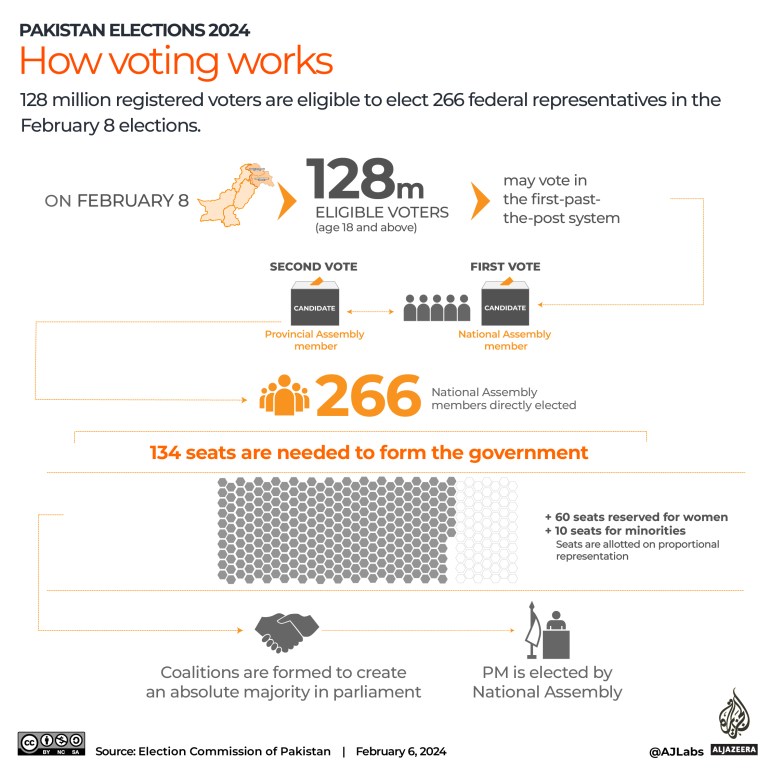
About 128 million voters were registered to vote in national and state elections amid political and economic challenges. Pakistan is counting votes in a general election marred by violence by armed groups and a suspension of mobile phone services. More than 128 million people were registered to elect representatives of the National Assembly and the nation’s four provincial legislatures. The results will appear below as soon as they are available. How voting works in Pakistan Each voter can cast two votes — one for the National Assembly and the other for the provincial assembly. The National Assembly comprises 336 seats – 266 to be decided through direct voting, while 60 seats are reserved for women and 10 for minorities which are allotted on the basis of 5 percent proportional representation in the federal parliament. A party or a coalition will need 134 seats to form the government. Breakdown of national seats Based on the results of the national census conducted in 2023, the constituencies went through a delimitation process. The boundaries of many constituencies were altered and the number of seats was reduced from 272 to 266. Punjab: 141 seats Sindh: 61 seats Khyber Pakhtunkhwa: 45 seats Balochistan: 16 seats Islamabad Capital Territory: 3 seats Who are the leading candidates to be Pakistan’s next prime minister? A crackdown on the biggest opposition party, Pakistan Tehreek-e-Insaf (PTI), and its leader, former Prime Minister Imran Khan, fuelled concerns that the polls would not be free and fair. Here are the country’s major parties: Pakistan Muslim League-Nawaz (PMLN) Nawaz Sharif, a three-time prime minister, returned to Pakistan after four years – in late 2023 – to assume the role of the head of the party. Several corruption cases that had led to his dismissal as prime minister in 2017 have since been dropped. Shehbaz Sharif, his younger brother, has also briefly been prime minister in an alliance with key opposition parties to remove Khan as prime minister in April 2022. If the PMLN forms a government, it is unclear which brother might become PM, but Nawaz will likely hold the strings either way. Seats won in 2018: 64 Seats won in 2013: 126 Pakistan Peoples Party (PPP) Bilawal Bhutto Zardari is the scion of the Bhutto dynasty. He will be leading his party after having served as foreign minister for a short period after Khan’s removal as PM in 2022. One of the youngest mainstream politicians, his campaign pays attention to climate change, gender equity in the economy, and striving for civility among parties. His grandfather Zulfikar Ali Bhutto and mother Benazir Bhutto ruled the country as prime ministers, and his father Asif Ali Zardari was Pakistan’s president from 2008 to 2013. Seats won in 2018: 43 Seats won in 2013: 34 Pakistan Tehreek-e-Insaf (PTI) Cricketer-turned-politician Imran Khan is the leader of the opposition PTI party. He is currently in jail in cases related to corruption and leaking state secrets. He led protests against the country’s powerful military after his removal from office in 2022. His conviction in a corruption case resulted in him being disqualified as a candidate. His party has ruled Khyber Pakhtunkhwa for the past decade, and the country’s most influential province, Punjab, for most of the past five years. Seats won in 2018: 116 Seats won in 2013: 28 Adblock test (Why?)
Auspicious but unlucky: The perils of a lunar new year dragon baby boom

Taipei, Taiwan – IHua Wu was born in 1976, the Year of the Dragon in the Chinese zodiac. The only mythical animal in the zodiac, which includes a rabbit, a pig and a horse, the dragon is seen as particularly auspicious. Wu is unsure whether his parents planned for him to be born that year – it was at least a pleasant surprise – but other Taiwanese parents certainly seem to have hoped for dragon children. The year 1976 was a bumper year for babies in Taiwan – 425,125 births, up from the crude birth rate of 396,479 over the 1970s. It was a noticeable reversal from a birth rate that had been slowly on the decline. “People in Taiwan kind of prefer to have kids who are dragons,” Wu said, because the dragon is known to be wise and charismatic in Chinese folklore. The least popular sign is the tiger, by contrast, with those born in those years seen as potentially wild or stubborn by superstitious parents – or grandparents. While Wu said he did not feel extra pressure at home to become a model “dragon”, his zodiac sign followed him throughout his education and into adulthood due to the sheer size of his school year. “Because we have more dragon kids in this year, we could expect for university or high school exams … more competition,” he told Al Jazeera, “Even my compulsory military service, there were more opportunities to be unlucky.” He ended up volunteering to become a paratrooper rather than risk two years stationed on one of Taiwan’s lonely outlying islands, thanks to the bumper crop of recruits in his year. IHua Wu, born in a Year of the Dragon, stands next to a statue of his zodiac animal at a temple in Taipei, Taiwan [Erin Hale/Al Jazeera] Dragon babies everywhere Wu’s experience growing up in Taiwan is one that is not uncommon for ethnic Chinese across Asia born in the Year of the Dragon. While their parents may hope for an auspicious birth, the impact of a small population spike can follow dragon babies throughout their lives. In 2017, researchers in Singapore studied the experience of ethnic Chinese “dragons” in the city-state and found that they struggled more than other zodiac signs – and that some of their bad luck spread to other minority groups. “We find that larger dragon cohorts face weaker educational and economic prospects due to greater competition,” said Tan Poh Lin, one of the authors behind the study and a senior researcher at the National University of Singapore’s Lee Kuan Yew School of Public Policy. In multiethnic Singapore, ethnic Indian and Malay Singaporeans also felt the knock-on effect of as many as 10 percent more births during dragon years, she said. Singaporean women born two years later also faced stiff competition from “dragon” men who entered the workforce at the same time, after taking time off to perform compulsory national service. “These externalities spill over to non-Chinese born in the dragon year, and since men enter the labour market two years later than women do due to National Service requirements, we also see depressed earnings among women born in the year of the horse, their labour market co-entrants,” she said by email. Tan and her team specifically studied Singapore, but similar patterns can be seen across ethnic Chinese communities and clustered around the dragon years of 1988, 2000 and 2012. Another bump is expected to start this week with the start of the new lunar new year on February 10 when the next dragon year officially starts. A not-so-ancient tradition The Chinese zodiac dates back at least 2,000 years, but the dragon baby boom is a distinctively modern phenomenon, according to researchers. The year of the first dragon boom – 1976 – also coincided with an overall upswing in East Asia and some parts of Southeast Asia as countries finally felt the positive benefit of widespread post-war industrialisation. Economists even had a name for four of its biggest stars, the “Asian tigers” of Hong Kong, Singapore, Taiwan and South Korea. “These zodiac swings… started really in the 1970s in Chinese societies,” said expert demographer Daniel Goodkind, who has studied Chinese zodiac birth patterns. “This is the fifth cycle where we’re starting to see this pattern, and it’s not just the dragon where you see these zodiac fluctuations. In Chinese societies, you also tend to see a drop in the tiger year two years before,” he said. Those born in the Year of the Dragon often face stiffer competition for places in school, even as toddlers [File: Bobby Yip/Reuters] While conducting fieldwork in Asia in 1990 on the issue – shortly after the “second dragon cycle” of 1988 – Goodkind said he struggled to find an exact answer. He recalled even asking fortune-tellers at the time if they encouraged parents to have a “dragon” baby, they would look at him confused and respond” “Why are you asking me that?” The preference “doesn’t really come from formal principles or collective wisdom”, he said. “That’s not what parents are relying on. It’s more like a folk belief based on the animals themselves.” The contemporary drive for dragon babies has resulted in some of the greatest fluctuations in Malaysia and Singapore, he said, although they are felt to varying degrees in Taiwan, Hong Kong, Brunei, the Philippines and Thailand, where at least 10 percent of the population is ethnic Chinese. China proper has been the latest entrant thanks to the impacts of the one-child policy and the Cultural Revolution, which temporarily suspended many folk practices, but parents there are now also seeking dragon babies. Indeed, rather than disappear with other superstitions, astrology has only become more popular with the passing decades – both in Asia and beyond, according to Singapore’s Tan. “Among affluent and well-educated populations from East to West, astrological services have become heavily commercialised as a form of entertainment, social activity and belief system parallel to organised religion,” Tan said. “In Singapore,
Japan’s stock market barely grew for decades. Now it’s booming

Kuala Lumpur, Malaysia – For decades, international investors shunned Japan’s stock market, whose meagre gains mirrored the country’s protracted economic stagnation. These days, Japanese stocks are the hottest game in town as the Nikkei 225 index rides a 34-year high. After limping through Japan’s “lost decades” following the collapse of a massive asset bubble in the 1990s, Tokyo’s benchmark index last year gained 28.2 percent, comfortably beating the S&P 500 in the United States. There are no immediate signs of the buying frenzy slowing down. In January, the Nikkei 225 climbed a further 8 percent, with foreign investors buying a net 956 billion yen ($6.5bn) of Japanese stocks in the span of a single week. Some market analysts believe that 2024 could be the year the Japanese stock market finally tops its 1989 peak of 38,915.87. For Japan, the world’s third-largest economy, it has been a “dramatic recovery story”, said Nicholas Smith, Japan strategist at investment group CLSA. “Profitability is recovering rapidly from depressed levels. Profit growth is growing strongly while others are stumbling. Price/earnings is relatively low and growth is high,” Smith told Al Jazeera. “What’s not to like? Companies are starting to return their cash piles to shareholders.” For foreign investors, a confluence of factors has made Japanese firms appear more attractive than they have in decades. Recent corporate governance reforms driven by the Tokyo Stock Exchange have led Japanese companies to seek to increase shareholder returns through share buybacks and higher dividend payouts. A weak yen, hovering at its lowest levels since the 1990s, has boosted corporate profits and made Japanese stocks, already cheap by international standards, even better value. Warren Buffett has invested heavily in the Japanese stock market [File: Bloomberg] Billionaire investor Warren Buffett, the most high-profile booster of Japanese stocks, cited the “ridiculous price” he was offered for stakes in Japan’s five biggest trading companies as a reason he snapped up $6bn in their shares during the COVID-19 pandemic. Under Prime Minister Fumio Kishida’s “new capitalism” drive, Tokyo has also sought to encourage a shift from saving towards investing, relaunching its Nippon Individual Savings Account (NISA) programme with higher annual investment limits and extended tax-exemption periods. There have also been signs that the Japanese economy may at last be starting to emerge from its decades-long deflationary spiral, with workers last year seeing their biggest wage increases since the early 1990s. Ryota Abe, an economist at the global markets and treasury unit of Sumitomo Mitsui Banking Corporation (SMBC), said expectations that wage growth will continue to pick up has been the biggest of several drivers of the stock market rally. “Recent events are suggesting that what has changed in the society the most is that business leaders in Japan have started contemplating more seriously the need for constant wage growth given the inflation situation and corporates,” Abe told Al Jazeera. Japanese stocks have also benefitted from the lagging fortunes of other markets, particularly China. As China’s economy grappled with challenges ranging from Beijing’s crackdowns on private industry to a slow-moving real estate crisis last year, foreign investors pulled $29bn out of the Chinese stock market, erasing 90 percent of inward investment in 2023. Still, analysts differ on how long Japanese stocks’ moment in the sun might last. Martin Schulz, a senior researcher with the Fujitsu Research Institute, said Japan’s stock market has the potential to keep delivering big returns as corporate leaders push for greater productivity and higher payouts to shareholders. “While the upside is limited in a slow growth economy, leading companies that gain from long-term trends, such as digitalisation, renewable energy, Asian economic integration, are still lagging their peers in valuation,” Schulz told Al Jazeera. “They have room to grow.” Others see a comedown on the horizon. The yen is expected to rise significantly against the dollar this year as the US Federal Reserve begins cutting interest rates, which would undercut the affordability of Japanese stocks. Taiki Murai, a doctoral researcher at the Institute for Economic Policy at Leipzig University, said Japan’s attractiveness will fade as business sentiment in the United States and Europe improves in a lower interest rate environment. “As a result, international capital flows would likely leave Japan in search of higher yield,” Murai told Al Jazeera. Japan’s economy has stagnated since the collapse of a massive asset bubble in the early 1990s [File: Kiichiro Sato/AP] There are also differing views about the extent to which Japan’s stock rally foreshadows a broad-based economic revival. After promising signs in 2023, wage growth has recently stalled. Structural issues, including a shrinking population and a rigid labour market that has resisted reform, continue to cloud the long-term outlook for growth. Smith of CLAS expressed optimism about the direction of recent economic trends. “Government, the ministries and shareholders are working together in a way I have never seen before in my 35 years in the country,” he said. Murai, the researcher at Leipzig University, said the strong performance of the stock market does not remove the serious challenges facing the Japanese economy. “Prime Minister Fumio Kishida’s new capitalism has postponed comprehensive structural reforms of the Japanese economy. Shinzo Abe, former prime minister, had also included a structural reform in his economic policy package ‘Abenomics’, but only fiscal and monetary expansions were implemented,” he said. “Moreover, there has been little or no positive news from the Japanese corporate sector regarding innovation.” Abe, the economist at the Sumitomo Mitsui Banking Corporation, said the outlook for the economy will become clearer after wage negotiations between firms and employees in the spring. “We have to continue keeping an eye on the actual expenditure as well as wages rise in the later part of this year for us to be able to see the virtuous cycle between wages and expenditure in the economy,” Abe said. “I want to see more changes in the deflationary mindset among the Japanese,” he added. “If this is the case, I will become more confident about higher stock prices.” Adblock test (Why?)
Satellite images show increase in tents of displaced people in Rafah

NewsFeed Satellite images show a dramatic increase in the number of tents of displaced people in Rafah. More than half of Gaza’s 2.3 million people are sheltering in Rafah. Published On 8 Feb 20248 Feb 2024 Adblock test (Why?)
What next for Gaza and the talks to end the war?

International negotiations continue on a possible ceasefire. Talks are under way about a possible ceasefire in Gaza – while Israel is still bombing much of the besieged territory after rejecting a Hamas offer for a lengthy pause. So what next? And when will respite come for millions of Palestinians suffering from months of bombardment? Presenter: Adrian Finighan Guests: Daniel Levy – President of the US-Middle East Project and a former peace negotiator for Israel Mustafa Barghouti – Secretary-general of the Palestinian National Initiative Akbar Shahid Ahmed – Senior diplomatic correspondent for HuffPost Adblock test (Why?)
Mapping Israel’s destruction of Gaza

NewsFeed The scale of destruction across Gaza has been described as being among the worst in modern history. Al Jazeera’s Nada Qaddourah illustrates the extent of the damage through maps. Published On 8 Feb 20248 Feb 2024 Adblock test (Why?)
Pakistan voting ends; results expected soon amid charges of manipulation

Lahore, Pakistan – After raucous protests charging pre-poll manipulation, a mobile service suspension and bomb blasts that killed at least nine people, Pakistan’s 12th general election was declared closed. The Election Commission of Pakistan (ECP) said ballot counting started soon after the closure of the polls on Thursday evening. The results are expected to start trickling in during the night. Three-time former Prime Minister Nawaz Sharif of the Pakistan Muslim League-Nawaz (PML-N) is considered the frontrunner. Sharif spoke to the media after casting his vote, declaring he never had any problems with the Pakistani military, the primary powerbroker in the country, with whom he has had major differences in the past. His path to another potential premiership was cleared after his chief political rival, ex-Prime Minister Imran Khan, was barred from participating in the election due to a conviction in a corruption case. Khan is currently in jail serving multiple sentences for a range of convictions but had urged his voters to ensure that they came out on election day. Khan’s Pakistan Tehreek-e-Insaf (PTI) also had its party symbol taken away by the ECP, but it still managed to put up independent candidates in a coordinated campaign. Earlier in the day, former Foreign Minister Bilawal Bhutto Zardari of the Pakistan Peoples Party (PPP) cast his vote in the province of Sindh, where the PPP is particularly strong. The PPP will hope it can spring a surprise and upset predictions by emerging victorious. Before the voting started at 8am (03:00 GMT), the government announced the suspension of mobile services across the country, citing security concerns. Yet there were multiple bomb blasts during the day, which killed at least nine people in the northwestern province of Khyber Pakhtunkhwa and the southwestern province of Balochistan. This followed two bomb blasts in Balochistan on Wednesday at election offices of two candidates, which resulted in the deaths of at least 27 people. After the closure of the polls, interim Prime Minister Anwaar-ul-Haq Kakar said in a statement that the elections were a “momentous occasion”. Kakar also praised the enthusiasm of the people of Pakistan and expressed appreciation for their participation in the polling process. “The high voter turnout is a clear indication of public commitment to shaping the future of our country,” he said. However, reports emerged from across the country that voter turnout had been subdued during the day. Pakistan historically has seen low voter turnout in elections. Since 1985, it has exceeded 50 percent only twice: in 2013 (54 percent) and 2018 (51 percent). Of the 128 million people registered to vote this year, more than 45 percent of them are between the ages of 18 and 35. According to election statistics, from 1997 onwards, the voter turnout of those aged 18 to 30 never surpassed 40 percent, reaching a high of 37 percent in 2018. When polling started in Pakistan on Thursday morning, all eyes were on PTI supporters. With a state crackdown on the party since May and now the imprisonment of Khan, the party’s supporters had vowed to respond through their votes. However, at more than a dozen polling stations that Al Jazeera visited until 3pm, mostly in Lahore’s middle-income and working-class localities, voter enthusiasm appeared lacklustre. In one polling station in the Mochi Gate area where nearly 1,400 voters were registered, fewer than 250 had shown up. “I have done election duties in the past, and it was never so dismal,” ECP official Mohammed Ashfaq told Al Jazeera. Several complaints emerged from Karachi, the largest city in the country, where voters alleged that polling staff at various polling stations were absent and in many places voting did not begin on time, starting as late as 3pm (10:00 GMT). “This is my third attempt to vote today. I came in the morning. There was no one here. All the rooms were empty. I came earlier in the afternoon, and the rooms were empty and polling booths weren’t set up. People were running back and forth trying to figure out which room to go to. It’s been a nightmare,” Elhaam Shaikh, 35, told Al Jazeera. While the ECP has barred exit polls in the country, the voters Al Jazeera spoke to appeared to be split between the PTI and PML-N. Ayesha Siddiqua, a teacher in Lahore, said she had been a lifelong Imran Khan fan and would vote for him regardless of what other parties have to offer. “I have been following him since his cricket days and then the cancer hospital he built,” she told Al Jazeera after casting her vote in Lahore. “For me, he can do no wrong.” Khan built a cancer hospital in Lahore in 1994 named after his mother, who had died of the disease in 1985. Another voter, Khalid Taimur, a tour guide in Lahore, said his vote was reserved for the PML-N supremo. “Nawaz Sharif gave us roads, buses, trains. He gave us infrastructure projects that helped the life of common people. His legacy is his work, which speaks for itself,” the 52-year-old told Al Jazeera after voting. In Balochistan, voter turnout for women remained low compared with the rest of the country. Tribal traditions in the province often serve as a deterrent to women moving about in public. Pakistan’s election body said that if the total female turnout in any constituency was less than 10 percent of the total votes, it might order fresh voting there. “If the total female voters’ count in a constituency remains below 10% of the total votes cast, the Election Commission of Pakistan, as per law, can void the voting in that constituency and order for re-polling,” the electoral watchdog said in a message on X, formerly known as Twitter, a day before the elections. #ECP pic.twitter.com/k9MyQMGdua — Election Commission of Pakistan (OFFICIAL)🇵🇰 (@ECP_Pakistan) February 7, 2024 Muteeba Naz, 21, came to cast her first-ever ballot in Quetta, Balochistan’s capital. “The next government’s priority should be inflation and terrorism because yesterday, over two dozen people were killed
Ukraine’s Zelenskyy names new army chief after dismissing Zaluzhnyi

President Zelenskyy thanked General Valerii Zaluzhnyi for his service, says he should remain ‘on his team’. Ukrainian President Volodymyr Zelenskyy has appointed Oleksandr Syrsky, who has led Ukraine’s ground forces since 2019, as the new head of Ukraine’s armed forces, after he dismissed General Valerii Zaluzhnyi. In a post on X, Zelenskyy on Thursday thanked Zaluzhnyi for his two years of service, and said that the time had come for changes in the military leadership. Zelenskyy said Zaluzhnyi should remain “on his team”. I met with General Valerii Zaluzhnyi.I thanked him for the two years of defending Ukraine.We discussed the renewal that the Armed Forces of Ukraine require.We also discussed who could be part of the renewed leadership of the Armed Forces of Ukraine.The time for such a renewal… pic.twitter.com/tMnUEZ3BCX — Volodymyr Zelenskyy / Володимир Зеленський (@ZelenskyyUa) February 8, 2024 Zaluzhnyi conceded that the country’s military strategy “must change” almost two years into Russia’s invasion. “The tasks of 2022 are different from those of 2024. Therefore, everyone must change and adapt to the new realities as well in order to win together,” he said after his long-rumoured dismissal was announced. The move amounts to the most serious shakeup of the top military brass since Russia’s full-scale invasion of Ukraine in Febraury 2022. “The war does not remain the same. War changes and demands change. New approaches and new strategies are needed. Today, a decision was made on the need to change the leadership of the Armed Forces of Ukraine,” Ukraine’s Defence Minister Rustem Umerov said. Zelenskyy said the new armed forces leadership team will be taking over on Thursday. He called on the country’s new military leadership to devise a strategy for this year to beat back Russian forces. “A realistic, detailed action plan for the Armed Forces of Ukraine for 2024 should be on the table, taking into account the real situation on the battlefield now and the prospects,” Zelenskyy said. Last year, he said, Ukraine managed to “regain control” of the sky, but said failed to reach objectives “on the ground”. Zelenskyy said the country needs “working rotation systems”, and a new approach to mobilisation and recruitment. Adblock test (Why?)