

Civil society urge nationwide strike, protest in Senegal after vote delay

The call for mass mobilisation comes as a major political upheaval continues in the usually stable West African nation. A coalition of Senegalese civil society groups on Thursday called for mass mobilisation against the delay to this month’s presidential poll, outlining a series of planned actions including a protest and strike. The normally stable West African nation has plunged into its worst political upheaval in decades after lawmakers backed President Macky Sall’s decision to postpone the February 25 election until mid-December. “We invite all citizens concerned by the preservation of democratic gains to mobilise en masse throughout the country and in the diaspora to prevent this seizure of power,” the newly formed platform Aar Sunu Election (Let’s protect our election) said in a statement. The collective includes some 40 citizen, religious, and professional groups, including several education unions. “A major demonstration is planned for Tuesday,” Malick Diop, who described himself as one of the platform’s coordinators, told journalists in Dakar. The speakers at the event also mentioned a call for a general strike on an unspecified date and a walkout in the education sector from Friday. The platform called on Muslims to attend Friday prayers wearing white and flying the national colours. The call comes as West African foreign ministers are holding emergency talks in Nigeria’s capital Abuja to discuss the political crisis in Senegal. Ahead of Thursday’s meeting, the Economic Community of West African States (ECOWAS) has urged Senegal – one of its most stable member states – to return to its election timetable. But critics have already questioned the group’s sway over increasingly defiant member states. Adblock test (Why?)
In Romania, some fathers opt to take on the lion’s share of childcare
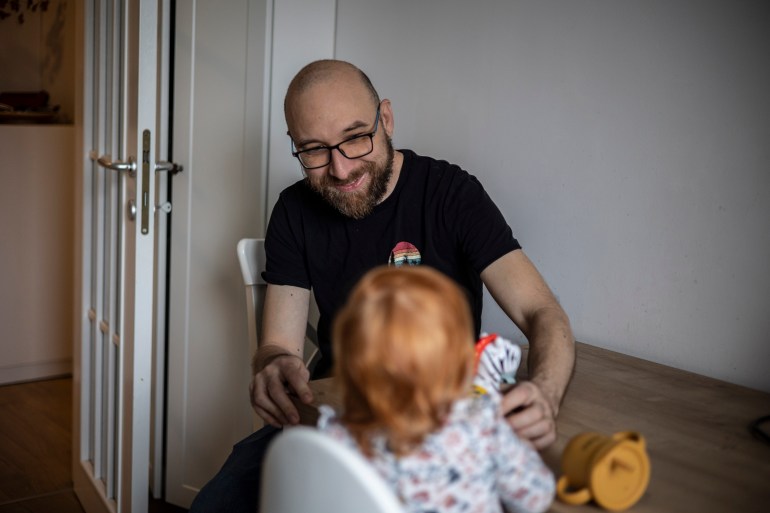
Bucharest, Romania – In an eastern Bucharest neighbourhood filled with apartment blocks, Oana wakes up and makes breakfast as her husband, Vlad, tends to their baby, a little girl named Mara. After a nappy change and with full bellies, father and daughter head to the park. Oana switches on her laptop and in a flash, the living room is transformed into an office as she hosts Zoom meetings for the public relations agency she operates. In 2022, 36,507 fathers and 223,100 mothers took parental leave in Romania, according to data provided by Romania’s Ministry of Labor and Social Solidarity. The trend continued into 2023, with 33,689 men and 201,108 women taking parental leave between January and October. Maternity leave is 126 days, with 85 percent of a salary paid. Paternity leave is a far shorter 15 days. But beyond these periods, either mothers or fathers can opt to take childcare leave until their infant blossoms into a two-year-old toddler. Typically, mothers take childcare leave. “[But] I am 40 and I feel that I have accomplished enough things, so I would not be frustrated for being home for a while with my daughter,” said Vlad, explaining why Oana’s career was prioritised. Vlad is among a growing number of Romanian dads who are opting to take parental leave [Lola García-Ajofrín/Al Jazeera] At 33, she has just started her own communications company. “I run a small business, and I could not put it on pause for two years,” Oana said. Most of her income comes from the company’s earnings. Parental and childcare allowance only applies to salaries. Romania’s parental leave is among Europe’s longest. By comparison, women in Austria receive 16 weeks of paid maternity leave, after which either parent can take unpaid parental leave until the child is two. In Bulgaria, paid maternity leave is 58 weeks. When it comes to fathers, Spain is home to the longest paternity leave in Europe, which at 16 weeks is the same for maternity. Sergiu, a 24-year-old father in Brasov, is also on parental leave, looking after his one-year-old. “The first six months we managed things together. Since then, I am in charge,” Sergiu said proudly. His partner is 20 and studying medicine. “We agreed she could follow further more classes if stay home with the toddler,” he said. For Gabriela, 34, an actress who gave birth in October, and her partner, Silviu, 34, a pharmacist manager, there was only one option. “I am a freelancer, and in Romania if you don’t work under a permanent contract, you are inexistent for fiscal administration,” said Gabriela. “The most challenging part will be not to go to work”, said Silviu, who started his leave allowance in January. “And for the rest, we will wait and see what happens.” “We go with the flow but I don’t think we found a rhythm yet,” Gabriela said, adding that while grandparents visit, the bulk of the childcare is down to them. Silviu and Gabriela take their baby for a walk on a snowy day in Romania’s capital, Bucharest [Lola García-Ajofrín/Al Jazeera] Sweden’s parental package is considered pioneering: paid leave for 480 days. Fathers who enjoy the time to look after their children, often with a coffee in hand, have been nicknamed “latte dads”. Romania’s latte dads can usually be seen in parks. While playing with Mara on a seesaw, Vlad said their decision will be useful in the long term, “for the relationship I am building with my daughter”. Near them, another two fathers play with their respective children. “I did not have something like this with my father,” he said. Diana, meanwhile, opted to take the extended leave because in her family, she’s the higher earner. “This two-year parental leave is a blessing”, said Diana. “I have a permanent job and a better salary.” But in a quip that could be heard among mothers the world over, she added: “Among all my female friends there is a lot of frustration because we are doing everything … It is so easy having children when playing is the only thing you do with them.” Raluca Popescu, a sociology professor at the University of Bucharest, said it is “remarkable” that men often choose to take parental leave, “especially in rural areas”. While she would like to think that this trend could represent a better work-life balance, “considering the whole picture of gender equality in Romania, this explanation becomes hard to believe”. Popescu, who was pregnant when she was researching parental leave, said men are more involved now rather as a “strategy of adaptation to the lack of resources”. In many cases, men are more likely to be the only employed partner in the household, meaning they can benefit from paid allowance. In other cases, they probably earn less than the mother and so a decision is made to sacrifice some of his salary instead, she said. Romania’s parental leave is the expression of reforms throughout history, from socialism until the country’s entry into the European Union. Professor Anca Dohotariu, who has studied maternity leave, said that during the socialist era, Nicolae Ceausescu, the former authoritarian president, aimed to boost the Romanian population by implementing a strict pro-natalist policy and limiting abortion, while also exerting pressure on women’s participation in the workforce. “We got this very long maternity leave, but they were more interested in children than in women’s position in the labour market,” Dohotariu said. “They were obsessed with the needs of children.” She lauded the current parental leave as providing an incentive to fathers, but warned “it is not enough to make sure that fathers get more involved in parental obligations”. Romania’s parental leave package is considered generous, but some families still struggle [Lola García-Ajofrín/Al Jazeera] In 1965, maternity leave of 112 days was introduced, but it was exclusively for mothers. Romanian fathers have only had the right to paternity leave since 2000. In 1992, the EU adopted a directive on maternity leave for the first time, entitling mothers with a minimum of
UN committee urges Russia to end ‘forcible transfer’ of Ukrainian children

Kyiv claims 20,000 children have been taken from Ukraine to Russia without families’ or guardians’ consent. The United Nations Committee on the Rights of the Child has urged Russia to end the forcible transfer of children from occupied areas of Ukraine and return them to their families. Last month, a panel of 18 independent experts pressed Russia on deportation allegations while reviewing its record. Their conclusions, published on Thursday, called on Russia to “put an end to the forcible transfer or deportation of children from occupied Ukrainian territory”. Russia, which launched a full-scale invasion of Ukraine in February 2022, has argued that “placements for evacuated children are arranged, first and foremost, at their request and with their consent”. Yet Kyiv has alleged that 20,000 children have been taken from Ukraine to Russia without the consent of their families or guardians, and the International Criminal Court (ICC) is seeking the arrest of Russian President Vladimir Putin for alleged illegal deportation of children, an accusation the Kremlin denies. Russia’s commissioner for children’s rights, Maria Lvova-Belova, is also accused of abducting children from Ukraine and has been issued an arrest warrant by the ICC. The UN committee demanded that Moscow investigate war crimes allegations against Lvova-Belova but did not mention Putin. [Al Jazeera] The committee also asked Moscow to provide information about how many children were taken from Ukraine and where they are living, so “parents or legal representatives can track them, including through identification of such children and registration of their parentage, and ensure that children are returned to their families and communities as soon as possible”. They expressed concern at the impact that Russia’s war in Ukraine is having on children, outlining the “killings and injuries of hundreds of children as a result of indiscriminate attacks … with explosive weapons”. However, Russia has argued that it has only been protecting vulnerable children from a warzone. In January’s hearing in Geneva, the head of the Russian delegation, Alexey Vovchenko, the labour and social protection deputy minister, denied that any Ukrainians were forcibly removed from their country. He said 4.8 million residents of Ukraine, including 770,000 children, had been taken in by Russia. But UN committee chairperson Ann Skelton said the committee members and the Russian delegation had been “talking past one another” at the meeting. “We found often in the dialogue that we were using one type of terminology and they were using another,” she said. “We were using the word ‘adoption’, and they were denying that it’s adoption and talking about ‘fostering children’.” Last year, the UN added Russia to a list of countries that violate children’s rights in conflicts, referencing boys and girls who were killed during attacks on schools and hospitals in Ukraine. Adblock test (Why?)
Haitian PM calls for calm as violent protests demand his resignation

Rallies have paralysed the country amid calls for ouster of Ariel Henry in line with political agreement forged in 2022. Haitian Prime Minister Ariel Henry has called for calm in a public address as violent protests have erupted across the country demanding he step down. Henry’s brief speech did little to appease the thousands of Haitians angry and frustrated over growing gang violence and deepening poverty with no general election in sight. “I think the time has arrived for all to put our heads together to save Haiti, to do things another way in our country,” Henry said on Thursday without elaborating. He encouraged Haitians not to view the government or national police as their enemies. Those who choose violence, destruction and killing people to take power are “not working in the interests of the Haitian people”, he added. The legislature is empty after the terms of its last 10 senators expired in January 2023. The country failed to hold planned elections in 2019 and 2023, and Henry assumed power with the support of the international community after the July 2021 assassination of President Jovenel Moise. According to an agreement in December 2022, Henry was supposed to hold elections and pass power to newly elected officials on February 7 this year. A day after that deadline, Henry pledged to hold general elections as soon as the country’s security issues are resolved and congratulated police for their efforts on fighting gangs, promising he would keep pushing for the United Nations-backed deployment of a Kenyan police force. “I want to reassure everyone the government will do whatever it can for the mission to come as fast as possible,” he said. Thousands of people have held daily protests this week calling for Henry to leave and warned they would continue to take to the streets until he steps down. February 7 is an important day in Haitian history. On that date in 1986, former dictator Jean-Claude Duvalier fled to France, and in 1991, Jean-Betrand Aristide, Haiti’s first democratically elected president, was sworn in. Henry has held onto power, and an aide said the prime minister intends to form a national unity government. On Wednesday, five agents from an environment agency, an armed government bureau now in open rebellion, were killed in a shootout with national police in the capital, Port-au-Prince. Lionel Lazarre, the head of the Synapoha police union, told The Associated Press news agency that the environmental agents had opened fire after police asked them to drop their weapons, prompting officers to shoot. Last week, Henry called on the agency to register with the Ministry of the Environment in an apparent crackdown against the body. In recent weeks, former coup leader Guy Philippe, who was repatriated to Haiti late last year after serving about six years in a United States prison, has also been rallying supporters for a “revolution” against Henry’s government. Adblock test (Why?)
Suspect in Boston femicide case escapes from police custody in Kenya

Suspect was jailed and awaiting a ruling on a US extradition request after being accused of killing his girlfriend in Massachusetts. A Kenyan national awaiting extradition to the United States after being accused of killing his girlfriend and leaving her body in a car at a Boston airport has escaped from police custody in Kenya, police say. Kevin Kangethe, 40, slipped out of the police station and jumped into a privately owned minivan, Nairobi police chief Adamson Bungei said on Thursday. A search for him began immediately. Four police officers who were on duty at the station are in custody and have recorded statements, according to a police report seen by The Associated Press. The officers said that about 4pm (13:00 GMT) on Wednesday, a man named John Maina Ndegwa introduced himself to the officers as Kangethe’s lawyer and said he wanted to speak with his client. “The officers agreed to his request and removed the prisoner from the cells and took him to [an] office … leaving them there. After a short while the prisoner escaped by running away and left the [lawyer] behind,” the report said. Officers pursued Kangethe but did not catch him, the police report said, adding that Ndegwa was arrested. Bungei said he rushed to the station when he learned of the escape. “We have arrested the officers who were on duty when he escaped to explain how it happened. It is just embarrassing to us,” he said. Kangethe had been detained pending a ruling on whether he should be extradited to face a first-degree murder charge in connection with the death of Margaret Mbitu on October 31. Mbitu, a health care aide in Halifax, a town in the US state of Massachusetts, was last seen leaving work on October 30 and was reported missing by her family. The preliminary investigation showed Mbitu had left her workplace and travelled with Kangethe to Lowell, Massachusetts, where he lived, the prosecution said. Massachusetts State Police said in early November that Kangethe had left her body in a car at Logan International Airport and boarded a flight to Kenya. Massachusetts officials said they were working with Kenyan authorities to locate him, and he was arrested in a Nairobi nightclub on January 30 after being on the run for three months. A Kenyan court approved a police application for him to be detained for 30 days while an extradition request was heard. Police have been ranked as Kenya’s most corrupt institution for decades, and his escape raised suspicions that bribes were paid for his freedom. Other suspected killers have escaped police custody in the past. On October 14, 2021, Masten Wanjala, who had confessed to killing 10 children in his hometown of Bungoma in western Kenya, reportedly escaped from police cells in Nairobi under unclear circumstances. A mob in his hometown traced him to a house and beat him to death a couple of days later. Adblock test (Why?)
‘We’re waiting to be martyred’: Palestinians await Israeli attack on Rafah
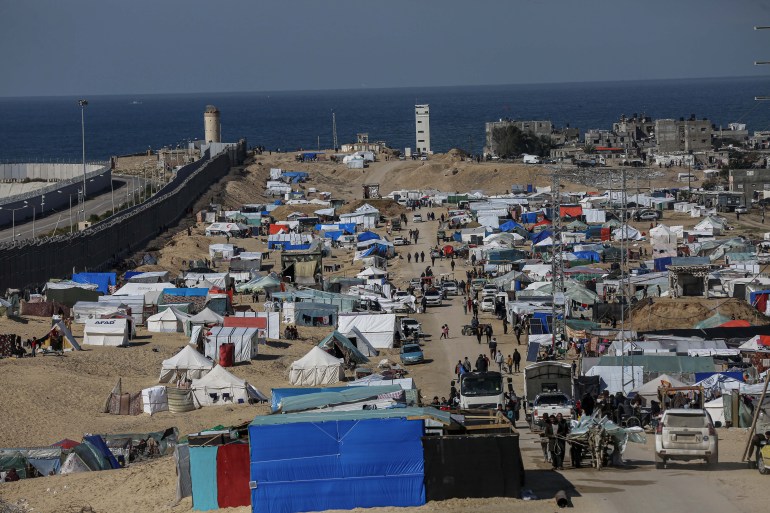
Rafah, Gaza Strip – Seham al-Najjar and her family have nowhere else to run if Israel intensifies its assault on Rafah, a town in southernmost Gaza. Like 1.8 million people, Seham fled to Rafah in search of relative safety from Israel’s relentless bombardment and ground invasion in other parts of the Gaza Strip. She arrived weeks ago with 20 members of her family from Khan Younis, a city that Israel designated as “safe” at the start of the war and then reduced to rubble in December. Seham fears that Rafah could suffer an even worse fate. Israeli Prime Minister “Benjamin Netanyahu wants to take this area from [Palestinians] and give it to the Zionists,” Seham, 30, told Al Jazeera. “Nowhere in Gaza is safe.” Hundreds of thousands of Palestinians in Rafah are bracing for an Israeli onslaught that could add to the long list of atrocities committed in Gaza, according to rights groups and United Nations agencies. They said Israel has deliberately and disproportionately targeted civilians in Gaza in retaliation for Hamas’s surprise attack on Israeli communities and military outposts on October 7, in which 1,139 people were killed and 240 taken as captives into Gaza by fighters from the Qassam Brigades and other armed Palestinian groups. More than one million people are sheltering in the Rafah area, facing extreme overcrowding and very difficult living conditions [Abdelhakim Abu Riash/Al Jazeera] Israel has responded by killing 27,000 Palestinians and injuring more than 66,000 in attacks that have reduced most of Gaza to rubble, including homes, hospitals, museums and universities. The carnage has killed more than 1 percent of Gaza’s population in just four months, prompting the International Court of Justice to warn last month that genocide is “plausible” in Gaza. The UN says “everything must be done” to halt a planned offensive on Rafah, but Israel has disregarded the concerns and killed scores of people in the city already. “Gaza is one of the most densely populated places on Earth, and Rafah is now the most densely populated place in Gaza. Any sort of military campaign or air strike would amplify risks of disproportionate attacks,” said Omar Shaki, the Israel-Palestine director at Human Rights Watch. Looming catastrophe Feryal al-Najjar, 42, said she fears her son and six daughters could die at any moment. The family has been displaced multiple times since October 7, first fleeing their home in Jabalia refugee camp to Khan Younis, where they took shelter in a factory for a couple of months. With Khan Younis increasingly pounded by Israeli forces, they realised there was no safety to be had there, and they left for Rafah, where most of the displaced civilians are staying in schools and residential buildings or sleeping in tents pitched on cold streets. Potable water is in short supply, and people have to survive on very little [Abdelhakim Abu Riash/Al Jazeera] “This is the last place in Gaza… If they attack us here, then where else can we go?” Feryal asked. “We’ll have to stay here and die.” Even if Israel delays its offensive on Rafah, thousands of civilians could die of starvation in Gaza. Most have little access to food or clean water due to Israel’s policy of blocking the delivery of aid. Israel has also razed farm areas as part of what Human Rights Watch said is a broader policy of using starvation as a weapon of war – a war crime. “Every day for the last four months”, Feryal said, “we heard news that there may be a possible ceasefire, but one never arrived. “Now we need a ceasefire. Enough of this nonsense.” Qatar, Egypt and the United States are working to broker a truce between Israel and Hamas, which would see an exchange of Israeli and Palestinian captives as well as the scaling-up of aid to the besieged enclave. Talks are ongoing, but a deal does not appear imminent. Waiting to die? Netanyahu says Israel wants to control the Philadelphi Corridor, the strip of land on the border between the Gaza Strip and Egypt, to ensure that Hamas cannot smuggle weapons into Gaza. The people who have fled to Rafah are terrified of Israel’s attacks [Abdelhakim Abu Riash/Al Jazeera] But any operation to control that border may drive hundreds of thousands of Palestinians over the border into Egypt, according to Palestinians in Gaza and Egyptian officials. Egyptian President Abdel Fattah el-Sisi has consistently been against “the dilution of the Palestinian cause” by driving Palestinians off their lands and leaving them to fight for their right of return as past generations of Palestinian refugees are doing. Egypt said Israel should allow Palestinians to return to northern Gaza before any sort of military operation begins in Rafah. Cairo also warned that any attempt by Israel to control the Philadelphi Corridor risks upending the 1979 Camp David Accords, a peace deal between Egypt and Israel that demilitarised the border. “It’s hard to anticipate what the next step is going to be [for Egypt] should such an Israeli attack [on Rafah] materialise,” said an expert on Egypt, who requested anonymity due to the sensitivity of the subject. “Egypt’s agency is limited in this situation.” Meanwhile, Seham is living with her fears that the world is going to allow Israel to commit massacres in Rafah. “We are waiting to be martyred,” she said. “We know that wherever we go and whatever we do, we’ll be killed.” [embedded content] Adblock test (Why?)
Panic in hemmed-in Rafah as Israel PM orders troops to prepare ground entry

UN chief says ground invasion of city would widen the ‘humanitarian nightmare with untold regional consequences’. Panic is growing in Rafah over an imminent ground invasion after Israel’s prime minister ordered his military to prepare to enter the city in the southern Gaza Strip that is sheltering 1.2 million people with nowhere else to go as he rejected Hamas’s truce plan and rebuffed US efforts to reach a deal. A new round of talks aimed at securing a truce with Hamas were set to open on Thursday in Egypt after Prime Minister Benjamin Netanyahu said Israel will not end the war and will push on until “total victory” over the Palestinian group. Visiting United States Secretary of State Antony Blinken insisted on Wednesday that he still saw “space for agreement to be reached” and was meeting on Thursday in Tel Aviv with Israel’s war cabinet members Benny Gantz and Gadi Eisenkot to discuss the release of captives being held in Gaza. “We are on the way to an absolute victory,” Netanyahu said on Wednesday, adding that the operation would last months, not years. “There is no other solution.” Israeli air strikes overnight on Rafah – which Israel had once declared a safe zone for displaced Palestinians – killed 14 people, including five children. Al Jazeera’s Hani Mahmoud, reporting from Rafah, said: “What people are experiencing in the southern part of the Gaza Strip is a surge in attacks from air, land and sea.” Safia Marouf, a displaced Palestinian who sought refuge in Rafah with her family after being uprooted from their home farther north, said she is afraid of what’s to come. “The children are scared all the time, and if we want to leave Rafah, we don’t know where to go. What will be our destiny and that of our children?” United Nations Secretary-General Antonio Guterres said a ground invasion of Rafah would “exponentially increase what is already a humanitarian nightmare with untold regional consequences”. ‘Critical phase’ Al Jazeera’s Hashem Ahelbarra said the meeting in Egypt indicated that “we’re moving towards a critical phase of any potential agreement between Israel and Hamas” after senior Hamas leader Osama Hamdan said a delegation was going to Cairo. “I think we have reached a point where we’re really talking about operational aspects of the agreement, and what is happening behind closed doors is a real, genuine push towards that,” Ahelbarra said. The Muslim fasting month of Ramadan in March puts “political pressure on leaders in this part of the world”, he said, adding that if Israeli attacks continue then “I wouldn’t see a chance of any deal in the near future.” Hamas had laid out a three-phase plan to unfold over four and a half months that would see the release of all captives in exchange for hundreds of Palestinians imprisoned by Israel, including senior fighters, and an end to the war. “While there are some clear non-starters in Hamas’s response, we do think it creates space for agreement to be reached, and we will work at that relentlessly,” Blinken told reporters after meeting Netanyahu to discuss the Hamas counterproposal to a truce plan drawn up by US and Israeli spy chiefs and delivered to the Palestinian group last week by Qatari and Egyptian mediators. Reporting from occupied East Jerusalem, Al Jazeera’s Rory Challands said Blinken “came to get a deal and he didn’t get it”. “He’s still going to try to bridge the huge gap between Israel and Hamas. He might be right – there might be a chance. But at the moment, he’s going back to Washington, DC, empty-handed,” Challands said on Thursday. Adblock test (Why?)
Five killed in clashes with police as protests rock Haiti

Five armed environmental protection agents were killed in clashes with police near Haiti’s capital, Port-au-Prince, as violent protests seeking the removal of Prime Minister Ariel Henry paralysed the country. Haiti has been engulfed in unrest since Monday, with thousands of people in the city and the rest of the country demanding that Henry step down in line with a political agreement forged in 2022. A police source said the five agents of the National Agency for Protected Areas (BSAP), an armed government bureau now in open rebellion, had been shot on Wednesday after refusing to drop their weapons and firing in the direction of police. Three other members of the agency were arrested. According to an agreement concluded in December 2022 following the assassination of President Jovenel Moise a year earlier, Henry was supposed to hold elections and then cede power to newly elected officials on February 7, 2024. But Henry has remained in power, with an aide saying the prime minister intends to form a government of national unity. The Western hemisphere’s poorest nation has been in turmoil for years, with armed gangs taking over parts of Haiti and unleashing brutal violence, leaving the economy and public health system in tatters. The 2021 assassination of Moise plunged the country further into chaos. No elections have taken place since 2016 and the presidency remains vacant. The protests have been called by several opposition parties and joined by employees of the environmental agency. On Tuesday evening, a police station in the northeastern province of Ouanaminthe came under attack, local media reported. Major roads and schools have been closed across the country since Monday. The Dominican Republic, which shares the island of Hispaniola with Haiti, said on Wednesday that it was reinforcing its borders due to the violence. Adblock test (Why?)
A new chapter in the Baloch struggle for justice in Pakistan

November 23, 2023 marked the beginning of a new chapter in the Baloch struggle for justice and accountability in Pakistan. On that day, the country’s Counter Terrorism Department (CTD) claimed that Balach Mola Bakhsh, a 24-year-old Baloch man who had been forcibly disappeared in October, was “killed in an encounter” with security forces in the city of Turbat in Balochistan. His family knew this could not be true, as Bakhsh had been presented to a “anti-terrorism” court by the same department just two days earlier and charged with possessing five kilogrammes of explosives. He was in state custody when he was killed. The killing of Bakhsh, and the attempts by security forces to lie about what happened to him, was not only a mockery of Pakistan’s justice system, but also a perfect example of the injustices and gaslighting our community has been facing in this country for many decades. After receiving the young man’s dead body, his family organised a sit-in protest in Turbat attended by thousands. At the protest where Bakhsh’s corpse was also present, they demanded the state investigate his death and punish those responsible. On November 25, a local court called for a First Information Report (FIR) to be registered against counterterrorism department officials, but the police defied the order. Eventually, the High Court had to intervene and get the FIR registered. Yet, the culprits who had custody of Bakhsh at the time of his death remained free (in fact, they did not face any accountability to this day). After our week-long sit-in alongside Bakhsh’s dead body in Turbat achieved no results, in the first week of December we decided to move our women-led protest to Quetta, the provincial capital. Our aim was to find justice for Bakhsh and prevent other young Baloch men like him from being forcibly disappeared and extrajudicially killed. We protested in Quetta for three days, but our cries for help once again fell on deaf ears. So we decided to move to the national capital, Islamabad. But reaching the political heart of the country proved much more difficult than we imagined. We were not breaking any regional or national laws with our peaceful march towards the capital, but the police used force to stop us anyway. At least 20 participants of our peaceful march were arrested in Dera Ghazi Khan. As the march progressed, sedition cases were lodged against many of us, including me, in many different parts of the province. However, these intimidation attempts were not successful. We continued our march, and calls for justice and accountability, because we know that inaction is no longer an option for our community. Because we know that the extrajudicial killing of Balach Mola Bakhsh was not an anomaly, a one-off tragedy, but part of a devastating pattern. Indeed, unlawful arrests, forceful disappearances and extrajudicial killings have become a routine part of life for Baloch people in Pakistan in the past 20 years. Since a flare-up in the decades-old ethno-nationalist insurgency in the early 2000s, thousands of Baloch have been forcefully disappeared, and hundreds have been brutally murdered and their bodies dumped on desolate mountains or deserted roads. Many of these corpses bore signs of torture, with limbs snapped, faces bruised, and flesh sliced or punctured with drills; some even had slogans like “Pakistan Zindabad (Long Live Pakistan)” written on their backs. My own family also suffered the consequences of these systematic attacks on the Baloch community. My father, Abdul Ghaffar Lango, who was a political activist for the ethno-nationalist Balochistan National Party (BNP), was forcefully disappeared from outside a hospital in Karachi, Sindh Province, in December 2009. At the age of 16, as the eldest among my six siblings, I embarked on a desperate struggle to find my father. My family asked the police to register an FIR, but they refused. We then turned for help to the Sindh High Court, which summoned top officials, including the chief of Pakistan’s intelligence agency ISI, the inspector-general of the Sindh Police, and the Sindh province home secretary, among others. But they all defied the court’s orders and refused even to register an FIR on my father’s disappearance. Nearly two years after his disappearance, in July 2011, my father’s bullet-riddled body – which bore apparent signs of torture – was recovered in an abandoned hotel in the Lasbela district of Balochistan. Despite everything my family had been through, I chose to remain silent and focus on my education. However, in December 2017, my brother, Nasir Baloch, was also forcefully disappeared. Terrified that my only brother would share the fate of my father, I decided not to stay quiet any longer. I began to campaign for justice for my father, brother and countless other Baloch men sharing the same fate with them. My decision to speak up triggered a campaign of harassment against me and my family. My brother was thankfully released and returned to us in March 2018, but the organised campaign of intimidation against me and my family continued unabated. I, alongside others in our movement, faced many baseless charges, threats and attacks over the years. And yet, I continued to talk about forced disappearances and extrajudicial killings of Baloch men because I knew the experiences of my family mirrored the experiences of hundreds of other families in our community. With the killing of Balach Mola Bakhsh in November, our principled struggle for justice entered a new phase. Now, the Baloch people are more determined than ever before to put an end to these blatant attacks on our community. Our women-led protest march reached Islamabad on December 20. Three days later, we initiated a sit-in in front of the National Press Club in Islamabad. From that day on, we faced the worst harassment at the hands of the Islamabad police. Officers attacked us with batons and tried to disperse our protest using water cannons in freezing temperatures. Some 290 protesters, including myself, were arrested, and released only after the intervention of the Islamabad High Court. The
North Korea ends all economic cooperation with South as ties hit new low

Relations have deteriorated as Pyongyang ramps up weapons development and Seoul bolsters ties with US, Japan. North Korea’s parliament has voted to abolish all economic cooperation agreements with South Korea as ties between the two neighbours sharply deteriorate. The latest decision comes after Pyongyang last month declared Seoul its main enemy, jettisoned agencies dedicated to reunification, and threatened to occupy the South during war. The Supreme People’s Assembly, which takes formal steps to adopt policy allegedly dictated by the ruling Workers’ Party, on Wednesday voted to scrap the law on inter-Korean economic cooperation, the official Korean Central News Agency (KCNA) reported on Thursday. Relations between the two Koreas have been in a deadlock, with key projects suspended for years, as Pyongyang ramps up its weapons development programmes and Seoul bolsters its military cooperation with the United States and Japan. The assembly also abolished laws on the operation of the Mount Kumgang tourism project, which offered tours and was a symbol of economic cooperation between the two sides that began in the early 2000s, drawing nearly two million South Korean visitors. The resort was built by South Korea’s Hyundai Asan. The project was suspended in 2008 when a South Korean tourist was shot dead by North Korean guards for straying into a restricted zone. The Mount Kumgang resort was once one of the two largest inter-Korean projects, along with the now-shuttered Kaesong industrial zone. During its peak, it housed the factories of 125 South Korean companies employing 55,000 North Korean workers. Seoul pulled out of the venture – launched in the wake of a 2000 inter-Korean summit – in 2016 in response to a nuclear test and missile launches by the North, saying Kaesong profits were helping fund the provocations. ‘Not rational’ North Korea last year ended a military pact signed in 2018 to de-escalate tensions near the military border which was drawn up under a truce ending the 1950-53 Korean War. South Korean President Yoon Suk Yeol on Wednesday called Pyongyang’s move “an extraordinary change” but said it was hard to understand their logic. “What hasn’t changed is that the North has tried for more than 70 years to turn us into Communists, and while doing that, it realized its conventional weapons were insufficient so they went onto nuclear development to threaten us,” he said in an interview with state TV KBS. Yoon said he was still open to engaging the North and would provide aid if needed, but added that the North Korean leadership is “not a rational group”. After years of border closures because of the COVID-19 pandemic, restarting its lucrative tourism business would offer the North a means of generating hard cash, but could now violate international sanctions imposed on Pyongyang over its nuclear and ballistic weapons programmes. Adblock test (Why?)