

In legal no-man’s land, refugees in Malaysia struggle to eat, pay rent

Kuala Lumpur, Malaysia – It is late afternoon in Kuala Lumpur and in the harsh heat, Zabi* concludes his third visit to the doctor in a month, still unsure of what is causing his excruciating stomach aches despite all his reports being normal so far. He worries about paying for the doctor as, being a refugee, he does not have much money or any medical benefits. When Zabi came from Afghanistan to Malaysia as a teenager five years ago, he had no choice but to fend for himself. His family had only enough money for one of them to flee. “I know it’s illegal for a refugee to work in Malaysia. But I have no choice as an orphan, as I have no trace of my family at the moment. I work around 18 hours a day and I hardly get paid four ringgit ($0.88) an hour,” the 18-year-old told Al Jazeera. Zabi is working as a housekeeper in a Malaysian-owned hotel in Kuala Lumpur but because he is a refugee and not officially allowed to work, he has no written contract. He has had a series of other jobs – as a security guard, in restaurants and in customer service – and lives a precarious existence, struggling to make enough money to pay his 500 Malaysian ringgit ($106) monthly rent. “After extremely exhausting long working days, Maggi instant noodles are something I eat most days,” he said. Malaysia has no formal framework for refugees, which means they are left in a legal no-man’s land where they are vulnerable to exploitation by those who do employ them. Under Malaysian law, refugees are also no different to undocumented migrants who are often targeted in official crackdowns. Malaysia has cracked down on undocumented migrants in recent years [File: Hasnoor Hussain/Reuters] Asked about refugees at the United Nations last month, the Malaysian representative defended the government’s approach and indicated that there was no room for change. “Who is the deserving refugee? Who is a deserving asylum seeker? Who is an economic migrant? Who is to determine them as such?” Foreign Affairs Ministry Deputy Secretary General (multilateral affairs) Bala Chandran Tharman told the Universal Periodic Review (UPR) in Geneva, according to the Malay Mail. Lack of legal protection While Malaysia is a member of the UN, it has never signed the 1951 Refugee Convention and there are no laws (PDF) in place to recognise and provide for those fleeing persecution and conflict. Refugees also have no right to work, attend school or access medical care. Registration with the local office of the UN High Commissioner for Refugees (UNHCR) provides some measure of protection and support, including limited access to healthcare, education and other services provided by the UN and its partners. “This is only an identity document and has no formal legal value in Malaysia,” the UNHCR website notes of the card given to all those registered with it. In 2022, the Malaysian government said all asylum seekers and refugees would need to register under the government’s Tracking Refugees Information System (TRIS), which was launched in 2017. The TRIS website talks about safety and the risk of social problems linked to the influx of refugees but suggests registration may allow cardholders to work in some, mostly unskilled, areas. “The lack of legal protection forces refugees to work illegally, and most of the jobs that they find are 3D jobs, the ‘difficult, dangerous, and dirty’ kind of work that Malaysians try to avoid,” said Jana Stanfield, the co-founder of Together We Can Change the World and founder of the Refugee Film School in Kuala Lumpur. More than 100 Rohingya refugees escaped from an immigration detention centre in Bidor this month. The UNHCR has not been able to visit the centres since 2019 [Hasnoor Hussain/Reuters] Without legal protection and proper contracts, many do not receive Malaysia’s national minimum pay (introduced in May 2022) of 1,500 Malaysian ringgit ($329) per month or 7.21 Malaysian ringgit ($1.64) an hour. Zabi, who spent five months learning English after arriving in Malaysia in 2018, says the boss at the security firm where he once worked had agreed to pay him about 1,000 Malaysian ringgit ($219) a month but never did. Even now, he is forced to do overtime, which is unpaid, and work in other roles to meet his employer’s needs. He told Al Jazeera he has to agree to these conditions, having no alternative. ‘Win-win’ More than 70 percent of the 185,000 refugees in Malaysia registered with the refugee agency are of working age. According to information gathered from refugee communities, most make a living in restaurants, retail and other service jobs as well as agriculture and construction. “It is a ‘win-win’ for Malaysia, as it would take into consideration both the humanitarian needs of refugees, whilst also benefiting the Malaysian economy as it recovers from the social and economic impact of the pandemic,” UNHCR spokeswoman Yante Ismail said in a statement to Al Jazeera about allowing the community to work legally. Malaysia has allowed certain groups of refugees to join the workforce in the past. In 2015, some Syrians were allowed to work and send their children to school under a scheme based on an initiative in the early 1990s for Bosnians fleeing the Balkan wars. “Malaysia can allow refugees to exercise their right to work under an existing legal framework … and then this can be expanded to include education and healthcare,” said Mahi Ramakrishnan, an investigative filmmaker and activist based in Malaysia. “The question is whether the government has the political will to do so.” Malaysia has millions of foreign workers who usually travel to the country on government-sponsored schemes to fill low-skilled jobs [Mohd Rasfan/AFP] In 2017, a pilot project allowed about 300 Rohingya refugees with UNHCR cards to work legally in the plantation and manufacturing sector, but was not adopted. In October, the Human Resources Ministry said refugees might be allowed to work officially in the so-called “3D jobs” amid shortages of workers
New Zealand calls on Papua rebels to release pilot kidnapped a year ago

Phillip Mehrtens, a commercial pilot with Susi Air, was taken captive from an airstrip in the troubled Indonesian province. New Zealand has called for the immediate release of pilot Phillip Mehrtens who was taken captive by fighters in Indonesia’s troubled Papua province a year ago. Mehrtens, who was flying a single-propeller plane for Indonesia’s Susi Air, was snatched from his aircraft on February 7 last year by a group of fighters from the West Papua National Liberation Army (TPN-PB) who said he would only be released if Papua was given its independence. The group, led by regional commander Elias Kogoya, later released images and videos showing Mehrtens surrounded by rebels – some armed with guns and others with bows and arrows – in remote forested areas. New Zealand Foreign Minister Winston Peters said the New Zealander had been providing “vital air links and supplies to remote communities” at the time he was kidnapped. “We strongly urge those holding Phillip to release him immediately and without harm. His continued detention serves the interests of no one,” Peters said in a statement to mark a year since the pilot was taken. The incident in the remote highlands region of Nduga, one of the most restive areas of the province, drew renewed attention to one of the world’s least-known and longest-running conflicts. Papua, whose people are ethnically Melanesian, occupies the western half of the island of New Guinea – just 200km (124 miles) north of Australia – and shares a land border with Papua New Guinea (PNG). A low-level battle for independence has been under way since Indonesia took control of the resource-rich former Dutch colony after a controversial referendum in 1969. Peters said New Zealand had been working with Indonesian authorities and others towards securing Phillip’s release. “Let me be absolutely clear,” he said. “There can never be any justification for hostage taking.” Peters’s statement came after the TPN-PB, the armed wing of the Free Papua Movement (OPM), said they had asked Kogoya to release Mehrtens, although they gave no timeframe for when that might happen. “We plan to proceed with the release based on humanity,” TPN-PB spokesperson Sebby Sambom was quoted as saying by the Associated Press news agency. “We believed that most Australians and New Zealanders support Papua’s independence,” he added. “We don’t want to be blamed by international community if the pilot dies while he is being held hostage by our fighters.” Peters said Mehrtens had been able to contact some friends and family before Christmas and had assured them that he was well. New Zealand was “exploring all avenues” to bring the pilot home, he added. Indonesia deployed police and soldiers into the highland district in an attempt to rescue Mehrtens shortly after he was taken captive and there have been a number of clashes since. Outsiders, including foreign journalists, international organisations and diplomats require special permission from Jakarta to visit the region, which is the location of one of the world’s largest gold and copper deposits. There has been a surge in violence in Papua since 2018 when rebels killed 24 Indonesian men who were building a major new road to connect the coast with the highlands. United Nations human rights experts have expressed concern about the deteriorating situation. Adblock test (Why?)
Michigan school shooter’s mother found guilty of involuntary manslaughter
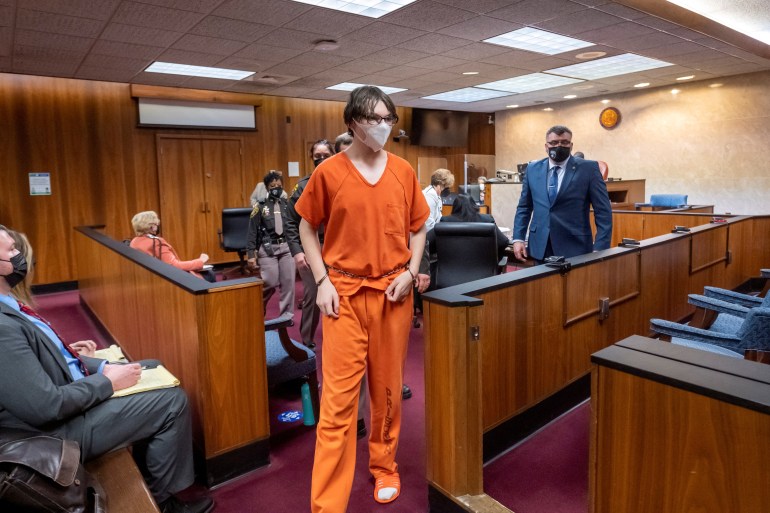
In 2021, Ethan Crumbley walked out of a toilet, pulled a gun from his backpack at school and killed four students. A Michigan jury has convicted a school shooter’s mother of involuntary manslaughter in a first-of-its-kind trial to determine whether she had any responsibility in the killing of four students in 2021. Prosecutors said on Tuesday that Jennifer Crumbley was negligent when she failed to tell Oxford High School that the family owned guns, including a 9mm handgun that her son, Ethan, used at the November 30 attack. Crumbley, 45, faced four counts of involuntary manslaughter, one for each of the victims. Her husband, James, 47, is set to face his trial next month. Oakland County prosecutors argued during the trial that the mother, despite not pulling the trigger herself, negligently stored the gun and ammunition and, therefore, should be held criminally responsible for the deaths. They said that she and her husband knew Ethan was mentally in a “downward spiral” and posed a danger to others but allowed him access to the fateful pistol. Ethan Crumbley, in Pontiac, US, February 22, 2022 [File: David Guralnick/Pool via Reuters] They added that Crumbley had a duty under Michigan law to prevent her son, who was 15 at the time, from harming others. But Shannon Smith, the lawyer for Crumbley, argued that she was not responsible for buying or storing the gun used by her son and that there were no warning signs that he would harm his classmates or to foresee a crime taking place. Crumbley testified in her defence during the trial and said her husband was responsible for securely storing firearms at home and that her son had been anxious about getting into college. During Smith’s closing arguments, she asked the jury, comprising six men and six women, including some gun owners, to find her client not guilty since her son’s crimes were “unforeseeable”. “Can every parent really be responsible for everything that their children do?” Smith asked. School shooting On the morning of the school shooting, staff members who were concerned with Ethan’s drawing of a gun, bullet and wounded man next to the words “Blood everywhere,” “My life is useless,” and “The thoughts won’t stop – help me”, on his math assignment, met the Crumbleys. According to prosecutors, Ethan’s parents were told that he needed counselling and they needed to take him home, but the couple resisted taking him and did not search his bag or ask about the gun. However, Jennifer challenged that account, telling jurors they had mutually agreed that Ethan could remain in school that day and did not think he posed a danger to other students. Hours later, Ethan walked out of a toilet, pulled a gun from his backpack and shot 10 students and a teacher, killing four students. The gun used was a Sig Sauer 9mm that his father, James, had bought just four days earlier. Jennifer had also taken her son to a shooting range that weekend. Ethan, now 17, pleaded guilty to murder and “terrorism” and is serving a life sentence. Adblock test (Why?)
Pakistan’s upcoming election explained

NewsFeed Pakistan is heading to the polls to choose its next prime minister. Al Jazeera’s Abid Hussain explains 4 things you need to know about the upcoming election. Published On 6 Feb 20246 Feb 2024 Adblock test (Why?)
Chile ex-president Sebastian Pinera dies in helicopter crash

The 74-year-old billionaire tycoon has died in a crash in the popular vacation spot Lago Ranco in southern Chile. Chile’s former President Sebastian Pinera, a billionaire tycoon who twice held the South American nation’s top job, has died in a helicopter crash, his office said in a statement. “It is with deep regret that we announce the death of the former president of the Republic of Chile,” said the statement on Tuesday, adding that 74-year-old Pinera had died in the popular vacation spot Lago Ranco, some 920km (570 miles) south of Santiago. Chile Interior Minister Carolina Toha confirmed the death of the former president. No further details were immediately released about the cause of the accident. Chile’s national disaster agency SENAPRAD confirmed that one person had been killed and three people injured. The government did not immediately name who was aboard. Pinera, also a successful businessman, oversaw quick economic growth and a steep fall in unemployment during his first 2010 to 2014 presidency, at a time when many of Chile’s trade partners and neighbours were facing sharply slower growth. His second presidency from 2018 to 2022 was marked by violent protests against inequality that led to accusations of human rights violations and ended with the government promising to draft a new constitution. Pinera was the owner of the fifth largest fortune in Chile, estimated at some $3bn. He worked as an academic in several universities for almost 20 years and as a consultant for the Inter-American Development Bank and the World Bank. As a businessman in the 1970s through the 1990s, he worked in a variety of industries, including real estate. He held shares in major airlines as well as telecommunication, real estate and electricity companies. He also created one of the largest credit card companies in the country. In 2009, he handed over the management of his businesses to others. He entered politics representing the centre right, which was the civilian support of the military regime. At the same time, he distanced himself from the 1973-1990 rule of General Augusto Pinochet, when more than 3,000 suspected leftists were killed or “disappeared.” Pinera ran three times for president of Chile. In 2006, he lost to socialist Michelle Bachelet; then in 2010, he defeated former President Eduardo Frei. Four years after his first term, in 2018, he won a second four-year term after defeating a leftist independent. Twelve days before the beginning of his first term, an 8.8 magnitude earthquake and a tsunami claimed the lives of 525 people and devastated the infrastructure of central-southern Chile. Pinera’s government agenda was postponed in order to take on emergency reconstruction. In 2010, he also led the unprecedented rescue of 33 miners trapped for 69 days at the bottom of a mine in the Atacama desert, which captured the world’s attention. The event became a global media sensation and was the subject of a 2014 movie, The 33. He closed his administration having created an estimated one million jobs. Adblock test (Why?)
US ‘deeply troubled’ by photo of injured Palestinian

NewsFeed The US State Department says a photo of an Israeli soldier standing over a stripped and wounded Palestinian in Gaza is ‘deeply troubling’. Published On 6 Feb 20246 Feb 2024 Adblock test (Why?)
Who should step in to end the humanitarian crisis in Sudan?

War has forced millions from their homes and to the brink of starvation. The war in Sudan has created one of the world’s worst humanitarian crises. More than nine months of fighting between the army and paramilitary Rapid Support Forces has pushed almost five million people to the brink of starvation. The World Food Programme says the number of Sudanese going hungry has doubled since the violence began in April. Insecurity and restricted access have made aid agencies’ operations nearly impossible. Humanitarian organisations are appealing to the international community to increase their funding – and not forget about Sudan as other wars dominate the world’s attention. So, what can be done to ease the suffering of the Sudanese people? Presenter: Tom McRrae Guests: Hajooj Kuka – Spokesperson for Emergency Response Rooms, a youth-led volunteer network delivering aid in Sudan. Raga Makawi – Editor of African Arguments, a pan-African online news platform. William Carter – Sudan country director for the Norwegian Refugee Council. Adblock test (Why?)
UN envoy in Iraq to step down at end of May, says country ‘on a knife edge’

Jeanine Hennis-Plasscha urges cessation of attacks, ‘reining in armed actors operating outside state control’. The head of the United Nations political mission in Iraq, Jeanine Hennis-Plasschaert, has told the Security Council she expects to step down at the end of May, adding the country was “on a knife edge”. The former Dutch defence minister was appointed by UN Secretary-General Antonio Guterres in late 2018. The UN Assistance Mission for Iraq aims to advance inclusive political dialogue and helps coordinate humanitarian and development aid. “For Iraq to further continue on its path of stability and progress, an enabling environment will prove essential. And, such an environment requires restraint from all sides,” Hennis-Plasschaert told the 15-member Security Council on Tuesday. Iran-aligned groups, known collectively as the “Axis of Resistance”, have been waging attacks against Israeli and US targets from Lebanon, Yemen, Iraq and Syria, since Israel began its war in Gaza following the Hamas attack on October 7. Washington responded with attacks in a cycle of escalating violence that Iraqi officials said threatened to undo progress towards stabilising the country after decades of conflict. “While we are, of course, aware that many authorities and actors seek to limit further escalation, it is clear that the situation remains volatile. Iraq – indeed, the wider region – remain on a knife-edge, with the tiniest miscalculation threatening a major conflagration,” Hennis-Plasschaert said. There was an “urgent need to cease attacks, be they originating from within or outside” of Iraq, she said, adding, “And, as stated many times in past years, this must include reining in armed actors operating outside state control.” Security Council permanent members Russia and China have criticsed the US for its recent air raids on targets in Iraq and Syria. The two countries accused Washington of raising the risk of regional escalation at a meeting of the Security Council late on Monday. Moscow claimed that the US decision to launch the attacks was linked to the upcoming presidential election in November. Russia had requested the council meeting after the US launched dozens of attacks against Iran-aligned targets in Iraq and Syria. The raids followed a drone attack on a US base in Jordan that killed three soldiers. The US air raids, which killed more than a dozen people, including civilians, demonstrate Washington’s complete disregard for international law, Moscow’s UN Ambassador Vassily Nebenzia said. He accused the US of seeking to draw Middle Eastern powers, including Iran, into a regional conflict. The United States invaded Iraq and toppled leader Saddam Hussein in 2003, precipitating years of rebellion and fighting among Iraq’s ethnic and religious groups. It withdrew its troops in 2011, but sent thousands back after ISIL’s surge into the country three years later. Adblock test (Why?)
Kenya religious cult leader, 29 others charged with murder of 191 children

The 191 children were among the 425 victims found in the Shakahola forest in coastal Kenya last year. Kenyan cult leader Paul NthengeMackenzie and 29 associates were on Tuesday charged with the murder of 191 children whose bodies were found among hundreds of people buried in a forest. The defendants all denied the charges brought before a court in the coastal town of Malindi near the Indian Ocean. One suspect was found mentally unfit to stand trial and has been ordered to return to the Malindi High Court in a month. Prosecutors said Mackenzie ordered his followers to starve themselves and their children to death so that they could go to heaven before the world ended, in one of the world’s worst cult-related disasters in recent history. The former taxi driver turned self-proclaimed pastor has already been charged with “terrorism”, manslaughter as well as child torture and cruelty. He was arrested in April last year after bodies were found in the Shakahola forest. Autopsies revealed that the majority of the 429 victims had died of hunger. But others, including children, appeared to have been strangled, beaten, or suffocated. The case, dubbed the “Shakahola forest massacre”, led the government to flag the need for tighter control of fringe denominations. A largely Christian nation, Kenya has struggled to regulate unscrupulous churches and cults that dabble in criminality. Adblock test (Why?)
Argentina president Javier Milei says plans to move embassy to Jerusalem

Javier Milei made the remarks upon his arrival to Israel, where is he set to meet Prime Minister Benjamin Netanyahu. Argentina President Javier Milei has announced plans to shift his country’s embassy to Jerusalem as he embarked on a visit to Israel. The 53-year-old economist, who upended traditional politics to win election last year, was greeted warmly by Israel’s Foreign Minister Israel Katz at Ben Gurion airport near Tel Aviv. Milei, on his first official visit since taking office barring a brief swing through the Davos economic forum in Switzerland, said, “My plan is to move the embassy to west Jerusalem.” Confirmation of the widely expected announcement found favour with Prime Minister Benjamin Netanyahu, whose office said he “warmly welcomes” the move. “The prime minister spoke about this with President Milei after his election, and welcomes the fact that the president has kept his promise,” a statement read. Right-winger Netanyahu and the libertarian Milei, who has been compared with former US president Donald Trump – who moved the US embassy to Jerusalem in 2018, are set to meet for talks on Wednesday, with the aim of deepening ties between the two countries. After his arrival, Milei headed to the Western Wall in occupied East Jerusalem’s historic Old City, the holiest place where Jews can pray. His trip will also see him visit a kibbutz and meet families of hostages taken by the Palestinian armed group Hamas when it attacked southern Israel on October 7, killing at least 1,139 people according to an Al Jazeera tally based on official Israeli figures. The group, which governs Gaza, seized about 240 other people as hostages. After the Hamas attack, Israel launched a devastating bombardment and ground offensive on Gaza, while severely restricting supplies of water, food and aid to the territory. The campaign has reduced much of the territory to rubble and displaced more than 80 percent of Gaza’s residents. More than 27,500 people have been killed in the Israeli assault, and more than 66,000 others have been wounded, according to Palestinian authorities. Palestinian group Hamas said it “strongly condemns” Milei’s announcement. Hamas, the group that governs Gaza, said it viewed the move “an infringement of the rights of our Palestinian people to their land, and a violation of the rules of international law, considering Jerusalem as occupied Palestinian land”. Milei, known for his fiery speeches and wild sideburns, describes himself as an “anarcho-capitalist”. He was raised in a Catholic family but has studied Jewish scripture. After his election win in November, he visited the tomb of a revered rabbi in New York – a popular spiritual destination for some Jews. Argentina’s Jewish community is 250,000 strong and one of the largest in Latin America. From Israel, Milei heads to Rome on Friday for a meeting with Prime Minister Giorgia Meloni, and a private audience with Pope Francis. Milei has previously criticised his fellow Argentinian but toned down his rhetoric more recently. Adblock test (Why?)