

Former British PM Liz Truss announces new political movement ahead of polls

Ex-PM Liz Truss unveils ‘Popular Conservatism’ movement, urges Conservative Party to shift to the political right. Former British Prime Minister Liz Truss has announced a new movement aiming to push the ruling Conservative Party more toward the right of the political spectrum. Truss – Britain’s shortest-serving leader, who was in office for only 49 days- announced the “Popular Conservatism” movement on Tuesday alongside former Business Secretary Jacob Rees-Mogg. She said it was time to listen to voters and return to traditional conservative values on issues such as immigration, climate change and state regulation. “The fundamental issue is that for years and years and years … Conservatives have not taken on the left-wing extremists,” Truss said at the party’s launch. “And the problem is when we don’t know what we stand for, when we’re not prepared to stand up for conservative values, who is?” she asked. Truss blamed her colleagues in the party for trying to be “popular at London dinner parties” rather than defending conservative ideals and challenging “wokeism” and climate narratives. Rees-Mogg attacked human rights legislation, and railed against the “international elite”, adding that the “age of Davos man is over”. Tory Deputy Party Chairman Lee Anderson, who also attended, argued that Britons care little about hitting net-zero carbon targets. Truss’s brief stint as prime minister was marred by a damaging mini-budget that sunk the pound and affected financial markets. Since leaving office, Truss has urged the government to cut taxes, disregard net-zero commitments and increase the retirement age from its current age of 66. But she remains a deeply unpopular politician among the British public, which faces a cost-of-living crisis that economists say her budget was partly responsible for. Prime Minister Rishi Sunak speaks during a press conference in Downing Street in London on January 18, 2024 [File: Stefan Rousseau/Pool via Reuters] The Conservative Party, which has been in power for almost 14 years, is currently lagging behind the opposition Labour Party in the polls ahead of the general election later this year. The creation of a new conservative group in a party already divided over immigration and Brexit is another obstacle for Prime Minister Rishi Sunak and his attempts to bring his party together before the election. Last month, Truss ally MP Simon Clark urged Sunak to step down before the election. However, the new movement has said they are not calling for Sunak to be replaced as Tory leader. The director of Popular Conservatism, Mark Littlewood, said that the group had not been formed to influence the leadership of the party and wanted Sunak to lead it into the election. Adblock test (Why?)
Nigeria vs South Africa: CAF AFCON 2023 semifinal preview

Who: Nigeria vs South AfricaWhat: CAF AFCON 2023 semifinalWhen: Wednesday, February 7, 2024, 17:00 GMTWhere: Stade Bouake, Ivory Coast Nigeria have a major concern over the fitness of African Footballer of the Year Victor Osimhen ahead of the Africa Cup of Nations semifinal with South Africa on Wednesday. The Super Eagles striker missed the squad’s flight from Abidjan to Bouake on Monday after complaining of abdominal discomfort. Before that, the 25-year-old had been ever present for his side at the tournament and has scored 21 goals in 32 international appearances. “Team medics confirmed that he has been placed under close watch with a member of the medical team staying behind in Abidjan with him,” Nigeria said on Tuesday on the social media platform X. “He will join the rest of the squad before 5pm, if cleared by tomorrow [Wednesday] morning.” Members of the team traveled from Abidjan to Bouaké today via a 10pm Air Cote D’Ivoire flight. Osimhen did not however make the trip as a result of an abdominal discomfort. Team medics confirmed that he has been placed under close watch with a member of the medical team staying… pic.twitter.com/G39LqaKcVA — 🇳🇬 Super Eagles (@NGSuperEagles) February 5, 2024 Osimhen, who was the leading scorer in Serie A last season with champions Napoli, has scored only once in five matches so far at the tournament. His performance and work rate, however, were praised as “fantastic” by his coach Jose Peseiro after the 2-0 round of 16 victory against Cameroon. Peseiro added that the striker’s ability off the ball is just as prolific as his goal-scoring ability. “Nobody can win a match alone – everyone has to play – but he is a good example,” the coach said. This is Nigeria’s record-equaling 16th semifinal appearance in their 20th AFCON tournament. Only seven-time champion Egypt has played as many semifinals although the Pharaohs have played in 26 tournaments. Wednesday’s game against the Bafana Bafana is a repeat of the semifinal in 2000 when Nigeria won 2-0 in Lagos. Nigeria won the last of its three titles in 2013 while South Africa’s only win came in 1996. 𝙏𝙊 𝙏𝙃𝙀 𝙎𝙀𝙈𝙄-𝙁𝙄𝙉𝘼𝙇𝙎! 🔥 Four teams. One aim. ✨#TotalEnergiesAFCON2023 pic.twitter.com/YGNyqzUsDc — CAF (@CAF_Online) February 3, 2024 South Africa have grown into the tournament after an opening 2-0 defeat against Mali in the group stage. Bafana Bafana finished second in their group thanks to a goalless draw with Tunisia in their final match, which eliminated the 2004 finalists. Tournament favourites Morocco were overcome in the round of 16. South African coach Hugo Broos admitted that another victory, the quarterfinal win on penalties against Cape Verde, was his side’s worst performance at the tournament as he believed nerves got the better of the players. Broos himself is no stranger to AFCON success and does appear to have the Midas touch at the competition. The former Belgium international won the continental title with Cameroon in 2017, taking a side given little chance before the start all the way to the winners podium and now, seven years later, has led equally unfancied South Africa to the last four. Before the tournament, Broos, who was handed a five-year contract in 2021, had won 11 of 22 games and, after initially using players only under 26 to rebuild the side, was forced to abandon those plans when the youngsters were not delivering. But his Cup of Nations record is impressive even if the statistics belie some lucky escapes. His Cameroon side reached the knockout stage in 2017 only after a brilliant last-gasp save by young goalkeeper Fabrice Ondoa denied hosts Gabon the winner after they struck the post in the last minute. Cameroon went on to edge Senegal in the quarterfinals on penalties and then beat Ghana and Egypt to win the title. After Bafana Bafana advanced to the semifinals, Broos’s Cup of Nations record now reads five wins and five draws with a single loss in 11 games over the two editions. South Africa were fortunate to see off Cape Verde on Saturday when goalkeeper Ronwen Williams made an astonishing series of saves in the post-match shootout. The stopper also pushed a late Blue Sharks effort onto the bar in the dying seconds of normal time. Many believed the round of 16 match-up between Osimhen and Cameroon and Manchester United goalkeeper Andre Onana was going to be one of the highlights of the tournament. Onana, though, was benched for the second consecutive game. All of Nigeria and all neutrals around the world will be hoping a face-off between Williams and Osimhen is not also denied by the latter’s medical concerns. Our first training session in Bouake, at Lycee Technique. Semi final loading… #TotalEnergiesAFCON2023 #AfCON2023 #BafanaPride pic.twitter.com/HmoomTmXTE — Bafana Bafana (@BafanaBafana) February 5, 2024 Form Nigeria remain unbeaten at the tournament after their win against Ivory Coast along with two draws in the group stage. Cameroon were overcome 2-0 in the round of 16 while Angola were seen off 1-0 in the quarterfinals, which means the Super Eagles have not conceded a goal since their tournament opening draw with Equatorial Guinea. Similarly South Africa’s strength has been their defence, and they too have not conceded since their opening loss to Mali. The penalty win against Cape Verde in the quarterfinals will have put a lot of fatigue into the Bafana Bafana bodies, especially after the momentous win against Morocco in the round of 16 Nigeria: D W D W W South Africa: D W D W W Nigeria team news Osimhen’s abdominal complaint overshadows the build-up to the semifinal, and it will be all eyes on the Super Eagles striker to see if and when he departs Abidjan to link up with the squad in Bouake. Predicted XI: Nwabali, Ajayi, Troost-Ekong, Bassey, Aina, Onyeka, Iwobi, Sanusi, Simon, Lookman, Osimhen South Africa team news South Africa have no new injury complaints going into the semifinal. Fatigue will be their greatest concern after the victory on penalties against Cape Verde. Whether that influences
Nevada’s duelling Republican primary and caucus thwart Haley-Trump rematch

The latest contest in the United States presidential primary season is set to be a Republican doubleheader, with not one but two races in a single state. The problem is, only one will carry weight in the battle for the party nomination. This week, Nevada, a battleground state in the southwest, is set to host both a Republican primary and a Republican caucus — rival events poised to spur voter confusion. The US already has a notoriously idiosyncratic election process. In the lead-up to a presidential election, candidates compete for delegates in state-level votes in order to receive major party nominations. Whoever wins the most party delegates becomes the nominee. Typically, states hold either a primary or caucuses to determine how their party delegates are divided up. But a clash between Nevada’s state politicians — and the Nevada branch of the Republican Party — has resulted in both a primary and a caucus being held. But on February 6, Nevada will organise a state-run primary, as mandated by a recent state law. However, the Republican Party is protesting the vote and will award no delegates to the victor. Two days later, however, the party will host its own caucuses: a series of meetings where registered voters gather, debate and decide which candidate to support. The winner will receive all of the state’s 26 delegates. With former United Nations ambassador Nikki Haley competing in the primary — and ex-President Donald Trump in the caucus — the top two Republican candidates are effectively in two separate state races. Why are there two races? The duelling events underscore a schism between the Republican Party in Nevada and state election officials. In 2021, Nevada’s state legislature — which was dominated by Democrats at the time — passed a law that required the state to hold a presidential primary. That represented a major break from tradition, as the state had held party-run caucuses for decades. But officials argued the change was necessary: Caucuses are relatively rare and widely criticised for being inaccessible, as they require voters to attend in-person meetings to participate. Democrats also pointed to delays in the announcement of the 2020 caucus results as justification for the switch. The Republican Party in Nevada swiftly raised concerns that the state-run primaries did not require voter identification and allowed mail-in voting. It argued that both factors could lead to widespread fraud, a position that has been regularly disproven. However, the new law mandating state-run primaries did not preclude parties from continuing to hold caucuses. So that is exactly what the Republican Party did. “The caucus requires Voter ID and features paper ballots, completely transparent vote tabulation, same-day results and no mail-in ballots or same-day registration,” the state Republican Party said in a statement in October. “It is a crucial event in the political calendar because it provides Nevadans with a unique opportunity to voice their preferences and play a pivotal role in shaping the direction of our country.” What’s the benefit of having a caucus? Critics have argued that the state’s Republican Party opted to hold caucuses because that style of contest is more likely to benefit Trump. Caucuses require a significant time investment from voters. As a result, they tend to attract more committed political supporters. Some observers have also noted the chair of the state Republican Party, Michael McDonald, is an avid Trump supporter. He and five other Republicans falsely certified a 2020 victory for Trump in the state, a move for which he was later indicted. Under McDonald, the party has set strict rules for candidates to participate in the caucus. Presidential hopefuls had to cough up a $55,000 entry fee to take part. The Republican Party also prohibited candidates from participating in both the primary and its caucuses. Haley, who opted to run in the primary, said, “The caucuses have been sealed up, bought and paid for.” “That’s the Trump train rolling through that,” she said in New Hampshire, adding her campaign will focus on the states that are “fair”. Her campaign is instead focused on the fourth race in the Republican primary calendar, in her home state of South Carolina. She previously served as governor there. Haley previously placed third in the Iowa caucuses and lost to Trump by 11 percentage points in New Hampshire. Could both Haley and Trump win? Yes, they could each win their own separate races. But only the caucuses matter for the eventual party nomination. Haley is running essentially unopposed in the Nevada primary, although registered Republicans could opt for a “none of the above” option in the voting booth. In the party-run caucuses, Trump is expected to crush Ryan Binkley, a Republican pastor leading a long-shot campaign. So is it a done deal? On the surface, the two Nevada races are relatively inconsequential, but a few scenarios could make the outcomes interesting. The news website Axios reported disquiet in the Trump camp: Campaign officials fear that confusion and poor organising could result in a low turnout — which could, in turn, raise questions about Trump’s appeal in the key battleground state. Meanwhile, if Haley performs comparatively well in the state-run primary, she could give Trump’s campaign a black eye. For its part, Haley’s campaign has barely poured any resources into Nevada. That could be a mistake though, according to Nevada political analyst John Ralston. “Truth is [Nevada] should have mattered, but Haley botched the opportunity,” he wrote on the social media platform X. “Early states are NOT about delegates, but about momentum and narrative.” Adblock test (Why?)
Israel should be disqualified from Eurovision 2024: European politicians

The organisers of the Eurovision Song Contest are under increasing pressure to exclude Israel from this year’s competition as it wages a devastating war on Gaza. More than 20 politicians wrote to the European Broadcasting Union (EBU) on Tuesday saying Israel’s participation in the contest “whitewashes a regime that is carrying out ethnic cleansing in Palestine and committing war crimes and genocide”. European Parliament members and politicians from Spain’s left-wing Podemos party are among the signatories of the letter seen by Al Jazeera. The annual contest is set to take place in May at Sweden’s Malmo Arena after Swedish singer Loreen won last year. The politicians behind the letter acknowledged that the EBU, which is a group of public media organisations, wants Eurovision to remain a non-political event. “However, the Eurovision Song Contest did veto Russia’s participation in the contest from 2022 in response to its invasion of Ukraine. Also, in 2019, Iceland was fined by the festival organisers because the Icelandic contestant displayed a Palestinian flag at the Eurovision Song Contest in Tel Aviv,” they said. “Israel’s participation is in clear conflict with what the EBU claims to stand for, as it misinforms about Israel and conceals its genocidal behaviour,” they added. Thirty-seven countries will participate this year. Israel became the first non-European country to participate in 1973 and hosted the pop culture event in Tel Aviv in 2019. Entry to the contest is open to all members of the EBU. Besides the European politicians, musicians in Sweden, artists in Finland, and protesters in Norway and Ireland have sent letters to the EBU urging public broadcasters to exclude Israel from the contest. Iceland, meanwhile, is reconsidering its participation if Israel is allowed to compete this year. At the time of publishing, the EBU had not responded to Al Jazeera’s request for comment. Israel accuses everyone of terrorism to continue massacring the Palestinian people with total impunity. We must prevent its participation in any international event that allows it to whitewash its barbarism, such as Eurovision. pic.twitter.com/g8A1BiUCSh — Ione Belarra (@ionebelarra) February 4, 2024 ‘Boycott Eurovision’ Eurovision, which began in 1956, is an international music pageant watched and adored by millions of viewers. But this year, some fans said they will join protests against Israel by boycotting the contest and turning off their screens should it be allowed to participate. “I’m a huge Eurovision fan. It should just be a bit of fun, but we all know behind the glitz and glamour, geopolitical games are at play,” Ciara Greene, a Belgium-based fan told Al Jazeera. “The day after Russia invaded Ukraine, it was rightly excluded from the song contest. Allowing Israel to participate contributes to Israeli exceptionalism and normalises the state’s genocidal policies.” In Sweden, home to the 1974 Eurovision winner Abba, famous musicians like Robyn have also signed a letter calling out the competition’s alleged double standard. “It’s hard to not be political with music,” said Ida, a 33-year old student in the Swedish capital, Stockholm. “If Israel were to take part, I think most just wouldn’t vote for them and make their displeasure known.” [embedded content] Israel is reportedly planning to announce its entry on Tuesday. Brian Donnelly, a human rights activist in Ireland, organised a campaign designed to pressure RTE, Ireland’s representative broadcaster in the Eurovision Song Contest, into urging the EBU to disqualify Israel. “We heard this strategy worked when Russia invaded Ukraine, but in our case, we have not yet got a reply from RTE,” Donnelly told Al Jazeera. “If Israel takes part, it will help their PR campaign of normalising what they’re doing to the Palestinian people.” Claire Charles, a marketing manager from France, said Israel’s inclusion was a sign of “Western hypocrisy”. “All these public institutions are useless. Western governments are useless. Murder and occupation and war and genocide continues to happen,” she told Al Jazeera. “Excluding Russia last time reveals the blatant racism of not excluding Israel this year.” Adblock test (Why?)
Anger as Turkey marks anniversary of devastating earthquake

One year on from disaster, mourning mixes with frustration over authorities’ response. Crowds have gathered across Turkey to mark the one-year anniversary of the earthquake that devastated the country, with many people expressing anger over the authorities’ response to the disaster. In Antakya, capital of Hatay, the worst affected of the 11 southern provinces hit by the magnitude 7.8 earthquake on February 6, 2023, crowds jostled with police, calling on city mayor Lutfu Savas to resign and booing Health Minister Fahrettin Koca. The tremor and its aftershocks left towns and cities in ruins and killed more than 50,000 people in Turkey and 5,900 in Syria. Locals say the delayed response of the authorities meant that many were left to die, trapped for days under the rubble, in the freezing cold. People chanted “Can anyone hear me?” – echoing the voices of those who lost their lives while waiting for help. “We won’t forget, we won’t forgive,” the crowd declared. After a moment of silence at 4:17am to mark the time that the quake struck, carnations were thrown into the river. People gather to mark the first anniversary of the country’s catastrophic earthquake, in the city of Antakya, southern Turkey, February 6, 2024. A banner reads, ‘Can anyone hear my voice?’ [Metin Yoksu/AP Photo] ‘The disaster of the century’ The government has organised a series of events across the country to commemorate the anniversary. President Recep Tayyip Erdogan said in a post on X that the pain is still fresh. “The unity of the century was displayed in the face of the disaster of the century,” he said. Bir yıl önce yaşadığımız Kahramanmaraş merkezli depremlerde kaybettiğimiz canların acısı ilk günkü tazeliğiyle yüreklerimizi yakmayı sürdürüyor. Yitirdiğimiz 53 bin 537 canımızın her birine Allah’tan rahmet, yakınlarına ve milletimize başsağlığı diliyorum.… pic.twitter.com/19AufD6qMt — Recep Tayyip Erdoğan (@RTErdogan) February 6, 2024 Touring the earthquake zone, he planned to visit Kahramanmaras, marking the epicentre, to inspect the work being done to rebuild the city and rehouse thousands who remain in tents and prefabricated containers. He also will take part in handing over completed homes to survivors who are among the millions who were left homeless by the disaster. People whose homes were destroyed during the earthquake live in tents in Antakya, southern Turkey, January 12, 2024 [Khalil Hamra/AP Photo] Schools were closed for the day in many of the earthquake-affected provinces. However, authorities were also braced for anger. In Malatya province, the governor banned any marches or other public displays outside officially sanctioned events for three days. Adblock test (Why?)
Worst drought recorded hits Spain’s Catalonia, sparking fears and ingenuity

Barcelona, Spain – The Magic Fountain is a popular tourist attraction where coloured jets of water shot up in the air as classical or pop favourites played. Not anymore. Like fountains across Barcelona, it lies dry and a little forlorn with signs reading: “Fountain turned off due to drought”. The free musical show at the water feature, which had run for nearly 100 years, is another casualty of what Catalan authorities in northern Spain have described as the “worst drought ever”. After three years without sustained rainfall, emergency measures were brought at the weekend, which include a ban on refilling swimming pools in hotels or campsites or topping them up unless recycled water is used. The Magic Foundation, once a popular tourist spot, is closed because of the drought. The sign reads: Jets stop as a measure of savings due to drought [Courtesy: Ana Miquel] If the heavens do not open in the next few months, Spain may order two ships per day to carry water from Valencia to the Catalan capital, Barcelona port authorities said. Tourists visiting Catalonia – Spain’s most popular tourist region, which attracted 18 million visitors last year – face the prospect of swimming pool closures as experts predicted pools will inevitably run dry because of spillage and evaporation. The only exception will be swimming pools used for medical reasons. Fears for summer With the lucrative summer tourist season ahead, campsites are exploring ways to use seawater in pools. One option could be bringing seawater to top up pools, but this is expensive. Washing cars and watering public gardens were banned as part of the first stage of this emergency plan – unless the water comes from an approved recycling system. Swimming clubs with outdoor pools are exempt – for now – but are banned from using showers. Television reports showed showers being taped up so they could not be used. Beach showers were turned off. On the beach in Gava, a town south of Barcelona, Lavinia Mestre was taking advantage of unusually hot weather for February to enjoy a quick swim. “I know some people who have stopped coming to the beach because of the lack of showers. But I bring a bottle and use the seawater to get the sand off my legs,” Mestre, a 20-year-old student, told Al Jazeera. “I understand why they have turned off the showers and it is not much of a sacrifice in the middle of a drought.” ‘Worst drought ever recorded’ In Barcelona, many have been stirred into action after months without rain. As Ana Miquel waited for the water to warm in her kitchen, she collected five litres in a bottle. “We have no choice but to save the water. It is silly to waste the water when we have a chronic drought,” Miquel, 65, a retired hotel executive who lives in Barcelona, told Al Jazeera. The restrictions affect about six million people in Barcelona and 200 towns, or about 80 percent of the region’s population. Miquel Marti uses water from his shower to flush his toilet as Barcelona suffers a severe drought [Courtesy: Miquel Marti] Miquel Marti, a university lecturer in urban planning in Barcelona, believes people must change their behaviour while living in a drought. “We put a bucket in the shower to collect water then use it in the toilet. We take less water to wash up and make sure that the washing machine is not on a long cycle. We have to change the way we live,” Marti, 50, told Al Jazeera. Authorities are under no illusion about the seriousness of the drought, which has seen reservoirs in the region fall to 15.8 percent of normal levels, according to Spanish government figures. “It’s the worst drought ever recorded,” Pere Aragones, Catalonia’s regional president, told a press conference last week. The emergency measures are designed to reduce the daily amount permitted for residential uses from 210 to 200 litres (55 to 53 gallons) per person. An average 10-minute shower consumes 150-200 litres (40-53 gallons), according to the World Health Organization. Most households in Barcelona already fall well below that limit. However, hotels are using far higher amounts of water, according to a 2016 survey from Barcelona Regional, a development authority, which showed that Jacuzzis and pools in five-star establishments exceeded 540 litres (143 gallons) per guest per day. The Barcelona Hotel Guild, an industry body, hit back by publishing a report from 2022 which claimed that after years of campaigns about sustainable water use, the average daily use per person in five-star hotels had fallen to 242 litres (64 gallons). Yurbban Hotels, which has three hotels in Barcelona, has asked guests to take up the “four-minute shower challenge.” “We have decided to go a bit further and involve our guests so that they shower in four minutes,” said Javier Diaz, director of hotels and sustainability. If there are no rains before spring, the personal daily limit will be lowered to 180 litres (47 gallons), then 160 litres (42 gallons). Under the new restrictions, agricultural irrigation must be cut by 80 percent – and water use in livestock farming by half and in the industry and leisure sector by 25 percent. If triggered, a second phase of restrictions would see showers at gyms switched off. ‘Climate without rain for years’ Catalonia’s water crisis comes after Spain and other parts of Europe suffered a series of heatwaves last year that depleted reserves through evaporation while consumption increased. In Andalusia in southern Spain, a deep drought has also left authorities considering bringing in similar emergency measures. Antonio Aretxabala, a hydrology expert at the University of Zaragoza, said Spain’s water crisis was caused by a lack of rain and over-use of water for agriculture, which only accounts for 2.3 percent of the country’s gross domestic product. Ana Miquel, a retired hotel executive from Barcelona, collects water in her kitchen [Courtesy: Ana Miquel] “We have a climate without rain for years and exorbitant use of water for agriculture.
Former Thai PM Thaksin charged with royal insult

Jailed former leader the latest to face prosecution under Thailand’s strict laws protecting monarchy against criticism. Thai police have charged former prime minister Thaksin Shinawatra with insulting the monarchy over comments he made almost a decade ago. Officials said on Tuesday that the complaint concerns a 2015 interview that Thaksin gave while in South Korea. The potential charge comes just weeks before his possible release on parole. Although it is not yet clear if the case will go ahead, the jailed billionaire is the latest political figure to face prosecution under the country’s strict lese majeste laws. The complaint was filed by the military government that ran Thailand after overthrowing a government led by Thaksin’s sister Yingluck Shinawatra in May 2014. Thaksin has repeatedly pledged loyalty to the monarchy. Prayuth Pecharakun, spokesman for the attorney general’s office, told reporters that the long delay in acting on the complaint was due to Thaksin’s previous absence from the country. Backroom deal The controversial billionaire, twice a prime minister but overthrown in a 2006 coup, returned from self-exile in August last year. He was immediately jailed on corruption and abuse-of-power charges. The 74-year-old was transferred to a police hospital almost straight away and has undergone at least two operations. Prosecutors will wait for police to complete their investigation before deciding whether to proceed with the case, Prayuth said. Thaksin denies the charge and has written to the attorney general asking for fair treatment, he added. Insulting the crown is a serious offence in Thailand, where the constitution states the king must be held in a position of “revered worship”. The lese majeste law is one of the strictest of its kind in the world, carrying a jail sentence of 15 years for each perceived insult to the monarchy. Critics say the law has been weaponised to silence dissent. There has been a surge in charges under the laws – known in Thailand as “112” after the relevant section of the criminal code – since youth-led pro-democracy street protests in 2020. At least 260 people have been prosecuted under it in recent years. Thaksin’s return to Thailand coincided with his Pheu Thai Party’s return to power in a controversial deal with promilitary parties. The timing triggered rumours of a backroom deal to help Thaksin with his legal troubles. That speculation was fuelled further when the king cut his jail sentence from eight years to one year. Loved by millions of rural Thais for his populist policies in the early 2000s, Thaksin is reviled by the country’s royalist and promilitary establishment, which spent much of the past two decades trying to keep him and his allies out of power. Adblock test (Why?)
9/11 firefighter who stood next to Bush in famous images dies

Bob Beckwith was working in the smouldering ruins of the World Trade Center when George W Bush visited the site. A retired New York City firefighter who rose to fame after being photographed next to then-President George W Bush in the aftermath of the September 11, 2001, attacks has died at the age of 91. Bob Beckwith was working in the smouldering ruins of the World Trade Center three days after the attacks when Bush visited the site and gave a speech promising to hold the perpetrators responsible. “I can hear you, the rest of the world hears you, and the people who knocked down these buildings will hear all of us soon,” Bush said in remarks to rescuers scouring for survivors. Pictures of Bush speaking into a megaphone with his arm around Beckwith became some of the most well-known images symbolising the grief and resolve of Americans in the days after hijackers crashed planes into the Twin Towers. “Bob Beckwith was one of many retired FDNY [Fire Department of New York] members who responded to the World Trade Center site in the days and months following September 11 to aid in rescue and recovery as a testament to their devotion to their FDNY family,” Fire Commissioner Laura Kavanagh said in a statement on Monday. “His iconic picture with President Bush captured a moment that was both inspiring and heartbreaking. We are grateful to his service to our city and our nation, and we join his family and friends in mourning his loss.” Bush on Monday paid tribute to Beckwith, saying he had been privileged to have stayed in touch with the “decent, humble man” over the years. “When the terrorists attacked, Bob suited back up and, like so many brave first responders, raced toward the danger to save and search for others. His courage represented the defiant, resilient spirit of New Yorkers and Americans after 9/11,” Bush said in a statement posted on X. Born in 1932, Beckwith had a nearly 30-year career as a New York City firefighter. Despite retiring in 1994, he joined many other current and former first responders to help search for survivors in the hours and days after the attacks. Adblock test (Why?)
Syrian earthquake survivors still sleep outside one year on

NewsFeed Families in Syrian towns devastated by last year’s earthquake are still choosing to sleep in tents outside, one year on. They fear that another quake could strike at any moment and that they could be crushed in their sleep. The Turkey-Syria earthquakes struck the region on February 6, 2023, killed more than 50,000 people. Published On 6 Feb 20246 Feb 2024 Adblock test (Why?)
In Pakistan, old hopefuls jostle to turn around struggling economy
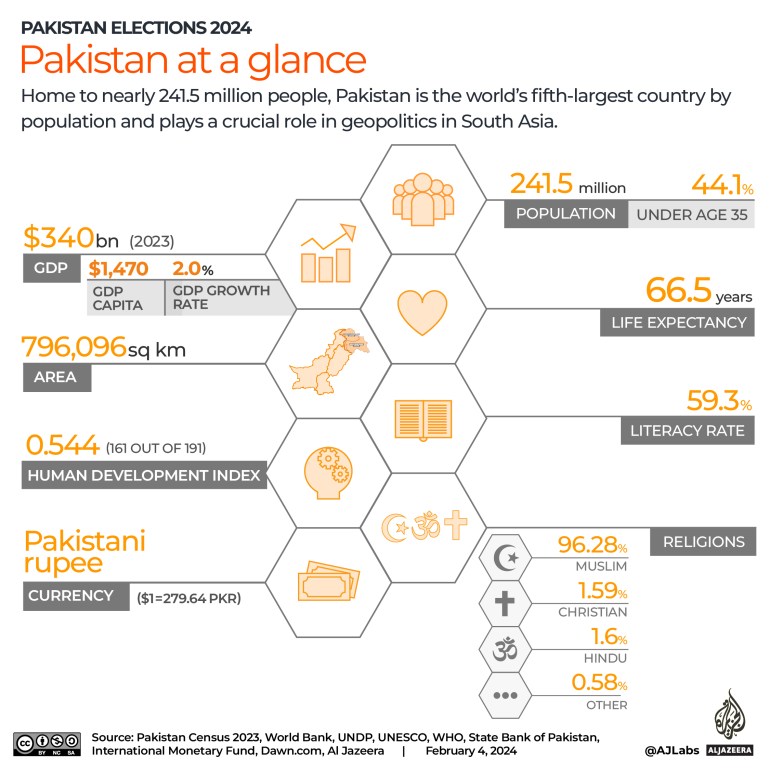
Pakistani voters head to the polls on Thursday amid a deep-seated economic crisis. Inflation is hovering at 30 percent, close to 40 percent of people live below the poverty line, and the debt-to-gross domestic product (GDP) ratio has climbed to 72 percent. Pakistan’s new government will have to contend with these and an ageing public infrastructure. “We have power outages every day for two hours,” says Muhammad Waqas, a janitor from Islamabad. “In the summer, when it’s hot, you sit idly and suffer.” As with other state-owned firms, the inability of successive governments to invest in Pakistan’s National Transmission and Despatch Company has left it prone to failure. More recently, the COVID-19 pandemic and energy supply challenges dampened Pakistan’s growth prospects and constrained efforts to diversify its export base away from low-value-added products – such as cotton and rice – to higher-value goods. In late 2022, meanwhile, monsoon floods displaced eight million people and cost the country $30bn in damage. The loss of cotton crops ravaged the country’s textile industry, a key source of exports. In all likelihood, Pakistan’s growth rate fell into negative territory in 2023. Pakistan, which imports much of its food and fuel, consistently records large trade deficits. Owing in part to elevated commodity prices, foreign exchange reserves dwindled to less than one month of imports last May, leading to shortages of vital goods. The following month, Islamabad narrowly avoided default after it secured a $3bn loan from the IMF – its 23rd fund programme since 1958. However, the lending package came with strict conditions and unpopular reforms. As part of the deal, the government agreed to impose new taxes on its faltering power sector. It also agreed to lower utility subsidies, which led to sharp hikes in electricity prices, hitting poorer households particularly hard. Inflation, which reached nearly 30 percent in December, has been climbing since the start of last year after Pakistan’s central bank agreed to liberalise its exchange rate as part of a pre-existing IMF programme. Once exchange controls were dropped, the value of the currency fell sharply. The Pakistani rupee was Asia’s worst-performing currency in 2023, depreciating by roughly 20 percent against the US dollar. “We think the rupee will continue trending down slightly,” said Krisjanis Krustins, a director at Fitch Ratings. “This will lower Pakistan’s current account deficit as goods from abroad will become more expensive, compressing import levels.” According to the State Bank of Pakistan, the country posted a balance of payments surplus of $397m last December. Krustins told Al Jazeera, “Pakistan’s goods imports fell by 27 percent in the last calendar year. As for exports, they continue to be held back by limited human capital and poor infrastructure. So, corrections in the trade account have had a depressing impact on the economy.” Recent job losses have lifted the official unemployment rate to a record high of 8.5 percent, pitching an additional 8.4 to 9.1 million people into poverty. ‘Structural issues’ Separately, Pakistan has long suffered from “structural issues”, says Tariq Banuri, professor of economics at the University of Utah. “For starters, Pakistan’s growth rate is not high enough to absorb its rapidly expanding population. It’s also one of the world’s worst performers on tax collection. Agricultural landowners are exempt from income tax, and there’s no capital gains tax on real estate.” Successive governments have stopped short of imposing robust tax legislation for fear of upsetting powerful business interests, Banuri said. “But that may change this year because of the debt situation,” he added. Islamabad’s failure to boost tax revenues and modernise state-owned enterprises has generated persistent fiscal deficits and a large debt burden. In absolute terms, external debt reached $125.7bn last year. Looking ahead, Pakistan faces $24.6bn in external debt repayments by the end of June, the bulk of which is owed to China. China is Pakistan’s largest bilateral creditor, and Beijing agreed to roll over $2.4bn in loans last year. Many economists expect the incoming government to try and secure longer-term financing from the IMF – its current deal expires in April. Given the cutbacks to public spending last year, “further fiscal consolidation is unlikely”, says Yousuf Farooq, director of research at Chase Securities. “The Fund is going to try and eke out further conditions, but probably from wealthier sections of society.” “Assuming the new government can get another IMF loan, it will struggle to repay unless it imposes new taxes on agriculture and real estate. If it can also roll over short-term contracts with longer repayment schedules, I’m hopeful that debt will fall in the near term,” he said. In the meantime, foreign investment continues to be hamstrung by security concerns along the Pakistan-Afghanistan border. Since the Taliban returned to power in Kabul in 2021, Islamabad has accused its neighbour of harbouring fighters carrying out attacks on its soil. Political crisis An unfolding political crisis is also threatening Pakistan’s economic recovery. Today, Islamabad’s fragile democracy is overseen by a caretaker government following Imran Khan’s dismissal as prime minister in April 2022. The legitimacy of the February 8 elections has been questioned as Khan is absent from the ballot sheet. He is in jail on corruption charges. And while he is disqualified from running, Khan’s approval rating stands at 57 percent, higher than any other politician. As things stand, the head of the Pakistan Muslim League-Nawaz (PMLN) – is favourite to win. Sharif’s PMLN has assumed power four times in the past three decades, under either himself or his brother Shehbaz Sharif. Earlier this month, the Supreme Court further weakened Khan’s Pakistan Tehreek-e-Insaf (PTI) campaign by banning the use of a cricket bat as its symbol – a serious setback in a country where millions of illiterate voters identify candidates by their party logos. For Banuri, the economics professor, “People are right to criticise Pakistan’s political system, which is dynastic and extractive. But for all that, I remain an optimist. I think the worst of the economic crisis is behind us.” “While I always hope tomorrow will be