

In Modi’s constituency Varanasi, India’s next temple-mosque spat explodes

Varanasi/Bengaluru, India – A festive atmosphere engulfed Varanasi, one of Hinduism’s holiest cities situated on the banks of the river Ganga. It was the week Prime Minister Narendra Modi had inaugurated the new temple to the Hindu deity Ram where the 16th century Babri Masjid once stood in the city of Ayodhya, 200km (124 miles) to the north. In Varanasi, the streets and boats on the river were decked up with saffron flags bearing illustrations of Ram. Outside Varanasi’s famous and historic Kashi Vishwanath temple, the smell of burning camphor and the sound of Indian classical music drifted through the air as pilgrims flocked in large numbers to the temple to offer their prayers. But next door, towards the west of the temple, the carnival-like spirit was replaced with a strict and sombre atmosphere, with barricades and police officers greeting crowds. The officers were guarding the Gyanvapi Mosque – which is widely believed to have been built on the ruins of a 16th-century Kashi Vishwanath temple demolished by Mughal emperor Aurangzeb in 1669. While the partially ruined Kashi temple has been reconstructed and stands adjacent to the Gyanvapi Mosque, Hindu supremacist groups have been trying to reclaim the mosque for decades. Security personnel stand guard near the Gyanvapi Mosque in Varanasi [File: Niharika Kulkarni/AFP] In May 2022, some Hindu patrons went to the Varanasi local court asking for permission to worship within the mosque’s complex after a court-ordered video survey found that a ‘Shivling’ – a symbol of the Hindu deity Shiva – was found near the wuzukhana, a well used by Muslim devotees at the mosque. This case gained momentum in January this year when a survey from the Archaeological Survey of India (ASI), among other things, stated that a large Hindu temple existed on the site before the mosque and that sculptures of Hindu deities were also present in the cellars of the mosque. Within a few days, on January 31, Judge Ajaya Krishna Vishvesha from Varanasi’s local court passed an order ruling that Hindus would be allowed to pray in the mosque’s basement – a section which had been sealed due to security concerns. “District court Varanasi has created history today,” Vishnu Jain, a Supreme Court lawyer representing the Hindu side said in a post on X. A day later, videos and images began appearing on social media of a priest offering prayers to the Hindu deities inside the mosque cellar. #WATCH | A priest offers prayers at ‘Vyas Ji ka Tehkhana’ inside Gyanvapi mosque in Varanasi, after District court order. Visuals confirmed by Vishnu Shankar Jain, the lawyer for the Hindu side in the Gyanvapi case pic.twitter.com/mUB6TMGpET — ANI (@ANI) February 1, 2024 The Anjuman Intezamia Masajid, the committee managing the Gyanvapi Mosque, rejected the local court’s order and is scheduled to challenge the case at the Allahabad High Court in the city of Prayagraj, formerly known as Allahabad, on February 6. “It seems like the judicial system is against Muslims,” Rais Ahmad Ansari, an advocate in Varanasi representing the Muslim side, told Al Jazeera. Even amid a heightened momentum among India’s Hindu supremacist movement to target mosques, often facilitated by government authorities – a centuries-old mosque was razed in New Delhi last week – the case involving the Gyanyavi structure holds deep political significance. Varanasi is the electoral constituency of Modi, who leads the Hindu majoritarian Bharatiya Janata Party (BJP) that rules the country, yet has built strong relations with the presidents and ministers of Western liberal democracies. India will vote in general elections expected to be held between March and May. ‘You can feel a Hindu vibe all around you’ While the court order hasn’t stirred any violence or communal riots, a sense of anxiety is prevalent in the Muslim neighbourhoods of the city, according to advocate Ansari. “Muslim-owned shops closed after the [January 31] hearing fearing a dispute. Friday’s namaz [prayers] was also greeted with tight security presence as hundreds gathered outside the Gynavapi Mosque to offer prayers. There is a sense of anxiety in every Muslim’s mind,” he said. “It is still peaceful in Varanasi. But this peace feels uneasy,” he added. Meanwhile, some news channels in the country hailed the local court order and the onset of prayers in the mosque as “a big win for Hindus” – a sentiment shared by several Hindus in Varanasi. “We plan to go visit the site and see the priest performing rituals at the mosque as soon as our exams end,” Ayush Akash and Harshit Sharma, two 21-year-old political science students at the Banaras Hindu University (BHU), told Al Jazeera. Nita*, a Hindu devotee at the Kashi Vishwanath temple, was also keen to pray at the temple. “We feel great about it [court ruling]. If we are let to visit and pray, we will go. When Hindus pray in Varanasi, they have their own places of worship. My brother is a priest and can only worship in his temple. But if the priest allows us into Gyanvapi, we will surely go,” she told Al Jazeera. “People here have been going crazy since the inauguration of the Ayodhya temple,” Nita said. “You can feel a Hindu vibe all around you on the streets. It was never like this before, but everybody is happy about things that are happening and that the Gyanvapi is a Hindu temple,” she added. Spectators gather to watch the nightly Ganga Aarti prayer, in which several Hindu priests twirl flaming lanterns and censers over the Ganges, in Varanasi, India [Joseph Campbell/Reuters] BHU’s Akash pointed out that people from all religions in Varanasi have coexisted peacefully for years and are mature enough not to riot over the temple-mosque dispute. “It might look like Hindus are in power, and yes, some Muslim people might be unhappy about the local court’s decision on the Gyanvapi Mosque. But in this city, while ideologies do differ, it doesn’t stop Hindu-Muslim friendship. That’s how the real Varanasi is,” he said. ‘All about politics’ Since Modi came to power
Senegal parliament delays election to December 15 after chaotic vote
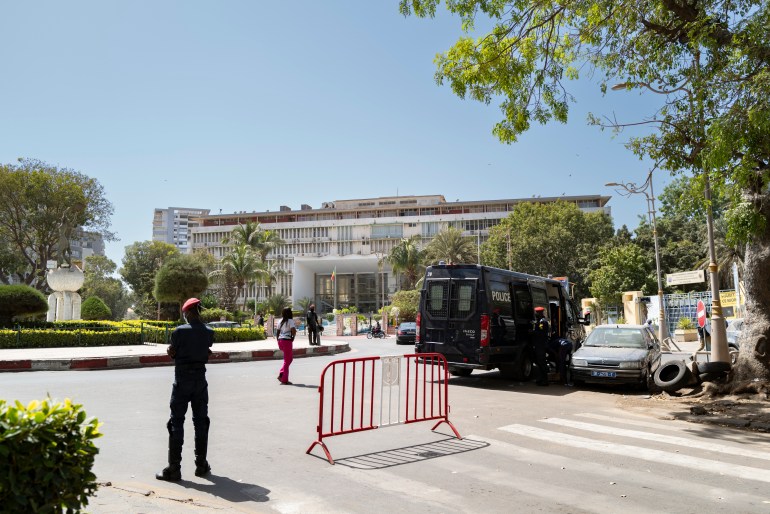
Senegal’s parliament has voted to delay the presidential election to December 15 in a chaotic vote that took place after opposition lawmakers were forcibly removed from the chamber as they debated President Macky Sall’s earlier decision to delay the crucial election. Sall announced on Saturday that the election, which was scheduled for February 25, would be postponed, pitching the West African nation into uncharted constitutional waters, and triggering violent protests. Parliamentary backing came late on Monday when 105 MPs in the 165-seat assembly voted in favour of the measure, which delays the election until December and keeps Sall in office until his successor is installed. The bill initially set an election date on August 25, and the move to delay the poll even further is likely to risk more unrest. The president, who has served the maximum two terms, was originally due to leave office on April 2. Sall has said previously he has no plans to extend his term, but protesters are sceptical. As the lawmakers debated the bill on Monday, security forces fired tear gas at protesters who had gathered outside the parliament in Dakar, burning tyres and criticising Sall. Demonstrator Malick Diouf, 37, said he had no preferred candidate and did not even have a voting card, but felt it was crucial to come out and protest. “The main thing for me is to say ‘no’ to this political agenda, this coup de force to try to stay in power,” he told the AFP news agency. Security was tight around the National Assembly in Dakar [Sylvain Cherkaoui/AP Photo] Opposition leaders had condemned the proposed delay, announced just as campaigning was due to start, as a “constitutional coup” and an assault on democracy. The mood in parliament was also tense with some deputies shoving and pushing one another, leading to a temporary recess. Security forces later stormed the building and forcibly removed several opposition lawmakers who had occupied the central dais and were trying to block the voting process. “What you are doing is not democratic, it’s not republican,” said Guy Marius Sagna, who was one of several rebel MPs wearing a sash in the colours of the Senegalese flag. Democracy at risk The postponement faced strong pushback elsewhere on Monday. At least three of the 20 presidential candidates submitted legal challenges to the delay, Constitutional Council documents showed. Two more candidates have pledged to challenge it via the courts. Authorities temporarily restricted mobile internet access from Sunday night, citing hate messages on social media and threats to public order. Several schools sent pupils home early. The private Walf television channel said it was taken off air on Sunday and had its licence revoked. “Senegal has been known as a country with a strong democracy but this is no longer the case,” one protester who only gave his first name, Dame, told Reuters. “The only thing we want is a fair election.” He said he was worried Sall would cling on to power indefinitely. The chairman of the African Union Commission, Moussa Faki Mahamat, urged Senegal to resolve its “political dispute through consultation, understanding and dialogue”. Human Rights Watch warned that Senegal risked losing its democratic credentials. “Senegal has long been considered a beacon of democracy in the region. This is now at risk,” it said in a statement. “Authorities need to act to prevent violence, rein in abusive security forces, and end their assault on opposition and media. They should respect freedom of speech, expression and assembly, and restore internet, putting Senegal back on its democratic course.” The crisis has led to fears of the kind of violent unrest that broke out in March 2021 and June 2023, which resulted in dozens of deaths and hundreds of arrests. Sall said he delayed the election due to a dispute over the candidate list and alleged corruption within the constitutional body that handled the list. The opposition Senegalese Democratic Party (PDS), whose candidate was barred from running because of dual nationality issues, supports the delay and proposed the postponement bill in parliament before Sall’s announcement. The bill passed due to backing by the ruling party and the opposition coalition, which includes PDS. Other opposition and civil society groups have angrily rejected it, with some saying Sall is trying to postpone his departure. The F24 platform, a large group of organisations behind past demonstrations, and candidate Khalifa Sall, have called it an “institutional coup”. Adblock test (Why?)
US admits it did not give Iraq notice of strikes despite earlier claims

White House National Security Council spokesman John Kirby says he regrets confusion caused by his remarks. The United States has admitted it did not notify the Iraqi government before its recent air strikes in the country after a top White House official claimed Baghdad had been informed in advance. State Department deputy spokesman Vedant Patel said on Monday that Iraqi officials were only informed after the strikes on Iranian-linked targets. “Iraq, like every country in the region, understood that there would be a response after the deaths of our soldiers. As for this specific response on Friday, there was not a pre-notification,” Patel told reporters. “We informed the Iraqis immediately after the strikes occurred.” The clarification came after White House National Security Council spokesman John Kirby on Friday said that Washington had informed the Iraqi government in advance. Kirby said on Monday that he had responded to reporters’ questions with the “information that I had been provided at the time”. “It was not as specific as it could have been, and I regret any confusion caused,” he said. “That said, we had made no secret – both to Iraqi officials and in public channels – that we would respond to the attacks on our troops. And, we did, in fact, officially notify Iraq, as appropriate with standard procedure.” US President Joe Biden on Friday ordered air strikes against 85 targets in Iraq and Syria alleged to be linked to Iran’s Islamic Revolutionary Guard Corps (IRGC) and pro-Iranian groups, following a drone attack in Jordan that killed three US troops. Iraq condemned the strikes, which officials said killed 16 people, including civilians, as a violation of its sovereignty that placed the security in the region on the “brink of the abyss”. Iraqi government spokesman Bassem al-Awadi rejected the suggestion that his country had helped to coordinate the attacks, accusing Washington of making a “false claim aimed at misleading international public opinion and disavowing legal responsibility”. Tensions between Washington and Baghdad have escalated in recent months as the Biden administration has carried out strikes inside Iraq in response to a surge in attacks on US forces since the start of the war in Gaza that it has blamed on Iran-aligned groups. About 2,500 US troops are stationed in Iraq, a legacy of the US-led coalition’s war against the ISIL (ISIS) group. Last month, US Defense Secretary Lloyd Austin said Washington would begin talks with Baghdad on the withdrawal of US-led forces in the country while maintaining security ties between the sides. Adblock test (Why?)
Prospects shaky for Philippines’ government and communist peace talks
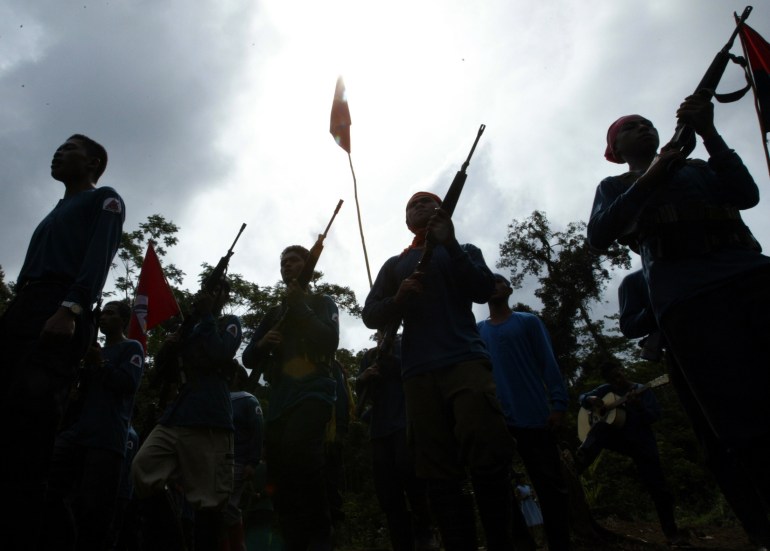
Manila, Philippines – Fighting continues between the Philippine military and communist rebels despite an agreement to resume peace talks this month in an effort to end the world’s longest-running communist armed rebellion. President Ferdinand Marcos Jr surprised many when, in November, his government announced an agreement with the National Democratic Front (NDF), the rebels’ political wing, to restart peace talks that his predecessor Rodrigo Duterte had ended shortly after taking office. In the agreement, signed in Oslo after months of secret negotiations facilitated by the Norwegian government, both parties acknowledged “the deep-rooted socioeconomic and political grievances” at the heart of the conflict and agreed to seek reforms. Since then, however, contradictory statements, public bickering and continued armed clashes between the military and the New People’s Army (NPA), the communist party’s armed wing, have tarnished hopes of an agreement. Many in the military apparatus – and especially within the government’s controversial anti-communist task force – still want to “finish off the armed conflict by physically wiping out the [NPA] forces,” Satur Ocampo, founder of the leftist Bayan Muna party-list group, told Al Jazeera. The Communist Party of the Philippines (CPP) said late last year it remained focused on “waging extensive and intensive guerrilla warfare” and rebuilding NPA forces. The NPA has been fighting the government for more than 50 years in one of the world’s longest-running insurgencies [File: Erik de Castro/Reuters] The Philippine government was “very perplexed and disappointed” by the statement, National Security Council spokesman Jonathan Malaya told reporters earlier this month. However, the military has also continued armed operations against the NPA, including December air strikes on the southern island of Mindanao that killed nine alleged rebels. Roadblocks to peace The Philippine government and NPA have been engaged for more than 50 years in a conflict that has killed more than 40,000 people. It peaked in the 1980s, during the martial law rule of Marcos’s father, the dictator Ferdinand Marcos Sr. Over the years, there have been repeated announcements of peace talks, which have then collapsed. Marcos Jr’s surprise move to reopen negotiations dovetails with the military’s stated ambition to switch its focus from domestic conflict to “external or territorial defence”, military chief Romeo Brawner Jr told reporters in November. The Philippines has shifted closer to the United States due to a series of conflicts with Chinese vessels in the disputed South China Sea, which is claimed almost in its entirety by Beijing despite an international tribunal ruling against it in 2016. Marcos initially opposed peace talks when he took office in June 2022. However, he may be growing weary after witnessing a “resurgence in armed fighting” in areas the military has claimed to have cleared, Ocampo said. “[Marcos] may be doubting the assurance of security forces that they can finish off the CPP-NPA within his term,” which ends in 2028, Ocampo said. “He’s opening up the option of seeking a negotiated settlement.” Under Philippine law, presidents can serve only one term in office. The November communique drew optimism partly because of its use of explicit language committing both parties to seek “socioeconomic and political reforms towards a just and lasting peace”. Numerous attempts at agrarian land reform in the Philippines have failed since the 1980s, leaving many rural farmers destitute and landless while families retain oligarchic control of land passed down from the colonial rule of Spain and the US. However, disagreement quickly emerged on how to institute reforms. Armed Forces of the Philippines Chief of Staff General Romeo Brawner Jr walks past honour guards during the arrival ceremony at Western Command, Puerto Princesa, Palawan, Philippines, August 10, 2023 [Eloisa Lopez/Reuters] The NDF wanted to reintroduce an agreement to distribute land forged during Duterte-era talks. But the office of presidential peace adviser Carlito Galvez Jr, which is leading negotiations, insisted the talks were “new” and a “restart”, raising concern within the NDF that he wanted to toss aside past agreements. Instead, Galvez has pitched “specific programmes that can be handled by the government and big business”, Ocampo said. “There’s nothing that touches on deep socioeconomic reforms.” National Security Adviser Eduardo Ano has also opposed removing the CPP-NPA from the country’s list of “terrorist” organisations, along with freeing currently jailed peace negotiators – positions which appear to be nonstarters for the communist side. “It is critical that Marcos rescind earlier proclamations … designating the NDF as terrorists,” a CPP spokesperson told Al Jazeera. “However, Marcos’s officials … have repeatedly expressed resistance to these measures.” Julie de Lima, interim chairperson of the NDF negotiating panel, told Al Jazeera her group was negotiating for the release of consultants needed to forge [promised] agreements on socioeconomic reforms. “It will be very difficult without that,” she said. “We still have this guarded optimism that these talks may proceed, [but] there are issues that must be resolved.” Continued conflict Last month, Marcos claimed there were no remaining active NPA fronts as of December. The government says fewer than 1,500 NPA rebels remain, although the CPP and NPA say the number is higher. The CPP spokesperson told Al Jazeera that neither side was currently seeking a joint ceasefire. De Lima, the NDF negotiator, said her panel has not been approached by the government since the November communique, and that it is “disheartening” that the peace office led by Galvez had chosen to “negotiate publicly”, referencing the secretary’s plans to collaborate with major businesses to provide socioeconomic reforms. Galvez did not respond to multiple requests for comment. “Both sides are still not trusting each other,” said Georgi Englebrecht, senior analyst at the International Crisis Group, who noted that many observers are “cautious” rather than optimistic. “But the fact we are at this stage is already progress,” he said. “Now, both sides need to show their commitment and genuine intentions.” The first step is setting an agenda, and finding realistic goals to work towards, before any talk of a ceasefire or of freeing the NDF’s negotiators, said Miriam Coronel-Ferrer, a peace negotiator who led the government’s efforts
Russia-Ukraine war: List of key events, day 713

As the war enters its 713th day, these are the main developments. Here is the situation on Tuesday, February 6, 2024. Fighting Four people were killed and at least one injured after Russia shelled the southern Ukrainian city of Kherson, local officials said. France summoned Alexey Meshkov, the Russian ambassador to France, after two French aid workers were killed in Russian artillery fire near Kherson last Thursday. Three more French citizens were also injured in the attack that Paris described as an act of “barbarism”. Russia’s FSB security service said three Russian citizens had been detained on suspicion of attempting to assassinate a high-ranking Crimean official with a car bomb. The FSB claimed Ukraine’s security service was behind the attempted attack and said the three had been charged with “terrorist” offences. It did not name the official who was allegedly the target. Politics and diplomacy The Kremlin warned Western countries that any attempt to use frozen Russian assets as collateral to raise funds for Ukraine would be illegal and lead to a Russian legal challenge. The United States and its allies banned transactions with Russia’s central bank and the Ministry of Finance, after President Vladimir Putin began his full-scale invasion of Ukraine two years ago, freezing an estimated $300bn of sovereign Russian assets. The presidential bid of antiwar candidate Boris Nadezhdin is hanging in the balance. Nadezhdin said Russia’s Central Election Commission (CEC) had informed him that 15 percent of the signatures he submitted to access the electoral race were invalid. The CEC could now block his bid to enter the election. Lawmakers from Hungary’s ruling party boycotted an emergency parliament session in which a vote on Sweden’s bid to join NATO was on the agenda. Hungary is the only member of the 31-member security alliance not to have backed Sweden’s bid. The US said it was disappointed at the move. Weapons Kajsa Ollongren, the Dutch defence minister, said The Netherlands would deliver six more F-16 fighter jets to Ukraine, taking the total number pledged to 24. “Ukraine’s aerial superiority is essential for countering Russian aggression,” Ollongren said. Georgia said it seized a clandestine shipment of explosives bound for the Russian city of Voronezh from the Ukrainian port of Odesa. It said the explosives, hidden in a cargo of car batteries, arrived in Georgia in a Ukrainian-owned minivan and were to be transported to Voronezh, about 180km (110 miles) from the Ukrainian frontier. It did not say what for. Adblock test (Why?)
UK to spend $125m on AI research and regulation

Technology minister says technology has potential to ‘transform our public services and the economy for the better’. The United Kingdom has unveiled plans to spend over 100 million pounds ($125m) on research and training related to artificial intelligence (AI). Under the plans announced on Tuesday, the government will launch nine new AI research hubs across the UK, support research projects examining the responsible use of AI in education, policing and creative industries, and train regulators on managing the risks and benefits of the technology. Secretary of State for Science, Innovation and Technology Michelle Donelan said AI had the potential to “transform our public services and the economy for the better” and produce treatments for diseases like cancer and dementia. “AI is moving fast, but we have shown that humans can move just as fast. By taking an agile, sector-specific approach, we have begun to grip the risks immediately, which in turn is paving the way for the UK to become one of the first countries in the world to reap the benefits of AI safely,” Donelan said in a statement. The announcement comes after the UK in November launched the world’s first institute dedicated to AI safety and hosted a global summit on the topic, at which more than 25 countries signed the so-called Bletchley Declaration acknowledging the technology’s risks of “serious, even catastrophic, harm”. UK Prime Minister Rishi Sunak has sought to position his country as a leader in AI regulation, arguing that only governments can properly assess the risks of the technology and possess the “power and legitimacy to keep their people safe”. Executives at leading players in AI, including Microsoft, Google and Amazon, welcomed the government’s announcement. “The hub and spoke model will help the UK benefit from the domain expertise of regulators, as well as provide clarity to the AI ecosystem – and I’m particularly supportive of the commitment to support regulators with further resources,” Google DeepMind’s Chief Operating Officer Lila Ibrahim said in a statement. “AI represents an opportunity to drive progress for humanity, and we look forward to working with the government to ensure that the UK can continue to be a global leader in AI research and set the standard for good regulation.” Adblock test (Why?)
Syria’s ‘miracle baby’ turns a year old

NewsFeed It’s been a year since Syria’s ‘miracle baby’, Afraa was born under the rubble of her home after an earthquake. Now, one year, after losing her parents and siblings, she turns one. Published On 5 Feb 20245 Feb 2024 Adblock test (Why?)
Scepticism as Gibran Rakabuming Raka runs for Indonesia’s vice presidency

Solo, Indonesia – For more than 40 years, Sarti has been cycling his pedicab around the streets of the Indonesian city of Surakarta, or Solo. It’s a tough job, especially in the relentless heat, and the wiry 67-year-old’s muscles strain as he pushes on the pedals to manoeuvre his vehicle through the traffic. Sweat drips from his brow and he puffs his way along the narrow backstreets, his passengers seated in the canopied cab in front of him. For all the effort, business can be slow, and Sarti sometimes earns just one dollar a day. Government support has been crucial for his survival, and he has nothing but praise for President Joko Widodo, better known as Jokowi, who was Solo’s mayor from 2005 to 2012. “I liked Jokowi, I liked him so much. He was such a good mayor of Solo. He would visit all the areas of the city, handing out aid and groceries to people and providing financial assistance,” he told Al Jazeera. “He really cared about people who were struggling.” But when it comes to Jokowi’s son, it’s a different story. Gibran Rakabuming Raka followed in his father’s footsteps to run for mayor of Solo in 2020 and is now a vice presidential candidate in the elections scheduled for February 14. Gibran is the running mate of former general Prabowo Subianto, who is running for the presidency for a third time [File: Adek Berry/AFP] Gibran is just 36, and despite being mayor since February 2021, Sarti says he has never met him. “He has never visited many of the poorer parts of the city, like his father used to,” he said. “Gibran picks the people he wants to help. He doesn’t help everyone. He doesn’t help all the residents of Solo.” ‘A good kid’ Solo, despite its stature as the former home of the president and the historic royal capital of Java, is a relatively small city with a population of about half a million people. Known for its old-world charm, it boasts two royal palaces, is renowned for the quality of its traditional batik and is surrounded by rice fields. When Gibran, the eldest of Jokowi’s three children, announced that he was planning to run as Solo’s mayor, many residents were surprised, even those who had known him since he was a child. “He is a good kid, all of Jokowi’s children are. They are polite and hard workers, but I was surprised when he became mayor of Solo because I thought it was too soon for him to hold that kind of office,” Slamet Raharjo, a longtime friend of the family, told Al Jazeera. “Logically, you have to take it step by step. You can’t create leadership in a moment. It is a psychological process that takes time, but he has been forced to grow up quickly.” Gibran, who was born in 1987, had never appeared to harbour any political aspirations. Sarti has been riding his pedicab around the streets of Solo for more than 40 years [Al Jazeera] He studied at secondary school in Singapore and then in Australia before returning to Singapore and earning a bachelor’s degree in management. Most expected him to join the family’s now famous furniture business, as his father had done. Instead, Gibran opened a catering business in 2010, and five years later a chain of pancake shops. Markobar, as he called the business, focused heavily on digital marketing, but has since closed. Local residents laughed when asked if Gibran had ever personally fried any of the sweet treats. Markobar had been designed to appeal to a social media crowd and featured signature dishes of eight and 16 flavours such as chocolate and green tea, priced from $2.50 for a single topping. In a city where the pancakes, called murtabak, are known as a cheap street food snack, Markobar was considered expensive. While the pancakes flopped, local residents say Girban’s tenure as mayor has been more successful. They say he made efforts to improve the city by further developing infrastructure and public transport, as well as designing initiatives to foster inclusivity. These included setting up decorations in front of the town hall to celebrate various religious holidays, including during the Christmas period, which some saw as an effort to enhance religious tolerance in a country where 87 percent of the population is Muslim. Still under probation Fransiskus Xaverius Hadi Rudyatmo, who was deputy under Jokowi and took over from him in 2012 until 2021, told Al Jazeera that he had been blindsided when Gibran’s vice presidential candidacy was first mentioned. “I was disappointed when Gibran ran for the vice presidency. He isn’t old enough and has only been mayor for two years. If you work in an office for two years, you are still in your probation period,” Rudyatmo said. Fransiskus Xaverius Hadi Rudyatmo was Jokowi’s deputy when the president was mayor of Solo [Al Jazeera] When Gibran originally stood for mayor, Rudyatmo said that he rallied behind the young candidate because they were both members of Indonesia’s Democratic Party of Struggle (PDI-P), a secular-nationalist party that champions workers’ rights across Indonesia. But he was shocked when Gibran announced that he would run as a vice presidential candidate alongside three-time presidential hopeful Prabowo Subianto, who was twice beaten to the presidency by Jokowi and is leader of the Gerindra Party, and backed by Golkar, which has close ties to the Indonesian military and was the ruling political group under former presidents Soeharto and BJ Habibie. Following the shock announcement, PDI-P said that Gibran had left the party, which already had candidates for president and vice president in the form of Ganjar Pranowo, the governor of Central Java, and Mahfud MD, the current coordinating minister for political, legal and security affairs, as vice president. Many wondered whether Jokowi, who had advanced to the very top with PDI-P, had shifted his support away from the party in favour of his son and Prabowo, a former general, although he has not
King Charles diagnosed with cancer

NewsFeed Buckingham Palace says King Charles is undergoing treatment for an unspecified form of cancer. In a statement, the palace said the diagnosis was confirmed while the king was being treated last month for a separate health issue. Published On 5 Feb 20245 Feb 2024 Adblock test (Why?)
Robinson, Pelosi and the sham of Western progressive politics

Politicians love to talk. It’s a big part of the job. You talk in legislatures. You talk at committees. You talk to voters. You talk to reporters. If you’re lucky, you’re asked to talk on TV, the radio, or other popular platforms. Politicians crave the attention. It’s validating. It means that you’re important. You’re a somebody with important things to say. You’re noticed. People listen. Politicians know that the bigger their job, the more careful they have to be when they’re talking to an audience – however small or large. That’s especially true if you’re a cabinet minister or a “leader”. Too much unscripted talking can be dangerous. So, more often than not, what politicians say while they’re talking is forgettable or worse, meaningless. They have to stick to their talking points. They adore cliché. Still, there are moments when politicians get too comfortable. They get complacent. They slip up and say something candid and revealing about who they are and what they actually think and believe. Fortunately, two politicians opted for refreshing bursts of honesty over the standard rhetorical gruel this past week. One is Canadian. The other is American. You probably don’t know the first politician. The second is quite well-known. Both were talking, in a roundabout way, about what is happening in Gaza. The first politician’s name is Selina Robinson. She is, as of this writing, the minister of post-secondary education in the “socialist” provincial government of British Columbia, Canada. On January 30, Robinson was talking on Zoom as part of a panel of Jewish politicians organised by a pro-Israeli advocacy group. She was among “friends”, talking to and with “friends”. In one remarkable swoop, Robinson not only rewrote history, but trafficked in a familiar racist trope. Before the engineered birth of Israel, she said, Palestine was “a crappy piece of land with nothing on it”. “There were several hundred thousand people but other than that, it didn’t produce an economy … it couldn’t grow things. It didn’t have anything on it, and that it was the folks who were displaced that came and the people who had been living there for generations and together they worked hard,” the minister said. Translation: 700,000 idle Muslim and Christian Palestinians had, for generations, squandered the chance to make the desert bloom. Happily, it flowered after the arrival of “displaced”, hard-working Israelis who “were offered” the “crappy piece of land”. Since she said what she said, Robinson has stopped talking – in public, at least. Instead, the minister has had to watch and listen to a lot of other people talking about how and why she must resign. Even the pro-Israeli outfit that invited Robinson to talk has more or less abandoned her, reportedly telling a CBC reporter that: “The comments made by Minister Robinson … do not reflect the opinion of our organization.” You know you have talked too much when your once-close “friends” cut you adrift. So, Robinson did what politicians have to do when they give fulsome voice to what they think and believe: she made a grovelling apology on X. Robinson wrote that her “flippant” and “disrespectful” comments had “caused pain”. “I regret what I said and I apologize without reservation.” Few are convinced by Robinson’s belated, performative act of contrition, including two of her “socialist” colleagues in Ottawa. One member of parliament (MP) is demanding a “reassessment” of her place in cabinet. Another MP pilloried Robinson for “an appalling disregard for the horrific violence being inflicted on Palestinians”. Robinson’s boss, the premier of British Columbia, is also talking. He said that the minister’s remarks were “wrong”. Rather than fire her, the premier is giving Robinson a good talking to. He told her, in effect, to keep talking. “She’s got some work to do to go out to the community to address the harm that her comments have caused,” he said. In other curious words, the premier wants Robinson to talk her and the government’s way out of a prickly jam. Right. That should do it. The second chatty politician is the former speaker of the US House of Representatives and the grande dame of Congressional Democrats, Nancy Pelosi. She did her troublesome talking in the ever-agreeable studios of CNN’s Washington bureau on January 29. The influential “Speaker Emerita” was asked to comment on those pesky, mostly young demonstrators who have been interrupting President Joe Biden with chants of “Genocide Joe” at campaign stops and address whether she was “concerned that they might just stay home” in the fast approaching presidential election. A condescending Pelosi promptly played the victim card, saying: “I have been the recipient of, shall we say, their exuberance in this regard … they’re in front of my house all the time.” Poor, pampered Pelosi. The “Speaker Emerita” compounded her, shall we say, disdain with a lecture, claiming that unlike the “exuberant” rabble, she and other serious types on Capitol Hill were required to “think” about “how to try to stop the suffering in Gaza”. Poor, misunderstood Pelosi. Apparently, she “thinks” that a “ceasefire” would not “stop the suffering in Gaza” since that’s what Russian President Vladimir Putin “would like to see”. Pelosi’s McCarthyite-smear-laden logic is loathsome and bizarre. What, apart from a ceasefire, is going to “stop the suffering in Gaza” – with or without Putin’s blessing? Silly, exuberant me, but I can’t “think” of anything other than a “ceasefire” that will “stop the suffering in Gaza”. Pelosi ought to have stopped talking. Thankfully, she didn’t. She then proved that behind every America-flag-pin-wearing speaker emerita, there lies an Alex Jones-like conspiracy theorist who is convinced that the homeland is awash with fifth columnists disguised as citizens exercising their constitutional rights to challenge a sitting president. “I think some of these protestors are spontaneous and organic and sincere,” Pelosi said. “Some, I think, are connected to Russia.” Again, Pelosi ought to have stopped talking. Thankfully, she didn’t. Not done tarring millions of her fellow, albeit “exuberant”, Americans of Arab, Muslim, and Palestinian