

Somalia rejects mediation with Ethiopia gov’t over Somaliland port deal
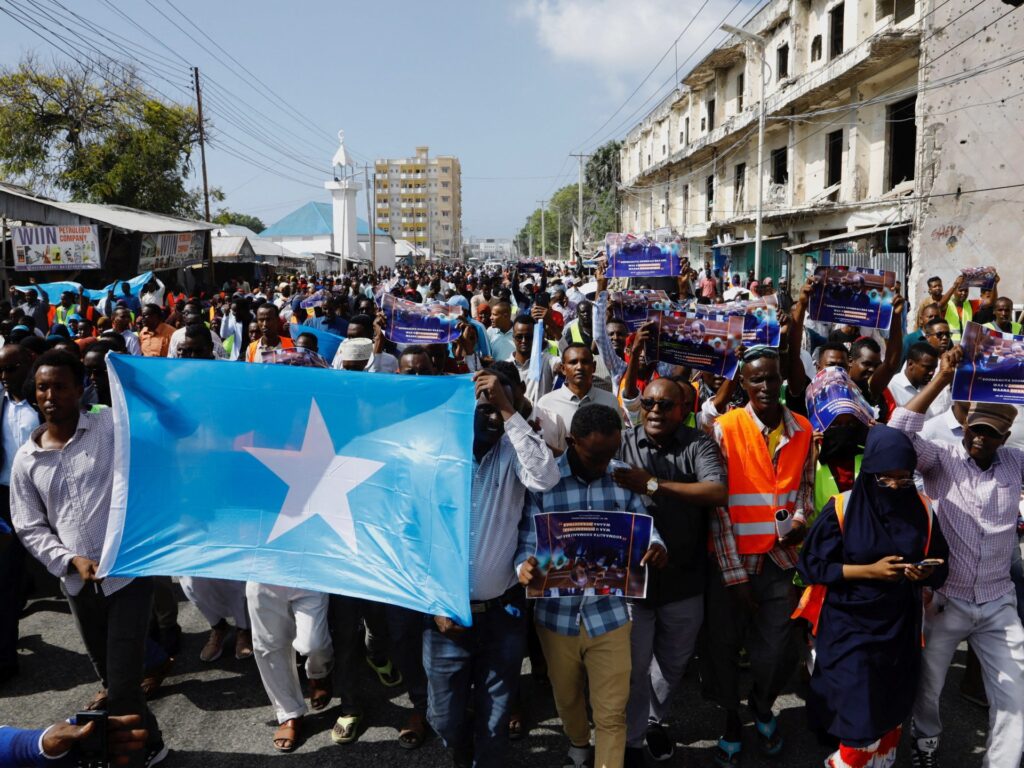
The Ethiopia-Somalia feud continues with Mogadishu claiming its territorial integrity has been violated by the deal. Somalia said on Thursday there was no room for mediation in a dispute with Ethiopia unless Addis Ababa cancelled a controversial deal with the breakaway region of Somaliland. Tensions in the Horn of Africa have escalated after landlocked Ethiopia reached a memorandum of understanding with Somaliland on January 1 that gives it access to the sea. “There is no space for mediation unless Ethiopia retracts its illegal MOU and reaffirms the sovereignty and territorial integrity of Somalia,” the country’s foreign ministry said in a statement posted on its official social media accounts. The comment comes after the African Union’s conflict resolution body on Wednesday discussed the crisis and called on the two countries “to exercise restraint, de-escalate and engage in meaningful dialogue towards finding a peaceful resolution of the matter”. The eight-country trade bloc Intergovernmental Authority on Development (IGAD) is also holding an extraordinary summit in Uganda on Thursday on the Ethiopia-Somalia feud, as well as the conflict in Sudan. All four countries are part of the bloc, along with South Sudan, Djibouti, Kenya and Eritrea. Access to the sea Somalia says its sovereignty and territorial integrity have been violated by the pact and has appealed for international support. Somaliland is a former British protectorate facing the Gulf of Aden which declared its independence from Somalia in 1991, a move not recognised by the international community. Under the January 1 deal, Somaliland agreed to lease 20 kilometres (12 miles) of its coast for 50 years to Ethiopia, which wants to set up a naval base and a commercial port on the coast. For years, Ethiopia, with a population of approximately 100 million people, has sought access to the sea after Eritrea broke away from Addis Ababa and formally declared independence in 1993 following a three-decade war. The Horn of Africa country currently relies on neighbouring Djibouti for most of its maritime trade. In Ethiopia, where for much of 2023 the government stressed the economic need for a seaport and even subtly hinted at possibly invading Eritrea for access to the Red Sea, the deal is being portrayed as a victory. Adblock test (Why?)
Why does the US act as Israel’s lawyer?

Former US diplomat Aaron David Miller says prospects for a ‘conflict-ending solution’ have entered ‘a long, dark tunnel’. President Joe Biden’s failure to demonstrate the same regard and sympathy for Palestinian suffering as he has shown Israel has turned the United States into “Israel’s lawyer,” says former US State Department official Aaron David Miller. Miller tells host Steve Clemons that Israel has lost the Western perception of being David in the story of “David v Goliath,” and its image will be further damaged the more its people veer to the right. US officials “don’t have any better answers right now than the Israelis do”, Miller says, adding that there will be no “open breach” in relations with the Netanyahu government. Adblock test (Why?)
US launches new strikes on Houthi targets in Yemen

On fourth day of strikes, the US military says it targeted 14 Houthi missiles that were ‘loaded to be fired’ from Yemen. The United States military says its forces launched strikes on 14 Houthi missiles “that were loaded to be fired” from Yemen in the fourth day of direct attacks on the Iran-aligned group in less than a week. The missiles posed a threat to commercial ships and US Navy vessels in the region, the US Central Command (CENTCOM) said on Wednesday. The group, which controls most of Yemen and has been attacking ships in the region since November, said it will not stop its strikes on shipping routes despite increasing assaults by the US military. “We will not give up targeting Israeli ships or ships heading towards ports in occupied Palestine … in support of the Palestinian people,” the group’s spokesperson, Mohammed Abdelsalam, told Al Jazeera on Thursday. “These missiles on launch rails … could have been fired at any time, prompting U.S. forces to exercise their inherent right and obligation to defend themselves,” CENTCOM said on X. The strikes are meant to degrade the Houthis’ “capabilities to continue their reckless attacks on international and commercial shipping in the Red Sea, the Bab-el-Mandeb Strait, and the Gulf of Aden”, it added. U.S. CENTCOM Strikes Houthi Terrorist Missile Launchers In the context of ongoing multi-national efforts to protect freedom of navigation and prevent attacks on U.S. and partner maritime traffic in the Red Sea, on Jan. 17 at approximately 11:59 p.m. (Sanaa time), U.S. Central… pic.twitter.com/MMCQbzr1f7 — U.S. Central Command (@CENTCOM) January 18, 2024 The Houthi-controlled Saba news agency said the US and the United Kingdom launched the strikes in the provinces of Hodeidah, Taiz, Dhamar, al-Bayda and Saada overnight. However, CENTCOM did not mention any involvement of the UK in the latest attacks. “It is an open war, and they must endure the earth-shattering, powerful, and crushing strikes and responses, God willing,” Houthi official Ali al-Qahoum wrote on X after the latest strikes. The US on Wednesday redesignated the Yemeni group as a “terrorist” organisation in response to its continuing attacks and threats to shipping and imposed sanctions on it. The designation does not go into effect for 30 days. The Houthis said the designation will not affect its operations to prevent Israeli ships or vessels heading to Israel from crossing the Red Sea, the Arabian Sea and the Bab al-Mandeb Strait. Rights advocates and analysts say the US move may negatively affect Yemeni civilians. The Houthis, who support the Palestinian armed group Hamas, launched their attacks in response to Israel’s war on Gaza. Their strikes have slowed trade between Asia and Europe and alarmed major world powers. Earlier on Wednesday, CENTCOM said a drone launched from areas controlled by the Houthi rebels in Yemen struck the US-owned ship Genco Picardy in the Gulf of Aden. It inflicted some damage, but no injuries, it said. Adblock test (Why?)
Pakistan attacks ‘terrorist hideouts’ in Iran

NewsFeed Pakistan has launched retaliatory air strikes on Iran, saying it attacked several ‘terrorist hideouts’, a day after Iran says it struck ‘terrorist headquarters’ in Pakistan. It’s the first missile attack on Iranian soil since the end of the Iran-Iraq War in 1988. Published On 18 Jan 202418 Jan 2024 Adblock test (Why?)
Israel’s war on Gaza: List of key events, day 104

EXPLAINER Medical aid enters Gaza while deadly Israeli strikes continue on the south of the enclave. Here’s how things stand on Thursday, January 18, 2024: Latest updates Five trucks carrying medical aid for hospitals and 45 Israeli captives entered Gaza on Wednesday, announced Qatar, which mediated a deal between Hamas and Israel. The United States has redesignated Yemen’s Houthis as a “global terrorist” group in response to their attacks on shipping in the Red Sea, the White House’s National Security Advisor, Jake Sullivan, said in a statement on Wednesday. Israel’s far-right national security minister, Itamar Ben-Gvir, called for Israel’s occupation of the Gaza Strip and said that Palestinians should be “encouraged” to leave the territory in an interview with Israel’s Channel 13 news on Wednesday night. Human impact and fighting At least 16 Palestinians, including children, were killed in an Israeli shelling of a house east of Rafah in the Gaza Strip overnight, according to local sources and video footage verified by Al Jazeera. An estimated $15bn will be required to rebuild just the homes in Gaza, the head of the Palestine Investment Fund, Mohammad Mustafa said at the World Economic Forum in Davos, Switzerland on Wednesday. The US Central Command (CENTCOM) said that it targeted 14 missiles “that were loaded to be fired” in Houthi-controlled areas of Yemen on Wednesday. Diplomacy Australian foreign Minister Penny Wong said the country is “deeply concerned by ongoing settler violence against Palestinians in the occupied West Bank”, in a post on X after visiting the territory on Wednesday. The United Kingdom’s Foreign Secretary David Cameron met Iran’s Foreign Minister Hossein Amirabdollahian on the sidelines of the Davos Summit on Wednesday. In a post on X, Cameron said he made “clear” to Amirabdollahian that “Iran must cease supplying the Houthis with weapons and intelligence”. On Thursday, China’s Foreign Ministry spokesperson, Mao Ning, urged Iran and Pakistan to “avoid actions that would lead to an escalation of tension”. Israeli raids in the West Bank Israel arrested 46 people from one family in Tuqu village near Bethlehem overnight, according to Al Jazeera Arabic. A military raid on the occupied West Bank’s Tulkarem continued into a second day on Thursday. Six Palestinians have been killed in Tulkarem, according to Al Jazeera correspondent, Hamdah Salhut. On Wednesday, the Office of the United Nations High Commissioner for Human Rights called for an independent investigation into the Israeli military amid deadly Israeli air strikes on Nablus and raids in Tulkarem refugee camp. Adblock test (Why?)
Protests erupt in Tunisian town as search continues for 37 missing migrants

Tunis, Tunisia – A boat said to be carrying some 37 migrants and asylum seekers has gone missing off the coast of Sfax in Tunisia. Relatives described receiving final phone calls at around 2:30pm on January 11, as the boat was setting out to sea. By around 10pm the same night, all contact with the boat and its passengers had been lost. Other than three or four people from elsewhere in Tunisia, all of the boat’s passengers are reported to be from the small village of El Hencha in the Sfax Governorate. They range in age from about 13 to 35 years old. Frustrated by the lack of news since the boat’s disappearance, the families of the missing migrants erected roadblocks and burned tyres around the village yesterday, only withdrawing when the government authorities assured the public that search efforts would continue. Mohammed Jlaiel’s 25-year-old brother Ali is among the missing. “We haven’t heard anything about him. Nothing! It’s torturous,” Mohammed told Al Jazeera by phone. “We’re desperate for a piece of news on them,” he continued. ”They were all our neighbours and friends. The whole [of] Hencha is in pain. My mom is in a terrible state.” Migrants and asylum seekers attempting to cross the Mediterranean Sea on October 6, 2023, are rescued by a boat from the group Doctors Without Borders [File: Paolo Santalucia/AP Photo] The Tunisian National Guard released a statement on Tuesday saying “all field units”, including maritime vessels and helicopters, have been mobilised to find the 37 passengers Maltese and Italian units were also reported to have been involved in the search. On Tuesday, the Italian news agency Agenzia Nova indicated that the ongoing search efforts were focused on the coastline between Sfax and the coastal town of Mahdia, some 80 miles (129km) north. Nevertheless, within Tunisia, politicians and the family members of the missing passengers have voiced disquiet about how long it is taking to receive concrete news. “Imagine not knowing anything about a brother for six days. They sent planes, boats, all sorts of things to look for them, but there’s no trace of them whatsoever,” Jlaiel said. “Tunisians, Italians, Libyans … Everyone is searching, and yet they can’t find anything. It’s so strange.” Majdi Karbai, a member of parliament responsible for Tunisians overseas, told Al Jazeera that the missing migrants and asylum seekers were “the latest victims of Europe’s migration policies”. He criticised the European Union’s efforts to control irregular migration along its southern border as endangering lives. The coastal town of Zarzis, Tunisia, is an occasional departure point for boats carrying migrants and asylum seekers [File: Angus McDowall/Reuters] Karbai added that he was in contact with family members in El Hencha. The continued absence of information about the lost boat was troubling to residents there, he explained. He worried that the situation could trigger unrest, as happened after another vessel sank in 2022. The southern Tunisian town of Zarzis lost 18 inhabitants in that shipwreck, leading to protests denouncing the speed of the rescue effort and the economic conditions that prompted the fatal voyage. Tunisian President Kais Saied eventually intervened to help quell ill feelings. “This is bad,” Karbai said of the current situation in El Hencha. “This could be very bad, like Zarzis.” Poverty and the absence of employment prospects within Tunisia often drive locals to depart for new lives in Europe. Other migrants, however, arrive on Tunisia’s coasts from elsewhere across the globe, particularly from impoverished and conflict-stricken areas of sub-Saharan Africa. Both Tunisia and neighbouring Libya are key departure points for those looking to travel irregularly by boat to Europe. However, despite its popularity, the migration route is also one of the world’s deadliest. According to the International Organization for Migration (IOM), 2,498 migrants and asylum seekers are known to have drowned while crossing the central Mediterranean Sea in 2023. The true figure is likely far higher. In the first 11 months of 2023, Tunisia’s National Guard intercepted almost 70,000 irregular migrants and asylum seekers. Of those, 77.5 percent had travelled to Tunisia from across Africa. The remainder came from Tunisia itself. Migrants and asylum seekers rest in the port city of Ben Gardane, Tunisia, after being rescued from the waters of the Mediterranean by the Tunisian navy on July 7, 2021 [File: Hamadi Sehli/AP Photo] Ali Jlaiel from El Hencha was as typical a passenger as any. His brother Mohammed described the missing 25-year-old as someone who struggled to settle down after a series of low-wage jobs, none lasting any great length of time. “He felt cornered,” Mohammed Jlaiel said. “He had no hope of a good future.” Ali’s last job was as an overnight security guard at the Mall of Sfax. But even with a steady wage, his budget barely covered his expenses, Mohammed explained. “He got 600 dinars [$193] as a salary [a month]. Ten dinars [$3] would be spent on daily transportation from Hencha to Sfax. Add to that the cost of his cigarettes and coffee. Nothing would be left. It’s depressing.” “There’s nothing in Hencha. And he’s not a special case. The boat was full of our neighbours. Even kids as young as 13 and 14,” he said. “They all didn’t find any chance here.” Adblock test (Why?)
Biden ‘playing with fire’ by redesignating Yemen’s Houthis as ‘terrorists’
It was one of Joe Biden’s first major foreign policy decisions. Less than a month after taking office in January 2021, the United States president lifted two “terrorist” designations imposed by his predecessor, Donald Trump, against Yemen’s Houthi rebels. At the time, Secretary of State Antony Blinken said the move came in “recognition of the dire humanitarian situation in Yemen”. The United Nations, as well as humanitarian groups and US lawmakers, had warned the “terrorist” designations could interrupt the flow of aid to the country. Now, almost exactly three years later, the Biden administration is reimposing one of the designations against the Houthis, declaring them to be a “Specially Designated Global Terrorist group” amid a series of attacks in the Red Sea. And once again, rights advocates and political analysts are sounding the alarm over the negative effects the decision may have on Yemeni civilians. Many also question whether Wednesday’s designation will succeed in pushing the Houthis to end their attacks. “I’m very concerned about the devastating consequences for ordinary people in Yemen,” said Afrah Nasser, a non-resident fellow at the Arab Center Washington DC who previously worked as a Yemen researcher at Human Rights Watch. Nasser told Al Jazeera that the designation risks deepening the humanitarian crisis in Yemen, which has experienced a years-long war between the Houthis and a coalition led by Saudi Arabia and the United Arab Emirates. More than half of the Yemeni population — 18.2 million people — is in need of assistance, according to the UN, as the country reels from an economic crisis, rising costs, mass displacement and hunger. “The ordinary Yemeni family today is suffering because of both the Houthi domestic policies and also the international community policies in Yemen, such as this [US] designation that we heard today,” Nasser said. “Yemenis are caught between two fires.” Red Sea attacks In a statement on Wednesday morning, Blinken said the “Specially Designated Global Terrorist group” designation (SDGT) came in response to Houthi attacks on commercial vessels in the Red Sea. “This designation seeks to promote accountability for the group’s terrorist activities. If the Houthis cease their attacks in the Red Sea and Gulf of Aden, the United States will reevaluate this designation,” the top US diplomat said. The Iran-aligned Houthis, who control large swaths of Yemen, began firing missiles at Israel and attacking commercial ships in the Red Sea shortly after the war in Gaza began in October. The group pledged to target Israel-linked vessels as part of an effort to pressure the country’s government to end its Gaza bombardment and allow more humanitarian aid deliveries into the coastal Palestinian enclave. It later expanded the threat to any commercial vessels travelling to and from Israel along the arterial trade route off Yemen’s coast. The attacks led shipping companies to suspend operations in the Red Sea and drew condemnation from the US and its allies. Washington launched a naval coalition to protect commercial vessels in December, and it also carried out several strikes against Houthi targets in Yemen this month in what observers called a “dangerous” escalation. On Wednesday, the Biden administration defended its decision to reimpose the SDGT designation on the Houthis, saying there would be “carve-outs” to protect aid to Yemen. “Today’s designation targets the Houthis, not the Yemeni people,” National Security Council spokesperson John Kirby said in a press conference. When asked about how any related sanctions would impact negotiations with the Houthis, Kirby responded firmly: “There’s no negotiations. There’s not a bargaining chip. It’s a way of holding the Houthis accountable.” But experts cast doubt on whether the SDGT designation would lead the Houthis to stop their attacks in the Red Sea, as the administration suggested. “It seems highly unlikely to have any positive effect on the behaviour of the Houthis,” said Brian Finucane, a senior US programme adviser at the International Crisis Group think tank. “I think it’s a form of do-something-ism,” he told Al Jazeera. The reimposition of the SDGT designation, he added, is a reflection of Washington’s refusal to recognise that recent Houthi attacks are linked to the war in Gaza. “The Biden administration has put itself in a box … where it doesn’t have good policy options.” The designation An SDGT designation focuses primarily on the finances of an individual or a group. In this case, it will freeze the Houthis’ assets in the US and prohibit American citizens from having any financial dealings with the organisation. And while “civil and criminal penalties may be assessed for violations”, the designation is more narrow in scope than the second label that the Trump administration had imposed on the Houthis: that of “Foreign Terrorist Organization” or FTO. That label makes it a serious crime to provide support to a blacklisted group. “This [SDGT designation] is sort of a minimal: restricting access to funds from abroad, access to international markets. These are things that Houthis don’t have and never had. They don’t own stock on the New York Stock Exchange,” said Nabeel Khoury, a former deputy chief of mission at the US embassy in Yemen. Houthi supporters attend a protest against US-led air strikes on January 12, 2024, in Sanaa, Yemen [AP Photo] Nevertheless, Khoury told Al Jazeera that the Houthis are unlikely to make a distinction between an SDGT or FTO designation and will see Wednesday’s decision as an affront that could lead to further escalation. Hours after the designation was announced, the Houthis said they fired “naval missiles” at an American ship in the Gulf of Aden. There was no immediate confirmation from Washington. “It’s really baffling what this administration is engaged in. I don’t think there’s much thought that went into this,” he said. “This designation is more like an insult. It’s the old glove in the face, slap someone with your glove. You’re sort of challenging, but not really hurting them.” Nasser also warned that it could further embolden the Houthis and “contribute in radicalising some parts of the population and strengthen the Houthi
Sierra Leone court allows ex-President Koroma to go abroad for medical care

The former leader is charged with treason for his alleged role in a failed coup in November. A Sierra Leone court has allowed former President Ernest Bai Koroma, who is charged with treason, to travel abroad on medical grounds. Koroma, 70, was charged early this month with four offences for his alleged role in a failed military attempt to topple the West African country’s government in November. The High Court on Wednesday ruled in favour of Koroma, whose lawyers had asked it to allow the former leader a trip abroad for medical reasons. The ex-president, who has been under house arrest, will be allowed to travel to Nigeria for no more than three months, the magistrate said before adjourning the case to March 6. “The High Court approved the order, and that was transmitted to the Magistrate’s Court where [Koroma] has been appearing since the day investigations started into his case,” Al Jazeera’s Ahmed Idris said, reporting from the capital, Freetown. Chernor Bah, Sierra Leone’s minister of information, told Al Jazeera the state is “happy to abide by the ruling of the court because we believe in the rule of law”, adding that Koroma is leaving for medical attention but his case remains open. “At this stage, the case is still alive. It is adjourned,” he said, adding that the court’s instructions to the lawyers included continuing to send updates on Koroma’s health to the state and the judiciary for the duration of his absence. Nigeria had previously offered to allow Koroma to enter on a temporary basis, which he accepted, according to West Africa’s main regional bloc. “We know the Economic Community of West African States has been trying hard to convince the Sierra Leone government to think about releasing Mr Koroma to leave the country – probably into exile – but again, the court said he is going on medical grounds to be checked,” Idris said. Coup attempt On November 26, gunmen launched a series of attacks in Sierra Leone, breaking into a key armoury, military barracks and prisons, freeing about 2,200 inmates. More than 20 people were killed in the violence. The government said later that it was a foiled coup led mostly by Koroma’s bodyguards. They summoned the ex-president for questioning at the start of December and charged him with treason on January 3. Koroma condemned the attacks in a statement shortly after they happened and has denied any involvement. His lawyers have called the charges “trumped up” and part of a “political vendetta”. There are concerns Koroma’s indictment could stoke tensions that arose from a contentious election in June in which President Julius Maada Bio was re-elected for a second term. The main opposition candidate rejected the results, and international partners questioned the vote. Two months after Bio was re-elected, police said they arrested several people, including senior military officers planning to use protests “to undermine peace”. Koroma served as Sierra Leone’s president for 11 years until 2018. Although officially retired from politics, he remains an influential figure within his political party. Twelve other people were also charged with treason in connection with the failed coup, including former police and correctional officers and a member of Koroma’s security detail. According to Sierra Leone’s penal code, a person found guilty of treason could face life imprisonment. Adblock test (Why?)
Israel ramps up attacks on Khan Younis as aid for Gaza arrives in Egypt

Israel has increased attacks on Khan Younis in southern Gaza and sent tanks westwards, prompting accusations from Jordan that its field hospital in the city had been badly damaged by nearby shelling. The Jordanian army said on Wednesday that it held Israel responsible for a “flagrant breach of international law” due to the damage to the facility. Elsewhere in the city, people at and around Nasser Hospital were forced to flee as Israeli tanks approached the district overnight following a statement from the Israeli army that it had come under fire in the area. Palestinian health officials said at least seven people were killed by Israeli air raids that damaged homes near the hospital. At least 24,448 people have been killed in the Israeli assault on Gaza since October 7, the Palestinian health ministry has said. At least 1,139 people, mostly civilians, were killed in the Hamas attack on southern Israel on October 7 according to an Al Jazeera tally based on official figures. Al Jazeera’s Hani Mahmoud, reporting from southern Gaza, said there were growing fears that Nasser Hospital could soon not be operational as happened with several other facilities targeted by Israeli forces since the start of the war. “The vast majority of healthcare facilities were attacked, destroyed and left severely damaged to the point that they’re pushed out of service completely,” he said. [Al Jazeera] Israeli government spokesperson Eylon Levy said extra field hospitals were expected in the coming days. “These have, of course, been necessitated by Hamas’s strategic militarisation of Gaza’s existing hospitals,” he said. Hamas has repeatedly denied using hospitals for cover. Israel also announced on Wednesday that it had killed six Palestinian fighters in southern Gaza. In a statement, the military said its latest operation had resulted in the death of counterespionage officer Bilal Nofal and “significantly impacts the terrorist organisation’s capacity to develop and enhance its capabilities”. Airport workers unload crates with aid delivered from Qatar, destined for Gaza, at El Arish International Airport, El Arish, Egypt [Qatar’s Ministry of Foreign Affairs/Handout via Reuters] Aid Under a deal brokered by Qatar and France, desperately needed aid and medication has arrived in the Egyptian city of El Arish near the Gaza border. The International Committee of the Red Cross has welcomed the deal, which will see the 61 tonnes of medicine and food enter the enclave, and called it a “much-needed moment of relief”. Israel’s war on Gaza has left its population facing crisis levels of hunger and at growing risk of disease as supplies run low, aid agencies said. On Wednesday, the head of the Palestine Investment Fund, Mohammed Mustafa, told the World Economic Forum in Davos, Switzerland, that it would take at least $15bn to rebuild houses in Gaza, not accounting for basic infrastructure and hospitals. “If the war in Gaza continues, more people are likely to die of hunger or famine than war,” Mustafa said. [Al Jazeera] At the beginning of January, Israel announced it was scaling back operations in northern Gaza and beginning a new phase of lower-intensity bombing. However, Al Jazeera’s Tareq Abu Azzoum, reporting from Rafah in southern Gaza, said that does not seem to be reflected on the ground. “The strikes have not stopped over the last few hours across the Gaza Strip, despite the fact that Israel says that they’re moving to a completely new phase with low-intensity bombing,” he said. “We can see that the death toll and casualties among civilians keeps rising, to reach more than 163 Palestinians killed in the previous 24 hours,” he said, citing Palestinian authorities. Adblock test (Why?)
What’s behind North Korea’s shock change of policy towards the South?

Pyongyang announces it is scrapping its long-term aim of reunification with South Korea. In a dramatic shift, North Korea is tearing up its goal of unification with South Korea, a policy that has been in place for decades. North Korean leader Kim Jong Un also said his country does not want war – but will not avoid one either. So what’s behind his surprise move? Presenter: Adrian Finighan Guests: Ji-Yeon Yuh – board member of Women Cross DMZ and professor at Northwestern University Fyodor Tertitskiy – senior research fellow at the Institute for Korean Studies, Kookmin University Einar Tangen – senior fellow at the Taihe Institute Adblock test (Why?)