

Palestine boost Asian Cup knockout hopes after draw with UAE

Al Wakrah, Qatar – It was a night to remember at Al Janoub Stadium – a night that belonged to Palestine irrespective of the result on the pitch. The crowd’s noise, flags and numbers all were in the favour of the team that came into the match with an AFC Asian Cup 2023 loss to its name and a relentless war on its people. The unrestrained show of love and support for the war-struck nation began before kickoff, increased as the night wore on and quietened down only when the last set of fans had left the stadium at the end of Palestine’s Group C match against the United Arab Emirates (UAE) in Al Wakrah on Thursday night. Chants of “Free, free Palestine” went up in a crescendo when the players walked out of the tunnel and onto the pitch. The Palestinian players acknowledged the crowd with waves and applause before gathering in a huddle. “The players will feel a sense of responsibility tonight – they must be aware that they are carrying the hopes of a nation under war,” Mariana al-Hindi, a Palestinian resident of Qatar, told Al Jazeera ahead of kickoff. “They will want to put a smile on everyone’s face by doing well tonight,” she said as she approached the turnstiles with her husband and daughter. “As Palestinians, we are happy to see our country represented and recognised at a big event, but at the same time, we are heartbroken about the situation in Gaza,” Abdullah, her husband, said. Mariana al-Hindi, Abdullah and their daughter outside the stadium [Hafsa Adil/Al Jazeera] Once the match kicked off, the men in red were willed on by a roaring crowd. Every touch of the ball by a Palestinian player was cheered and every time the UAE held possession the unabashedly partisan crowd loudly booed. Palestine enjoyed some early possession, but the UAE soon settled into a rhythm and began attacking the Palestinian goal. Their efforts bore fruit in the 23rd minute when Sultan Adil scored from a free header. The stadium fell silent for a moment until a small contingent of Emirati fans began singing. Sultan Adil celebrates scoring for the UAE [Sorin Furcoi/Al Jazeera] Not to be deterred, the rest of the crowd picked up again and urged the Palestinian team to push for a goal and when Oday Dabbagh was hauled down in UAE’s box 12 minutes later, the crowd jumped up and pointed to the penalty spot. The referee’s dismissal of the appeals was not taken well by the crowd, who willed him on to run a VAR check. When a penalty was subsequently awarded to Palestine and Khalifa al-Hammadi was shown a red card, the stadium stood up to applaud the decision. Tamer Sayem failed to convert from the spot and the first half ended with UAE still in the lead. There was no let up in cheering during half-time, especially when the intro to the song Dammi Filastini (My Blood is Palestinian) blared from the PA. The crowd was up on its dancing feet and singing along to the chorus – they were all Palestinian for one night. Palestine fans at Al Janoub Stadium [Sorin Furcoi/Al Jazeera] When play resumed, Palestine looked to take control of the proceedings with early pressure and it bore fruit as the UAE scored an own goal in the 48th minute. Palestine didn’t care how the goal came – they ran around the pitch in delight. In the stands, it was pandemonium. Children jumped on the seats, women hugged each other and men let the tears flow when the ball went in. “These players have been through a lot, all Palestinians have been through a lot, so this was a very special moment,” Yassine Abdullah, a Palestinian student, said moments after the goal. “Everyone saw what hard work, inspiration and support did for Morocco at the World Cup. We are hoping this match can do the same for our team,” he said as Palestine pressed for a second goal. “We could be the Morocco of this tournament.” Palestine equalise through an own goal [Sorin Furcoi/Al Jazeera] Despite their relentless attacks, the 10-man UAE team kept Palestine at bay and held on for a 1-1 draw. At the full-time whistle, the Palestinian players walked around the pitch to applaud their supporters for the electric atmosphere that kept them going all the way until the end. Assad Qusais, who watched the match with his family, said the men in red may have done just enough to keep some hope alive. “It depends on they play against Hong Kong [in the last group match] but we could still make it as one of the best third-placed teams,” he said with a shrug. Abdullah, who compared the support enjoyed by Palestine to the backing Morocco enjoyed at the World Cup, said he would love it if his team replicated a similar run. The continental tournament and the match may not carry the weight of a World Cup, but the night meant the world to the passionate Palestinian supporters. Adblock test (Why?)
At least 10 civilians dead in suspected Jordanian air raids in Syria

An estimated 10 civilians have been killed in air strikes targeting the neighbouring towns of Arman and Malh in the southeast Syrian province of Sweida, according to local media. Jordanian forces are believed to be behind Thursday’s attacks, though its government has yet to confirm any involvement. Sweida 24, a news platform based in its namesake city, said warplanes carried out simultaneous strikes on residential neighbourhoods after midnight local time (21:00 GMT). The attack in Malh caused material damage to some houses. The second strike in Arman, however, collapsed two houses and killed at least 10 civilians, including four women and two girls, both under the age of five. Jordan is thought to have carried out previous raids in Syria, mostly near the countries’ shared border, in an effort to disrupt weapons smuggling and drug-trafficking operations. The news outlet Suwayda shared this image on social media of the wreckage following a suspected Jordanian air raid on January 18 [Suwayda 24 via Reuters] But inhabitants of the towns struck on Thursday questioned the choice of targets. “What happened was a massacre against children and women,” Murad al-Abdullah, a resident of Arman, told Al Jazeera. “The air strikes that targeted the villages are far from being identified as fighting drug traffickers.” Al-Abdullah said the bombing was not limited to houses of people suspected to be involved in drug trafficking. He noted other homes were damaged as well, terrorising villagers while they were asleep and causing needless civilian deaths. “It is unreasonable for two girls who are no more than five years old to be involved in drug trafficking,” al-Abdullah said. Tribes and residents of the villages near the Jordanian border issued separate statements this week disavowing any involvement in drug smuggling. The statements also pledged to lend a hand to Jordan to eliminate criminal networks trafficking narcotics and other drugs across the border. In turn, they asked Jordan to suspend its bombings of civilian sites. The spiritual leader of the Druze religious group in Syria, Sheikh Hikmat al-Hajri, appealed to Jordan to prevent further civilian bloodshed. “The attacks should be heavily focused towards the smugglers and their supporters exclusively,” al-Hajri said in a public statement. Al-Abdullah, the Arman resident, also called on Jordan to collaborate with Syrian locals to stop the trafficking operations. “We are a society that does not accept the manufacture or trade of drugs, and the Jordanian government should have communicated with our elders to cooperate in combating drug traffickers, instead of bombing residential neighbourhoods,” al-Abdullah said. Suspected attacks aimed at drug-trafficking operations Thursday’s attack is believed to be the third time this year that Jordanian planes have carried out air raids on Syrian territory. A previous attack occurred on January 9, resulting in the deaths of three people in the countryside of Sweida, according to the Syrian Observatory for Human Rights, a London-based rights monitor. The Observatory said that five smugglers were also killed in a border attack on January 7. Fighting that day took place sporadically over 10 hours. By the end of the raid, Jordanian forces had arrested 15 suspects. They also claimed to have recovered 627,000 pills of Captagon, an illicitly manufactured amphetamine, and 3.4kg of cannabis. “What Jordan is doing can certainly delay drug-smuggling operations but unfortunately, cannot stop them completely. The border with Syria is 375km (233 miles) long, and smuggling operations are carried out by professional groups, not some random individuals carrying out bags of drugs to cross the border,” said Essam al-Zoubi, a lawyer and human rights activist. Drug enforcement officials in the United States and other Western countries have said that war-torn Syria has become a major hub in the Middle East for the drug trade. The country, for instance, has become the primary manufacturer for Captagon, a multibillion-dollar business. Experts have said smugglers are using Jordan as a route through which Syrian drugs can reach the oil-rich Gulf states. A Syrian soldier arranges packets of Captagon pills in Damascus, Syria, on November 30, 2021 [File: SANA via AP Photo] Al-Zoubi and other human rights advocates have warned the Syrian government itself is involved in the drug trade, in an effort to shore up its war-drained finances. Reports indicated that the Fourth Armoured Division of the Syrian Army has played a role in overseeing the country’s drug operations, alongside the Iran-backed armed group Hezbollah, an ally of the Syrian government. “The officials responsible for drug smuggling in Syria are Hezbollah of Lebanon, the Fourth Division, and the security apparatuses of the Syrian regime that control southern Syria,” al-Zoubi said. Jordan and its allies have also taken other approaches to stopping the drug trade. In March last year, for instance, the US Department of the Treasury imposed sanctions on six people, including two relatives of Syrian President Bashar al-Assad, for their role in producing and trafficking Captagon. Some of those sanctioned had ties to Hezbollah as well. But al-Zoubi warns that even targeted attacks on Syrian drug dealers will not be enough to stop the trade. “It does not matter to the drug officials from Hezbollah or the Fourth Division if traders are killed, as the trades themselves will continue regardless of the people,” al-Zoubi said, pointing to an example in May 2023. Jordanian soldiers patrol the Jordan-Syria border in 2022, as the country seeks to crack down on drug smuggling [File: Raad Adayleh/AP Photo] Jordanian planes, at the time, had carried out air raids in the Sweida countryside, targeting the house of one of the most famous drug traffickers in Syria, Marai al-Ramthan. He was ultimately killed in the attack. But, al-Zoubi said, his death “did not limit drug trafficking but, in fact, increased it”. Other smugglers used his demise as an opportunity to expand their trade in his absence. Omar Idlibi, director of the Doha office at the Harmoon Center for Contemporary Studies, said that geopolitical turmoil in the region has also allowed trafficking to flourish. “Drug-smuggling operations to Jordan did not exist before 2018, that is, before
‘So sad and scared’: Asylum fears mount as White House hints at border deal

Washington, DC – The White House has upped pressure on members of the United States Congress as it seeks a deal that could see aid for Ukraine approved in exchange for possible asylum restrictions. Ornela Medom, a 28-year-old who fled war-torn Cameroon, is among those currently seeking asylum in the US. At a “Save Asylum” demonstration outside the Capitol, she told Al Jazeera she is horrified by what a new immigration deal could bring. “I’m so sad and I’m so scared,” Medom said on Thursday, only a day after Republican and Democratic senators said a vote on a deal could be imminent. Also on Wednesday, Speaker Mike Johnson suggested Republicans in the House of Representatives may take an even harder line on access at the US-Mexico border. “Our lives depend on these secret negotiations that are ongoing,” said Medom, who arrived in the US through the southern border in April. “I am pleading for them to think about us”. A slate of progressive and Hispanic legislators also attended Thursday’s news conference, appealing to Democrats not to accept major changes to US border law as part of any deal. Ornela Medom, an asylum seeker from Cameroon, addresses a news conference at the US Capitol [Joseph Stepansky/Al Jazeera] For months, the White House has sought continued aid to Ukraine, pushing for a $110bn package which would also include military funds for Israel and Taiwan, as well as other security spending. But Republicans have premised further Ukraine aid on changes to stem the flow of migrants and asylum seekers at the southern border. Democratic leaders like President Joe Biden and Senate Majority Leader Chuck Schumer have signalled a willingness to compromise. Biden “wants to make really significant change on the border”, Schumer said on Wednesday. Asylum rights advocates, however, have described a potential deal as “extortion” and “hostage-taking”. “Republicans are holding foreign aid hostage to extract extreme immigration measures that will not solve the problem,” Representative Nanette Diaz Barragan, a Democrat and chair of the Congressional Hispanic Caucus, told reporters on Thursday. The terms of the deal have not yet been made public. But Diaz Barragan said they are expected to include “expanded enforcement, deportations, changes to make it harder to get asylum, and possibly limits to the president’s parole authority”. “It’s gutting asylum, and it’s going to terrorise our communities.” Negotiations ongoing On Wednesday, Biden summoned a group of Democratic and Republican members of Congress to the White House in hopes of bringing negotiations closer to a conclusion. He told those assembled that they needed to “send a strong signal of US resolve” on Ukraine, the White House said in a statement. “He was clear: Congress’s continued failure to act endangers the United States’ national security, the NATO alliance and the rest of the free world,” the statement said. Schumer told reporters afterwards, “I am more optimistic than ever before that we come to an agreement.” Referencing the anticipated deal, Senate Republican leader Mitch McConnell said he was “anticipating that it’ll be before us next week”. Meanwhile, Speaker Johnson underscored that House Republicans, who have a majority in the lower chamber, would not support any deal unless it included “meaningful” new border restrictions. He pointed to a hardline immigration bill passed by the House in May, which included a ban on claiming asylum for those who cross the border irregularly and the resumption of a policy that required asylum seekers to wait in Mexico for their claims to be processed. “I told the president what I had been saying for many months, and that is that we must have change at the border, substantive policy change,” Johnson told reporters. “We must insist — must insist — that the border be the top priority.” Speaking on Thursday, Democratic Representative Pramila Jayapal, the chair of the Congressional Progressive Caucus, said the entire premise of the deal must be rejected. She warned that the bipartisan efforts could herald historically “cruel, unworkable and permanent policy changes on immigration”. “It’s imperative that my Senate colleagues and the White House understand what is on the table are policies that are so extreme that, if enacted, they would be the most exclusionary, restrictive immigration legislation since the racial quota laws of the 1920s, literally turning back the clock 100 years,” she said, referencing laws that had set immigration quotas based on nationality, excluding some altogether. ‘What will Republicans ask for the next time?’ Immigration legislation is rarely passed on the federal level in the US, where matters of migration and asylum remain a political third rail. Instead, most recent immigration policy has been set by presidential administrations through executive actions and rules. Those are more vulnerable to court challenges than measures passed as law. That makes the stakes of a congressional deal high. US media has reported that Senate and White House negotiators have broadly agreed in closed-door meetings to several policies reminiscent of those enacted under former President Donald Trump. Those include making eligibility standards higher for people claiming asylum after crossing into the US irregularly, expanding the categories of arrivals who can be detained and monitored, and making it easier to expel migrants and asylum seekers. The Associated Press also reported that one proposal under discussion would have simplified the process for deporting migrants across the country who have been in the US for fewer than two years. It is unclear whether that measure is still on the table, though. Meanwhile, a key sticking point has been attempts to limit the White House’s ability to issue humanitarian parole, which can be used to grant access to migrants on an emergency basis. That power has been a cornerstone of the Biden administration’s most recent border strategy, which limits the ability to claim asylum at the southern border while broadening some legal pathways. “Parole has a really long and bipartisan history of being used to provide safety to Vietnamese allies who worked with the US government, to Soviet Jewish refugees, to Cambodians fleeing the Khmer Rouge, to Cuban political
Israeli arrests of Palestinian journalists soared in 2023: CPJ

More than a dozen Palestinian journalists held in Israeli jails since the start of the Gaza war on October 7. Israel emerged as one of the world’s leading jailers of journalists in 2023, according to a report by a press freedom watchdog, with the number of reporters behind bars soaring after the start of the Israel-Hamas war in Gaza. In its annual snapshot of jailed journalists published on Thursday, the Committee to Protect Journalists (CPJ) found that Israel was the joint sixth biggest jailer of journalists in 2023, alongside Iran. There were 17 Palestinian reporters held in Israeli jails as of December 1, the CPJ said. By comparison, the previous year one Palestinian reporter was held in an Israeli prison, according to the New York-based non-profit group. “Israel has appeared several times on CPJ’s annual census, but this is the highest number of arrests of Palestinian journalists since CPJ began documenting arrests in 1992 and the first time Israel has ranked among the top six offenders,” read the report. All those held in Israeli prisons were detained in the occupied West Bank after the Israel-Hamas war began on October 7, when Hamas fighters launched a surprise assault into southern Israel, killing at least 1,139 people, mostly civilians, according to an Al Jazeera tally based on official statistics. Around 240 others were taken captive, according to Israeli authorities. Israel responded with a devasting bombardment and ground offensive on Gaza. More than 24,600 people have been killed in the Israeli assault, according to Palestinian officials. In the more than three months since the Gaza war started, violence has soared in towns and cities across the West Bank, with Israeli forces conducting near-daily raids and mass arrests. According to the new report, most of the journalists arrested were held under administrative detention – a practice where Israeli authorities hold detainees without charge or trial for up to six months. The detention can be extended based on “secret evidence” that neither the detainees nor their lawyers are allowed to see. Due to the lack of information on the reason behind the jailing, the CPJ said it has been difficult to establish why the 17 journalists had been arrested. Several of the reporters’ families said they believe they were jailed for messages posted on social media, the report said. The CPJ’s list is a snapshot of people incarcerated on December 1, and it does not include those imprisoned or released throughout the year. As of January 17, at least 19 reporters were still in jail, the CPJ said. Al Jazeera journalist Wael Dahdouh reacts as he attends the funeral of his son, Palestinian journalist Hamza Dahdouh, after Hamza was killed in an Israeli strike, in Rafah in the southern Gaza Strip [Ibraheem Abu Mustafa/Reuters] The Gaza war has also seen a spike in the number of journalists killed in the region. As of mid-January, 83 reporters have been killed since the start of the conflict. At least 67 were Palestinians, four were Israeli and three were Lebanese, according to the CPJ. Since the start of 2024, the committee recorded that at least six journalists were killed, including Hamza Dahdouh, the eldest son of Al Jazeera’s Gaza bureau chief Wael Dahdouh. He was the fourth member of Dahdouh’s close family to have been killed in the war. Hundreds held worldwide The report found that 320 journalists were in prison worldwide on December 1 of last year, the second-highest number recorded since the committee began documenting arrests in 1992. The total marks a fall from a record global high in 2022 when more than 360 reporters were behind bars. This represents “a disturbing barometer of entrenched authoritarianism and the vitriol of governments determined to smother independent voices”, read the report. “Some governments go a step further, using transnational repression to threaten and harass reporters beyond their own borders,” it added. China is the worst offender, with 44 journalists in jail, followed by Myanmar (43) and Belarus (28). More than 65 percent of those listed in the census are accused of spreading false information and of “terrorism in retaliation for their critical coverage”. In 66 cases, those held have not yet been told of the charges they are facing, read the report. Adblock test (Why?)
How much will the US Supreme Court shape the 2024 presidential election?

Los Angeles, California – As the United States’ presidential primary season kicks off, the Supreme Court is expected to weigh in on several high-profile cases that could influence the election results. But experts say that puts the court in a precarious position. With Republican frontrunner and former president Donald Trump embroiled in multiple legal proceedings, the court may be forced to confront the limits of its impartiality. Some justices may even have to publicly evaluate the conduct of the former president who nominated them to the role. Trump, after all, is credited with giving the court its current conservative supermajority, after appointing three justices during his term in office. The Trump cases will be “a test for whether or not the court can somehow put aside their political preferences and biases”, said Michael Gerhardt, a professor of jurisprudence at the University of North Carolina at Chapel Hill. Former President Donald Trump is the Republican frontrunner in the 2024 presidential race [File: Alex Brandon/AP Photo] Testing the limits of presidential immunity One of the cases likely headed to the Supreme Court has to do with Trump’s broad claims to immunity for actions he took while president. Federal prosecutors, led by special counsel Jack Smith, have argued Trump conspired to overturn the 2020 election results during his final days in office. But Trump’s legal team has called on the court system to throw out the charges, on the premise that, as president, he was immune to criminal prosecution. An appeals court heard arguments in the case this month. If Trump loses there, he will likely turn to the Supreme Court with another appeal. Gerhardt said Trump’s immunity case will be a tough sell, though. “Trump’s immunity argument is incredibly weak. In fact, it’s just bad. And I have a hard time imagining that any court would agree with his argument.” But Gerhardt added the Supreme Court may not take the case at all, leaving the federal appeal court’s decision as the last word. “They’re probably not eager to get involved at all. The immunity case probably presents a great opportunity for the court to just stay out of it.” A courtroom sketch on January 9 depicts former President Donald Trump and his legal team at an appeals court hearing over presidential immunity claims [File: Bill Hennessy/Reuters] ‘Insurrection clause’ on the docket The Supreme Court has already been asked to intervene in another case, over whether states can remove Trump from their primary ballots. Colorado and Maine maintain that Trump is not qualified to be on their ballots due to his actions on January 6, 2021, when his supporters stormed the US Capitol to prevent Congress from certifying 2020 election results. Both states cited the 14th Amendment of the US Constitution, which includes a section that bars individuals from holding public office if they swear an oath of allegiance and then aid in an insurrection. Trump had spoken to the rioters before the 2021 attack on the Capitol, repeating false claims that the election was stolen and calling on the crowd to “fight like hell”. Experts told Al Jazeera that, of all the cases the Supreme Court may take in 2024, its decision on whether Trump can be removed from state ballots could have the greatest impact on the election. Never before has the Supreme Court ruled on the so-called “insurrection clause”. The states’ actions also mark the first time in history that the clause has been used against a presidential candidate. For their part, Trump’s lawyers argue it is unclear whether the law applies to the president’s office, and they have framed Trump’s remarks as falling within the limits of free speech. Colorado lawyer Eric Olson argues before the state Supreme Court on December 6 that Donald Trump should not appear on the state’s primary ballots [File: David Zalubowski/Pool via AP Photo] A likely win for Trump The court is scheduled to hear arguments in the case starting on February 8, ahead of the Maine and Colorado primaries on March 5. Each primary vote helps decide which candidates receive major party nominations. Mark Graber, a law professor at the University of Maryland School of Law, said the Supreme Court justices will want to have the case wrapped up swiftly to prevent voter confusion. “They’re likely to weigh in fairly quickly, in the sense that they’ll realise that this is something that ought not to be left hanging,” Graber said of the justices. “So far, he [Trump] has not been kicked off any ballot where there is a primary that looks immediate.” The primary season is set to start on January 23 with a vote in New Hampshire. Barbara Perry, professor of presidential studies at the University of Virginia, expects the conservative-stacked Supreme Court to ultimately decide in Trump’s favour. “I think it’s highly likely that they will,” she told Al Jazeera. “Typically, political scientists have found across the board that justices tend to follow the ideology of their appointing president 70 to 80 percent of the time.” Graber called the case “very challenging” for the court’s justices, particularly given their political leanings. “It’s going to be very hard to avoid the appearance of bias, given the nature of the case,” he explained. “Like abortion, everyone believes their position is the neutral position, and anyone who decides differently is obviously biased.” The Supreme Court is composed of nine members, including six justices who lean conservative and three liberal votes [File: J Scott Applewhite/AP Photo] Bias on the bench The question of judicial bias is a growing concern for the Supreme Court. Historically, the high court has been framed as a body that stands above politics, answerable only to the law. But that image has been shaken, as the court finds itself facing credibility questions. Public opinion of the Supreme Court recently dropped to a historic low. In 2023, the Pew Research Center found that only 44 percent of Americans perceived the court favourably — marking the first time since 1987 that the
‘Libya is hell’ 126 refugees rescued in the Mediterranean say
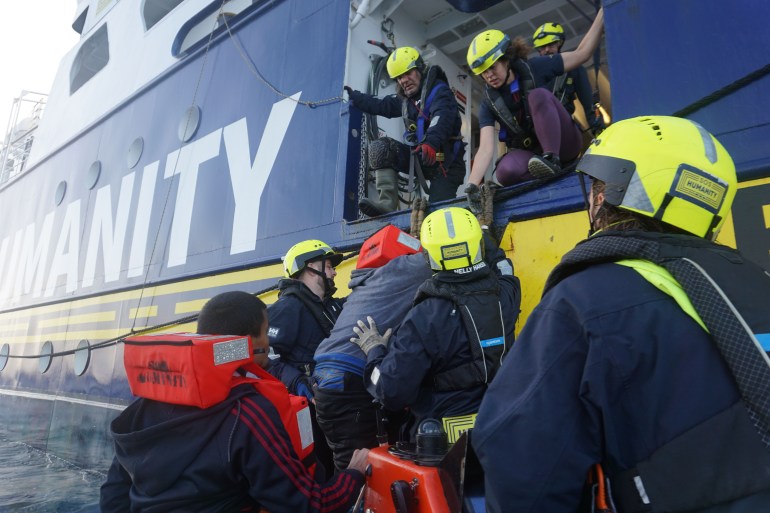
Mediterranean Sea – In the pitch-black hours of early Thursday morning, the Humanity 1 rescue ship approached a sky-blue wooden boat in distress in the central Mediterranean Sea. On board were at least 126 people who were suffering from hypothermia, dehydration and exhaustion from clinging to the boat for hours as it struggled to stay upright amid waves as high as two metres (six feet). Cries for help in Arabic echoed off the waves in the pre-sunrise. “‘We were ready for death, we were dying,’” a 30-year-old Syrian survivor told Al Jazeera as he clung to the orange rescue RIB (rigid inflatable boat) shuttling the refugees to the mothership while fighting against the high waves. Among the survivors were one newborn and 30 minors, most of whom had embarked on the treacherous Mediterranean crossing on their own without an adult to accompany them. “The newborn was completely covered in blankets, it was not easy to recognise that there was a baby inside. “We also had very old people this time, some of them weren’t even able to walk by themselves due to dehydration and exhaustion,” Viviana di Bartolo, Humanity 1’s search and rescue coordinator, said. According to the survivors, they had departed from the Libyan coast two days ago and were in distress due to rough weather conditions and high waves when they were intercepted by Humanity 1 while drifting in Maltese waters. Many of the survivors were afraid they would be taken back to Libya [Nora Adin Fares/Al Jazeera] They boarded the Humanity 1 barefoot, completely soaked in saltwater and obviously suffering from the cold and severe dehydration. Many were disoriented and afraid they would be taken back to Libya. ‘Not even treated as humans’ The survivors spoke to Al Jazeera about the horrific ordeals they had suffered to make it across the Mediterranean, especially human rights violations on the Libyan side. A young Syrian survivor in his early 20s, suffering from severe hypothermia, said he had tried to make the crossing from Tripoli to the south of Italy three times and that every time he had been intercepted by the Libyan coastguard. “It has been hell. Libya is hell. I tried leaving for eight months now without success, over and over again, we were forced back,” he said. Another survivor on board Humanity 1 testified to the inhumane conditions in Libyan prisons over the past year, after he had been forced back in a failed attempt to leave the North African coast in early 2023. “You don’t understand, we were not even treated as humans”, he said. The Humanity 1 was assigned a port of safety in Genova, north of Italy – but will request a closer port to disembark the suffering survivors sooner. Viviana di Bartolo, Humanity 1’s search and rescue coordinator [Nora Adin Fares/Al Jazeera] “We’ll ask for a closer port of safety because of the rough weather conditions and the fact that we have several vulnerable cases on board and people that require medical attention,” Lukas Kaldenhoff, Humanity 1’s press officer, says. ‘Boats in distress’ The desperate people who make these dangerous crossings have usually paid every last penny they have to human smugglers who put them on board rickety boats with no concern for their safety. As the boats flounder on the high seas, often the only hope these refugees have of survival is that their plea for help is picked up by a vessel that is willing to come help. “They [the survivors] were not only in distress because of the water conditions, but because of the boat,” di Bartolo said, exhausted after shuttling refugees between the wooden boat and the mothership for more than two hours. “It was very poorly structured, had no safety equipment at all or people that could navigate. The people on board had no life jackets or even basic stuff such as water, food or even a toilet. This kind of boat is not meant to sail in a safe way, not at all,” she continued. According to international law, vessels have a clear duty to help boats in distress. That definition is determined on a case-by-case basis but, according to di Bartolo, the term “boat in distress” is applicable to nearly every departure from Tunisia and Libya that aims to cross the central Mediterranean route. The small, overloaded boat had no safety precautions on board when the Humanity 1 intercepted it [Nora Adin Fares/Al Jazeera] On Wednesday night, Humanity 1’s crew had received two different Mayday calls about boats in distress, and they desperately tried to clarify whether there was another boat nearby. The first Mayday came from Frontex, the European border control, regarding a wooden boat carrying 40 people and the other from Alarm Phone, [a hotline for people in distress] regarding 90 people. “We’re now sure that both calls were regarding the boat we rescued this morning”, Kaldenhoff said. Humanity 1 is operated by the German NGO SOS Humanity and has been undertaking risky search-and-rescue missions across the Mediterranean Sea since 2022. At least 2,498 refugees, migrants and asylum seekers are known to have drowned in 2023 while crossing the central Mediterranean according to the International Organization for Migration, making it the deadliest year since 2017. But the real number is believed to be far higher. The Central Mediterranean is the deadliest known migration route in the world, with more than 17,000 deaths and disappearances recorded by the Missing Migrants Project since 2014. Most of the departures are from Libya and Tunisia – but the refugees and migrants have often travelled far from countries such as Syria, Afghanistan, Lebanon, Turkey or Egypt, fleeing violence, discrimination, and a loss of livelihood. [embedded content] Adblock test (Why?)
Which are the armed groups Iran and Pakistan have bombed — and why?
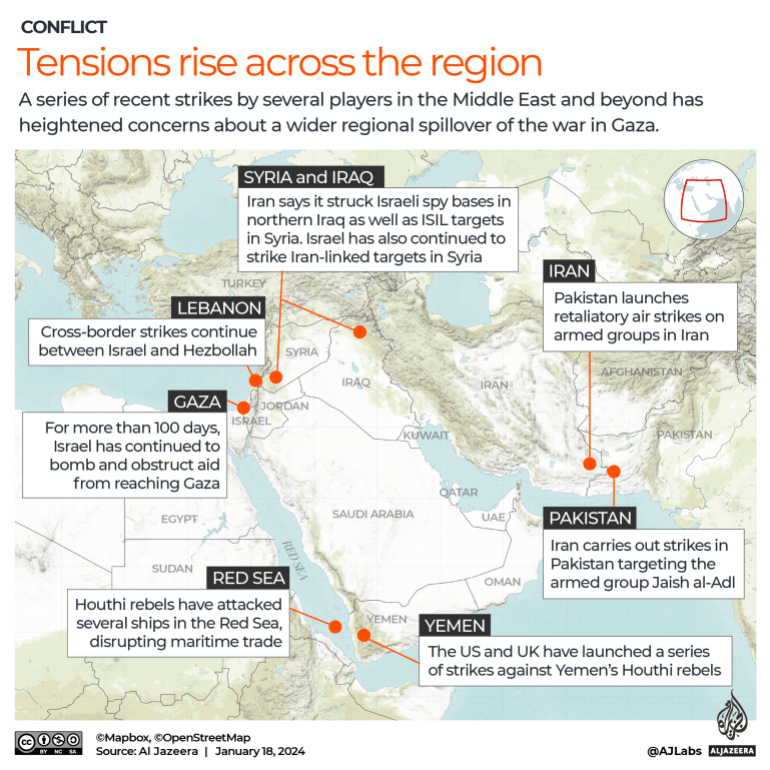
Iran and Pakistan have carried out air attacks on each other’s territories, targeting armed groups near their 900km-long (559-mile) volatile border, which they say were meant to ensure their respective national security. Iran’s powerful Islamic Revolutionary Guard Corps (IRGC) targeted an armed group in Panjgur town of Pakistan’s Balochistan province late on Tuesday, prompting Pakistan to bomb hideouts of armed groups in the Sistan-Baluchestan province of Iran early on Thursday. Let’s take a look at why the neighbours have resorted to direct military strikes, who the targets were, and what the attacks tell us. (Al Jazeera) What has happened so far? The IRGC, an elite force which is a vital part of the Iranian establishment but separate from Iran’s army, hit the Jaish al-Adl armed group with missile and drone strikes in a mountainous region in Pakistan close to the Iranian border. Iran said it targeted the Iranian “terrorist” group it blamed for recent attacks in the Iranian city of Rask in the southeastern province of Sistan-Baluchestan. “The group has taken shelter in some parts of Pakistan’s Balochistan province. We’ve talked with Pakistani officials several times on this matter,” Iran’s Foreign Minister Hossein Amirabdollahian said on Tuesday from the Swiss city of Davos. Videos from the scene showed what appeared to be a precision strike on a building, and Iranian media celebrated the destruction of a “terrorist” site. The Pakistani government said two children were killed in the attack, believed to be the first such attack by Iran on Pakistani soil. Pakistan launched several air attacks using drones and rockets on a border village in Saravan town, about 1,800km (1,100 miles) from the Iranian capital, Tehran, saying it hit Baloch “notorious terrorist” separatists. Tehran said nine people, including seven women and children, were killed in the attacks. Both countries’ foreign ministries released statements to say they respected the other’s territorial integrity but took measures to safeguard their national security. The Iranian attack came hours after Iran and Pakistan held a joint naval exercise, and the two countries’ foreign ministers spoke in Davos on the sidelines of the World Economic Forum. Both summoned their respective envoys, but there has been no talk of cutting diplomatic relations. Iran on Thursday held a large-scale military exercise in its southeastern areas near Pakistan, deploying a range of aircraft and missile systems. Who are the ‘terrorists’ targeted? Iran’s target inside Pakistan was the ethnic Baloch and Sunni group known as Jaish al-Adl, meaning Army of Justice, which surfaced around 2012. It purports to fight for better living conditions in the southeastern Sistan-Baluchestan province, which is Iran’s most impoverished and the longstanding scene of border tensions. Tehran considers it a “terrorist” group due to numerous deadly assaults on Iranian outposts and security forces near the border over more than a decade. Officials call it Jaish al-Zulm – the Army of Injustice. The group was born out of Jundallah, another Iranian Baloch group, which Tehran accused of having direct links with the United States and Israel. It was responsible for a string of deadly attacks, including one in 2009 which killed dozens, including senior IRGC officials. The leader of Jundallah, Abdolmalek Rigi, was captured in a dramatic operation by the Iranian army, with fighter jets forcing the landing of a passenger aircraft taking him from the United Arab Emirates to Kyrgyzstan in 2010. He was executed in Tehran the same year. Pakistan, for its part, said its targets were the Balochistan Liberation Front (BLF) and Balochistan Liberation Army (BLA), armed separatist groups which have launched numerous attacks inside Pakistan. The BLF claimed in a statement on Thursday that none of its fighters – known as Sarmachar – were killed, dismissing as fake an earlier statement that had quoted one of its members as confirming air strikes had hit BLF positions inside Iran. The latest cross-border strikes come against a backdrop of months of border attacks, with the latest attack by Jaish al-Adl on an Iranian border outpost launched from inside Pakistan in December killing 11 police officers. What do the Iranian attacks tell us? Even though the strikes come after years of border tensions, they are happening within the context of Israel’s war on Gaza, which has pitted the Iran-backed “axis of resistance” against Washington and its allies. This was the first time that Iran and Pakistan launched direct assaults on each other’s territory, and the first time since the end of the eight-year invasion of Iran by Iraq in 1988 that Iranian soil was targeted by a missile. Iran’s attack on Pakistan came a day after it launched 24 missiles from three different Iranian provinces on Iraq and Syria in a military show of force amid US and United Kingdom attacks on Yemen and Western support for the Gaza war. The attacks in the Levant were also framed as revenge for twin bombings in Kerman earlier this month that killed at least 90 civilians, serving to assuage domestic calls for retaliation. Yet they also showcase the capabilities and precision of the largest and most varied missile arsenal of the Middle East. In Iraq, Iran claims to have hit a Mossad-linked target in what appeared to be a precision strike. A wealthy Kurdish businessman Peshraw Dizayee was confirmed killed. Images from the area show that only the villa of the Dizayee was destroyed and it was located in the vicinity of the US consulate and the international airport in the regional capital, Erbil, where US and other foreign forces are stationed. For ISIL (ISIS)-linked targets in Syria’s Idlib, the IRGC made a point of saying that it used its brand new Kheibar Shekan ballistic missile with a stated range of 1,450km (900 miles). Even though the missiles could have been launched from a province closer to Syria, their stated launch site was in Khuzestan, which is several hundred kilometres farther. This means that the missiles travelled close to 1,300km (807 miles) to hit precise targets. That puts the entirety of Israel and occupied Palestinian territories within
What is the UK’s ‘Safety of Rwanda’ bill and why are MPs fighting over it?
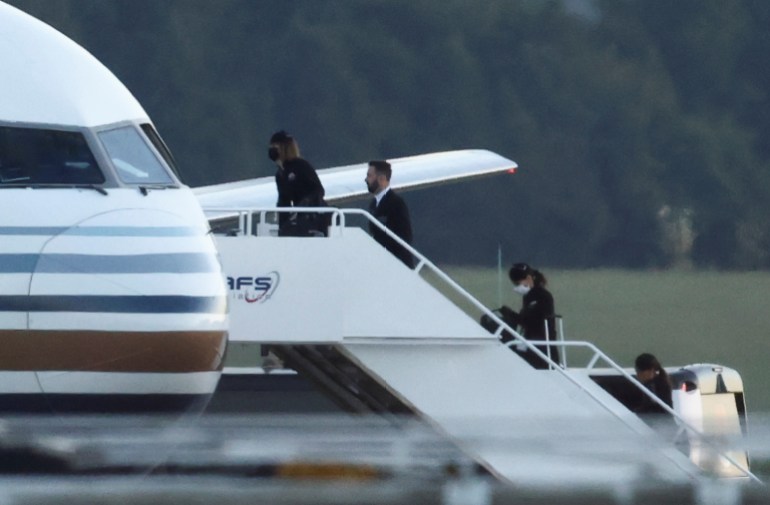
British Prime Minister Rishi Sunak has succeeded in pushing his asylum and immigration bill through the House of Commons after an expected rebellion by Conservative Party MPs came to nothing. Some MPs from Sunak’s own party had threatened to vote against the “Safety of Rwanda” deportation bill on the grounds that government plans to send some asylum seekers to Rwanda were not robust enough to survive legal challenges. But in the end, only 11 hardline Conservatives rebelled and the legislation passed on Wednesday evening by a 320-276 vote. What is the ‘Safety of Rwanda’ bill? Sunak has made his anti-immigration “Stop the Boats” campaign central to his government’s legislative programme as he seeks to deter asylum seekers from trying to reach the United Kingdom across the English Channel. But the Rwanda deportation bill, which seeks to deport refugees and migrants to Rwanda to have their asylum claims heard and for resettlement, has been anything but plain sailing. In November, the Supreme Court struck down Sunak’s original Rwanda bill after it ruled that the landlocked African republic was not a safe country for asylum seekers, prompting the Conservative Party leader to introduce his so-called Safety of Rwanda bill. This new bill was intended to make it harder for the courts to challenge his legislation by asking the House of Commons to declare by majority vote that Rwanda is indeed a safe country for asylum seekers. Sunak presented his Safety of Rwanda bill to parliament in December but had to contend with hard-right MPs from his own party who asserted that the bill was still not “sufficiently watertight”. In the end, the Conservative Party leader secured a comfortable majority in favour of his bill after rebels, many of whom abstained, decided to let the legislation pass in the hope of holding Sunak’s feet to the fire at the final stage. How long has the government’s Rwanda policy been in the pipeline? The Rwanda legislation was first announced by former Prime Minister Boris Johnson in April 2022. Two months later, on June 14, 2022, the first Rwanda-bound flight from Britain was due to depart with asylum seekers on board. It was halted after a last-minute intervention by the European Court of Human Rights (ECHR), which decreed that one of the asylum seekers, a man from Iraq, was at “real risk of irreversible harm” should he end up in the East African nation. Legal battles over the government’s policy ensued. The issue came to a head when the Supreme Court made its ruling two months ago, but Sunak has nevertheless managed to drag his party kicking and screaming to Wednesday’s final vote. Members of staff board the first plane due to transport asylum seekers to Rwanda at MOD Boscombe Down base in Wiltshire, UK, on June 14, 2022, before the flight was halted by a court order [Henry Nicholls/Reuters] What happened to the expected Conservative rebellion? Rebel Conservatives, including MP Robert Jenrick, who resigned his role as immigration minister in December after accusing Sunak of presiding over defective legislation, tried to make changes to the Safety of Rwanda bill ahead of Wednesday’s vote. This included a Jenrick-drafted amendment designed to stop 11th-hour injunctions from the ECHR against deportations. But this was voted down easily. “In the end, the hardcore rebels – those who wanted both to toughen the bill and to use it to force a change of leader – just didn’t have the numbers that might have persuaded their other rather less zealous colleagues to join them,” Tim Bale, a professor of politics at Queen Mary University of London, told Al Jazeera. “They shot and missed.” Analysts said most rebel Conservatives were forced to accept that it was better to have some kind of legislation than to have no legislation at all. Among the 11 Conservative MPs to vote against the government were Jenrick and former UK Home Secretary Suella Braverman, whose hard-right credentials have led her to become something of a hate figure for leftists. After the vote, Braverman wrote on X: “The Rwanda Bill will not stop the boats. It leaves us exposed to litigation & the Strasbourg Court. I engaged with the government to fix it but no changes were made. I could not vote for yet another law destined to fail. The British people deserve honesty & so I voted against.” The ECHR is in Strasbourg, France. What happens next? The bill will now move on to Britain’s second chamber, the House of Lords, which will debate and vote on the legislation. The Lords, Bale said, “could still stymie or at least delay the bill”, so Sunak is far from home and dry. Indeed, Bale said that Wednesday’s success could turn out to be little more than a pyrrhic victory for the prime minister, who, according to opinion polls, is heading for an electoral wipeout in the next general election, which is likely to be held in the second half of this year and must be held no later than January 28, 2025. “Sunak has won a victory of sorts – but possibly only a temporary one,” the British academic said. “And he’s not come away completely unscathed: The divisions within the Conservative Party have been laid bare and his authority seriously questioned yet again.” Adblock test (Why?)
DR Congo’s shambolic election should be a wake-up call for the SADC
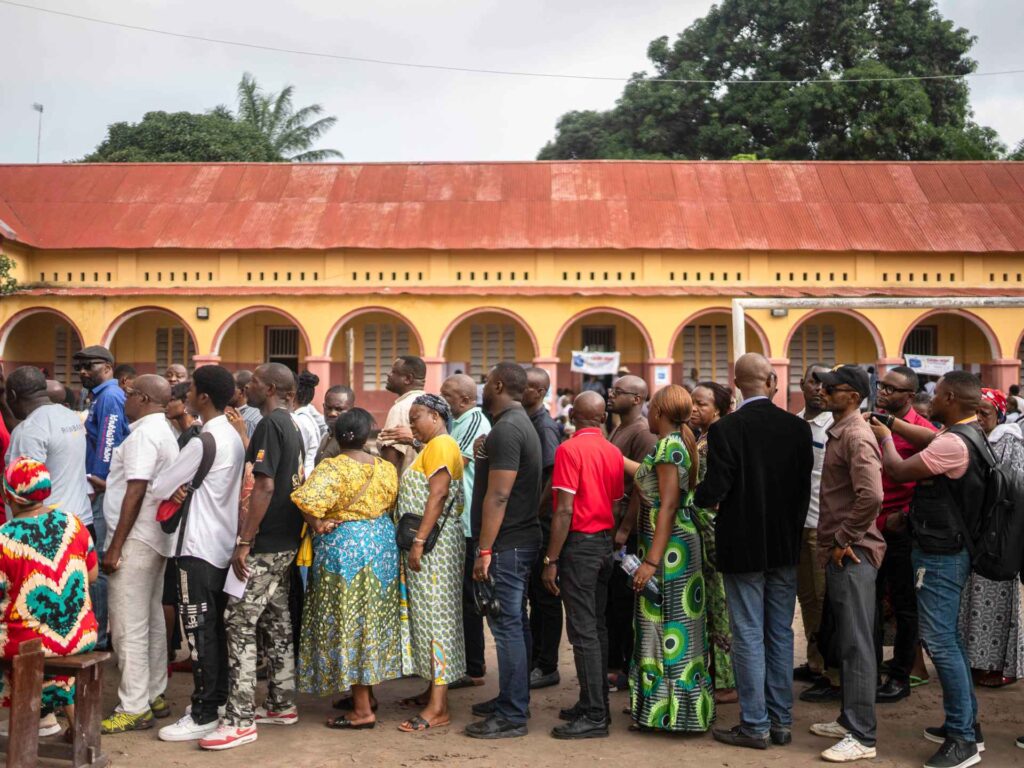
On January 9, the Constitutional Court of the Democratic Republic of the Congo (DRC) confirmed incumbent President Felix Tshisekedi’s landslide victory in the hotly disputed December 20, 2023 election, but failed to pull the Central African nation out of its full-blown electoral crisis. According to the DRC’s Independent National Electoral Commission (CENI) and highest court, Tshisekedi legitimately won a second and final five-year term in office with an impressive 74 percent of the vote, ahead of Moise Katumbi and Martin Fayulu, who placed second and third respectively. However, in the eyes of many, including failed presidential contenders Fayuli and Katumbi, the country’s synchronised presidential, local, provincial and national polls were a complete “farce”, and perhaps even less trustworthy and legitimate than the shambolic 2011 and 2018 elections. The joint observer mission from the Catholic Church and the Church of Christ of Congo (ECC) said they documented 5,402 cases of serious irregularities at polling stations. The churches said these alleged anomalies – malfunctioning voting devices, unopened polling stations, vote buying, plundering of polling materials, shoddy electoral lists, and ballot stuffing – could have compromised “the integrity of the results”. On Christmas Eve, while the shambolic election was still ongoing in many localities where the state failed to open polling stations on election day, the Archbishop of Kinshasa Cardinal Fridolin Ambongo voiced the feelings of countless angry voters in the country when he said: “What should have been a great celebration of democratic values quickly turned into frustration for many.” Indeed, it was extremely frustrating to see the DRC repeat the mistakes of the past, ignoring insistent warnings. Last April, for example, Fayulu, who many independent observers believe won the country’s controversial December 2018 presidential poll, published an opinion piece on this very page warning his country was “heading towards another sham election” and encouraging CENI to change course and ensure a “free and fair” presidential poll before it is too late. Denis Kadima, the president of CENI, however, chose to ignore this and other similar counsel. Confident as ever, he even launched a thinly veiled attack on the opposition a few days before the polls opened, claiming there were “political groups in this country that are not ready for elections” who “discredit the process, no matter what we do’’. When the sheer scale of the electoral fiasco became obvious in late December, Kadima went on to call Fayulu and other candidates who understandably demanded a rerun “bad losers”. In the end, Fayulu and others refused to challenge Tshisekedi’s win in court, saying state institutions were not trustworthy or independent. Now, the Congolese people are forced to accept the results of a clearly bungled poll and a leader with a crisis of legitimacy for the second time in five years. It is time to admit that electoral malfeasance and incompetence have become a substantial menace to societal cohesion, peace and development in the DRC. And regrettably, this is a widespread and deep-rooted problem across the Southern African Development Community (SADC) region. Take Zimbabwe, which has failed to hold a single truly free, fair and transparent election since its independence from British colonial rule in April 1980. President Emmerson Mnangagwa has won two disputed elections – in July 2018 and August 2023 – over his chief rival, Nelson Chamisa, leader of the main opposition Citizens Coalition for Change (CCC) party. Last year’s polls, for example, were deemed a colossal failure after many polling stations opened late or failed to open at all. The anomalies were particularly prevalent in Harare and Bulawayo, traditional strongholds of the opposition, raising suspicion the Zimbabwe Electoral Commission (ZEC) wanted to suppress votes there and give the ruling Zanu-PF party a helping hand. Meanwhile, the Zimbabwe Election Support Network (ZESN) and Election Resource Centre (ERC) stated Zanu-PF actors were engaged in voter intimidation tactics throughout the country. Understandably, Chamisa asserted the polls were a “blatant and gigantic fraud”, while his party called for a rerun. And just like the DRC’s Fayulu, he refused to challenge Mnangagwa’s corrupted triumph in court, alleging Zimbabwe’s Constitutional Court was “captured”. Meanwhile, a SADC electoral observer mission (SEOM), led by Dr Nevers Mumba, the former vice president of Zambia, delivered a scathing preliminary analysis of the August 2023 poll. Among others, the SEOM criticised aspects of ZEC’s Delimitation Report of 2022, and highlighted the contentious decision to exclude Saviour Kasukuwere, a former Mugabe-era Zanu-PF minister, from the presidential race. In this regard, the mission found that “some aspects of the Harmonised Elections, fell short of the requirements of the Constitution of Zimbabwe, the Electoral Act, and the SADC Principles and Guidelines Governing Democratic Elections (2021)”. A plethora of delays, it added, had “a knock-on effect as they dissuaded voters from voting in the first place” and effectively had “the unfortunate effect of creating doubts about the credibility of this electoral process”. Harare denounced SEOM’s objective assessments and demanded revisions to the preliminary report. At the same time, government-owned media launched a vicious smear campaign against Mumba, accusing him of being on a Western-sponsored “regime change mission”, all without offering a shred of evidence. Meanwhile, South Africa’s President Cyril Ramaphosa came to Harare’s defence, as he usually does, by declaring that other countries, like the US, also have electoral challenges – as if millions of frustrated and disfranchised Zimbabweans care at all whether such problems are also experienced to some extent in Washington. This is not a problem only for Zimbabwe, or the DRC, or whatever country that experiences the latest election debacle either. It is important to uphold SADC electoral standards, in every single member country, as Mumba boldly advocated for in his preliminary report, to improve our shared wellbeing in Southern Africa. SADC leaders have failed us all. The ability to deliver peace, stability and socioeconomic change through the ballot box has been turned into a mere pipe dream in most SADC countries. Zimbabwe has extensive socioeconomic problems, including an underperforming economy, a dilapidated health sector, and high unemployment for many decades.
Maghazi residents left reeling after Israeli forces withdraw
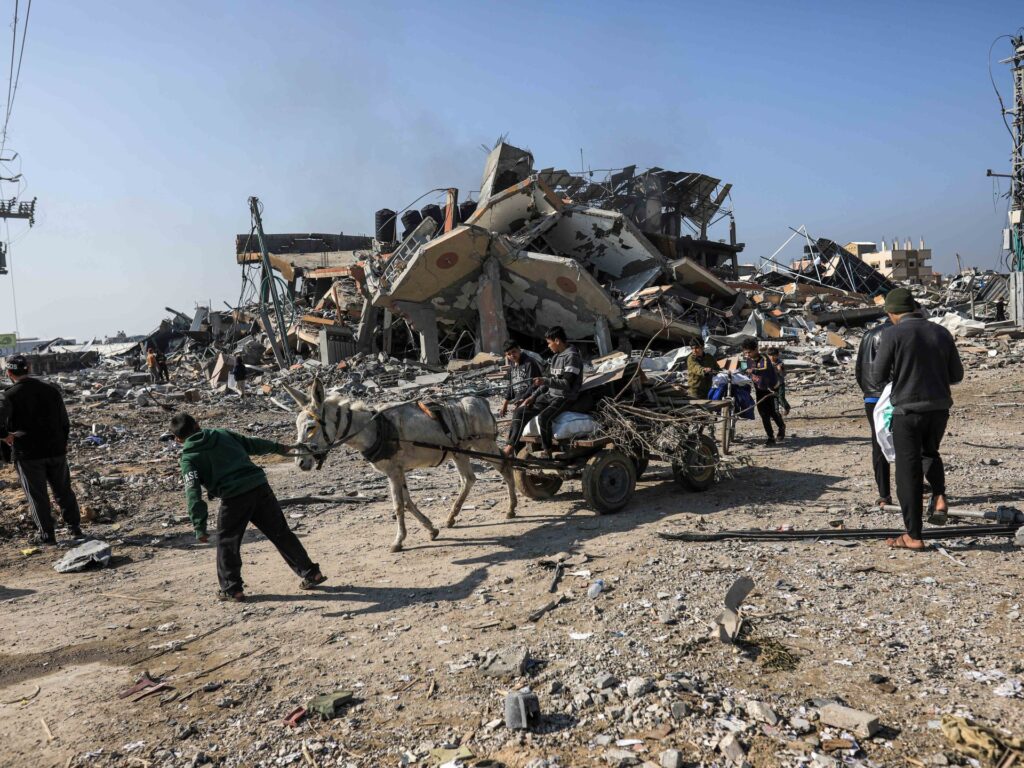
Central Gaza Strip – Palestinians in Gaza’s smallest refugee camp have once again found themselves digging the bodies of their relatives out from under rubble, hours after Israeli forces announced their withdrawal from the area. Witnesses in the Maghazi refugee camp say many of the residents were shot at close range by Israeli soldiers “in cold blood”. Piles of broken concrete and scenes of widespread destruction are evidence that homes were not spared in Israeli attacks, which included missile strikes and heavy artillery shelling. Israeli soldiers have been conducting ground operations in northern, central, and parts of southern Gaza, for more than three months. Maghazi camp has come under Israeli attack several times over the last few weeks. In one of the deadliest attacks last month, more than 100 people were killed, mostly displaced women and children. Dozens more have been reported killed in the camp in the past several days. Ambulances have been unable to navigate destroyed roads and infrastructure in order to recover the bodies. The camp normally houses about 30,000 people, according to the United Nations Relief and Works Agency for Palestinians in the Near East (UNRWA). But the population of the camp rose to at least 100,000 as thousands more frightened Palestinians came there seeking shelter from Israel’s relentless bombardment in other parts of the besieged enclave. Attacks on refugee camps and civilian infrastructure have become common since October 7. Nuseirat and Bureij camps in central Gaza have also been targeted several times, as well as the Jabalia refugee camp in northern Gaza. The attacks have killed thousands of Palestinian civilians. Adblock test (Why?)