

‘Criminal complaints’ filed against Israeli President Herzog in Switzerland

Swiss prosecutor confirmed the filing but would not reveal details about the nature and number of the complaints. Israeli President Isaac Herzog is the subject of criminal complaints during his visit to the World Economic Forum in Davos, Swiss prosecutors have confirmed, as Israel finds itself accused of committing war crimes in Gaza. “The criminal complaints will be examined according to the usual procedure,” the Office of the Swiss Attorney General said on Friday, adding that it would contact the Swiss foreign ministry to examine the question of immunity of the individual concerned. In theory, third countries do not hold criminal jurisdiction over current heads of state, heads of government and foreign ministers of other countries. The reasons behind the complaints and who filed them were not specified. A spokesperson for Herzog’s office did not comment on the statement by Swiss prosecutors, saying only that Herzog had been to Davos to present Israel’s position on the situation in Gaza. The AFP news agency obtained a statement allegedly issued by the people behind the complaint, entitled “Legal Action Against Crimes Against Humanity”. It said several unnamed individuals had filed charges with federal prosecutors and with cantonal authorities in Basel, Bern and Zurich. The statement said the plaintiffs were seeking a criminal prosecution in parallel to a case brought before the United Nations International Court of Justice (ICJ) by South Africa, which has accused Israel of genocide in its offensive in Gaza. While it could take years for the ICJ to produce a final verdict, South Africa asked the court to instruct “provisional measures” – a temporary order for Israel to stop the war – while the case is pending. Israel has called South Africa’s accusations “baseless” and a “blood libel”. Universal Jurisdiction The reasons behind the complaints filed to the Swiss prosecutor are unclear, said Al Jazeera’s diplomatic editor James Bays. They could relate to something that took place in Switzerland while Herzog attended the Davos summit, he explained, or they could relate to previous statements Herzog made about Palestinians, which were also cited by South Africa’s legal team at the Hague while presenting their case. Days after October 7 – when Hamas fighters launched an unprecedented attack into southern Israel killing nearly 1,200 people – the Israeli president said it was not only Hamas fighters but “an entire nation” that was responsible for the violence and that Israel would fight “until we break their backbone”. After the Hamas attack, Israel launched a ferocious bombardment of Gaza that has killed more than 24,500 people, 70 percent of whom are women and children, according to the United Nations. If prosecuted, such a case filed to the Swiss court would be dealt with under “universal jurisdiction”, William Shabas, a professor of international criminal and human rights law at Middlesex University in the UK, told Al Jazeera. Under international law, universal jurisdiction is based on the principle that certain crimes are so serious that their perpetrators must be prosecuted transcending borders. This means that states or international organisations can file legal complaints against people regardless of their nationality or where the alleged crime was committed. Such cases are usually related to international crimes. “It used to be extremely rare for this to happen but more and more, particularly in European countries, there is an effort to prosecute such crimes – the crime of genocide, war crimes, and so on, using universal jurisdiction,” Shabas said. “The obstacle would be the alleged immunity of a president of a country – that is going to be a real problem,” he added. Addressing the issue of immunity, the statement seen by AFP suggested that it could be lifted “in certain circumstances”, including in cases of alleged crimes against humanity, adding that “these conditions are met in this case”. Another obstacle for the prosecutor to proceed, Shabas said, would be obtaining “a level of political approval”. Adblock test (Why?)
Could Ethiopia and Somalia go to war?

Mogadishu says a deal to grant Addis Ababa access to sea in Somaliland is a violation of its sovereignty. An agreement between Ethiopia and a breakaway part of Somalia is raising tension on the Horn of Africa. Somalia regards Somaliland as part of its territory, and has warned Ethiopia against interfering in its affairs. But Ethiopia is landlocked and wants access to the sea – something Somaliland can provide. Regional blocs are trying to mediate, but neither side is willing to back down. So how will this dispute play out? And is war a possibility? Presenter: Elizabeth Puranam Guests: Kemal Hashi Mohamoud – Member of the Ethiopian parliament Matt Bryden – Strategic adviser at Sahan Research, a political think tank covering the Horn of Africa Abdi Aynte – Former Somali minister of the Ministry of Planning, Investment and Economic Development Adblock test (Why?)
Palestine, the alchemy of big lies and future of the university

In September 1944, as the genocide of European Jews was ongoing and the violence of World War II was at its peak, Max Horkheimer, co-founder of the Institute for Social Research – aka the Frankfurt School – and the methodology of “critical theory” it developed, declared that “wittingly or unwittingly, the Jews have become the martyrs of civilization. … To protect the Jews has come to be a symbol of everything that mankind stands for. Their survival is the survival of culture itself.” It is telling that 80 years later with the forced resignation of Harvard President Claudine Gay, so many of the same issues that occupied the Frankfurt School then are at the centre of a culture war that, with the 2024 presidential election looming, could determine the fate of democracy in the United States – just as the founders of critical theory predicted. Only now it’s Palestinians and not Jews who are the martyrs and symbols, whose survival as a national community on their land has become, more than any other contemporary conflict, a bellwether of the possibility to address the increasingly intractable problems facing humanity. Critics of Gay’s forced resignation, even when accounting for her admittedly sloppy citation practices, point to her race; advocacy of diversity, equity and inclusion (DEI) policies; and mostly, her overly lawyered response to questions about “calling for genocide of Jews” during the now infamous December 5 congressional hearing on anti-Semitism on campus as the reasons for her departure. But her position was doomed, and deservedly so, before she fumbled her context-dependent answer to Representative Elise Stefanik’s question about whether calls for genocide on campus would be considered hate speech. It was Gay’s moral cowardice in the face of Stefanik’s unmistakably mendacious set-up to the genocide question that revealed not only Gay’s unsuitability for leadership of the world’s premier research university but also the deeper intellectual and political rot at the highest echelons of American academia. The congresswoman claimed that merely by chanting the phrases “river to the sea” and “globalize the intifada”, protesters are in fact calling for “violence against civilians and the genocide of Jews”. “Are you aware of that?” Stefanik asked Gay. Here Stefanik was brazenly deploying the well-worn fascist tactic most recently resuscitated by Donald Trump to great effect: the “big lie”. It couldn’t have worked better; before Stefanik could even finish her accusation, Gay interjected that she found those phrases “hateful, reckless, offensive speech [that] is personally abhorrent to me”. Soon-to-be-fired University of Pennsylvania President Liz Magill, who only a few months before had worked overtime to prevent the Palestine Writers Literature Festival from taking place at UPenn, similarly bent the knee to Stefanik’s concocted allegations about rabid anti-Semitism on her campus. Gay might have a problem citing colleagues, but it’s simply inconceivable that the now former president of Harvard is so ignorant and ill-informed as to believe that those two phrases are tantamount to a call for genocide (it is worth noting that “river to the sea” has been used by Zionists for over a century, most recently by Netanyahu to declare that there will be “no Palestinian state from the river to the sea”). Her rush to second Stefanik’s racist accusation in the most “personal” way possible represented both a complete disavowal of what she and her colleagues must know to be reality and the kind of grovelling by academic leaders to state officials that characterise totalitarian systems, not functioning democracies. If there was ever a moment for academic integrity to show its face, it was then. If there was ever an inflection point in the struggle against fascist propaganda in the halls of Congress, it was then. The only ethical response to Stefanik’s deployment of such brazen falsehoods in the service of repressive politics was the one another Harvard alum, Joseph Nye Welch, famously gave to Senator Joseph McCarthy some 70 years ago after McCarthy, during a nationally televised hearing, accused a young colleague from Welch’s law firm of being a communist and suggested that the man should be fired. “Have you no sense of decency, sir?” Welch had said before refusing to answer any more questions on the matter. Only clear courage and harsh truth can defeat “the big lie”. Welch’s shaming of McCarthy’s “cruelty and recklessness” turned public and media opinion about McCarthy’s anti-communist crusade against him overnight. It has inspired congressional witnesses ever since, although clearly not Gay and her colleagues. And the price of their cowardice arrived directly with the punchline of Stefanik’s interrogation: her demand they declare whether chanting to “genocide the Jews” would be permissible speech on their campuses. The question flummoxed the three Ivy League presidents precisely because no such phrase has been chanted on their or any other campuses. Instead, in another deployment of big lie tactics, chants accusing Israel – plausibly, it must be stressed – of genocide in Gaza have been deliberately and falsely transformed by Israel’s long-formidable hasbara, or propaganda, machine into chants calling for the genocide of Jews, circulated virally on social media and then taken up by Stefanik on cue as the basis for her self-righteous inquisition of Gay, Magill and MIT President Sally Kornbluth. Perhaps a generation ago, the three university presidents could have been forgiven for having no ready response to such a fantastical accusation since it existed outside the reality-based universe academics are used to functioning in. Back then, as Karl Rove famously declared in the lead-up to the US invasion of Iraq (another big lie that shaped American politics for a generation), the imperial United States was so powerful “we create our own reality.” But at least scholars and journalists were still allowed “to study that reality … judiciously, as you will.” Today, even that courtesy is no longer afforded the intellectual class as the empire moves closer to ruin and its realities become harder to maintain. The “reality-based community” in academia, journalism and social media is under unprecedented assault, not just by hardcore conservatives but also
Christian Zionist cowboys: American and Israeli affinities laid bare
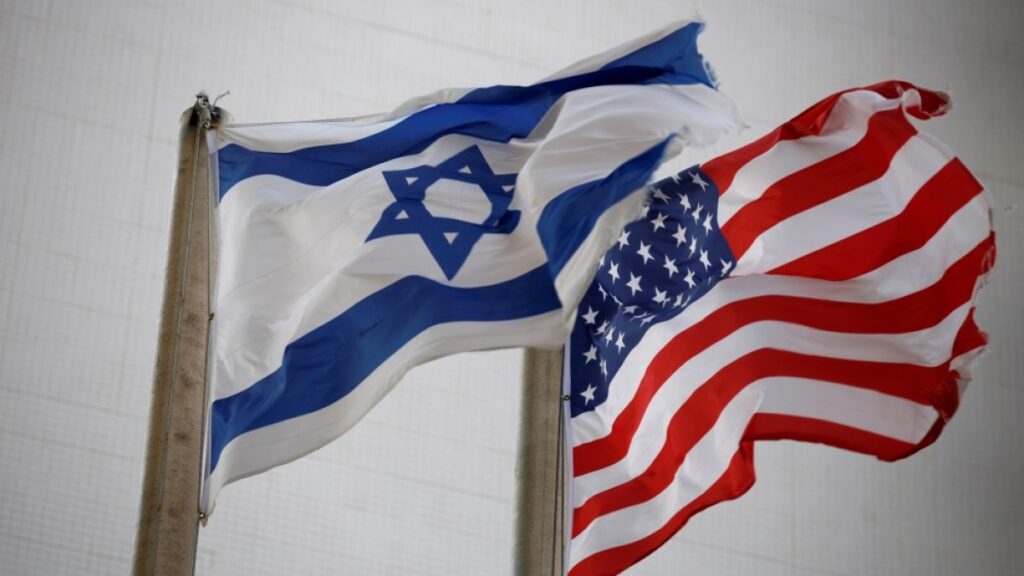
In early November, a photograph of four white men in cowboy hats at JFK airport was uploaded to social media with the caption, “These cowboys from Arkansas and Montana were at JFK today on their way to help out at the farms in Israel. They are not Jewish.” By the time the cowboys landed in Tel Aviv, a Jerusalem Post commentator declared, “they were already a social media sensation”. Indeed, since then they have netted thousands of likes and comments such as “God bless Israel! I will always stand with her” and “The Jewish people are so grateful to have friends.” Israeli and American media outlets have also celebrated the cowboys through interviews and updates about their work and time in Har Bracha, a Jewish settlement in “Judea and Samaria” – the term for the West Bank used by those who believe the land belongs to the Jewish people. Yet the cowboys are also a conduit to understanding a fundamental likeness between white American and Jewish Israeli society, namely their settler projects intent on the erasure of dehumanised “natives”. The men volunteer through the Christian Zionist organisation HaYovel, or “The Jubilee”; according to the organisation’s website, this biblical term “looks forward to a day of worldwide redemption and a fully restored land of Israel.” As Christian Zionists, the cowboys and their sponsors believe that four millennia ago, God promised the land to the Jewish people, who will rule it until the rapture and, ultimately, the second coming of Christ. In this scenario, Christians will be saved and ascend to heaven while those adhering to other religions will be sent to hell. While not all evangelical Christians in the United States (approximately a quarter of the population) hold these Christian Zionist convictions, polls show that a large majority believe that the modern state of Israel and the gathering of millions of Jewish people there are “fulfillments of Bible prophecy that show we are getting closer to the return of Jesus Christ”. Many Christian Zionists also believe in the “prosperity gospel,” which contends that blessing Israel results in personal and financial gain. These tenets compel Christian Zionists to support Israel’s settlements and other expansionist policies through donations, lobbying, and, as in the case of the cowboys, labour. For two decades, HaYovel has brought hundreds of volunteers each year to work in settlement agriculture. With many foreign workers fleeing since Hamas’s attack on October 7 as well as Palestinians barred from working in settlements and Jewish Israelis called up for military duty, more Christian Zionists like the cowboys are filling in. As one American worker told Israeli channel i24, “I can’t go into Gaza and fight, so I’m gonna help here on the farm.” The Christian volunteers also speak of themselves as “boots on the ground” during Israel’s time of need, invoking their labour as a military operation. This white, militaristic masculinity common among evangelicals was examined by scholar Kristin Du Mez in her 2020 book, Jesus and John Wayne. Du Mez explores 75 years of white evangelical history in the United States, tracing how evangelicals have replaced Jesus with an “idol of rugged masculinity and Christian nationalism,” including through such pop culture figures as Mel Gibson and John Wayne as well as politicians like George W Bush and Donald Trump, all of whom “assert white masculine power” and embody the evangelical values of patriarchy, authoritarian rule, belligerent foreign policy and fear of Islam. While Du Mez’s study doesn’t focus on Christian Zionism, she has noted the evangelical practice of supporting Israel. “[It’s a] kind of slippage into America as a new Israel,” she said in a 2021 interview. Here Du Mez ostensibly refers to the idea of early American colonists escaping religious persecution in England as the new Jews and America the new Israel, promised to the settlers by God. This conflation of America and Israel as God-instructed colonialism – one that depends on the replacement of savage natives with righteous settlers – is revealed in the Christian Zionist cowboys’ rhetoric. Media interviews with Montanan John Plocher in particular highlight the trope of good cowboys versus bad Indians and the dehumanisation of natives – tropes transposable on to Israeli Jews and Palestinians. In a December conversation with Israel Now News, Plocher was asked why he thinks the Jewish population in Israel is so excited about him and his fellow cowboys. “They’ve said that seeing the cowboys is like seeing the good guys,” Plocher responded. “You think of all the Westerns and John Wayne and all these people who stand up for the right thing and so it’s just an encouragement to them.” Despite the fact that American settlers murdered and terrorised Indigenous women, children, and other unarmed Native civilians and took the land for themselves, the narrative of good white cowboys versus bad Indians has appeared time and again in US popular culture. Scholar Michael Yellow Bird has examined this narrative “as part of the colonial cannon asserting white supremacy and Indigenous inferiority” and relates how in Western movies and television, “Not only did we spectacularly lose, but … we were also presented as screaming, grunting, unreasonable savages.” Though Zionists and Christian Zionists may declare that Jews are Indigenous to the land, it is Palestinians – made Indigenous through Israel’s process of settler colonialism – who are often depicted as barbaric and backward, as “beasts walking on two legs,” “little snakes,” and “human animals.” Similarly, in a November interview with Israel National News, Plocher compared Hamas and Palestinians more broadly with grizzly bears and declared the need for the land to be rid of them. He recounted that grizzlies are a problem in Montana and that the “original people” who came to Montana (meaning white settlers) eliminated them. The problem now, he continued, is that people want the grizzlies “everywhere”. “Let us do what we need to do to defend ourselves,” he said, meaning kill the grizzlies. “It’s the same with you guys, it’s Hamas … We understand you guys have
It’s high time for all those at Harvard to stand with Palestine
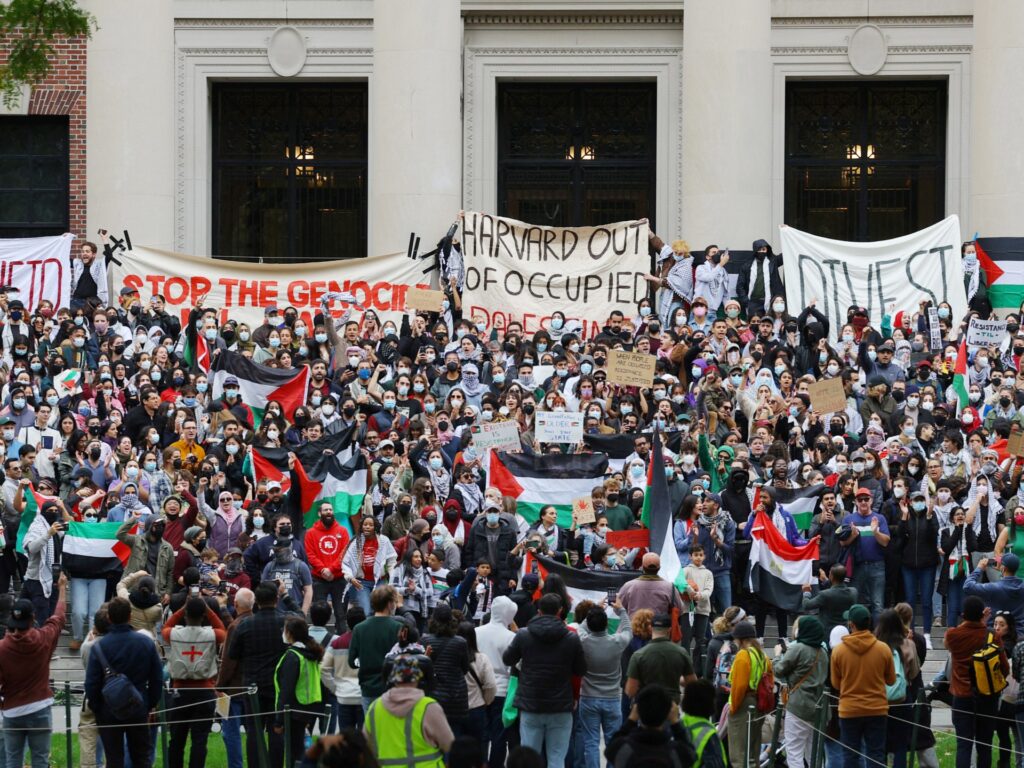
These days one of the most talked-about news stories in the United States is the resignation of Harvard University President Claudine Gay. As Harvard and its leadership are centred in the media, however, Palestinians continue to be killed by US-supplied bombs and buried under the rubble of their homes, schools, mosques and hospitals. While Harvard Yard is filled with speculation about the career of a millionaire academic, two million Palestinians are displaced by carpet bombing intended to ethnically cleanse Gaza. Amid the attempted distractions from an actualised genocide whose targets include families of students at Harvard, those of us in solidarity with Palestine remain subject to relentless attacks. Indeed, while hundreds of intellectuals at the university mobilised to sign a letter to the Harvard Corporation in support of Gay – the very president who spent weeks denouncing students protesting in solidarity with the victims of the ongoing Nakba – we are barely afforded minimal support. The letter, urging the Harvard Corporation “in the strongest possible terms to defend the independence of the university and to resist political pressures”, received ample attention from the national media. In the end, however, this effort by Harvard faculty not only failed to save Gay’s job but also did not translate into any meaningful support for those of us in solidarity with Palestine who refuse to cower. As Palestinians in Gaza and the rest of the occupied territories are subject to unfathomable conditions, relentless killing and irreversible destruction, at Harvard condemnation remains wrongfully assigned to students organising for justice in Palestine. Leading faculty appears ready to back only Gay, who, despite failing to recite the exact script demanded by Zionists, still classifies our activities in support of liberation as “abhorrent”. When solidarity is reserved for elite academics during an active genocide and there is only limited activity to demand Harvard end its complicity, or even just protect students standing with the oppressed, we have a problem. When a Trump endorsee’s rhetorical trap is left unchallenged and there is no rejection of the harmful premise that students calling for the end of an actual genocide are somehow calling for a hypothetical genocide, we have a problem. When some mobilise to preserve “free inquiry”, but avoid recognising the Palestine exception to free speech, we have a problem. For years, many have asked Harvard to disclose and divest from its material complicity in what has been widely recognised as an apartheid regime. In the past few months of censorship and particularly egregious threats to largely Muslim, Arab, Black, and brown students, we have been subject to attacks on campus. A student-compiled list of over 70 incidents include: a woman in hijab chased by someone wielding a knife; doxing via a billboard truck while targeted students face job losses, evictions, and academic sanctions; frivolous police reports against visibly Muslim students; and students being followed and harassed for wearing a keffiyeh (by the wife of a Harvard professor who signed the letter in support of Gay). During her limited tenure which held capacity for making various Zionist claims in public and private spheres, President Gay did not recognise a single one of these incidents; not even behind closed doors when rare opportunities for Muslims to express their hurt presented themselves. Over the fall semester, victims of anti-Palestinian and anti-Muslim racism found little support from the majority of faculty signatories on the letter to the Harvard Corporation. Only around 10 percent of the 764 signatories joined an open letter asking Gay to recognise the suffering of Palestinians and denounce the silencing of supporters of Palestinian liberation (which she has never done, not even in her post-resignation op-ed). Even the killing of over 100 family members of a single Palestinian student at Harvard Law School has not been enough to garner sympathy – let alone rage – from this institution. Recognising pervasive anti-Black racism, speaking out against the bigotry motivating Gay’s ousting – even if her administration perpetuated its own modes of injustice against marginalised communities – is necessary. Also necessary is recognising that following an earlier smear campaign by a billionaire mogul against a Black student protester and a Muslim security marshal, Gay would succumb to this hateful campaign and release an email to notify the public that these students are under investigation by local police and the FBI. While Gay is backed by hundreds of faculty in an attempt to save her elite position, Elom Tettey-Tamaklo was promptly robbed of his job as a residential assistant, with minimal outcry. The president of Harvard at the time even condemned the liberatory phrase “from the river to the sea” Palestine will be free, in communication to the entire Harvard community. While leading intellectuals attempted to rescue Gay under the claim of free speech, many caused disappointment by ignoring Harvard’s neglect of its students speaking for a free Palestine. Now, will these Harvard faculty sign on to support the crucial chapter of Faculty and Staff for Justice in Palestine? Focus ought to shift towards understanding why many stand by, as students showing solidarity with Palestine face smear campaigns ignored or supported by their universities, and others within these institutions mobilise only for a president who boasts about punishing these students. Some at Harvard shamefully rationalise away speaking against the Zionist genocidal campaign, refusing to use institutional privilege to pursue veritas in the most basic way. Even as the university attempts to restrict speech and censure voices for Palestine, hundreds of faculty, who happily signed an open letter in support of Gay, turn away from their students advocating for justice in Palestine. As Palestinians are slaughtered, many of us at Harvard, many at Harvard, through rhetoric and actions, support their plight “from the river to the sea”. Yet elite academics and headlines only notify us of a defence for a president who credulously opened herself up to a frivolous congressional hearing. As a grave injustice unfolds before our eyes, at the most basic level, Harvard – as one of the most influential institutions based
Israeli minister says only a deal can free captives as rifts split cabinet
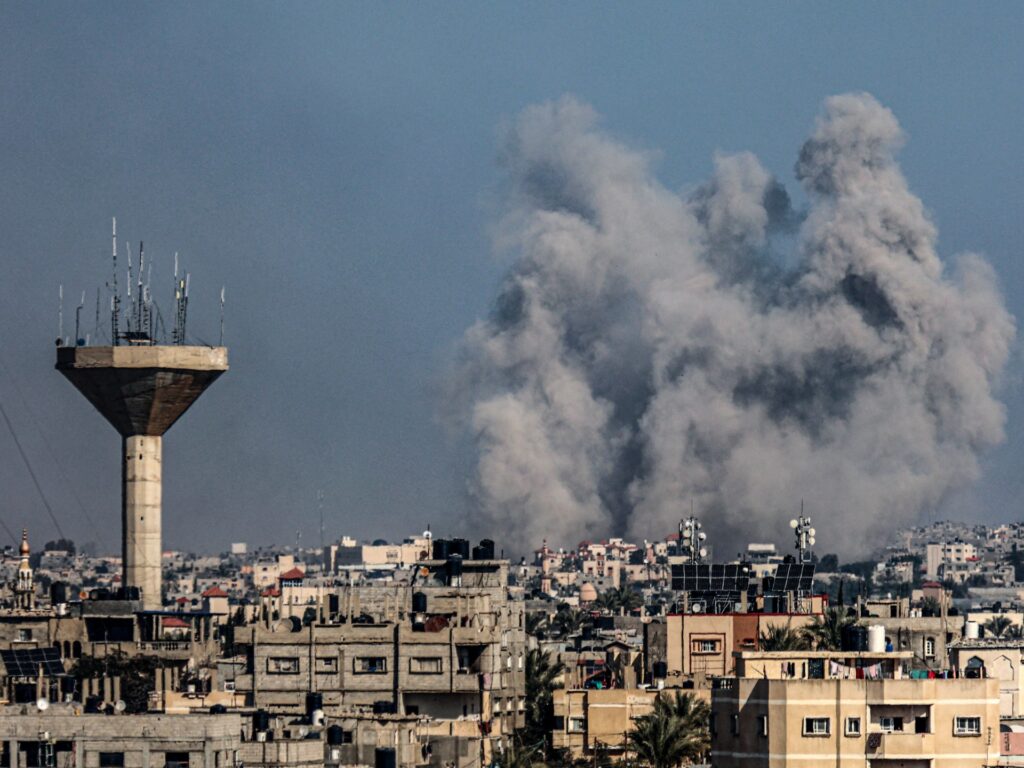
Gadi Eizenkot’s comments come amid disagreement in the war cabinet about how to handle the war in Gaza. A deal will be needed to ensure captives still held in the Gaza Strip are released alive, Israeli war cabinet minister and former military chief Gadi Eizenkot says, adding that a lightning raid would be extremely unlikely to succeed. Eizenkot, whose youngest son was killed in fighting in Gaza last month, said the fate of the captives should take priority over other war aims, even if that means Israel missing out on an opportunity to take out the political header of Hamas. Asked if the captives could be released in a rescue mission similar to the 1976 operation in which Israeli commandos freed about 100 hostages in Entebbe, Uganda, he said it was unlikely to happen. “The hostages are scattered in such a way – even underground – that the likelihood [of such an operation] is extremely low,” Eizenkot told Israel’s Channel 12 programme Uvda late on Thursday. “We are still making efforts and looking for every opportunity, but the likelihood is low and to say that this is how it will happen is to sow an illusion.” Israel estimated that about 130 captives remain in Gaza and 27 have died in captivity. More than 100 captives seized during Hamas’s cross-border attack into southern Israel on October 7 were freed during a week-long November truce. “I think it is necessary to say boldly that it is impossible to bring the hostages back alive in the near future without a deal,” Eizenkot said in the interview. But he added that the broader war aims would “still be valid” after any temporary ceasefire. At least 24,762 people have been killed in Israel’s air, ground and sea offensive in Gaza. The revised death toll in Israel from the October 7 Hamas attacks stands at 1,139. Internal rifts Eisenkot’s comments were the latest sign of disagreement among Israel’s political and military leaders over the direction of the offensive in Gaza, now in its fourth month. Prime Minister Benjamin Netanyahu and Defence Minister Yoav Gallant have said the fighting will continue until Hamas is crushed and argued that only military action can win the captives’ release. Hamas seeks an end to the war before discussing releases and has demanded thousands of Palestinians imprisoned by Israel be released in exchange for those held captive in Gaza. Eisenkot is one of four members of the war cabinet along with Netanyahu, Gallant and former Defence Minister Benny Gantz. In his interview, he also said he had convinced officials in the group to hold off on any attack on Hezbollah in Lebanon in the days after the Hamas attacks, confirming that a preemptive strike was called off at the last minute during the early days of the war. He described himself as being among those arguing against such a strike in an October 11 cabinet meeting that left him hoarse from shouting. “I think our presence there prevented Israel from making a grave strategic mistake,” he said. Both Israel and Hezbollah have signalled they want to avoid war, but both said they are ready to fight if necessary. Eizenkot also dismissed suggestions that the military has delivered a decisive blow against Hamas. Gallant said Israeli forces have disabled the Hamas command structure in northern Gaza, from where significant numbers of soldiers were withdrawn this week, and that Israel’s focus is now on the southern half of the territory. But Hamas has continued to fight back across Gaza, even in the most devastated areas, and launched rockets into Israel. “We haven’t yet reached a strategic achievement, or rather only partially,” Eisenkot said. “We did not bring down Hamas.” Adblock test (Why?)
‘Used to be a festival’: Why Pakistan is seeing a subdued election campaign

Rawalpindi, Pakistan – Muhammed Iqrar stands outside his small shop in Muslim Town, a commercial area in Rawalpindi. Something is amiss, he says. “We have general elections in less than a month, but I don’t recall our area being so dead before,” the 46-year-old says. “We used to have buntings, banners, flags, music blaring from the speakers put up by different candidates. … It used to be a festival. Now, it’s just so quiet.” Pakistan, a country of 241 million people, is scheduled to hold its delayed national elections on February 8. But the vote has been tainted by allegations of rigging made by the main opposition party, headed by jailed former Prime Minister Imran Khan. Khan, by many accounts the country’s most popular politician, has been behind bars since August under various charges. He is also barred from standing in the elections due to his conviction in cases he says are part of a military-backed crackdown on him and his party. Last week, Khan’s Pakistan Tehreek-e-Insaf (PTI) party was stripped of its election symbol, a cricket bat, through a Supreme Court order, leaving its leaders with no choice but to fight as independents with their own individual symbols. In a country with a literacy rate of 60 percent, election symbols are necessary to help voters identify the parties they support on the ballots. Two days after the top court’s decision, Maryam Nawaz, daughter of three-time former Prime Minister Nawaz Sharif, kickstarted her party’s campaign on Monday with a rally in the city of Okara in Punjab province, the deciding region in the polls. ‘People are not interested’ But the absence of any real opposition has turned the run-up to the election into a lukewarm affair – something Iqrar says he never experienced in the past. A supporter of Sharif’s Pakistan Muslim League-Nawaz (PMLN) party, he recalls participating in campaigning, going door to door to distribute flags and inviting people to street meetings. “We used to get into the swing of things some two or three months before the elections. We put flags of our leaders and tried to engage people. But now it appears as if people are not interested at all,” he says. Muhammed Iqrar says he used to be active in past election campaigns [Abid Hussain/Al Jazeera] Maqbool Sharif Toor, a retired government employee, agrees. A resident of Babu Mohalla, a densely populated neighbourhood in central Rawalpindi, Toor says he is uncertain if the elections would be held as scheduled. Earlier this week, Iran fired missiles at Pakistan, allegedly targeting ‘terrorist’ bases, and prompting retaliatory strikes from Pakistan. Those tensions have further injected uncertainty over whether the elections will indeed proceed as planned on February 8. “One party has been completely sidelined, ruining the competition. We loved the ‘halla gulla’ [cacophony] during the campaigning, but now there is hardly anything here,” he says. The 12th general election in Pakistan is being held under a cloud of political and economic instability and a deteriorating security situation. The vote was originally scheduled in November, but the Election Commission of Pakistan (ECP) said it needed more time to redraw constituencies based on the population census conducted last year. Political instability in Pakistan began in April 2022 when Khan was removed from power through a no confidence vote in parliament. The former cricketing icon accused the “establishment” – a euphemism for the country’s powerful military – for orchestrating his removal. Since his ouster, Khan has been in the crosshairs of the military, once considered his patron and architect of his rise to power in 2018. Chaudhry Mussadiq Ghumman, a PTI candidate in Rawalpindi, says the state’s cases against his party has disenchanted a large number of voters. “The court cases against us meant we never knew if we will be allowed to contest or not, and now our leader is in jail and our symbol has been taken away. In such an environment, it’s difficult to prepare for an election campaign,” he says. Ghumman also claims the rallies and public meetings being held by PTI opponents have met with a muted response from the people. Workers preparing party flags as Pakistan prepares to vote on February 8 [Shahzaib Akber/EPA] Analysts say that despite clear directions by the Supreme Court and repeated assurances by the ECP, the prevalent sentiment among voters is of “uncertainty” over whether the vote will take place or will be further delayed. “There is so much scepticism among people. It appears that a deliberate tactic has been deployed to keep the electoral temperature down,” says political commentator Zaigham Khan. While the PTI had been dealing with legal hurdles and cancellations of candidate nominations, candidates for the two other major parties, the PMLN and Pakistan People’s Party (PPP), were finalised only last week. Ahsan Iqbal, a PMLN candidate from Narowal city in Punjab, says the delay was due to an “exhausting process of scrutinising the names to be nominated”. “We wanted to ensure transparency in our selection process,” he says. “In the coming days, our campaign will pick up more speed.” Rawalpindi is unusually quiet three weeks before the polls [Abid Hussain/Al Jazeera] Waleed Ashfaq, who runs a printing business in Lahore’s Anarkali Market, says his constituency used to have so many banners and posters hanging on the streets that the municipal authorities would have to remove them every week, only for new banners to appear the next day. “People used to book us out two, three months in advance. This time, we even placed advertisements on the road, but nobody has come,” he says. “Political parties, their candidates and workers would print flags, shirts, keychains and other memorabilia, but there is hardly any order in the market this year. It appears that the people are just bored and uninterested.” ‘Imagine if Imran Khan was not in jail’ Muhammad Meeran Mohmand, a furniture shop owner in Tarnol, a suburb of Islamabad, says his neighbourhood always saw a spirited contest during the elections but no political activity has started
North Korea touts ‘underwater nuclear weapon system’, blasts US drills

Pyongyang promises to deter ‘hostile military manoeuvres’ after naval exercises between US, South Korea and Japan. North Korea has tested a nuclear-capable underwater attack drone in response to joint naval exercises involving South Korea, the United States and Japan, state media has said. Pyongyang tested the “Haeil-5-23″ in waters off the east coast as the US and its allies were “seriously threatening the security” of the country “destabilising the regional situation”, North Korea’s defence ministry said in a statement carried by the Korean Central News Agency (KCNA) on Friday. “Our army’s underwater nuke-based countering posture is being further rounded off and its various maritime and underwater responsive actions will continue to deter the hostile military manoeuvres of the navies of the US and its allies,” the statement said, warning of “catastrophic consequences” for the US and its “followers.” North Korea last year claimed to have tested the drone twice, touting its ability to carry out sneak attacks and destroy enemies with a “radioactive tsunami” generated by an underwater explosion. The weapon’s operation has not been independently verified and South Korean officials have said its capabilities are exaggerated. Washington, Seoul and Tokyo earlier this week conducted joint naval drills involving nine warships, including the aircraft carrier USS Carl Vinson, off South Korea’s south coast. The allies announced the drills after Pyongyang said on Sunday it had tested a new solid-fuel missile fitted with a hypersonic warhead. Tensions on the Korean Peninsula have been elevated in recent months amid Pyongyang’s repeated weapons tests and moves by authoritarian leader Kim Jong Un to roll back efforts towards reconciliation with South Korea. On Tuesday, state media reported that Kim had ordered the closure of several government bodies dedicated to inter-Korean rapprochement after determining that reunification was no longer possible. On Thursday, the nuclear envoys of the US, South Korea and Japan gathered in Seoul to condemn Pyongyang’s weapons tests and its trade in armaments with Russia. Adblock test (Why?)
Netanyahu rejects Palestinian statehood

NewsFeed During a press conference Israeli Prime Minister Benjamin Netanyahu said that he objects to Palestinian statehood that does not guarantee Israel’s security after the Gaza war. Published On 19 Jan 202419 Jan 2024 Adblock test (Why?)
US says ‘not at war’ with Houthis; Biden admits strikes not halting attacks

Remarks after US conducted its fifth round of strikes against targets in Houthi-controlled areas of Yemen. United States President Joe Biden has pledged to continue strikes against Yemen’s Houthis even as he admitted that military action against the rebel group has failed to halt attacks on commercial shipping. Biden made his remarks on Thursday after the US conducted its fifth round of strikes against targets in Houthi-controlled areas of Yemen. US Central Command (CENTCOM) said in a statement that it had destroyed two anti-ship missiles after determining they were an “imminent threat to merchant vessels and US Navy ships in the region”. Asked by reporters if strikes against the rebel group were working, Biden acknowledged they had not stopped attacks on international shipping in the Red Sea. “Well, when you say working, are they stopping the Houthis? No,” Biden said. “Are they gonna continue? Yes.” Pentagon spokesperson Sabrina Singh said in a later briefing that the Houthis would have to make the decision to stop the attacks. “We never said that the Houthis would immediately stop,” Singh said, adding that it was in the group’s “best interests” to halt the attacks. “You’ve seen that we’ve been able to degrade and severely disrupt and destroy a significant number of their capabilities since Thursday. But it’s really on them when they decide that they want to stop interrupting commercial shipping, innocent mariners that are transiting the Red Sea.” Singh also said that the US did not consider itself to be at war with the Houthis and that its actions are in self-defence. “We don’t think that we are at war. We don’t want to see a regional war,” Singh said. “The Houthis are the ones that continue to launch cruise missiles, anti-ship missiles at innocent mariners, at commercial vessels that are just transiting an area that sees, you know, 10 to 15 percent of world’s commerce.” The Houthis in a statement later on Thursday said it had carried out a missile attack on the US ship Chem Ranger in the Gulf of Aden, resulting in “direct hits”. CENTCOM said the rebel group had launched two missiles at the US-owned tanker, but they missed their target. The Iran-backed Houthis have carried out repeated attacks on cargo ships in the Red Sea, a major conduit for global trade, in a show of support for Palestinians under Israeli bombardment in Gaza. More than two dozen vessels have been attacked by the group since they seized the Israeli-linked Galaxy Leader vessel in November. The attacks have forced some of the world’s largest shipping operators to redirect their vessels around the southern tip of Africa, severely disrupting global trade. The US and its partners last month launched a multinational force, Operation Prosperity Guardian, to protect commercial vessels from drone and missile attacks in the waterway. Adblock test (Why?)