

What’s behind Antony Blinken’s latest visit to the Middle East?

US secretary of state has made at least five trips to the region since war on Gaza began. US Secretary of State Antony Blinken is back in the Middle East – for his fifth visit since Israel began its war on Gaza. His previous trips did not bring any respite for Palestinians under bombardment. So, what’s the purpose of this latest visit? Presenter: Adrian Finighan Guests: Trita Parsi – Executive vice president of the Quincy Institute for Responsible Statecraft Hafsa Halawa – independent consultant who works on political, social and economic affairs across the Middle East, North Africa and the Horn of Africa Gawdat Bahgat – Professor of National Security Affairs at the National Defense University’s Near East South Asia Center for Strategic Study Adblock test (Why?)
UEFA set to ‘lose power’ but will football’s Super League take off?

European football’s governing body UEFA is set to “lose a lot of power” in the wake of a recent court ruling on a breakaway league, experts have said, as the continental body’s long-standing monopoly on the running of the sport faces a new challenge. The European Court of Justice (ECJ) ruled that the Union of European Football Associations (UEFA) and global governing body the Federation Internationale de Football Association (FIFA) violated European Union laws by preventing the formation of the Super League in 2021, when 12 of Europe’s premier football clubs including Manchester United and Bayern Munich announced they had signed up for the planned league, sending shock waves through the sport. UEFA and FIFA were deemed to have abused their dominant position by prohibiting clubs from participating in the “closed” league, as per the initial proposal. Following protests from fans, widespread condemnation and a stark warning from UEFA that clubs and players who took part in it would be barred from competitions like the World Cup, the project crashed. Within 48 hours, nine of the 12 rebel clubs – including six from England’s Premier League – backed down and the project collapsed. The league’s promoters, A22 Sports Management, launched a legal challenge through Spanish courts, which referred the question to the Luxembourg-based ECJ. [embedded content] Judgement on UEFA’s ‘abuse of power’ Sports management and economic experts believe the court’s “very strong judgement” proves that UEFA’s long-standing monopoly on the running of the game on the continent can be challenged, but the fate of the breakaway project remains uncertain. “It’s a judgement on the abuse of power by UEFA,” JD Tena, a senior lecturer in sports business and management at the University of Liverpool, told Al Jazeera. “It’s difficult to forecast what will happen in the future, but it’s not difficult to figure out that UEFA will lose a lot of power in terms of organising and taking the reigns of competitions.” UEFA, which has organised pan-European competitions for nearly 70 years, considers the Super League as a threat to its flagship Champions League and has launched a major reform of the competition. From 2024-25 onwards, the Champions League will include 36 teams instead of 32. The clubs will play in a single league competition, replacing the current group stage and guaranteeing at least eight matches for each team. UEFA has said ECJ’s ruling does not signify an endorsement or validation of the Super League, but addressed a “pre-existing shortfall” in UEFA’s framework, which it said it had subsequently corrected in June 2022. “UEFA remains resolute in its commitment to uphold the European football pyramid, ensuring that it continues to serve the broader interests of society,” UEFA said in a statement. pic.twitter.com/yKJSXByR1n — UEFA (@UEFA) December 21, 2023 ‘Reputational damage’ While Super League organisers were excited about the unexpected reprieve by the ECJ, major leagues and clubs moved to support the status quo. Premier League club Manchester United were one of the first to say they remained committed to playing in competitions run by UEFA, as did Bundesliga champions Bayern Munich. France’s Ligue de Football Professionnel (LFP) said it “unequivocally supports” competitions organised by UEFA, while the European Club Association, which represents nearly 500 clubs across the continent, said the football world had “moved on from the Super League years ago”. Spanish La Liga’s Real Madrid and Barcelona are the only clubs that have shown strong support for the proposed league, which analysts say suffered considerable “reputational damage” in 2021. “For the Super League or any other breakaway league to be alive, there needs to be a legal and financial case for it. And I think the financial case is starting to look slightly shaky,” Christina Philippou, who teaches accounting, economics and finance at the University of Portsmouth, told Al Jazeera. Philippou believes that despite interest from several big clubs, the league’s image has taken a blow. “Potential partners will need big reassurances and will weigh up the risk,” she said. Sports management expert Tena believes the Super League proposal is “very interesting”, but it is difficult to predict which clubs would be interested in joining it. “This is like a poker game. You don’t know what is the real feeling about it,” Tena said. “Many of these clubs that now are against the Super League were involved in the initial process – they suddenly moved out when they were threatened by UEFA. So we don’t know if, in a free environment, they will freely choose to join the Super League.” Real Madrid and Barcelona are the only clubs that have shown strong support for the proposed league [File: Nacho Doce/Reuters] New format After ECJ’s ruling, A22 announced a rebooted version of the Super League, introducing promotion and relegation that was missing in its initial proposal. It also attempted to win over fans by promising free-to-watch matches. The proposed format for the men’s competition includes 64 teams in three leagues – Star, Gold and Blue. The Star and Gold Leagues will have 16 clubs each while the Blue League has 32 clubs. The women’s competition would have two leagues of 16 clubs each. However, the revamped structure and lure of free matches may not be enough to enthuse football fans. “It does feel a bit like flogging a dead horse in terms of pursuing the European Super League idea,” Mark Middling, a senior lecturer in accounting at Northumbria University, said of the new proposals. “The new format, still, seems too much of a trade-off compromise. If you’re in that Star League at the top, it is still going to be very difficult for that team to be relegated from European football. “So even though a team might be doing poorly in their domestic league, they could still be at the upper echelons of the European league as far as I can work out. It almost takes away the romanticism of football.” Tena, on the other hand, believes the Super League could attract fans and sponsors, as the format would
Fighting for Space: The Low Earth Satellite Race

People & Power investigates the new satellite space race and its implications for the future. Space may be infinite, but the Earth’s orbit is not. Since 2019, the number of satellites circling the planet has more than doubled. Companies like Elon Musk’s Starlink, OneWeb, Amazon’s Project Kuiper, and even entities as large as the European Union Agency for the Space Programme (EUSPA) have launched thousands of satellites in hopes of gaining an upper hand in the lucrative market of orbital space around the Earth. The commercial possibilities of space offer the potential to empower the roughly three billion people who are currently without broadband internet and provide an invaluable tool for researchers. But there is potential peril embedded in the promise. Expanded internet access increases the surveillance capabilities of government and private entities. The military use of satellites has already resulted in sabre-rattling between world powers. Reflected light from satellites could change the way we see the stars in the night sky. And every new satellite increases the chance of a disastrous collision which could set off a chain of events that could render the Earth’s orbit unusable. Adblock test (Why?)
Week in pictures: Iowa shooting to Bangladesh elections
[unable to retrieve full-text content] From a US high school shooting to rescue operations after an earthquake in Japan, here is the week in photos.
Maldives suspends three officials for insulting Indian PM Modi

Three deputy ministers were disciplined over social media posts about India’s Prime Minister Narendra Modi. The government of the Maldives has suspended three deputy ministers after they made derogatory remarks about India’s Prime Minister Narendra Modi on social media. Malsha Shareef, Mariyam Shiuna and Abdulla Mahzoom Majid who all worked for the Ministry of Youth Empowerment, Information and Arts were disciplined for their comments against Modi on social media, a senior government official told Reuters on Sunday. The three had variously described Modi as a “clown”, “terrorist” and “puppet of Israel” on social media platform X, in response to a video of promoting tourism in Lakshadweep, an Indian Union territory in the Arabian Sea. In the Maldives, some viewed Modi’s visit as trying to draw tourists away from the globally popular Maldives, whose 1,192 islands in the Indian Ocean are dotted with luxury resorts. Recently, I had the opportunity to be among the people of Lakshadweep. I am still in awe of the stunning beauty of its islands and the incredible warmth of its people. I had the opportunity to interact with people in Agatti, Bangaram and Kavaratti. I thank the people of the… pic.twitter.com/tYW5Cvgi8N — Narendra Modi (@narendramodi) January 4, 2024 According to Indian media reports, the Indian High Commission in the Maldives raised the issue with the Maldives’ government. Some Indian celebrities including Bollywood actors and sports stars expressed their discontent over the Maldives officials’ remarks. “Came across comments from prominent public figures from Maldives passing hateful and racist comments on Indians. Surprised that they are doing this to a country that sends them the maximum number of tourists,” Akshay Kumar, a popular Indian actor said on X. In a statement on Sunday, the Ministry of Foreign Affairs of Maldives acknowledged it was aware of derogatory remarks on social media platforms against foreign leaders and high-ranking individuals. “These opinions are personal and do not represent the views of the Government of Maldives,” the statement said. Former Maldives President Ibrahim Mohamed Solih condemned the use of “hateful language” against India. “India has always been a good friend to Maldives and we must not allow such callous remarks to negatively impact the age old friendship between our two countries,” Solih said in a post on X. I condemn the use of hateful language against #India by Maldivian government officials on social media. India has always been a good friend to Maldives and we must not allow such callous remarks to negatively impact the age old friendship between our two countries. — Ibrahim Mohamed Solih (@ibusolih) January 7, 2024 A senior administrative official told AFP that Maldives President Mohamed Muizzu ordered an investigation. The official said Muizzu is concerned about repercussions since Indians are the largest group of foreign visitors to the Maldives, where tourism accounts for almost one-third of the economy. China trip The row comes days after an announcement that President Muizzu will visit China. On Friday, China’s Ministry of Foreign Affairs said Muizzu will pay a state visit to the country from January 8 to 12. Both India and China have been vying for influence in the region. Muizzu, who won the presidential election in September, campaigned to alter the Maldives’ “India first” policy and promised the removal of a small Indian military presence of some 75 personnel. Last month he said India had agreed to withdraw its soldiers from the Maldives. But after coming to power, Muizzu has toned down his anti-Indian rhetoric and said he would not upend the regional balance by replacing Indian forces with Chinese troops. Adblock test (Why?)
Bangladesh holds election to keep PM Sheikh Hasina in power

Polls have closed and counting is under way in Bangladesh’s general election, marked by a low voter turnout and a boycott by the opposition and its allies. Sunday’s “one-sided” vote, as the opposition Bangladesh Nationalist Party (BNP) put it, is set to keep Prime Minister Sheikh Hasina in power for the fourth straight and overall fifth term. It was the 12th general election in the nation of 170 million people since it seceded from Pakistan and became an independent state in 1971. The opposition announced its boycott of the vote last year after Hasina refused to step down and make way for a neutral caretaker government to conduct the election. There was a similar boycott by the opposition in 2014. The turnout was about 40 percent, Chief Election Commissioner Kazi Habibul Awal said, almost half of the more than 80 percent in the 2018 election. Initial results are expected early on Monday. “The key question in this election is not who will win – the result is predetermined – but rather a test of its credibility,” said Al Jazeera’s Jonah Hull, reporting from the capital Dhaka. Adblock test (Why?)
Jordan’s King Abdullah II presses Blinken to push for a ceasefire in Gaza

Jordan’s King Abdullah II has urged US Secretary of State Antony Blinken to push for a ceasefire in Gaza and bring an end to the humanitarian crisis in the besieged Palestinian territory, as the months-long war continues to rage. The king met Blinken in the Jordanian capital Amman and warned him of the “catastrophic repercussions” of the continuation of the war which began three months ago, the royal palace said. At least 22,835 people have been killed – including 9,600 children – in Israel’s assault on Gaza since October 7, according to Palestinian officials. At least 1,139 people were killed in Hamas’s October 7 attack on Israel, according to Israeli authorities, and at least 200 people remain in captivity. The king reiterated “the important role of the United States in bringing pressure for an immediate ceasefire in Gaza, protection of civilians, and guaranteeing delivery” of medical and humanitarian aid, the royal palace said. Blinken, who kicked off a weeklong trip across the Middle East on Friday, aimed at calming tensions in the region and ensuring the war does not spread, arrived in Jordan from Turkey and Greece, where he noted that there was “real concern” over the Israel-Lebanon border. “We want to do everything possible to make sure that we don’t see escalation there” and to avoid an “endless cycle of violence”, he said. Today in Amman, I met with His Majesty King Abdullah II to discuss efforts to protect civilians in Gaza and the West Bank. I thanked him for his leadership in providing humanitarian aid to Palestinians in Gaza. The conflict must not spread further in the region. pic.twitter.com/ya5FvABxjJ — Secretary Antony Blinken (@SecBlinken) January 7, 2024 After visiting Jordan, Blinken will travel to Saudi Arabia, Egypt, Qatar, the United Arab Emirates, Israel and the occupied West Bank, where he will deliver a message that Washington does not want a regional escalation of the Gaza conflict. The top US diplomat also hopes to make progress in talks about how Gaza could be governed after the war. Future of Gaza Earlier on Sunday Blinken met Jordan’s Foreign Minister Ayman Safadi, who discussed a future scenario that would bring the West Bank and Gaza together as the basis of a two-state solution for Israelis and Palestinians, according to a statement from Jordan’s Ministry of Foreign Affairs and Expatriates. Jordan signed a peace treaty with Israel in 1994 and King Abdullah reaffirmed the need for a two-state solution to the Israel-Palestinian question and underlined Jordan’s “total rejection” of any forced displacement of Palestinians from Gaza and the occupied West Bank. Washington also insists on a two-state solution, something rejected by Israeli Prime Minister Benjamin Netanyahu, some of whose cabinet members have also called for Palestinian inhabitants of Gaza to leave. A senior US State Department official travelling with the top diplomat told Reuters that Blinken will continue pressing hesitant Muslim nations to prepare to play a role in the reconstruction, governance and security of Gaza. The US delegation aims to gather Arab states’ views on the future of Gaza before taking those positions to Israel, the official said, acknowledging there would be a significant gap between the different parties’ positions. Humanitarian crisis After his meeting with Jordanian officials, Blinken visited the World Food Programme’s regional coordination warehouse near the Jordanian capital and highlighted that “it is imperative” to “maximise assistance to people in need”, by getting the aid in and distributing it effectively. Inside the warehouse, stocked with pallets of canned food aid, the senior UN official in Jordan, Sheri Ritsema-Anderson, described the situation in Gaza as unlike anything she had seen during 15 years in the Middle East. It is “catastrophic”, she told reporters. Blinken said the US was working to keep aid routes into the strip open and multiply them. “We are intensely focused on the very difficult and indeed deteriorating food situation for men, women and children in Gaza, and it’s something we’re working on 24/7.” [embedded content] Adblock test (Why?)
Fire at Rohingya refugee camp leaves thousands homeless again

NewsFeed Around 7,000 displaced Rohingya Muslim refugees have been made homeless yet again after a fire tore through their camp in southeastern Bangladesh, according to the UN refugee agency. Published On 7 Jan 20247 Jan 2024 Adblock test (Why?)
Lula declares three-day national mourning for Brazil football great Zagallo

Brazilian President Luiz Inacio Lula da Silva has declared three days of national mourning for four-time World Cup-winning football legend Mario Zagallo, a day after his death at age 92. Zagallo, who played alongside Pele in Brazil’s 1958 and 1962 World Cup-winning teams and later won the trophy as a coach, died on Friday of multiple organ failure, said the Barra D’Or Hospital in Rio de Janeiro, where he had been treated for a series of health problems in recent months. Lula led a flood of tributes to the man known as the “Old Wolf”, who coached Brazil’s 1970 World Cup-winning side starring Pele – considered by many the greatest team in history – and served as assistant coach when the “Selecao” repeated the feat in 1994. The first person to win the World Cup as both a manager and as a player. 🏆🏆🏆🏆 A #FIFAWorldCup legend in every sense. Rest in peace, Mário Zagallo. 💛💚 pic.twitter.com/AWmOvxQKSa — FIFA World Cup (@FIFAWorldCup) January 6, 2024 “He was one of the greatest football players and coaches of all time,” Lula said in a statement. “Courageous, passionate… [he] leaves a lesson of love, dedication and the will to overcome for our country – and for world football.” Messages also poured in from around the football world. “Zagallo’s influence on football, and Brazilian football in particular, is supreme,” said FIFA chief Gianni Infantino. Infantino called the diminutive left winger a “tactical genius”, underlining his role in four of football powerhouse Brazil’s five World Cup titles – more than anyone in history. “He will be remembered as the Godfather of Brazilian football and his presence will be sorely missed… The story of the FIFA World Cup cannot be told without Mario Zagallo,” Infantino said. “The story of the FIFA World Cup cannot be told without Mário Zagallo.” FIFA President Gianni Infantino has paid tribute to the great Mário Zagallo, following the Brazilian legend’s passing at the age of 92. — FIFA (@FIFAcom) January 6, 2024 ‘As important as Pele’ The only other men to win the World Cup as both player and coach are Franz Beckenbauer of Germany (1974 and 1990) and Didier Deschamps of France (1998 and 2018). Current and former players also paid their respects, including Brazilian World Cup winners Ronaldinho, Romario, Bebeto, Taffarel and Cafu. “Thank you for everything, Professor!!! Rest in peace,” Ronaldinho posted on Instagram, alongside a photo of him and Zagallo. “He’s as important as Pele,” Romario told journalists. “Today is a sad day for football.” Zagallo’s first dream was to be an airline pilot but he was forced to abandon that due to poor eyesight. Instead, he studied accountancy and played football in his spare time with local side America, then one of the biggest clubs in the city. “My father didn’t want me to be a football player, he wouldn’t let me,” Zagallo said in an interview published by the CBF. “Back then it wasn’t a profession that was respected, society didn’t look kindly on it … That’s why I say football came into my life by accident.” Zagallo started off as a left midfielder, wearing the number 10 shirt, which back then, before Pele, had not yet assumed the significance it has today. But intuition told him he was in the wrong place at the wrong time. “I saw it would be hard to get into the Brazil side wearing the number 10 shirt as there were lots of great players in that position,” he said. “So I moved from left midfield to left wing.” He also moved from America to Flamengo, where he won three Carioca state championship medals. The latter half of his career was spent at city rivals Botafogo, where he won two more state titles. His first World Cup came in Sweden in 1958, where he started all six matches and played alongside Garrincha and Pele, who was then just 17. “I was 27 and Pele was 17,” he said. “That’s why I say that I never played with him, but that he played with me.” Pele, left, embraces Mario Zagallo after the latter was appointed coach of the Brazilian national football team, in Rio de Janeiro, Brazil, in March 1970. Zagallo reached the World Cup final a record five times, winning four, as a player and then a coach with Brazil [File: AP] A country in mourning The Brazilian Football Confederation (CBF) said a minute’s silence for Zagallo would be held at upcoming matches. Many of Brazil’s top-flight clubs also paid tribute, including ones where Zagallo played or coached, such as Rio de Janeiro teams Botafogo, Flamengo, Fluminense and Vasco. A public wake for Zagallo will be held from 9:30am (12:30 GMT) Sunday at CBF headquarters in Rio, officials said, followed by a burial at the Sao Joao Batista cemetery, the final resting place of some of Brazil’s most famous citizens. Beloved in Brazil for both his football heroics and outsize personality, Zagallo is remembered for his warm humour, deep superstition – he swore by the number 13 – and combative passion for the game. His death comes at a difficult moment in Brazilian football, which is still mourning the loss of Pele just over a year ago. Brazil sacked national team coach Fernando Diniz Friday after the “Selecao”, playing without injured star Neymar, suffered a string of losses in World Cup qualifying, including a humiliating 1-0 home loss to archrivals Argentina in November. The CBF has meanwhile been embroiled in a messy legal battle over its leadership and has struggled to find a new coach, with Real Madrid boss Carlo Ancelotti turning down the role. Adblock test (Why?)
Human remains scattered as Israeli drone targets West Bank city of Jenin
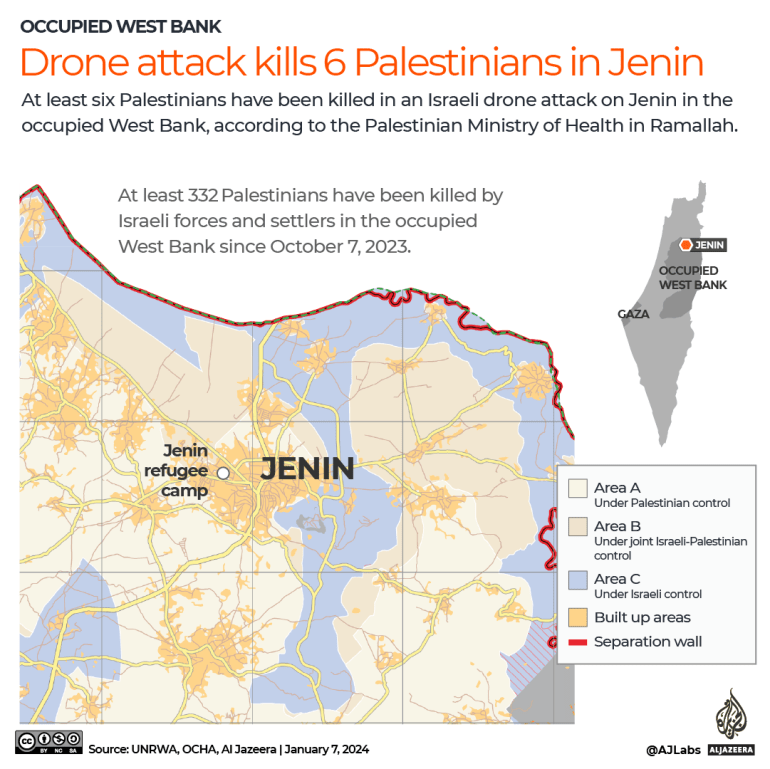
Six Palestinians and one Israeli police officer were killed as fighting flares again in the occupied West Bank. At least six Palestinians are reported to have been killed by an Israeli drone raid in the city of Jenin in the occupied West Bank. The attack on the city, host to a large refugee camp, came amid multiple Israeli raids across the West Bank overnight, the Palestinian Ministry of Health reported on Sunday. Israeli officials noted that a police officer was also killed during the operations. Witnesses said human remains were scattered at the site of the drone attack in Jenin. “We have seen some pretty gruesome pictures of a number of bodies lying on the floor. People say those targeted were civilians,” said Al Jazeera’s Laura Khan, reporting from occupied East Jerusalem. The strike targeted a gathering of citizens in Jenin, the Health Ministry said. Four brothers were reportedly among the dead. Israel asserted that its aircraft had fired on “Palestinian militants who had attacked troops”. Witnesses said the attack took place as Israeli forces were withdrawing. The Israeli army stormed Jenin at about 1am (23:00 GMT on Saturday) and left at about 5am (03:00 GMT), Al Jazeera’s Khan said. “We know that there was at least one IED [improvised explosive device] that exploded and destroyed an Israeli army vehicle,” she said, adding that there was “fierce resistance” from fighters in the camp. A border police officer was killed and at least four Israeli soldiers were wounded when their vehicle was hit by the IED blast, Israel said. A helicopter helped rescue them with covering fire, the military said, adding that an aircraft fired at a “terrorist squad that hurled explosives and endangered our forces, a number of terrorists were killed”. “This is just part of the nightly raids that we’re witnessing in the occupied West Bank,” said Khan. The Jenin Brigades, an armed wing of the Palestinian Islamic Jihad movement, issued a statement claiming responsibility for the attack on the Israeli forces. “We know, at least 5,600 people have been arrested, more than 3,000 injured and with this latest death toll, we’re looking at around 332 Palestinians killed in the occupied West Bank since October 7,” Khan said. Al Jazeera’s team in the occupied West Bank reported that Israeli forces also raided the cities of Nablus, Hebron, Qalqilya, and Jericho overnight. In Nablus, Israeli forces arrested a young Palestinian after raiding her home, according to video footage verified by Al Jazeera. Nightly raids by the Israeli army have been taking place for almost two years, but they have intensified following the attack by Hamas on October 7, which killed about 1,140 people in Israel. Israel’s retaliatory offensive has since killed at least 22,722 Palestinians and injured more than 58,000 people. The overnight raids on Jenin took place amid US Secretary of State Antony Blinken’s visit to the region. He is due to visit some Arab states, as well as Israel and the occupied West Bank. A woman, centre, mourns after her four children were killed in what Palestinian authorities said was an Israeli air raid, at a morgue in Jenin [Raneen Sawafta/Reuters] Adblock test (Why?)