

Hundreds missing from Gaza’s Al-Aqsa Hospital amid Israeli bombardment

WHO and UN officials say patients arrive every few minutes in central Gaza hospital operating with 30 percent of staff. Hundreds of patients and staff are reported to be missing from Al-Aqsa Martyrs Hospital in central Gaza, which is struggling to cope amid intense air strikes across the enclave. The majority of medical staff, as well as around 600 patients, have been forced to leave the complex to unknown locations with no information of their whereabouts, the World Health Organization (WHO) and the United Nations (UN) reported on Monday. The two institutions note chaotic scenes as the remaining staff at the hospital continues to try to cope with an influx of injured people as “heavy Israeli bombardment from air, land, and sea intensified across much of the Gaza Strip”. Staff from the WHO and the UN Office for the Coordination of Humanitarian Affairs (OCHA) visited the only functioning hospital in the governorate of Deir el-Balah in central Gaza on Sunday. They noted that intense bombing had driven many to seek medical help at Al-Aqsa. The Ministry of Health in Gaza reports that 225 Palestinians were killed and 296 people injured due to Israeli attacks on January 5 – 7. The officials said that large numbers of wounded were being treated by very few staff at the facility and called for more protection for medical centres. The director of the hospital reported that because of increasing hostilities and ongoing evacuation orders, most local health workers and about 600 patients have been forced to leave the facility to unknown locations. WHO official Sean Casey said that new patients were arriving at the hospital every few minutes, adding that due to evacuation orders and the dangerous situation, there were only five doctors left to oversee hundreds of emergency cases and casualties. “It is really a chaotic scene. The hospital director just spoke to us, and he said his one request is that this hospital be protected, even though many of his staff have left,” Casey said. “This hospital is currently operating with about 30 percent of the staff that it had just a few days ago. They are seeing, in some cases, hundreds of casualties every day in a small emergency department.” Medical Aid for Palestinians (MAP) and the International Rescue Committee (IRC) stated that their emergency medical team had been forced to cease activities at the hospital and leave the facility, as a result of increasing Israeli military activity. ‘Sickening scenes’ WHO Director-General Tedros Adhanom Ghebreyesus said that his staff had witnessed “sickening scenes of people of all ages being treated on blood-streaked floors and in chaotic corridors”. .@WHO has received troubling reports of increasing hostilities and ongoing evacuation orders near the vital Al-Aqsa Hospital in the Middle Area of #Gaza, which according to the facility’s director forced over 600 patients and most health workers to leave. Their locations are not… pic.twitter.com/Vzd9UWThNm — Tedros Adhanom Ghebreyesus (@DrTedros) January 7, 2024 “Al Aqsa is the most important hospital remaining in Gaza’s Middle Area and must remain functional, and protected, to deliver its lifesaving services,” Ghebreyesus stated. “Further erosion of its functionality cannot be permitted – doing so in the face of such trauma, injury and humanitarian suffering would be a moral and medical outrage.” Casey said his team delivered some medical supplies and beds to the hospital on Sunday for thousands of patients in need of dialysis and trauma care. He added WHO was looking into deploying emergency staff for Al-Aqsa which is “on its knees” like many other medical facilities in Gaza. Despite growing international pressure for a respite, Israel continues its attacks on Gaza’s health facilities and residential areas in Gaza. The WHO says hospitals in northern Gaza are completely out of service. Ghebreyesus has expressed shock at the scale of health needs and devastation in northern Gaza after security concerns forced WHO to cancel a visit to the region’s al-Awda Hospital. “Urgent, safe and unhindered access to the region is needed to deliver humanitarian aid. Further delays will lead to more death and suffering for far too many people,” he declared. Overall, at least 22,835 people have been killed – including 9,600 children – in Israeli attacks on Gaza since October 7, according to the authorities in the enclave. Israel says about 1,139 people were killed in Hamas’s October 7 attack. Adblock test (Why?)
China accuses UK of sending spy to access state secrets

China and the UK and its Western allies have traded barbs, accusing each other of espionage. China has announced that it has uncovered a British spy whom it accused of passing on state secrets. The Ministry of State Security stated on Monday that it had discovered that the head of a foreign consultancy was spying for the United Kingdom’s MI6 intelligence service. It is the latest in a series of recent accusations traded between Beijing and London. The Chinese spy agency announced the detection of the espionage on its WeChat social media account. It stated that MI6 had used foreigner Huang Moumou to collect secrets and information. The British British foreign intelligence service had established an “intelligence cooperative relationship” with Huang, who heads an overseas consulting agency, in 2015, it said. According to the statement, Huang does not have Chinese citizenship. The state security body did not disclose the nationality or gender of the suspect. “After careful investigation, the state security organs promptly discovered evidence of Huang’s involvement in espionage activities, and took criminal coercive measures against him,” the ministry noted. According to Beijing, MI6 instructed Huang to enter China on several occasions and to use his public identity to collect China-related intelligence for British spying. The British intelligence service also trained Huang and provided equipment for intelligence cross-linking, the statement continued. Huang allegedly passed 17 pieces of intelligence, including confidential state secrets, to MI6 before he was identified. The statement did not provide details of Huang’s identity or employer, or describe their current condition or whereabouts. Tit-for-tat China and the UK and its Western allies have traded barbs recently as they have accused one another of espionage. London says that Chinese spies are targeting its officials in sensitive positions in politics, defence and business. A researcher in the UK Parliament recently denied he was a Chinese spy, an accusation Beijing branded “entirely groundless” and “malicious slander”. China has publicised several other alleged spying cases in recent months. American citizen John Shing-wan Leung, 78, was sentenced to life in prison for espionage in May. China has also conducted raids and arrests at a number of large consulting, research and due diligence firms. The Chinese government has also warned citizens of the dangers of espionage activities, encouraging them to instead join counterespionage work. Adblock test (Why?)
Sheikh Hasina: Once Bangladesh’s democracy icon, now its ‘authoritarian’ PM

Bangladesh’s Prime Minister Sheikh Hasina once joined her rivals in a fight to restore democracy but her long reign in power has been marked by arrests of opposition leaders, crackdowns on free speech and suppression of dissent. Hasina, 76, won a fourth straight term and fifth overall in power by sweeping Sunday’s general election, which was boycotted by the main opposition Bangladesh Nationalist Party (BNP) for the second time in the last three polls. Hasina branded the main opposition party a “terrorist organisation”. The daughter of the country’s founding father Sheikh Mujibur Rahman, who led Bangladesh’s independence from Pakistan, Hasina was fortunate to have been visiting Europe when most of her family members were assassinated in a military coup in 1975. Born in 1947 in southwestern Bangladesh, then East Pakistan, Hasina was the eldest of five children. She graduated with a degree in Bengali literature from Dhaka University in 1973 and gained political experience as a go-between for her father and his student followers. She returned to Bangladesh from India, where she lived in exile, in 1981 and later joined hands with political foe, BNP chief and former Prime Minister Khaleda Zia, to lead a popular uprising for democracy that toppled military ruler Hossain Mohammad Ershad from power in 1990. But the alliance with Zia did not last long and the bitter and deep-rooted rivalry between the two women, often called the “battling begums”, went on to dominate Bangladeshi politics for decades. Hasina first served a term as prime minister in 1996 but lost to Zia five years later. The pair were then imprisoned on corruption charges in 2007 after a coup by a military-backed government. The charges were dropped and they were free to contest an election the following year. Hasina won in a landslide and has been in power ever since. As time went on, she became increasingly autocratic and her rule has been marked by mass arrests of political opponents and activists, forced disappearances and extrajudicial killings. The 78-year-old Zia meanwhile is in ailing health and confined to hospital after corruption charges saw her sentenced to a 17-year prison term in 2018. Top BNP leaders have been sent behind bars while Zia’s eldest son and heir apparent Tarique Rahman is in exile in Britain. Rights groups have warned of a virtual one-party rule by Hasina’s Awami League. Hasina refused BNP demands to resign and allow a neutral authority to run the election, accusing the opposition of instigating antigovernment protests that have rocked Dhaka since late October and killed at least 14 people. Both Hasina and her rivals have accused their opponents of trying to create chaos and violence to thwart political peace and jeopardise the democracy that has yet to take firm root in the South Asian country of 170 million people. Hasina said she did not need to prove the credibility of the election to anyone. “What is important is if the people of Bangladesh will accept this election.” Asif Nazrul, professor of law at Dhaka University, told Al Jazeera Hasina is a “shrewd” politician but history will remember her as a leader “who stayed in power through repression, not popular mandate”. “Never in the history of this region has a politician stayed in power despite lacking people’s mandate,” he said. “In fact, I would call her unpopular now as [Sunday’s] turnout has proven what percentage of people’s support Hasina and her party has.” Nazrul said Hasina has “set up a milestone before the world on how a leader can establish complete autocracy in a nation in the garb of democracy”. “But that’s not a legacy one should be proud of,” he said. Mixed legacy of 15-year rule Hasina has been praised by supporters for leading Bangladesh through a remarkable economic boom, largely on the back of the mostly female factory workforce powering its garment export industry. Bangladesh, one of the world’s poorest countries when it gained independence from Pakistan in 1971, has grown an average of more than 6 percent each year since 2009. Poverty has plummeted and more than 95 percent of the country’s 170 million people now have access to electricity, with per capita income overtaking India in 2021. Hasina also received international acclaim for opening Bangladesh’s doors to hundreds of thousands of Rohingya refugees fleeing a 2017 military crackdown in neighbouring Myanmar. She has been hailed for a decisive crackdown on hardline Muslim groups after five homegrown extremists stormed a Dhaka cafe popular with Western expatriates and killed 22 people in 2016. But Hasina’s intolerance towards dissent has given rise to resentment at home and expressions of concern from the Western powers. Five top Muslim leaders and a senior opposition figure were executed over the past decade after convictions for crimes against humanity committed during the country’s brutal 1971 liberation war. Instead of healing the wounds of that conflict, the trials triggered mass protests and deadly clashes. Her opponents branded the trials a farce, saying they were a politically motivated exercise designed to silence dissent. The United States imposed sanctions on an elite branch of Bangladesh’s security forces and seven of its top officers over charges of widespread human rights abuses. Meanwhile, the economy has also slowed sharply since the Russia-Ukraine war pushed up prices of fuel and food imports, forcing Bangladesh to turn last year to the International Monetary Fund for a $4.7bn bailout. Inflation was 9.5 percent in November, one of the highest in decades, and tackling it will be one of Hasina’s biggest challenges in her next term while the spotlight will be on how she deals with upholding democracy. Munshi Faiz Ahmed, former director-general of Bangladesh Institute of International and Strategic Studies, a state-funded think tank on security and strategic issues, called Hasina “perhaps the most strategic political maneuverer in Bangladesh’s history”. Ahmed, also a former Bangladeshi ambassador to China, told Al Jazeera that one should be mindful of the conditions in which Hasina operated in the last decade: a massive population cramped in a small land
Which teams are favourites to win the 2023 Africa Cup of Nations?

Some of football’s biggest stars will showcase their skills when the 2023 Africa Cup of Nations (AFCON) gets under way in Ivory Coast on January 13. While the timing of the tournament has upset elite European clubs, the presence of five African teams at the Qatar World Cup 2022 has proved that football in Africa is coming of age. Record AFCON winners Egypt, led by their talismanic captain Mohamed Salah, will look for their eighth title. Morocco will hope their superb display at the last World Cup will translate into continental success, while Victor Osimhen will aim to replicate his club form for Nigeria. Here’s a look at Al Jazeera’s favourites to win the tournament: Morocco Morocco are the red-hot favourites after their historic run at the Qatar World Cup 2022. The North African nation became the first-ever team from the continent to qualify for the semifinals in Qatar, where they were beaten by France. By defeating Spain and Portugal in the knockout stages, the Atlas Lions had already made their own history in reaching the quarterfinal stage. Morocco’s manager Walid Regragui has been quite clear that his team’s task now is to prove that Qatar was no fluke by winning the AFCON title. Paris St Germain defender Achraf Hakimi and Chelsea winger, on loan at Galatasaray, Hakim Ziyech remain the star attractions. Sofyan Amrabat’s efforts in Qatar did not go unnoticed either, with Manchester United agreeing a season-long loan from Fiorentina with a view to sign a permanent deal. Bayern Munich’s Noussair Mazraoui and Romain Saiss of Al Shabab along with Hakimi form the tournament’s best defence. Youssef En-Nesyri carries some pressure on his shoulders after the Seville striker had to be defended by his manager in Qatar following criticism for his profligacy in front of goal. Morocco were beaten in the quarterfinals by defeated finalists Egypt at the last AFCON. In fact, since winning the 1976 edition, the Atlas Lions have only reached the final once, in 2004, when they were beaten by North African rivals Tunisia. Senegal Defending champions Senegal start the tournament on the heels of favourites Morocco. Their sole AFCON triumph in 2022, was closely run with penalties required to overcome Egypt following a goalless draw in the final. The Lions of Teranga were the favourites from Africa to push for the latter stages of the World Cup in Qatar but the loss of Sadio Mane to injury dealt them a crushing blow. Following a 2-0 defeat by Netherlands in their opening match, they overcame Qatar and Ecuador only to lose 3-0 to England in the first knock-out round. The emergence of Chelsea’s striker, Nicolas Jackson, signed in the summer from Villareal, is a huge boost to an already impressive ensemble. The 22-year-old has scored seven times in his first 19 appearances for the Blues. Pape Matar Sarr is expected to be the main man in midfield and, while Edouard Mendy offers great assurance in goal, the formidable presence of Kalidou Koulibaly is the rock on which the strength of the Senegalese spine is built. Egypt “I want to win the competition” was the clear message from Mohamed Salah about his ambitions at AFCON as he departed Premier League leaders Liverpool. Egpyt’s place among the favourites rests solely on the shoulders of Africa’s best – and arguably greatest ever – footballing talent. Salah helped the Reds end a 30-year wait for a league title as well as helping them to a seventh Champions League trophy. Despite his overwhelming club success, the forward’s commitment to his country is unwavering but he will need to inspire all the support he can get – from a team that is far from star-studded – if the king is to achieve the crowning glory of an AFCON title. Mohamed Elneny a bit-part midfielder at Arsenal and Al Ittihad’s Ahmed Hegazy is the other name of note. Egypt can, however, point to their appearance in the final of the last tournament – and their route to reach the showpiece game after overcoming Ivory Coast, Morocco and Cameroon. A glittering past for Egypt, a glittering present for Salah but can the two combine to fulfil the dreams of the Pharoah’s greatest footballer? Denied a shot at the World Cup but a play-off eliminator and denied twice in the 2017 and 2022 AFCON finals, the clock is ticking for the 31-year-old and his place in his country’s history books. Just imagine this team 🤩 The CAF @FIFPRO Men’s BEST XI is just 🤌#CAFAwards2023 | @FIFProAfrica pic.twitter.com/ZL9two84On — CAF (@CAF_Online) December 11, 2023 Nigeria The Super Eagles have had their wings clipped of late – eliminated in a play-off for a place at the Qatar World Cup by rivals Ghana and falling at the first knockout hurdle at the 2022 AFCON. Nigeria had won all three of their group games, including a win over Salah’s Egypt, but Alex Iwobi’s sending-off against Tunisia in the round of 16 was costly, as the side slipped to a 1-0 defeat. Nigeria’s squad arguably boasts the most depth of all the teams at the tournament and only three AFCON titles will pain Africa’s largest nation, despite the presence of an Olympic gold medal in their trophy cabinet. Iwobi, formerly of Arsenal and Everton, will be joined in the squad by Fulham teammate, Calvin Bassey – the full-back was named player of the match in the Premier League win against Arsenal on December 31. The loss to injury of Wilfred Ndidi from the midfielder cannot be overstated. The fact they can turn to yet another European top-flight club to call up a replacement in Royal Antwerp’s Alhassan Yusuf could soften the blow. It’s in attack where Nigeria will be expected to light up the tournament with Victor Osimhen in particular. The striker was Serie A’s leading scorer last season as he led Napoli to their first league title since Diego Maradona became the darling of Naples in 1990. The recently crowned African Footballer of the Year will be joined up
Israel’s war on Gaza: List of key events, day 94

EXPLAINER Son of Al Jazeera journalist was killed by an Israeli missile and Al-Aqsa Hospital was evacuated. Here’s the latest. Here’s how things stand on Monday, January 8, 2024: Latest updates Al-Aqsa Martyrs Hospital in central Gaza was partially evacuated as a result of increasing Israeli military activity. World Health Organization (WHO) chief Tedros Adhanom Ghebreyesus posted on X on Sunday that about 600 patients and medical staff were forced to leave and their location is unknown. Israeli Prime Minister Benjamin Netanyahu said his government is grappling with a “plague of leaks” and proposed that ministers who attend security meetings should undergo a polygraph test. There are rising divisions within the Israeli government. Three ministers from the National Unity Party, including Benny Gantz, have boycotted a meeting, Al Jazeera’s Hamdah Salhut reported. Israel has signalled that it is ready to end its bombardment of northern Gaza, saying it has “dismantled” Hamas in that part of the Gaza Strip. However, intense military operations look set to continue in the rest of the enclave. WHO cancelled a mission to northern Gaza’s al-Awda Hospital for the fourth time since December 26 after the UN agency failed to receive security guarantees. Today, @WHO cancelled a planned mission to Al-Awda hospital and the central drug store in northern #Gaza for the fourth time since 26 Dec because we did not receive deconfliction and safety guarantees. The mission planned to move urgently needed medical supplies to sustain the… pic.twitter.com/6v09rPbBb1 — WHO in occupied Palestinian territory (@WHOoPt) January 7, 2024 Human impact and fighting As many as 73 Palestinian people were killed and 99 wounded in attacks by Israel on Gaza over the past 24 hours, according to Gaza’s Health Ministry. Palestinian media reported that at least eight people were killed after an Israeli air attack hit a house in the city of Deir el-Balah in central Gaza. Hamza Dahdouh, the eldest son of Al Jazeera’s Gaza bureau chief, Wael Dahdouh, was killed by an Israeli missile attack on a vehicle in Khan Younis. Journalist Mustafa Thuraya was also killed in the attack. The missile hit the vehicle near al-Mawasi, a supposedly safe area towards the southwest. UN Relief and Works Agency (UNRWA) said on Sunday that 142 of its employees have been killed by ongoing Israeli air raids on Gaza since the war broke out on October 7. Diplomacy A large group of people gathered outside the US embassy in Stockholm on Sunday to protest against Israel’s ongoing attacks on Gaza. In a diplomatic visit to the Middle East, US Secretary of State Antony Blinken met leaders from Qatar and Jordan. The Jordan Foreign Ministry said in a statement that it has agreed with the US on rejecting the forced displacement of Palestinians from the Gaza Strip, a proposal repeatedly laid out by Israeli Ministers Bezalel Smotrich and Itamar Ben-Gvir. Former UNRWA spokesperson Chris Gunness told Al Jazeera that an International Court of Justice (ICJ) decision could put “huge pressure on the Americans to bring about a proper ceasefire” as Israel and South Africa head to The Hague later this week. Hamas official Sami Abu Zuhri criticised Arab and Islamic countries which have not yet expressed official support for South Africa’s call for genocide proceedings against Israel at the ICJ. German Foreign Minister Annalena Baerbock arrived in Israel on Sunday for meetings with Israeli President Isaac Herzog and Foreign Minister Israel Katz. Foreign Minister @ABaerbock has arrived for her 4th visit to Israel since the Hamas terror attacks. She has come to meet President @Isaac_Herzog and her colleague minister @Israel_katz, hostage families, and experts on the sexual crimes committed on 7/10. pic.twitter.com/yFGyocz2HP — Steffen Seibert (@GerAmbTLV) January 7, 2024 West Bank raids There are reports of ongoing raids in Bethlehem’s Dheisheh camp, Arroub camp, north of Hebron, Dura and Yatta, south of Hebron and Qabalan, south of Nablus. Al Jazeera Arabic colleagues have reported that Israeli forces arrested a doctor and a nurse as they raided several locations in the adjacent cities of Ramallah and el-Bireh in the occupied West Bank on Sunday night. An Israeli settler attack on Sunday injured a man in the northern Jordan Valley region, just northeast of the occupied West Bank. local sources told Palestinian news agency Wafa. Adblock test (Why?)
Australia outlaws Nazi salute and hate symbols

The law is introduced amid a surge in anti-Semitic and hate crimes, driven by the Israel-Hamas war. The Nazi salute and associated hate symbols have been criminalised in Australia. Legislation banning the salute and the display or sale of symbols associated with terror groups took effect on Monday, as the Australian government responds to a rise in hate and anti-Semitic incidents in recent months, especially amid Israel’s bombardment of Gaza. The legislation criminalises the sale and display of Nazi motifs including the swastika and lightning bolt insignia of the SS (Schutzstaffel), the paramilitary wing of the Nazi party. “It is now unlawful to perform the Nazi salute in public or to publicly display, or trade in, Nazi hate symbols,” Attorney General Mark Dreyfus said in a statement. “The new laws also ensure that glorifying and praising acts of terrorism are criminal offences.” The passage of the bill through parliament by a unanimous vote on December 6 sent a clear message that there is “no place in Australia for acts and symbols that glorify the horrors of the Holocaust and terrorist acts”, Dreyfus said. Worrying rise Initially, a ban on the Nazi salute was not included in the bill, with the federal law planned to leave the issue to the discretion of individual states. However, following several incidents, the bill was amended. In March, a group of neo-Nazis clashed with transgender rights protesters in Melbourne and members were seen raising their arms in a Nazi salute near the state parliament building. In October, three men were charged after allegedly performing a Nazi salute outside the Sydney Jewish Museum. In a separate incident the same month, an unverified video showing a group of men outside the iconic Opera House shouting “gas the Jews” during a pro-Palestinian protest triggered outrage around the world and a police investigation. There were more anti-Jewish incidents in October and November last year than in the twelve months prior, according to the Executive Council of Australian Jewry. Dreyfus noted in June, as the legislation was presented, that it would see federal law mesh with state legislation, all Australian states and territories having already either passed laws or announced plans to ban Nazi symbols. “We’ve seen, very sadly, a rise in people displaying these vile symbols, which are symbols that have no place in Australia, they should be repugnant,” he said as he explained the plan. “There is no place in Australia for symbols that glorify the horrors of the Holocaust.” The new law also bans the public display or trade in symbols associated with organisations that Australian designates as “terrorist,” such as the Islamic State of Iraq and the Levant (ISIL or ISIS), Hamas or the Kurdistan Workers’ Party (PKK). Australia’s spy agency has been warning that far-right groups are on the rise in Australia and that they had become more organised and visible. An Australian-born white supremacist murdered 51 Muslim worshippers in the 2019 Christchurch mosque massacre in New Zealand. Adblock test (Why?)
A poll with outsize importance: What to know about Taiwan’s election

Taipei, Taiwan – In what is set to be a historic year for elections worldwide, Taiwanese voters will head to the polls this week to choose their next president, vice president and legislative representatives on January 13. Despite a population of just 23.5 million people, Taiwan’s election carries an outsized importance due to its disputed political status. While de facto independent since the 1940s, the island and its outlying territories are still claimed by the Chinese Communist Party (CCP) – something nearly all Taiwanese reject but fear saying publicly because of the risk of war. Observers in the United States and China will be closely watching the outcome to see whether voters opt for the more conservative and Beijing-friendly Kuomintang (KMT) or the more centre-left and US-friendly Democratic Progressive Party (DPP), which has ruled Taiwan for the past eight years. There is also the smaller Taiwan’s People Party (TPP), which lies somewhere between both parties on the political spectrum. Since its first democratic elections in 1996, Taiwan’s two major political parties have alternated leadership every eight years – but this year, the DPP’s William Lai Ching-te is the frontrunner with the KMT, which has far failed to mount a substantial challenge to Lai following the collapse of efforts to agree on a joint opposition ticket with the TPP. While voters are unhappy with key domestic issues such as Taiwan’s stagnant economy, the high cost of housing and the future of the island’s energy policies, the presidential election is often overshadowed by the bigger question of Taiwan’s political status. In 2020, voters chose the DPP and its Taiwan-first agenda by a landslide against a backdrop of massive pro-democracy protests in Hong Kong, a former British colony that Beijing promised to allow semi-autonomy for 50 years after its return to Chinese sovereignty in 1997. Taiwan had long been offered a similar deal if it returned to the “motherland” but for many in Taiwan, events in Hong Kong, where Beijing imposed a sweeping security law and an electoral overhaul, were evidence that Beijing does not keep its promises. Taiwanese Vice President William Lai is hoping he can extend the DPP’s hold on government for a third successive term [Chiang Ying-ying/AP Photo] With the Hong Kong protests long over, voters will now have to decide if they want the economic benefits of a closer relationship with Beijing offered by the KMT or if they want to continue standing apart and risk facing regular Chinese aggression as they have under incumbent President Tsai Ing-wen. “Because of Taiwan’s contested status and the uncertainty that that brings not just to the region, but the world as well, everyone is really invested in who’s going to be the one steering the ship, so to speak, because that will have a lot of implications for not just security, but also risk and economic potential,” said Lev Nachman, an expert in Taiwanese politics and an assistant professor at Taipei’s National Chengchi University. “The reason so many people want to make sure that this is a free and fair election is because the world will be very interested if Taiwan’s status as a democracy changes. I think people not only care about who wins the election but how they win,” he said. Here is all you need to know about the Taiwan elections. How does the election work? On January 13, people in Taiwan will vote three times: for president and vice president, for their local legislator, and for their favoured “party list” – a list of legislators-at-large who are given seats based on their party’s proportion of votes. The party list is particularly important in Taiwanese politics as a measure of a party’s popularity and reputation. Taiwan’s 113-person legislature is made up of 73 legislators based on geographic constituencies, 34 based on party lists and six seats reserved for Indigenous Taiwanese representatives, all of whom will serve four-year terms. Polls will open from 8am (00:00 GMT) until 4pm (08:00 GMT) and voters will cast paper ballots that will be counted by hand. About 19.5 million people are registered to vote and results should be out by the end of the voting day. Critics say Taiwan’s voting system deprives younger people of a voice because voters have to be at least 20 years old and return to the location of their “household registration” – typically their hometown – to vote. The day before the election, tens of thousands of people will be on the move, flying to one of Taiwan’s outlying islands, driving to a remote mountain town, or taking the high-speed rail to one of its major west coast cities. Despite these challenges, turnout has been relatively high in the last two elections – at 66.27 percent in 2016 and 74.9 percent in 2020. Hou Yu-ih is hopjng to win back power for the KMT, the region’s oldest political party [Ann Wang/Reuters] On the ground, it is not hard to see why so many people get excited about polling day, Brian Hioe, the co-founder of New Bloom Magazine and a frequent commentator on Taiwanese politics, told Al Jazeera. “Just go around the city and you see election ads everywhere, blanketing everywhere, just like you just see speaker trucks blaring election slogans everywhere in your daily life,” he said. “So, it’s very ubiquitous and it points to how politics is very integrated into everyday life in Taiwanese society.” Along with election fever has also come a wave of election scandals – another popular ingredient in Taiwanese politics, according to Hioe, thanks in part to Taiwan’s politically polarised and tabloid-dominated media. This election, all three presidential candidates are facing questions about their various property holdings, including a student dorm, a family home and an illegally-zoned parking lot. What are Taiwan’s main political parties? Taiwanese politics is still overshadowed for some voters by the island’s tumultuous 20th-century history. Passed between multiple colonial powers from the 17th to the late 19th century, Taiwan was a Japanese colony from 1895 until 1945, when Tokyo
Sheikh Hasina wins fifth term in Bangladesh amid turnout controversy
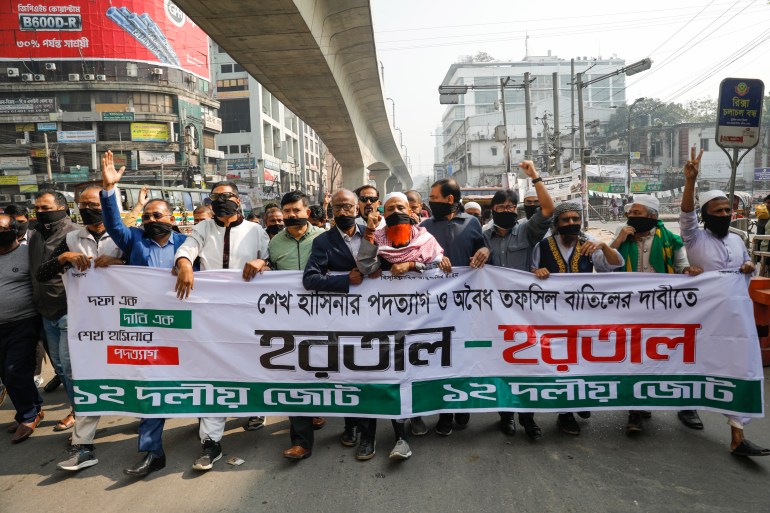
Sheikh Hasina has secured her fifth term as Bangladeshi prime minister in an election whose outcome was decided the moment its schedule was announced in early November when the main opposition boycotted the poll. The surprise was who came second. Instead of any political party, independent candidates secured a total of 63 seats, the second highest after Hasina’s Awami League (AL), which won 222, creating a problem of finding a parliamentary opposition. The current opposition, the Jatiya Party, managed to secure just 11 of the 300 parliamentary seats, according to the Elections Commission. Almost all the winning independent contenders were people who had been rejected by the AL but were asked by the party leadership to stand as “dummy candidates” to give the election a competitive veneer in front of the world. “This is a bizarre outcome of a bizarre election,” Shahidul Alam, a renowned Bangladeshi rights activist and photographer, told Al Jazeera. “Dummy candidates in a dummy election will now lead to a dummy parliament.” Shunned by the Bangladesh Nationalist Party (BNP) – the AL’s main political opponent – which wanted the balloting held under a neutral entity instead of Hasina’s administration, Sunday’s “one-sided election” was just a “mere formality” to put Hasina back in power again, analysts say. The only suspense, they added, was voter turnout, after Western governments put pressure on Hasina’s government to ensure a free, fair and participatory poll. After polling closed at 4pm (10:00 GMT on Sunday), the Election Commission (EC) said turnout was 40 percent. But many were doubtful it was even that high. “I don’t know about the rest of the country but I think I have not seen such an empty Dhaka in years,” Abdullah Yusuf, an engineer in the Dhanmondi area of the capital, told Al Jazeera. “It felt like the initial COVID days. I crossed two polling centres midday and didn’t see many people besides Awami League activists who were wearing badges. EC’s claim of 40 percent is quite absurd.” ‘Ridiculous’ Some analysts, meanwhile, pointed to confusion at the EC announcement. “It’s hard to believe the turnout was 40 percent, especially given the fact that the chief election commissioner himself uttered 28 percent first while briefing the media and then changed it to 40 percent all of a sudden,” said Sakhawat Hossain, a former election commissioner. The turnout figure, which was shown on the dashboard at the EC headquarters hours after the briefing, was 28 percent, and a photo of it was widely circulated in the country’s social media and received criticism. Al Jazeera checked and verified that figure. EC earlier declared at an hour before the poll closing that the turnout was about 27 percent. Al Jazeera visited at least 10 polling stations across the capital Dhaka in the last hour and did not see any voters. Sharmin Murshid, the head of the reputed election observer organisation Brotee, told Al Jazeera that a jump from 27 to 40 in a span of an hour or so was “ridiculous” and had “tainted the EC reputation severely”. “It was a sure way to further lose the confidence of the people and credibility which it did not have to start with,” she said. “This was not an election, rather it was an exercise in casting votes by one party for one party,” she added. Activists from Bangladesh’s opposition called a “hartal”, or strike, over the election weekend [Mahmud Hossain Opu/AP] BNP leaders, meanwhile, termed even 28 percent very high, saying that most of the polling booths across the country had been empty throughout the day. The opposition party earlier declared a 48-hour “hartal”, equivalent to a total strike, from Saturday morning, which it believed also reduced turnout. “In most pictures and footage shared in media and social platforms, you would find photos of dogs standing, lying down and basking in the sun along with police and a few Awami League activists,” said Abdul Moyeen Khan, a senior BNP leader, while briefing journalists after the election, “But no voters.” Khan said people had heeded their call to boycott ballots and show a “red card” to the election. “Even Awami League supporters didn’t bother to go to booths to cast their votes because they knew their candidates would win anyway,” he added. Concerns on legitimacy AL leaders, however, said the BNP’s plan to foil the election through “hartal” and “arson attacks” had not paid off because people did turn out to vote. “This is a victory for our democracy,” Obaidul Quader told the media after finding a clear lead in poll results, “People give BNP’s terrorism befitting reply through balloting.” Quader also said most people voted for their preferred candidates without any intimidation or interference in voting. “This was one of the most peaceful elections of the country,” he said. While the last two national elections were tainted with dozens of deaths and severe violence, Sunday’s poll saw only one death and very few clashes, making it one of the most peaceful polls in the South Asian nation’s history. “People of your country should be proud of holding such a peaceful election,” Hisham Kuhail, the CEO of the Central Election Commission of Palestine, one of several foreign observers of the poll, told a media briefing afterwards. Election officials at Armanitola Government High School in Dhaka wait for voters [Mohammad Ponir Hossain/Reuters] Kuhail, however, avoided questions about voter turnout and said he was assessing only the technicalities of the voting process – whether voters were allowed access and whether voting took place systematically. “I cannot comment on the political scenario here. For that I need to stay at least a month,” he added. Russian observer Andrei Shutov also said the voting process was systematic and peaceful. “This election is legitimate,” he added. AKM Wahiduzzaman, the information and technology affairs secretary of the BNP, said there was no question it was peaceful because “there were no voters”. “But it is obviously not legitimate,” he said. The Awami League’s victory, he added, was “illegal and
Russia-Ukraine war: List of key events, day 684
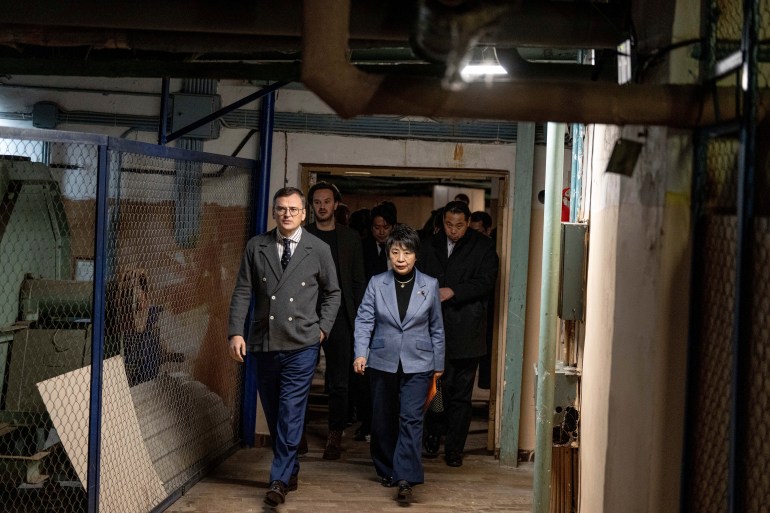
As the war enters its 684th day, these are the main developments. Here is the situation on Monday, January 8, 2024. Fighting Ukraine’s Air Force said it shot down 21 out of 28 Russian drones aimed at the south and east of the country. Russia also launched three cruise missiles, the Air Force added, without offering further details. Dnipropetrovsk regional authorities said 12 people were injured in a Russian drone attack on the city of Dnipro. Local officials said two people were killed in the city of Kherson after Russian forces occupying the opposite bank of the Dnipro River hit the city with numerous shelling attacks. Roman Mrochko, the head of the Kherson city administration, said several people were also injured. In the northeast, the Kharkiv Regional Prosecutor’s Office said one man was killed and two other civilians, including a child, injured in Russian shelling of Kupiansk. Russia’s Defence Ministry said soldiers fighting on the front line in Ukraine marked Orthodox Christmas with military priests leading prayer services. Politics and diplomacy Japanese Foreign Minister Yoko Kamikawa, on an unannounced trip to Kyiv, promised $37m to NATO to help Ukraine avert Russian drone strikes. She also said Japan would donate five mobile gas turbine generators and seven transformers to maintain power supplies. Kamikawa was forced to hold her press conference with Ukrainian Foreign Minister Dmytro Kuleba underground after an air raid alert. “Japan is determined to continue to support Ukraine so that peace can return,” she said. VIsiting Japanese Foreign Minister Yoko Kamikawa had to hold her press conference in a bomb shelter because of an air raid [Evgeniy Maloletka/AP] Ukrainian President Volodymyr Zelenskyy told a security conference in Sweden that the situation on the battlefield remained relatively stable and that Russia could be defeated. Speaking at the same event, Swedish Foreign Minister Tobias Billstrom said the primary task of Sweden’s foreign policy in the coming years would be to support Ukraine. Weapons Zelenskyy said the war in Ukraine had shown the need for Europe to develop joint weapons production to ensure it can “preserve itself” and defend its freedoms. Adblock test (Why?)
Blinken says Palestinians displaced in Gaza must be able to return home

US Secretary of State Antony Blinken has said that Palestinian civilians must be able to return home and rejected statements by Israeli officials calling for the mass displacement of Gaza residents. Speaking at a press conference in Doha on Sunday alongside Qatari Prime Minister Mohammed bin Abdulrahman bin Jassim Al Thani, Blinken said the United Nations can play a crucial role in allowing displaced civilians in Gaza to return home as Israel moves to a “lower-intensity phase” of its military campaign. “They [Palestinian civilians] cannot – they must not – be pressed to leave Gaza,” he said. The top US diplomat condemned the killing of Al Jazeera journalist Hamza Dahdouh, the son of Al Jazeera’s Gaza bureau chief and correspondent Wael Dahdouh, and called it an “unimaginable tragedy”. Hamza was killed along with fellow journalist Mustafa Thuraya in an Israeli attack on southern Gaza on Sunday. Israeli forces previously killed several members of Wael Dahdouh’s immediate family in an air raid. “I can’t begin to imagine the horror that he’s experienced – not once, but now twice,” Blinken said. “This is why we are pressing the need – the imperative – not only of making sure that humanitarian assistance can get to people who need it, but that people are protected from harm from this conflict in the first place.” Tamer Qarmout, assistant professor in public policy at the Doha Institute of Graduate Studies, told Al Jazeera that while Blinken has expressed sorrow over Dahdouh’s loss, the top US diplomat has not held Israel accountable for killing journalists in Gaza. The US Department of State has issued emergency declarations twice in recent weeks to deliver bombs to Israel without congressional oversight. At the press conference in Doha, Blinken said that all US weapons deliveries to any country, including Israel, are made with conditions that humanitarian law is respected. He said that while Israel has a right to target Hamas and ensure that the group can no longer launch attacks, it is “imperative” to protect civilians. “As operations phase down, that will certainly make it easier to ensure that civilians are not harmed and will also ensure that more assistance can get to people who need it,” he said. Qatar’s Al Thani said that the world is getting used to the images of civilian suffering in Gaza. “This is a big test for our humanity,” he said. At least 22,835 people have been killed – including 9,600 children – in Israel’s assault on Gaza since October 7, according to Palestinian officials. At least 1,140 people were killed in Hamas’s October 7 attack on Israel, according to Israeli authorities, and around 240 others taken captive. Al Thani said the killing of Hamas deputy political leader Saleh al-Arouri in Beirut has affected Qatar’s efforts to negotiate between the Palestinian group and Israel over freeing the captives. Qatar previously played a key role in mediating a seven-day truce between Israel and Hamas that saw more than 100 captives freed and hundreds of Palestinian prisoners released from Israeli jails. Al Thani said Doha continues to negotiate and that he and Blinken discussed efforts to reach a ceasefire and ensure the release of more captives. Blinken warns Houthis The top US diplomat was in Doha as a part of a week-long diplomacy tour in the Middle East, seeking to calm what he said is a “moment of profound tension” in the region amid Israel’s three-month-long war in Gaza. Since the Israel-Hamas war began on October 7, Israel and the Lebanese armed group Hezbollah have frequently exchanged cross-border fire. Dozens of Lebanese civilians and more than 140 Hezbollah members have been killed in the fighting, leading to growing concern that the Gaza war could escalate into a regional conflagration. On a separate front, the Iran-aligned Houthi rebels in Yemen have fired missiles at Israel and carried out several attacks on commercial ships in the Red Sea in what they say are acts of solidarity with Palestinians in Gaza. The group, which controls much of Yemen, say they are targeting vessels which are destined for Israel. The attacks have led to many global shipping companies including Maersk to avoid the Red Sea shipping route, and the US has responded by setting up a multinational maritime force to protect shipping lanes in the region. Blinken noted how the Houthi attacks were “hurting people around the world”, with shipping costs increasing and goods deliveries taking longer. He stressed that Washington is keen to ensure the war does not spread. “Over a dozen countries have made clear that the Houthis will be held accountable for future attacks,” Blinken said, referring to the US-led coalition. Qarmout told Al Jazeera that it is clear that the Americans are sending a clear message from Doha to neighbouring Iran, who back the Houthis, that they [the US] doesn’t want to see an escalation of the war. “There is war fatigue … It is an elections year in the US as well. I think the Americans don’t have an appetite for this conflict to escalate and to involve other parties like Hezbollah and Iran,” Qarmout said. “So I think there is a sincere will by the Americans to engage in diplomacy and achieve some gains.” Adblock test (Why?)