

Ethnic conflict in India’s Manipur has ‘completely ruined’ businesses

Kolkata, India – Helena Kshetri has seen her fruit sales wiped out since an ethnic conflict engulfed the northeast Indian state of Manipur in early May. “We are often forced to shut shops due to curfews and shutdowns even after months of violence,” said the 50-year-old vendor, who works at Ima Keithel, or the Mother’s Market, in the state’s capital Imphal. Her sales have crashed from 30,000-40,000 rupees ($360-$480) per day to barely 4,000 rupees ($48). “I deal in fruits and cannot hold them for long in case they rot, and I’m forced to sell even in losses. The government should bring the situation under control so that we can run our businesses,” Kshetri said. Businesses and entrepreneurs, both small and large on both sides of the divide, are hurting on account of the violence that broke out on May 3 and has continued to engulf the state in an ethnic conflict. So far, about 180 people, including women and children have been killed, and several homes, businesses and places of worship have been torched with thousands left homeless, many of whom have fled to other states to seek refuge. Retail inflation is through the roof at 11.63 percent and the internet has been shut down for vast periods, affecting businesses and residents. “We are passing through a very difficult phase and the situation is even worse than insurgency, demonetisation [of currency] and COVID,” said Haorokcham Anil, the secretary of the Manipur Chamber of Commerce and Industry. “The business has been completely ruined and it’s very hard to predict when the situation would be even close to normal.” Violence begins Manipur is home to several communities and tribal groups including the Meitei, Nagas and Kuki. The dominant Meitei community is largely Hindu and lives in the Imphal Valley, while the Naga and Kuki tribes, who are predominantly Christians, mostly reside in the hills. The Meiteis comprise 51 percent of Manipur’s population of 2.3 million but are concentrated in the plains, holding only 10 percent of the land. Kukis and Nagas, who comprise 40 percent of the population, occupy 90 percent of the land as they are mostly based in the hills that dominate the state’s landscape. Due to their larger numbers, Meiteis have a larger share of representation in the politics and state assembly. While tension between the Meitei community and the Kuki tribes had been brewing for a while, it came to the forefront in the first week of May after the Manipur High Court, acting on a writ petition on April 14, directed the state government to send a recommendation to the federal government to grant tribal status to the Meiteis. The court’s order was strongly opposed by the Kukis who argued that it would further strengthen the already dominant Meitei community. Members of a community with tribal status get reservations in government jobs and educational institutions. On May 3, the All Tribal Students’ Union Manipur rallied across all hill districts of the state to protest the court order. The demonstrations turned violent and the next day, the violence spread to the capital Imphal with clashes breaking out between the two groups. The situation is still tense and this journalist was held briefly by members of one of the groups for nearly two hours while conducting interviews in the state last month. Shops in Imphal are frequently forced to close because of curfews [Gurvinder Singh/Al Jazeera] ‘Forced to completely shut’ The violence has almost paralysed the state economy, leaving the business community in severe distress with no signs of recovery in the near future. Several entrepreneurs said their businesses have been hit by more than 70 percent in losses and it has become difficult to even maintain daily expenses, forcing them to retrench their employees and adopt other cost-cutting measures. Thangjam Joy Kumar Singh, the managing director of Likla, one of the biggest fast-moving consumer goods (FMCG) brands in the state selling fruit juices, pickles, bakery and packaged drinking water, conceded that he has been forced to lay off 200 of his 900 employees. “Initially, I didn’t take the situation seriously and thought that things would turn normal within a week, but I was wrong. It was something that we had never witnessed before. We were forced to completely shut our factories for the first 15 days before we started producing packaged water as it was a necessary commodity,” he said. Singh shut his bakery division for nearly three months and closed the bakery outlets in Kuki-dominated areas fearing violence. “At present, we are operating at just 50 percent of our capacity and somehow managing to run the show,” he said. The ethnic tension has split the two communities into separate zones. As a result, neither side can enter the other’s territory to do business or any activity for fear of being attacked or even killed. Keisham Ranjan Singh, a Meitei who had a modular furniture showroom in the Kuki-dominated Churachandpur District about 60km (37 miles) from Imphal, rued that he had lost approximately 8 million rupees ($96,000) in the mayhem after his shop there was set on fire on May 16. “We had Kuki workers also but they have lost their livelihood due to the turmoil,” he said. Businesses in Imphal have not been spared. FMCG brand Likla has laid off 200 of its 900 employees as sales have crashed [Gurvinder Singh/Al Jazeera] Dinesh Kapoor, 59, a sound engineer who runs a sound system shop in the state capital has seen his sales crash as he used to get a lot of customers from the hills. Compared with the 1 million rupees ($12,029) that Kapoor would typically make per day in the holiday season from sales of sound systems, his revenue from the shop has crashed to a mere 15,000 rupees ($180) a day. “The months starting from November to March [are] good for business because Christmas, New Year, Holi and even Thabal Chongba, the biggest festival of the state, is held. But the violence has destroyed all.
Ecuador declares state of emergency, curfew after druglord escapes prison

Ecuador has declared a state of emergency after an “extremely dangerous” druglord escaped from maximum-security detention and unrest broke out at several prisons in the violence-plagued country. President Daniel Noboa, in office since November, announced a 60-day mobilisation of soldiers in Ecuador’s streets and prisons as authorities searched for Jose Adolfo Macias, alias Fito. There would also be a curfew from 11pm (04:00 GMT) to 5am (10:00 GMT) daily, the president said. The state of emergency, Noboa said in a video on Instagram, would give members of the armed forces “all the political and legal support” they need to carry out their duties in a battle against what he described as “narcoterrorists”. “We will not negotiate with terrorists nor rest until we return peace to all Ecuadorans,” Noboa said. On Sunday, Fito, the leader of the powerful Los Choneros gang, was found missing by police conducting an inspection of a prison in the port city of Guayaquil. The 44-year-old, who is said to have instilled terror in his fellow inmates, is believed to have escaped just hours before police arrived, according to presidency spokesperson Roberto Izurieta. He was apparently tipped off. “The full force of the state is being deployed to find this extremely dangerous individual,” Izurieta told domestic television on Monday. He said the prison system had failed and bemoaned “the level of infiltration” by criminal groups. The prosecutor’s office, meanwhile, said it had opened an investigation and filed charges against two prison officials “allegedly involved in the escape” of Fito. ‘He must be found’ Fito had been serving a 34-year sentence for organised crime, drug trafficking and murder since 2011. This is his second prison escape – the last was in 2013 when he was recaptured after three months. In an operation involving thousands of security forces, Fito was transferred to a maximum-security prison last August following the assassination of presidential candidate Fernando Villavicencio. A week before his death, anti-cartel candidate Villavicencio said he had received threats from Fito. Long a peaceful haven between top cocaine exporters Colombia and Peru, Ecuador has seen violence explode in recent years as rival gangs with links to Mexican and Colombian cartels vie for control. Gang wars largely play out in the country’s prisons, where criminal leaders such as Fito wield immense control. Some 460 inmates have been killed in these battles since 2021, and their bodies are often found dismembered, decapitated or incinerated. Izurieta said Fito, who studied law in prison, was a “criminal with extremely dangerous characteristics, whose activities have characteristics of terrorism”. “The search continues … He will be found, he must be found,” said the spokesperson. After Fito’s escape, unrest broke out at penitentiaries in six of Ecuador’s 24 provinces on Monday, according to the SNAI prison authority, with guards taken hostage at some of the facilities. Heavily armed police and soldiers entered the prisons of El Oro, Loja, Chimborazo, Cotopaxi, Azuay and Pichincha, after which the military distributed images of half-naked inmates rounded up in courtyards. The SNAI said there had been no injuries due to the “incidents”. Other videos on social media, not verified by the authorities, purported to show hooded inmates threatening officials with knives as they pleaded for their lives. Noboa came to power with promises to clamp down on gangs and insecurity. On the campaign trail, he proposed creating a separate judicial system for the most serious crimes, militarising the borders with Colombia and Peru, and jailing the most violent offenders on barges offshore. Last week, he announced the construction of two new maximum-security prisons similar to those built by El Salvador’s President Nayib Bukele, who has led a controversial crackdown on gangs credited with drastically reducing his country’s murder rate. Adblock test (Why?)
Russia-Ukraine war: List of key events, day 685

As the war enters ifs 685th day, these are the main developments. Here is the situation on Tuesday, January 9, 2024. Fighting Four people were killed and at least 45 injured as Russia continued its barrage of drone and missile attacks on Ukraine. One person was killed after missiles hit a shopping centre and residential buildings in President Volodymyr Zelenskyy’s hometown of Kryvyi Rih in the southeast, while two people were killed in a separate missile attack on the western region of Khmelnytsky. At least one person was also killed in northeastern Kharkiv after four missiles hit the city. Kherson regional Governor Oleksandr Prokudin said Russian troops carried out 131 artillery attacks on the southern region, killing two people and injuring five. Ukraine’s military said Russia had launched “a large number of ballistic missiles” and it was able to bring down 18 of the 51 that were fired. Air Force spokesman Yuri Ignat said air defences achieved “a good result”, with all eight drones destroyed and some Russian missiles missing their targets. The Russian Defence Ministry said in its daily briefing it had used sea and air-launched long-range missiles, including Kinzhal hypersonic missiles, to strike what it called “facilities of Ukraine’s military-industrial complex”. Belgorod regional Governor Vyacheslav Gladkov said 300 people had been evacuated from Russia’s Belgorod because of Ukrainian attacks. Russian forces destroyed 10 Ukrainian rockets over the region in the evening, Moscow’s Defence Ministry said. Two drones were also destroyed over the Russian border region of Bryansk, it added. A missile launched from Russia’s Belgorod region flying towards Kharkiv in northeastern Ukraine [Vadym Bielikov/AFP] The Ukrainian military said Russian forces made unsuccessful efforts to advance in several areas along the front line, including around Lyman in the Kharkiv region as well as in the Donetsk and Zaporizhia regions. Leonid Pasechnik, the Moscow-installed head of Ukraine’s occupied Luhansk region, said a Russian warplane accidentally released a bomb, an FAB-250 which carries a high-explosive warhead, on the occupied Ukrainian town of Rubizhne. No one was injured, he said. Politics and diplomacy A Ukrainian lawmaker said controversial new draft legislation on military mobilisation will not conscript women or introduce a lottery. “There will be no unconstitutional positions,” Yehor Chernev, the deputy chairman of the parliamentary Committee on National Security, Defence and Intelligence, told Ukraine’s public broadcaster. Pope Francis, addressing conflicts in the Middle East and Ukraine in his yearly address to diplomats, said “indiscriminately striking” civilians was a war crime because it breached international humanitarian law. Weapons German Chancellor Olaf Scholz urged European Union countries to provide more military assistance to Ukraine, saying most countries were not doing enough to give Ukraine the weapons it needed to battle the Russian invasion. United States White House officials met about a dozen executives from the technology and defence industries as part of an effort to support Ukraine’s access to cutting-edge US equipment. Companies like Palantir Technologies and Skydio joined the talks that focused on drones and demining. Adblock test (Why?)
US officials renew calls for Israel to reduce civilian casualties in Gaza
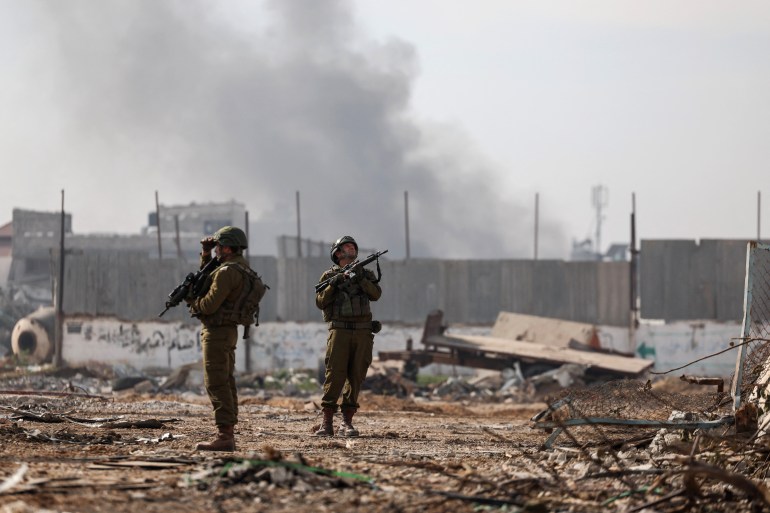
Palestinian Health Ministry says 249 people killed and 510 wounded in Israeli assault on Gaza over 24 hours. US officials have reiterated calls for Israel to ease its assault on Gaza as the Ministry of Health in the besieged Palestinian territory reports hundreds of more deaths. US Secretary of State Antony Blinken is visiting the Middle East amid growing alarm that Israel’s war on Gaza could turn into a regional conflagration. He arrived in Israel late on Monday after a day meeting Gulf Arab leaders. Israeli officials have said they are entering a new phase of more targeted warfare after the mass bombardments that have laid waste to the Gaza Strip and killed more than 23,000 people, according to Palestinian authorities. Blinken held talks in the United Arab Emirates and Saudi Arabia on Monday to try to chart a way out of the conflict. Saudi state news agency SPA reported that Crown Prince Mohammed bin Salman (MBS) stressed the importance of ceasing hostilities in Gaza and forming a path to peace. SPA said MBS emphasised the need to restore stability and to ensure the Palestinian people gain their legitimate rights. Blinken said he would tell Israeli officials in their meeting later that they must do more to prevent civilian casualties in Gaza and they must allow Palestinians to return to their homes after several calls from right-wing Israeli officials for the displacement of Palestinians out of Gaza. Israeli soldiers deployed in Gaza [Ronen Zvulun/Reuters] He announced that Turkey, Saudi Arabia, Jordan, Qatar and the UAE would consider participating in and contributing to “day after” scenarios for Gaza. “We agreed to work together and to coordinate our efforts to help Gaza stabilise and recover, to chart a political path forward for the Palestinians to work toward long-term peace, security and stability in the region as a whole,” he told reporters. While he did not offer specifics, he said the countries had agreed to use their leverage and influence in the region to prevent the war from spilling into neighbouring countries. European Union foreign policy chief Josep Borrell also attended the meeting in Saudi Arabia. In the United States, President Joe Biden was interrupted by protesters calling for a ceasefire while giving an address in Charleston, South Carolina. “I understand their passion, and I’ve been quietly working, quietly working with the Israeli government to get them to reduce and significantly get out of Gaza,” Biden said. ‘New phase of war’ Israeli Defence Minister Yoav Gallant announced on Monday that the war in Gaza would move away from the “intense manoeuvring phase of the war” toward “different types of special operations”. Gallant told The Wall Street Journal that the next phase will last for a “longer time”. “We’re close to the next phase in the north, including Gaza City. … It will take some time, but we aren’t going to give up.” At least 23,084 people have been killed, and 58,926 wounded in Israel’s assault on Gaza, according to Gaza’s Health Ministry. At least 249 people were killed in the latest 24-hour reporting period and 510 wounded, the ministry said on Monday. Adblock test (Why?)
Governor’s revolt: Why Iowa’s Kim Reynolds split from Trump ahead of caucus

For decades, it was a tradition for Iowa governors to remain neutral ahead of the state’s all-important caucuses — the first major contest of the United States presidential race. And Republican Governor Kim Reynolds seemed poised to uphold that tradition for much of last year. “I’m going to remain neutral,” she told Fox News in May, touting her role in welcoming all Republican presidential hopefuls, no matter who they are, to her state. But facing pressure from Republican frontrunner Donald Trump to pick a side, Reynolds made a defiant choice: She decided to back Florida Governor Ron DeSantis over the former president, her erstwhile ally. Now, with the Iowa caucuses only days away, her decision is being seen as a test of her power as a rising star in the Republican Party — and a high-stakes gamble that could alienate her from Trump’s broad base of supporters. “Governors have long played key roles in endorsing particular presidential candidates and organising their state parties to gear up for the year’s elections,” Ken Kollman, a political science professor at the University of Michigan, told Al Jazeera. “What’s interesting is the calculations different leaders are making. What’s the right timing to break with Trump, betting that — when the party emerges from Trump and becomes a normal party again — it will be a boost to have opposed him now as opposed to later?” Whether that bet will ultimately pay off remains unclear, Kollman added. Leaders like Reynolds “are playing a longer game than others, but clearly a risky one”. Iowa Governor Kim Reynolds, whom Donald Trump hosted at the White House on several occasions, has since had a falling-out with the former president [File: Leah Millis/Reuters] Fractures in Trump’s leadership Going into the Iowa caucuses on January 15, Trump remains the faraway leader in the race for the Republican presidential nomination. A national polling average compiled by the website FiveThirtyEight shows Trump nearly 50 percentage points ahead of his next closest rivals, DeSantis and former United Nations ambassador Nikki Haley. So far, no Republican candidate has come close to challenging Trump’s lead. Nevertheless, Reynolds and New Hampshire Governor Chris Sununu — from another early primary state — have both backed Trump opponents for the party nod, revealing subtle fault lines in the Republican caucus. Reynolds credited her decision to political pragmatism in an interview with the Des Moines Register. “I don’t think he can win,” she said of Trump’s prospects in the general election, where he likely faces a rematch with current President Joe Biden. She also noted the 45-year-old DeSantis’s relative youth, compared to the 77-year-old Trump. “We have to look towards the future and not the past.” But some analysts believe behind-the-scenes friction contributed to Reynolds’s decision, particularly as Trump publicly blasted the governor for her early gestures at neutrality. No other Iowa governor, however, had endorsed a candidate before the caucuses since 1996. “Reynolds apparently can’t stand Trump personally, and she likes and clicked early with DeSantis,” Steffen Schmidt, an emeritus professor at Iowa State University, told Al Jazeera. Schmidt explained that DeSantis and Reynolds bonded during the COVID-19 pandemic, when both of their states resisted federal health recommendations to close public institutions and encourage physical distancing. “She also thought DeSantis would shortlist her, given her support for him, for the vice president role,” Schmidt added. Governor Kim Reynolds has appeared in multiple rallies with Donald Trump, including one in Sioux City, Iowa, on November 3, 2022 [File: Charlie Neibergall/AP Photo] A poster child for ‘Trump’s America’ But Reynolds’s defection from the Trump camp was seen as a stark reversal for the Iowa Republican, whose political rise was intimately linked with the former president’s. Trump’s surprise victory in the 2016 elections quickly catapulted Reynolds into the national spotlight. At the time, Reynolds was a 57-year-old grandmother and former county treasurer working as lieutenant governor under Terry Branstad, the longest-serving governor in US history. But when Trump tapped Branstad to be his ambassador to China, Reynolds inherited the executive seat. In doing so, she made history, becoming Iowa’s first female governor. Very quickly, Reynolds developed into the poster child for Trump’s transformation of the Republican Party. Politico Magazine dubbed her “the governor of Trump’s America”, describing a new political landscape where it would be “dangerous for any Republican to abandon the president”. And Reynolds embraced the association. Faced with running for governor for the first time in 2018, she appeared on the campaign trail with both Trump and his daughter Ivanka. “The Midwest has a partner in the White House with President Donald Trump,” she said, standing next to him at a 2018 rally in Council Bluffs, Iowa. When Trump made his re-election bid in 2020, Reynolds likewise made appearances on his behalf, helping him to carry Iowa by eight percentage points over Biden. But Trump ultimately lost that race. Though Reynolds eventually acknowledged his defeat, she was careful not to criticise or contradict Trump — despite his false claims that the election had been “stolen” through widespread voter fraud. “What we need to do is stop pointing fingers, and we need to move forward,” she said in a call to reporters in January 2021, shortly after Trump supporters attacked the US Capitol. Governor Kim Reynolds hosted Republican candidates including Ron DeSantis (right) and Doug Burgum at the Iowa State Fair for ‘Fair-Side Chats’, a play on the presidential tradition of ‘fireside chats’ [File: Evelyn Hockstein/Reuters] Surviving Trump’s ire While Trump briefly faltered, Reynolds’s star continued to rise. She cruised to an easy re-election in 2022, and she has since styled herself as a Republican kingmaker, holding “Fair-Side Chats” at last year’s Iowa State Fair, where she hosted presidential hopefuls for public interviews. Some of those contenders even courted her endorsement. In July, Haley praised her as a “conservative rockstar” on social media. Meanwhile, Chris Christie, another Republican candidate, told a SiriusXM radio show that she is someone who “has the capabilities, if she wanted to be president, to
Modi row with the Maldives

NewsFeed Prime Minister Narendra Modi’s latest tourism campaign in India’s tropical island territory of Lakshadweep has sparked an ugly row with Maldives government officials who believe India cannot compete against their nation’s renowned tourist hotspots. Published On 8 Jan 20248 Jan 2024 Adblock test (Why?)
White House rejects calls for US defence chief to go

Lloyd Austin criticised for not disclosing his multiday hospitalisation to the president and public for several days. US President Joe Biden does not plan to fire Defense Secretary Lloyd Austin over his failure to disclose for days that he has been hospitalised, the White House says, despite calls from Republicans for the removal of the Pentagon chief. Austin, 70, sits just below Biden, a Democrat, in the chain of command of the US military. He remains in hospital, which he entered on New Year’s Day. “There is no plan for anything other than for Secretary Austin to stay in the job and continue the leadership that has been exhibited,” John Kirby, the National Security Council spokesman, told reporters on Air Force One on Monday. “We’ll do what’s akin to a hot wash and try to see if processes and procedures need to be changed at all or modified so that we can learn from this,” Kirby said. US President Joe Biden is flanked by Secretary of State Antony Blinken, left, and Secretary of Defense Lloyd Austin [File: Leah Millis/Reuters] Austin has been criticised for failing to immediately tell the president and the public about his hospitalisation during a war in the Gaza Strip and fears that the conflict could spread in the Middle East. Former President Donald Trump, a Republican who is a likely rival to Biden in November’s presidential election, has argued that Austin should be fired from his position for his lack of transparency, calling it “improper professional conduct and dereliction of duty”. “He has been missing for one week, and nobody, including his boss, Crooked Joe Biden, had a clue as to where he was or might be,” Trump wrote on his social media platform Truth Social. Elise Stefanik, a Republican congressperson from New York and member of the Armed Services Committee in the House of Representatives, called for Austin’s resignation. “There must be full accountability beginning with the immediate resignation of Secretary Austin and those that lied for him and a Congressional investigation into this dangerous dereliction of duty,” Stefanik said in a statement. White House Press Secretary Karine Jean-Pierre told reporters Biden had “complete confidence” in Austin. Kirby said the “main focus” is Austin’s health and recovery. “He has already resumed all his authorities. He’s already doing all the functions he would normally do. He’s just doing it right now from the hospital,” he said. It was revealed on Sunday that Austin’s hospitalisation was kept more secret than previously known, including his deputy and others close to Biden being unaware of Austin’s health condition. “There was no notification of knowledge at the White House or the National Security Council until Thursday afternoon,” Kirby said. The health issue that Austin is receiving treatment for has not been disclosed by the US government. Kirby said he did not have that information but Biden and Austin had spoken in recent days. Adblock test (Why?)
German football legend Franz Beckenbauer dies aged 78

Beckenbauer captained West Germany to a World Cup victory on home soil in 1974. Franz Beckenbauer – one of Germany’s greatest football players, who captained the country’s team to World Cup victory in 1974 then won the tournament again as manager in 1990 – has died at the age of 78, his family said. “It is with deep sadness that we announce that my husband and our father, Franz Beckenbauer, passed away peacefully in his sleep on Sunday, surrounded by his family,” his family said in a statement on Monday. Known in football-obsessed Germany as “the Kaiser” meaning “the Emperor”, Beckenbauer played a central role in some of the country’s greatest sporting achievements. Born in Munich in 1945, he helped establish Bayern Munich as his country’s strongest club. He was a classy, dominant presence on the pitch for West Germany and Bayern Munich in the 1960s and 70s, using the calmness on the ball and effortless distribution that marked his midfield performances to virtually invent the central defensive sweeper role where he found most success. He collected 103 caps for West Germany, winning the 1972 European championship and then the World Cup on home soil. His Bayern Munich team was the best club side in the world during the mid-1970s, winning three successive European Cups and three successive Bundesliga titles, and Beckenbauer himself was twice named European footballer of the year. When he was national team manager, his West Germany team lost in the 1986 World Cup final to Argentina but triumphed four years later in Italy as a combined German team. After coaching, Beckenbauer moved into football administration. But in 2016 he was fined by FIFA’s ethics committee for failing to co-operate with an inquiry into corruption over the awarding of the 2018 and 2022 World Cups. Over the next few years, he was engaged in tending to health issues, and the last time he appeared at Bayern Munich’s Allianz Arena was in August 2022, when he attended a match of Bayern Munich against Borussia Monchengladbach. ‘We will miss him’ Tributes have poured in from across Germany and global the football community, honouring Beckenbauer’s legacy. German Chancellor Olaf Scholz mourned Beckenbauer’s death and said he was one of the greatest footballers in Germany and for many ‘the emperor’ because he “inspired enthusiasm for German football for generations”. “We will miss him. My thoughts are with his family and friends,” Chancellor Scholz said in X. Weltmeister als Spieler und Trainer: Franz Beckenbauer war einer der größten Fußballer in Deutschland und für viele „der Kaiser“ – auch, weil er über Generationen für den deutschen Fußball begeistert hat. Er wird uns fehlen. Meine Gedanken sind bei seiner Familie und Freunden. pic.twitter.com/hSEWFfYk7R — Bundeskanzler Olaf Scholz (@Bundeskanzler) January 8, 2024 “Franz Beckenbauer, one of European football’s greatest sons, has passed away aged 78. ‘Der Kaiser’ was an extraordinary player, successful coach and popular pundit who shaped German football like no other,” the Union of European Football Associations (UEFA) said in a statement. Germany’s Bundesliga called Beckenbauer “a true icon, then, now, and always” while the English Premier League said “‘Der Kaiser’ was as elegant as he was dominant. He will forever be remembered.” Rudi Voller, World Cup winner in 1990 and director of the German national team, said it was “one of the great privileges” of his life to “have known and experienced Franz Beckenbauer”. “Our time together with the national team was crowned with the 1990 World Cup title in Rome, a title that would never have been possible without his outstanding coaching performance,” he said. “German football is losing its greatest personality; I am losing a good friend.” Adblock test (Why?)
What international solidarity exists with journalists under Israeli attack?

More journalists killed in three months of Gaza war than in all of World War II or Vietnam War. Al Jazeera journalist Hamza Dahdouh and fellow journalist Mustafa Thuraya were killed in an Israeli air strike on Dahdouh’s car on Sunday. The Palestinian Journalists Syndicate has documented the killing of 102 journalists and the injury of 71 others by Israeli forces since hostilities began in October. Why have so many journalists been killed in the Israeli assault on Gaza? And what’s the reaction of the world’s media? Presenter: Adrian Finighan Guests: Tim Dawson – deputy secretary general of the International Federation of Journalists Ali Abunimah – founder of the Electronic Intifada Jodie Ginsberg – president of the Committee to Protect Journalists Adblock test (Why?)
Blast in Pakistan kills five police officers during polio vaccination drive

Bomb blast kills at least five police officers deployed to protect polio vaccination workers in northwestern Pakistan. Islamabad, Pakistan – At least five police officers have been killed and nearly two dozen others wounded after an explosive device targeted their vehicle during a polio vaccination drive in northwestern Pakistan. Officials told Al Jazeera the blast took place early morning on Monday in Bajaur, a tribal district in Khyber Pakhtunkhwa province neighbouring Afghanistan, when Pakistan began its latest round of the vaccination campaign. Five of those wounded were in critical condition and have been shifted to the provincial capital, Peshawar, about 133km (82 miles) south of Bajaur. “The blast took place early in the morning when the police team went out for the polio vaccination drive. We have shifted most of the injured to local hospital in Bajaur while critical patients were sent to Peshawar,” Bilal Faizi, spokesperson for the provincial rescue services, told Al Jazeera. There was no immediate claim of responsibility for the attack. In recent years, the Pakistan Taliban, also known by the acronym TTP, has killed dozens of polio vaccination workers and security officials in Pakistan. Resistance to the polio immunisation drive grew in Pakistan after the CIA, the intelligence agency of the United States, organised a fake vaccination drive to track Osama bin Laden, who was killed in the Pakistani garrison town of Abbottabad in 2011. Religious leaders in the Pakistan-Afghanistan border region also spread misinformation that the vaccine contained traces of pork and alcohol, which are forbidden in Islam. Pakistan and Afghanistan are the only two countries yet to be declared free of the wild poliovirus type 1 (WPV-1) disease. For a country to be recognised “free of polio”, it should show an absence of WPV-1 transmission for at least three consecutive years, according to the Global Polio Eradication Initiative. Pakistan reported six polio cases in 2023 – a considerable improvement from 2022 when 20 cases were reported across the country. The attack on the polio vaccination team came amid a dramatic surge in violent incidents in Pakistan. According to data compiled by the Pakistan Institute of Conflict and Security Studies, an Islamabad-based research organisation, more than 600 violent attacks took place in the country in 2023, an increase of 70 percent from the preceding year, killing more than 950 people. Adblock test (Why?)