

US sinks Houthi boats in the Red Sea: How did the fight unfold?
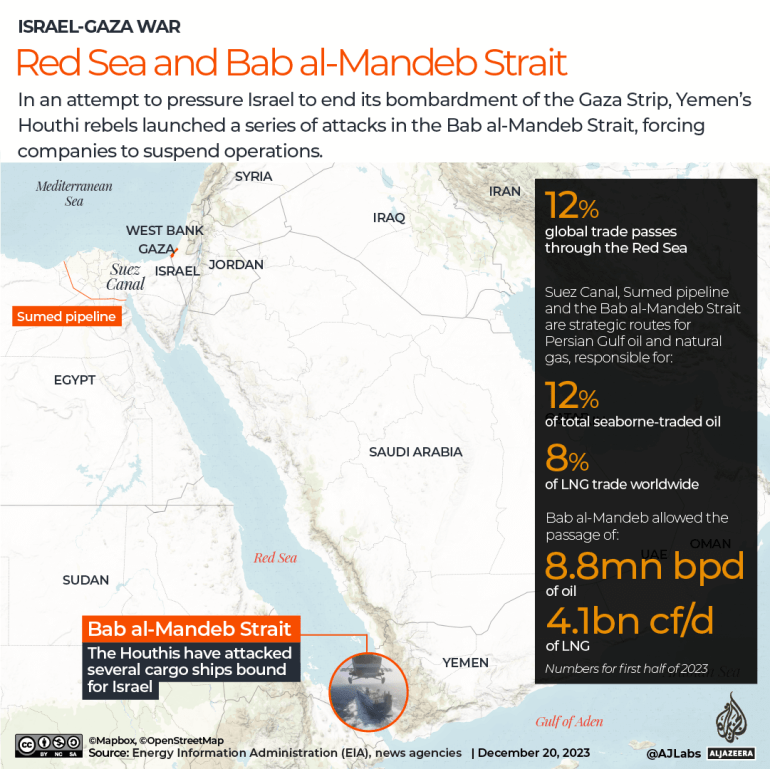
The US military said that it sunk three Houthi vessels in the Red Sea in a statement on Sunday, and killed 10 fighters of the Yemeni armed group after a clash in the middle of one of the world’s most important trade waterways. The escalation follows weeks of Houthi attacks on ships passing through the sea, ostensibly in a bid to pressure Israel to stop its devastating war on Gaza that has killed more than 21,000 Palestinians in the besieged strip. US destroyers have teamed up with a few other nations to try and stop the Houthi attacks in the Red Sea under Operation Prosperity Guardian — though several of its partners have distanced themselves from the initiative. The Red Sea clash on Monday was the first major direct military engagement between the US military and Houthi fighters. Here is what we know about how it all unfolded: What happened on Sunday? On Sunday at 6:30am Yemen time (03:30 GMT), the Denmark-owned and Singapore-flagged container ship Maersk Hangzhou issued a second distress call in a day, reporting being attacked by four “Houthi small boats”, the US Central Command (CENTCOM) posted on X. CENTCOM added that the Houthis tried to board the Maersk vessel that was sailing through the Southern Red Sea. In response to this distress call, helicopters from two warships, the USS Eisenhower and USS Gravely, flew towards the Maersk ship. CENTCOM said the crew of the USS Gravely destroyer first shot down two antiship ballistic missiles fired at the Maersk vessel. Why did the US sink Houthi boats? Four small boats then attacked the same cargo ship with small arms fire and Houthi fighters tried to board the vessel, the US Navy said. The US Navy said it then warned the fighters to stay away from the ship, at which point, the helicopters came under fire. The helicopters fired back, sinking three of the boats. Houthi crew members in the boats were killed. The fourth boat escaped the area and US personnel and equipment did not bear harm, CENTCOM added. “We’re going to act in self-defence going forward,” a White House official said. A spokesman for the Houthis confirmed that ten of their fighters were “dead and missing” after their boats were attacked. Iranian-backed Houthi small boats attack merchant vessel and U.S. Navy helicopters in Southern Red Sea On Dec. 31 at 6:30am (Sanaa time) the container ship MAERSK HANGZHOU issued a second distress call in less than 24 hours reporting being under attack by four Iranian-backed… pic.twitter.com/pj8NAzjbVF — U.S. Central Command (@CENTCOM) December 31, 2023 How have Maersk and other shipping firms reacted? Maersk announced on Sunday that it was pausing all sailing through the Red Sea for the next 48 hours. On December 27, it had scheduled several dozen container vessels to travel via the Suez Canal and the Red Sea in the coming days and weeks. Together with German shipping company Hapag-Lloyd, Maersk operates almost a quarter of the world’s shipping fleet. Other shipping firms have also responded to the escalating maritime conflict. Firms including CH Robinson, Evergreen, HMM, Ocean Network Express, Wallenius Wilhelmsen and Yang Ming Marine Transport are planning to avoid the Red Sea and increase the number of ships rerouting around Africa’s Cape of Good Hope rather than the Suez Canal. This new route is longer and costlier. Evergreen has also temporarily stopped accepting Israeli cargo. While these attacks have had a “fairly limited” impact on the oil market so far, experts postulate that prices could rise if the situation continues. Why are the Houthis attacking ships in the Red Sea? The Iran-backed Houthis began launching drones and missiles towards the southern parts of Israel in October soon after the war broke out on October 7. However, the drones were intercepted or fell short. In a change of tactic, the group started attacking ships in the Red Sea that they claimed were linked to Israel. Their attacks have disrupted many ships for making their way into Israel. On December 19, US Defense Secretary Lloyd Austin announced the establishment of a multinational maritime protection force to counter the Houthis. Despite this, the Houthis have said they will not back down unless Israel ceases its war on Gaza. Despite a multinational coalition agreeing to support the US cause, only the United Kingdom has directly contributed warships, leaving Washington to effectively “act alone” against the Houthis, reports Al Jazeera’s Resul Serdar from Djibouti on the edge of the Red Sea. Serdar added that the US has “not been able to deter the Houthis” so far, with the group waging attacks even more frequently. He added that the latest clash marked a serious escalation because the US not only sunk Houthi boats but also killed Houthi fighters. Such confrontations are sparking fears of a regional escalation of the war that could pull Yemen into the conflict. Adblock test (Why?)
Israel’s war on Gaza: List of key events, day 87

EXPLAINER Israel rejects South Africa’s ICJ claim and the world protests on New Year’s Eve – here are the latest updates. Here’s how things stand on Monday, January 1, 2024: Latest updates Israel has rejected South Africa’s recent case filed in the International Court of Justice against Israel. The Israeli government voted on Sunday to postpone municipal elections, originally scheduled for January 30, to February 27, according to local media. A total of 688 candidates for 144 cities and towns are currently serving in army reserves. Israel’s Finance Minister Bezalel Smotrich reiterated his call for the “voluntary migration” of Palestinians from Gaza. “They want to leave. They have been living in a ghetto for 75 years and are in need,” said Smotrich. Shipping giant Maersk announced a temporary halt in operations through the Red Sea on Sunday following a missile attack on a vessel by Yemen’s Houthi rebels. Human impact and fighting: The Government Media Office in Gaza says it recorded 1,825 Israeli “massacres” in the strip in the past 85 days. Israeli attacks resulted in 28,822 people killed or missing, including 9,100 children, the Government Media Office added. Hamas’s military wing, the Qassam Brigades, has said it has fired at least 20 rockets towards Israel. This comes as Israel says it’s going to prolong its war on Gaza, reported Al Jazeera’s Laura Khan from East Jerusalem. Turkey’s Ministry of Health posted on X on Sunday that it received 292 wounded and sick from Gaza for treatment. The Israeli attacks in Gaza continue. The Palestinian Red Crescent Society says that several people have been killed and injured during Israeli shelling in the Beach Street area of Khan Younis, south Gaza. At least 68 Palestinians were killed in new Israeli air strikes in Gaza on Sunday. Former Palestinian Minister of Awqaf and Religious Affairs Yousef Salameh was killed in an Israeli air strike that targeted his home in central Gaza on Sunday, according to Palestinian news agency Wafa. Israeli warplanes have also targeted civilians in the eastern Gaza district of Zeitoun, Wafa reported. Israeli attacks have also affected civilians in the Maghazi and Nuseirat refugee camps in Gaza, reported Wafa. New Year’s Eve protests: Residents of Ramallah took to the streets on New Year’s Eve to demonstrate in solidarity with the Palestinians in Gaza, Al Jazeera’s Imran Khan reported from Ramallah in the occupied West Bank. Protest actions for Palestine on New Year’s Eve were also held in communities around the world, including Pakistan, Turkey and Iraq. The UN refugee agency, UNRWA, said that the year 2023 brought devastation and tragedy to Palestinian refugees on Sunday. The UN’s World Food Program reiterated its call for a long-term ceasefire and unhindered humanitarian aid access in the beleaguered Gaza strip in an X post on Saturday. As we count down to a new year, there is a different kind of countdown in #Gaza. We are racing against time to avert a complete collapse of even the most basic services and starvation for millions. Only a long-term ceasefire and unhindered humanitarian access can end this. pic.twitter.com/AU7EPHTAyn — World Food Programme (@WFP) December 30, 2023 Raids in the West Bank Israeli forces have continued to raid areas in the occupied West Bank including el-Bireh city in the south of Qalqilya; Biet Iba west of Nablus; Beit Ummar north of Hebron and Barta’a in Jenin. Wafa reports that Israeli forces injured a young Palestinian man with live bullets and detained a man in his 60s, along with his son, during an Israeli military raid on the town of Bani Naim, east of Hebron. Israeli settlers attacked Palestinian shepherds in Masafer Yatta area, south of Hebron, Wafa reports. Wafa also reported that Israeli occupation forces on Sunday evening detained two teenagers — Nasr Jihad Mansour, 17, and Mohammad Rizq Mansour, 16 — from the town of Deir Istiya, northwest of Salfit, which is in the central West Bank. Adblock test (Why?)
Kenyan farmers battle toxic legacy of locust plague three years on

Garissa, Kenya – In January 2020, one of the biggest locust plagues to hit the Horn of Africa in 70 years landed in Garissa, a remote town in northeastern Kenya near the Somali border. The region is honeycombed with small-scale croplands growing mostly maize and an array of produce – tomatoes, watermelons, bananas, lemons – belonging to farmers such as Mohammed Adan. As millions of locusts descended, devouring all living flora in sight, Adan and his fellow farmers were horrified. This region is no stranger to locusts––the United Nations Food and Agriculture Organization (FAO) even has a designated Desert Locust Control Committee (DLCC) to mitigate periodic damage from locusts. Still, mayhem ensued during the plague. The FAO spearheaded a “Desert Locust” campaign with a budget of more than $230m, in partnership with the World Bank and World Food Programme. Together, they aided Kenya’s Ministry of Agriculture in spraying a cocktail of pesticides across 100,000 hectares (250,000 acres) of land, home to 26,650 households. Adan, responsible for a family of 11, was relieved to receive such support, as were his neighbours. After a rushed, impromptu workshop hosted by a government agricultural extension officer, where they learned how to mix the pesticides with water to fill knapsack sprayers, the farmers set off to save what was left of their crops. But the farmers say they were not briefed on what kind of chemicals they were given, nor provided with any protective gear. Amidst the frenzy, Adan sloshed some of the concoction across his torso. He did not think much of it at the time. It was hours before he rinsed himself off with water, and weeks before he started feeling really sick with abdominal pain, nausea, and an inability to pass urine. Thus began a long journey of being shuttled in and out of hospitals. Now, three years later, he is facing the possibility of a sixth surgery. “It’s hard to calculate how much the damages came to,” 28-year-old Abubakar Mohammed (Abu), one of Adan’s sons, tells Al Jazeera. “A lot of it can’t be [quantified].” Mohammed Adan in his grove of mangoes at his Garissa farm. Despite selling most of his camels to cover his medical bills for six surgeries, he is not sure that his health will ever be the same after chemical poisoning from pesticides [Kang-chun Cheng/Al Jazeera] Bureaucratic aftermath The Ministry of Agriculture has denied issuing pesticides to farmers; Ben Gachuri, a communications officer in Garissa told Al Jazeera by telephone that it was “impossible that farmers could have been instructed to spray [pesticides] themselves” and that in the “three years since the final spraying, no one has ever come forward with complaints about suffering effects from the pesticides”. FAO representatives declined to publicly release reports about documented user errors and exact pesticide makeup information, or their procurement procedure. The East Africa regional office emailed a statement downplaying FAO’s role in selecting products – authorised or not. They also denied the possibility that untrained community members were involved, insisting that only “well-trained/properly equipped teams undertake controls, not communities or farmers”. In March 2023, the DLCC hosted a meeting in Nairobi to tout its success in salvaging northern Kenya’s food security. The meeting, according to Christian Pantenius, a former FAO staff member who attended, failed to address multiple errors internally admitted by the FAO as part of their 2020 spraying campaign in Kenya and Ethiopia. “I was so, so disappointed,” Pantenius, who worked as an independent consultant coordinating the campaign, told Al Jazeera. “It was a massive missed opportunity.” Farmers in Garissa, Kenya stand on the banks of the Tana River, which they pipe water from for their crops [Kang-chun Cheng/Al Jazeera] Of the 193,600 litres (51,000 gallons) of pesticides the FAO procured for the Kenyan government, 155,600 litres were organophosphates such as fenitrothion and chlorpyrifos. These chemicals have been banned for use on food or feed crops across most Western countries for their proven neurological toxicity to humans and ecological devastation. Still, the FAO procured and distributed them to untrained community members against the advice of its own independent advisory body, the Locust Pesticide Referee Group (LPRG). In a 2021 report, the LPRG expressed uneasiness about FAO’s choice of outdated chemicals: “In view of increasing concerns about the use of synthetic insecticides and the absence of new products evaluated for locust control, emphasis should be given to the least toxic compounds already evaluated in relation to human health and environmental impact.” “If countries decide to use pesticides that are not supported by the FAO, such as carbofuran, they are within their rights. The FAO will just not use them in campaigns it runs itself,” said James Everts, an ecotoxicologist with the LPRG, in an email interview with Al Jazeera. “A compound like fipronil – banned in the UK, approved in the US, Australia, Belgium, and the Netherlands – is extremely effective against locusts. However, large-scale, long-term observations have shown that there is a long-term threat to ecological key organisms.” The FAO’s East Africa office dismissed these concerns from its own advisory body and has insisted all pesticides were procured through official channels and are technically legal, according to Kenya’s Pesticide Control Board listing. An internal report dated September 2020 that Al Jazeera obtained from sources at the Ministry of Agriculture showed that the FAO did not conduct required environmental and social impact assessments as per Kenya’s environmental laws. The report condemned the lack of communication with communities on the ground regarding when the pesticides were sprayed. In northern Kenya’s Samburu County, fenitrothion – banned in New Zealand in 2016 – was found to be used by “non-trained personnel” wielding motorised and knapsack sprayers. The rate of application was also dangerously high: 34 litres per hectare, far more than the recommended rate of 1 litre per hectare. Spraying had also been done on a rainy day, spiking risks of chemical run-off. High honeybee mortality was observed shortly afterwards. Mohammed Adan has scars from multiple surgeries in the attempt
Russia: Ukrainian attack on Belgorod killed dozens

NewsFeed Russia has begun retaliating for what it says was an indiscriminate Ukrainian attack on the Russian city of Belgorod on Saturday which killed dozens of people, including children, according to local officials. It followed some of the heaviest Russian strikes on Ukraine which resulted in the deaths of more than 41 people. Both sides deny intentionally targeting civilians. Published On 1 Jan 20241 Jan 2024 Adblock test (Why?)
Injured Palestinian boy in Gaza no longer recognises his own face

NewsFeed “I hope my face comes back as it used to be.” 11-year-old Palestinian boy Ali Mushtaha was injured in an Israeli attack on his family’s home in Gaza which left his face burnt and disfigured. He says the sight of his face, now unrecognisable, makes him cry. 12 of his relatives were killed in the attack. His wish is to one day meet the goalkeeper for the Egyptian football club Al Ahly FC, Mohamed El Shenawy. Published On 1 Jan 20241 Jan 2024 Adblock test (Why?)
Kim Jong Un tells army to ‘annihilate’ South Korea, US if provoked

North Korean leader echoes earlier bellicose rhetoric after promising to launch new satellites and further expand arsenal. North Korean leader Kim Jong Un has ordered his military to “thoroughly annihilate” South Korea and the United States if they initiate a military confrontation in another round of bellicose rhetoric targeting Seoul and Washington. The two allies ramped up military and political cooperation in 2023 as North Korea conducted a record number of weapons tests, including of a new solid-fuelled intercontinental ballistic missile (ICBM), and put its first spy satellite into orbit. At a meeting with North Korea’s top commanding officers in Pyongyang on New Year’s Eve, Kim said his military should “annihilate” the enemy if provoked, the official Korean Central News Agency (KCNA) reported on Monday. Kim has already indicated he plans to put three more satellites into space and further develop his country’s weapons arsenal this year. “If the enemy opts for military confrontation and provocation against the DPRK, our army should deal a deadly blow to thoroughly annihilate them by mobilising all the toughest means and potentialities without [a] moment’s hesitation,” Kim said, using the abbreviation of North Korea’s official name. Kim’s comments echo the rhetoric of last week’s yearend party meetings. North Korean leader Kim Jong Un acknowledges the crowd at the 2024 New Year’s Grand Performance at the May 1st Stadium in Pyongyang [KCNA via Reuters] During the five-day event to set the policy agenda for 2024, the North Korean leader accused the US of posing “various forms of military threat”. Kim told the meeting he would no longer seek reconciliation and reunification with South Korea, noting the “uncontrollable crisis” that he said was triggered by Seoul and Washington. In his New Year’s Day address on Monday, South Korean President Yoon Suk-yeol said he would strengthen his military’s preemptive strike, missile defence and retaliatory capabilities in response to the North Korean nuclear threat. “The Republic of Korea is building genuine, lasting peace through strength, not a submissive peace that is dependent on the goodwill of the adversary,” Yoon said, using South Korea’s official name. Pyongyang declared itself an “irreversible” nuclear power in 2022 and has repeatedly said it will never give up its nuclear weapons programme, which it views as essential for its survival. The United Nations Security Council UNSC) has adopted many resolutions calling on North Korea to halt its nuclear and ballistic missile programmes since Pyongyang first conducted a nuclear test in 2006. With the US holding a presidential election in November, and Donald Trump once again in the running, analysts have suggested Kim may be hoping his expanded nuclear arsenal will give him leverage against the US should Trump be re-elected. In 2018-19, Kim met Trump on three occasions but the flurry of diplomacy collapsed after the US rejected Kim’s offer to dismantle his main nuclear complex, a limited step, in exchange for extensive reductions in US-led sanctions. Since 2022, North Korea has conducted more than 100 missile tests, prompting the US and South Korea to expand their joint military drills. North Korea has also tried to strengthen its relationships with longtime allies China and Russia, which blocked efforts by the US and its partners in the UNSC to toughen UN sanctions on North Korea over its weapons tests. KCNA said Kim and Chinese President Xi Jinping exchanged New Year’s Day messages on Monday on bolstering bilateral ties. North Korea faces suspicions that it has supplied conventional arms for Russia’s war in Ukraine in return for sophisticated Russian technologies to enhance the North’s weapons programmes. The successful launch of the spy satellite came two months after Kim travelled to Russia where he held a summit with President Vladimir Putin and toured Russian weapons factories. Adblock test (Why?)
‘Turbulence’ hits India-US ties after Sikh separatist murder plot

New Delhi, India — Indian Prime Minister Narendra Modi is not known to give interviews to the media. In late December he made an exception and spoke to the London-based Financial Times, which had first reported on how the United States government had thwarted an alleged plot hatched by an Indian agent to kill a Sikh separatist on American soil. New York-based Gurpatwant Singh Pannun, a US-Canada dual citizen, has been branded a “terrorist” by India for issuing threats of violence against New Delhi and for his call for a separate Sikh homeland carved out of India, called Khalistan. In the interview, Modi made light of suggestions that the US allegations of Indian involvement in an attempted extraterritorial and extrajudicial killing had hurt bilateral ties between the world’s two largest democracies. “I don’t think it is appropriate to link a few incidents with diplomatic relations between the two countries,” he said while committing — as his country’s Ministry of Foreign Affairs had done earlier as well — to an internal Indian investigation into the allegations. Yet a series of visits — and one key decision to avoid a visit — point to a strain in ties at a time when both nations are headed towards elections, shrinking the political space available to their leaders to make moves that could attract domestic criticism. On December 11, FBI chief Christopher Wray visited New Delhi for talks that are believed to have included a conversation on the Pannun case — it was the first visit by an FBI director to India in 12 years. The US Congress-appointed watchdog on religious freedom also released its annual report early, demanding that the Biden administration declare India a “country of particular concern”. The US Commission on International Religious Freedom linked the allegations of a hit ordered against Pannun to the broader concerns about attacks on religious minorities in India. It said it was “alarmed” by India’s increased transnational “targeting of religious minorities and those advocating on their behalf”. Then, US President Joe Biden turned down Modi’s invitation to attend India’s January 26 Republic Day celebrations as chief guest. No formal reason has been made public, but Biden’s refusal to come to New Delhi has also forced India to postpone a meeting of the Quad grouping — which also includes Australia and Japan — it was hoping to hold during the US leader’s visit. These are among a series of “signs” of the tensions in ties, said Sushant Singh, a senior fellow at the New Delhi-based Centre for Policy Research. “June was the high peak of India-US ties and they have cooled down since,” he told Al Jazeera, referring to Modi’s visit that month to Washington, during which he became a rare leader to address the US Congress for a second time. “The Pannun murder plot has had a definite role to play in this.” That doesn’t mean that India-US relations are in any serious trouble, said Christopher Clary, an assistant professor of political science at the University of Albany and a non-resident fellow at the Washington-based Stimson enter. Besides the Pannun episode, he told Al Jazeera, relations between the two countries were fine. “This is like a commercial airliner that encounters turbulence,” he said. “It can be unpleasant for those aboard but does not endanger the aircraft. We will keep flying even if we encounter bumpy air sometimes.” Clary said that “shared US and Indian concerns about a rising China can paper over many potential US-India differences.” Still, in India, a refrain — from influential voices in the strategic community to people on the street — has gained ground that New Delhi did no wrong if it indeed tried to assassinate Pannun. “If the US can kill Osama bin Laden on foreign soil, then what stops us,” asked an analyst who requested anonymity because of concerns that his candid comments might affect his ability to work on bilateral relations. “Why different yardsticks? Yet India too has deployed different responses to the US allegations, and similarly dramatic assertions by Canada that New Delhi might have been behind the assassination of another Sikh separatist, Hardeep Singh Nijjar, in the town of Surrey near Vancouver. After Canadian Prime Minister Justin Trudeau levelled accusations against India in his parliament in October, New Delhi retaliated hard. It accused Canada of sheltering and supporting individuals and entities it describes as “terrorists” and put a halt to trade talks. New Delhi asked the High Commission of Canada to reduce its staff and temporarily froze visas for those trying to visit India. India was a lot more circumspect in its response to the US allegations — there were no public protestations, and New Delhi instead promised its own investigation into the accusations. The Modi government has explained that difference in its response to the nature of Washington’s approach. While Canada, according to India, is yet to offer concrete proof linking New Delhi to the Nijjar assassination, the US has revealed much more of what its investigation has shown. The indictment against an Indian businessman, Nikhil Gupta, who is now incarcerated in Prague jail at Washington’s request, says that he was in contact with an Indian intelligence operative identified in the legal paperwork as “C1”. C1, the indictment claims, paid Gupta $15,000 and promised a total of $100,000 for the assassination of Pannun. But the hitman Gupta tried to hire turned out to be an informant of the US government who blew the lid on the plot. While the Indian government has tried to suggest that it knew nothing of the alleged plan to kill Pannun, AS Dulat, the former head of India’s external intelligence agency — the Research and Analysis Wing (RAW) — has said that any such plot would have been known to National Security Advisor Ajit Doval. Whatever the truth may be, other reports have suggested that India has withdrawn many RAW operatives from North America in recent months. Meanwhile, progress on defence deals over the purchase of Predator drones by
Ukraine, Russia accuse each other of New Year’s Day attacks

At least five people have been killed in Donetsk and Odesa as the two sides continue a wave of escalating attacks that began on Friday. Five people have been killed in New Year’s Day attacks on Ukraine’s southern Odesa region and the Russian-occupied eastern city of Donetsk, amid escalating conflict between Moscow and Kyiv. Denis Pushilin, the Russian-installed head of the broader Donetsk region, said four people had been killed in Donetsk, accusing Ukraine of “massive shelling from multiple launch rocket systems”. At least 14 people had been injured, he added. Oleh Kiper, the governor of the Odesa region, meanwhile, said one person had been killed after a Russian air raid on Odesa. Kiper said that Ukraine’s air defence systems were engaged in repelling the drone attack, but the falling debris caused several fires in residential buildings in different parts of the city, and at least three people had been injured. A social media video, posted by Odesa Mayor Henadii Trukhanov, showed him inspecting a damaged apartment with broken windows. “They say that how you welcome the New Year is how you will live the year,” Trukhanov said in the post. “Well, this year Ukraine will break this rule: We will persevere and we will win. Ukraine’s Air Force said that Russian air attacks also targeted the Mykolaiv and Dnipro regions, as well as the city of Lviv. Air attacks have escalated since Friday when Russia launched some 158 missiles and drones on Ukraine’s major cities in a barrage that killed at least 30 people and injured more than 140. That was followed on Saturday by a Ukrainian attack on the Russian border town of Belgorod in which at least 21 people were killed and 111 injured. With Moscow promising to retaliate, on Sunday it launched a new aerial bombardment of Ukraine, targeting Kharkiv, the country’s second biggest city, with six missiles, as well as drones. Both sides deny targeting civilians in the war, which began when Russia sent its soldiers into Ukraine in February 2022 in a full-scale invasion of the country. Adblock test (Why?)
Best of 2023: Editor’s picks from the Asia Pacific

From the deepening conflict in Myanmar as a result of the 2021 coup to North Korea’s record years of weapons testing and confrontations in the South China Sea, it has been a busy year in the Asia Pacific. Here are some of our most-read and must-reads from our original reporting in 2023. Myanmar More than two years since the generals seized power in a coup in February 2021, civilians found themselves caught in an escalating conflict, and targeted by a military notorious for its brutality. Starting with satellite imagery of five villages burned to ashes in the country’s Sagaing region, Zaheena Rasheed and Nu Nu Lusan gathered evidence from villagers and witnesses to piece together what had happened. “We have been working so hard for generations to build these houses and own this land, but they burned our homes and our grain in just one day,” one farmer told them. “They want us to become so poor that we do not resist them. I think they believe that if we are left with nothing, we would not resist. But they are wrong.” You can read more in their story, Charred bodies, burned homes: A ‘campaign of terror’ in Myanmar. There is a video of the story as well. At the end of October, three ethnic armed groups formed an alliance to begin a major offensive against the military in northern Shan state along the border with China. Emily Fishbein, Jaw Tu Hkawng and Zau Myet Awng found Operation 1027, as the offensive was dubbed, sparking renewed optimism among anti-coup forces as the armed groups notched up early gains. They have since made further advances from Shan state across to western Rakhine state despite a ferocious response from the military. The fighting has worsened the humanitarian situation for many civilians, with local relief agencies providing assistance in the absence of an international response. In Rakhine’s Minbya, a Rohingya woman told Al Jazeera she was living in fear amid relentless shelling and artillery fire. “We can’t get out of Minbya right now. The fighting is all around,” she said in November. “I can hear bombing and gunfire every day, but I don’t know where they’re fighting. There’s no internet and the phone also often doesn’t work. I worry about everything.” Rakhine has long been a troubled state. Home to the mostly Muslim Rohingya, it was where the military launched a brutal crackdown that sent hundreds of thousands of people fleeing into neighbouring Bangladesh in 2017. Cyclone Mocha caused devastation in Myanmar’s western Rakhine state [File: Sai Aung Main/AFP] Many of those who remain are forced to live in camps where their movements are restricted. These areas were hit in May by Cyclone Mocha, the most serious storm to hit Myanmar since Cyclone Nargis killed thousands of people in 2008. Hpan Ja Brang, working with Emily Fishbein, were the first to report in international media of the devastation wreaked by the storm, especially in the Rohingya camps. You can read their report here. Surge in trafficking The Myanmar crisis has also had an increasing effect regionally – not just as a result of the generals’ refusal to carry through on promises to end the violence made to fellow members of the Association of Southeast Asian Nations (ASEAN), but because the instability is driving criminality. Kevin Doyle travelled up to northern Thailand and the so-called Golden Triangle where seizures of drugs including methamphetamine and heroin have soared since the coup. You can read more on what he found here. Chris Humphrey, meanwhile, who is based in Hanoi, found a surge in the number of Vietnamese being trafficked into Myanmar and forced to work as sex slaves or in scam call centres. And Alastair McCready went to Laos where he discovered the supply of methamphetamine had grown so much that it had become cheaper than beer. The crisis in Myanmar has increased the regional drugs trade [Alastair McCready/Al Jazeera] Vietnam Hanoi-based Chris Humphrey heard foreigners were being held in Vietnamese detention long after they had completed their prison sentences. The reason? Unpaid court fines and compensation to the victims of their crimes. At the time the story was published, nationals from countries including Malaysia, Cambodia, South Africa and Nigeria were being held beyond their sentences in sometimes horrific conditions. “It’s terrible. It is prison after prison,” Nigerian Ezeigwe Evaristus Chukwuebuka told Al Jazeera. “I was seriously humiliated, locked up in a dark, stinky, small room without a toilet, and my legs locked up in bars for two weeks.” Indonesia For 30 years until May 1998, Indonesia was ruled by strongman Soeharto. His departure, amid mass protests, brought new freedoms for Indonesia’s more than 200 million people, particularly its ethnic Chinese minority who had long endured government-sponsored discrimination and were often targeted for their perceived wealth. Randy Mulyanto and Charlenne Kayla Roeslie spoke to five Indonesians of Chinese descent to find out more about those times and how things had changed. Iskandar Salim told them that he used to struggle with his identity – feeling like he was not Indonesian enough but not fully Chinese either. Now, he is proud to define himself. “I can simply say, ‘I am Indonesian, more specifically Chinese Indonesian’,” Iskander told Al Jazeera. “In the end, our identity is ours to decide and define.” Find out more here. Staying in Indonesia, after Aisyah Llewellyn heard that school children had been caught up in tear gas fired by police at protesters on the island of Rempang – not too far from Singapore – she went there to find out what was going on. She discovered a controversial plan for a Chinese factory to make glass for solar panels and develop a massive eco-city. The problem? Thousands of residents would have to move to make way for it. “This is my home and this is where I want to die,” 80-year-old Halimah told Al Jazeera. “I love this place more than anything.” You can learn more about the villagers and their determination to
Russia-Ukraine war: List of key events, day 677

As the war enters its 677th day, these are the main developments. Here is the situation on Monday, January 1, 2024. Fighting Russia launched a new wave of drone and missile attacks across Ukraine, with at least 28 people injured after six missiles hit the northeastern city of Kharkiv. Russia said the attack on Ukraine’s second biggest city was “retaliation” for a deadly Ukrainian air raid on the Russian city of Belgorod not far from the border. Moscow targeted a hotel housing military commanders and “foreign mercenaries” as well as the headquarters of the Ukrainian Security Service for the region. Kharkiv city officials said the missiles struck residential buildings, hotels and medical facilities, while drones hit residential buildings. Ukraine’s Air Force said it had destroyed 21 of 49 Iranian-made Shahed drones Russia fired in its latest attack. Most were aimed at the front line and parts of the Kharkiv, Kherson, Mykolaiv and Zaporizhia regions, it said. Separately, Kharkiv regional Governor Oleh Syniehubov said that three people were killed when Russian forces shelled a village near the front line. In the southern Ukrainian city of Kherson, meanwhile, Russian shelling killed a 14-year-old boy and left a 9-year-old boy in hospital in critical condition, according to regional Governor Oleksandr Prokudin. People clear debris and broken glass after Russia fired six missiles at Kharkiv city [Kharkiv Regional Administration via AP Photo] Politics and diplomacy Ukrainian President Volodymyr Zelenskyy struck an optimistic note as he sought to rally the country in his New Year address. The 20-minute video message from his Kyiv office made almost no direct reference to the situation on the 1,000km (600-mile) front line or the limited success of a counteroffensive launched in June. Nor did it refer to the political and diplomatic challenges facing Kyiv as it seeks to secure continued military and other aid from its allies. Instead, Zelenskyy stressed the strength and unity of the Ukrainian people in the face of Russia’s aggression and referenced successes against the Russian Navy in the Black Sea. He promised that Ukraine would wreak “wrath” on Russian forces in 2024. In his New Year’s address, Russian President Vladimir Putin made only passing reference to the invasion, praising Russia’s soldiers on the front line as “heroes” in a fight for “truth and justice”. He also called for unity among Russians in the face of “difficult tasks” and lauded Russian citizens’ “solidarity, mercy and fortitude.” The four-minute pre-recorded video was aired just before midnight in each of Russia’s 11 time zones. Adblock test (Why?)