

‘Regime of impunity’: Victims react to Fujimori’s prison release in Peru
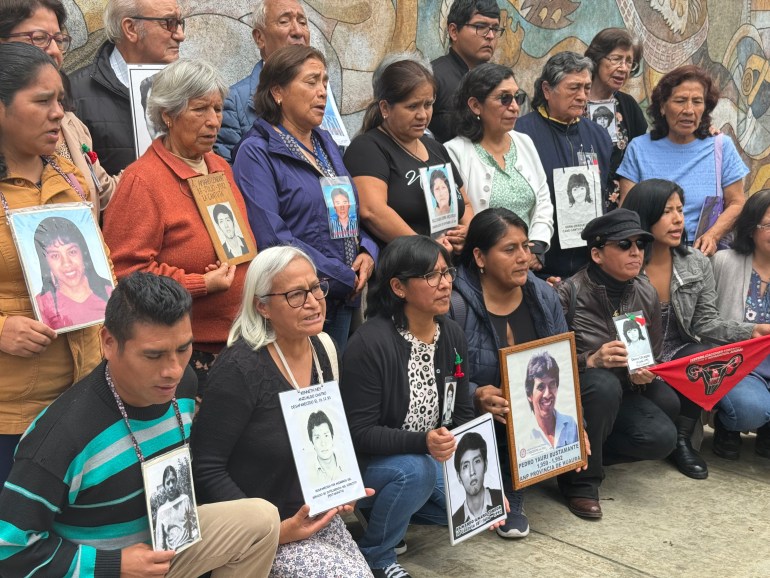
He was horrible at math. Loved to play sports. And always seemed to be smiling. When Gisela Ortiz thinks back to her older brother Luis Enrique, she remembers someone who was kind and generous, willing to lend clothes out of his own closet to classmates in need. But when Ortiz was 20, her brother disappeared. She later learned that soldiers had burst into the university residence hall where he was staying and abducted him, along with eight other students. Together with a professor, they were taken into a field and executed, their bodies dumped in a mass grave. Luis Enrique was only 21 years old. Now, more than three decades later, the person Ortiz holds responsible has been released from prison — and Ortiz is among those raising their voices in protest. On December 6, former Peruvian President Alberto Fujimori was freed, 16 years into a 25-year sentence. In 2009, he had been convicted of ordering massacres between 1991 and 1992 that claimed the lives of 25 people, including Luis Enrique. But critics have said that his record of human rights abuses stretches much further, to include allegations of torture, involuntary sterilisation and forced disappearances. The Inter-American Court had ordered Peruvian authorities to refrain from releasing Fujimori, given the severity of his crimes. “A regime of impunity has been established,” Ortiz said after Fujimori’s release. “Ignoring the ruling of the Inter-American Court really makes us a country that does not respect human rights at the international level, and that is a step that is difficult to reverse.” Families hold up photos of loved ones who disappeared under the presidency of Alberto Fujimori [Jacob Kessler/Al Jazeera] Peru is a member of the Inter-American Commission on Human Rights and is legally bound by the decisions of the Inter-American Court. But Fujimori has remained a towering figure in Peru’s conservative politics, with a broad base of popular support. Proponents credit him with stabilising the economy, combatting armed leftist groups and launching infrastructure projects that improved transportation, education and healthcare. The former president was first granted a humanitarian pardon in 2017, though it was later nullified. Peru’s Constitutional Court reinstated the pardon this month, partially on the basis of Fujimori’s advanced age and poor health. Still, César Muñoz, the Americas associate director at Human Rights Watch, told Al Jazeera that Fujimori’s release is an “extremely serious setback” for rule of law, not to mention for those harmed. “It’s a slap in the face to the victims,” Muñoz said. He explained that, according to international law, humanitarian pardons may indeed be granted to human rights abusers, but two conditions must first be met. The first condition requires countries to punish human rights abusers according to a consistent standard, without discrimination or favour. “You cannot have rules that change depending on who the person is,” said Muñoz. The second condition requires that medical professionals render an independent, thorough and impartial determination about the need for a humanitarian release. “Those two elements were not there” in the case of Fujimori’s pardon, Muñoz explained. Former Peruvian President Alberto Fujimori, wearing a face mask, exits a prison on December 6 near Lima, Peru, where his daughter Keiko and Kenji guide him to a waiting car [Courtesy of Elio Riera/Reuters] Following Fujimori’s release, the Inter-American Commission on Human Rights said it “rejects Peru’s decision” and called for the country “to take effective measures to guarantee the victims’ right to access justice”. Cameras last week captured Fujimori, 85, stepping out of the prison gates and into the arms of his two children, Kenji Fujimori and Keiko Fujimori, both influential politicians. The news left Javier Roca Obregón, also 85, feeling “indignant”. He has long since lost hope of ever seeing his son, Martin Roca Casas, again. “I am 85 years old, and I have no hope,” Obregón told Al Jazeera. “I just want to die soon.” In 1993, Casas was a student at the National University of Callao when he was tortured and detained by Peruvian military forces. His body has never been recovered. Obregón and others believe Casas’s abduction was linked to his student activism. He remembers his son as a beacon of hope for other young people — “an example of overcoming” life’s obstacles. Shortly before he went missing, Casas participated in a march against a tuition increase at his university. When two people started to film the protest, he and other students grabbed the camera and destroyed it — an act Obregón suspects precipitated his kidnapping. “In Peru, the life of a poor person is worth nothing. The poor have no right to justice,” said Obregón, who originally hailed from the small, rural town of Yanama. “Just like a dog, they can kill it and then forget about it. That is what is being repeated.” Javier Roca Obregón, right, and his wife remember their son Martin Roca Casas, who disappeared after being detained by military officials [Jacob Kessler/Al Jazeera] Critics have said Fujimori governed with relative impunity during his term in office, from 1990 to 2000. His presidency oversaw the dissolution of Congress and the suspension of Peru’s constitution, allowing him to consolidate power. Carolina Oyague said it was a “terrible” feeling to see the video of a smiling Fujimori being released to his children. Her older sister Dora, 21, was one of the nine students abducted from the Enrique Guzmán y Valle National University of Education in 1993, alongside Luis Enrique Ortiz. Oyague remembers her sister as “cheerful and creative”, a budding entrepreneur who sold everything from makeup to cakes to pay for her education. It was not until September of this year that parts of Dora’s skeletal remains were recovered and presented to her family. To watch Fujimori walk free only a few months later left Oyague furious. “There’s no mea culpa,” she said. “He doesn’t even have a modicum of remorse.” Fujimori has issued vague apologies in the past but has never taken direct responsibility for the military killings or the other abuses that occurred
Turkish MP who suffered heart attack during speech in parliament dies
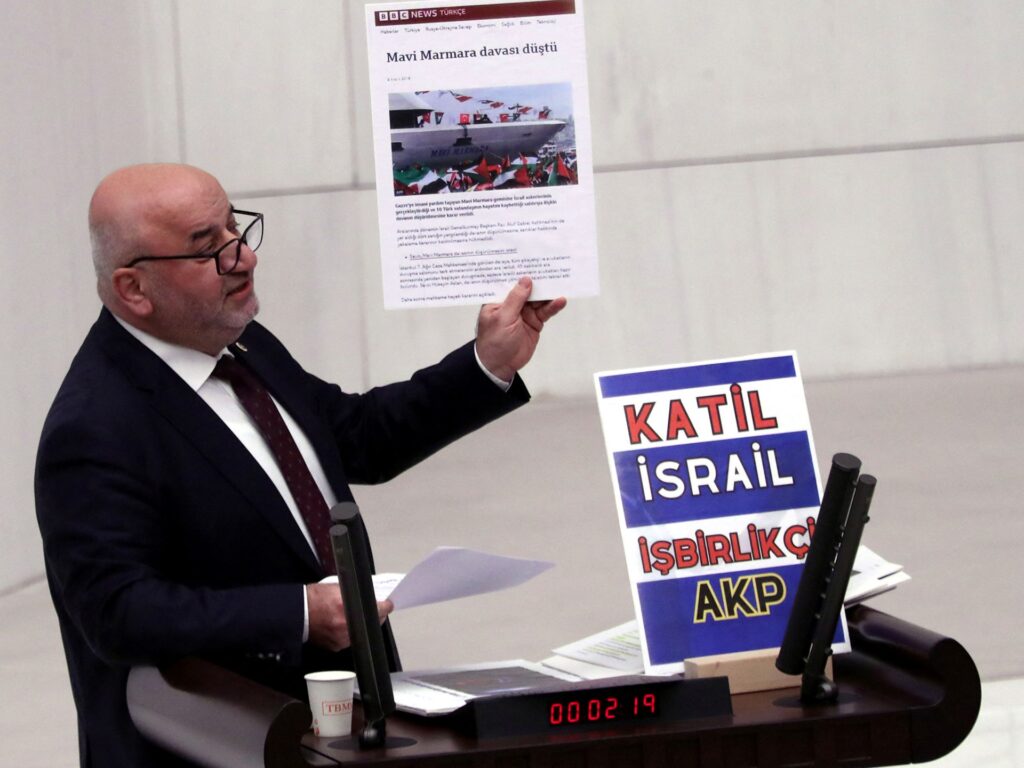
Hasan Bitmez dies at a hospital in Ankara two days after heart attack during anti-Israel speech. A Turkish opposition legislator who suffered a heart attack and collapsed in parliament during a speech railing against the government’s policy towards Israel has died. Health Minister Fahrettin Koca said on Thursday that Hasan Bitmez, a 54-year-old member of the Islamist Saadet Partisi, or Felicity Party, had died in an Ankara hospital two days after the incident. “You allow ships to go to Israel, and you shamelessly call it trade. … You are Israel’s accomplice,” Bitmez said in his speech targeting President Recep Tayyip Erdogan’s Justice and Development Party (AK Party) on Tuesday after placing a poster on the podium reading: “Murderer Israel; collaborator AKP.” “Even if you escape the torment of history, you will not be able to escape the wrath of God,” he said at the end of the 20-minute speech before collapsing at the lectern. Other members of the Grand National Assembly rushed forward to help, and Koca said on Tuesday that Bitmez had been “resuscitated in parliament and transferred within 20 minutes to hospital” where medical equipment had kept him alive. The opposition figure, who was married and a father of one, graduated from Cairo’s Al-Azhar University, worked for Islamic nongovernmental groups and was chairman of the Centre for Islamic Union Research. His speech accused the government of continuing friendly economic relations with Israel during its assault on Gaza, which has killed nearly 19,000 Palestinians. His remarks drew jeers from AK Party members. While Erdogan has worked to improve ties with Israel after a period of frosty relations, he has also railed against the current war between Israel and the Palestinian armed group Hamas, calling Israel a “terror state” and pushing for a ceasefire. In a small ceremony on Thursday on the grounds of the Grand National Assembly, Bitmez’s coffin was draped with a Turkish flag, and a small Palestinian flag was attached as well. Adblock test (Why?)
How much environmental damage is Israel’s war on Gaza causing?
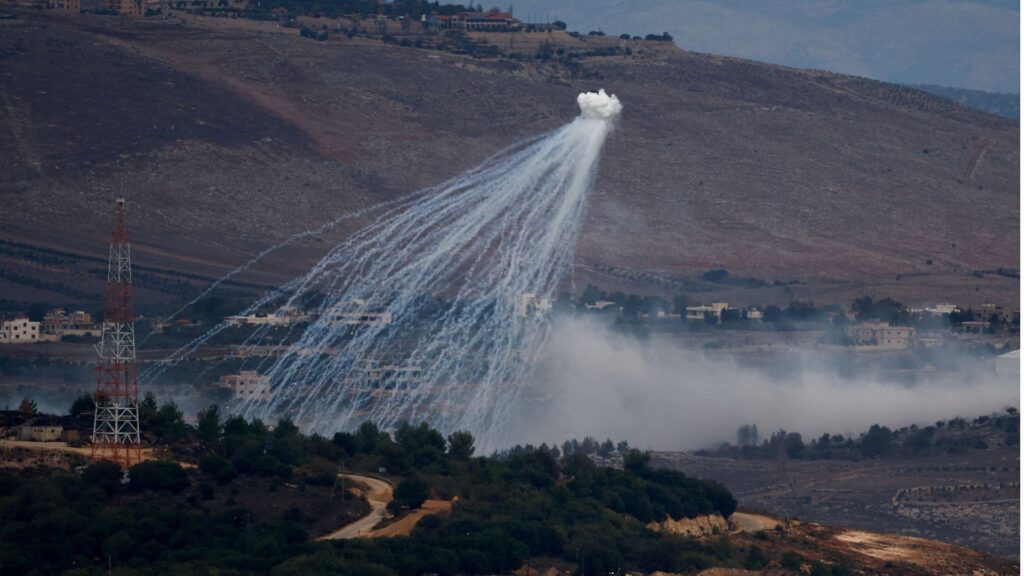
Israel’s military onslaught has devastated built and natural environments in Gaza. Palestinians continue to suffer in Israel’s brutal assault on Gaza – thousands killed and tens of thousands of others wounded. One of the most intense bombing campaigns since World War II will leave not just a legacy of grief for Gaza’s people, but one of lasting physical damage to the environment. Sanitation and water treatment systems have been destroyed. Thousands of Israeli and Western-supplied bombs pollute the air and ground. The war is leaving a new layer of toxic chemicals in Gaza’s soil, adding to those left behind after the many wars Israel has waged before. Can Gaza recover? Presenter: Adrian Finighan Guests: Nada Majdalani – Palestinian director of EcoPeace Middle East, an organisation that brings together Jordanian, Palestinian, and Israeli environmentalists Marwan Bardawil – Head of Gaza Programme Coordination Unit of the Palestinian Water Authority Hadeel Ikhmais – Director general of the Climate Change Section of the Palestinian Authority’s Environment Quality Authority Adblock test (Why?)
Ireland’s prime minister urges EU leaders to call for Gaza ceasefire
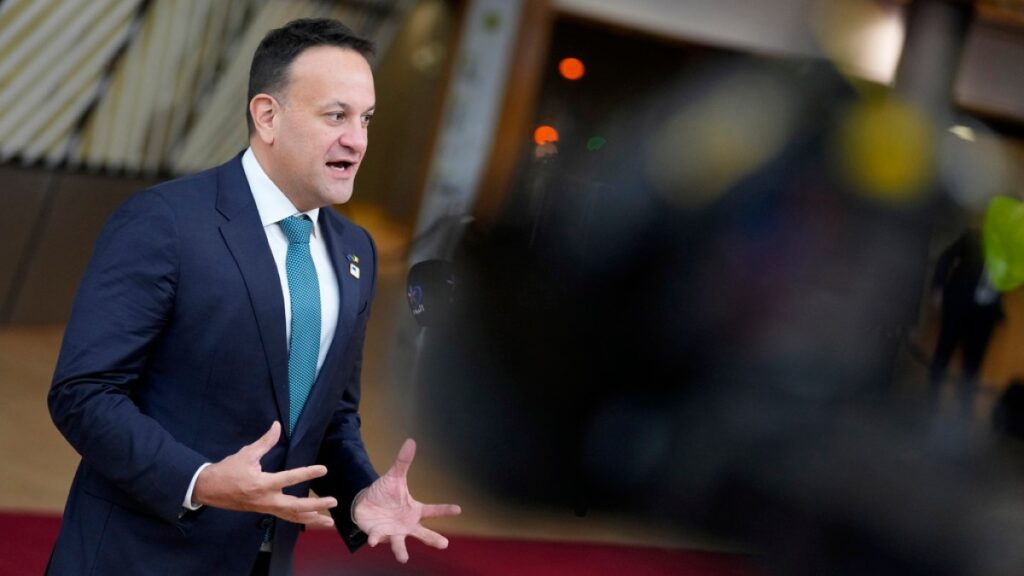
Irish Prime Minister Leo Varadkar says there is ‘some truth’ to accusations that EU employs a double-standard on Gaza. A growing number of countries in the European Union have expressed support for a humanitarian ceasefire in the Israel-Hamas war as Israel’s assault on Gaza plunges the Palestinian territory into a dire humanitarian crisis. In remarks on Tuesday at an EU summit focused largely on Ukraine, Irish Prime Minister Leo Varadkar urged his colleagues to take a firmer stance and call for an end to the fighting between Israel and the Palestinian armed group Hamas in the besieged Gaza Strip. “I think the European Union has lost credibility because of our inability to take a stronger and more united position on Israel and Palestine,” Varadkar said. “We’ve lost credibility at the Global South, which actually is most of the world, because of what is perceived to be double standards. And there’s some truth in that, quite frankly.” Before the summit, Varadkar and the prime ministers of Spain, Belgium, and Malta wrote to European Council President Charles Michel asking him to host a “serious debate” about the Israel-Hamas war and the “humanitarian catastrophe unfolding in Gaza.” “We must call urgently for all the parties to declare a lasting humanitarian cease-fire that can lead to an end of hostilities,” the four leaders wrote. The comments came several days after a large majority of nations represented at the United Nations General Assembly voted in favour of a resolution calling for a humanitarian ceasefire and the number of Palestinians killed in Israel’s assault on Gaza passed 18,000, most of them women and children. The resolution passed with 153 nations in support, 23 abstaining, and 10 voting against it. In Tuesday’s UN vote, 17 EU countries were among those that backed the call for a ceasefire. In October, only eight had backed a resolution calling for a truce. Varadkar insisted that a ceasefire could lead “to a new peace process and Palestinian statehood, which is the only way to secure justice and security for everyone living in the region.” Spanish Socialist leader Pedro Sánchez, whose country currently holds the rotating presidency of the Council of the EU, backed his Irish colleague. “Europe has to speak out … in a clear, strong, firm and unified voice,” he said. The current round of fighting began on October 7 when Hamas launched an attack on southern Israel that killed about 1,200 people, mostly civilians, and took about 240 others captive. Israel responded with a devastating assault on Gaza, bombarding the territory and launching a ground offensive, claiming that it seeks to topple Hamas. The Hamas attack was widely condemned, and Israel received strong international backing for its war against Hamas from the United States and several European countries. But as the Israeli assault continued, leading to dire humanitarian conditions and displacing more than 80 percent of Gaza’s 2.3 million residents, some allies have tempered their support with growing warnings about the toll on civilians. Western countries have also been accused of employing a double-standard, chastising Russia for violations of international law during its invasion of Ukraine but relatively muted when faced with similar acts by Israel. Speaking on Tuesday, US President Joe Biden said that Israel risks losing support due to “indiscriminate bombing” in a rare moment of sharp criticism. But despite mounting international pressure, Israel has shown no signs of scaling down its fighting in Gaza, where UN officials have described conditions as “hell on earth”. On Thursday, Israeli Defence Minister Yoav Gallant said that the fighting in Gaza would last “more than several months”. Adblock test (Why?)
Israel bombards Rafah as pressure mounts over civilian death toll in Gaza
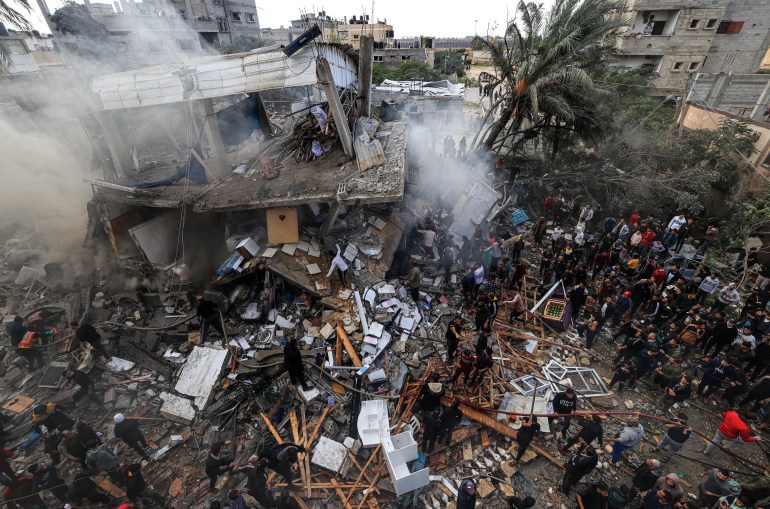
At least 26 people have been killed in an Israeli air strike on Rafah in southern Gaza, according to Palestinian officials as international calls grow for a ceasefire in the Israel-Hamas war. Footage from the scene shared online and verified by Al Jazeera on Thursday showed local residents trying to extinguish a fire and rescue survivors as black smoke rises from one of the buildings. Two adjacent homes belonging to the Abu Dhbaa and Ashour families were obliterated in the attack on the city, where tens of thousands of displaced people have sought shelter since a weeklong truce collapsed in early December. Displaced people have been sleeping in makeshift shelters and in the streets after evacuating from the north and from other areas of southern Gaza that had previously been deemed safe by the Israeli army. “It was difficult because of the dust and people’s screams. We went there, and we saw our neighbour who had 10 martyrs,” said Fadel Shabaan, a resident who rushed to the area after the bombing. “This is a safe [refugee] camp. There is nothing here. The children play football in the street,” he told the news agency Reuters. Gaza health authorities said 26 people were killed in the attack. Gaza’s Ministry of Health said on Thursday that at least 179 people had been killed and 303 wounded in Israeli attacks over the past day, bringing the death toll in Gaza since the war began on October 7 to 18,787 with 50,897 injured. Footage verified by Al Jazeera shows relatives mourning by the shrouded bodies of at least 20 people. A member of the Ashour family said she lost her mother, two brothers, their wives and their children. “I have a niece who is still under the rubble,” she said. “We had displaced people. One of them was our cousin who was displaced from the north. Our neighbour and his grandmother who were displaced from Beit Lahiya were killed too.” Another member of the Ashour family said there were more than 50 people inside the four-storey building. “They were people from Beit Lahiya, Jabalia, al-Saftawi and Nuseirat,” she said. “We lost [an] old lady, a five-month pregnant lady, her little boy and her husband, … my brother, his son and his wife.” An Israeli air strike has killed at least 26 people in the southern city of Rafah, where tens of thousands of displaced Palestinians have sought shelter in recent days [Mahmud Hams/AFP] Fighting rages across Gaza Two weeks after the truce collapsed, the war has entered an intense phase with fighting now raging across the entire Palestinian enclave and international organisations warning of a worsening of the humanitarian catastrophe there. Israel has brushed off calls for a ceasefire, including a resolution at the UN Security Council blocked by a US veto last week and another that passed overwhelmingly in the General Assembly this week. Despite Israel’s pledges to reduce harm to civilians, it has extended its ground campaign from the north to the south this month, leaving no part of the enclave unscathed. It says it is offering warnings where it can before attacking an area. In the main southern city, Khan Younis, where advancing Israeli forces reached the centre this week, a whole city block was bombed to dust overnight. Although most people had fled after Israeli warnings, neighbours digging in the rubble with a hand shovel afterwards said they believed four people were under the debris. One body had been recovered. In the north, including the ruins of Gaza City, fighting has escalated since Israel announced that its troops had largely completed their military objectives last month. In Jabaliya also in the north, Gaza’s Health Ministry said Israeli forces had stormed a hospital, detaining and abusing medical staff and preventing them from treating a group of wounded patients, at least two of whom had died. Twelve children were in the intensive care unit, where the electricity had been cut and there was no milk, ministry spokesperson Ashraf al-Qudra said. Israel’s military said Palestinian fighters had been operating inside the hospital, 70 of whom had surrendered there “with weapons in hand” and were now undergoing interrogation. Washington has provided diplomatic cover for its ally but expressed increasing alarm over civilian deaths. US President Joe Biden, whose government has provided Israel with billions of dollars in military aid, delivered his sharpest rebuke of the war on Wednesday. He said Israel’s “indiscriminate bombing” of Gaza was eroding its international support. White House National Security Adviser Jake Sullivan, who arrived in Israel on Thursday, will discuss with the Israelis the need to be more precise with their strikes, spokesperson John Kirby said. Up to 45 percent of the 29,000 air-to-ground munitions that Israel has dropped on Gaza since October 7 have been unguided “dumb bombs”, according to a US intelligence assessment reported by CNN. Agriculture Minister Avi Dichter, a member of Israel’s security cabinet and Prime Minister Benjamin Netanyahu’s Likud party, rejected Biden’s characterisation of Israel’s strikes as indiscriminate. “There is no such thing as ‘dumb bombs’. Some bombs are more accurate. Some bombs are less accurate. What we have is mostly pilots who are precise,” he told Army Radio. “There is no chance that Israel’s air force or other military units fired at targets that were not terror targets.” “[Sullivan] will likely point to the UN General Assembly vote in favour of a ceasefire earlier this week, but we have already heard from Netanyahu and [Israeli Defense Minister Yoav] Gallant that this war will be conducted the way they want,” Al Jazeera’s Alan Fisher said, reporting from occupied East Jerusalem. Netanyahu promised to carry on the war “until victory, nothing less than that”, and Foreign Minister Eli Cohen has said the war would continue “with or without international support”. The United Nations estimated 1.9 million out of Gaza’s 2.3 million people have been displaced. The head of the UN Relief and Works Agency for Palestine Refugees, Philippe Lazzarini, said on Wednesday that Palestinians in Gaza
Finland set to again shut its entire border with Russia
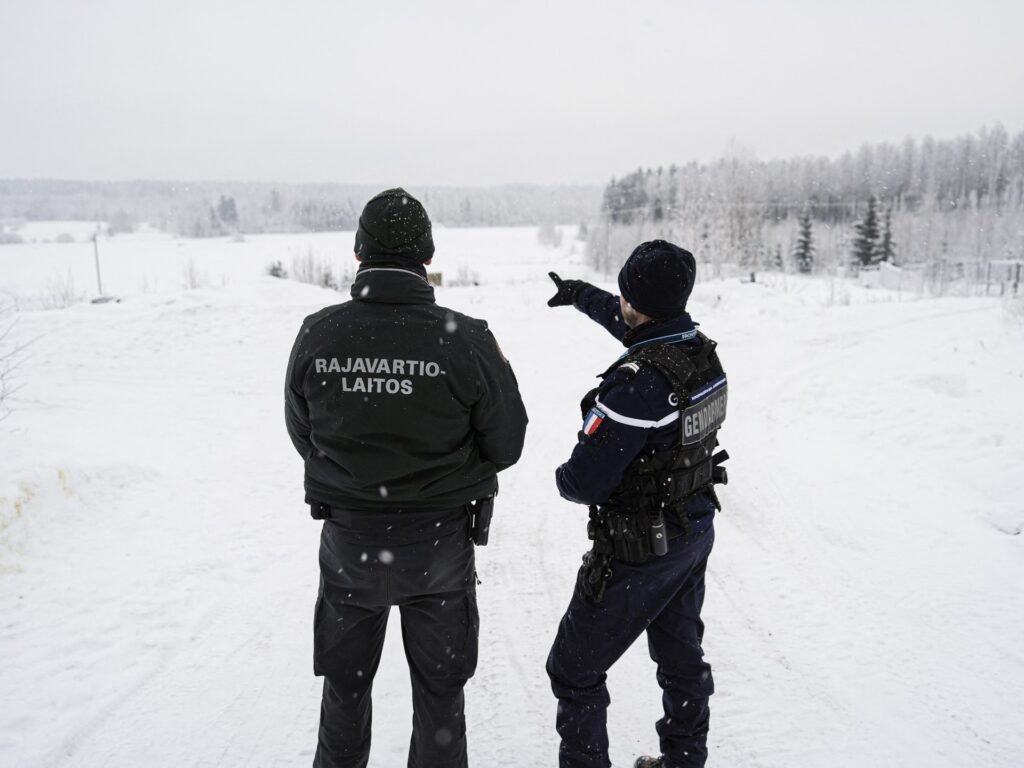
The decision comes amid renewed asylum seekers arrivals that Helsinki has labelled a Russian hybrid attack. Finland will close its eastern border with Russia, the country’s interior minister has said, just hours after the Nordic nation relaxed a two-week closure of all roads between the two countries. Helsinki has said a recent rise in asylum seekers arriving via Russia was an orchestrated move by Moscow in retaliation for the Nordic country’s decision to increase defence cooperation with the United States, a charge the Kremlin has denied. The arrivals stopped when Finland shut the border in late November, but resumed on Thursday when two of the eight crossings were opened, with some 36 people seeking asylum, the Finnish Border Guard said. “The phenomenon has started again and we will close the whole border,” Interior Minister Mari Rantanen told the country’s parliament. “This is a sign that the Russian authorities are continuing their hybrid operation against Finland. This is something that Finland will not tolerate,” Rantanen said in a statement. Finland joined NATO in April after decades of military non-alignment and pragmatic friendly relations with Moscow. Its 1,340km (832-mile) border with Russia serves as the European Union’s external border and makes up NATO’s northeastern flank. Approximately 900 asylum seekers from nations such as Kenya, Morocco, Pakistan, Somalia, Syria and Yemen entered Finland from Russia in November, an increase from fewer than one per day previously, according to the Border Guard. Concerns about the rights of asylum seekers In a letter published on Monday, the Council of Europe said it was “concerned about the rights of refugees, asylum seekers and migrants” following the temporary border closure, and asked Finland to ensure it remained possible to seek protection. Rantanen, who represents the anti-immigration Finns Party, on Monday told the news agency Reuters there was no cause for human rights concerns, however, as asylum could be sought at other entry points. “Undoubtedly Russia is instrumentalising migrants” as part of its “hybrid warfare” against Finland, Foreign Minister Elina Valtonen said last month. “At the EU border with Finland, Russian border guards have been letting people through without Schengen visas or EU residence permits. People who are being misled. People who are being used by Russia,” said EU Commissioner for Home Affairs Ylva Johansson. At the end of November, the European Union’s border protection agency, Frontex, deployed 50 officers to Finland, and said it would send equipment such as patrol cars “to bolster Finland’s border control activities”. In 2021, 3,000 to 4,000 asylum seekers became stranded in a no-man’s land on the border between Poland and Belarus as Warsaw deployed security forces to stop people from entering amid freezing winter temperatures. The EU and Warsaw said Minsk was deliberately enticing migrants and refugees to Belarus and then pushing them westwards with promises of easy entry into the bloc, and accused Russian President Vladimir Putin of masterminding the crisis. Adblock test (Why?)
Photos: South Korea island is a field of dreams for young baseball hopefuls
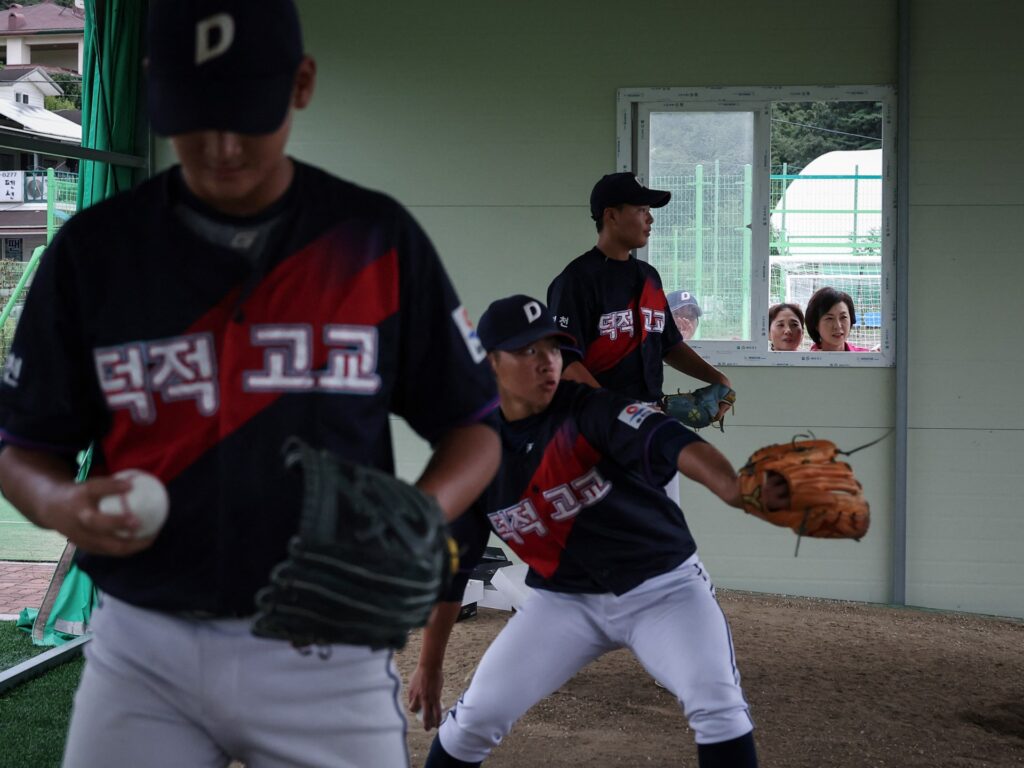
Dreaming of making it big in baseball, teenage brothers An Seung-han and An Seung-young travelled hundreds of kilometres away from home to remote Deokjeok Island, where the sport and their team are now the closest thing they have to a family. The boys are among a few dozen teenagers who have left the bright lights of some of South Korea’s biggest cities to join a specialised sports academy set up by Kim Hak-yong, former manager of the elite Dongguk University team, which has produced scores of players in the national KBO major league. “If I work hard here, I can be a main player, so I’m working even harder. If I keep doing well, I can also become a professional baseball player,” 16-year-old Seung-young, the younger brother, said during a training session. In addition to helping the boys achieve their dreams, the sports academy has breathed life into Deokjeok, which was struggling to retain and attract youngsters like many other rural areas in the world’s most rapidly ageing society. The island has a population of 1,800, the majority of them elderly. Last year, it was on the brink of losing its last school under a nationwide school board guideline that stipulates closures if the number of students falls below 60. That has now changed, thanks to Kim and his friend Chang Kwang-ho, manager of the Deokjeok High School baseball team. “The players who come here come with an amazing mindset. You don’t come here unless you’re willing to give up everything,” Chang said. Although the island is less than two hours away by ferry from the city of Incheon, it remains quite isolated from the mainland and is much less developed. Adblock test (Why?)
What’s an impeachment inquiry and what’s next for President Joe Biden?
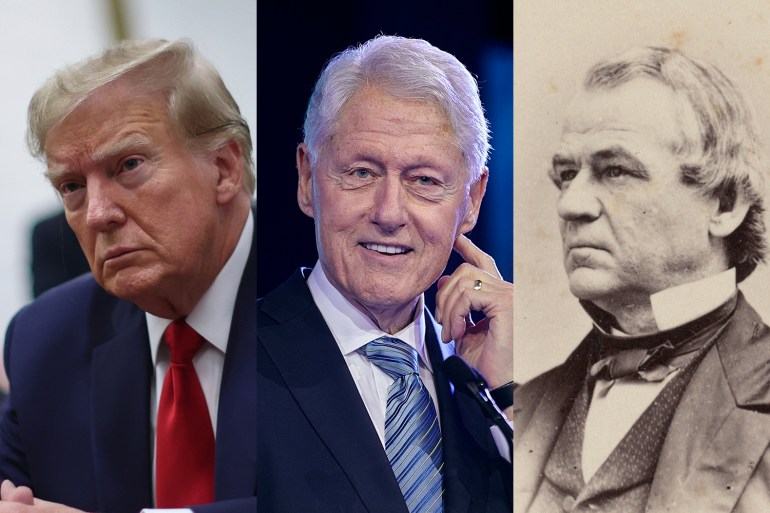
The Republican-led United States House of Representatives has voted to formally authorise its impeachment inquiry into President Joe Biden. Up until this point, the House had not had enough votes to legitimise the ongoing inquiry, but on Wednesday, lawmakers voted 221-212 in favour, with every Republican voting for it and every member of Biden’s Democratic Party against. The decision to hold a vote came as Republican Speaker Mike Johnson and his team faced growing pressure to demonstrate progress in what has become a nearly yearlong probe into the business dealings of Biden’s family members. The vote took place hours after his son Hunter Biden defied a congressional subpoena by failing to appear for a private deposition at the House of Representatives. He refused to testify behind closed doors, saying he would testify only in public because he feared his words would otherwise be misrepresented. Here is what you need to know: What is an impeachment inquiry? An impeachment inquiry is a formal investigation into possible wrongdoing by a federal official, such as the president, cabinet officials or judges. The process is written into the US Constitution and is the most powerful check that Congress has on the executive branch. It is a first step towards a potential impeachment, which means essentially that charges are brought against an official. The US founders included impeachment in the constitution as an option for the removal of presidents, vice presidents and civil officers. Under the constitution, they can be removed from office for “treason, bribery, or other high crimes and misdemeanours”. While the House of Representatives wields the power to impeach an official, only the Senate has the ability to convict and remove an individual from office. This played out recently when former President Donald Trump was impeached twice by the House but acquitted in the Senate. To date, no president has ever been forced out of the White House through impeachment, but Joe Biden is the eighth president to face an impeachment inquiry. Only three other presidents have been impeached after an inquiry: Andrew Johnson, Bill Clinton and Trump. From left, former US Presidents Donald Trump, Bill Clinton and Andrew Johnson [File: AP] Why is this happening now? The House of Representatives started an impeachment inquiry in September, but the process has now been formalised. In November, a top White House attorney claimed the investigation was illegitimate because the House had not yet formalised the impeachment inquiry through a vote. The White House questioned the legal and constitutional basis for the Republican lawmakers’ requests for information. The constitution does not require a vote to start an impeachment inquiry, and neither do the rules governing the House, but authorising resolutions have been passed in previous presidential impeachments. Most of the Republicans who were initially reluctant to back the impeachment push due to the lack of concrete evidence against the president have also been swayed by their leadership’s more recent argument that authorising the inquiry will give them better legal standing and would convince the White House to cooperate fully in the investigation by providing more information. “This vote is not a vote to impeach President Biden,” Johnson said at a news conference on Tuesday. “This is a vote to continue the inquiry of impeachment. … I believe we’ll get every vote that we have.” Congressional investigators have already obtained nearly 40,000 pages of subpoenaed bank records and dozens of hours of testimony from key witnesses, including from several high-ranking Department of Justice officials currently tasked with investigating Hunter Biden. Is there enough evidence against Joe Biden? Republicans have accused the president and his family of profiting from his time as vice president from 2009 to 2017 and have zeroed in on his son’s business activities. Conservatives accuse Hunter Biden of “influence peddling”, effectively trading on the family name in “pay-to-play” schemes in his business dealings in Ukraine and China. They have pointed to an FBI document from 2020 in which an informant claims the head of Burisma, a Ukrainian energy firm that included Hunter Biden on its board of directors, said: “It cost 5 (million) to pay one Biden, and 5 (million) to another Biden.” This bribery claim relates to the Republican allegation that President Biden pressured Ukraine to fire its top prosecutor to stop an investigation into Burisma. Democrats have reiterated that the Justice Department investigated the Burisma claim when Trump was president and closed the matter after eight months, finding “insufficient evidence” to pursue it further. The head of Burisma, Mykola Zlochevsky, has said nobody from the company had any contact with Joe Biden or his staff and that the elder Biden “did not help the firm”. Hunter Biden, the son of US President Joe Biden, speaks at a news conference outside the US Capitol on December 13, 2023 [Reuters] Devon Archer, a business associate of Hunter Biden, told the House Oversight Committee in July that the younger Biden had sought to create “an illusion of access to his father” and put his father on the phone with foreign associates “maybe 20 times” over the course of about 10 years. Archer said those conversations did not involve any business dealings, however, and he was not aware of any wrongdoing by President Biden. Devon Archer, a former business associate of Hunter Biden, arrives for a deposition before the House Oversight Committee in Washington [File: Kevin Wurm/Reuters] Hunter Biden faces an array of legal woes. In September, prosecutors with US Special Counsel David Weiss’s office charged him with making false statements about illegal drug use while buying a firearm. And last week, a grand jury indicted Hunter Biden for tax offences. He has pleaded not guilty to the three federal gun charges, and his lawyer says he has paid his taxes in full. “There is no evidence to support the allegations that my father was financially involved in my business because it did not happen,” Hunter Biden told reporters outside the US Capitol on Wednesday. After he defied their subpoena, members of the House Oversight
Analysis: Russia’s tiny, Pyrrhic advances in Ukraine’s east
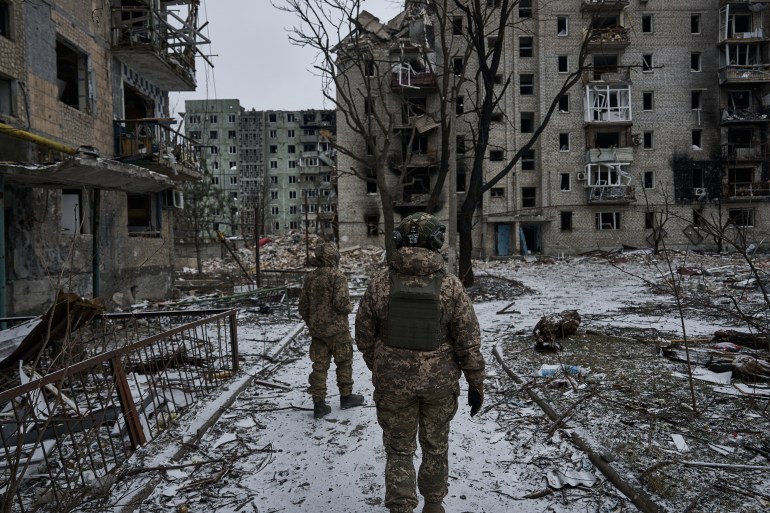
Kyiv, Ukraine – Russian forces are close to rolling into a Ukrainian stronghold of immense strategic and symbolic importance. Troops have almost surrounded Avdiivka, a southeastern town which has been nearly razed to the ground after almost a decade of assaults by pro-Moscow separatist fighters. The town is strewn with craters from explosions, burned-out armoured vehicles and the uncollected bodies of Russian soldiers and separatists who doubled their efforts in October. Avdiivka is just 20km (12 miles) north of the separatist capital of Donetsk and is crucial to the Kremlin’s objective of seizing the entire southeastern Donbas region that has been partly controlled by rebels since 2014. The Kremlin shifted to this strategy a year ago after its blitzkrieg to conquer all of Ukraine failed and its forces withdrew from around Kyiv and most of Ukraine’s north. But Kyiv’s long-awaited summer counteroffensive to regain areas lost to Russia last year hasn’t yielded tangible results. Ukrainian forces lack air support and medium-range missiles to disrupt Russian supply lines and break through heavily fortified Russian defence installations along the crescent-shaped, 1,000km-long front line. Counterattacking Ukrainian forces largely consist of recently trained servicemen who replaced dead and wounded veterans. They lack battlefield cohesion and, because of their inexperience, had not expected to encounter thousands of kilometres of newly built Russian trenches and tunnels, some of which lie 30 metres (33 yards) underground. Moscow has also deployed hundreds of thousands of newly mobilised servicemen to man the defence lines and plant up to five landmines per single square metre of no-man’s land. As a result, Ukrainian forces have failed to achieve their goal of reaching the Sea of Azov and cutting off Russia’s “land bridge” to the annexed Crimean peninsula amid heavy, debilitating losses of manpower and weaponry, including Western-supplied armoured vehicles. Ukraine’s top military analyst warned that in the freezing winter months, the nation’s military will have to circle the wagons and focus on defence as they re-evaluate next year’s offence strategy with Western allies, increase domestic production of weaponry and mobilise tens of thousands more men. “These days, we are focusing on switching to defence, and, to boost its effectiveness, to equipping and mining the most threatening [front-line] areas and use this time to amass resources,” Lieutenant General Ihor Romanenko, former deputy chief of the General Staff of the Ukrainian Armed Forces, told Al Jazeera. He and other analysts blame Ukraine’s failures on delays in supplies of Western weaponry as well as Russia’s prowess in the large-scale use of unmanned aerial vehicles, especially the FPV (first-person view) kamikaze drones. These inexpensive camera-equipped drones carry tiny explosives and can get into manholes or open hatches of armoured vehicles – all while their pilots operate them from safe hideouts. This year, Russia began the massive industrial production of FPV drones, while Ukraine still largely relies on the output of makeshift workshops, the numbers of which have mushroomed around the nation and where volunteers retrofit Chinese-made models. “This year, [Russians] managed to catch up with us and go ahead of us, and to produce large quantities of unmanned aerial vehicles,” Romanenko said. However, some analysts claim the advantages of FPV drones are somewhat exaggerated. “They’re cheaper and more simple, but also less effective in comparison with high-precision means of destruction, including advanced kinds of loitering munitions,” Pavel Luzin, a visiting scholar at Boston’s Tufts University, told Al Jazeera. Ukrainian soldiers walk through the crater-ridden town of Avdiivka, which is now almost surrounded by Russian forces, on December 7, 2023 [Kostya Liberov/Libkos/Getty Images] Taking The Chemist To take over Avdiivka, Russian forces have to seize The Chemist, a district named after a nearby plant, according to Rybar, a pro-Russian Telegram channel. “This will let them bisect the Ukrainian grouping in Avdiivka, to break the unified system of defence and to significantly simplify the storming of the entire defence site,” Rybar, a primary source of news on the Russian offensive, posted on Monday. Moscow needs to take Avdiivka for publicity purposes. Russian President Vladimir Putin has announced that he will run in the 2024 election and needs a victory that the Kremlin-controlled media can trumpet. “Putin needs such a victory ahead of the vote considering that the situation on the front lines is in a limbo for both sides,” Kyiv-based analyst Igar Tyshkevich told Al Jazeera. The Kremlin and its top brass largely ignore the plight of their servicemen who reach the front lines after no or next-to-no training and have been dying in droves. “To trudge two kilometres across the forest only to jump a machine gun and die within two seconds is the real-life story of a Russian stormtrooper,” a Ukrainian serviceman wrote on Telegram in August. This has led to catastrophic losses. Some 315,000 Russian servicemen have been killed or wounded since the war began in February 2022, amounting to 87 percent of Moscow’s active-duty ground troops, according to a declassified US military assessment released on Tuesday. Apart from the incessant storming of Avdiivka, Russian forces also intend to advance on other key areas of the eastern front – the towns of Kupiansk, Lyman and Bakhmut. The latter was taken over in May, mostly by Wagner mercenaries leading thousands of Russian prisoners who signed up for military service in exchange for a presidential pardon in what became known as “meat marches”. Over the following months, Ukraine retook key positions around Bakhmut – and Russians are dying in a bid to take them back. But real military triumphs are just not on the cards for Moscow, another analyst said. “One should not expect any breakthroughs for Russian forces. They hit in various directions, just a little. Spend the ammo they amassed, as well as contract soldiers and [recruited] inmates,” Nikolay Mitrokhin of Germany’s Bremen University told Al Jazeera. Russian forces may manage to seize Avdiivka, are likely to restore their positions around Bakhmut and improve their logistics by crossing the Zherebets river near Lyman, he said. “Russia will consider [these steps] the winter campaign’s
Conned, exploited, trapped: Romania’s new flock of Asian delivery riders
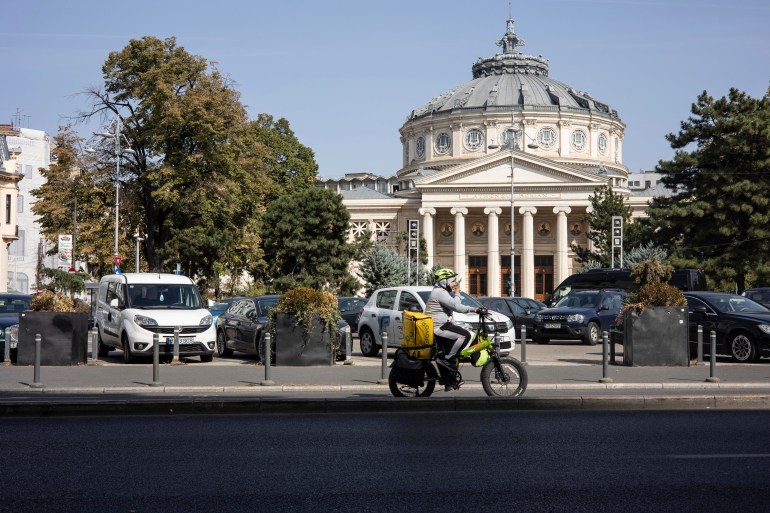
Names marked with an asterisk have been changed to protect identities. Bucharest, Romania – For six months, Douglas* worked hard at a Bucharest restaurant, cooking more than 200 hamburgers a day in the kitchen. But like many other foreign workers in Romania, he took on a second job delivering takeaway food by motorcycle to supplement his income. On Sundays, his day off from the restaurant, he wakes up at 7.30am in a room provided by his employer. It is crammed, to say the least. Fourteen Sri Lankan men sleep in seven bunk beds, “like in a hospital”, he jokes. Their jackets and towels hang on the edge of the beds. Douglas’s spacious green square backpack, with the words Bolt Food, sits on the floor. He eats rice and lentils for breakfast before getting on his motorcycle for a seven-hour shift, to deliver sushi and pizza to famished customers. Between 2pm and 9pm, he delivers about 14 orders. Afterwards, he eats dinner – rice again, this time with chicken. “The most difficult thing for me is to get used to the idea because I didn’t come for this. But I can do it. I can try for a good salary,” he said. Each week, he makes about 120 Romanian lei ($26) profit as a rider. He pays 250 lei ($54) to rent the motorcycle and 30 lei ($6.50) for petrol. He arrived from Kandy, a lush plateau of tea plantations and Buddhist temples in the heart of Sri Lanka. He had spotted a job offer online last November, to work as a housekeeper in a European Union country. Accommodation and meals would be provided, the advertisement said. The opportunity could see his dreams achieved, he thought. His 12-year-old son – a cricket enthusiast – could eventually study in the United Kingdom after all. He had tried working abroad before, in Dubai, “but it was very expensive”, he said. To secure the European job and work permit, Douglas took on a loan to pay about 3,000 euros ($3,200) to a recruitment agency. A year later, sitting in a café in central Bucharest, he looks over the WhatsApp conversations he had with the agent, a Sri Lankan man. “Things were not as they had told me,” he said. When he arrived in Romania, the job and salary were different from what was initially offered. He had been promised 800 euros ($864) for a housekeeping job, not 500 euros ($540) to flip burgers. “I’m trapped. I can’t go back because I have to pay [off] the loan but earning so little, I don’t know how I’m going to pay it either,” he said with a tired smile. Delivery riders, who often hail from Asia, work relentlessly across Romanian cities [Lola Garcia Ajofrin/Al Jazeera] Ali*, a robust 27-year-old who emigrated with his brother from Colombo in late July, rides for up to 15 hours a day. The siblings had worked as mechanics back home, but “the salary was nothing”, Ali said. Their father knew a Sri Lankan expatriate in Romania, who found them cleaning jobs in Bucharest, but soon after they arrived, their work permits were cancelled. While they get to grips with a new round of paperwork, they deliver food by bike. Food delivery is a booming business in Romania. Tazz, a Romanian enterprise, and international companies such as Glovo, Bolt Food, FoodPanda and Takeaway compete for hungry fingertips in the country’s large cities. According to Glovo, which has 3,000 delivery riders nationally, a rider can earn about 23 lei per hour ($5). Meanwhile, the number of Sri Lankans travelling abroad for work is on the rise. According to Sri Lanka’s labour and foreign employment ministry, more than 300,000 emigrated in 2022. Between January and September this year, more than 200,000 left. Sri Lankans have left the island for a number of reasons – due to security fears after the 2019 Easter Sunday bombings, amid the COVID-19 pandemic and as a result of political and economic crises. The people behind the 100,000 quota Douglas, Ali and several others Al Jazeera interviewed for this story are just some of the people who make up the quota the Romanian government set in 2023, of 100,000 work permits for non-EU workers, a number that will rise to 140,000 in 2024, to alleviate employment gaps. According to The Economist, the Eastern European nation is changing from a country of “emigrants to one of immigrants”. Most of Romania’s foreign workforce, excluding Europeans, are Nepalis. Sri Lankans make up the second largest non-EU expatriate force, with 15,807 people. “It is only in the past year or so that we started to see migrants from Southeast Asia delivering food in the streets of Bucharest,” said Maria-Luiza Apostolescu, a researcher in public policy. “Initially you could see them in the kitchen, in the background.” She said some arrive on a student visa and deliver food part-time, while for others, it’s a second job. But she warned that there are no NGOs supporting “economic migrants”, partly because of a lack of funds. “It is [also] hard for Romanians to understand that other people are coming here to have a better life. We are [usually] the ones who emigrate.” ‘You must assure decent conditions for foreigners’ At the immigration office in Bucharest, an official shouts to the crowd, which has formed into various queues. “If you don’t have an online appointment, get out of the room!” Many waiting are young Asian men. There are also some families. “A significant number of vacant jobs were registered between January and August 2023,” said a spokesperson of the Ministry of Labour, Solidarity and Social Solidarity, citing positions such as couriers, builders, secretaries, kitchen helpers and security guards. “This quota looks very good on paper but if you can’t find Romanian workers, you must assure decent conditions for foreigners,” said Radu Stochita, a Romanian journalist who has investigated the plight of Nepali workers. Like Sri Lankans, many of those from Nepal pay exorbitant sums to recruitment agencies,