

El Salvador, US shift responsibility for wrongful deportation
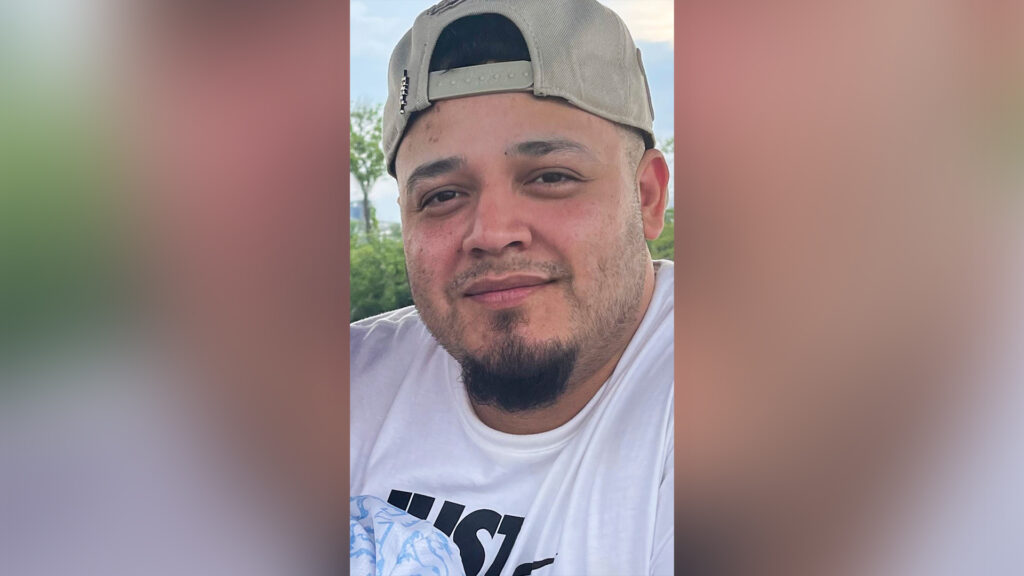
NewsFeed In an Oval Office meeting between the presidents of El Salvador and the United States, officials from both governments tried to say it was the other side who could determine if the wrongfully deported Kilmar Abrego Garcia would be returned to the US. Published On 14 Apr 202514 Apr 2025 Adblock test (Why?)
Lebanese PM visits Syria’s president to reset years of strained relations
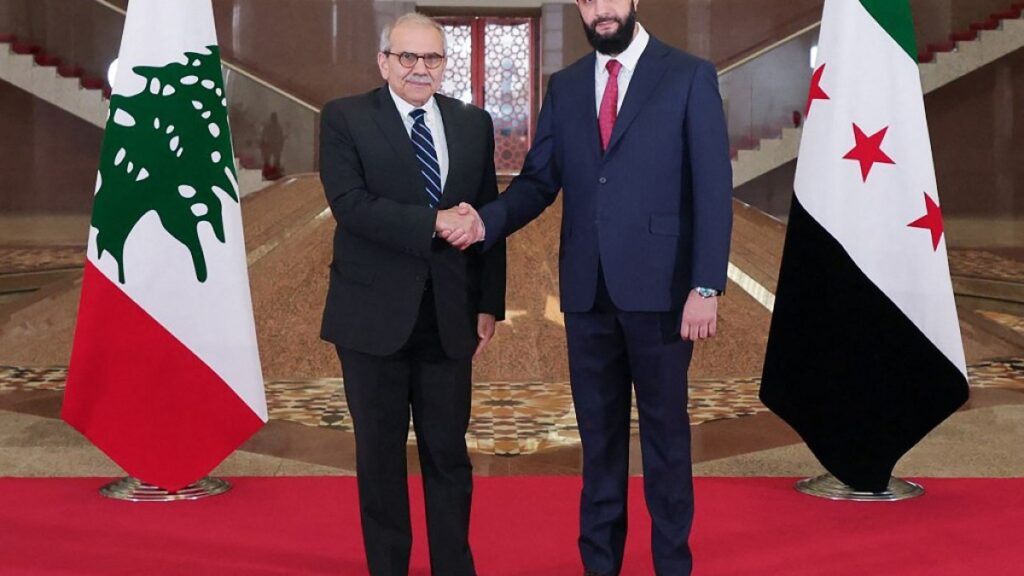
Nawaf Salam meets Ahmed al-Sharaa to discuss border security, refugees, and past political killings under ousted Syrian leader Bashar al-Assad. Lebanese Prime Minister Nawaf Salam has held talks in Damascus with Syrian President Ahmed al-Sharaa, in his first official visit to Syria, in an effort to recalibrate relations between the two nations, which have been strained for decades. The diplomatic shuttle on Monday marks the highest-level Lebanese delegation visiting Syria since Beirut’s new government took office in February, following the ouster of former Syrian leader Bashar al-Assad by opposition forces. A Lebanese official, speaking to the AFP news agency anonymously as they were not authorised to brief the media, described the visit as “key to correcting the course of ties between the two countries on the basis of mutual respect”. ‘Resetting bilateral relations’ Senior Al Jazeera correspondent Zeina Khodr, reporting from Damascus on a pivotal moment for Lebanon-Syria relations, said, “No doubt this is a significant visit. Lebanese officials say that this is an opportunity to correct the trajectory of the relationship between the two countries.” Advertisement The two nations have long faced strained ties marked by “conflict, friction and tension”, Khodr noted. “There was a time when Bashar al-Assad was in power. Syria was accused of interfering in Lebanon’s internal affairs in dictating domestic policy in Lebanon,” she said, recalling Syria’s years of military presence in the neighbouring country and Hezbollah’s support for al-Assad during Syria’s civil war. Recent political shifts in both countries have opened new possibilities. “New authorities are now in Damascus and there is also a new government in Lebanon … al-Assad is out of power, and his ally, Hezbollah in Lebanon, is no longer the dominant player,” Khodr said, adding that all this has led to a mutual desire to “reset bilateral relations”. After the talks concluded and the Lebanese delegation left Damascus, Salam posted on X: “My visit to Damascus today aims to open a new page in the history of relations between the two countries, based on mutual respect, restoring trust, good neighbourliness, preserving the sovereignty of our two countries, and non-interference in each other’s internal affairs. Lebanon’s prime minister also noted that “Discussions with President Ahmed al-Sharaa focused among other issues on border and crossing control, preventing smuggling, and ultimately demarcating the land and sea borders.” Tense relations and political assassinations Relations between Lebanon and Syria have remained tense since al-Assad’s fall. Additionally, both countries have been regularly bombarded by Israel. In Lebanon’s case, that has come in spite of the November ceasefire that ended a year-long war. Advertisement Monday’s talks focused on border security, including efforts to combat smuggling and demarcate the 330km (205-mile) border. Last month, Lebanon and Syria’s defence ministers signed a security agreement in Saudi Arabia following deadly border clashes that left 10 dead. Beirut was also expected to push for a joint investigation into past political killings in Lebanon linked to Syria’s former leadership. Accompanied by senior ministers, Salam discussed the repatriation of Syrian refugees, with Lebanon estimating it hosts 1.5 million Syrians, though the United Nations has registered only 750,000. Before departing from Syria, Salam said he would also raise the issue of Lebanese detainees who vanished in Syrian prisons under al-Assad’s rule. This visit follows a December meeting between al-Sharaa and former Lebanese Prime Minister Najib Mikati, the first such encounter since Syria’s civil war began in 2011. Al-Sharaa had pledged in December that Damascus would respect Lebanon’s sovereignty. Adblock test (Why?)
Russia’s latest strikes in Ukraine kill four in Kharkiv after Sumy attack
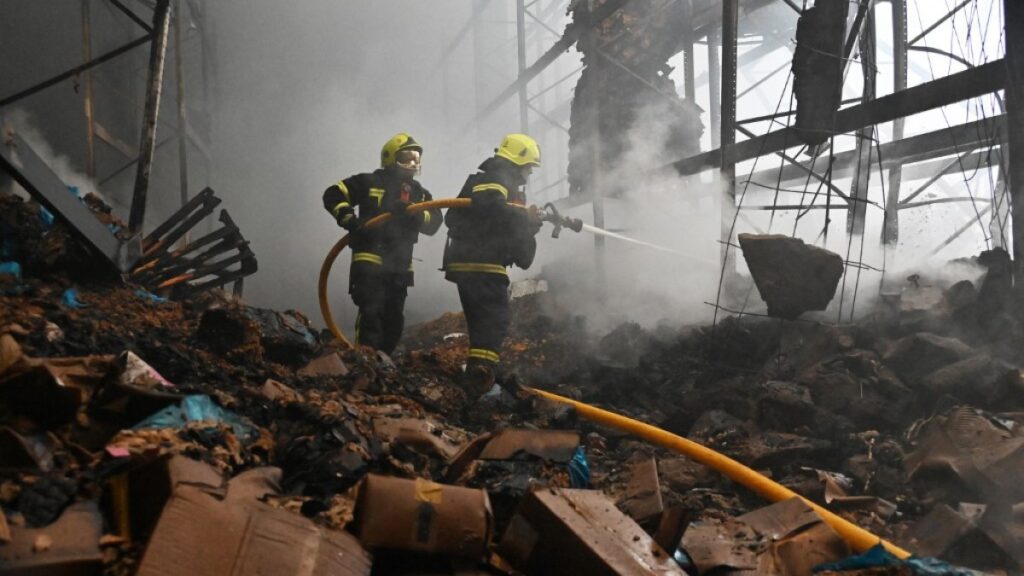
The strikes in eastern Ukraine follow an attack in Sumy that killed more than 30 people, sparking condemnation. Russian strikes on eastern Ukraine have killed at least four civilians, a day after one of the deadliest attacks in recent months left more than 30 people dead in Sumy in the northeast and drew condemnation. Local officials in the Kharkiv region reported that artillery and rocket fire on Monday hit the town of Kupiansk, a strategic rail junction once held by Russian forces and retaken by Ukraine in 2022. Kharkiv, Ukraine’s second largest city, also came under renewed drone attack overnight, underscoring Moscow’s concerted efforts to gain ground in the northeast. Kharkiv Governor Oleh Syniehubov said a 68-year-old man and a 61-year-old woman were killed in Monday’s shelling while a rocket strike claimed the lives of a 77-year-old woman and a 52-year-old man. ‘Russian mistake’ The attacks follow Sunday’s twin missile strike on the centre of Sumy, where Christian civilians had gathered to mark Palm Sunday. Ukrainian officials said at least 34 people were killed and more than 100 injured in the blast. Among the dead were two children. Advertisement Ukrainian President Volodymyr Zelenskyy condemned the attack as a deliberate targeting of civilians. He urged United States President Donald Trump in an interview on the CBS TV network’s 60 Minutes news programme to “please, before any kind of decisions, any kind of forms of negotiations, come to see people, civilians, warriors, hospitals, churches, children destroyed or dead”. Despite the heavy civilian toll, Trump, who has previously faced criticism for his perceived leniency towards Russia and President Vladimir Putin, called the Sumy attack a “mistake” and a “horrible thing”. ‘Human shields’ claim The Kremlin said it struck a military target, saying two Iskander-M tactical missiles hit a meeting of Ukrainian officers in Sumy and blamed Kyiv for using civilians as “human shields” without providing any evidence. Russia accused Ukraine of endangering civilians by carrying out military operations in urban areas. According to Russia’s Ministry of Defence, the target was part of an operational command centre and the attack killed more than 60 Ukrainian soldiers. There has been no confirmation of that from Ukraine’s side. Polish Foreign Minister Radoslaw Sikorski on Monday urged Trump and his advisers to recognise that Putin is “mocking their goodwill”. Several other European Union leaders and the United Kingdom condemned Russia on Sunday. Russia accuses Germany of escalation In the meantime, the Kremlin warned Germany’s incoming chancellor, Friedrich Merz, over suggestions his government might consider sending long-range Taurus missiles to Ukraine. Advertisement Merz told German media that if there was a consensus among European allies, he would support the move. “That would be one way of finally putting this country [Ukraine] strategically – to stay with the term – ahead of the situation,” adding that he was not convinced that “Putin would react positively to weakness and peace offers”. Merz called the Sumy attack “a serious war crime”. Kremlin spokesman Dmitry Peskov warned that such a step would “inevitably lead only to a further escalation” and accused Western leaders of fuelling the war. Berlin, one of Kyiv’s top arms suppliers, has so far held back from providing Taurus missiles despite repeated Ukrainian appeals. Adblock test (Why?)
It is time Liberia enacts legislation banning FGM
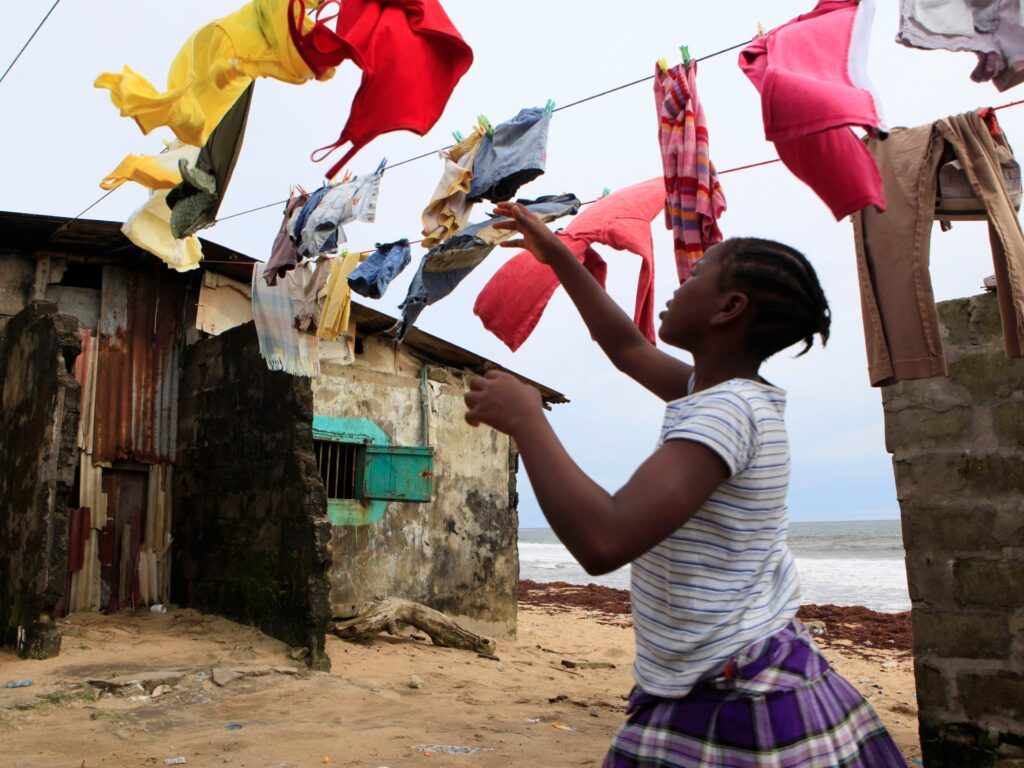
In 2022, the National Council of Chiefs and Elders of Liberia (NACCEL) announced a three-year moratorium on female genital mutilation (FGM). A year later, the council made another proclamation to ban FGM and then held ceremonies to end the practice in five of the 11 counties where FGM is practised. However, despite the ban, there have been continuing reports of FGM activity. In September 2024, the National Coalition Against Harmful Practices (NACAPH), a coalition of civil society actors, released a statement expressing concerns about “widespread resurgence of Female Genital Mutilation activities in various regions of Liberia”. It is now clear that the measures already taken have been ineffective. With the three-year ban having expired in February, Liberia needs to move decisively against the practice. Lawmakers must pass a law criminalising FGM, which should be accompanied by government measures to convince communities to end the practice. FGM usually involves the partial or total removal of the external female genitalia. This practice is prevalent in Liberia as it is part of the practices of the Sande Society, a powerful, traditional, secret society, which initiates girls into adulthood in bush schools. Advertisement According to the United Nations, more than 50 percent of Liberian women between the ages of 15 and 49 have undergone the harmful procedure. However, the exact percentage is difficult to estimate because the secret nature of the Sande Society has resulted in FGM activities being largely underreported, as victims maintain a code of silence. There have also been instances of journalists being targeted and threatened with forceful cutting due to their reporting on FGM, which has further added to the problem of underreporting. Thus far, the fight against FGM has largely been championed by the international community and Liberia’s civil society. But the influence of the Sande Society, traditional beliefs, and patriarchy have largely prevented any attempts to take legal measures against the practice. For example, in 2016, members of Liberia’s lawmakers removed a clause banning the practice from a proposed domestic violence bill, and in 2022, a bill banning the practice was introduced in the Liberian parliament, but it did not get enough support to pass. Pressure to end the practice has resulted so far in interim measures only, which have been largely ineffective. In 2018, on her last day in office, President Ellen Johnson Sirleaf signed an executive order that placed a one-year ban on FGM. This was followed by a one-year ban on the practice by NACCEL in 2019, and then the 2022 three-year moratorium and the 2023 ban. There are several problems with tasking NACCEL with the enactment and enforcement of a ban. First, a ban declared by the traditional council does not have the force of law. While the council has traditional authority and influence over the communities who engage in the practice, it remains unclear how it can hold those who breach its prohibitions accountable. Advertisement Second, some of the chiefs and elders themselves encourage FGM or are not necessarily opposed to it. Third, entrusting the issue of FGM in the hands of NACCEL means that any action on it is based on the political will of whoever is in charge of the council at a given time. The enactment of a law criminalising FGM can solve all of these problems. The state and its agencies have the operational capacity to supervise and enforce a legal ban throughout Liberia. Facing the prospect of punishment would also have a more powerful effect on discouraging the practice. In addition to the law, the Liberian government should also set up a robust reporting and witness protection system to ensure FGM is adequately reported. FGM is largely a taboo topic and reporting could lead to ostracisation. Individuals who choose to inform the authorities when the law is broken should be adequately protected. The implementation of a legal ban should also go hand-in-hand with other initiatives to fight the practice. It has to be recognised that FGM is also an economic matter, as most zoes – female chiefs who traditionally lead initiation rites for the Sande Society and perform FGM – charge for the service. Ending the practice would mean a loss of livelihood for hundreds of women. Therefore, the government should also seek to expand programmes that provide zoes willing to leave behind the practice with training and skills so they can find alternative livelihoods. There is also a cultural element that needs to be recognised. The Sande bush schools have been around for centuries, and they involve various other practices, rituals, and training to prepare girls for their lives as adult women. The government needs to work with communities to ensure that these schools can continue functioning without the FGM component. The NACCEL can help in this regard and with communities accepting the criminalisation of FGM. Advertisement The best time to enact a law is now, as the political will to do so is higher than it has ever been. Over the past few years, more traditional chiefs have demonstrated openness on the issue, which could influence lawmakers to vote in favour of such legislation. Liberia remains one of the few countries where FGM is endemic that does not have a law criminalising it. This is despite the fact that it is a signatory to a number of regional and international instruments, including the Maputo Protocol, that call for the end of this harmful practice. It is time for Liberia to take action to protect its girls and fulfil its international commitments to end FGM. The views expressed in this article are the author’s own and do not necessarily reflect Al Jazeera’s editorial stance. Adblock test (Why?)
Sudan war to enter third year as RSF assaults in Darfur intensify
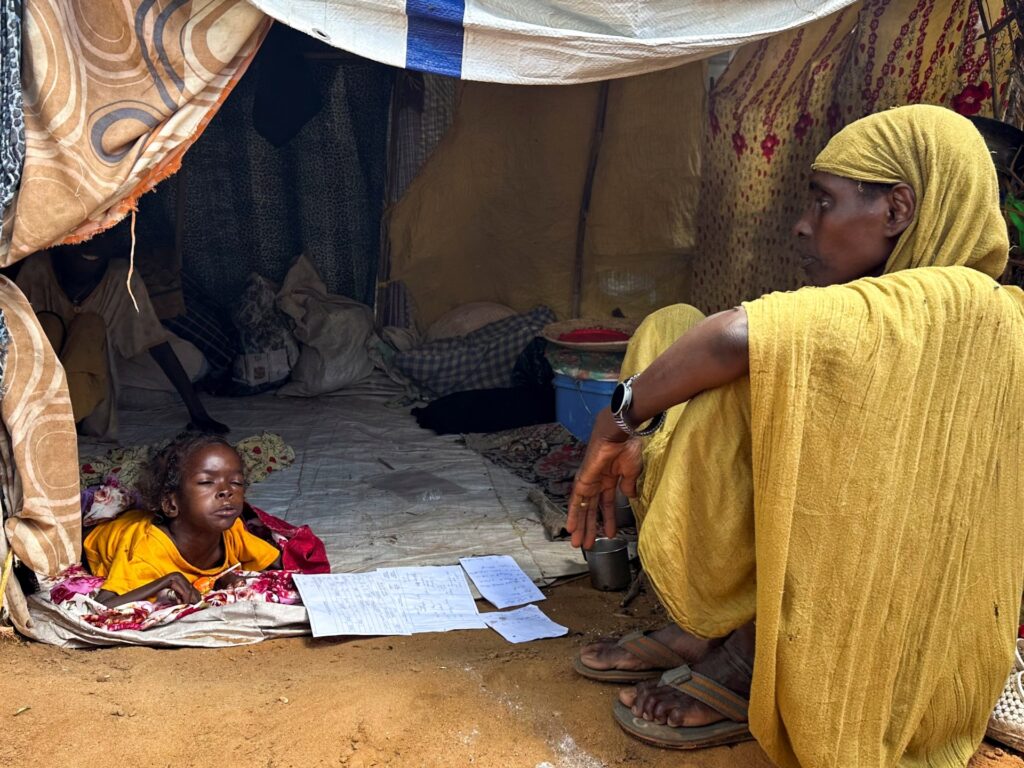
The United Nations and rights groups are calling for an end to the violence in Sudan as the second anniversary of its civil war looms and the paramilitary Rapid Support Forces (RSF) has intensified its attacks in Darfur, killing dozens of people in recent days. As representatives from dozens of countries are to meet in London on Tuesday to try to resolve the Sudan crisis, Human Rights Watch urged the international community to “urgently work to protect civilians and guarantee safe, unfettered aid provision” in the country. “For the last two years, Sudan’s warring parties have subjected the population to horrific abuses and suffering, and blocked aid, plunging the country into the world’s worst humanitarian disasters,” Mohamed Osman, Sudan researcher at Human Rights Watch, said in a statement on Monday. “International leaders should ensure that discussions to improve the humanitarian situation go hand in hand with commitments at the highest level to protect civilians.” This week marks two years since war broke out on April 15, 2023, between the RSF and the Sudanese military. It has killed thousands of people, displaced nearly 13 million people, according to the United Nations High Commissioner for Refugees (UNHCR), and sparked a hunger crisis in parts of the country. Advertisement In recent weeks, the army has managed to push RSF fighters out of the capital, Khartoum, but the paramilitary group has been claiming advances in the western region of Darfur, where an already dire humanitarian crisis has been worsening. On Sunday, the RSF said it took control of the Zamzam camp for displaced people near el-Fasher, the provincial capital of North Darfur state. The assault has killed dozens of people, including 23 children and nine aid workers, according to the UN. ‘Thousands of displaced trapped and cut off from aid’ The UN Office for the Coordination of Humanitarian Affairs (OCHA) warned on Monday that the fighting near el-Fasher, which has been under an RSF blockade, is hampering access to humanitarian assistance. “Thousands of displaced people are trapped & cut off from aid,” OCHA Sudan said in a social media post. “Hostilities must stop now. All those engaged in the conflict must ensure safe passage for civilians and humanitarian access.” UN Secretary-General Antonio Guterres had condemned the attacks on civilians in and around el-Fasher, urging an end to the fighting. “The Secretary-General emphasizes that attacks directed against civilians and indiscriminate attacks are strictly prohibited under international humanitarian law,” Guterres said in a statement issued via his spokesperson on Sunday. “Humanitarian relief personnel and medical personnel must be respected and protected. The perpetrators of these attacks must be brought to justice. Safe, unhindered and sustained access to the area, including the Zamzam camp, is urgently needed. Civilians who want to leave must be allowed to do so safely.” Advertisement In a joint statement on Monday, Egypt and Qatar also expressed “grave concerns over the ongoing armed conflict in the Sudan and emphasized the importance of an immediate cessation of military operations”. Warring rival generals But the violence continued on Monday. Al Jazeera Arabic quoted local sources in reporting that RSF fighters were shelling the Abu Shouk camp for displaced people outside el-Fasher. Sudan has seen growing instability since longtime President Omar al-Bashir was removed from power in 2019 after months of antigovernment protests. In October 2021, the Sudanese military staged a coup against the civilian government of Prime Minister Abdalla Hamdok, leading to his resignation in early 2022. Sudan’s army chief, Abdel Fattah al-Burhan, and his rival general Mohamed Hamdan Dagalo, who leads the RSF, shared power after the coup but then started fighting for control of the state and its resources in April 2023. Davis Makori, humanitarian policy and advocacy specialist, highlighted the impact of the war on children – including psychological trauma, gender-based violence and inability to attend school – saying minors make up half of the civilians affected by the conflict. “While there are pockets of states in Sudan that are not actually active conflict zones, this humanitarian crisis has spread to almost every facet of life,” Makori told Al Jazeera. Adblock test (Why?)
Video: Pregnant woman pulled from rubble after Israeli attack on north Gaza
[unable to retrieve full-text content] A pregnant woman was pulled alive from the rubble after an Israeli attack killed seven people.
Kyren Lacy: Ex-LSU player’s death an apparent suicide, authorities say

Police say the 24-year-old former LSU wide receiver self-inflicted a gunshot wound following a pursuit in Houston. Former Louisiana State University (LSU) receiver Kyren Lacy has died at the age of 24 in an apparent suicide in his car while being pursued by authorities in Houston, according to a Harrison County sheriff’s report released to the media. Lacy was already facing criminal charges stemming from a fatal car accident in Louisiana last December that had clouded his National Football League prospects. Harris County authorities say their pursuit of Lacy late on Saturday night ended when Lacy crashed. When officers approached the vehicle to extract Lacy, they say he had died in an apparent suicide, the report said on Sunday. Lacy was pronounced dead at the scene by emergency responders. “We’re saddened to learn of the tragic passing of former LSU football student-athlete Kyren Lacy,” LSU said in a statement. “Our thoughts and prayers are with his family and loved ones, as well as his former teammates and coaches impacted by his passing.” Lacy, who led LSU in touchdowns receiving with nine last season, had declared for this month’s NFL draft. But his draft stock plummeted after his alleged involvement in an accident that killed a 78-year-old man in Lafourche Parish, Louisiana. Advertisement Lacy, who was from Thibodaux, Louisiana, was allegedly driving recklessly – speeding and passing in a no-passing zone – when a motorist who was swerving to avoid Lacy’s Dodge Charger crashed head-on into another vehicle. Herman Hall of Thibodaux, who was involved in the head-on crash, died after being transported to a hospital, a state police report said. Authorities with Louisiana State Police Troop C said Lacy fled the scene of the accident without calling for help. He was booked with negligent homicide, felony hit-and-run and reckless operation of a vehicle. Lacy played in 12 games for LSU last season and was second on the team in catches with 58 and yards receiving with 866. He declared for the NFL draft just days after the accident and did not play in LSU’s victory over Baylor in the Texas Bowl on December 31. LSU wide receiver Kyren Lacy (2) runs through drills during the school’s NFL football pro day on March 26, 2025, in Baton Rouge, Louisiana [Gerald Herbert/AP] Adblock test (Why?)
Russia-Ukraine war: List of key events, day 1,145
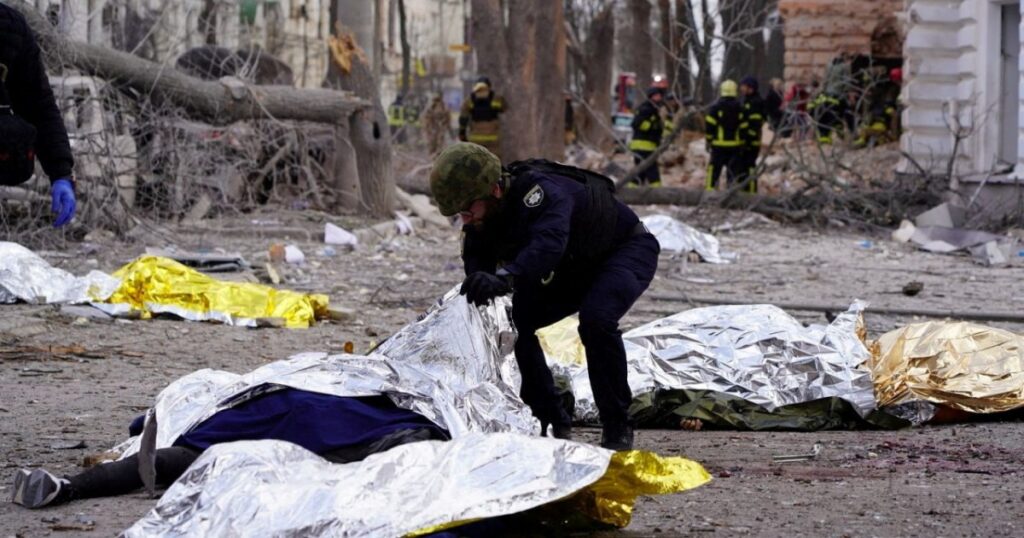
These are the key events on day 1,145 of Russia’s war on Ukraine. Here is where things stand on Monday, April 13: Fighting At least 34 people were killed and another 117, including 11 children, were injured by a Russian missile attack on the northern Ukrainian city of Sumy, Ukraine’s state emergency service said. This was the deadliest attack on Ukraine this year. The Ukrainian Air Force said its units intercepted and destroyed 43 of 55 Russian drones launched at Ukraine overnight. The attacks reportedly targeted the northern, southern and central areas of Ukraine. Russian forces captured the village of Yelyzavetivka in Ukraine’s Donetsk region, Russia’s Ministry of Defence said. The Defence Ministry in Moscow said its units destroyed 12 Ukrainian drones over Russia’s Rostov region and one over the country’s Belgorod region. The Defence Ministry said Ukraine carried out two attacks on Russia’s energy infrastructure over the past day despite a mutually agreed 30-day moratorium on energy strikes, according to the Interfax news agency. The ministry also said it had shot down a Ukrainian F-16 fighter aircraft, according to Interfax. Advertisement Politics and diplomacy Ukraine’s President Volodymyr Zelenskyy called for “strong pressure” on Russia to end its war against Kyiv after Moscow’s deadly attack on Sumy. He also said “only filthy scum” could act like this. United States President Donald Trump said he was told the attack on Sumy was a “mistake”, without elaborating, but that it was a “horrible thing”. French President Emmanuel Macron, Italian Prime Minister Giorgia Meloni and United Kingdom Prime Minister Keir Starmer condemned Russia’s attack on Sumy and called for strong measures to impose a ceasefire on Russia. The US special envoy to Ukraine, Keith Kellogg, also condemned the “horrifying attack” and said it “crosses any line of decency”, while Germany’s chancellor-in-waiting, Friedrich Merz, said Russia committed a “serious war crime”. United Nations Secretary-General António Guterres called for a “durable ceasefire”, noting a “devastating pattern of similar assaults on Ukrainian cities and towns in recent weeks”. Zelenskyy urged Trump to visit Ukraine to understand the gravity of destruction in the country at the hands of Russia. “You will understand what [Russian President Vladimir] Putin did,” he said. Russian and Ukrainian foreign ministers, speaking at the annual Antalya Diplomacy Forum in Türkiye, accused each other’s countries of violating the energy strike moratorium. Kremlin spokesperson Dmitry Peskov said Russia’s relations with the US were moving ahead, but that “reanimating relations from scratch is a very difficult task, requiring very intense diplomatic and other efforts”. Advertisement Adblock test (Why?)
Israel’s attack on al-Alhi Hospital in Gaza City draws global condemnation
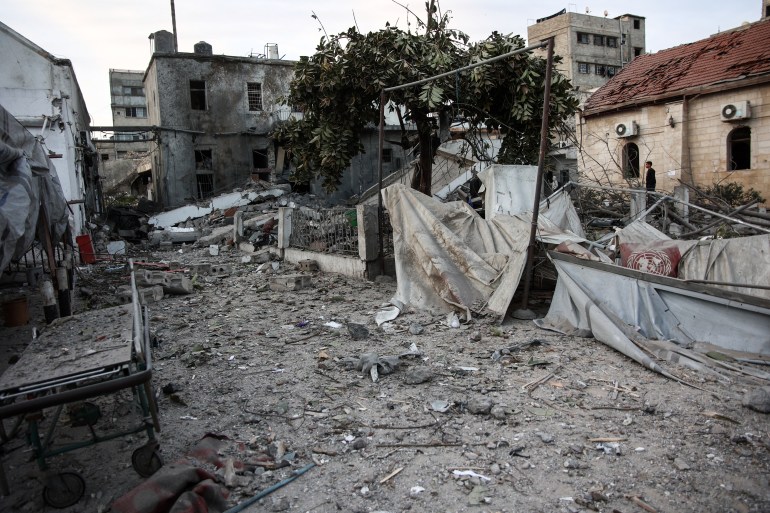
A predawn Israeli strike on al-Ahli Hospital in Gaza City, the last major hospital providing critical healthcare in northern Gaza, has sparked condemnation in Palestine and across the world as Israel continues to attack healthcare facilities. Israel on Sunday claimed it struck a Hamas command and control centre at the hospital, without providing evidence, while Hamas denied the allegations. The Episcopal Diocese of Jerusalem, which runs al-Ahli Hospital, condemned the attack, saying it occurred on “Palm Sunday, the start of the Holy Week, the most sacred week of the Christian year.” It said the twin strikes demolished the hospital’s two-storey genetic laboratory and damaged the pharmacy and the emergency department buildings. The Higher Presidential Committee for Church Affairs in Palestine, which is affiliated with the Anglican Church, said the attack constituted “a grave violation of religious sanctity and fundamental principles of international humanitarian law”. The head of the committee, Ramzi Khoury, asserted that the attack was a direct affront to Palestinian Christians and the global Christian community. Advertisement Britain’s Archbishop of York Stephen Cottrell said in a statement on Sunday: “The Anglican-run Ahli Hospital in Gaza is a place of healing and care for Palestinians living through unimaginable suffering. In unbearable conditions, its heroic doctors and nurses have cared for civilians who have endured 18 months of devastating violence”. “For the only Christian hospital in Gaza to be attacked on Palm Sunday is especially appalling. I share in the grief of our Palestinian brothers and sisters in the Diocese of Jerusalem,” he said. Gaza’s Health Ministry said the bombing forced the evacuation of patients and staff. “We call on international institutions and relevant authorities to protect the health sector in accordance with international laws and agreements,” it said in a statement. The Palestinian Islamic Jihad (PIJ) said the “heinous aggression” was “part of a systematic series of attacks targeting hospitals, schools, shelters and tents for the displaced in Gaza, within the context of a systematic war of extermination that violates all humanitarian and moral standards”. PIJ blamed Israel for sowing panic among patients and staff by issuing a warning shortly before the strike. “The international silence on Gaza is forcing it to become a graveyard for law and humanity,” it added. A gurney lies amid the debris in the aftermath of an Israeli strike on the al-Ahli Hospital [AFP] International condemnation: ‘Attacks on health care must stop’ Hospitals have special protection under international law. Israel has besieged and raided them nevertheless, some several times, and struck multiple ones while accusing Hamas of using them as cover for its fighters. Last month, Israel struck Nasser Hospital in Khan Younis, the largest hospital in southern Gaza, killing two people and causing a large fire. Advertisement Director-General of the World Health Organization (WHO) Tedros Adhanom Ghebreyesus said the hospital was out of service and a child had died as a result of the disruption of care. The hospital was also forced to move 50 patients to other health centres, but 40 critical patients could not be moved, Tedros added. “Attacks on health care must stop,” the WHO chief wrote on X. “Once again we repeat: patients, health workers and hospitals must be protected. The aid blockade must be lifted. Ceasefire.” Al-Ahli hospital in #Gaza is out of service following this morning’s evacuation order and attack – @WHO has received an update from the hospital’s director. A child died due to disruption of care. The emergency room, laboratory, emergency room X-ray machines and the pharmacy… — Tedros Adhanom Ghebreyesus (@DrTedros) April 13, 2025 British Foreign Minister David Lammy said Israel’s bombing of medical facilities had “comprehensively degraded access to healthcare” in the enclave. “Al-Ahli Hospital has been attacked repeatedly since the conflict began. These deplorable attacks must end. Diplomacy not more bloodshed is how we will achieve a lasting peace,” Lammy wrote on X. Qatar said the attack on the last functioning hospital in northern Gaza was a “horrific massacre and a heinous crime against civilians” that constituted a grave violation of international humanitarian law. The Foreign Ministry warned about the expansion of the cycle of violence across the region and said the international community must assume its responsibilities in protecting civilians. Advertisement Jordan also condemned the attack as well as Israel’s systematic targeting of civilians in Gaza and the destruction of vital facilities that provide essential services to its population. Egypt, too, issued a statement, calling the attack a grave violation of international humanitarian law and international norms and appealing for the international community’s intervention in halting the attacks. German Foreign Minister Annalena Baerbock questioned the modalities of the strike but stopped short of condemning the attack. “The cruel Hamas terror must be combated. But international humanitarian law applies, with a special obligation to protect civilian areas. How can a hospital be evacuated in less than 20 minutes?” she asked in a post on X. Adblock test (Why?)
How the sick and injured fled as Israel bombed Gaza’s al-Ahli Hospital
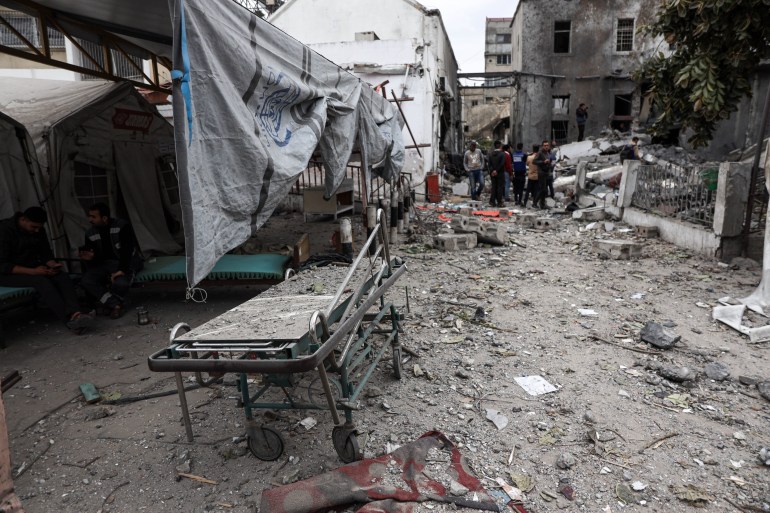
Gaza City, Gaza – Yousef Abu Sakran was dozing next to his injured child and wife, Iman, in a tent ward at al-Ahli Arab Hospital when the sounds of people running and shouting woke him up. He stepped into the hospital courtyard well before dawn on Sunday to ask what was happening but found no clear answer, only vague news that the Israeli army had made calls to people living around the hospital, demanding the expulsion of everyone in the medical facility. The 29-year-old father reacted instantly. He scooped up his five-year-old son, Mohammad, and he and Iman ran towards the gate. Mohammad has severe injuries across his body, including third-degree burns on his back and legs, but Yousef had to keep running with him. “I was carrying my son, whose body was burned, and running while he screamed,” Yousef said. “His back was bleeding – his wounds were bleeding heavily – and he was screaming in agony. “[So many people’s] injuries reopened from the sudden movement. I saw the family of a girl with spinal injuries trying to pull her bed, but it was stuck in the debris. Advertisement “Just seconds after we left the hospital, it was struck by two missiles that shook the entire place. I told my wife: ‘Imagine if we had been a minute later. We’d be dead.’” A damaged gurney and rubble litter the area near the tent wards that al-Ahli had to set up to accommodate all its patients [Abdelhakim Abu Riash/Al Jazeera] Where to go with an injured boy? Yousef and his wife were in the street with everyone else from the hospital. “It was around 2am, and I had no idea where to take my injured son. He was in pain and bleeding. There were no clinics or hospitals, and the tent we live in is very far and completely unsuitable for his condition.” Mohammad had been injured in an Israeli air strike on a block of homes in Gaza’s Shujayea neighbourhood, which killed more than 20 people and wounded dozens. An hour after the hospital was bombed, Yousef and his wife decided there was nothing they could do other than take Mohammad back to al-Ahli. “The place was pitch-black, and it reeked of gunpowder and dust. I went to the surgery building at the far end of the hospital, where I found a nurse who took pity on Mohammad’s condition, treated his wounds and admitted him.” Bombing a hospital like this, Yousef said, is a stain on humanity’s conscience. “They bomb our homes over our heads and then bomb hospitals while patients and the wounded are inside. Where are we supposed to go? “Isn’t all this grief and suffering enough?” Dragging himself out of danger Suhaib Hamed, 20, was asleep in another tent ward, right next to the hospital’s emergency building, which was hit. Advertisement Hamed was injured when he went to fetch flour for his starving family on February 29, 2024 – a day known as the “Flour Massacre“, during which Israel killed 109 Palestinians and wounded dozens while they waited for food aid. He was shot in the leg by Israeli tanks, damaging his bones and tissue to the point that he needed metal implants and has been in the orthopaedic department since then. “My brother, who usually stays with me, wasn’t there. I don’t even know how I managed to stand on my injured leg, grab my crutches and flee,” Suhaib told Al Jazeera as he exited the surgery department after having the wounds to his leg cleaned and checked. “I forgot my pain because of what I saw around me. Everyone was screaming in terror and fear, just trying to survive. It felt like the Day of Judgement.” Suhaib also managed to get out of the hospital minutes before two Israeli missiles landed. “My leg couldn’t handle it any more, and my wound reopened and started bleeding again.” He couldn’t keep walking, so he stopped and called his brother, who came and supported him to their home in the Zeitoun neighbourhood, a half-hour’s walk for a healthy person on undamaged roads. Two members of al-Ahli Arab Hospital’s staff examine what’s left of its emergency department after Israel bombed it on April 13, 2025 [Abdelhakim Abu Riash/Al Jazeera] The pain in his leg kept Suhaib up, but he was also worried about the hospital being forced to close. “I’ve been staying in the hospital [for more than a year] because of my condition,” he said. Suhaib has a medical referral to travel outside Gaza for treatment but has been waiting to leave for a year. Advertisement “Isn’t the closure and banning of our travel enough? They even target the hospital that was still treating us with the little that’s available.” Making a catastrophic situation worse The Israeli strike on al-Ahli has exacerbated an already catastrophic situation for Gaza’s healthcare system, which has been collapsing as Israeli bombardments and a blockade on medicines, medical supplies and fuel continues. In the panic that ensued because Israel did not give hospital staff even the bare minimum of time to evacuate patients, a child died due to lack of oxygen, Fadel Naeem, director of al-Ahli, told Al Jazeera. Israel destroyed the vital emergency, radiology, laboratory and central pharmacy departments, the doctor continued. “We’ll need weeks or months to resume operations,” he noted. “This hospital is a hub for services and includes all essential facilities, including the only CT scan machine available. “The fate of patients and the wounded is now unknown. We’ll have to distribute them to other hospitals, but no hospital is equipped to provide full services.” Adblock test (Why?)