

Israeli ‘massacre’ in Gaza’s Shujayea as residential tower targeted
[unable to retrieve full-text content] An Israeli strike destroyed an entire residential tower block in Gaza’s Shujayea neighbourhood.
Israel pushes on with strategy to keep neighbours weak in Lebanon and Syria
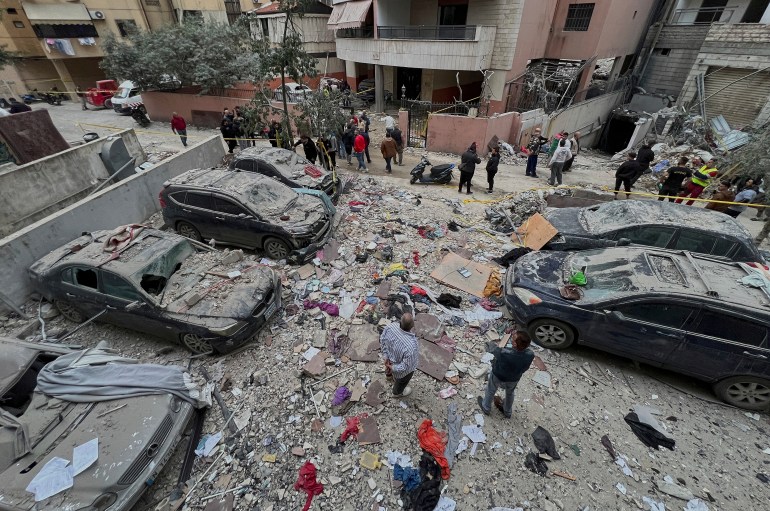
Beirut, Lebanon – Israel’s continuing attacks intend to keep its neighbours unstable, weak and fragmented, analysts say, and are contributing to the derailing of governing projects in Lebanon and Syria. Conversations with experts, analysts, and diplomats reveal a belief that Israel wants to keep the two states weak and fractured, maintaining Israel as the strongest regional power. “The Israelis believe that having weaker neighbors, as in states that aren’t really able to function, is beneficial for them because, in that context, they’re the strongest actor,” Elia Ayoub, writer, researcher, and founder of The Fire These Times podcast, told Al Jazeera. Lebanon and Syria, the targets of Israel’s forays, have largely not retaliated against the Israelis, who outpower them militarily, financially and technologically. ‘Israel has no limits’ Lebanon and Syria are both in a fragile condition. Lebanon has been in dire economic straits for at least six years, with bouts of political paralysis, and has just emerged from a prolonged Israeli assault that killed more than 4,000 people and destroyed swaths of the country. Advertisement That war, which also badly damaged the armed movemen tHezbollah, a major domestic actor in Lebanon since the 1980s, ostensibly ended with the November 27 ceasefire. Syria, meanwhile, recently emerged from a nearly 14-year-long war that displaced millions and killed hundreds of thousands. The transitional government is working to unify armed factions, stabilise the economy and gain international recognition. Lebanese residents gather around damaged cars at the site where an Israeli air strike hit a building in Dahiyeh, a southern suburb of Beirut, Lebanon, early Tuesday, April 1, 2025 [Hussein Malla/AP] Along with Lebanon, which is led by its first functioning cabinet in years, Syria has new leadership that wants to turn a page on recent history but, analysts told Al Jazeera, Israel seems intent on preventing that. Israel has been violating the ceasefire with Lebanon since it was signed, justifying each breach by claiming it had hit “Hezbollah targets”. The situation is particularly gruesome along Lebanon’s southern border, where some villages were obliterated during the war and others were completely razed since the ceasefire was agreed on. “There are a lot of violations,” a member of Lebanon’s civil defense force, who asked to not be named, told Al Jazeera from the battered southern town of Meiss el-Jabal, adding, “There’s nothing we can do about it.” Israel has also refused to fully withdraw from Lebanon, as the ceasefire stipulates, instead, leaving its forces in five points that experts say are likely being held for future negotiations over delineating the Lebanon-Israel border. Advertisement “The very clear path ahead is that Israel has no limits in its operations within Lebanon,” Mohanad Hage Ali, a senior fellow at the Carnegie Middle East Center in Beirut, told Al Jazeera. “The only distinction made is in firepower and destruction, which is reserved for disproportionate responses to attacks on northern towns in Israel.” Israel betting on Syria’s failure In Syria’s chaos following the Assad regime’s overthrow on December 8, Israel launched attacks on military infrastructure around the country, focusing on the south and creeping its forces further into Syrian territory. Syria’s transitional government has said it has no interest in regional war. Instead it has said that it has no intention to attack Israel and would respect the 1974 Agreement on Disengagement between the two countries. But the Syrian government’s overtures fell on deaf ears, and the attacks have continued. The Israeli government immediately revealed its position towards the new Syrian government following President Bashar al-Assad’s overthrow, calling it “a terror group from Idlib that took Damascus by force”. Israel has since repeatedly bombed Syria, and seized territory along the frontier between the occupied Golan Heights and the rest of Syria. Israeli strikes on Syria [Jalaa Marey / AFP] “Israel has made a bet that Syria will fail and will be fragmented,” Aron Lund, a fellow at Century International, told Al Jazeera. “What they’re doing is trying to position themselves in that scenario, as a push to have sway over the south and keep it unthreatening to them and protect their now almost unlimited freedom of manoeuvre in their airspace.” Advertisement In March, Israeli air strikes on Syria increased and expanded to new areas, with ground incursions increasing by 30 percent, including into the southern areas of Deraa and al-Quneitra. “The impact on civilians has been increasingly deadly,” Muaz al-Abdullah, ACLED’s Middle East Research manager, said in a statement. Smoke rises from Taibeh, following Israeli strikes in response to cross-border rocket fire, as seen from Marjayoun in southern Lebanon, March 22, 2025 [Karamallah Daher/Reuters] “To defend themselves, residents in the village of Kuya, in Deraa, fired warning shots to deter Israeli forces from advancing into the village on March 25. The response by Israeli forces was an air strike and shelling of the village, and at least six civilians were killed.” Imad al-Baysiri, from Deraa, told Al Jazeera about a similar incident in Nawa, 34km (21 miles) north of Deraa city. The Israeli army “tried to advance to all the large squares in Nawa so some young men started running and the Israeli army started shooting at them”, he said, adding that locals confronted the army and forced them to retreat. “They brought in helicopters and drones and for around four hours bombed the area,” he said. “Warplanes and helicopters also bombarded the city of Nawa with missiles from helicopters and drones.” The Israelis listen to the Americans ‘but only to a certain extent’, a diplomatic source said [Saul Loeb/ AFP] ‘They know war, but not peace’ Analysts can see little that would stop Israel’s near-daily attacks on Lebanon and Syria. Advertisement “They listen to Americans, but only to a certain extent,” a Western diplomatic source, speaking on condition of anonymity, told Al Jazeera. Hezbollah’s arsenal may once have acted as a deterrent, but the latest war has changed that calculus. “All deterrence has been lost,” Hage Ali said. Without any diplomatic or military pressure in its way, Israel seems set
Netanyahu’s visit to the White House “is a win back home”
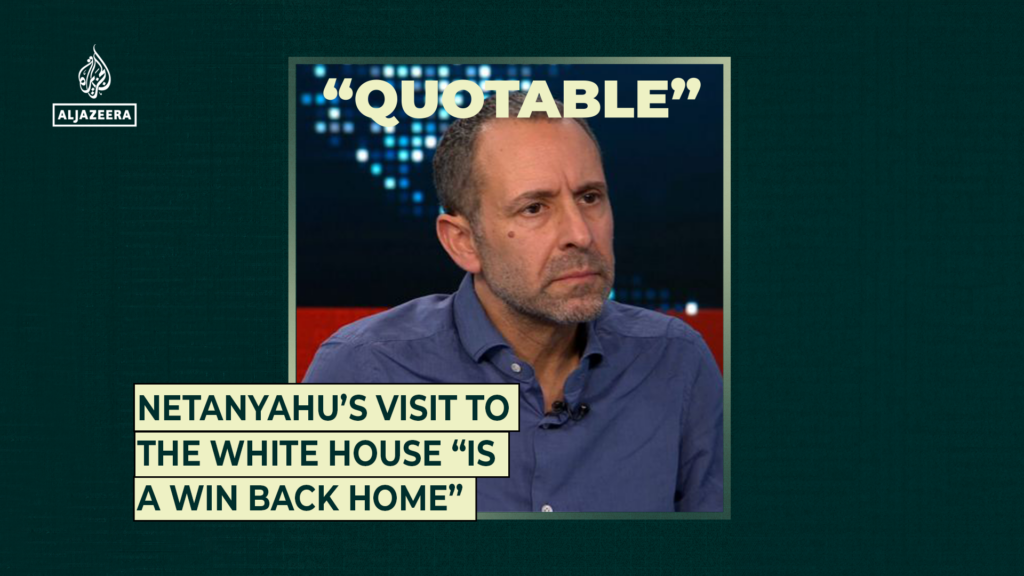
Daniel Levy on Trump and Netanyahu’s White House meeting on Iran and Gaza: why now, and what message does it send? Daniel Levy, president of the US / Middle East Project, weighs in on Trump and Netanyahu’s recent White House meeting on Iran and Gaza. Why now — and what message does it send? Adblock test (Why?)
Trump’s tariff war: What’s at stake for China’s economy?
It’s started. At 12.01am EST (04:01 GMT) on Wednesday, United States President Donald Trump’s “reciprocal” trade tariffs kicked in. And no country has been hit worse than China, which now effectively faces a 104 percent levy on the goods it sells to the US. Even as Washington moved to start negotiations with other trading partners targeted by tariffs, the new levies on Beijing mean that anything the US imports from China will cost more than double what it did two months ago. In response, China quickly raised its US tariffs to 84 percent. Stock markets have nosedived since last week’s announcement of US tariffs on dozens of countries, as investors braced for the fallout from what is now a global trade war. For his part, Trump has long accused other countries – especially China – of exploiting the US on trade, casting his protectionist agenda as necessary to revive domestic manufacturing and re-shore American jobs. What is the status of US-China tariffs? On February 3, Trump imposed an extra 10 percent tariff on all goods from China, on top of various tariffs levied during the first Trump administration in 2017-2021 and the administration of former US President Joe Biden in 2021-2025. Advertisement Then, on March 5, Trump doubled the rate on Chinese imports to 20 percent. On April 2, he lifted it again by another 34 percent – stacking up to 54 percent in total. Last Friday, on April 4, China announced a 34 percent reciprocal tariff on US imports. Trump raised the temperature again by threatening still more tariffs unless Beijing withdrew its levies on US goods. “If China does not withdraw its 34 percent increase above their already long-term trading abuses by tomorrow, April 8th, 2025, the United States will impose ADDITIONAL Tariffs on China of 50%, effective April 9th,” Trump said on his Truth Social platform on Monday. As the hours ticked away, Trump remained confident that Beijing would buckle. “China also wants to make a deal, badly, but they don’t know how to get it started,” the US president wrote in a social media post. “We are waiting for their call. It will happen!” It didn’t. Instead, Beijing raised its tariff on US goods to 84 percent on Wednesday. What has China said in response to Trump’s tariffs? Announcing its latest round of tariffs on US exports on April 9, China’s Commerce Ministry said that Beijing “has the firm will and abundant means to take necessary countermeasures and fight to the end”. “History and facts have proven that the United States’ increase in tariffs will not solve its own problems,” said the policy statement. “Instead, it will trigger sharp fluctuations in financial markets, push up US inflation pressure, weaken the US industrial base and increase the risk of a US economic recession, which will ultimately only backfire on itself. Advertisement In a statement the previous day, on April 8, the Ministry of Commerce also made combative overtures, saying Washington’s actions were “completely groundless” and a form of economic “bullying”. Beijing defended its reciprocal tariffs and said they were aimed at safeguarding China’s “sovereignty, security and development interests”, as well as maintaining a balanced international trade market. Elsewhere, China’s Foreign Ministry spokesperson Lin Jian said “We Chinese are not troublemakers, but we will not flinch when trouble comes our way.” How will tariffs impact China’s economy? Despite growing tensions between the US and China, Washington and Beijing remain major trade partners. According to the Office of the United States Trade Representative, America imported $438.9bn in Chinese goods last year. That amounts to roughly 3 percent of China’s total gross domestic product (GDP), which is heavily reliant on exports. In a report shared with clients on Tuesday, Goldman Sachs said it expects Trump’s latest tariffs would drag down China’s GDP by as much as 2.4 percent. The investment bank is forecasting 4.5 percent growth for this year, citing concerns that China’s proven tactic of rerouting exports through countries like Vietnam and Thailand – to bypass US tariffs – will become less effective now that Trump has erected trade barriers globally. That 4.5 percent is lower than the Chinese government’s official growth target of 5 percent for 2025. Analysts at UBS are even more pessimistic: They’ve said that Trump’s tariff hikes could reduce China’s economic growth rate to just 4 percent in 2025. And that’s assuming the government engages in “broad fiscal expansion” [i.e. extra public investment]. Advertisement China’s economy has already been growing at a slower pace than when Trump first took office. The latest trade war comes as China is struggling with deflation, a crisis-stricken property market and elevated debt levels. In 2018, when Trump launched his first trade war against China, Beijing’s official GDP growth figure was 6.6 percent. How has Beijing responded so far? Al Jazeera’s Beijing correspondent Katrina Yu says Chinese officials are working to guard against shocks in the stock market. “The government does have the ability to intervene strongly,” Yu said. On Tuesday, China’s Premier Li Qiang said that the government is “fully capable of hedging against adverse external influences”. The same day, several public investment firms – such as Chengtong and Huijin – vowed to increase equity investments and stem financial market selloffs. Yu noted that Chinese stock exchanges have performed better than elsewhere in Asia. Shanghai’s SSE Composite Index posted gains of 1.1 percent on Wednesday, while Shenzhen’s SE Composite rose 2.2 percent. Meanwhile, Japan’s Nikkei index closed down by 3.9 percent. “The [Chinese] government is really looking to stabilise the stock market. It seems to be working so far, but investors here … some of them are still very anxious,” Yu said. Adblock test (Why?)
Trump’s ‘reciprocal’ tariffs hit dozens of countries, stock markets plunge
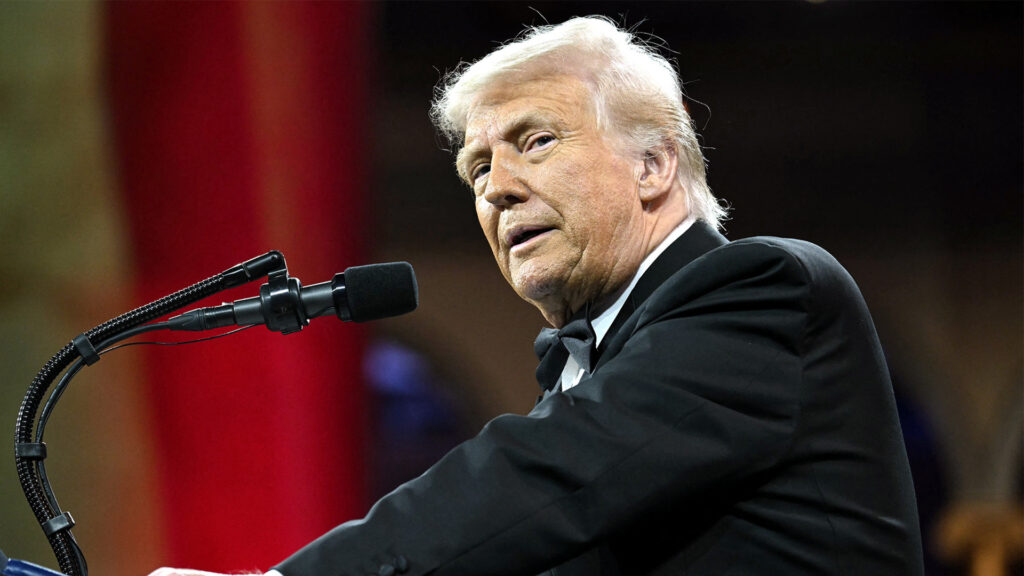
NewsFeed US President Donald Trump unleashed a massive 104% tariff on China as the ‘reciprocal’ trade levies against dozens of countries took effect on Wednesday. China soon hit back, hiking its tariffs on US imports to 84% Published On 9 Apr 20259 Apr 2025 Adblock test (Why?)
Arsenal stun Real Madrid in Champions League with Declan Rice double
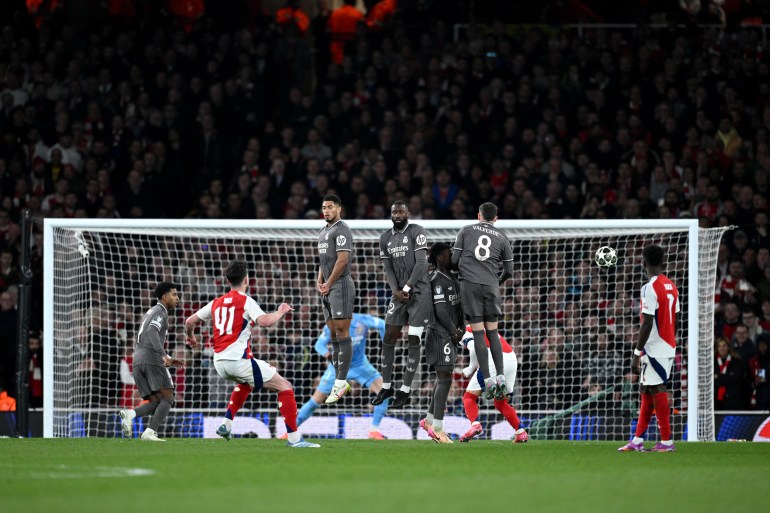
Arsenal midfielder Declan Rice nets two free kicks in shock 3-0 quarterfinal first-leg win against defending champions. Declan Rice curled home two superb free kicks to help give Arsenal a 3-0 win over defending champions Real Madrid in the first leg of the Champions League quarterfinals. Rice opened the scoring in the 58th minute on Tuesday by bending a free kick around the Madrid wall and inside the near post, leaving goalkeeper Thibaut Courtois stranded. With Madrid great Roberto Carlos looking on in the stands – the Brazilian scored a number of spectacular free kicks in his day – Rice then repeated the feat in the 70th by curling another effort into the far top corner. Mikel Merino added the third five minutes later to put Arsenal on the brink of returning to the semifinals for the first time since 2009. Declan Rice of Arsenal scores his team’s first goal from a free kick as Jude Bellingham, Antonio Ruediger, Eduardo Camavinga and Federico Valverde of Real Madrid jump in a defensive wall [Justin Setterfield/Getty Images] Only a handful of saves from Courtois prevented the scoreline from getting even bigger. Advertisement “In the second half, we knew we had to score and to score three was a real positive,” Rice told Prime Sports. “The message from the manager was that we needed to be super convinced that we could come and win this game. “As a group of players, we were really convinced that we were out there as a team fighting for each other.” It was the teams’ first meeting since 2006, when Arsenal eliminated Madrid in the round of 16. The second leg will be played on April 16 at Santiago Bernabeu Stadium. “It’s not going to hit me yet because there is another leg to go,” Rice said of his two sensational strikes. “I’m excited, I’m happy, I’m over the moon. I don’t mean to be cliched but I think this will hit me in a few years’ time – that what I did was really special.” French forward Kylian Mbappe had the best of Real’s chances but was twice denied by David Raya in the Arsenal goal. “For 68 minutes, the game was level, and then they hit two fantastic free kicks and the game changed,” Real Madrid coach Carlo Ancelotti told Prime Sport. “We did not react as we need to react and they scored another goal and now it will be very difficult but we have to try. Mentally, we went down and we had problems in the last 30 minutes of the game.” Real midfielder Jude Bellingham was more critical of last season’s double winners: “We were nowhere near it, that’s the fact. Arsenal were really good. I know two of their goals were free kicks but, to be honest, they could have had way more. We were lucky to get away with three. Advertisement “If there’s one place where crazy things can happen, it’s our house … We are still alive, we’ve still got 90 minutes of football and anything can happen at the Bernabeu.” Adblock test (Why?)
DR Congo repatriates three US citizens convicted over failed coup
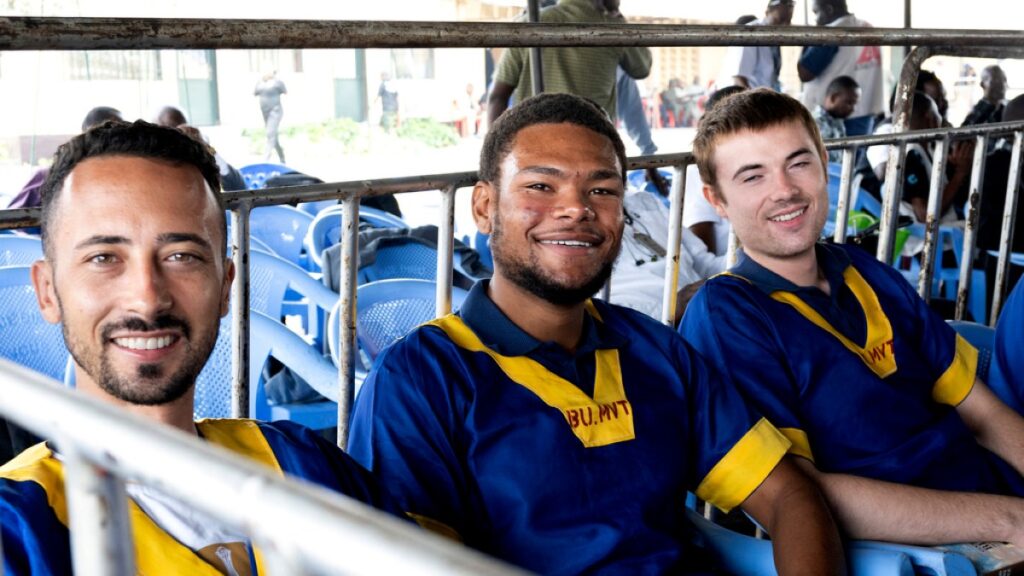
Move coincides with DRC’s drive to sign minerals deal with US in exchange for security in war with Rwanda-backed rebels. Three United States citizens initially sentenced to death in the Democratic Republic of Congo (DRC) over a botched coup attempt have been repatriated after Kinshasa commuted their death sentences to life imprisonment last week. Congolese presidential spokesperson Tina Salama said on Tuesday that the three men, including the son of political exile Christian Malanga, who led the attack on the presidential palace in May last year, would all serve out their life sentences in the US. Marcel Malanga, 21, claimed he had been forced to take part by his father, who live-streamed from the palace during the coup attempt before being shot and killed by Congolese forces. Also repatriated were Tyler Thompson Jr, 21, a friend of the younger Malanga, and Benjamin Reuben Zalman-Polun, 36, who reportedly got to know the father through a gold mining company. US Department of State spokesperson Tammy Bruce confirmed the transfer on Tuesday, saying that the US condemned the armed attacks and supported DR Congo’s bid to hold the convicts accountable, but that it also sought “consistent, compassionate, humane treatment and a fair legal process”. Advertisement When the US assumes custody of prisoners convicted abroad, it typically agrees to carry out the sentence of imprisonment designated by that country. Jared Genser, a US-based international human rights attorney, said that lawyers representing the three could try to get their sentences reduced by arguing they signed their consents to the prisoner transfer treaty under duress. “But it would be very hard to prevail in such a case as there would be enormous implications for other potential transfers in the future if the US failed to abide by such agreements,” Genser said. Multibillion-dollar deal The repatriation came amid efforts by Congolese authorities to sign a minerals deal with the US in exchange for security support that will help Kinshasa fight Rwanda-backed M23 rebels in the country’s conflict-hit east. US senior adviser for Africa Massad Boulos said last week that the countries were in talks on the issue, adding that it could involve “multibillion-dollar investments”. The US has estimated that Congo has trillions of dollars in mineral wealth. Boulos, whose son is married to US President Donald Trump’s daughter, is set to visit DR Congo to discuss tensions between the country and Rwanda. News of the trio’s repatriation brought joy to the families. Miranda Thompson, stepmother of Thompson, who had flown to Africa from Utah for what his family believed was a free vacation, said the family was “excited” to have him return home. A total of 37 people were sentenced to death in the purported coup attempt, also including a Belgian, Briton and Canadian, all naturalised Congolese. Advertisement The fate of the others was not immediately clear. Family members last year said the men slept on the floor at a high-security military prison in Kinshasa, struggling with health issues and having to pay for food and hygiene products. Adblock test (Why?)
At least 66 killed in Dominican Republic nightclub roof collapse
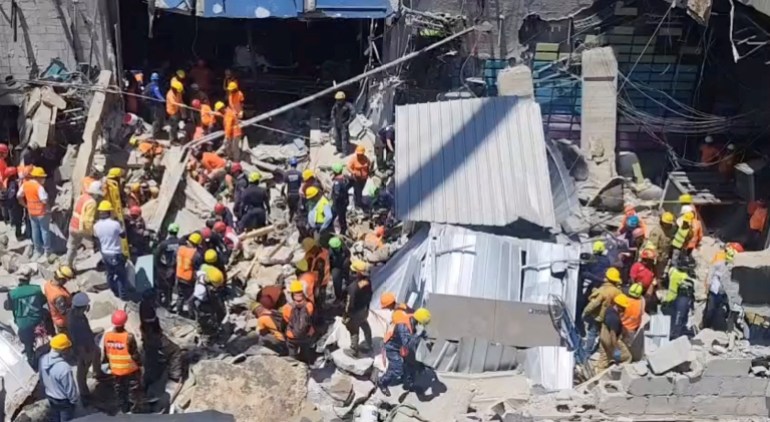
A catastrophic roof collapse at an iconic nightclub in the Dominican Republic’s capital, Santo Domingo, has left at least 66 people dead including a provincial governor and former Major League Baseball (MLB) pitcher Octavio Dotel. At least 160 other people were injured and some 400 emergency crews were still working to pull survivors from the rubble as families of the victims gathered at the site searching for their loved ones, authorities said on Tuesday. Juan Manuel Mendez, head of the Dominican Republic’s emergency operations centre, said that efforts to rescue those trapped under the debris were continuing, though the exact number of people inside the Jet Set nightclub at the time of the collapse remained unclear. Local media reported there were between 500 and 1,000 people in the club when disaster struck in the early hours of Tuesday. The roof collapse happened during a concert attended by politicians, athletes and other prominent figures. Among the victims was Nelsy Cruz, governor of the northern Monte Cristi province, President Luis Abinader said. Cruz is the sister of former baseball player Nelson Cruz, a seven-time MLB All-Star. Advertisement Former MLB pitcher Dotel died en route to a local hospital after being pulled from the debris, a spokesman for the nation’s Ministry of Sports said. The Dominican Republic’s Professional Baseball League expressed “its sorrow over the death of former pitcher Octavio Dotel” and concluded: “Peace to his soul”. Dotel, 51, debuted for the New York Mets in 1999 and played until 2013 for more than a dozen teams including the Houston Astros, Oakland A’s, New York Yankees, Chicago White Sox and Detroit Tigers. “Thinking about our people in the Dominican Republic,” Carlos Mendoza, manager of the Mets, said in a press conference. “We have a lot of the Dominican community in the baseball world.” Nearly 150 people have been taken to local hospitals for treatment, according to the government. The cause of the roof collapse remains under investigation. ‘Save lives’ Iris Pena, a woman who had attended the concert, told the Dominican channel SIN how she escaped with her son. “At one point, dirt started falling like dust into the drink on the table. I asked the security officers … whether the ground had shaken,” she said. “A stone fell and cracked the table where we were, and we got out,” Pena recounted. “The impact was so strong, as if it had been a tsunami or an earthquake.” Dozens of family members flocked to hospitals for news. “We are desperate,” Regina del Rosa, whose sister was at the concert, told SIN. “They are not giving us news; they are not telling us anything.” Rescuers work at the site of the collapsed Jet Set nightclub in Santo Domingo, Dominican Republic [Reuters] At the scene, meanwhile, helicopter images revealed a large hole where the club’s roof once was. A construction crane was helping to lift some of the heavier rubble as men in hard hats dug through the debris. Advertisement The authorities have issued a call for Dominicans to donate blood. “We are rescuing all the people we can save alive and recovering those bodies we find along the way. But we have focused on people we can rescue alive because we hear them asking for help,” Mendez said. “The main objective is to save lives,” President Abinader said as he arrived at the scene. The Instagram page of the Jet Set club said it has been in operation for more than 50 years, with shows every Monday until the early hours. On Tuesday, the club issued a statement saying it had “collaborated fully and transparently with the authorities to help the victims and clarify what happened”. The Dominican Republic, which shares the island of Hispaniola with Haiti, received more than 11 million visitors in 2024, according to its Ministry of Tourism. Tourism generates about 15 percent of gross domestic product (GDP), with visitors attracted by the country’s Caribbean beaches, music and nightlife, as well as the colonial architecture of Santo Domingo. Adblock test (Why?)
Palestinians mourn journalist burned alive in Israeli strike on Gaza tent
[unable to retrieve full-text content] Palestinians in Gaza are mourning the death of journalist Ahmad Mansour who was filmed burning alive.
‘Mediterranean Blue’: Rare diamond makes dazzling debut
[unable to retrieve full-text content] Sotheby’s unveiled a newly discovered 10.03-carat fancy vivid blue diamond at an Abu Dhabi exhibit.