

Zelenskyy: Chinese soldiers fighting for Russia inside Ukraine

NewsFeed Ukrainian President Volodymyr Zelenskyy said his country’s military captured two Chinese soldiers fighting alongside Russian forces in the territory of Ukraine. He added that he believes there are “significantly more” and is raising the issue with Beijing. Read more Name(required) Email(required) Website Message Submit Published On 8 Apr 20258 Apr 2025 Adblock test (Why?)
Under Trump, US Justice Department ends cryptocurrency investigations
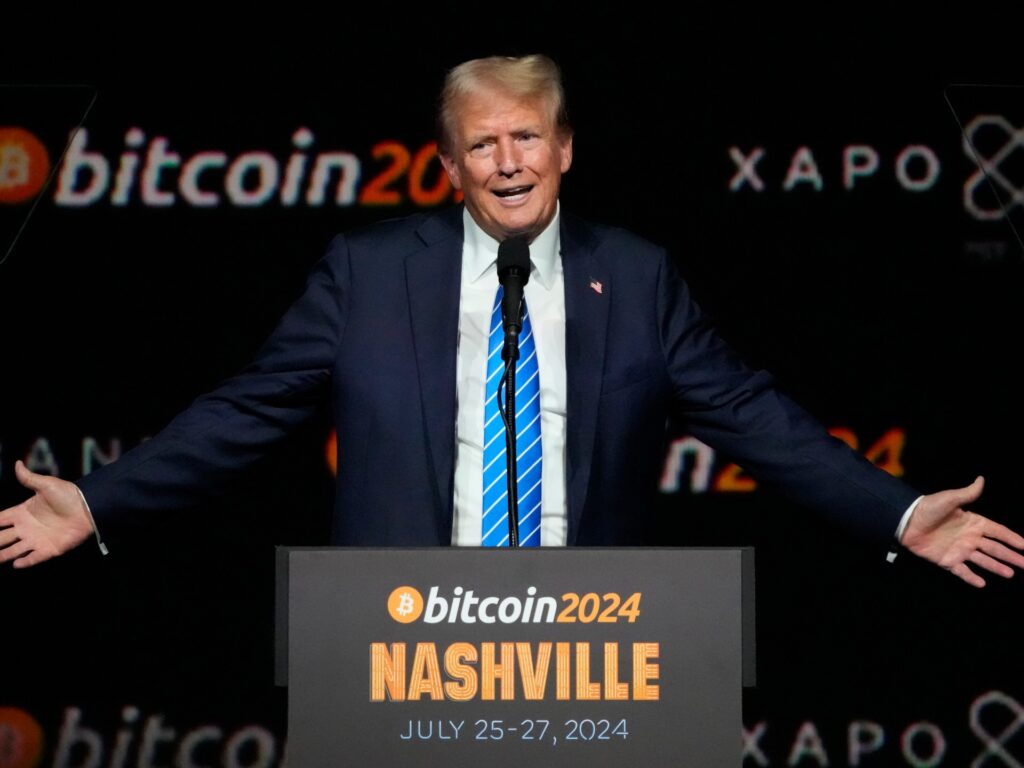
The United States Department of Justice has announced it plans to pare back its investigations into cryptocurrency fraud, instead redirecting those resources towards immigration enforcement, terrorism and drug trafficking. In a memo late on Monday, Deputy Attorney General Todd Blanche quoted President Donald Trump’s pledge to “end the regulatory weaponization” of the cryptocurrency industry. “The Department of Justice is not a digital assets regulator,” Blanche wrote. “The Justice Department will no longer pursue litigation or enforcement actions that have the effect of superimposing regulatory frameworks on digital assets.” Instead, Blanche explained that Trump regulators in other departments would enforce financial law “outside the punitive criminal justice framework”. “Prosecutors should not charge regulatory violations in cases involving digital assets,” Blanche wrote. As part of the changes, the Justice Department will immediately dismantle its National Cryptocurrency Enforcement Team (NCET), which was launched in February 2022 under the administration of former President Joe Biden. Advertisement The team was designed to pursue cases of alleged fraud and illicit finance schemes. In 2024, it announced a conviction in its first “cryptocurrency open-market manipulation case”. The suspect, Avraham Eisenberg, was found guilty of commodities fraud for artificially manipulating cryptocurrency prices. That, in turn, allowed him to amass $110m in cryptocurrency, according to prosecutors. NCET has also led high-profile investigations against cryptocurrency firms like Binance and Tornado Cash, the latter of which was accused of laundering money for North Korea. Trump has repeatedly slammed the Biden administration and has set about dismantling some of the former president’s signature policies, including NCET. In Monday’s memo, Blanche echoed Trump by blaming the “prior administration” for pursuing “a reckless strategy of regulation by prosecution”. Trump has sought to distance himself from Biden’s investigations into the largely unregulated cryptocurrency industry, instead positioning himself as a champion of digital currencies. On January 23, three days after returning to the White House for a second term, Trump issued Executive Order 14178, entitled “Strengthening American leadership in digital finance technology”. It revoked a Biden-era executive action pushing for “responsible development” of cryptocurrency and instead laid the groundwork for a “national digital asset stockpile”. In the weeks since, Trump has made good on that pledge, announcing a national strategic reserve for cryptocurrency in early March. He named five currencies to the reserve — XRP, Cardano, Solana, Bitcoin and Ethereum — giving each a brief boost in value. Advertisement Trump also released his own “meme coin” and has business interests in the cryptocurrency firm World Liberty Financial (WLF), netting him and his family billions of dollars. Critics, however, have questioned the ethics of those ventures, given Trump’s outsized role in the global economy. Calling himself the “crypto president”, Trump has nevertheless continued to make overtures to the digital currency industry. For example, he held a meeting with cryptocurrency leaders at the White House on March 7, dubbed the “first-ever White House Digital Assets Summit”. “Last year, I promised to make America the Bitcoin superpower of the world and the crypto capital of the planet, and we’re taking historic action to deliver on that promise,” Trump said at the meeting. “This will be a virtual Fort Knox for digital gold to be housed within the United States Treasury. That’s a big thing,” he added. He also drew a parallel between his legal woes and the investigations into the cryptocurrency industry. In 2023, Trump became the first president ever to be indicted on criminal charges, and in 2024, he was convicted of falsifying business documents in New York. “They weaponised government against the entire industry,” Trump said of the Biden administration’s actions probing cryptocurrency firms. “I know that feeling also, maybe better than you do. All of that will soon be over.” Under Trump’s direction, the federal government has indeed dropped several investigations into cryptocurrency businesses. Advertisement The Securities and Exchange Commission (SEC), for instance, dropped its probe into Coinbase, while the Justice Department ended its investigation of the financial company Robinhood, which had been accused of mishandling crypto assets. Monday’s memo did nevertheless say that some cryptocurrency-related investigations would remain a priority at the Justice Department. Instead, Blanche said the department would narrow its scope to focus on illegal activity that causes “financial harm to digital asset investors and consumers” and supports cartels, drug traffickers and designated “terrorist” groups. “For example, cartels and human trafficking and smuggling rings have increasingly turned to digital assets to fund their operations and launder the proceeds of their illicit businesses,” Blanche wrote. While the department would continue to pursue cartels and criminal organisations that use digital currencies, Blanche specified that his prosecutors “will not pursue actions against the platforms that these enterprises utilize to conduct their illegal activities”. Adblock test (Why?)
Tehran sceptical ahead of upcoming US-Iran nuclear talks
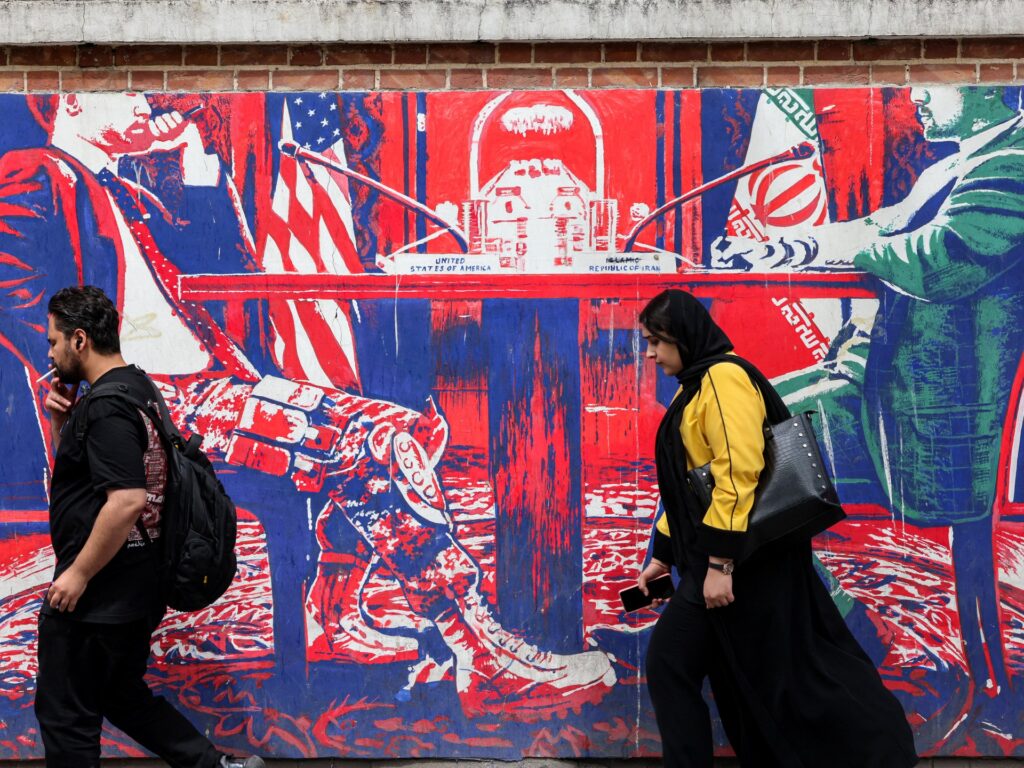
Iran is approaching talks in Oman with the United States over its nuclear programme with deep suspicions regarding Washington’s motives, following the latter’s repeated threats of military action in the lead-up to the meeting. US President Donald Trump announced this week that his administration would have “direct” talks with Tehran on Saturday. But his warning that Iran would be in “great danger” if talks failed comes after recent threats to bomb the country. While Iranian Foreign Minister Abbas Araghchi demonstrated Tehran’s willingness to engage on Tuesday, insisting amid the threats that the talks would nevertheless be “indirect”, he issued a note of warning, saying “Iran prefers diplomacy, but it knows how to defend itself”. In an opinion piece published Tuesday in the Washington Post, Araghchi alluded to “a significant wall of mistrust” and “doubts about the sincerity of intentions” exacerbated by the US’s revival of its “maximum pressure” campaign in the run-up to talks. Behind the scenes, three Iranian officials told news agency Reuters that Trump’s warnings were seen as a tactic “to box the Islamic Republic into accepting concessions in the talks Trump demands or face air strikes”. Advertisement “Trump wants a new deal: end Iran’s regional influence, dismantle its nuclear programme, and halt its missile work. These are unacceptable to Tehran. Our nuclear programme cannot be dismantled,” a senior Iranian official told the news agency. Iran’s suspicion may have been heightened by the presence of Israeli Prime Minister Benjamin Netanyahu at the White House when Trump announced Saturday’s talks. Netanyahu, who has repeatedly urged US governments to use strikes against Iran’s nuclear programme, said a diplomatic solution would be good if it was done “in a full way”, citing the complete dismantling of Libya’s atomic programme in 2003. Israel, which has engaged in tit-for-tat attacks on Iran as regional tensions mounted amid Israel’s war on Gaza, severely weakened Tehran’s Lebanese ally Hezbollah last year as it destroyed much of the group’s weapons arsenal and killed much of its leadership, including long-time chief Hassan Nasrallah. Tehran’s position in the region was weakened further by the toppling of another key partner, Syrian President Bashar al-Assad, by the country’s opposition last year. Analyst Tohid Asadi, speaking from Tehran, said that the signals from Iran and the US were at odds. “[Araghchi] said under these circumstances, in which we see pressure and threats directed from the United States, there’s no possibility for direct talks … That’s contradictory to what we heard from the US President Donald Trump, who said the two sides are getting ready for direct talks,” Asadi told Al Jazeera. Advertisement Russia and China ‘following’ talks Ahead of Saturday’s talks in Oman, the deputy foreign ministers of Russia, China and Iran met in Moscow, with the Kremlin welcoming the opening of dialogue between Washington and Tehran. Kremlin spokesman Dmitry Peskov said that Moscow “absolutely” supported the initiative. “This can only be welcomed because it can lead to de-escalation of tensions around Iran,” he said. Russia’s lower house of parliament also ratified on Tuesday a 20-year strategic partnership with Iran, a sign of the deepening military ties between the two countries. China offered pointed criticism of Washington, calling out Trump for tearing up a 2015 deal between Iran and six world powers – the US, Russia, China, France, the United Kingdom and Germany – that saw Iran receive sanctions relief in return for curbing nuclear activities. “As the country that unilaterally withdrew from the comprehensive agreement on the Iran nuclear issue and caused the current situation, the United States should demonstrate political sincerity [and]… mutual respect,” said China’s Foreign Ministry spokesman Lin Jian. Trump unilaterally withdrew from the deal in 2018, during his first presidency. Reporting from Moscow, Al Jazeera’s Yulia Shapovalova said Russia and China had agreed “to follow what is happening to the nuclear deal between Iran and the US, particularly in terms of the US rhetoric to resolve this issue by force”. Defence ‘non-negotiable’ Trump’s withdrawal from the nuclear deal was followed by an Iranian decision to stop complying with obligations under the agreement. Advertisement The result has been that Iran has built up large stocks of highly enriched uranium that leave it a short step from weapons-grade, according to the International Atomic Energy Agency. The agency said in February that Iran had an estimated 274.8 kilogrammes (606 pounds) of uranium enriched to up to 60 percent. Weapons-grade is around 90 percent. But Iran has repeatedly insisted in the past that its nuclear activities are solely for civilian purposes. Israel, which bitterly opposed the 2015 agreement, is widely believed to have an undeclared nuclear arsenal. There has been widespread speculation that Israel might attack Iranian facilities if no new agreement is reached in the upcoming US-Iran talks. “Our defence is non-negotiable. How can Tehran disarm when Israel has nuclear warheads? Who protects us if Israel or others strike?” an Iranian official asked in an interview with Reuters. Iran has withstood repeated sanctions programmes over recent decades, and Iranian military leaders have previously threatened to cut off regional oil exports – a significant proportion of the global energy supply. Adblock test (Why?)
A growing trade war? Trump says China ‘wants to make a deal’
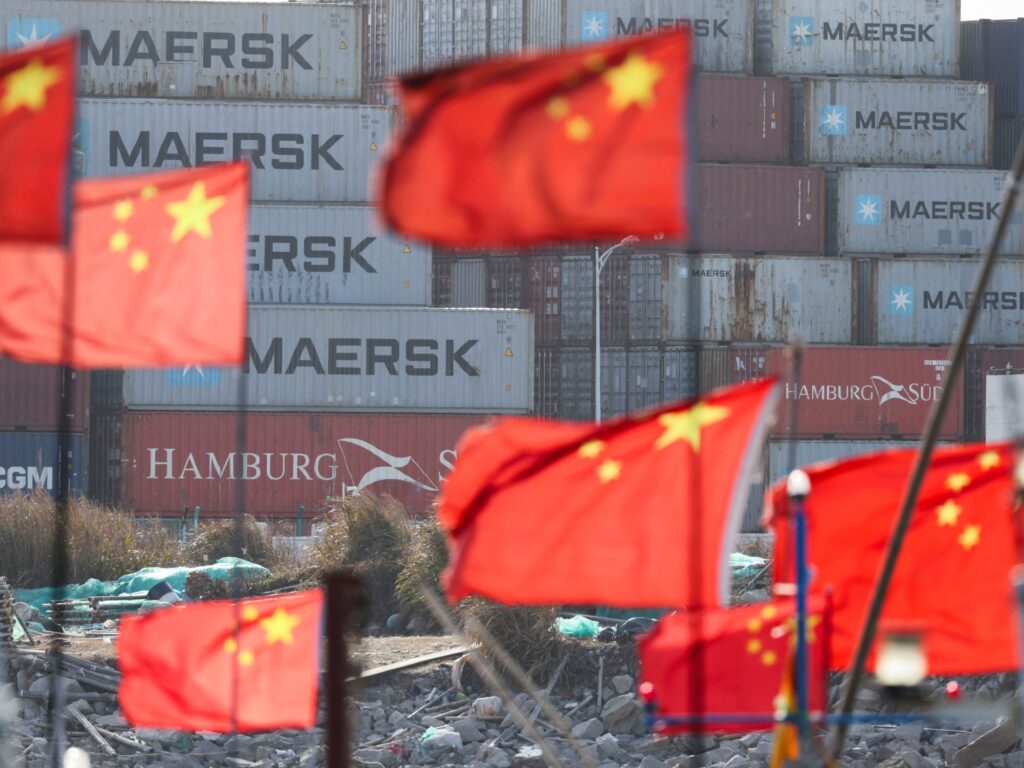
Washington, DC – With the clock ticking for additional United States tariffs to be placed on goods from China, President Donald Trump has said he is waiting for a call from Beijing to defuse a growing trade war. After a phone call with South Korea’s acting president, Han Duck-soo, on Tuesday, Trump said South Korean officials are travelling to the US for trade talks. He added that “many other countries” want to open economic negotiations with Washington. “China also wants to make a deal, badly, but they don’t know how to get it started,” the US president wrote in a social media post. “We are waiting for their call. It will happen!” However, hours later, a senior Trump aide cast doubt over Beijing’s willingness to negotiate a solution to tit-for-tat tariffs, suggesting that a breakthrough is unlikely in the coming days. “They [China] elected to announce retaliation,” US Trade Representative Jamieson Greer said at a Senate committee hearing on Tuesday. “Other countries did not. Other countries signalled that they’d like to find a path forward on reciprocity. China has not said that, and we will see where that goes.” Advertisement Trump has threatened to impose additional 50-percent tariffs on Chinese goods if China does not revoke the retaliatory levies it imposed on US products If implemented, the new US levies would be as high as 104 percent on some Chinese goods. Beijing, however, has appeared to refuse to budge, rejecting what it called “economic bullying” by Washington. “We Chinese are not troublemakers, but we will not flinch when trouble comes our way,” Chinese Foreign Ministry spokesperson Lin Jian said on Tuesday. “Intimidation, threats and blackmail are not the right way to engage with China. China will take necessary measures to firmly safeguard its legitimate and lawful rights and interests.” Lin added that, if the US is determined to engage in a trade war, “China’s response will continue to the end”. Despite the growing competition and tensions between the US and China, Washington and Beijing are major trade partners. According to US government data, the US imported $438.9bn in Chinese goods last year, making China the second largest exporter to the US after Mexico. US exports to China totalled $143.5bn in 2024. Foreign policy hawks in Washington have long called for scaling back economic ties with Beijing and reducing dependence on Chinese goods. On Tuesday, White House Press Secretary Karoline Leavitt used the friction with China as a means of illustrating Trump’s strength as president. “America does not need other countries as much as other countries need us, and President Trump knows this. He’s going to use the leverage of our markets and our country to the advantage of the people he was sworn in to represent,” Leavitt said. Advertisement “Countries like China who have chosen to retaliate and try to double down on their mistreatment of American workers are making a mistake. President Trump has a spine of steel, and he will not break.” Relations between the US and China have soured over many issues in recent years, including trade, the status of Taiwan, Beijing’s claims in the South China Sea and an ongoing US push against growing Chinese influence in the Indo-Pacific. But the ongoing tariff crisis between the two countries is part of Trump’s worldwide trade shake-up, which has not spared even the closest US allies. Trump has announced a 10-percent baseline tariff on all imports to the US, with additional levies — described as “reciprocal tariffs” — on countries with which the US has large trade deficits. On Tuesday, Greer portrayed the US as the victim of an unfair international trading system that has gutted American industries. Beyond tariffs, he slammed other countries for imposing barriers and regulations that limit US imports, including restrictions by the European Union on shellfish and by Australia on pork. Greer said “nearly 50 countries” have approached him to discuss Trump’s trade policy and “explore how to achieve reciprocity”. Trump’s tariffs, however, have rocked global markets and raised concerns about a spike in prices for US consumers. But the Trump administration has argued that the tariffs will ultimately force companies to manufacture their products in the US, reviving industries and creating jobs. Advertisement Greer said the plan will not achieve its aims “overnight”. “We must move away from an economy that’s based solely on government spending and the financial sector, and we must become an economy based on producing real goods and services that provide jobs for working class and middle class Americans in their communities,” he told senators. “This adjustment may be challenging at times. And in a moment of drastic, overdue change, I’m certain that the American people can rise to the challenges they’ve done before.” Adblock test (Why?)
Ukraine detains suspected Russian assassin
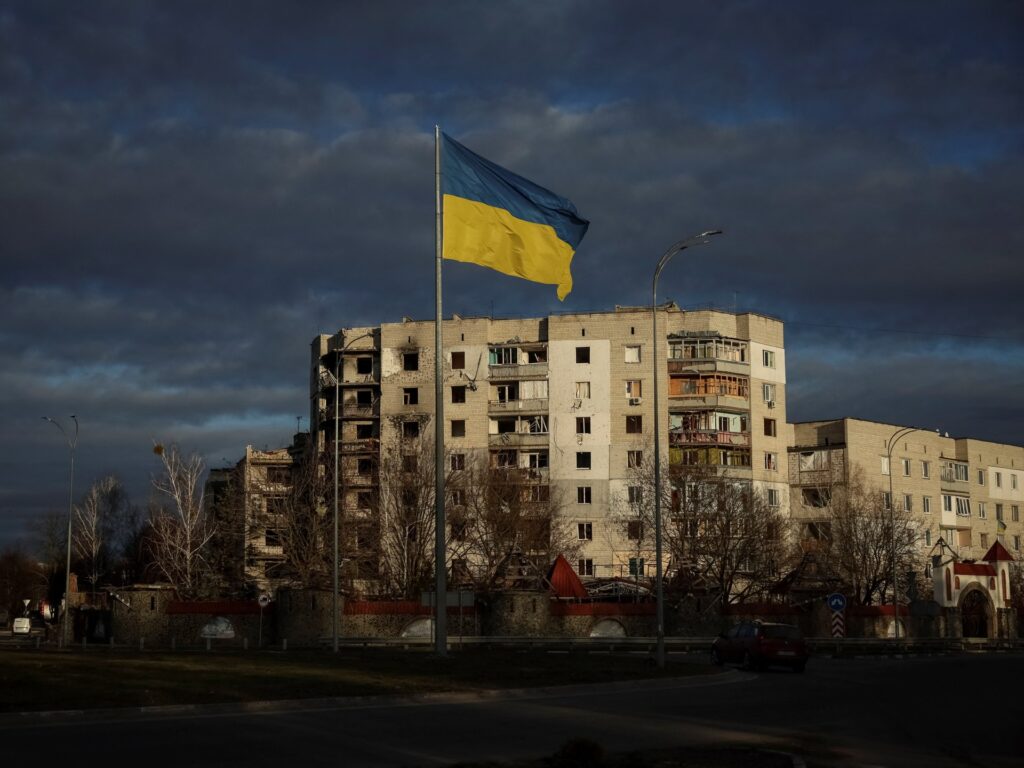
Indictment comes amid an uptick in targeted attacks on Ukrainian officials and public figures. Ukraine has arrested and indicted a man accused of assassinations and blowing up buildings on orders from Russia. The Ukrainian prosecutor general’s office said on Tuesday in a statement that the suspect is accused of murdering a Ukrainian soldier and plotting the assassination of officials. The arrest comes amid an apparent uptick in targeted attacks on Ukrainian officials and public figures, including a local lawmaker who was killed by a car bomb on Friday in the city of Dnipro. The prosecutor general’s office said under the orders of Russia’s Federal Security Service (FSB), the 56-year-old from the Crimean Peninsula, reportedly a persistent offender over many years, shot a Ukrainian soldier dead in March 2024. Prosecutors have also accused the suspect of planting an explosive under the car of Vyacheslav Zadorenko. However, the Kharkiv official spotted the bomb, “saving his own life”, they said in the statement. The suspect was also allegedly tasked with killing the head of the Kharkiv region, Oleh Synyehubov, for a reward of $50,000. Advertisement He also planted and set off explosives at strategically important buildings in the northeastern city of Kharkiv, the statement added. Russia and Ukraine have targeted one another’s officials in assassination plots since Moscow’s invasion in February 2022. Ukrainian counterintelligence investigators claimed last May to have foiled a Russian plot to assassinate President Volodymyr Zelenskyy, as well as the heads of Ukraine’s military intelligence agency and the SBU security service. Zelenskyy has said there had been numerous attempts to assassinate him since the start of the war with Russia, which has now stretched into a fourth year. The FSB did not comment on Kyiv’s claims regarding the suspect. Adblock test (Why?)
Germany halts UN refugee resettlement programme

The next German government, likely to be led by the centre-right CDU, is expected to be tougher on migration. Germany has suspended the admission of refugees through a United Nations programme, according to a document seen by the Reuters news agency, as a new conservative-led coalition government prepares to take office. Reuters reported on Tuesday that the Federal Ministry of the Interior had made the decision as negotiations between the centre-right Christian Democrats (CDU) and the centre-left Social Democrats (SPD) continue, with both sides likely to agree on a tougher migration and asylum policy. The German dpa news agency also reported that the Interior Ministry and the UN High Commissioner for Refugees (UNHCR) had confirmed news of the suspension. Migration has been a contentious issue in Germany, the third largest refugee-hosting country in the world, with 2.5 million refugees, including more than one million refugees from Ukraine. But a growing number of German voters want the country to accept fewer migrants. Immigration and asylum were hotly discussed before February’s German elections in which the far-right Alternative for Germany (AfD) doubled its vote share after several violent attacks blamed on refugees or asylum seekers. Advertisement The issue has been discussed as part of the coalition negotiations between the CDU and the SPD, with the CDU pushing for asylum seekers to be turned away from Germany’s borders on the grounds they have already passed through a safe country. The two sides have struck a preliminary agreement to end voluntary federal admission programmes for refugees such as the UN programme – the only one currently active – and not to launch any new ones, according to the document seen by Reuters. Since 2016, Germany has participated in a European Union resettlement scheme that accepts refugees selected by UNHCR. Most come from Turkiye, Egypt, Jordan or Kenya. The Interior Ministry said 4,711 people had arrived in Germany through the programme since 2024, out of the 13,000 refugees that Germany has promised the European Commission it would take in for 2024 and 2025 combined. Despite the suspension, admissions that are already well advanced, with concrete commitments, will go ahead, a ministry spokesperson said. On Monday, Germany said it no longer took top spot in the European Union for new asylum applications, local media outlets reported, citing EU data that put France and Spain ahead. Interior Minister Nancy Faeser was quoted as saying that the latest figures reflected measures taken to restrain “irregular migration towards Europe as a whole as well as to Germany itself”. Adblock test (Why?)
Are Iran and the US having ‘direct’ talks on the nuclear file?
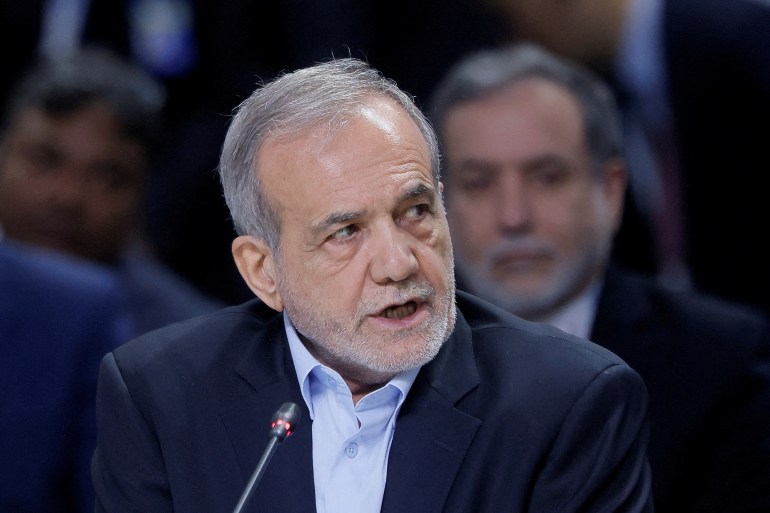
In a news conference on April 7, United States President Donald Trump said there were direct talks between Iran and his administration on the future of Tehran’s nuclear programme. “We’re having direct talks with Iran,” Trump said. “On Saturday, we have a very big meeting.” Iran denied the direct talks but admitted talks were set to take place through Omani mediation. Trump’s announcement came as a surprise to many, as Iran has long refused to hold direct talks. So, has something changed? Here’s everything we know so far. What did Trump say? Interestingly, he has doubled down on the talks being “direct”, saying they have begun and the next meeting would be on Saturday. “A lot of people say, oh, maybe you’re going through surrogates or you’re not dealing directly, you’re dealing through other countries,” he said. “No, we’re dealing with them directly. And maybe a deal’s going to be made. “Doing a deal would be preferable to doing the obvious,” he said, presumably in reference to attacking the regional giant, something that US ally Israel has done twice in the last 12 months. Advertisement In early March, Trump told reporters that he had written to Iranian authorities demanding talks on the country’s nuclear programme and threatening military action if there was no reply. Iran’s Supreme Leader Ayatollah Ali Khamenei said at the time that Iran would not negotiate with “bullying governments”. Trump has until now applied what he calls a policy of “maximum pressure” on Iran, consisting of intensified sanctions. What did Iran say? Iran’s Foreign Minister Abbas Araghchi said indirect talks between himself and US Special Envoy for the Middle East Steve Witkoff would take place in Oman. “It is as much an opportunity as it is a test,” Araghchi wrote on X. Iran has long said it will not hold direct talks with the US, but agreed to work through an Omani intermediary, who was announced by Iranian state media to be Omani Foreign Minister Sayyid Badr Albusaidi. Iran and the United States will meet in Oman on Saturday for indirect high-level talks. It is as much an opportunity as it is a test. The ball is in America’s court. — Seyed Abbas Araghchi (@araghchi) April 7, 2025 Iran’s messaging has oscillated between an openness to negotiate and rejection of the US’s threatening tactics. Iran’s President Masoud Pezeshkian said in September that direct talks were possible if the US showed it was amenable to good-faith talks. “We are not hostile towards the US. They should end their hostility towards us by showing their goodwill in practice,” Pezeshkian said at the time. “We are brothers with the Americans as well.” Advertisement However, earlier this week, Araghchi questioned Washington’s sincerity in calling for negotiations, saying on Sunday, “If you want negotiations, then what is the point of threatening?” Iranian President Masoud Pezeshkian [Maxim Shemetov/Reuters] What would Trump want to negotiate? Despite bombing Yemen and allowing Israel to have a free hand in Lebanon and Syria as well as to restart the war on Gaza, Trump says he wants to be seen as a “peacemaker”. He says he wants to negotiate Iran’s nuclear programme, to make sure that Iran never builds a nuclear weapon. During his first term in office, Trump actually withdrew the US from a nuclear deal between Iran and world powers that curbed Iran’s nuclear programme in return for some sanctions relief. After withdrawing, Trump reapplied sanctions. He said any agreement with Iran would have to limit its conventional weapons arsenal as well, not just the nuclear programme. In recent weeks, he has said Iran is materially aiding Yemen’s Houthis, blaming Iran whenever the Houthis launch an attack on Israel or what they say is Israel-linked shipping in the Arabian or Red seas. It is not clear if that will come up in negotiations. Trump may also want to discuss Iran’s increased oil sales to China. What would Iran want to negotiate? Iran is interested in sanctions relief to ease economic pressure on Tehran as the country suffers an economic crisis that has hit all sectors of society. This would include assurances that Iran would be able to access the SWIFT money transfer system as well as international investment. Advertisement However, Iran also wants recognition of its nuclear programme, including the right to some level of enrichment and to use its centrifuges, built since 2018. That said, the two sides’ starting positions are further apart than when negotiations first started on the Joint Comprehensive Plan of Action (JCPOA), widely known as the “Iran nuclear deal”. Iran is asking for more extensive sanctions relief than provided under Obama, while Trump has threatened to bomb Iran if they don’t cut a deal. Isn’t there already a deal on Iran’s nuclear programme? Yes, the JCPOA. As we mentioned above, it exchanged assurances from Iran on limiting its nuclear programme for sanctions relief. Trump withdrew the US from the agreement in 2018, and his close ally, Israeli Prime Minister Benjamin Netanyahu, has been one of the loudest voices opposing the JCPOA. Trump and Netanyahu are in agreement, saying the JCPOA didn’t go far enough for long enough, in reference to the JCPOA only prohibiting certain nuclear activities for 10 to 15 years. They said Iran’s conventional weapons programme should be included in any deal with Iran, and that any relief the Iranian economy receives would only enable Tehran to fund its regional allies to carry out activities assumed to “threaten Israel’s security”. Trump meets with Netanyahu in Washington, DC on April 7, 2025 [Kevin Mohatt/Reuters] How close is Iran to a nuclear weapon? No one really knows. Iran says its nuclear programme is for peaceful purposes and it does not want to develop a nuclear weapon. Advertisement Supreme Leader Khamenei issued a religious ruling to that effect in 2003, and that has been the cornerstone of Iran’s nuclear policy since. Some Western analysts claim that, in terms of capabilities, Iran is incredibly close to a nuclear weapon. In March 2025,
Pro-Palestine protesters ‘shut down’ New York’s Grand Central station
[unable to retrieve full-text content] Pro-Palestine protesters staged a demonstration at New York’s Grand Central station.
Has the dire wolf come back to life? Here is what we know
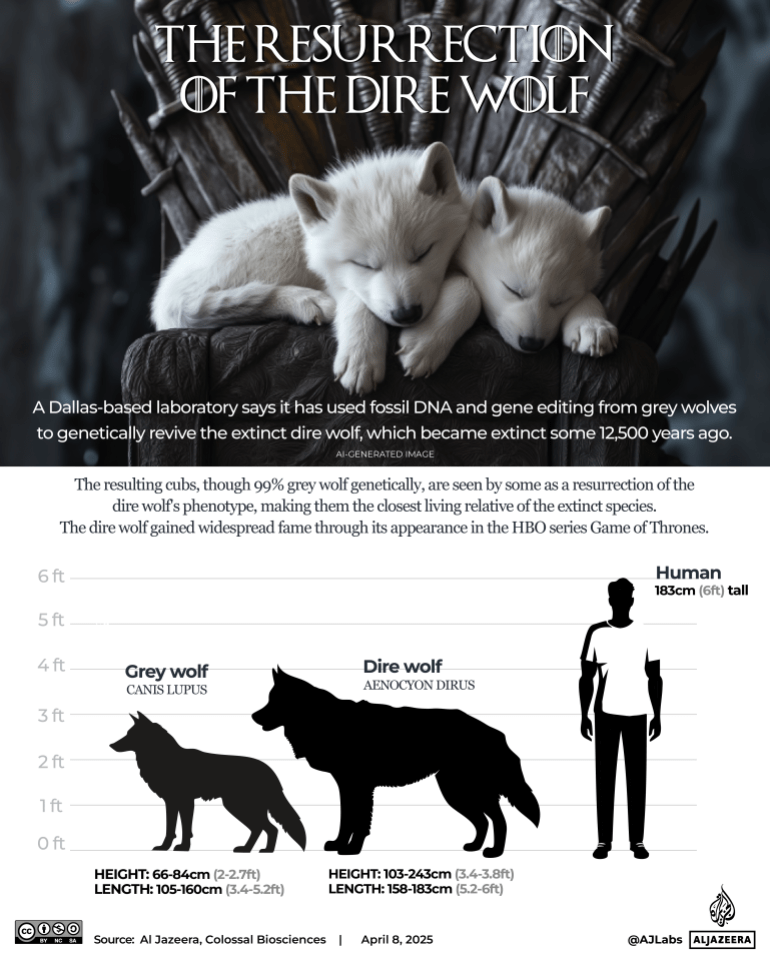
The dire wolf, a species that went extinct some 12,500 years ago but was made famous by the Game of Thrones series, has been brought back to life, according to Texas-based biotech firm Colossal Biosciences. The company has described the dire wolf as the “world’s first successfully de-extinct animal”. On Monday, the company announced that its research had led to the birth of three pups — Romulus, Remus and Khaleesi. But the recently born wolves have DNA which is very close to that of the grey wolf, leading to criticism of the company’s claims. So are Romulus, Remus and Khaleesi truly dire wolves? Here is what we know about them: What is a dire wolf? The dire wolf, the real-life inspiration behind the wolves in HBO’s Game of Thrones, was once a dominant predator across North America. Fossils suggest that dire wolves were built for strength, not speed. They had more muscle and a heavier build than other ancient or modern wolves. But despite their size, fossils show that the dire wolf could still move well through different environments, Colossal Biosciences said. It could hunt big animals and live alongside other species. Their powerful bodies made dire wolves strong predators. Advertisement These carnivores hunted large Ice Age animals like bison, horses and possibly mammoths. As many of their prey species disappeared, likely in part due to human hunting, dire wolves may have been driven to extinction, paving the way for the grey wolf to move down from northern Canada and Alaska to take over its ecological role. SOUND ON. You’re hearing the first howl of a dire wolf in over 10,000 years. Meet Romulus and Remus—the world’s first de-extinct animals, born on October 1, 2024. The dire wolf has been extinct for over 10,000 years. These two wolves were brought back from extinction using… pic.twitter.com/wY4rdOVFRH — Colossal Biosciences® (@colossal) April 7, 2025 “Many people view dire wolves as mythical creatures that only exist in a fantasy world, but in reality, they have a rich history of contributing to the American ecosystem,” said Game of Thrones author George RR Martin, who is also an investor and cultural adviser to Colossal. “I get the luxury to write about magic, but [they] have created magic by bringing these majestic beasts back to our world.” How are dire wolves different from more common wolves? According to Colossal, at first glance, dire wolves — their formal, scientific name is Aenocyon dirus — appeared more heavily built, with thicker legs, broader heads and shoulders, a stockier frame, and a more pronounced snout. Although they look alike, dire wolves are not closely related to grey wolves and are not their ancestors. Genetic studies reveal that the two species diverged millions of years ago and evolved separately in the Americas. How did scientists bring a dire wolf ‘back’? Scientists extracted and sequenced DNA from two ancient dire wolf specimens — a 13,000-year-old tooth and a 72,000-year-old ear bone. This analysis identified 20 key genetic differences between dire wolves and their closest living species, grey wolves. Advertisement Using CRISPR technology, a kind of molecular scissors to cut DNA at a specific spot, researchers edited the genomes of grey wolf cells to incorporate these 20 specific genetic variants associated with dire wolf traits, such as larger size, broader heads and thicker fur. The genetic material was inserted into an egg cell from a domestic dog. Once the embryos were developed, they were implanted into surrogate dogs. Sixty-two days later, the genetically engineered pups were born. What do we know about Romulus, Remus and Khaleesi? Romulus and Remus, both males, were born on October 1, 2024, while Khaleesi, a female, was born on January 30, 2025. Romulus and Remus, at six months old, each measure nearly 4 feet (122cm) in length and weigh approximately 80 pounds (36kg), with projections to reach 6 feet (183cm) and 150 pounds (68kg) at full maturity. Khaleesi, at three months, is developing similarly. The wolves exhibit physical characteristics such as white coats, larger body sizes, and broader heads. When the first dire wolf pup was delivered by Caesarean section, Colossal’s chief animal officer, Matt James, recalled gently rubbing the newborn between two towels to stimulate its first breath. “Good lord, this thing is huge,” he remembered thinking. The first two pups that were genetically engineered [Colossal Biosciences via AP] Are dire wolves really back? While Colossal Biosciences referred to these animals as “de-extincted” dire wolves on Monday, some experts argue that they are genetically modified grey wolves rather than true representations of the extinct species. Advertisement “We call them dire wolves,” Ben Lamm, founder and CEO of the Dallas-based startup, said. Love Dalen, a professor in evolutionary genomics based at the Centre for Palaeogenetics at Stockholm University and adviser to Colossal, also argued this is more of a philosophical question. “There’s no secret that across the genome, this is 99.9 percent grey wolf. There is going to be an argument in the scientific community regarding how many genes need to be changed to make a dire wolf, but this is really a philosophical question,” Dalen said. “It carries dire wolf genes, and these genes make it look more like a dire wolf than anything we’ve seen in the last 13,000 years. And that is very cool,” he added. The two newly born baby Dire Wolves, brought back from extinction by genetic engineering, seated on the Iron Throne. 🐺 George R.R. Martin serves as a Colossal Biosciences cultural advisor and investor, with Peter Jackson loaning his Iron Throne prop for the photoshoot. pic.twitter.com/Yax9WjCp7a — westerosies (@westerosies) April 7, 2025 Why bringing it back? According to Colossal, the project helps push the boundaries of genetic engineering and could provide tools for conservation, especially for species with shrinking genetic pools. The dire wolf also served as a high-profile case to demonstrate these capabilities. “This project demonstrates the awesome potential for advances in genetic engineering and reproductive technologies to recreate lost diversity,” Andrew Pask, Colossal advisory board member, said.
Devastation after deadly flooding in DR Congo’s capital
[unable to retrieve full-text content] Hundreds of people have been moved to emergency shelters after flooding in DR Congo’s capital, Kinshasa.