

Russia-Ukraine war: List of key events, day 1,125
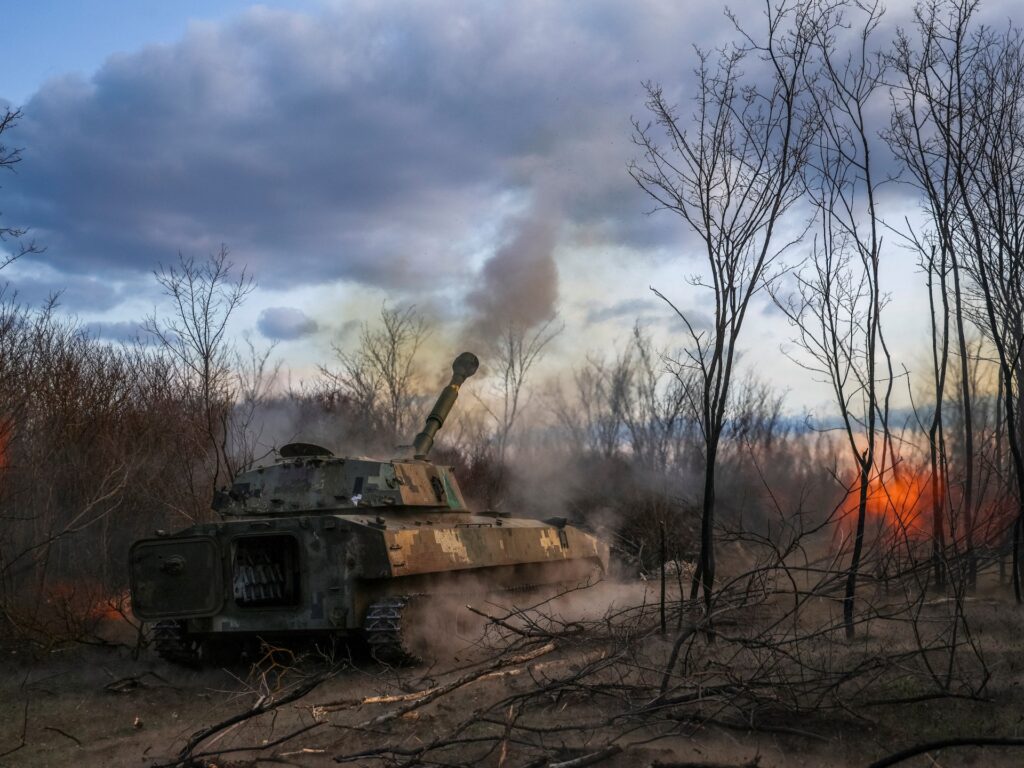
These are the key developments on day 1,125 of Russia’s war on Ukraine. Here is the roundup of key events on Tuesday, March 25. Ceasefire United States and Russian officials wrapped up daylong talks in Saudi Arabia on Monday focused on a narrow proposal for a maritime ceasefire between Kyiv and Moscow in the Black Sea, allowing the free flow of shipping, part of a diplomatic effort that Washington hopes will help pave the way for broader peace negotiations. A White House source said progress was made in the Riyadh talks and that a “positive announcement” was expected “in the near future”. Russia was represented at the talks by Grigory Karasin, a former diplomat who is now the chair of the Russian upper house’s Foreign Affairs Committee. Karasin was cited by Russia’s Interfax news agency as saying during a break in the talks that they were progressing “creatively” and that the two sides had discussed issues regarded as “irritants” in bilateral ties. A joint statement by Washington and Moscow is to be published on Tuesday, Russia’s state-run news agencies TASS and Ria Novosti reported, citing sources from the Russian delegation. No further details were given. United Kingdom and French defence chiefs met again in London to discuss plans for allied countries to safeguard a potential Ukraine ceasefire as part of UK Prime Minister Keir Starmer’s so-called “coalition of the willing”. The meeting was the third of its kind since Starmer earlier this month announced he would work to bring together nations who could guarantee any cessation of hostilities between Russia and Ukraine. Advertisement Fighting Russian missiles struck the Ukrainian city of Sumy, injuring more than 80 people. Several high-rise residential blocks were damaged along with a school and hospital, regional Governor Volodymyr Artiukh said. Ukraine’s Public Prosecutor’s Office said 17 minors were among the injured. A Ukrainian artillery strike killed six people, including three journalists, in eastern Ukraine’s Russian-occupied Luhansk region, the region’s Russian-installed governor, Leonid Pasechnik, said. A 14-year-old child was also killed in the attack, according to Pasechnik. The attack killed a journalist from Russia’s Izvestia media outlet, Alexander Fedorchak, as well as camera operator Andrei Panov and driver Alexander Sirkeli working for Russian state television channel Zvezda, according to Pasechnik. Zvezda said another correspondent, Nikita Goldin, had been seriously wounded in the attack. Russian news agencies quoted security sources as saying the strike had been carried out by a HIMARS missile supplied to Ukraine by the US. Figures from the National Union of Journalists of Ukraine show that 18 Ukrainian and foreign reporters have been killed on assignment during the war. Another 10 journalists have been killed by bombs or shelling while not at work. More than 80 media employees have been killed while serving in the Ukrainian military. The Ukrainian military said its forces destroyed four Russian military helicopters stationed near the border. The aircraft hit were two Mi-8 transport helicopters and two Ka-52 combat helicopters, it said. The media office of a Ukrainian special forces unit published images said to show a HIMARS multiple rocket launcher attacking helicopters stationed on an airfield in the Russian border region of Belgorod. Advertisement A powerful cyberattack knocked out the online ticketing system for Ukraine’s state railway service, causing long queues at stations in what Kyiv officials said looked like a Russian attempt to “destabilise” the situation. The Ukrainian rail company, which has grappled with Russian missile strikes at various points during the war, did not explicitly say who it thought was behind the attack. Politics and diplomacy The Kremlin confirmed that Russian President Vladimir Putin gifted US President Donald Trump a portrait he commissioned of the US president. Putin gave the painting to Trump’s special envoy, Steve Witkoff, in Moscow earlier this month, the Russian president’s spokesperson, Dmitry Peskov, said in a response to a journalist’s question, declining further comment. President Trump said that a strategic raw materials deal with Ukraine is likely to be agreed upon shortly. Trump said US Treasury Secretary Scott Bessent had told him that the rare earth minerals agreement with Ukraine was as good as finalised. “They’ll sign it shortly,” Trump said. Regional security At the meeting of British and French military chiefs in London, Admiral Tony Radakin, the head of the UK’s armed forces, said Europe’s two nuclear powers were “stepping up to forge a stronger and deeper partnership” after a meeting his French counterpart, General Thierry Burkhard. The two chiefs discussed efforts to “galvanise” the European response to the situation in Ukraine. Austria’s DSN domestic intelligence agency said it had uncovered an extensive Russian disinformation campaign centred around a Bulgarian national accused of spying and disseminating false information about Ukraine. The DSN said the woman had acknowledged working on behalf of Russia, especially in 2022 when Moscow launched its full-scale invasion of Ukraine, to turn public opinion in favour of Russia and against Kyiv. Russia has started planned exercises involving its Yars intercontinental ballistic missiles (ICBMs), the state-run RIA news agency reports, citing the Russian Defence Ministry. The Yars ICBM regiments in Sverdlovsk and Altai regions “will be deployed to field positions”, according to the ministry. Advertisement Sanctions A group of Republican and Democratic US senators has written a letter to push the Trump administration to transfer – and push allies to transfer – more than $300bn of seized Russian assets to help Ukraine, and not just use the debt’s interest to support Kyiv. The letter was described as a rare example of senior Republicans publicly pressing the Trump administration to be tougher with Moscow. The Czech Republic should finally stop receiving Russian oil supplies through the Druzhba pipeline, the country’s industry minister, Lukas Vlcek, said. The minister said the final decision lies with the refinery operator Orlen Unipetrol, which has been under Polish ownership since 2005. No Russian oil has been flowing through the Druzhba pipeline to the Czech Republic since March 4 because of payment problems due to the US sanctions imposed on Russian banks. Adblock test (Why?)
US to meet Ukraine again in Riyadh after talks with Russian delegation
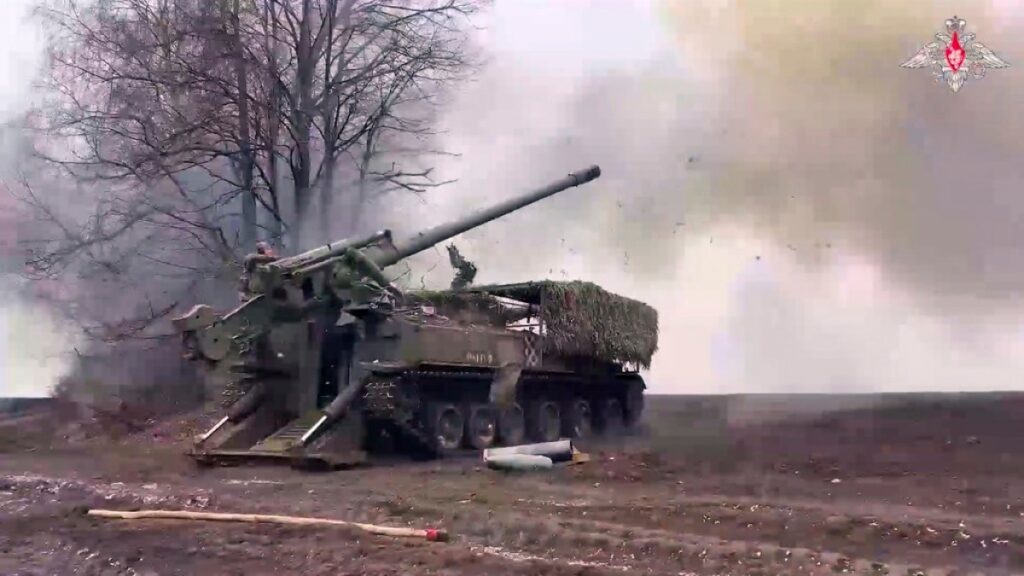
United States officials are set to meet with their Ukrainian counterparts again after a round of talks with Russian negotiators on a partial ceasefire in Ukraine. A senior Ukrainian official told the AFP news agency that the meeting would be held later on Monday after US and Russian delegations wrap up their day’s talks in Saudi Arabia’s capital Riyadh. Monday’s US-Russia talks were primarily focused on ending attacks on Black Sea shipping, with a view to ushering in a broader ceasefire agreement that would bring an end to the three-year Russia-Ukraine war. US officials had already met the Ukrainian team on Sunday to discuss the protection of civilian and energy infrastructure, said Ukrainian Defence Minister Rustem Umerov, who led the delegation and called the talks “productive”. Reporting from Kyiv, Al Jazeera’s Assed Baig said Ukraine was now keen to see Russia agree to a deal that would protect Black Sea shipping, particularly “the cessation of shelling of Ukrainian ports Odesa, Kherson and Mykolaiv”. Advertisement “Now that’s been a major concern for the Ukrainians. Ukraine really wants their ports operating and running and that’s why initially they proposed a ceasefire on air and sea,” said Baig. Kremlin spokesperson Dmitry Peskov confirmed on Monday that US and Russian officials were discussing the possible resumption of the 2022 Black Sea Grain Initiative, an agreement that was supposed to allow Ukraine to ship millions of tonnes of grain and other food exports from its ports. Moscow pulled out of the initiative – brokered by Turkey and the United Nations – in 2023, accusing the West of failing to uphold its commitments to ease sanctions on Russia’s own exports of farm produce and fertilisers. No breakthrough expected “Nobody is holding their breath here expecting any breakthroughs. Even the spokesperson of the Russian Foreign Ministry, Maria Zakharova, said there are no expectations for a breakthrough in Riyadh on Monday”, said Al Jazeera’s Dorsa Jabbari, reporting from Moscow. “What is expected is that they are going to hammer out details of what Russia is asking for. The Russian delegation has been talking to the US official for at least the past eight hours, as we understand it, about the details on a 30-day ceasefire agreement when it comes to energy and infrastructure, and also the Black Sea initiative”, she added. Oleksiy Melnyk, co-director of Foreign Relations and International Security Programmes at Ukraine’s Razumkov Centre think tank, said the length of the negotiations pointed to the Russian side once again making “more and more” requests and demands. Advertisement Speaking to Al Jazeera from Kyiv, he said there was “zero trust between the two sides” and no “possibility for direct talks” between Moscow and Kyiv. Melnyk said the US could increase its pressure on the Ukrainian government, but noted: “If there are no prospects or interest on the Russian side except capitulation of Ukraine, what is the reason for Ukraine to engage in such negotiations?” Maximalist demands The focus on the Black Sea is a much narrower one than a broad 30-day ceasefire agreement that the US proposed to Russia in Saudi Arabia earlier this month. Last week, after separate phone calls with US President Donald Trump, both Russia’s President Vladimir Putin and Ukraine’s President Volodymyr Zelenskyy agreed to a 30-day limited ceasefire, pledging not to attack energy infrastructure in each other’s territories. But both sides have accused the other of carrying out attacks on those specific energy targets in recent days. The Kremlin said on Monday that Russia was still abiding by the moratorium that Putin had promised Trump, despite Kyiv continuing to strike Russian energy facilities. Ukraine, which said it would only agree to the pause if a formal document was signed, has accused Moscow of flouting its own moratorium. Nevertheless, Trump has expressed broad satisfaction over the way talks have been going and has been complimentary about Putin’s engagement in the process so far, saying on Saturday that efforts to stop further escalation in the conflict were “somewhat under control”. Advertisement But there is scepticism among major European powers over whether Putin is ready to make meaningful concessions or will stick to what they see as his maximalist demands. Putin says he is ready to discuss peace but that Ukraine must officially drop its NATO ambitions and withdraw its troops from the entirety of the territory of four Ukrainian regions claimed and mostly controlled by Russia. Continued attacks Monday’s talks came after Russia launched its third consecutive overnight air attack on Kyiv, wounding one person and damaging houses in the region around the Ukrainian capital. Ukraine’s Foreign Minister Andrii Sybiha said Russia must stop its strikes instead of “making hollow statements about peace” in the wake of a Russian missile attack on the northeastern city Sumy in a “residential neighbourhood”. The attack injured at least 74 people, including 13 children, damaging a school and a hospital, according to the regional governor. “Any diplomacy with Moscow must be backed up by firepower, sanctions and pressure”, Sybiha said on X. Russia, for its part, said it had downed 227 Ukrainian drones in the last 24 hours, as firefighters in its southern Krasnodar region battled for a fifth day to put out a blaze at an oil depot struck in a Ukrainian drone attack last week. The Russian Defence Ministry claimed on Monday that Ukraine conducted two drone strikes on the Valuika gas distribution station in the Belgorod region on Saturday. Additionally, it said Ukrainian forces had attempted to attack the Glebovskoye gas condensate field in Crimea on Sunday, but that Russian air defences had repelled the assault. Advertisement Adblock test (Why?)
HIV and AIDS deaths could increase globally amid US aid freeze, UN says
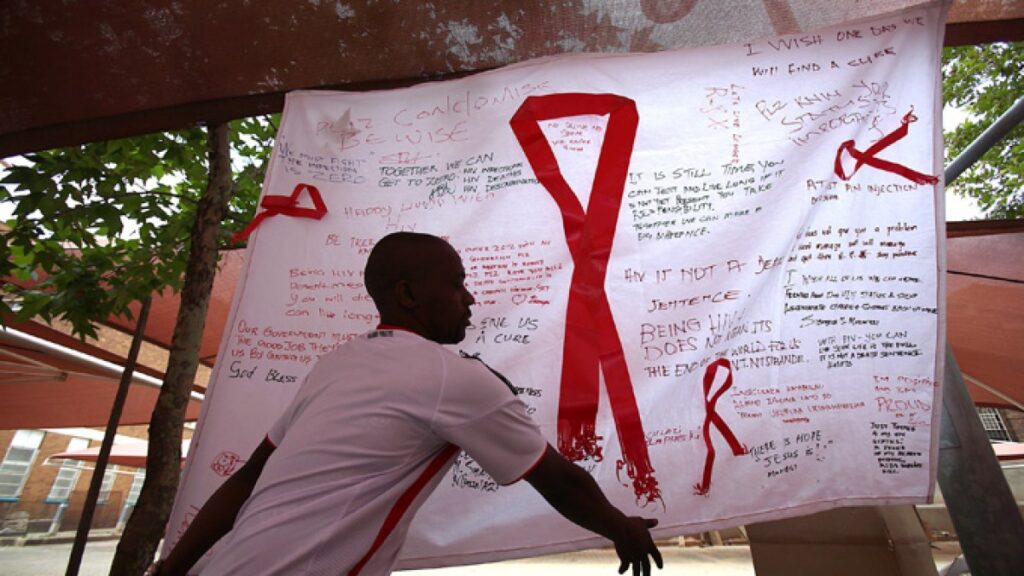
US President Donald Trump put almost all US foreign aid on hold upon taking office. There could be 2,000 new HIV infections a day across the world and a tenfold increase in related deaths, possibly in the millions in the years to come, if funding frozen by the United States is not restored or replaced, the United Nations AIDS agency has said. US President Donald Trump put almost all US foreign aid on hold upon taking office on January 20. Days later, the US Department of State said life-saving HIV work under the President’s Emergency Plan for AIDS Relief (PEPFAR) would continue. But the disruption to health funding and the impact on broader services were having a devastating impact on people living with HIV/AIDS, UNAIDS executive director Winnie Byanyima told reporters in Geneva on Monday. “This sudden withdrawal of US funding has been shutting down many clinics, laying off thousands of health workers … All this means that we expect to see new infections rising. UNAIDS has estimated that we could see 2,000 new infections every day,” she said. She added that if funding from the US Agency for International Development (USAID) did not resume at the end of the 90-day pause, in April, or was not replaced by another government, “there will be, in the next four years, an additional 6.3 million AIDS deaths.” Advertisement “We’ll see it come back, and we’ll see people die the way we saw them in the ’90s and in the 2000s,” she said. Byanyima said the figures were based on UN modelling, but did not give more details on how the estimates had been reached. According to the latest data, there were 600,000 AIDS-related deaths globally in 2023. UNAIDS, which coordinates the global response to preventing and treating HIV/AIDS, received $50m in core funding last year from the US, representing 35 percent of the UN agency’s budget. The Trump administration has said the funding was frozen to ensure it was in line with the president’s “America First” policy. US Secretary of State Marco Rubio has dismissed concerns that Washington is ending foreign aid, saying waivers had been provided for life-saving services. Trump’s team members say they have saved US taxpayers tens of billions of dollars through rapid-fire moves to cancel contracts, fire workers and root out fraud and waste in the government, although they have offered little evidence to support that assertion. Adblock test (Why?)
Turkiye detains over 1,100 as Erdogan blames ‘evil’ opposition for protests
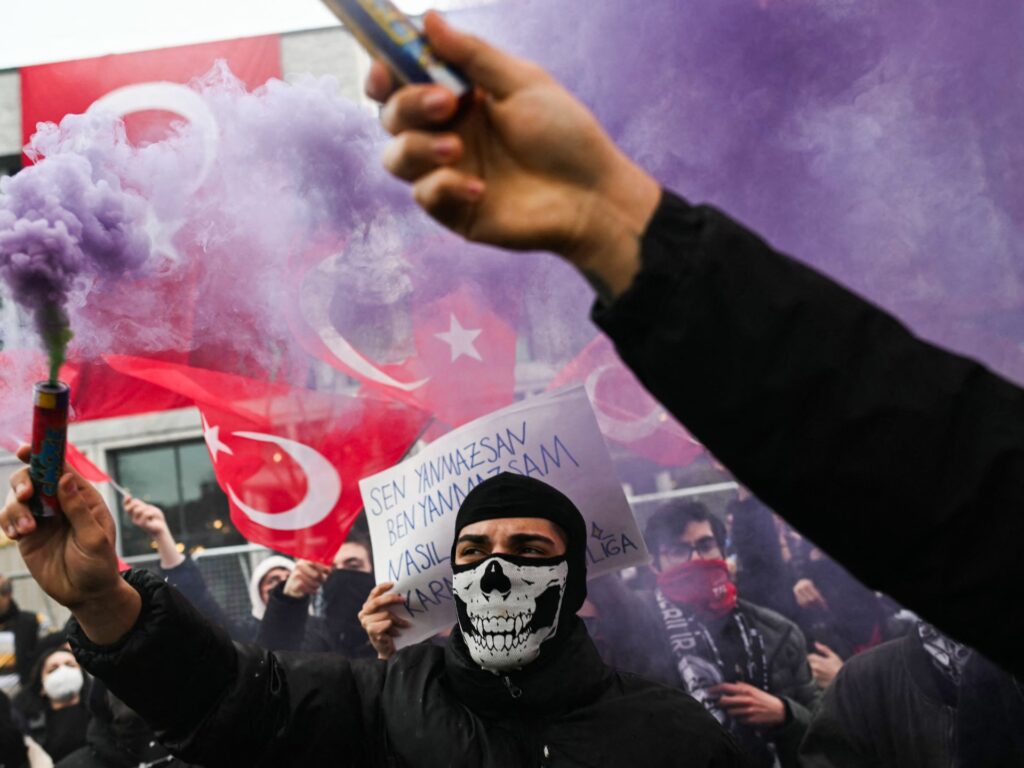
Despite the crackdown, opposition activists promise to ‘not back down’, urging more people to take to streets. Turkish police have detained 1,113 people across the country over five days of protests as President Recep Tayyip Erdogan blames the main opposition party for the unrest sparked by the detention of his main political rival. Interior Minister Ali Yerlikaya confirmed the total number of arrests on Monday after a fifth night of the largest anti-government protests the country has seen in more than a decade. They started after Istanbul Mayor Ekrem Imamoglu was arrested on Wednesday and charged with corruption, aiding the Kurdistan Workers’ Party (PKK), and leading a criminal organisation. Speaking in Ankara on Monday, Erdogan slammed the opposition Republican People’s Party (CHP) for starting a “movement of violence”, adding that its “show” would eventually end and it would feel ashamed for the “evil” it did to the country. Reporting from Istanbul, Al Jazeera’s Aksel Zaimovic said the arrests had not dimmed the opposition’s resolve. “They say they are not backing down. In fact, they are encouraging more people to come and join the rally that’s scheduled in a few hours from now. Advertisement “They are saying they should boycott what they perceive to be pro-government media, all the media outlets that are not covering these protests, but also companies that have ties with government,” he said. Imamoglu is widely seen as the only politician who could pose a significant challenge to Erdogan, who has dominated Turkiye’s politics since 2003, first as prime minister and then as president. The Turkish government denies that the arrest of Imamoglu was politically motivated, insisting that the nation’s courts are independent. On Sunday, 53-year-old Imamoglu was stripped of his mayoral title and jailed in Silivri Prison on the outskirts of Istanbul pending trial on corruption charges that he denies. A further charge of “terrorism” was dismissed for the time being. That same day, he was overwhelmingly voted in as the CHP’s candidate for the 2028 presidential election with about 15 million people casting their ballots in a show of support for him. The demonstrations began in Istanbul after Imamoglu’s arrest, spreading to more than 55 of Turkiye’s 81 provinces. Protesters have clashed with riot police who have deployed tear gas and water cannon. Despite bans on street gatherings in many cities, the antigovernment demonstrations continued for a fifth consecutive night on Sunday with fierce clashes between protesters and riot police. Before dawn on Monday, police detained 10 Turkish journalists at home, according to the Media and Law Studies Association rights group. Detained journalists’ police statements completed, expected to be sent to the courthouse tomorrow On the morning of March 24, at least 10 journalists were detained in dawn raids in Istanbul and Izmir. The statements of the detained journalists have been completed and they are… pic.twitter.com/c949nEbvpg — MLSA (@mlsaturkey) March 24, 2025 Advertisement On Monday, young protesters held a rally next to the Besiktas port on the Bosphorus in Istanbul before the main nightly rally outside city hall, scheduled for 17:30 GMT. Yerlikaya said 123 police officers had been injured during the protests so far, adding that the government would not allow “terrorising of the streets”. Adblock test (Why?)
Canada election 2025: What you need to know
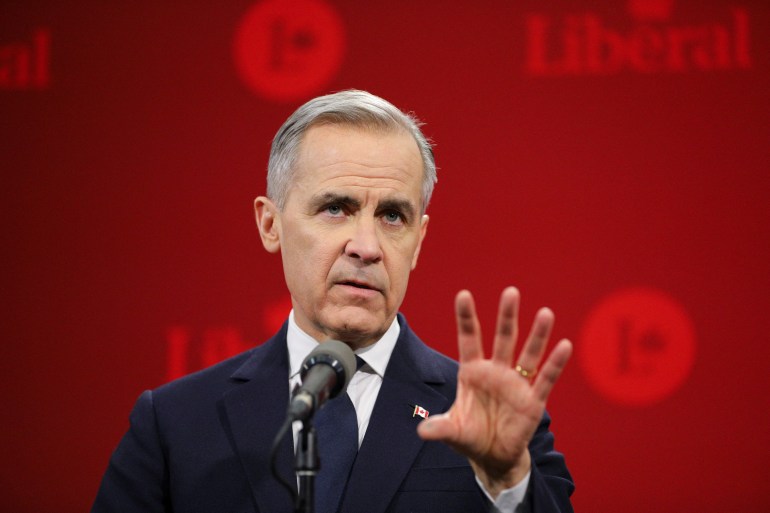
Montreal, Canada – Canadians will be heading to the polls next month for a federal election taking place in the shadow of a trade war with the United States. Prime Minister Mark Carney on Sunday triggered the vote as he seeks to build on his Liberal Party’s momentum since the start of the year. Experts say Canada-US ties – and a push for strong leadership to counter US President Donald Trump’s tariffs and annexation threats against the country – will dominate the five-week election race. Here’s a look at what you need to know about Canada’s election. When is the election? The parliamentary election will take place on Monday, April 28. Under Canadian election rules, federal campaign periods must be at least 37 days long but no more than 51 days. With Carney triggering the vote on Sunday and Election Day set for April 28, this year’s campaign will be the shortest allowable by law. Carney won the Liberal Party leadership race and became prime minister in March [Evan Buhler/Reuters] How does the election work? Canada has 343 federal electoral districts, which are known as ridings. Advertisement Eligible voters can cast a ballot for their preferred candidate in the riding in which they reside. The country has a first-past-the-post election system, which means that the candidate who secures the most votes in the riding wins – even if they don’t win a majority of the votes. They will then take up their respective seats in Canada’s lower house of Parliament, the House of Commons. Who will be the next prime minister? Under Canada’s parliamentary system, the party that wins the most seats in the House of Commons will typically be asked to form a government. If a party gets the most seats but not enough for an outright majority, it seeks to form an agreement with another party – or parties – to be able to pass legislation. The leader of the single largest party also becomes prime minister; Canadians do not vote directly for prime minister. Poilievre has been the leader of the Conservative Party since 2022 [Patrick Doyle/Reuters] What parties are in the running? Canada has four major federal political parties. The Liberals have been in government since 2015 and had 152 seats in Parliament at dissolution. The party was previously led by Justin Trudeau, who formally stepped down as prime minister on March 14 to allow Carney to take up the post. The Conservative Party served as Canada’s official opposition, with 120 seats in the previous Parliament. The party is led by Pierre Poilievre, an Ottawa-area legislator known for his populist rhetoric. The left-leaning New Democratic Party (NDP), led by Jagmeet Singh, had 24 parliamentary seats before the campaign was launched. The NDP had previously been propping up a Trudeau-led Liberal minority government but withdrew from that deal in September of last year. Advertisement The Bloc Quebecois – which only runs candidates in the French-speaking province of Quebec – had 33 legislators in the House of Commons. They are led by Yves-Francois Blanchet. Apart from the four big parties, there is also the Green Party of Canada, which had two seats in Parliament at dissolution but is not expected to make any major gains in the upcoming vote. Jagmeet Singh’s NDP had 24 parliamentary seats at dissolution [Patrick Doyle/Reuters] What do the polls say? Until as recently as January, the Conservatives had what many believed to be a clear path to winning a parliamentary majority. But Trump’s threats against Canada, coupled with Trudeau’s decision to resign and Carney’s rise as the new leader of the Liberal Party, have changed things: Most recent polls now suggest the Liberals either with a lead over the Tories, or locked in a neck-and-neck fight with their rivals. The CBC News Poll Tracker, which aggregates national polling data, had the Liberals with 37.5 percent support compared with 37.1 percent for the Conservatives on Sunday. The NDP was in third with 11.6 percent, followed by the Bloc Quebecois at 6.4 percent. The Greens had 3.8 percent. “The Liberals and Conservatives are effectively tied in national polls with the New Democrats trailing in a distant third place,” CBC reported as the election race began. “The Liberals would likely win the most seats, and potentially a majority government, if the election were held today due to the more efficient distribution of their support across the country.” Bloc Quebecois leader Yves-Francois Blanchet speaks to reporters in Ottawa [Carlos Osorio/Reuters] What issues will dominate the race? Opposition parties – including, most notably, Poilievre and the Conservatives – had hoped the 2025 election would centre on affordability issues, such as soaring grocery and housing costs. Advertisement But Trump’s tariffs and threats to make Canada into the US’s “51st state” have upended the conversation. Experts now say the central “ballot question” in the election campaign will be which party is best equipped to handle Trump and manage Canada-US ties. Canada’s main political party leaders have acknowledged Canadians’ concerns over Trump’s policies, promising to stand up for the country’s sovereignty. Adblock test (Why?)
Israeli air strike targets Nasser Hospital in Gaza kills Hamas official
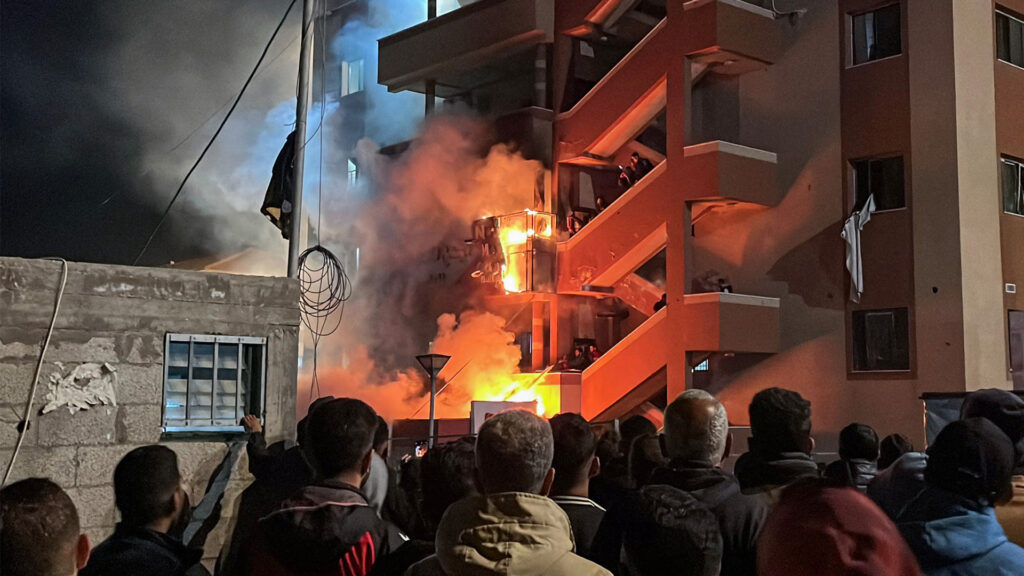
NewsFeed An Israeli air strike on Nasser Hospital in Khan Younis, Gaza has killed at least five Palestinians, including senior Hamas official Ismail Barhoum. Several others were injured. The attack targeted the surgical building of the hospital, destroying the second floor. Published On 24 Mar 202524 Mar 2025 Adblock test (Why?)
Mapping the human toll of the conflict in DR Congo
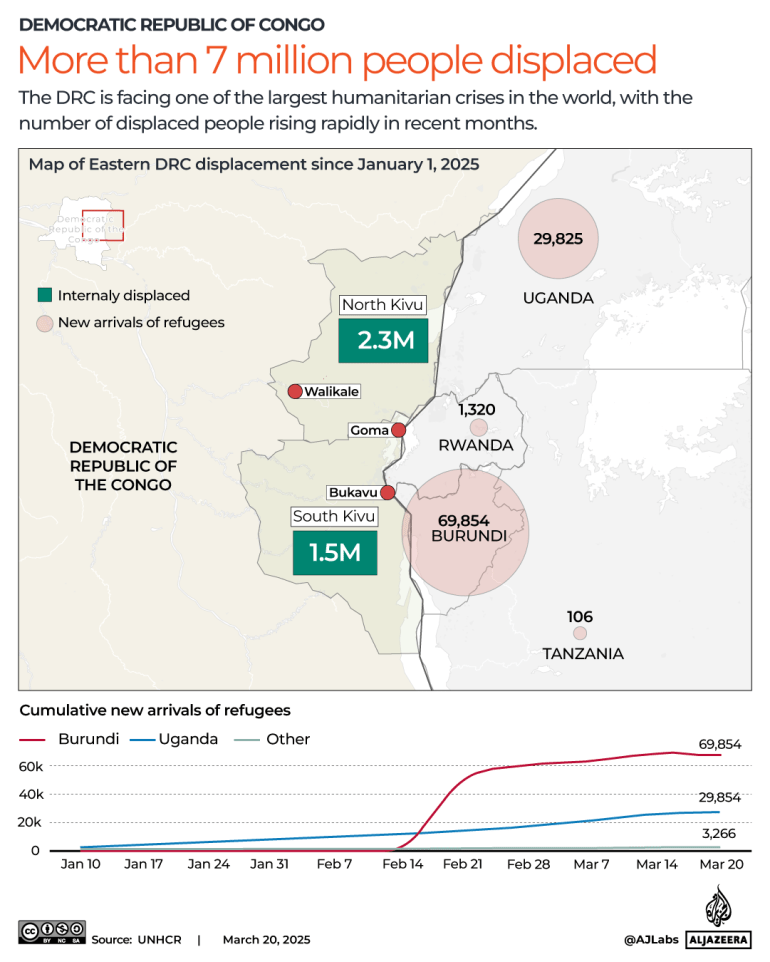
Ongoing violence and instability, including fighting by M23 rebels, has forced millions to flee their homes in Democratic Republic of the Congo. The Democratic Republic of the Congo (DRC) is facing one of the world’s largest displacement and humanitarian crises. Ongoing violence and instability have forced millions to flee their homes, with at least 7,000 people killed in recent months and many more injured. The violence this year has largely been driven by armed groups, particularly M23 rebels, who have intensified their offensive in eastern DRC. In January, M23 seized control of Goma, the capital of mineral-rich North Kivu province, before capturing Bukavu, the capital of neighbouring South Kivu, in February. They have since continued to advance west. Who are the M23? The M23 rebel group was formed in 2012 by former Congolese soldiers, mainly from the Tutsi ethnic group. The group takes its name from the March 23 Movement, referring to the date peace accords were signed in 2009 between the DRC’s government and the National Congress for the Defence of the People (CNDP) that aimed to integrate its fighters into the Congolese army. Advertisement However, M23 later accused the government of failing to fully implement the agreement, leading them to launch their rebellion. M23 briefly seized control of Goma in November 2012 but was defeated and forced into exile in 2013. After nearly a decade of dormancy, the group resurfaced in late 2021 and has since intensified its military campaign in eastern DRC. According to United Nations experts, Rwanda backs M23 with troops and ammunition. Kigali, however, denies the accusations. M23 rebels’ rapid advance The latest round of conflict escalated in December 2024 after peace talks in Angola between the presidents of DRC and Rwanda were cancelled over disagreements about M23. Rwanda had insisted on direct dialogue between DRC and M23, which the Congolese government at the time refused. January 27, 2025 – M23 captures Goma: In the worst escalation in a decade or more, M23 fighters took control of eastern DRC’s largest city, Goma – a crucial humanitarian hub near the Rwandan border, home to more than 2 million people. February 16, 2025 – M23 captures Bukavu: The rebels advanced into Bukavu’s city centre with little resistance, as DRC accused Rwanda of ignoring ceasefire calls. March 19, 2025 – M23 captures Walikale: The rebels seized the mining hub Walikale in North Kivu, the farthest west they have ever reached, dismissing ceasefire calls from DRC and Rwanda. They later said they would withdraw from the town in a peace gesture. More than seven million people displaced The DRC is home to one of the largest populations of displaced people around the world. Advertisement More than 7 million people are displaced, including 3.8 million in North and South Kivu provinces in the east of the country. Nearly 780,000 people were forced to flee their homes between November 2024 and January 2025 alone. According to the UN Refugee Agency, since January 1, more than 100,000 refugees have crossed into neighbouring countries, with 69,000 seeking refuge in Burundi, 29,000 in Uganda, and about 1,000 in Rwanda and Tanzania. A quarter of the country faces food shortage The security situation in Goma, a key humanitarian hub, remains highly volatile, with movement restrictions hindering aid delivery to those in urgent need. The DRC has a population of some 112 million. Before the latest escalation, 21 million people across the country already needed humanitarian aid – the highest figure globally, according to the UN’s Office for the Coordination of Humanitarian Affairs (OCHA). By the end of 2024, armed conflicts, rising food prices and epidemics had pushed 25.6 million people – nearly a quarter of the population – into acute food insecurity (IPC Phase 3 or worse). (Al Jazeera) According to OCHA, 2.7 million people in North Kivu, South Kivu, and Ituri were already facing severe food shortage before the latest escalation. Looting of humanitarian infrastructure and warehouses has further crippled relief efforts, with large quantities of food, medicine, and medical supplies lost in targeted attacks on humanitarian organisations. Adblock test (Why?)
Venezuela accepts US deportation flight with 199 people
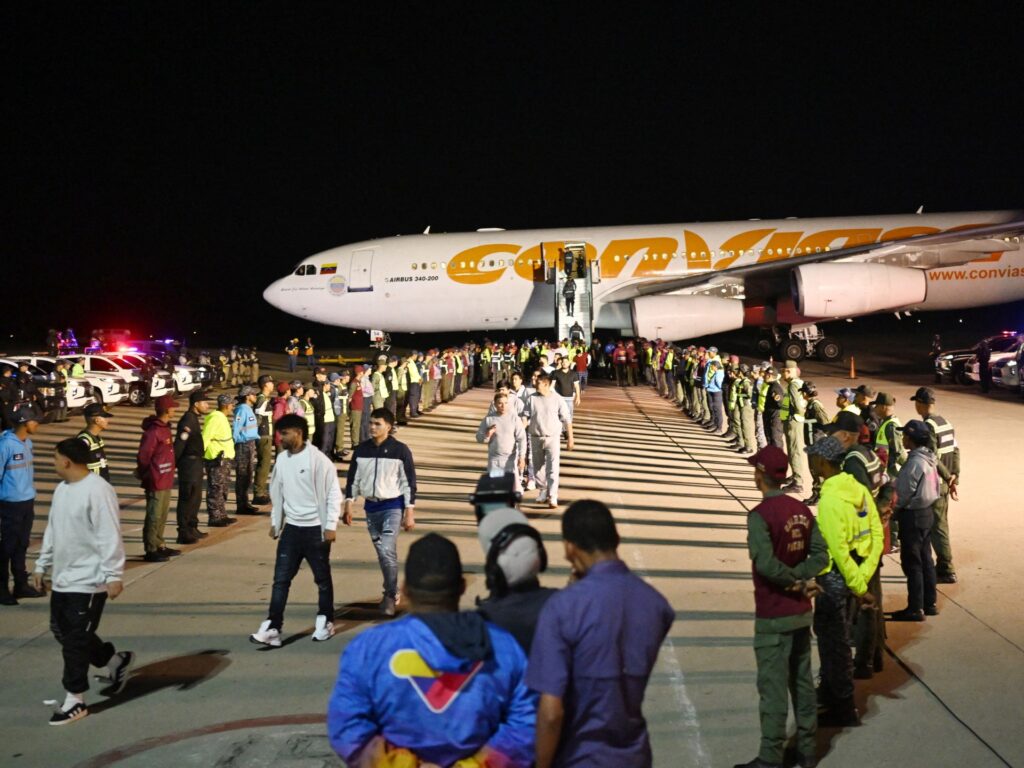
NewsFeed A US deportation flight carrying 199 people has landed in Venezuela. The resumption of flights comes after Donald Trump accused Nicolas Maduro of not accepting deportees at a sufficiently “rapid pace” and sent over 200 Venezuelans to a Salvadoran mega prison. Published On 24 Mar 202524 Mar 2025 Adblock test (Why?)
Who is jailed Turkish opposition leader Ekrem Imamoglu?
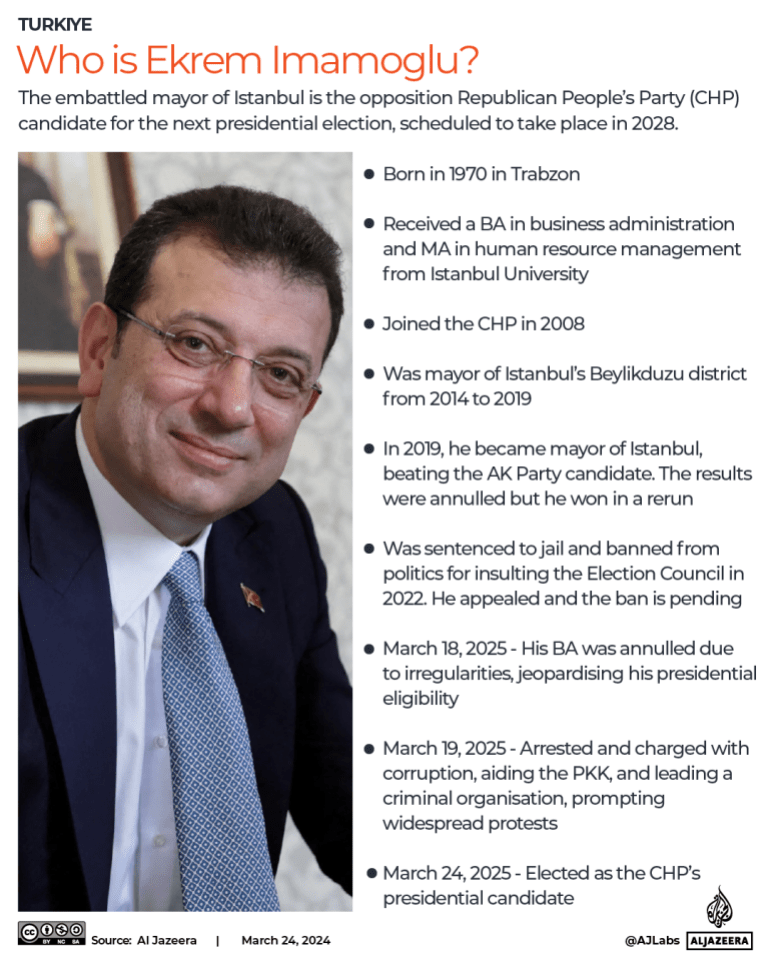
The embattled mayor of Istanbul is the opposition party’s candidate for the next presidential election, scheduled to take place in 2028. The embattled mayor of Istanbul, Ekrem Imamoglu, has been chosen as the opposition Republican People’s Party (CHP) candidate for the next presidential election, scheduled to take place in 2028. Imamoglu, who was detained on Wednesday, is widely seen as the top challenger of President Recep Tayyip Erdogan. His arrest has prompted widespread protests, which have been ongoing for several days, primarily centred in major cities such as Istanbul, Ankara, and Izmir. Below is a brief timeline of Imamoglu’s political career. (Al Jazeera) Early life and education Imamoglu was born on June 4, 1970 in Trabzon, northeastern Turkiye. He received a bachelor’s degree in business administration and a master’s degree in human resources management from Istanbul University. Elected mayor of Istanbul In 2008, he joined the Republican People’s Party (CHP), one of Turkiye’s major political parties. From 2014 to 2019 he served as mayor of Istanbul’s Beylikduzu district. In 2019, he became mayor of Istanbul, beating the Justice and Development Party (AK Party) candidate. The results were initially annulled, but he won in a rerun. In 2022, he was sentenced to two years and seven months in prison and was banned from politics for insulting the Election Council during the annulment of the 2019 Istanbul mayoral election. He appealed the ruling and the ban is pending. Advertisement University degree annulment On March 18, 2025, Istanbul University annulled Imamoglu’s bachelor’s degree, citing irregularities with the Council of Higher Education regulations. This annulment would jeopardise his presidential eligibility, as under Turkish law, a candidate must have at least a higher education degree to be eligible to run for president. Arrest and protests On March 19, 2025, Imamoglu was arrested and charged with corruption, aiding the PKK, and leading a criminal organisation. This led to widespread protests, which are still ongoing. CHP presidential candidate On March 24, 2025, Imamoglu was elected as the CHP’s presidential candidate. The next scheduled election is in 2028. But early elections are thought to be likely. Adblock test (Why?)
What poisoned Fallujah can tell us about toxic risks in Gaza and Lebanon
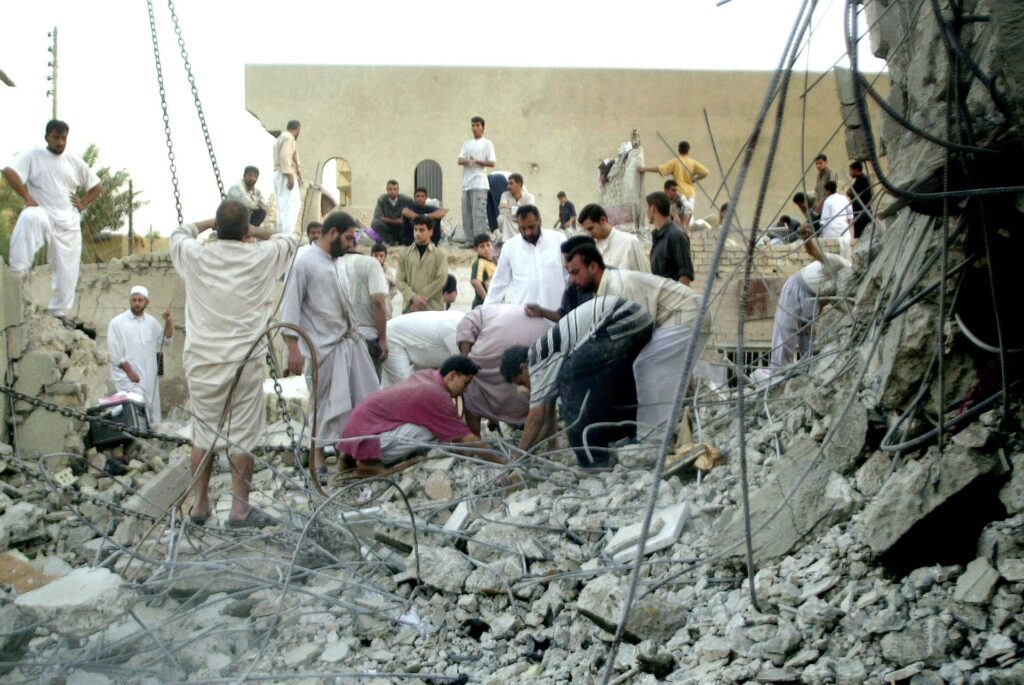
Over the past few months, thousands of people returned to their homes in Gaza, Lebanon, and Syria, where they faced threats from unexploded ordinances and lack of access to water, food, and safe shelter. Many were forced to handle war debris, which may pose long-term health risks. Our new research from Fallujah, Iraq published today by the Costs of War project at Brown University reveals just how dangerous this debris can be. Two decades after the US-led invasion and almost a decade after the occupation of the city by ISIS, the enduring health effects of war are still evident. Our team’s X-ray fluorescence bone sampling detected uranium in the bones of 29 percent of study participants in Fallujah, while lead was detected in 100 percent of them. The levels of lead were 600 percent higher than averages from similarly aged populations in the US. Healthy adults should have no uranium present in the bone, so any presence is significant. Heavy metals such as lead and uranium can cause serious adverse effects in neurodevelopment, general neurological health, cardiovascular health, and birth outcomes. Advertisement When ISIS occupied Fallujah in 2014, one of our study participants Reina (not her real name) and her young family managed to flee north to the relative safety of the Kurdistan Region of Iraq. While they were away, ISIS fighters used their house to store weapons. Iraqi and US warplanes then bombarded the entire neighbourhood, damaging the family’s house. After they returned to their home two years later, and during the first trimester of her pregnancy, Reina cleared up the rubble almost single-handedly – all the time breathing in a toxic admixture of concrete dust, munition remnants, and the burned fragments of her home’s interior. Her son was born in 2017 with a congenital anomaly. Reina and her family – among thousands of returning residents of Fallujah – faced the deferred health risks triggered by post-war clean-up activities. Though she has fully restored her home, Reina remains concerned: “I can’t tell if the house is still making us sick,” she told us. Her concerns are well-founded. More heavily bombarded areas in Fallujah still have higher levels of heavy metals in the soil than other areas. But the bombardment has not been the only source of toxicity threatening Iraqis. As the US army drew down its presence in Iraq, it burned huge amounts of military equipment and weapons in so-called burn pits, which produced toxic fumes that spread to nearby population centres. It was well-documented that these burn pits caused serious health issues among US veterans who faced only short-term exposure. Advertisement Reina’s story, and thousands of others like hers, contain lessons that are important for returnees in Gaza, Lebanon, and Syria. One key observation of our recent study, spearheaded by doctors Samira Alaani and Abdulqader Alrawi in Fallujah and led by Kali Rubaii at Purdue University, is that those who were first to return and rebuild in war-damaged areas may be at a higher risk of reproductive health harms. The children of men and women who were immersed in postwar cleanup activities may have a higher rate of certain congenital anomalies and poorer birth outcomes than the children of those who returned later or who did not directly participate in rebuilding. This is likely because their parents were exposed through inhalation to toxins from detonated munitions, incinerated materials, dioxins, and other forms of dust at a much higher rate than those who returned after buildings were restored. Fallujah’s increase in birth anomalies has been attributed to exposure to the weapons of war, as are manifold other similar spikes in, for example, early onset cancers and respiratory diseases. A second observation is that in the process of being displaced, returning, and re-establishing households, families face nutritional gaps that can compound health risks, even for the next generation. Post-war clean-up often brings malnourished bodies into contact with myriad harmful materials; a decreased intake of key nutrients can undermine the body’s ability to cope with toxins and intensify reproductive health risks. Advertisement For example, during the first trimester of pregnancy, insufficient folate intake can lead to neural tube defects in the foetus. War debris contains heavy metals that can also disrupt folate pathways in pregnant women. These patterns we observed in Fallujah’s public health will likely occur in other heavily bombarded cities, where returnees will bear the double burden of military violence: Not only have they suffered death, dismemberment, displacement, and dispossession, but they are also likely to experience intergenerational health effects yet to come. Certainly, the most effective way to limit heavy metal toxicity from war is by not bombing cities in the first place. But when that happens, there are steps that can be taken to limit the compounded health effects of toxic exposure. First, populations in war zones should not be deprived of adequate nutrition and safe drinking water. Second, international NGOs, health institutions, local clinics, and regional radio outlets should disseminate information about direct measures displaced people can take to protect their own health when they return to their homes. For example, it is critical that returnees wear a mask or scarf to limit inhaling fine particles during cleaning and reconstruction activities. Burying rather than burning trash can also reduce widespread exposure to toxins. And when pregnant or seeking to conceive, women should avoid participating in dust-producing cleanup and rebuilding activities. Additionally, vitamins C and D in food or supplements can limit both the uptake and release of heavy metals accumulated in one’s bones. Women in the first trimester of pregnancy – or seeking to conceive – should have priority in their consumption of folate-rich foods – like spinach, broccoli, fortified rice, and enriched wheat – or folic acid supplements (aka vitamin B9) when they can be found. Advertisement These are some of the ways – albeit limited – to mitigate the ongoing harm of post-war exposures to better protect future generations. Meanwhile, our collective and active effort to prevent military bombardment remains the most effective