

Thousands join march in Turkiye’s Istanbul to protest mayor’s arrest
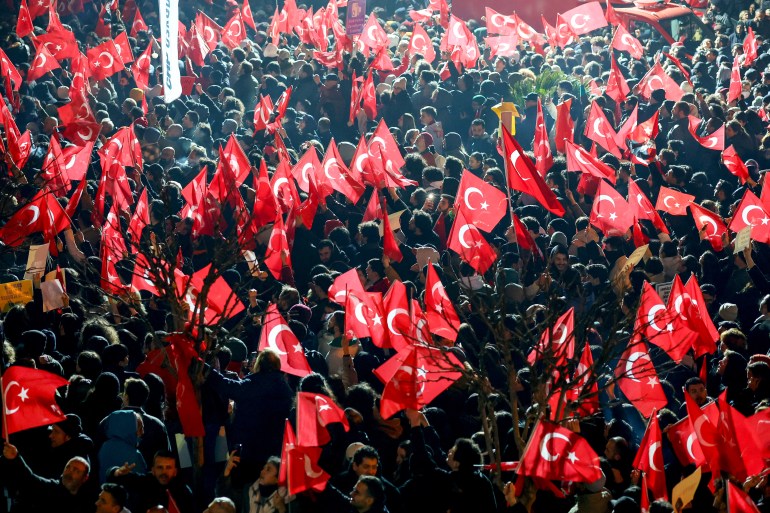
Thousands gather near Istanbul’s town hall in support of the city’s recently arrested mayor. Thousands of protesters have joined a march in Istanbul in support of the city’s arrested mayor, defying a warning from Turkish President Recep Tayyip Erdogan that authorities would crack down on “street terror”. Demonstrators took to the streets in Turkiye’s commercial hub on Friday for the third consecutive day to show their support for Ekrem Imamoglu – Erdogan’s chief political rival – who was arrested on Wednesday, days before he was due to announce his 2028 presidential run. Opposition leader Ozgur Ozel said more than 300,000 people had joined protests across Istanbul. “We are 300,000 people,” the CHP leader told the vast crowds in front of City Hall, saying protesters had gathered at several places across the country’s largest city due to the road and bridge closures preventing people from all being in one place. The mayor was arrested early on Wednesday over alleged corruption and “terror” links. Dozens of other prominent figures, including journalists and businesspeople, were also detained. After the detentions, the government announced a four-day ban on political demonstrations. Advertisement The arrests came a day after a university in Istanbul invalidated Imamoglu’s diploma, in effect disqualifying him from the presidential race because having a university degree is required to run for the nation’s highest office under the Turkish Constitution. Imamoglu said he would challenge Istanbul University’s decision. Erdogan on Friday said the government would not tolerate street protests and accused Imamoglu’s Republican People’s Party (CHP) of links to corruption and “terror” organisations. “An anticorruption operation in Istanbul is being used as an excuse to stir unrest in our streets. I want it to be known that we will not allow a handful of opportunists to bring unrest to Turkiye just to protect their plundering schemes,” Erdogan said. Government critics viewed Imamoglu’s arrest as an attempt to remove a key challenger to Erdogan from Turkiye’s next national ballot. Government officials rejected accusations that legal actions against opposition figures are politically motivated and insisted that Turkiye’s courts operate independently. Reporting from Istanbul, Al Jazeera’s Aksel Zaimovic said there were “many university students” at the protest outside Istanbul’s municipality building. “They say they are protesting the arrest of Imamoglu as well as the decision by Istanbul University to revoke Imamoglu’s diploma,” he said. Zaimovic also noted that protesters told him “this movement is intended to send a message about ‘systemic injustice’ in Turkish society rather than supporting any one political party.” Advertisement “Many say their right to elect an individual to represent them is being challenged by these latest developments,” he added. Supporters of Istanbul Mayor Ekrem Imamoglu gather outside the Istanbul Metropolitan Municipality building to protest on March 19, 2025 [Murad Sezer/Reuters] Protests over Imamoglu’s arrest began in Istanbul on Wednesday and quickly spread to 32 of Turkiye’s 81 provinces, according to an AFP news agency count. The CHP, Turkiye’s main opposition party, which was intending to make Imamoglu its presidential candidate on Sunday, has described his arrest as a “coup”. “Don’t be silent! Otherwise, they’ll come for you,” protesters yelled. Many held aloft placards with slogans such as “Don’t be afraid, the people are here” and “Rights, law, justice”. Since the protests erupted, at least 88 protesters have been arrested, Turkish media reported, with Interior Minister Ali Yerlikaya saying 16 police officers had been hurt. Police have also detained another 54 people for online posts authorities deemed “incitement to hatred”, he said. Imamoglu was elected mayor of Turkiye’s largest city in March 2019 in a historic blow to Erdogan and the president’s Justice and Development Party, which had controlled Istanbul for a quarter-century. Adblock test (Why?)
Netanyahu’s targeting of an Israeli spy chief and the attorney general
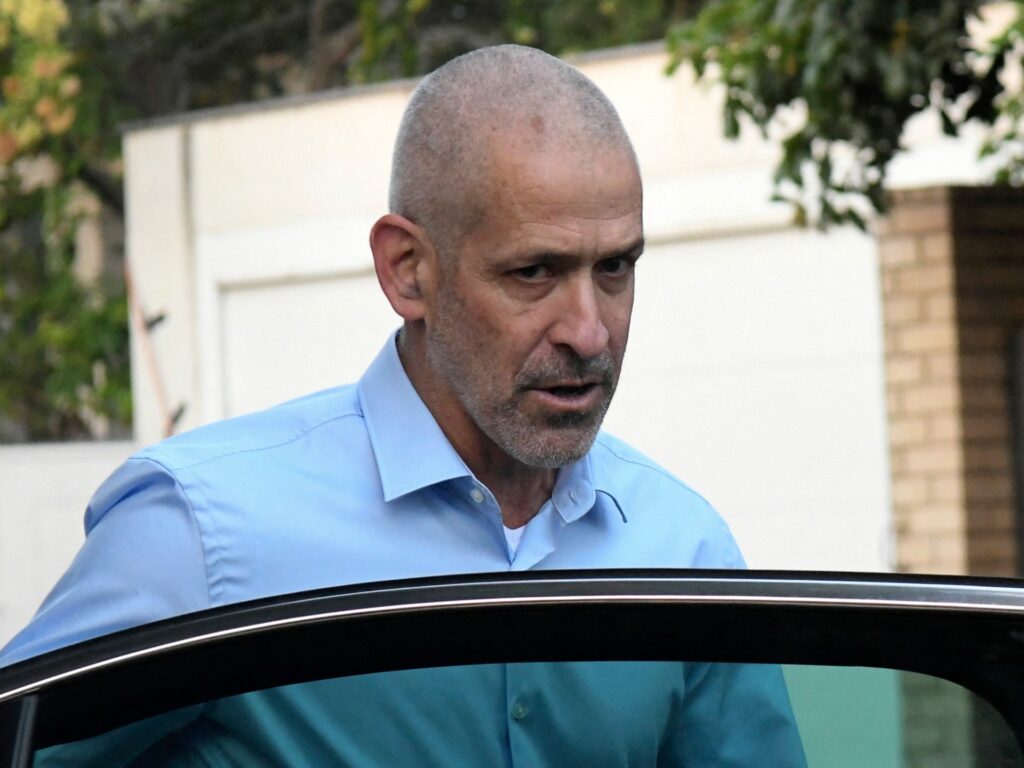
NewsFeed “Israel under Netanyahu is becoming more and more authoritarian.” Prime Minister Benjamin Netanyahu’s attempts to fire the Shin Bet spy chief and Israel’s attorney general have many worried the country may not survive as a democracy. Published On 21 Mar 202521 Mar 2025 Adblock test (Why?)
What challenges lie ahead for the new IOC president?

Zimbabwean lands top job in world sport. Kirsty Coventry becomes the first woman and first African to lead the International Olympic Committee, the world’s largest sports body. Bans on Russia but not Israel and the role of money in the Olympic Games are two challenges she faces. What other hurdles lie ahead? Presenter: Sami Zeidan Guests: Philip Barker – editor-in-chief of the Journal of Olympic History Donald Rukare – president of the Uganda Olympic Committee Bassil Mikdadi – founder of the FootballPalestine.com website Adblock test (Why?)
Trying to heal the trauma of Israeli raids in the occupied West Bank
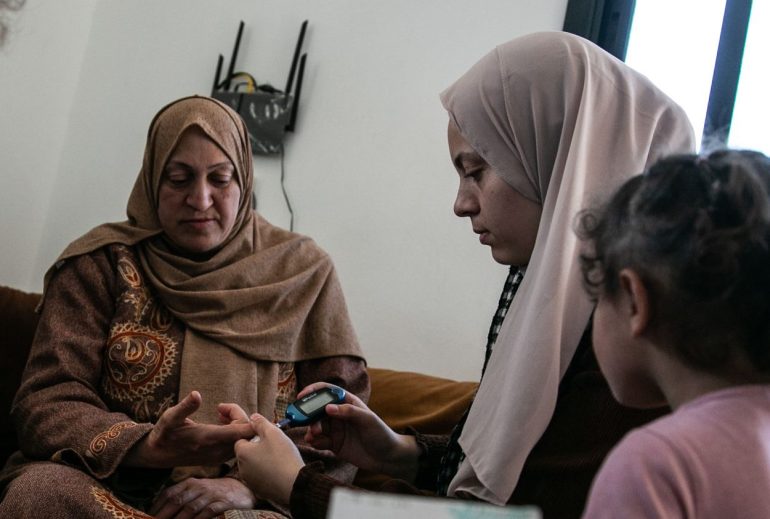
Jenin and Tulkarem, occupied West Bank – Omaima Faraj bows her head in silence for a moment – she’s tired, but the work does not stop. She arrives at a school-turned-shelter near Tulkarem where her first patient, an elderly displaced woman who greets her tenderly, is waiting for her to measure her glucose and blood pressure. Then she moves to the next classroom, the next patient, walking down an open passage drenched in late-February sunshine. Faraj, 25, has been volunteering to help residents devastated by the Israeli raids for weeks. She is one of the young Palestinians working to address the emergency Israel is creating across the occupied West Bank as it raids refugee camps and displaces thousands. Rushing into danger When Israel’s military occupation and displacement of the camp began in what the Israelis have called operation “Iron Wall”, on January 21, Faraj rushed into the camp instead of running away from the violence. The volunteers prioritise visits to patients with chronic diseases [Al Jazeera] She stayed there with her fellow volunteers for more than 12 critical days, when the attacks were at their fiercest and people were still trying to organise to flee the camp. Advertisement They focused on delivering aid to people in need – the injured, the elderly, and people with limited mobility. Nobody could get to a hospital because the Israeli soldiers wouldn’t let them. Israeli soldiers harassed the volunteers, Faraj recounts, describing how they would threaten her and her colleagues, telling them to leave and never return or they’d be shot. One incident particularly haunts her, of an elderly man who was trapped in his house for four days. The team kept trying to reach him, but Israeli soldiers blocked their path. Finally, the International Committee of the Red Cross intervened, coordinating with the Israelis to allow safe passage for the volunteers. When they reached the man, he was in dire straits – lacking food, water and hygiene for four days, but they were finally able to evacuate him. As they were leaving, they were goaded, warned not to return – or risk being shot. Backpack medics “We didn’t have an emergency plan for this,” says Alaa Srouji, director of the Al-Awda Center in Tulkarem. Two volunteers visit an elderly displaced woman to help her and check her health [Al Jazeera] Al-Awda and the Lajee Center of Aida Camp in Bethlehem are training volunteers to document the expulsions of people and camp conditions so they can assess the aid needed. The volunteers are about 15 mostly female nurses and medics who came together when the Israeli raids began, to provide medical aid and distribute essentials to the thousands who were harmed. Their young faces show the toll of nearly two months of working nonstop with people displaced by the Israeli attack on the Nur Shams and Tulkarem camps. Advertisement They are struggling to fill a huge gap left when Israel banned the United Nations Palestinian refugee agency (UNRWA) from helping people in the occupied West Bank. These volunteers don’t have headquarters, they spend all day walking around to serve people with nothing more than their backpacks and determination. They go to one of the 11 temporary, hurriedly set up shelters or wherever their patients have managed to find a place to live. They bring medical and psychological support and also clothes, food, and other necessities to those who have lost everything to Israel’s raiding soldiers. Ismael, 23, risked returning to Tulkarem camp, where his home was. He stands in awe of the destruction Israel has inflicted [Al Jazeera] In their backpacks are gauze, portable glucose monitors, gloves, bandages, tourniquets, manual blood pressure monitors, notebooks and pens. “Our role as a local community is so important,” says Alaa. The volunteers must also support each other emotionally, holding group sessions to cope with the toll of working within their devastated communities. Many of them are from the camp, so they are also displaced, targeted, and have seen their neighbourhoods levelled by Israeli bulldozers. Faraj is no different. Like many Palestinians, she is marked by loss and violence after her 18-year-old brother was killed by an Israeli drone in January 2024. The camp is a no-go zone. Some displaced residents take the risk of returning to their homes to try to retrieve some of their belongings. They navigate rubble-filled streets, the stench of rotting food left behind in now-abandoned houses, and sewers torn open by bulldozers, while Israeli soldiers patrol and drones hover overhead, searching for movement inside the camp. Advertisement Laughing, crying, screaming the trauma An hour’s drive from Tulkarem is Jenin, and 10 minutes from Jenin is a village called Kafr Dan where an unusual sound filters in the air – children’s laughter. Children shout, jump, and scream during a Freedom Theater programme to allow them to discuss their trauma and give them a space for play and laughter [Al Jazeera] About 20 children roam around the garden of a large house. They’re gathered into a rough circle by trainers who encourage them to speak – loudly – to let out their fear and anger. The activity is organised by the Freedom Theater of Jenin, which came to Kafr Dan to provide this moment of respite for displaced children to simply be, at least for a moment. They started up inside Jenin camp as a space where children and youth could participate in cultural activities but have been blocked by the Israeli army from being there. So, “We bring the theatre to the children,” says Shatha Jarrar, one of the three activity coordinators. The children are encouraged to be as loud as they like, to scream out the fear and anger they hold inside after the violence they have been exposed to. A game involving a small ball balanced on a spoon is next, making the children laugh again and their watching mothers smile, happy to see their children happy. Sitting by the side is a smiling Um Muhammed, 67, who has brought some of
Migrant deaths hit record number in 2024, UN agency says
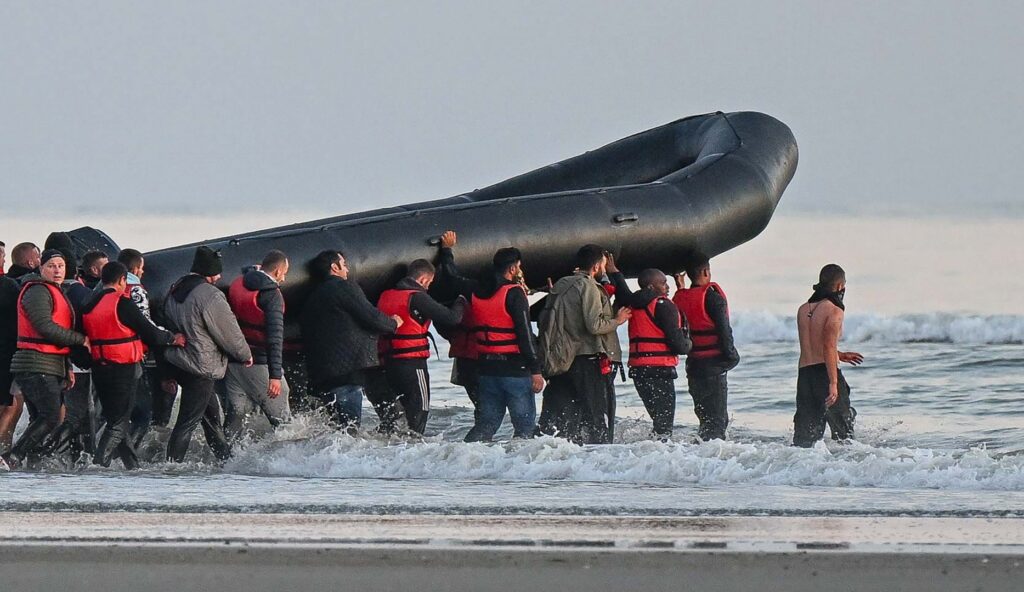
Nearly 9,000 fatalities confirmed worldwide, but real toll likely much higher. Nearly 9,000 people died last year trying to cross borders, the United Nations agency for migration says. The death toll set a new grim record for the fifth year in a row. The number of deaths on migratory routes has more than doubled since 2020. The International Organization for Migration (IOM) recorded 8,938 migrant deaths in 2024. The real death toll is likely much higher given that many deaths go unreported or undocumented, the IOM said in a statement on Friday. “The rise of deaths is terrible in and of itself, but the fact that thousands remained unidentified each year is even more tragic,” Julia Black, coordinator of the IOM’s Missing Migrants Project, said in the statement. The IOM’s deputy director general for operations, Ugochi Daniels, said: “The increase in deaths across so many regions in the world shows why we need an international, holistic response that can prevent further tragic loss of life.” “Behind every number is a human being, someone for whom the loss is devastating,” he added. Advertisement Asia was the region with the most reported fatalities with 2,788, followed by the Mediterranean Sea with 2,452 and Africa with 2,242. Final data are not yet in for the Americas, but at least 1,233 deaths (including 341 in the Caribbean) occurred in 2024. At least 233 migrants lost their lives in Europe and 174 in the Darien Gap between Colombia and Panama, a new record. According to the IOM, migrants are all people who leave their place of residence for any reason, for any length of time, whether voluntarily or involuntarily. Some seek asylum because they are fleeing war or violence. News of the record death toll comes days after the agency announced it was suspending many “lifesaving” programmes around the world and firing hundreds of employees due to United States aid cuts, impacting millions of vulnerable migrants and refugees worldwide. The Geneva-based IOM is one of several groups helping displaced people that have been hit by major US aid cuts, forcing it to scale back or shutter programmes, which it said will have a severe impact on migrants. Adblock test (Why?)
Israeli ex-deputy FM confronted over Israel’s renewed assault on Gaza

Redi Tlhabi challenges ex-Israeli deputy foreign minister Danny Ayalon on Israel’s ceasefire breach and its war on Gaza. Israel has shattered the ceasefire with Hamas this week through extensive air raids that killed hundreds of civilians, including at least 200 children. Israeli ground troops were also deployed, ending the ceasefire that lasted just less than two months. Then, on Tuesday, Israeli Defense Minister Israel Katz threatened the residents of Gaza with “destruction and devastation” if they did not expel Hamas. So, what lies ahead for Gaza and is it in danger of a complete takeover? This week on UpFront, Redi Tlhabi speaks with Israel’s former deputy foreign minister about Israel’s war in Gaza. Adblock test (Why?)
Are Gen Z rejecting city life for farm life?

Today on The Stream: We examine why so many people of Gen Z age are choosing farm life over city dwellings. Faced with burnout, soaring rents, and a yearning for a slower, more intentional life, Gen Z is leaving cities behind for farms. From homesteading to off-grid communities, young people are redefining success through self-sufficiency and sustainability. But is rural life truly the answer, or does it bring its own set of challenges? With increasing land costs, social isolation, and infrastructure limitations, can this movement endure? We hear from those embracing this shift. Is rural living the key to a healthier, more sustainable society? Presenter: Anelise Borges Guests:Shannon Hayes – CEO, SAP Bush Hollow FarmVictor Gabriel Lara – Creative directorPatrick Vernuccio – Urban gardening content creator and authorMohammed Ali Al Khater – Co-Founder and CEO, Torba Farm Adblock test (Why?)
Beijing slams request by US lawmaker for information on Chinese students
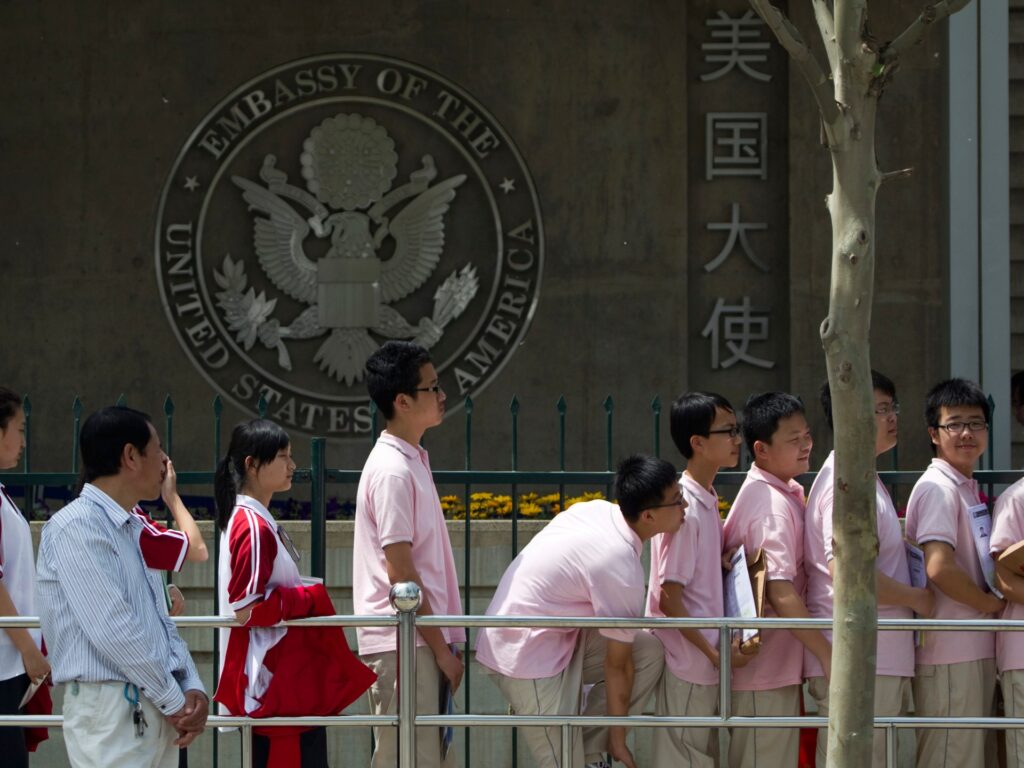
US congressional panel asks six US universities to share data on students enrolled in science and technology programmes. China’s Ministry of Foreign Affairs has protested a request from a US congressional panel this week for six universities in the United States to provide detailed information about Chinese students enrolled in advanced science and technology programmes. The letters were sent on Thursday by John Moolenaar, the chair of the US House Select Committee on the Chinese Communist Party, who alleged that Beijing was embedding its students in top research programmes to gain access to sensitive technology. In response, China’s Foreign Ministry spokesperson Mao Ning urged the US to “stop overstretching the concept of national security” and to “protect the legitimate rights and interests of Chinese students” in the country. Mao told reporters that Chinese students make up about 25 percent of all foreign students in the US and contribute to its “economic prosperity and technological development”. In recent years, US universities have widely welcomed Chinese students as a key funding source, as they often pay full international tuition. Advertisement However, the growing number of Chinese students has alarmed lawmakers like Moolenaar, who accused university administrators of jeopardising US research in exchange for higher tuition revenue. ‘Trojan Horse’ Moolenaar stated in his letter that the student visa system had become a “Trojan Horse” for Beijing, “providing unrestricted access to our top research institutions and posing a direct threat to our national security”. “The Chinese Communist Party has established a well-documented, systematic pipeline to embed researchers in leading US institutions, providing them direct exposure to sensitive technologies with dual-use military applications,” Moolenaar’s letter said. Letters were sent to Carnegie Mellon University, Purdue University, Stanford University, the University of Illinois, the University of Maryland, and the University of Southern California. They included requests for information on funding sources and the type of research carried out by Chinese students. The requests also sought “a country-by-country breakdown of applicants, admittances, and enrolments” at the universities. Student visas The letters follow a move earlier this week by Representative Riley Moore of West Virginia to stop Chinese citizens from receiving visas to study in the US or attend exchange programmes. Moore introduced a bill known as the “Stop CCP Visas Act” to Congress, though it is not expected to pass due to widespread opposition. Critics argue that the bill is reminiscent of the Chinese Exclusion Act, which restricted Chinese immigration to the US from 1882 to 1943. Advertisement Moore told NBC News that he would “never apologise for defending America’s national interests against our greatest geopolitical foe”. Adblock test (Why?)
Sudanese army retakes presidential palace
[unable to retrieve full-text content] Sudan’s army has retaken the presidential palace in the capital Khartoum, nearly two years after it was seized.
Fire causes day-long shutdown of UK’s Heathrow Airport
[unable to retrieve full-text content] London’s Heathrow Airport has been closed due to a nearby fire that caused a major power cut.