

UN humanitarian chief on worsening aid situation in Gaza

NewsFeed UN humanitarian chief Tom Fletcher told the UN Security Council that in addition to Tuesday’s airstrikes on Gaza, he was “distressed” by Israeli authorities cutting off aid to 2.1 million people in the enclave. Published On 18 Mar 202518 Mar 2025 Adblock test (Why?)
NASA astronauts stuck in space returning to Earth: All you need to know
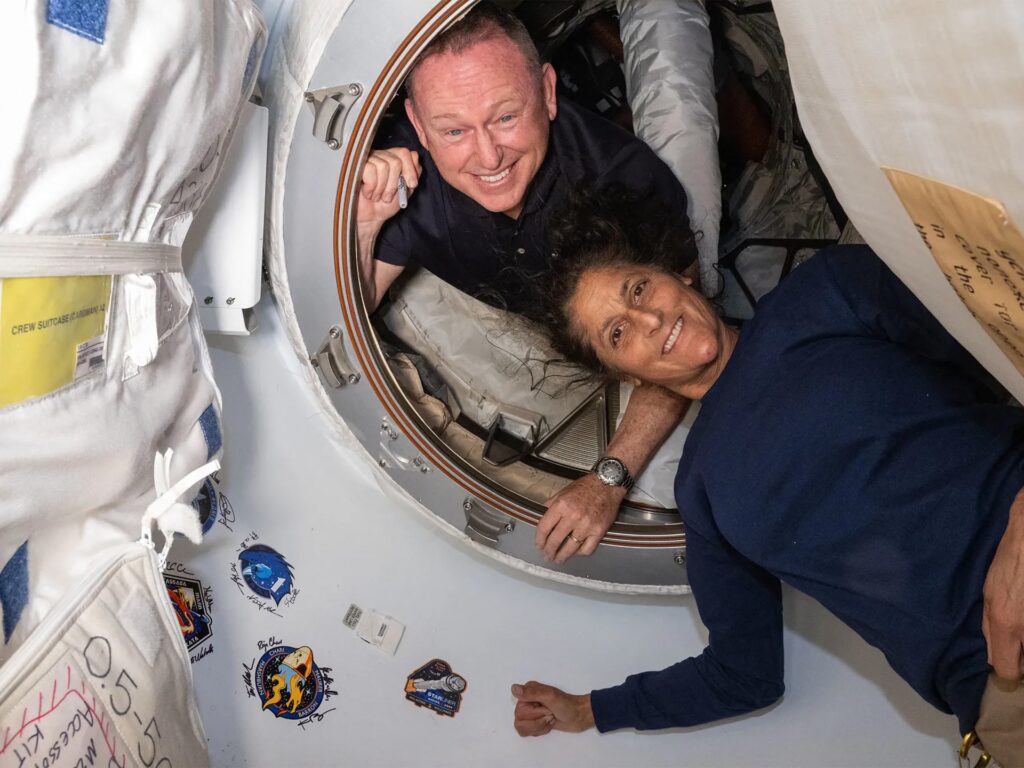
Two NASA astronauts are headed to Earth after spending nine months stranded in space. Sunita Williams and Barry Wilmore departed the International Space Station (ISS) early on Tuesday morning and are expected to splash down off the coast of Florida after a journey of 17 hours. Boeing’s Starliner, their original return spacecraft, was deemed unsafe for the journey home, forcing the astronauts to stay in space much longer than planned. Here’s all you need to know about their extended stay and long-awaited return: Who are the two astronauts who were stuck in space? The two astronauts stranded on board the International Space Station (ISS) are 59-year-old Sunita “Suni” Williams and Barry “Butch” Wilmore, 62, both veteran NASA-trained space travellers. Williams, the current commander of the ISS and a retired US Navy officer, joined NASA in 1998. Over her career, she has spent 322 days in space and completed nine spacewalks. She previously held the record for the most spacewalks by a female astronaut, until 2017 when the title went to Peggy Whitson, who completed 10. Advertisement Wilmore first flew to space in 2009 on board the Space Shuttle Atlantis. Before the Boeing Starliner mission, he had logged 178 days in space. He has served as a flight engineer and commander on previous ISS missions, conducting research on plant growth in space, the effects of microgravity on the human body and environmental changes on Earth. In the Boeing mission, Wilmore served as the commander and Williams was the pilot. When and how are they coming back to Earth? The SpaceX Crew Dragon carrying Wilmore and Williams undocked from the ISS at 1.05am ET (05:05 GMT) on Tuesday. It is expected to splash into the Atlantic Ocean just before 6pm ET (22:00 GMT). Late on Monday night, the process for Williams and Wilmore to return started. Hatch closure preparations began at 10:45pm ET (02:45 GMT). NASA is livestreaming the departure and return journey of the astronauts. They are returning on board a SpaceX Crew Dragon capsule, which had been docked at the station since September 2024. This capsule originally brought NASA astronaut Nick Hague and Russian astronaut Aleksandr Gorbunov to the ISS, with two empty seats left for Wilmore and Williams’ return. The four could not return on the same capsule until an additional crew carrying four other astronauts arrived to replace them. That has now happened. Crew-10, which docked at the ISS on Sunday at 12:04am ET (04:04 GMT), consists of NASA astronauts Anne McClain and Nichole Ayers, Japanese astronaut Takuya Onishi, and Russian astronaut Kirill Peskov. They launched from Kennedy Space Center in Florida, US, on Friday. Advertisement Why did they get stuck? Williams and Wilmore got stuck after technical issues with the spacecraft meant to bring them home. They had travelled to the ISS on board Boeing’s CST-100 Starliner as part of its first crewed test flight. The mission, under NASA’s Commercial Crew Program, aimed to develop private spacecraft for transporting astronauts to and from the station. By outsourcing low-Earth orbit missions, NASA has said it aims to focus on deep space exploration, including the Artemis missions to the moon and future human missions to Mars. During the 25-hour flight to the ISS, Starliner experienced helium leaks and a malfunctioning thruster, which helps steer and control reentry. When it arrived on June 6, four more of the 28 thrusters failed, delaying docking with the station. Although engineers restored four out of five failed thrusters, NASA deemed the spacecraft too risky for human travel and sent it back empty, leaving Williams and Wilmore stranded on the ISS. In August 2024, NASA decided to bring them back on a SpaceX vehicle. Crew Dragon-9, which launched on September 29, 2024, has been docked at the ISS since, but bringing them home earlier would have left only one US astronaut on the space station, limiting research and emergency response. Now, with their replacement members arriving on Crew-10, Williams and Wilmore are finally headed home. How long have the two astronauts been stuck in space? Williams and Wilmore have been in space since June 5, 2024, meaning they will have spent more than nine months in orbit by the time they return. Advertisement After blasting off from Cape Canaveral, Florida, in June, they were originally scheduled to stay in space for just eight days. The standard ISS rotation for astronauts is roughly six months. How did they survive in space for so long? Despite the unexpected extension of their stay, Williams and Wilmore have remained in good health and even conducted a spacewalk together in January. Life on board the ISS follows a structured routine with exercise, work and leisure. This includes regular routines on both the treadmill and resistance machine in order to maintain their bone and muscle strength. Throughout the year, several space agencies and private companies also scheduled missions to resupply the space station with food, water and oxygen, regularly replenished by cargo missions. Over Christmas, the two even enjoyed a festive dinner that included smoked oysters, crab, duck foie gras, cranberry sauce, Atlantic lobster and smoked salmon, according to The Times newspaper in London. Williams and Wilmore have also been able to maintain contact with their families through email and telephone. In an interview with Lester Holt on NBC Nightly News in November, Williams said she and Wilmore were “feeling good, working out, eating right”. “We have a lot of fun up here too,” she added. “People who are worried about us, really, don’t worry about us … We’re a happy crew up here.” Have astronauts been stuck in space before? Williams and Wilmore are not the first astronauts to face an extended stay in space due to unforeseen circumstances. There have been previous cases where astronauts had to remain in orbit longer than planned due to technical problems or geopolitical events. Advertisement The longest single spaceflight by a US astronaut was Frank Rubio’s 371-day mission on board the ISS, from 2022 to 2023, extended due to issues with
Israel launches major Gaza assault, shattering ceasefire

Israel has launched a major assault on Gaza, shattering the fragile two-month-old ceasefire between its forces and Hamas. Israeli air strikes across the territory early on Tuesday killed more than 200 Palestinians, Gaza’s Government Media Office said. The dead included at least 77 people in Khan Younis in southern Gaza and at least 20 people in Gaza City in the north, medical sources told Al Jazeera. Israel strikes also hit locations in central Deir el-Balah and Rafah in the south. Israeli Prime Minister Benjamin Netanyahu said he ordered the military to take “strong action” against Hamas over its refusal to release captives taken from Israel or agree to offers to extend the ceasefire. “Israel will, from now on, act against Hamas with increasing military strength,” the Prime Minister’s Office said in a statement. The Israeli military said on Telegram that it was conducting “extensive strikes on terror targets” belonging to Hamas. Hamas, which governs Gaza, said it viewed Israel’s attacks as a unilateral cancellation of the ceasefire that began on January 19. Advertisement “Netanyahu and his extremist government are making a decision to overturn the ceasefire agreement, exposing prisoners in Gaza to an unknown fate,” the Palestinian group said in a statement. Palestinian Islamic Jihad (PIJ) accused Israel of “deliberately sabotaging all efforts to reach a ceasefire”. “We affirm that what Netanyahu and his barbaric army failed to achieve in 15 months of crimes and bloodshed, they will not succeed in achieving again, thanks to the steadfastness of our oppressed people and the courage of our mujahideen in the fields of… resistance,” the group said, according to a statement shared with Israel’s Haaretz newspaper. Injured Palestinians are brought to the Al Nasser Hospital in Khan Yunis, Gaza on March 18, 2025 [Abdallah F.s. Alatta/Anadolu] Ahmed Abu Rizq, a teacher in Gaza, said he and his family woke up the sound of “Israeli strikes everywhere.” “We were frightened, our children were frightened. We had many calls from our relatives to check, to check [on] ourselves. And the ambulance started to run from one street to another,” Abu Rizq told Al Jazeera, adding that families started to arrive at the local hospital with the “remains of their children” in their hands. Reporting from Amman, Jordan, Al Jazeera’s Hamdah Salhut said that while Israel has accused Hamas of rejecting various proposals made by negotiators, talks had been stalled after Netanyahu refused to begin negotiations on phase two of the ceasefire deal on February 6. “Several Israeli analysts, several within the political opposition and several within Netanyahu’s own government said that this was the plan all along, a resumption of the fighting, to go back to full-scale war,” Salhut said. Advertisement “And in fact, there’s a new army chief of staff, one who said that 2025 is going to be a year of war – noting that Israel still has a lot of goals to accomplish when it comes to the Gaza Strip, meaning that they are in no way finished with their military action.” Hamas has released about three dozen captives in exchange for nearly 2,000 Palestinian prisoners since the start of the ceasefire. Negotiations on the second phase of the deal, which would see the release of nearly 60 remaining captives and the establishment of a permanent ceasefire, had been at an impasse over Israel’s insistence that the first stage be extended until mid-April. Mouin Rabbani, a non-resident fellow at the Middle East Council on Global Affairs, said it was unclear if the attacks marked a single offensive or “the beginning of a larger campaign”. “The most important element of which, from Israel’s perspective, was negotiations on the second phase leading to a durable ceasefire and a full withdrawal of Israeli troops from the Gaza Strip,” Rabbani told Al Jazeera. “And that is something that the Israeli government has repeatedly said it would not do.” “In other words, [Israel] signed an agreement, knowing that it would refuse to implement it,” he said. White House Press Secretary Karoline Leavitt said Israel had consulted with United States President Donald Trump about the strikes. “As President Trump has made clear, Hamas, the Houthis, Iran – all those who seek to terrorise not just Israel but the US – will see a price to pay, and all hell will break loose,” Leavitt told Fox News. Advertisement Adblock test (Why?)
Two people killed in Israeli air strike on Deraa in southern Syria

The Israeli army said it had targeted military sites in southern Syria that posed a ‘threat to the State of Israel’. At least two people were killed and 19 others wounded after an Israeli air strike on the outskirts of the southern Syrian province of Deraa, the Syrian state news agency, SANA, has reported. The Israeli military confirmed the strikes Monday night and said it was targeting military sites that contained weapons and vehicles that belonged to the forces of ousted Syrian President Bashar al-Assad. The Israeli army “is currently striking military targets in southern Syria, including command centres and military sites containing weapons and military vehicles belonging to the old Syrian regime,” an army statement said, adding that the “military assets” posed “a threat to the State of Israel”. The army said it “will not allow the presence of military threats in southern Syria and will operate against it”. The Syrian Observatory for Human Rights said Israel targeted a military site previously used by al-Assad’s forces but now used by the army of Syria’s new government. However, this is not the first time Israel has targeted the southern Deraa province, near the Jordanian border. Earlier this month, it targeted several Syrian military assets in the same area. Advertisement The Israeli military said at the time that the military sites, which had included bases and radar systems, posed a threat that the strike was meant to “eliminate”. Reporting from Damascus, Al Jazeera’s Resul Serdar said four Israeli air strikes targeted Deraa on Monday night. “This is a strategy of Israel [to] really reduce the country’s military capacity, particularly its defence capacity, and now Israel is going further, saying well it doesn’t want any military presence in the south of Syria,” Serdar said. “Of course, for the government in Damascus [this] is a huge, huge challenge, so practically, that means they’re not in control of the southern cities of Syria,” he added. Since al-Assad was ousted, Israel has carried out hundreds of air strikes in Syria and deployed troops to a United Nations-patrolled buffer zone on the Golan Heights. While al-Assad was in power, Israel also routinely attacked Syria, bombing what it said were Iranian and Hezbollah targets. Adblock test (Why?)
Video: Thousands of Yemenis rally in Sanaa against deadly US strikes
[unable to retrieve full-text content] Thousands of Yemeni demonstrators marched in the streets of Sanaa to protest the deadly US military strikes.
Trump says he will release 80,000 pages of JFK files on Tuesday

US president says files contain ‘a lot of reading’ about assassination that has fuelled conspiracy theories for decades. United States President Donald Trump has said his administration will on Tuesday release approximately 80,000 pages of files about the assassination of John F Kennedy, whose killing has fuelled conspiracy theories for more than six decades. Speaking at the Kennedy Center on Monday, Trump said the release will contain “a lot of reading” about the assassination of the 35th US president, who was killed in Dallas, Texas on November 22, 1963. “I don’t believe we are going to redact anything. I said, ‘just don’t redact, you can’t redact’,” Trump told reporters. “But we are going to be releasing the JFK files.” Asked if he had seen what was in the files, Trump said he was aware of their contents. “It’s going to be very interesting,” he said. Trump’s remarks follow a January executive order calling for the release of all remaining records on the JFK assassination, as well as files related to the assassinations of Robert F Kennedy and the civil rights icon Martin Luther King Jr. Under the order, Trump instructed the director of national intelligence, Tulsi Gabbard, to present a plan within 15 days for the “full and complete release” of files on the JFK assassination. Advertisement Last month, the FBI said that searches it had undertaken to comply with the order had turned up about 2,400 new files related to the assassination. The circumstances of JFK’s death have captivated US society for decades, with surveys showing a majority of Americans doubt official explanations of the case. In a 2023 Gallup poll, 65 percent of Americans said they did not accept the Warren Commission’s finding that Lee Harvey Oswald, a US Marine veteran arrested over JFK’s death, acted alone in killing the president. Twenty percent of those surveyed said they believed Oswald conspired with the US government, while 16 percent said they thought that he worked with the CIA. During his first administration, Trump promised to disclose all outstanding records on the assassination but ultimately only released about 2,800 documents after the CIA and FBI requested that thousands of pages of material be withheld pending review. Former US President Joe Biden’s administration released about 17,000 more records, leaving fewer than 4,700 files withheld in part or in full. According to the National Archives, authorities have released more than 99 percent of the approximately 320,000 documents reviewed under the 1992 JFK Records Act. The law mandated the disclosure of all remaining files by October 26, 2017, unless the president determined their release would cause “identifiable harm” to national defence, intelligence operations, law enforcement or foreign relations of such gravity that it “outweighs the public interest in disclosure”. Advertisement Adblock test (Why?)
Israeli forces detain and strip-search children in the occupied West Bank
[unable to retrieve full-text content] Two Palestinian boys were left in underwear after hours of Israeli detention and interrogation in the occupied West Bank
Palestinians in Gaza suffer extreme hunger under Israeli blockade
[unable to retrieve full-text content] Millions of people in Gaza are facing severe food and water shortages as Israel continues to block aid.
No, ‘nerds’ and their technologies are not going to save the world

The United States is in the midst of a soft coup. The country is being reshaped and restructured under the second administration of Donald Trump. It is not Trump himself, but his billionaire special adviser, Department of Government Efficiency (DOGE) head Elon Musk, who is guiding this change. And in Musk’s America, there is one demographic that seems to have found itself at centre stage and rapidly gaining power: “nerds”. Indeed, Musk’s mendacious band of merry, young white and white-adjacent acolytes, including Gavin Kliger, Edward Coristine, and Marko Elez, who has gained control over multitrillion-dollar government systems, easily fit the mold of nerd. The Information Age and the Internet Age that it spawned in the 1990s had already seen “nerds” – awkward, unattractive men with limited social skills but immense commitment to and enthusiasm for tech and STEM – become billionaires and gain widespread respect and admiration for delivering the world technologies that change lives. It was, we were repeatedly reminded, nerds who first gave us PCs and iMacs and then iPhones and Androids. Advertisement In numerous articles in tech magazines and in movies like Revenge of the Nerds (1984), Oppenheimer (2023), Steve Jobs (2015), and The Social Network (2010), creatives have portrayed nerds like nuclear weapons developer J Robert Oppenheimer, Apple’s Steve Jobs, and Meta’s Mark Zuckerberg as underdogs. Popular media have long described such nerdy visionaries as complex people with a tremendous need to save the world and make it a better place. Three decades ago, the UK’s Channel 4 and the US’s Public Broadcasting Service (PBS) aired the three-part documentary titled Triumph of the Nerds. Referencing the computer revolution the nerd set launched between 1975 and 1995, longtime technology journalist Robert X Cringely said, “The most amazing thing of all is that it happened by accident because a bunch of disenfranchised nerds wanted to impress their friends.” This perception of billionaire nerds may by now be a deep-rooted part of our culture, but the idea that the robber barons of the late 20th century accumulated immense wealth, almost by accident, while trying to save the world is a ridiculous lie. Especially given the iron-fisted ways in which we know many “nerd billionaires” – and especially Jobs and Bill Gates – ran their capitalist ventures. In light of the heavy-handed censorship that billionaires like Jeff Bezos and Patrick Soon-Shiong have exercised with the Washington Post and the Los Angeles Times in recent months, it is apparent that the tech-savvy billionaire class wants to control the flow of truth as well. Advertisement A much better description of the “nerds” who came to rule America under Trump was given in a single line in Lethal Weapon 2 (1989), when Martin Riggs (Mel Gibson), having extralegally entered the South African consulate, said to Arjen Rudd (Joss Ackland) and his group of apartheid-loving white South African mercenaries, “Well, well … it’s the master race!” This quote is far more than just a reference to Musk’s dubious path to US citizenship through South Africa and Canada. It’s about the reality that, like the South African henchmen in Lethal Weapon 2, tech nerd billionaires such as Musk and the people he has employed at DOGE believe in apartheid, eugenics, and other racist, misogynistic, and queerphobic paradigms. Sure, many of the Musk fanboys are engineers, can write, and make contributions to Tesla, SpaceX, and Starlink that lead to important and useful-to-humanity discoveries and inventions. Nevertheless, they also repost tweets on X and other social media platforms that refer to a woman as a “huzz” or declare “I just want a eugenic immigration policy, is that too much to ask?”. They are not exactly great role models for a multicultural democracy or for any workforce. And, like white men in general, they don’t seem to be concerned about making the world a better place for anyone other than themselves. They would too readily agree with Zuckerberg’s ridiculous claim that the tech world needs more “masculine energy”, when, in fact, white men remain the dominant demographic leading this economic sector. Advertisement I was once a part of the computer-crazy nerd world in the 1980s and 1990s. I learned Basic in eighth grade, took Pascal in 11th grade, and spent my first three semesters at the University of Pittsburgh as a computer science major before changing my path to becoming a writer and academic historian. As a work-study student, I worked in Pitt’s computing labs for two years. I observed as my equally geeky co-workers made jokes about our “computer illiterate” classmates (including the regular use of the r-word). I watched my male counterparts rub up too closely to the women who needed their help troubleshooting computer issues. And in my last three months on staff, I experienced sexual and racial harassment from an older white woman, a co-worker who groped me twice while at work. Social awkwardness can easily be portrayed as innocent and endearing in a film. But it rarely if ever translates to “sweet” in a world that socially defaults to racist, misogynistic, queerphobic, and xenophobic behaviours. Nerds or not, all white men in a white male supremacist society hold a metric tonne of racial and gender privilege – a sense of entitlement that, when left unchecked, makes them no different from “cool” white guys. Booger asking Gilbert, “Why? Does she have a penis?” – a transphobic reference to his friend not getting laid in Revenge of the Nerds – isn’t much different than Musk declaring that he “lost” his “son” – his estranged transgender daughter Vivian Jenna Wilson – to “the woke mind virus”. Advertisement There’s also the embedded assumption that the technologies created by the elite nerd set have always been good for the world. Not when addiction to social media has led to millions of younger Americans becoming depressed, anxious, and isolated. Not with a new generation of American males doxxing and committing image-based sexual abuse against girls and women. Certainly not when the plagiarism machines of AI (which isn’t true
EU warns of threat to Syrian transition while pledging billions in aid

NewsFeed The EU has pledged $2.7 billion in aid to Syria to help the country rebuild after the fall of Bashar al-Assad. The bloc made the pledge at a gathering of donor countries while warning that recent violence could threaten the progress made under the new leadership in Damascus. Published On 17 Mar 202517 Mar 2025 Adblock test (Why?)