

Russia, China call on US to drop Iran sanctions, restart nuclear talks
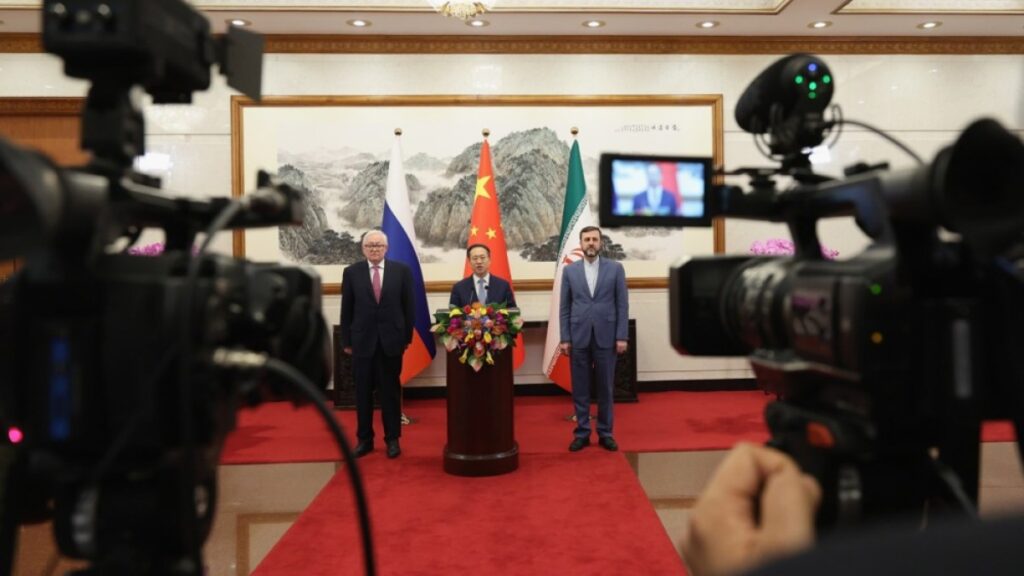
Deputy foreign ministers of Russia, China and Iran call for multilateral talks on ending ‘unlawful’ US sanctions. Representatives of Iran, Russia and China have urged United States President Donald Trump’s administration to end sanctions imposed against Tehran over its rapidly advancing nuclear programme, while calling for the resumption of the multilateral talks on the issue. The three nations “emphasised the necessity of terminating all unlawful unilateral sanctions”, China’s Vice Foreign Minister Ma Zhaoxu read from a joint statement issued on Friday. He was flanked by his counterparts from Russia, Ryabkov Sergey Alexeevich, and Iran, Kazem Gharibabadi. “The relevant parties should work to eliminate the root causes of the current situation and abandon sanctions, pressure and threats of the use of force,” Ma said. Iran’s Gharibabadi praised the meeting as “very constructive and positive”, even as he accused “some countries” of creating “an unnecessary crisis” to thwart Tehran. Later on Friday, Chinese Foreign Minister Wang Yi was due to meet with the three senior diplomats. The talks are the latest attempt to resolve the Iran impasse, as Trump tries to reach out to its Supreme Leader Ayatollah Ali Khamenei in an attempt to jumpstart talks. Advertisement Any progress on the Iran talks with the Trump administration requires the support of Russia and China, which are both permanent members of the United Nations Security Council alongside the US, France and Britain. The approval of the Security Council paved the way for the implementation of the 2015 Iran nuclear deal, which Trump abandoned in 2018 during his first term as president, setting in motion years of attacks and tensions in the wider Middle East. Under the original 2015 nuclear deal, Iran was allowed to enrich uranium only up to 3.67 percent purity and to maintain a uranium stockpile of 300 kilogrammes (661 pounds). The last report by the International Atomic Energy Agency (IAEA) on Iran’s programme put its stockpile at 8,294.4kg (18,286 pounds) as it enriches a fraction of it to 60 percent purity. Iran insists its nuclear programme is peaceful. While Iran has maintained it would not negotiate under threat, its economy has been savaged by the US sanctions. Protests over women’s rights, the economy and Iran’s theocracy in recent years have shaken its government. Last Friday, Trump said he had sent a letter to Khamenei, urging negotiations but also warning of possible military action. In response, Khamenei mocked the US president saying he was not interested in talks with a “bullying government”. He complained that Tehran “negotiated for years, reached a complete and signed agreement”, and Trump “tore it up”. Iranian President Masoud Pezeshkian also said that he would not negotiate with the US while being “threatened”, and Iran would not bow to US “orders” to talk. But he had previously said in a speech to the UN that Tehran was “ready to engage”. Advertisement Other Iranian officials have offered some signals over the possibility of negotiations, and the latest meeting in Beijing could indicate its openness for new talks. Adblock test (Why?)
South Sudan’s rising violence in “polarised regional environment”
Alan Boswell of the International Crisis Group unpacks South Sudan’s escalating violence, who’s behind it, and what’s next. Alan Boswell from the International Crisis Group unpacks what’s happening on the ground in South Sudan and the border region, who’s behind the escalating violence and what could further fuel the conflict. Adblock test (Why?)
Alcaraz’s Indian Wells three-peat bid on track with Draper next up
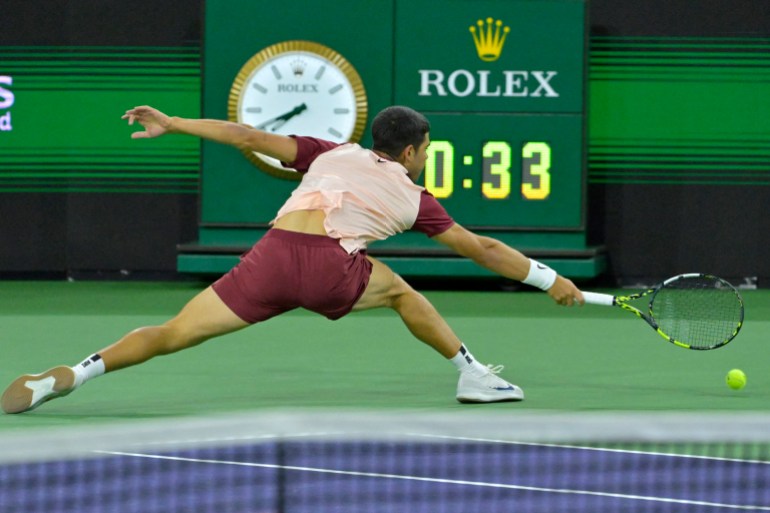
Carlos Alcaraz’s chase of a three-peat at India Wells continued on Thursday evening as the Spaniard overcame Francisco Cerundolo and will face Jack Draper, who in turn ended the hopes of the youngest American since 2004 to reach the event’s quarterfinals. Ben Shelton, at 22, had made headlines for his run on home soil but was stopped by Draper, of the United Kingdom, who claimed a straight sets 6-4 7-5 victory. The 13th-seeded Draper will face number two seed Alcaraz, the two-time defending champion who extended his winning streak at Indian Wells to 16 matches with a 6-3, 7-6 (4) win over Cerundolo. On another cold, blustery night in the California desert, Alcaraz battled back from 1-4 down in the second set, coming up with a break and two love service holds to force the tiebreaker, and keeping his bid to join Roger Federer and Novak Djokovic as the only men to win three straight Indian Wells titles on track. Carlos Alcaraz hits a shot as he defeats Francisco Cerundolo (not pictured) in the quarterfinal [Jayne Kamin-Oncea-Imagn Image/Reuters] Alcaraz had to save break points in each of his first three service games. But after an emphatic hold for 4-3 he gained the first break of the contest with a deft volley and just like that he was serving for the first set. Advertisement After sliding to pop a drop volley winner over the net for set point, Alcaraz drilled a deep forehand that Cerundolo could barely get a racquet on. But it was Cerundolo who broke first in the second, finally converting his ninth break point of the match then holding for 4-1. He couldn’t hold off the world number three, however, who raced to a 5-2 lead in the tiebreaker on the way to victory. “It was really difficult for me to start the match,” said Alcaraz, who looked less comfortable in the windy weather than he did just a day before. “He got a lot of chances in the first set,” Alcaraz said. “I’m just pleased about saving all of them and taking the only one that I had. “I didn’t hit the ball as clear as yesterday, but I just did what I had to and that’s what it’s about.” Jack Draper returns in his victory against Ben Shelton during his quarterfinal [Jayne Kamin-Oncea-Imagn Images/Reuters] Draper took the opening set against Shelton with one break of serve then rallied from 0-3 down in a second-set slugfest. Shelton’s 32 unforced errors included five double-faults – with one to hand Draper a break for 6-5 in the second. Russian Daniil Medvedev, runner-up to Alcaraz in each of the past two years, rallied from a break down in a wild, wind-blown final set to beat Arthur Fils 6-4, 2-6, 7-6 (9/7). The world number six booked a semifinal meeting with Denmark’s Holger Rune, a 5-7, 6-0, 6-3 winner over Tallon Griekspoor. Medvedev, a six-time Grand Slam finalist, trailed 20-year-old Fils 2-4 in the third set of a compelling clash that was momentarily paused as gusting winds sent towels and rubbish cans flying on Stadium Court. Advertisement France’s Fils had shown admirable maturity in the face of Medvedev’s formidable defensive skills. He cut down on the unforced errors that marred his first set to win the second with ease and maintained his poise as he erased an early break in the third to seize the lead. But Medvedev wouldn’t be denied and after forcing the tiebreaker prevailed on his third match point when Fils pushed a backhand volley long. Arthur Fils shakes hands with Daniil Medvedev after their quarterfinal [Jayne Kamin-Oncea-Imagn Images/Reuters] Medvedev, who had won just one of his past nine third-set tiebreakers, gave a leap of sheer joy after securing the win in 2 hours and 25 minutes to keep alive his bid for a first title since 2023 – when he won five. “I lost a lot of tight matches this year where I could have won, should have won maybe,” Medvedev said. “I have lost a lot of tight matches where it goes a little bit 50-50 and the more it goes like that, the more you can lose confidence in the tight moments. “I was happy I was able to get over the line as he saved some match points and had a break lead in the third. I am just happy to win.” Medvedev faces another young gun in Rune, who burst onto the scene in 2022 with a win over Novak Djokovic in the Paris Masters final. Rune has struggled often since, but after dropping the first set he dominated Griekspoor, the 43rd-ranked Dutchman who had removed top-seeded Alexander Zverev in the second round. Madison Keys, meantime, extended her winning streak to 16 matches, reaching the women’s semifinals with a 6-1, 6-1 wipeout of wild-card entry Belinda Bencic. Advertisement The Australian Open champion needed just 65 minutes to hold up her end of a rematch with top-seeded Aryna Sabalenka, who beat Liudmila Samsonova 6-2, 6-3 later. Keys beat Sabalenka in three sets in January at Melbourne Park, denying her a third consecutive title. Adblock test (Why?)
Is Trump trying to pull Putin away from China – and can it work?
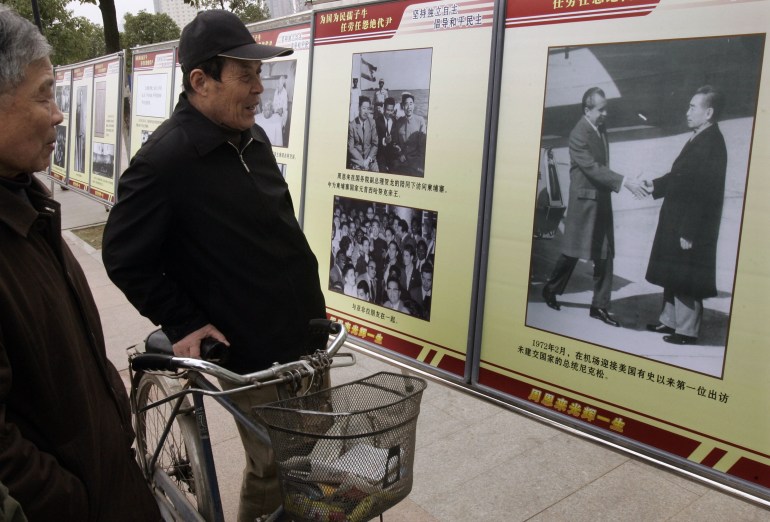
As US President Donald Trump sat in the Oval Office on February 28 with Ukrainian President Volodymyr Zelenskyy for an explosive meeting that would reveal deep fissures between Washington and Kyiv, he was also asked by a reporter about another world leader: Vladimir Putin. In the very setting in which he joined forces with Vice President JD Vance to berate Zelenskyy for not being grateful to the US for its military and financial aid, and for not backing his attempts at diplomacy with Moscow, Trump had more sympathetic words for the Russian president. “Let me tell you, Putin went through a hell of a lot with me,” Trump said, referring to the persistent allegations from opposition Democrats that Russia helped him come to power, which overshadowed his first term. Two weeks later, as Ukraine has accepted – under Trump pressure – a ceasefire with Russia without offering Kyiv the security guarantees it seeks, the question of what’s driving the United States president to go relatively soft on Putin is once again grabbing headlines. Advertisement One theory has gained some ground in recent days. Trump, some strategists argue, is attempting a subtle geopolitical manoeuvre: By pulling Russia closer to the US, he is trying to wean it away from China, Washington’s biggest long-term rival and Moscow’s biggest benefactor. They’re calling it the “reverse Nixon”, after US President Richard Nixon’s historic rapprochement with China in the 1970s. The move normalised US-China relations after nearly 25 years and deepened a wedge between the Soviet Union and China in a defining moment for the Cold War. So are Trump’s moves part of a diplomatic calculus to weaken the bond between Russia and China that has dramatically strengthened in recent years? And can the US succeed in that endeavour? The short answer: That’s unlikely. Experts point out that the US president has also sent feelers to China in a bid to improve ties – undercutting suggestions that he’s trying to pull Moscow away from Beijing. And nothing that the US does, they say, will make Putin risk relations with China. Instead, Trump’s moves could end up helping Beijing. Visitors view a photo showing late Chinese Premier Zhou Enlai meeting with former US President Richard Nixon during a photo exhibition on the life of Zhou to mark the 110-year-anniversary of his birthday, on March 5, 2008 in Wuhan, Hubei Province, China [China Photos/Getty Images) A ‘broader rehabilitation’ of ties with Russia While Trump ran for president on the promise that he would end the Russia-Ukraine war, his recent outreach to Putin since taking office has gone “far beyond” peace talks, according to William Jackson and Mark Williams, economists at Capital Economics, an independent macroeconomics consultancy based in the United Kingdom. By some accounts, the president appears set on a “broader rehabilitation of US-Russia relations”, they wrote in a late February note. Advertisement They cite Trump’s frequent use of Russian talking points on the war in Ukraine – the US president has alleged that Kyiv was responsible for starting the war – and his suggestion that Russia should return to the Group of Seven (G7), a select group of highly industrialised democracies, among other examples. Russia was a member of the grouping – then named the G8 – until its 2014 invasion of Crimea, when it was booted out by other members. Trump has publicly discussed the “potentially historic economic partnerships” and “incredible opportunities” for US companies in Russia should its war with Ukraine end. Russia has been economically isolated for the past three years due to international sanctions, and the end of the war could change that. Since Trump’s very public dismissal of Zelenskyy during their White House meeting two weeks ago, the US president has also spoken about how he finds it easier to deal with Russia than Ukraine at times, especially when it comes to peace negotiations. But behind Trump’s approach to Russia lies a larger game plan, some members of his administration, and some experts, have suggested. At the Munich Security Conference in February, Keith Kellogg, Trump’s special envoy for the Russia-Ukraine conflict, said that the US wanted to “break” the alliance between Russia, China and North Korea. In an interview with the right-wing website Breitbart, US Secretary of State Marco Rubio spoke of how Russia’s dependency on China – which has grown during the war with Ukraine – was not a “good outcome” for Washington. In a March article, historian and strategist Richard Luttwak argued that the White House bust-up with Zelenskyy and the push to get Ukraine to compromise in a bid to end the Russia war “was all done in the service of Trump’s larger and longer term ambition of neutralising China”. Luttwak, who did not respond to a request for comment from Al Jazeera for this article, described Trump’s policy as a “reverse Nixon”. Advertisement Other facts, however, raise questions about the idea of a grand strategy underpinning Trump’s efforts to woo Putin, say several analysts. A demonstrator holds a banner depicting a playing card with portraits of Russian President Vladimir Putin and US President Donald Trump during a rally against Trump’s stance on the Russia-Ukraine war in front of the US Embassy in Kyiv, Ukraine on March 8, 2025 [Valentyn Ogirenko/Reuters] Is this a ‘reverse Nixon’? For Michael Clarke, a historian and strategic expert at Australia’s Deakin University who specialises in China’s foreign policy, “there is a real ahistoricism with the ‘reverse Nixon’ argument”. “The current situation bears almost no resemblance to the situation confronted by Nixon and Kissinger in 1969-70,” Clarke told Al Jazeera, referring to Henry Kissinger, a former US national security adviser and secretary of state. A key difference, he said, is that by the time Nixon met with Chairman Mao Zedong in Beijing in 1971, relations between the USSR and China were in steep decline. The two sides were engaged in protracted ideological conflict over the future of the global Communist movement and they had recently engaged in a military confrontation over their
Passengers evacuate after American Airlines plane catches fire in Denver
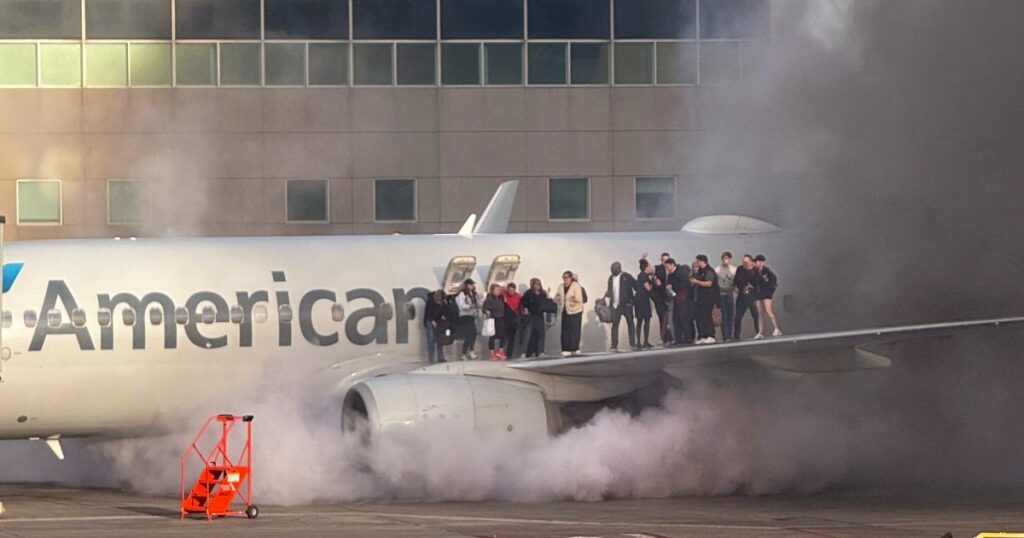
Twelve passengers treated for minor injuries after airliner’s engine catches fire on landing. More than 170 passengers and six crew were evacuated after the engine of an American Airlines jet – outbound from Colorado Springs – caught fire on landing in Denver. The incident unfolded on Thursday after the Boeing 737-800 aircraft diverted from its Dallas destination and landed in Denver at about 5:15pm local time (23:15 GMT) in response to reports of engine vibrations by crew on board. “After landing safely and taxiing to the gate at Denver International Airport (DEN), American Airlines Flight 1006 experienced an engine-related issue,” the airline said in a statement. According to the airline, all 172 passengers and six crew members safely evacuated the aircraft and were relocated to the terminal. Twelve passengers with minor injuries were reportedly taken to a local hospital for further evaluation. Dramatic images showed passengers clambering out of emergency doors and onto the wings of the plane. BREAKING: An American Airlines plane carrying 178 people appeared to catch fire on the tarmac after making an emergency landing at Denver International Airport Thursday evening, forcing passengers to evacuate by climbing out onto the wing of the plane. https://t.co/gWlirSyILE pic.twitter.com/AOSU1iB24H — CBS News (@CBSNews) March 14, 2025 Advertisement This is the second recent aviation incident involving an American Airlines aircraft. On January 29, a midair collision between an American Airlines plane and a United States Army helicopter near Washington, DC, killed 67 people. Last month, a Delta Air Lines regional jet flipped upside down upon landing at Canada’s Toronto Pearson International Airport in windy weather following a snowstorm, injuring 18 of the 80 people on board, though all passengers and crew members survived the incident. Just this week, American Airlines CEO Robert Isom and Delta’s CEO Ed Bastian listed recent air crashes and weather events in the US as contributing reasons for a decline in travel demand in the country, alongside economic uncertainty. Adblock test (Why?)
Iran, Russia, China discuss Tehran’s nuclear programme at Beijing meeting
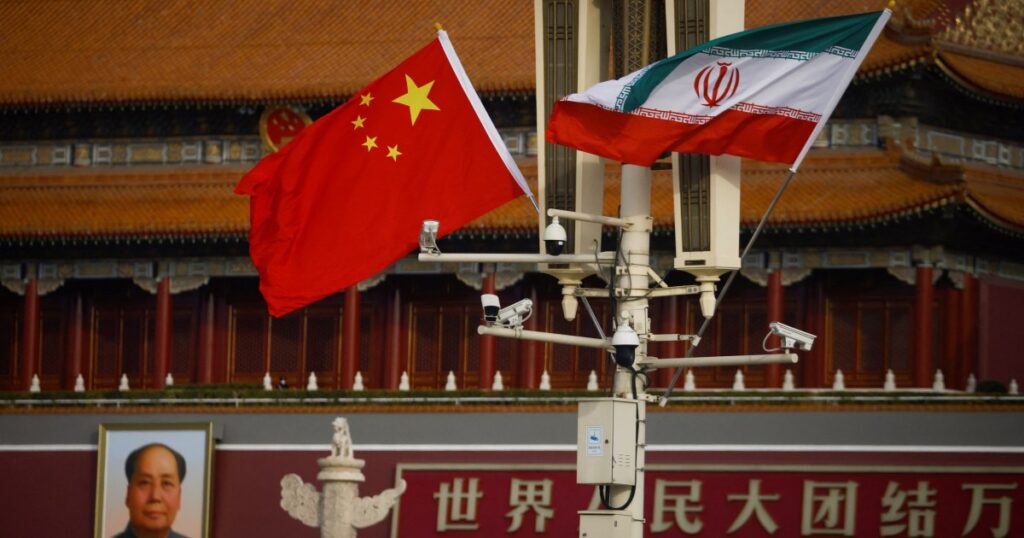
Meeting between top diplomats from three countries signals Tehran may be ready for renewed negotiations on its nuclear programme. Diplomats from Iran, Russia and China are meeting in Beijing for talks on Tehran’s nuclear programme that could lead to negotiations following years of delay. Beijing said the three countries hope to find a “diplomatic” solution to Iran’s nuclear issue, Chinese state media reported on Friday. “In the current situation, we believe that all parties should maintain calm and restraint to avoid escalating the Iran nuclear situation, or even walking towards confrontation and conflict,” China’s Foreign Ministry spokesperson Mao Ning told reporters before the meeting. The meeting was attended by Chinese Vice Foreign Minister Ma Zhaoxu, Russian Deputy Foreign Minister Sergey Ryabkov and Iranian Deputy Foreign Minister Kazem Gharibabadi, who “exchanged views on the Iran nuclear issue and other issues of common concern,” according to Chinese media. Donald Trump, a year into his first term as United States president in 2018, withdrew from a landmark pact Iran reached in 2015 with the US, Russia, China, Britain, France, Germany and the European Union, in which Tehran agreed to curb its nuclear programme in exchange for the lifting of international sanctions. Advertisement Tehran continued to abide by the terms of the deal – which was considered a milestone for the administration of then-US President Barack Obama – but began slowly rolling back its commitments after Trump ended the deal. The meeting in Beijing between the three diplomats follows a series of overtures from Trump since his return to the White House in January to resume nuclear talks with Tehran. The US president this week sent a letter to Iran’s Supreme Leader Ayatollah Ali Khamenei calling for new talks but also warning that the US was within its rights to take military action against the country’s nuclear programme. Iranian President Masoud Pezeshkian responded that he would not negotiate with the US while being “threatened”, and Iran would not bow to US “orders” to talk. Iran was further enraged after six of the United Nations Security Council’s 15 members – the US, France, Greece, Panama, South Korea and the United Kingdom – held a closed-door meeting this week to discuss its nuclear programme. Tehran said the meeting was a “misuse” of the UN Security Council. Separately on Friday, Iran also slammed the US for “hypocrisy” after Washington announced new sanctions targeting its oil minister, saying they were “another clear proof of the falsity of these statements and another sign of its hostility to development”. Ayatollah Khamenei maintains Tehran does not have or want nuclear weapons, but a recent report from the International Atomic Energy Agency said Iran’s stockpile of enriched uranium was close to the requirements for a nuclear bomb. Advertisement Adblock test (Why?)
UNICEF says 12 million at risk of sexual violence as Sudan crisis deepens
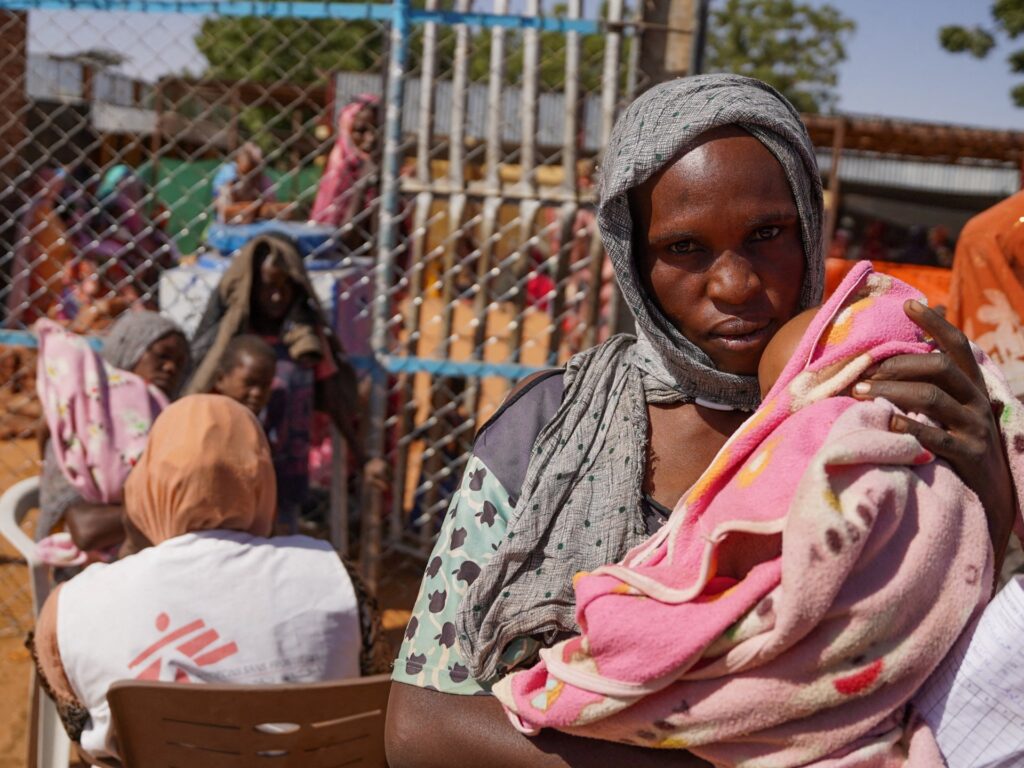
The war in Sudan has exposed more than 12 million people to “pervasive” sexual violence that is being used to “terrify” the entire population, according to the United Nations Children’s Fund (UNICEF). As the war nears the two-year mark, UNICEF executive director Catherine Russell told a UN Security Council meeting on Thursday that the number of women and girls – and increasingly, men and boys – at risk of rape and sexual assault had increased by 80 percent over the last year. Referencing data analysed by UNICEF, Russell said that 221 cases of rape against children were reported in 2024 in nine states, with 16 of these cases involving children under the age of five and four involving babies under the age of one. “The data only gives us a glimpse into what we know is a far larger, more devastating crisis,” said Russell. “Survivors and their families are often unwilling or unable to come forward due to challenges in accessing services, fear of social stigma, or the risk of retribution.” Much of the meeting focused on the suffering of the 16 million children needing humanitarian assistance this year as a result of the continuing war between the paramilitary Rapid Support Forces (RSF) and the Sudanese Armed Forces (SAF). Advertisement The fighting erupted in April 2023 and has since killed tens of thousands, uprooted more than 12 million people and created the world’s biggest humanitarian crisis. Russell cited more than 900 “grave violations” against children reported between June and December 2024, with victims killed or maimed in 80 percent of cases – mainly in the states of Khartoum, Al Jazirah and Darfur. The meeting took place as the SAF accused the RSF of targeting civilians in the besieged North Darfur state capital of el-Fasher, killing five children under the age of six and wounding four women on Wednesday. Fighting in el-Fasher has intensified in recent months, as the RSF tries to consolidate its hold on Darfur after army victories in central Sudan. The city is the only one of five state capitals in the vast Darfur region that is not under paramilitary control. ‘Hollow’ Christopher Lockyear, the secretary-general of Doctors Without Borders (Medecins Sans Frontieres, or MSF), accused the warring sides of not only failing to protect citizens but also “actively compounding their suffering”. “The war in Sudan is a war on people, a reality that grows more evident by the day,” Lockyear said. Lockyear also criticised the UN Security Council’s repeated calls for a ceasefire as “hollow”. “This council’s failure to translate its own demands into action feels like abandonment to violence and deprivation,” he said. “Whilst statements are being made in this chamber, civilians remain unseen, unprotected, bombed, besieged, raped, displaced, deprived of food, of medical care, of dignity,” he added Advertisement The ongoing violence led MSF last month to suspend all activities in the famine-stricken Zamzam refugee camp, located near el-Fasher. Sudan’s UN Ambassador, Al-Harith Idriss Al-Harith Mohamed, told the Security Council that the Sudanese government has a national plan for the protection of civilians and claimed Lockyear did not raise any issues with him in a previous private meeting. Reporting from the UN in New York, Al Jazeera’s Gabriel Elizondo said diplomats in the Security Council frequently harked back to the Jeddah Declaration, an agreement committing to protect civilians that was signed by warring parties in 2023 under the mediation of the United States and Saudi Arabia. “The Jeddah Declaration … is repeated by diplomats, particularly in the Security Council, over and over again as something that needs to be returned to,” he said. “Lockyear said that the international community needs to move beyond that and a new compact is needed for Sudan.” Adblock test (Why?)
EU parliament rocked by corruption investigation linked to China’s Huawei
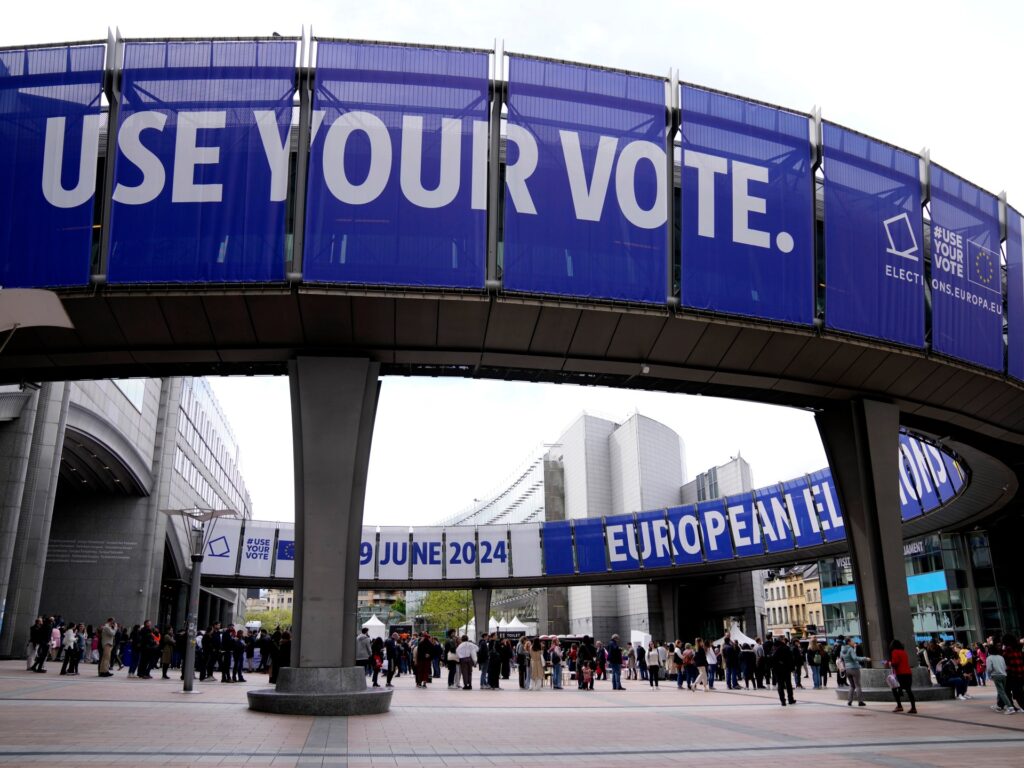
Belgian authorities announce arrests of several people in connection with alleged bribery within the parliament. Police have arrested several people as part of a corruption probe targeting the European Parliament and Chinese tech company Huawei, Belgian authorities have said. The suspects, who are alleged to have been involved in “active corruption” within the European Parliament to benefit Huawei, were arrested following searches at 21 premises in Belgium and Portugal, Belgium’s Federal Public Prosecutor’s Office said in a statement on Thursday. “The corruption is said to have been practised regularly and very discreetly from 2021 to the present day, under the guise of commercial lobbying and taking various forms, such as remuneration for taking political positions or excessive gifts such as food and travel expenses or regular invitations to football matches,” the prosecutor’s office said. Investigators believe the illicit payments may have been “mixed up” in financial flows linked to conference expenses in order to disguise their true purpose, according to prosecutors. “From this point of view, the investigation also aims to detect any evidence of money laundering, as the case may be,” the prosecutor’s office said. Advertisement Following the raids, a judge overseeing the case ordered seals to be placed on the offices of two parliamentary assistants at the EU parliament headquarters in France’s Strasbourg, prosecutors added. Prosecutors said they could not disclose further details, including the identities of the suspects, out of consideration for the presumption of innocence and the integrity of the investigation. Huawei and spokespeople for the EU parliament did not immediately respond to Al Jazeera’s requests for comment. The probe comes less than three years after several EU lawmakers and aides were embroiled in an alleged bribery scandal involving officials from Qatar and Morocco. Five current and former MEPs – Greece’s Eva Kaili; Italy’s Pier Antonio Panzeri and Andrea Cozzolino; and Belgium’s Marc Tarabella and Marie Arena – have been charged in the case. Panzeri cut a plea deal with prosecutors in 2023, in which he acknowledged his involvement in corruption. None of the other four have been convicted. The Qatari and Moroccan governments have denied any wrongdoing in the case. Adblock test (Why?)
Pentagon considering military options for Panama Canal access: Report
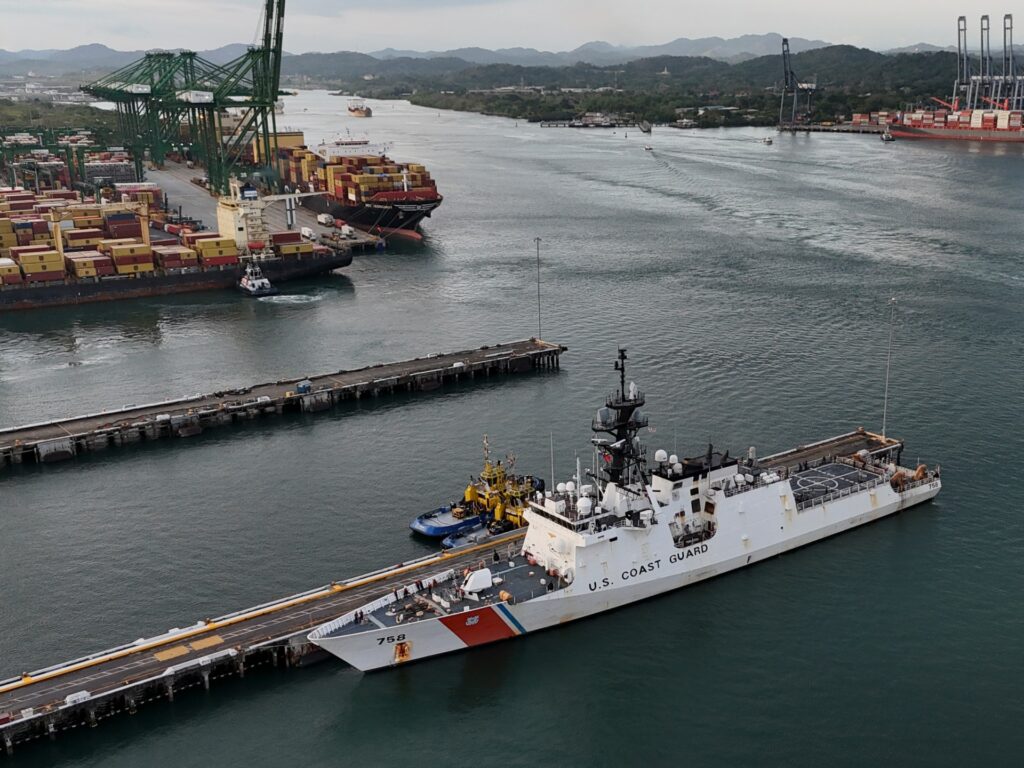
Officials say US military’s Southern Command exploring multiple options, from working with Panama to military action. The Pentagon is reportedly exploring military options for the Panama Canal to ensure ongoing US access to the strategically important waterway, following a request from the White House. The Reuters news agency reported on Thursday that a US official, who spoke on condition of anonymity, said a document, described as an interim national security guidance by the new Trump administration, called on US forces to look at military options to safeguard access to the Panama Canal. Responding to reports of possible US military action, Panama’s government said that it would remain “firm” in defending its sovereignty amid the news that US President Donald Trump is considering options aimed at “reclaiming” the strategic canal. “With respect to these statements, I have nothing more to say than that Panama remains firm in defending its territory, its canal, and its sovereignty,” Panamanian Foreign Minister Javier Martinez-Acha told reporters on Thursday. “Let it be clear, the canal belongs to the Panamanians and will remain so,” he added. Advertisement Tensions between the US and Panama have again spiralled over Trump’s repeated threats to “take back” the Panama Canal. News of US military planning was reported earlier this week by NBC, citing an internal memo from the Trump administration and remarks from unnamed US officials. Officials told the network that the US military’s Southern Command will consider several options, including working with Panama’s military or taking the canal by force. They also said a US invasion of Panama is still unlikely at this time. The memo, however, asked the Pentagon “to provide credible military options to ensure fair and unfettered US military and commercial access to the Panama Canal”, according to reports. The Panama Canal runs through the narrow isthmus of Panama connecting North and South America, and is highly valuable because it connects the Pacific Ocean to the Caribbean Sea and the Atlantic Ocean. While more than 100 years old, the waterway has been in the global spotlight since Trump took office in January. The US president said in an address to the US Congress last week that his administration “will be reclaiming the Panama Canal, and we’ve already started doing it”. Despite his frequent remarks about the canal, Trump has yet to speak publicly about how the canal will be taken and if the US military would be involved. The US acquired the rights to build and operate the canal in the early 20th century. In a treaty signed in 1979, during the administration of President Jimmy Carter, the US agreed to turn over control of the canal to Panama at the close of 1999. Advertisement But the US and Panama are treaty-bound to defend the canal against any threat to its neutrality and are permitted to take unilateral action to do so. Control of the canal has also been a point of contention between Washington and Beijing, as Trump has previously claimed – without evidence – that China is secretly controlling the waterway. Both Panama and China have denied any foreign interference. Until recently, two of the canal’s four major ports were majority-owned by the Hong Kong-based conglomerate, CK Hutchison Holdings. After weeks of scrutiny, the conglomerate last week sold most of its global port operations – spanning 23 countries – to a consortium of investors led by the US firm BlackRock for $22.8bn. While the sale may have appeased Trump for now, the company now appears to be in the crosshairs of China’s Communist Party. This week, the pro-Beijing Hong Kong newspaper Ta Kung Pao published a scathing op-ed calling the BlackRock deal a “betrayal” of the Chinese people and CK Hutchison a “spineless grovelling, profit-seeking, profit-forgetting” company. The newspaper’s commentary was later uploaded to the website of China’s representative offices in Hong Kong and Macau, indicating tacit approval of its contents. Adblock test (Why?)
Columbia University punishes pro-Palestine students who occupied building
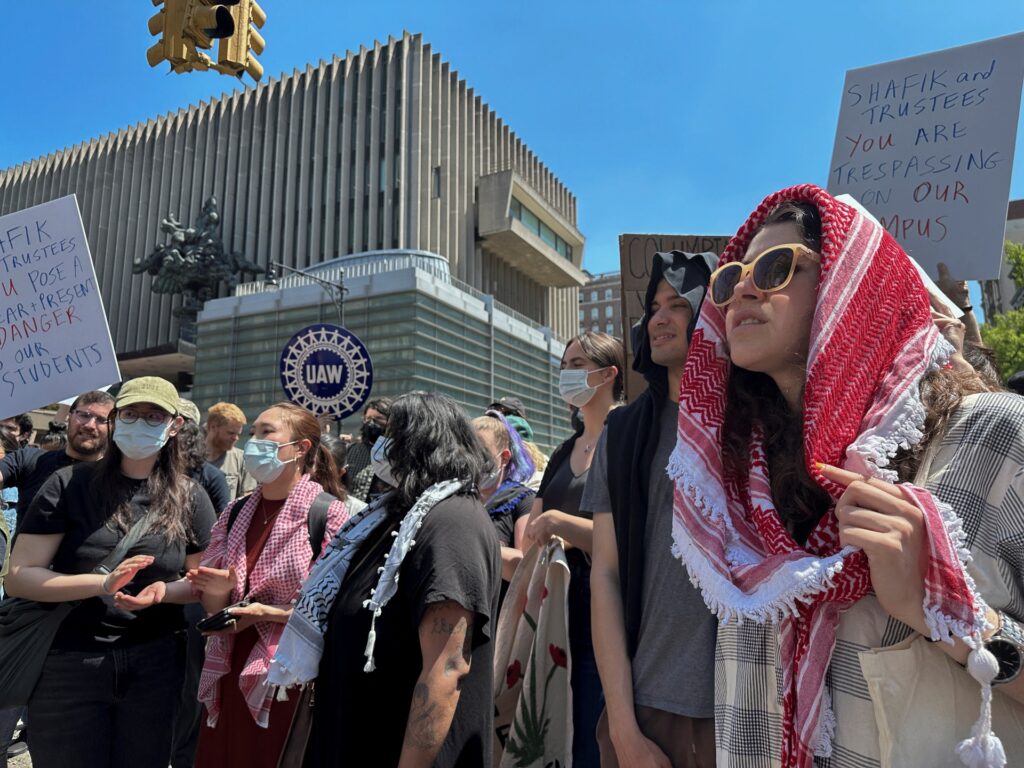
An unknown number of Columbia students were suspended from campus, expelled or had their degrees revoked. New York’s Columbia University said it has handed down punishments to pro-Palestine student protesters who occupied a university building last year during a pro-Palestine demonstration. Punishments range from multi-year suspensions to expulsions, and revocation of student degrees, the university said in a statement on Thursday, following a review of the “severity of behaviour at these events” and past infractions by students if any. The university did not say how many students were to be punished and declined to name those targeted to protect their privacy. The punishments relate to events in April 2024, when student protesters briefly occupied Hamilton Hall during a larger series of pro-Palestine and pro-Israel demonstrations across the university’s Manhattan campus. Protesters took action seeking an end to US support for Israel’s war on Gaza and for the university to divest from Israeli companies, among other demands. During the Hamilton Hall occupation, students barricaded themselves in the building but were later removed by police. The university claims the protesters also vandalised the building. Advertisement News of the severe punishment of student protesters comes just days after former Columbia postgraduate student Mahmoud Khalil was arrested by US immigration authorities at the behest of the US Department of State over his involvement in pro-Palestinian activism. Khalil, who is a permanent resident of the US and is married to a US citizen, took part in demonstrations until his graduation in December. Khalil’s deportation has been temporarily blocked by a federal judge, but he remains in custody in a detention facility in the southern state of Louisiana. Last week, US President Donald Trump also announced that he would be cancelling $400m of federal government grants and contracts due to “legitimate concerns” of anti-Semitism on campuses linked to the pro-Palestinian protests. Adblock test (Why?)