

Arrested on ICC warrant: What was Duterte’s ‘war on drugs’?
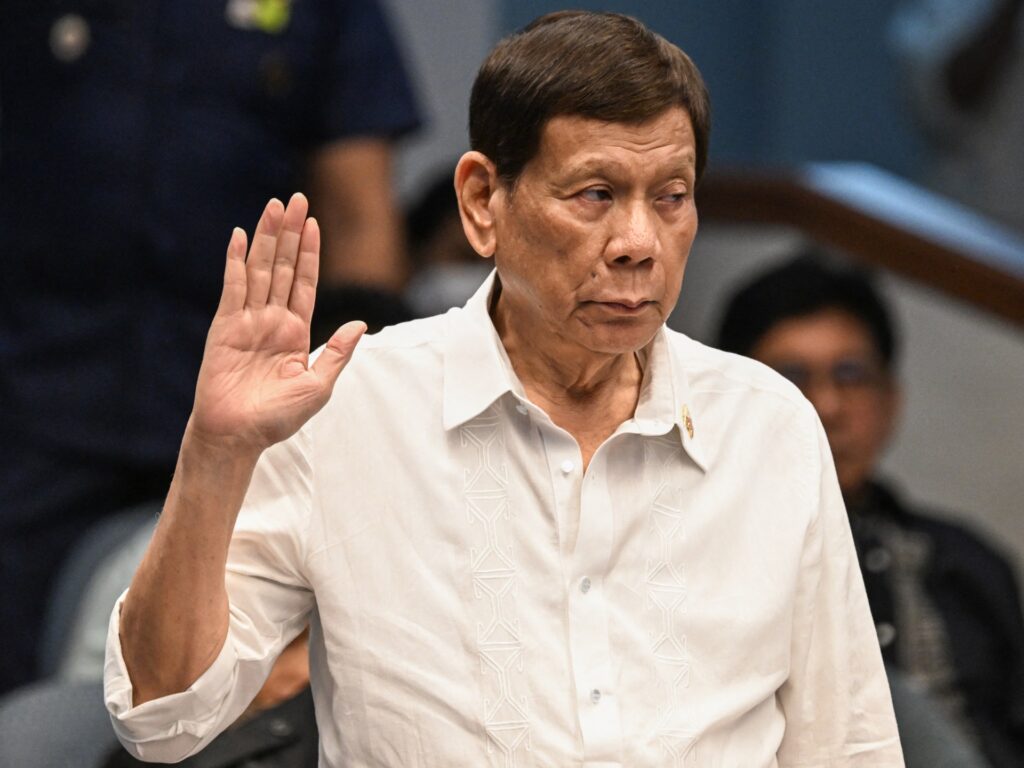
Former Philippines President Rodrigo Duterte, wanted by the International Criminal Court (ICC) for crimes against humanity, has been flown to the Hague hours after being arrested in the capital Manila on Tuesday. The ICC warrant seen by Reuters accuses Duterte of criminal responsibility for the murder of at least 43 people between 2011 and 2019 as part of his war on drugs as mayor of the southern city of Davao and later as the president between 2016 and 2022. Duterte wanted his trial to take place in a court in the Philippines. “If I committed a sin, prosecute me in Philippine courts,” he told police officers while in custody in Manila. Here’s what we know about Duterte’s war on drugs and the reactions of families of victims. What was Duterte’s ‘war on drugs’? Rodrigo Duterte built his reputation as “the punisher” while he was the mayor of Davao for more than 20 years, though he served intermittently. During his on-and-off tenure, more than 1,000 people were killed, including suspected drug users and dealers. Rights organisations have accused Duterte of running a “death squad” as mayor, a position that he held until his last term ended in 2016. Advertisement His pledge to launch a nationwide crackdown on drug gangs became the feature of his successful presidential campaign in 2016. Just after taking oath as president on June 30, 2016, Duterte vowed to solve the country’s illegal drug problem within six months.“I don’t care about human rights, believe me,” he later declared. He also offered soldiers and police his “official and personal guarantee” of immunity from prosecution for deaths undertaken in the performance of their duties. On July 1, 2016, the first full day of Duterte’s presidency, police carried out anti-drug operations across the country, killing at least 12 people and ushering in a bloody campaign for the next six years that would leave some 7,000 people dead, including women and children. By December 2016, more than 5,000 people had been killed across the country, including 2,041 drug suspects slain in police operations, according to data gathered by Al Jazeera. The other victims were killed by unknown gunmen, some of whom would later turn out to be police officers. In Duterte’s first few months in office, many of the victims were found bound, their remains dumped in polluted creeks, garbage dump sites and grasslands. By the end of his term in 2022, human rights advocates and the ICC prosecutor estimated some 30,000 people were killed by police and unidentified individuals. But police only reported 7,000 deaths during police operations, omitting those killed by unknown perpetrators. What was the public’s reaction to the war on drugs? Throughout his presidency, Duterte enjoyed a high approval rating from the public, allowing him to push for his brutal anti-drug war agenda. Advertisement Right after he took office in 2016, he received an approval rating of 86 percent. And just before he left office in 2022, his approval rating was at 73 percent, according to a Pulse Asia survey. At every turn, Duterte’s pronouncement about his bloody war on drugs was cheered on by an adoring public. In 2017, a national assembly of city and provincial legislators roundly applauded when he said there was nothing he could do if poor people were killed in his war on drugs. He also complained that the media were “treating victims as saints” and “innocent people”. An Amnesty International report in 2017 found that most of the people who were killed were living under the poverty line. The report said that police officers also confessed to receiving reward money equivalent to $150 to $300 for every drug suspect they killed, creating an “incentive to kill”. Surviving Duterte’s war on drugs While many of the victims in the drug war met their untimely death, a few have survived to tell the tale of police executions and abuse. In September 2016, Francisco Santiago Jr told Al Jazeera that he and another man were detained by police in Manila, before they were brought to a darkened alley and shot multiple times. Santiago’s companion, George Huggins, was killed on the spot. But Santiago stumbled on the ground and played dead. He got up after journalists came to the scene, and his rescue was dramatically caught on camera. His testimony to the media was later included as evidence in the complaint filed before the ICC. Advertisement Roger Herrero met a similar fate in 2018. The young father of four from Quezon Province was shot by police at point-blank range, shattering his jaw. He was accused by police of robbery, and of attempting to flee using a motorcycle. But Herrero’s wife later told photojournalist Ezra Acayan that the victim does not even know how to ride a motorcycle. Herrero also played dead to survive, and only managed to get up and ask for help after the police left. In another case in 2017, the Commission on Human Rights found a hidden cell inside a police station in Manila with 12 detainees cramped inside. The agency said that there was no record of their arrest and the police failed to notify their families or lawyers about their disappearance. In 2021, the government dismissed the complaint against the police officers, accused of the illegal detention. Children not spared As of June 2020, four years into Duterte’s drug war, an estimated 129 children had been killed by police or allied assailants, according to a Reuters news agency report that cited an activist group. One of the youngest to have been killed was three-year-old Myca Ulpina, who was hit during a 2019 raid targeting her father in the Rizal Province just outside of Metro Manila. Police claimed that the child was used as a “shield” during the operation. On Negros Island in the central Philippines, four-year-old Althea Fhem Barbon was also killed after police fired at her and her father while they were on a motorbike. Police claimed that her father was a drug dealer. Advertisement One of the most
A ‘dangerous’ moment: Advocates denounce arrest of activist Mahmoud Khalil
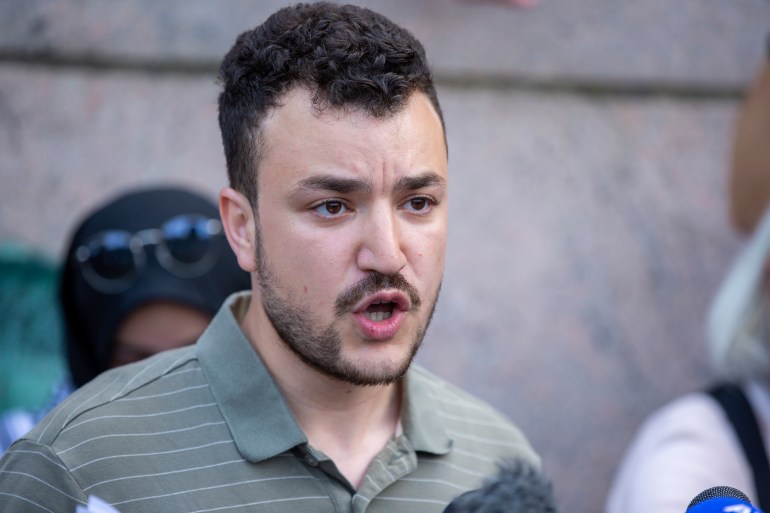
Free speech groups point out that the Department of Homeland Security (DHS) accused Khalil of leading “activities aligned with Hamas, a designated terrorist organization”. But analysts note that the department’s allegation falls short of more tangible claims. US law, for instance, prohibits anyone in the country’s jurisdiction from providing “material support” to terrorist organisations. The rationale provided for Khalil’s arrest, experts argue, was overly broad and could be wielded against any voices critical of Israel and US foreign policy. “It’s a loophole so big that you could drive a truck through it,” Will Creeley, the legal director of the Foundation for Individual Rights and Expression (FIRE), a free speech group, told Al Jazeera. “I think what’s perhaps most dangerous about this moment is that, given the rhetoric coming out of the administration today, folks across the country are going to think twice before they criticise the government, whether it’s the US government or Israeli government, and that chill is a real problem,” he added. The effort to connect criticism of Israel with support for terrorism also appears to mirror Project 2025, a controversial series of policy proposals for Trump’s second term compiled by the Heritage Foundation, a right-wing think tank. The document drew alarm for its expansive interpretations of executive power, as well as its views on issues like the pro-Palestinian protest movement. One Project 2025 proposal states that pro-Palestine protests are part of a “highly organized, global Hamas Support Network (HSN) and therefore effectively a terrorist support network”. Greer has told media outlets that, when she spoke with ICE agents over the phone, they appeared to have incorrect information about Khalil’s immigration status, informing her they were going to revoke his student visa. Khalil, a graduate student at Columbia until December, was previously in the US on a student visa but has since obtained a green card, making him a lawful permanent resident of the country. Greer said that, when she informed ICE agents that he was a permanent resident, they said his green card would be revoked instead. Student negotiator Mahmoud Khalil speaks to media on the Columbia University campus on April 29, 2024 [Ted Shaffrey/AP Photo] Nithya Nathan-Pineau, a policy lawyer with the Immigrant Legal Resource Center, told Al Jazeera that green card status can be revoked under some circumstances, such as the discovery of fraudulent information in an immigration application or certain criminal activity. “I haven’t seen any information about criminal convictions or arrests,” she said. “It sounds like the ICE agents just unilaterally decided that whatever immigration status he had, it didn’t matter.” Greer said that she and Khalil’s wife were told he was being held in an immigration detention facility in New Jersey, but when they arrived, he was not there. Khalil has reportedly been moved to a detention centre in Louisiana. “This is a tactic that ICE loves to use, transferring someone to a facility that is further away from their legal assistance, community and loved ones,” said Nathan-Pineau. “It increases the psychological strain of detention.” Greer has challenged Khalil’s detention, and a federal court is scheduled to hear the case on March 12. Adblock test (Why?)
Why China isn’t as worried about Trump’s trade war as in 2018
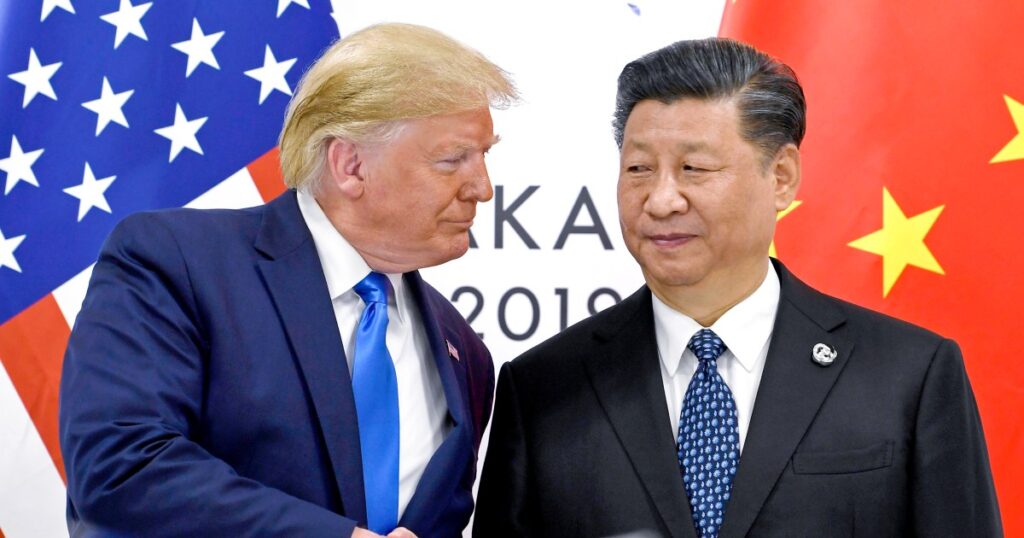
Taipei, Taiwan – As United States President Donald Trump kicks off a new trade war with China, analysts say he will face a much stronger and more prepared adversary in Beijing compared with his first term in office. Since returning to the White House in January, Trump has already imposed a 20 percent tariff on Chinese imports, citing Beijing’s alleged failure to curb the export of the deadly opioid fentanyl to the US. The tariff comes on top of previous duties imposed by Trump and former US President Joe Biden on more than $400bn worth of Chinese goods. After condemning the latest US tariffs as “bullying” and “intimidation,” Beijing hit back last week by announcing tariffs of 10-15 percent on numerous US agricultural goods, including corn, beef, pork, dairy and soybeans. The tariffs, which went into effect on Monday, followed Beijing’s announcement last month of a 10 percent tariff on crude oil, agricultural machinery, pick-up trucks, and some cars, and a 15 percent tariff on coal and liquefied natural gas. Advertisement “If war is what the US wants, be it a tariff war, a trade war or any other type of war, we’re ready to fight till the end,” Chinese Foreign Ministry Spokesperson Lin Jiang told reporters last week. While the tit-for-tat measures recall Trump’s first trade war in 2018, both Washington and Beijing are facing very different conditions today than seven years ago. The world’s two biggest economies have steadily decoupled in recent years, reducing their mutual dependency and blunting the impact of tariffs, according to analysts. Christopher Beddor, a deputy China research director at the Beijing-based Gavekal Dragonomics, said the latest tariffs should be “pretty manageable” for China, and noted that they are significantly below the 60 percent rate threatened by Trump during his election campaign. “I don’t want to understate the impact – that’s almost a tripling of the effective tariff rates for Chinese goods that are coming into the United States, so it’s big,” Beddor told Al Jazeera. “But Chinese exports into the United States are a pretty modest share of its overall economy,” Beddor said. Declining trade share China’s share of total US trade – measured as the sum of exports and imports – dropped from 15.7 percent to 10.9 percent between 2018 and 2024, according to Bloomberg. Over the same period, the US’s share of China’s total trade fell from 13.7 percent to 11.2 percent. Lynn Song, chief Economist for Greater China at ING, said Beijing is not likely to be panicking over the tariffs – at least for now. Advertisement “While avoiding this sort of trade friction would’ve been preferable, it’s something that’s been planned for, so I wouldn’t say there’s a feeling of panic,” Song told Al Jazeera. “With that said, with every tariff escalation, there inevitably will be parts of trade which become unviable and companies that will be impacted.” Another factor mitigating the impact of tariffs, Lynn said, is that Chinese exporters such as Shein and Temu have found success selling low-cost goods directly to customers by taking advantage of a tariff exemption on shipments worth less than $800. Beijing has continually rolled out measures to insulate the economy from any trade shocks. At the “Two Sessions” meetings last week in Beijing, the National People’s Congress – the highest body of state power in China – announced several fiscal stimulus measures, including raising the debt level for local governments and issuing 1.3 trillion yuan ($179bn) in long-term treasury bonds. Carsten Holz, an expert on the Chinese economy at the Hong Kong University of Science and Technology, said Beijing’s domestic policy moves have given it a significant buffer against US demands. “Even the effect of a complete Trump ban on imports from China – hardly realistic in an age when, for example, the bulk of iPhones are produced in China – may not make a dent larger than a fraction of a percentage point in China’s GDP,” Holz told Al Jazeera. “For an authoritarian leadership determined to project strength, this is unlikely to be enough to join what may look to the Chinese public like ‘peace talks’ with a foreign aggressor.” Advertisement Some analysts believe that despite its stronger position compared with 2018, Beijing still wishes to negotiate with Trump – at least for the moment. ‘Avoiding escalation’ One of the strongest signals that Chinese officials are open to talking is that their opening round of tariffs was relatively mild and restricted to a limited number of goods, suggesting a strategy of “avoiding escalation,” said Even Rogers Pay, a food and agricultural analyst at the Beijing-based research group Trivium China. “The retaliation demonstrates that while China’s government doesn’t intend to take trade pressure lying down, they are also not going to be baited into an escalatory trade conflict where early overreaction could make striking a deal more difficult,” Pay told Al Jazeera. “Instead, by applying moderate tariffs to a short list of key industries, Beijing is ramping up political pressure in the red states that are major exporters of corn, soybeans, sorghum and other farm products that they hope will bring Trump to the table.” Beijing may be angling for a “phase two” deal along the lines of the “phase one” deal struck with Trump in 2020 to bring an end to the first trade war, Pay said. Under the phase one deal, China pledged to buy $200bn in US goods and services, including agricultural products, over two years. Beijing, however, only fulfilled about 58 percent of this amount after trade was derailed by the COVID-19 pandemic, according to the Peterson Institute for Economic Research. John Gong, a professor of economics at the University of International Business and Economics in Beijing, agreed that China can withstand the pressure but is also ready to negotiate. Advertisement “The government in China is, of course, worried, but won’t back down in a humiliating way. They would love to negotiate a deal, but if it can’t, they would have a ‘so-be it attitude’,” Gong told
Israeli warplanes attack military sites in Syria’s southern Deraa province
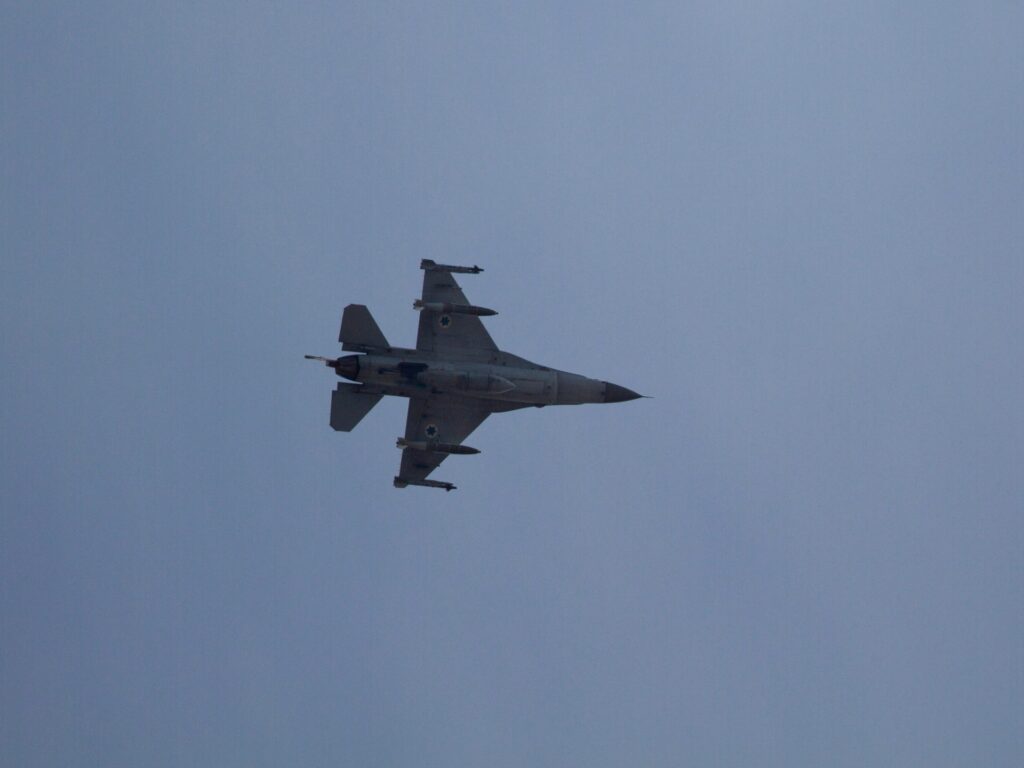
Syrian and Israeli media report air attacks on southern Deraa province targeting military sites of former Bashar al-Assad regime. Israeli military aircraft have carried out attacks in Syria’s southern province of Deraa, according to media reports and a monitoring group, in the latest attacks targeting military positions of the former Bashar al-Assad regime. The state-run Syrian Arab News Agency (SANA) said the attacks on Monday night hit two towns in the north of Deraa, which is located 103km (64 miles) south of the capital Damascus. “Israeli occupation aircraft carried out several strikes on the surroundings of the towns of Jbab and Izraa in the north of Deraa,” SANA reported. The UK-based monitoring group Syrian Observatory for Human Rights said 17 strikes by Israeli fighter jets hit two military positions located in the towns: the former regime’s Artillery Regiment 89 and the 12th Brigade. No casualties have been reported so far, the observatory said. Israeli media outlet Channel 14 said the air attacks targeted al-Assad regime army outposts, weapons depots, radars, tanks and artillery that rebel groups in Syria were “trying to take over”. Advertisement Since the overthrow of Syrian President al-Assad in December, Israel has carried out hundreds of air strikes on targets in Syria. According to the Syrian Observatory, Israel’s military carried out more than 500 air attacks on targets in Syria between December 8 and December 31, 2024, and has carried out 21 documented attacks so far this year. Most Israeli attacks have targeted facilities and weapons once held by the toppled regime’s forces in what Israel has said is a bid to prevent military assets from falling into the hands of forces hostile to Israel. Israeli Prime Minister Benjamin Netanyahu said last month that southern Syria must be completely demilitarised, warning also that his government would not accept the presence of the forces of the new government in Damascus, headed by Syrian interim President Ahmed al-Sharaa, near Israeli territory. Since the removal of al-Assad, Israel’s military has entered and taken control of territory inside a United Nations-patrolled buffer zone that has separated Israel and Syria in the occupied Golan Heights since 1974. Adblock test (Why?)
Pro-Russian candidate to challenge bar on Romanian presidential run
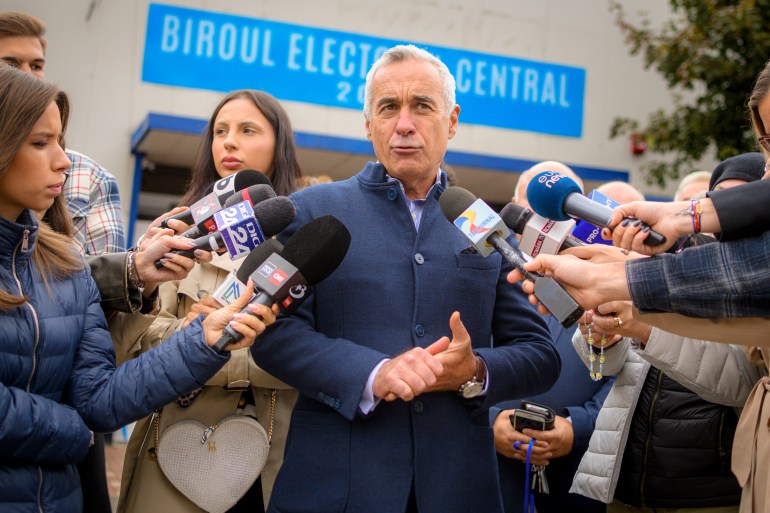
The move follows rioting in Bucharest overnight after a court threw far-right Calin Georgescu out of the race. Romania’s far-right presidential contender Calin Georgescu plans to challenge a decision to bar him from taking part in May’s rerun presidential election. The pro-Russian politician said on social media on Monday that he would make an appeal to Romania’s Constitutional Court to lift the ban, which was placed on him the previous day. He made the announcement after violent clashes broke between his supporters and police in Bucharest overnight. “We go together all the way for the same values: peace, democracy, freedom,” Georgescu said in a video posted on Facebook. The appeal, and the unrest in the capital, follow an announcement on Sunday by the Central Electoral Bureau (BEC) that it had rejected the NATO critic’s candidacy for the election on May 4. Calin Georgescu, running as an independent candidate for president, speaks to the media [File: Alexandru Dobre/AP] Shortly after the BEC’s announcement, Georgescu supporters gathered in front of the electoral commission’s headquarters. Faced by a significant police presence, the protest turned violent, as participants broke through security barricades. A broadcast van belonging to a television station regarded as supporting Georgescu’s rivals was overturned, and fires were lit. Police responded with tear gas as rioters threw cobblestones and fireworks. Advertisement Some posts on social media claimed that Romania was descending into turmoil, suggesting that events could spark a revolution or cause the closure of borders. In the United States, CBS News described the country as tipping into “chaos“. However, the violence and numbers at the protests were limited. ‘European dictatorship’ The controversy surrounding the Moscow-friendly Georgescu has placed Romania in the midst of the rift between Europe and the administration of US President Donald Trump over military spending and the nature of democracy. Georgescu secured poll position in the first round of the election in November, but the vote was later annulled owing to evidence of suspected Russian interference. US Vice President JD Vance has claimed that the move illustrated Romania does not share US values. The EU has praised the independence of the country’s courts. Georgescu, who is currently under criminal investigation on numerous counts, including for communicating false information about campaign financing, has claimed that the ruling shows that Europe is turning into a “dictatorship”, and warned that “if democracy falls in Romania, the entire democratic world will fall”. If the BEC decision is upheld, the three ultranationalist parties that backed Georgescu’s previous bid for the presidency – parties that hold 35 percent of the seats in the Parliament of Romania – risk having no candidate in the election. Adblock test (Why?)
Ukraine announces plan to boost FPV drone arsenal
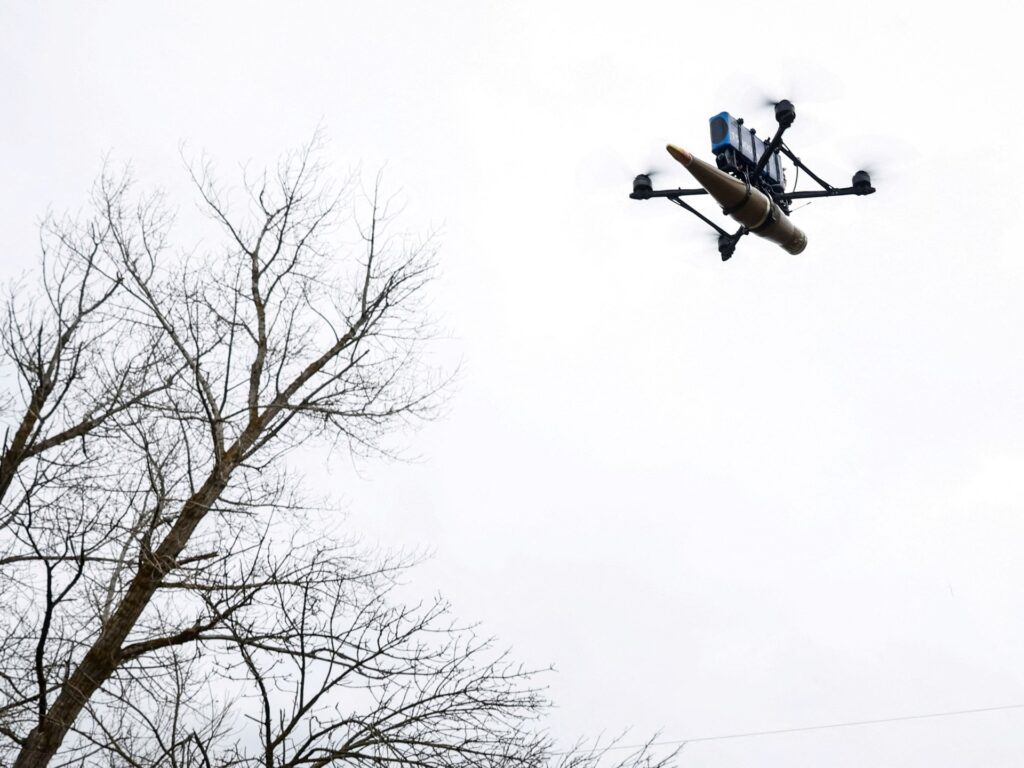
Ministry of Defence says it will buy 4.5 million first-person view drones in 2025, triple last year’s amount. Ukraine has announced plans this year to buy about 4.5 million first-person view (FPV) drones, one of the most inexpensive and potent weapons in its war effort against Russia. In a statement on Monday, the Ukrainian Ministry of Defence said it would allocate the equivalent of more than $2.6bn for the purchases. Hlib Kanevsky, director of the ministry’s procurement policy department, said Ukraine had purchased more than 1.5 million drones in 2024, 96 percent of which were bought from Ukrainian manufacturers and suppliers. “This year, the figures will be even higher because the capabilities of the domestic defence industry in 2025 are approximately 4.5 million FPV drones,” Kanevsky said, adding that the ministry “plans to purchase them all”. Small and cheap, FPV drones are controlled by pilots on the ground and often crash into targets while laden with explosives. In April, a NATO official said FPV drones that cost less than $1,000 had destroyed two-thirds of Russian tanks worth millions. Advertisement Ukraine became the world’s largest major arms importer from 2020 to 2024, the period when Russia launched its full-scale invasion in February 2022. Ukraine’s imports increased nearly 100 times over the previous four-year period. The country, which is seeking strong security guarantees from its partners before agreeing to any peace talks with Russia, is developing its own defence industry to reduce its dependence on its Western allies. It plans to also build long-range drones. The statement said the ministry for the past three years has purchased most of its drones in the country while the number of unmanned aerial vehicles (UAVs) supplied to its armed forces had increased significantly. Kanevsky also said all procurement plans for this year have received money in the budget, which will ensure that the front line is supplied with UAVs as soon as possible. Both Russia and Ukraine have come to rely on cheaper and more effective alternatives to conventional artillery during the three-year conflict. In a separate statement on Monday, Kyiv’s top general, Oleksandr Syrskii, said Ukrainian drones had destroyed 22 percent more targets last month compared with January, but added that Russian forces were also adapting. “We simply have no right to lag behind the enemy in those areas of technological warfare where we should be arming and strengthening ourselves by our own resources,” Syrskii said. Adblock test (Why?)
Syria clashes – what happened?
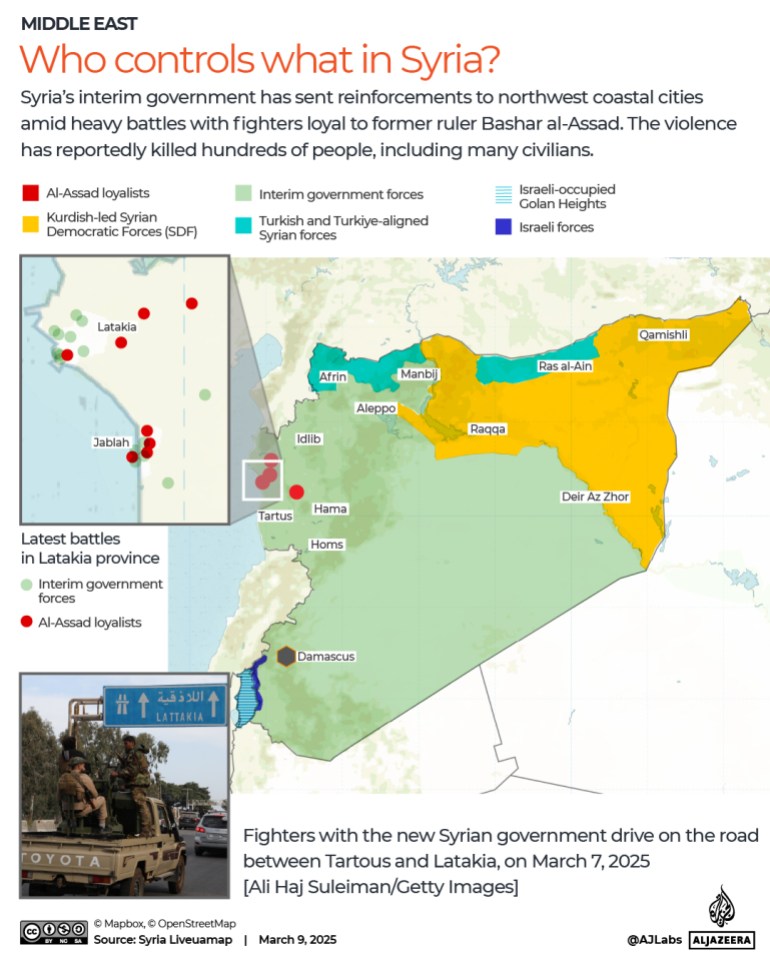
The government of Syria says it has ended an operation in the coastal governorates of Latakia and Tartous after four days of fighting between security forces and pro-Assad armed fighters. The unrest came only three months after the fall of Syria’s Bashar al-Assad in an offensive by opposition fighters. Reports from the Latakia region told of killings, kidnappings, theft, harassment and even public murders. So, what happened and who did this? Here’s what we know about the violence: What’s happening in Syria? On March 6, government forces began deploying to the coastal cities of Syria, including Latakia, Banias, Tartous and Jableh to fight what they dubbed “regime remnants”. The “remnants” are pro-Assad regime fighters who have announced their opposition to the new government. The Alawite religious sect, from which Bashar al-Assad hails, is concentrated in these cities. How did it start? On March 6, pro-Assad gunmen ambushed military personnel in and around Latakia in the northwest, killing at least 16 members of the security forces and the Ministry of Defence. Advertisement According to state media, the March 6 ambushes were not the first, with several past attacks on government forces since al-Assad fell. How many people have been killed or injured? Numbers are still emerging, but here’s what we know. According to a March 9 report by the Syrian Observatory for Human Rights (SOHR), at least 1,311 people have been killed as of Saturday evening – some 830 were civilians, 230 security personnel from various branches, and about 250 armed fighters. Al Jazeera has not been able to independently verify SOHR’s numbers. (Al Jazeera) Why this area in particular? The Latakia-Tartous axis lies along Syria’s Mediterranean coast, with Banias and Jableh lying between them. These two Alawi-majority governorates have long been considered al-Assad strongholds, with the family’s hometown, al-Qerdaha, lying east of Latakia. When al-Assad fell, observers feared there would be revenge attacks against the Alawite community. This may be why “regime remnants” chose to attack there – possibly hoping to inflame sectarian tensions. Banias also hosts Syria’s largest oil refinery. Armed fighters tried to attack the refinery, security forces said, but were repelled. Who’s fighting? State security troops confronted armed groups led by former officers in al-Assad’s army. There are also unidentified groups who went to the coast to “avenge” the ambushed security forces, an unidentified security official told Syria’s state news agency. The presence of these individuals, the official said, had “led to some individual violations and we are working on stop them”. Advertisement Alawite community members said armed groups have been harassing and kidnapping Alawite civilians. The Syrian government estimates there are 5,000 armed individuals in the coastal area. Who are these ‘regime remnants’? Videos on social media since February show former al-Assad army officer Muqdad Fteiha declaring the formation of a group to counter “HTS violations” in the coastal region. Fleiha, who was in al-Assad’s Republican Guard, claims in his message that the Alawite community is mistreated. Other statements on social media, attributed to former al-Assad army Brigadier General Ghiath Suleiman Dalla, declared the formation of a “Military Council for the Liberation of Syria” to “expel all occupying terrorist forces” and “dismantle the repressive sectarian security apparatus”. What did Syria’s government say? The escalating violence presented a huge challenge for Syria’s interim President Ahmed al-Sharaa. On Sunday, al-Sharaa announced two new committees to deal with the crisis. One is an independent committee of judges and lawyers to investigate the March 6 attacks and the violence that ensued and hold those responsible accountable, in pursuit of “higher national interest and civil peace”. The second is a “Supreme Committee for Civil Peace”, tasked with engaging with the residents of the affected areas and safeguarding their security. Earlier on Sunday, he spoke at a Damascus mosque, acknowledging the severity of the crisis and calling for national unity. Advertisement On Friday, March 7, he reaffirmed in a televised address his commitment to stability, and promised to pursue regime loyalists responsible for crimes and to consolidate state control over weapons. How are civilians doing in these areas? People are scared, panic has taken over the coastal regions. “I don’t ever go outside and I don’t even open the windows… There is no security here. There is no security for Alawis,” a resident of Latakia who chose to remain anonymous, told Al Jazeera. Those who remain speak of living in terror, fearing that armed fighters will attack them in their homes. This piece was published in collaboration with Egab. Adblock test (Why?)
Mahmoud Khalil, student leader of Columbia protests, arrested
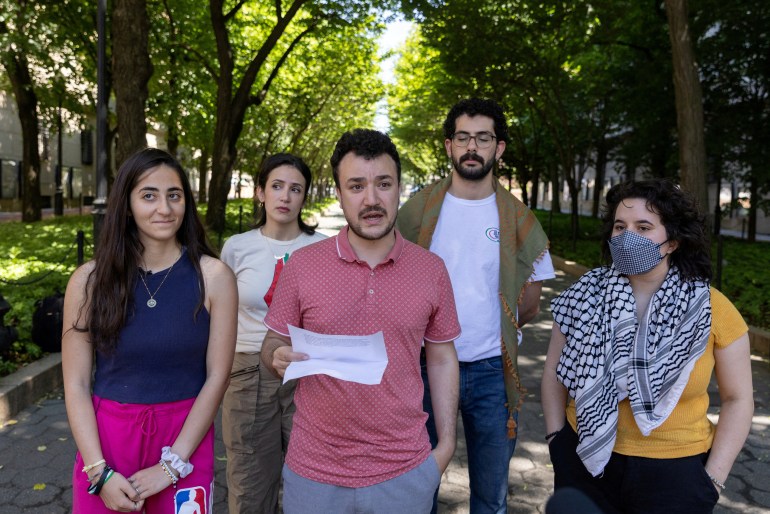
United States Immigration and Customs Enforcement agents (ICE) have arrested a Palestinian graduate student who played a prominent role in last year’s pro-Palestinian protests at New York’s Columbia University, the student workers’ union said on Sunday. The student, Mahmoud Khalil at the university’s School of International and Public Affairs, was arrested at his university residence on Saturday, the Student Workers of Columbia union said in a statement. Khalil’s wife is a US citizen and he has a permanent residency green card, the union said. He remained in detention on Sunday. Khalil’s wife declined to comment through one of Khalil’s fellow students. Khalil’s lawyer, Amy Greer, told the Associated Press news agency that she spoke by phone with one of the ICE agents during the arrest, who said they were acting on State Department orders to revoke Khalil’s student visa. Informed by the lawyer that Khalil was in the country as a permanent resident with a green card, the agent said they were revoking that too, according to the lawyer. Advertisement Greer said the authorities declined to tell Khalil’s wife, who is eight months pregnant, whether he was accused of committing a crime. Khalil has since been transferred to an immigration detention facility in Elizabeth, New Jersey. “We have not been able to get any more details about why he is being detained,” Greer told the AP. “This is a clear escalation. The administration is following through on its threats.” The arrest appeared to be among the first known actions under President Donald Trump’s pledge to deport international students who joined the protests against Israel’s war in Gaza that swept college campuses last year. His administration has claimed participants forfeited their rights to remain in the country by supporting Hamas, which is designated as a ‘terror’ organisation by the US. The move has been described as an attack on First Amendment freedoms. Khalil, an Algerian citizen of Palestinian origin, has been one of the school administrators’ lead negotiators of the pro-Palestinian student protesters, some of whom set up a tent encampment on a Columbia lawn last year and seized control of an academic building for several hours in April before police entered the campus to arrest them. Khalil was not in the group that occupied the building but was a mediator between Columbia provosts and the protesters. The protesting students called for Columbia’s divestment from companies with ties to Israel, a ceasefire and an end to the war that killed nearly 50,000 Palestinians and turned the enclave into rubble after nonstop bombardment. The US provided the bulk of the ammunition for the war. Maryam Alwan, Mahmoud Khalil and Layla Saliba speak to members of the media at Columbia University on June 1, 2024 [Jeenah Moon/Reuters] Columbia said last year that it would consider expediting some of the students’ demands through its investments committee. Advertisement Rights groups have accused Israel of committing genocide in Gaza – home to 2.3 million people. Despite a ceasefire in place since January 19, Israel has blocked the entry of any aid into Gaza since March 1, drawing condemnation from rights groups and aid agencies. The October 7, 2023, Hamas attack on Israel and subsequent Israeli military offensive on Gaza led to months of pro-Palestinian protests that roiled US college campuses. At least 1,100 people were killed in the Hamas attack and some 240 people were taken captive. Most of the captives have been released as part of truce deals. A new round of truce talks will resume in the Qatari capital, Doha, on Monday. Targeted by the government A spokesperson for Columbia said the school was barred by law from sharing information about individual students. The Department of Homeland Security and the State Department, which oversees the country’s visa system, did not respond to questions from the news agencies. It was not immediately clear on what grounds ICE agents arrested Khalil. The ICE comes under the US Department of Homeland Security. In an interview with the Reuters news agency a few hours before his arrest on Saturday about the Trump administration’s criticism of Columbia, Khalil said he was concerned that he was being targeted by the government for speaking to the media. The Trump administration on Friday said it had cancelled government contracts and grants worth about $400m to Columbia University. The government said the cuts and the student deportation efforts are due to “anti-Semitic” harassment at and near Columbia’s Manhattan campus. “What more can Columbia do to appease Congress or the government now?” Khalil said before his arrest, noting that Columbia had twice called in police to arrest protesters and had disciplined many pro-Palestinian students and staff, suspending some. Advertisement “They basically silenced anyone supporting Palestine on campus and this was not enough. Clearly, Trump is using the protesters as a scapegoat for his wider agenda [of] fighting and attacking higher education and the Ivy League education system.” In response to the announced grant cuts on Friday, Columbia’s interim president, Katrina Armstrong, said the school was committed to combating anti-Semitism and was “working with the federal government to address their legitimate concerns”. Protesting students have denied the charges of anti-Semitism. ‘This is only the beginning’ Maryam Alwan, a Palestinian American senior at Columbia who has protested alongside Khalil, said the Trump administration was dehumanising Palestinians. “I am horrified for my dear friend Mahmoud, who is a legal resident, and I am horrified that this is only the beginning,” she said. US Secretary of State Marco Rubio said last week that international students who support Hamas, which the US has designated a “terrorist” organisation, face visa revocation and deportation. On Thursday, Columbia issued a revised protocol for how students and school staff should handle ICE agents seeking to enter private school property. The school said ICE agents without a judicial arrest warrant may be allowed to enter its private property in “exigent circumstances”, which it did not specify. “By allowing ICE on campus, Columbia is surrendering to the Trump administration’s assault on universities across the
Who is Mark Carney, Canada’s new Liberal leader and next prime minister?
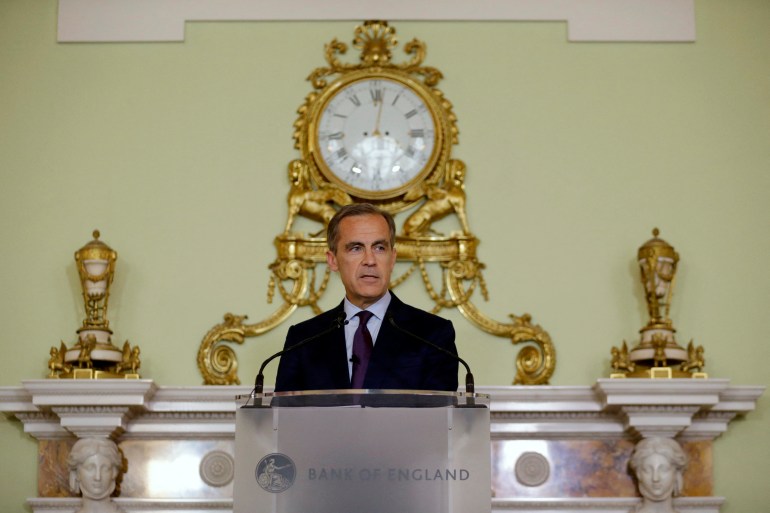
Montreal, Canada – Canada has its next prime minister. Mark Carney has been elected as the new head of the governing Liberal Party, replacing Justin Trudeau in the midst of historic tensions and fears of a trade war with the United States. An economist and former central banker, Carney will be sworn-in as prime minister in the coming days. He is making his first foray into Canadian politics at the country’s highest level – and with a federal election looming. He is also taking the helm of a party that, after years of declining support and criticism over its handling of social and economic issues, is riding a newfound wave of political momentum. “I will work day and night with one purpose, which is to build a stronger Canada for everyone,” Carney said in his victory speech on Sunday evening after securing 85.9 percent of the vote on the first ballot. But just who is Mark Carney? What policies does he plan to pursue, and will he be able to boost the Liberals’ fortunes in the upcoming federal election against a strong Conservative Party? Advertisement Oxford grad, central banker Born in Canada’s Northwest Territories and raised in the western province of Alberta, Carney has presented himself as a political outsider who can steer Canada through a period of economic turmoil and uncertainty. The country has been roiled by US President Donald Trump’s steep tariffs on Canadian products, which came into effect on March 4. Fears of a recession have fuelled a sense of Canadian nationalism and a desire for steady leadership in Ottawa. Carney holds degrees from Harvard and Oxford universities and spent over a decade at the investment firm Goldman Sachs. More recently, he served as the chair of Brookfield Asset Management, where he also led the company’s “transition investing” – an effort to promote investments that align with global climate goals. But it is his banking experience in times of crisis that Carney and his supporters say best demonstrates his ability to help Canada weather the Trump storm. The 59-year-old began his tenure as the governor of the Bank of Canada amid the global financial crisis of 2008, and he was credited with taking quick and decisive actions that helped spare Canada from a more serious downturn. In 2013, Carney left to take the helm of the Bank of England, where he remained until 2020 – the year the United Kingdom formally left the European Union. There, too, he was recognised as having minimised the effects of Brexit – though his assessment that a break with the EU posed a risk to the British economy drew the ire of conservatives who were in favour of leaving the bloc. Advertisement “He was an innovative and inventive central banker,” said Will Hutton, an author, columnist and president of the UK’s Academy of Social Sciences. “He understood that actually, central banks have a job to make capitalism as legitimate as possible by ironing out its worst proclivities. And he was appalled by Brexit, which he thought was self-defeating,” Hutton told Al Jazeera. “But he managed to organise the Bank of England’s behaviours so the fallout from it was less disastrous than it could have been.” Carney holds a news conference in 2016 as governor of the Bank of England [Matt Dunham/Pool via Reuters] Lack of political experience While few dispute Carney’s economic credentials, his lack of experience in electoral politics has raised questions. He previously served as an economic adviser to Trudeau, who resigned amid widespread anger over his government’s handling of a housing crisis and rising costs of living. But Carney has never run for political office before, and he spent much of the Liberal leadership campaign introducing himself to Canadians. “He’s someone who’s been behind the scenes, an adviser,” said Daniel Beland, a political science professor at McGill University who described Carney as a “technocrat on steroids”. Carney has laid out broad promises since he launched his campaign, including reining in government spending, investing more in housing, diversifying Canada’s trading partners and putting a temporary cap on immigration. A former United Nations Special Envoy on Climate Action and Finance, Carney is also a major proponent of the idea that the private sector must take a leadership role in tackling the climate crisis and getting to net-zero emissions. Advertisement “I know how to manage crises. I know how to build strong economies,” he said during a debate against the other Liberal leadership hopefuls last month. “I have a plan, a plan that puts more money back in your pockets, a plan that makes our companies more competitive, a plan that builds a strong economy that works for you.” Beland told Al Jazeera that the Liberal leadership contest largely failed to test Carney because his main opponent was longtime friend and former Finance Minister Chrystia Freeland. The pair did not attack each other much during the race. “That’s not the best test for someone who has no political experience and will then have to basically go into the lion’s den,” Beland said, referring to this year’s federal election, where Carney will face fiery opposition leaders such as the Conservatives’ Pierre Poilievre and Yves-Francois Blanchet of the Bloc Quebecois. ‘Consummate insider’ Carney’s attempt to paint himself as an outsider has been challenged as well. His time as a Liberal Party adviser, coupled with his experience atop the global financial world, make him “a consummate insider and a consummate elite”, said Canadian political analyst and journalist David Moscrop. “At the same time, he’s an accomplished policy expert, a renowned and respected mainstream economic thinker. And if that’s your sort of thing, then this is pretty much the cream of the crop,” Moscrop told Al Jazeera. “But if it’s not your sort of thing, then he represents what some on the left and some on the right see as a kind of global economic elite consensus that is oppressing day-to-day people.” Advertisement Poilievre and his Conservative Party have tapped into that feeling of public
Russia claims new gains; Zelenskyy says ‘committed’ to dialogue with US
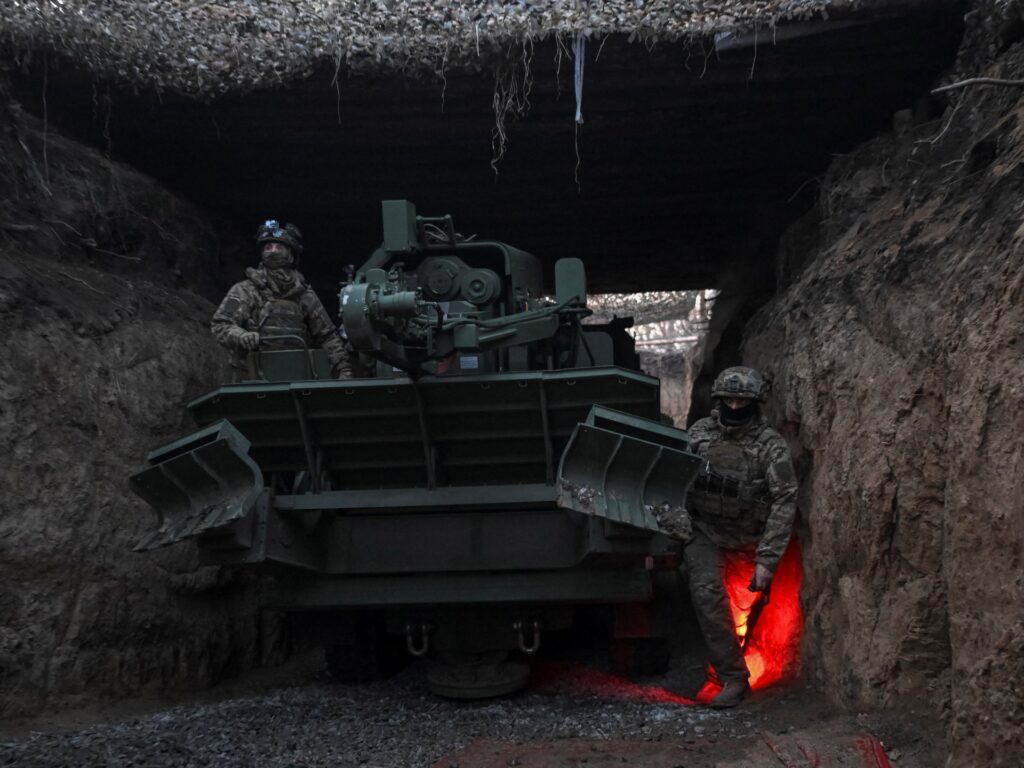
Moscow said it captured territory shortly before potential peace talks begin in Saudi Arabia. Moscow says it has made new gains in Ukraine’s Sumy region and Russia’s Kursk region as Ukrainian President Volodymyr Zelenskyy said he was “fully committed” to having a constructive dialogue with United States representatives ahead of talks in Saudi Arabia to discuss how to end Russia’s war on Ukraine. US and Ukrainian negotiators are set to meet for talks in the Red Sea city of Jeddah on Tuesday, with US President Donald Trump’s administration vying to secure a ceasefire and a “framework” for a peace agreement. Despite the upcoming talks, the Russian Ministry of Defence said in a briefing that its forces had “liberated” the small village of Novenke in Sumy near the border with Kursk. Moscow also announced the recapture of the villages of Lebedevka, Malaya Loknya, Cherkasskoye Porechnoye and Kositsa in Kursk. Russia briefly occupied parts of Ukraine’s Sumy at the start of its all-out invasion in 2022 but has not taken any territory there since. Kyiv has not yet commented on Russia’s claim to have captured Novenke, which analysts say could bring Russian troops closer to blocking a major Ukrainian supply route. Advertisement Zelenskyy said in his evening address on Sunday: “I want to thank all our units who are steadfastly and against all odds destroying the occupier, repelling attacks and defending our positions. “Diplomacy will be strong only on strong front-line positions. And we are doing our best to ensure that Ukraine’s front-line needs are met.” Who’s meeting who The US cut off Ukraine’s access to intelligence sharing and satellite data, as well as aid – following a White House public spat with Zelenskyy – in a bid to force Kyiv to negotiate an end to Russia’s invasion – Europe’s biggest conflict since World War II. Zelenskyy invited Trump’s wrath for rejecting a mineral deal, which the Ukrainian president says should involve a US security guarantee. But the Trump administration has refused to commit to that and instead asked Europe to step up aid for the war-battered country. European leaders have, meanwhile, agreed to boost defence spending as they pledged support to Ukraine against Russian threats. Washington has also poured cold water over Ukraine’s NATO ambitions. Zelenskyy confirmed on Saturday that he would visit Saudi Arabia next week and that after meeting with Crown Prince Mohammed bin Salman on Monday, Ukrainian diplomatic and military representatives would stay for a meeting on Tuesday with the US. “Ukraine has been seeking peace from the very first second of this war. Realistic proposals are on the table. The key is to move quickly and effectively,” the Ukrainian president said on X. Advertisement US envoy Steve Witkoff, meanwhile, confirmed last week that he would meet Ukrainian officials in Saudi Arabia, signalling that he would discuss an “initial ceasefire” and a “framework” for a longer agreement. US Secretary of State Marco Rubio will also visit Saudi Arabia between March 10 and 12 for talks with Ukrainian counterparts, a statement from the US Department of State said. He will also hold talks with Prince Mohammed to discuss regional issues and ways to bolster US-Saudi Arabian ties, the State Department said. Rubio spoke with Ukrainian Foreign Minister Andrii Sybiha on Friday and said Trump wanted to end the war in Ukraine as soon as possible. It will be the first high-level gathering of US and Ukrainian officials since the February 28 meeting between Zelenskyy and Trump devolved into a shouting match and ended with the Ukrainian leader being asked to leave the White House. Adblock test (Why?)