

Most adults, a third of children will be overweight or obese by 2050: Study

A third of such people will be living in two regions – MENA and Latin America and the Caribbean, researchers warn. Nearly 60 percent of all adults and a third of all children in the world will be overweight or obese by 2050 unless governments take action, says a new study. The research published in the Lancet medical journal on Tuesday used data from 204 countries to paint a grim picture of what it described as one of the great health challenges of the century. “The unprecedented global epidemic of overweight and obesity is a profound tragedy and a monumental societal failure,” lead author Emmanuela Gakidou, from the United States-based Institute for Health Metrics and Evaluation (IHME), said in a statement. The number of overweight or obese people worldwide rose from 929 million in 1990 to 2.6 billion in 2021, the study found. Without a serious change, the researchers estimate that 3.8 billion adults will be overweight or obese in 15 years – or nearly 60 percent of the global adult population in 2050. The world’s health systems will come under crippling pressure, the researchers warned, with about a quarter of the world’s obese expected to be aged more than 65 by that time. Advertisement They also predicted a 121 percent increase in obesity among children and adolescents around the world. A third of all obese young people will be living in two regions – the Middle East and North Africa (MENA), and Latin America and the Caribbean – by 2050, the researchers warned. But it is not too late to act, said study co-author Jessica Kerr from Murdoch Children’s Research Institute in Australia. “Much stronger political commitment is needed to transform diets within sustainable global food systems,” she said. That commitment was also needed for strategies “that improve people’s nutrition, physical activity and living environments, whether it’s too much processed food or not enough parks, Kerr said. The study said more than half the world’s overweight or obese adults already live in just eight countries – China, India, the United States, Brazil, Russia, Mexico, Indonesia and Egypt. While poor diet and sedentary lifestyles are clearly drivers of the obesity epidemic, “there remains doubt” about the underlying causes for this, said Thorkild Sorensen, a researcher at the University of Copenhagen not involved in the study. For example, socially deprived groups have a “consistent and unexplained tendency” towards obesity, he said in a linked comment in The Lancet. A separate study published on Monday, the World Obesity Atlas from the World Obesity Federation, also raised this issue. “The most affected regions are developing countries,” said Simon Barquera, president of the federation. The Obesity Atlas suggested that 79 percent of adults and 88 percent of children with obesity and overweight will be living in low- and middle-income countries by 2035, and only 7 percent of all countries have adequate health systems in place to deal with this. Advertisement “It’s really one of the main public health challenges around the world,” Barquera added. Adblock test (Why?)
Mexico, Canada say prepared as Trump’s tariff deadline looms
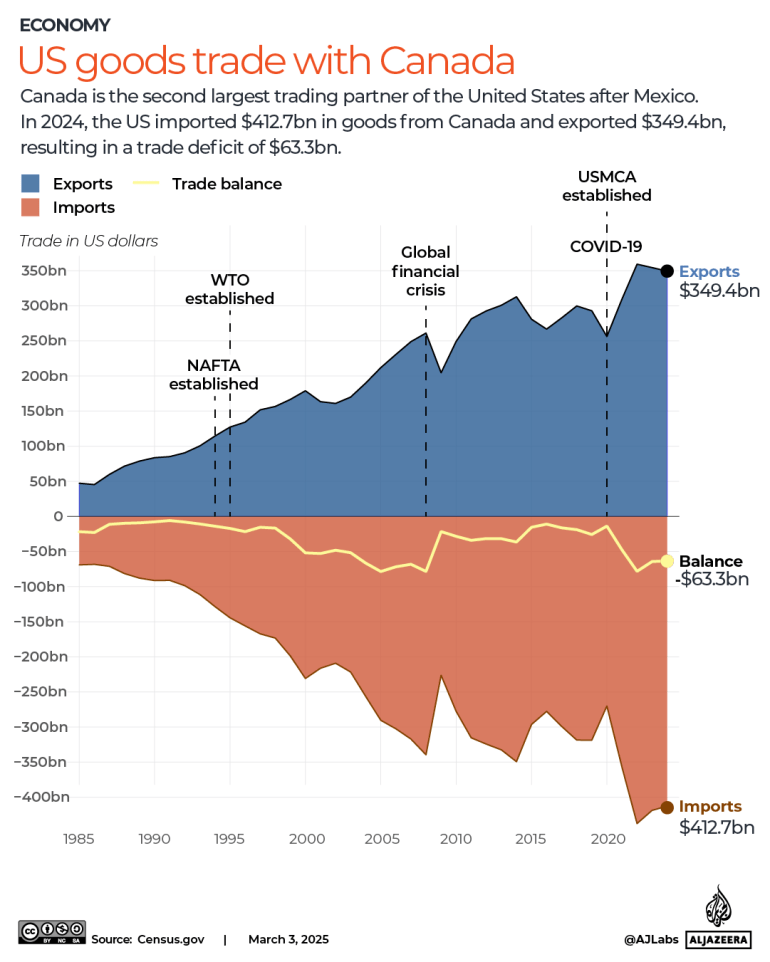
Mexico’s president says country is ready for anything ahead of Tuesday deadline, as Canadian officials warn retaliation. A day before US President’s Donald Trump’s tariffs are expected to go into effect, Mexico and Canada say they have plans in place for how to respond. Trump is expected to decide on Monday what levels of tariffs he will impose early on Tuesday on Canada and Mexico amid last-minute negotiations over border security and efforts to halt the inflow of fentanyl opioids. Trump has vowed to impose 25 percent tariffs on all imports from Canada and Mexico, with 10 percent for Canadian energy. Mexican President Claudia Sheinbaum said Monday that Mexico had made a strong case for staving off the tariffs, but that it would be up to Trump and the US government to decide how they will proceed. “So whatever his decision is, we will make our decisions and there is a plan and there is unity in Mexico,” Sheinbaum said during her daily news conference. Speaking on CNBC on Monday, Canadian Energy Minister Jonathan Wilkinson again vowed retaliatory measures if Trump went ahead with the tariffs. Canadian officials had previously drawn up a plan to target imports produced in stronghold’s of Trump’s Republican party before the tariffs were first averted last month. It was not clear if they would take a similar approach this time around. Advertisement CEOs and economists say the action, covering more than $900bn worth of annual US imports from its southern and northern neighbours, would deal a serious setback to the highly integrated North American economy. Commerce Secretary Howard Lutnick on Sunday signalled that Trump may not impose the full amount of tariffs, saying that the president would determine their exact levels. Mexico and Canada have “done a reasonable job” of securing their US borders and Trump is considering what the final tariff levels should be, Lutnick told Fox News. “He’s sort of thinking about right now how exactly he wants to play with Mexico and Canada, and that is a fluid situation,” he said. “There are going to be tariffs on Tuesday on Mexico and Canada. Exactly what they are, we’re going to leave that for the president and his team to negotiate.” ‘The path that he’s chosen’ Trump has broadly vowed to reshape nearly all trade relations since taking office, claiming the US was being treated unfairly in its constellation of agreements across the world. That has sparked fears of overlapping trade wars that could disrupt the global economy. But Trump’s emphasis on Mexico and Canada has been particularly surprising, given the deeply intertwined nature of the three countries’ industries and economies. In response to the threat, both Mexico and Canada last month announced a series of initiatives to meet Trump’s demands related to migration and drug trafficking. That has included Mexico sending 10,000 National Guard troops to its shared border with the US. Last week, Mexico also extradited 29 drug cartel members to the US. Advertisement Among other measures, Canada has appointed a so-called “fentanyl czar”, despite US authorities seizing less than 20kg (44 pounds) of the opioid smuggled from Canada from October 2023 to September 2024. Senior Canadian and Mexican officials also met with Trump cabinet members on Friday to discuss their response. Trump adviser Peter Navarro said it was unlikely that Trump would waiver, despite concerns over domestic economic blowback. “This is the path that he’s chosen,” he told CNBC. Adblock test (Why?)
Israeli anger at ceasefire delay focused on captives, not Gaza’s aid crisis
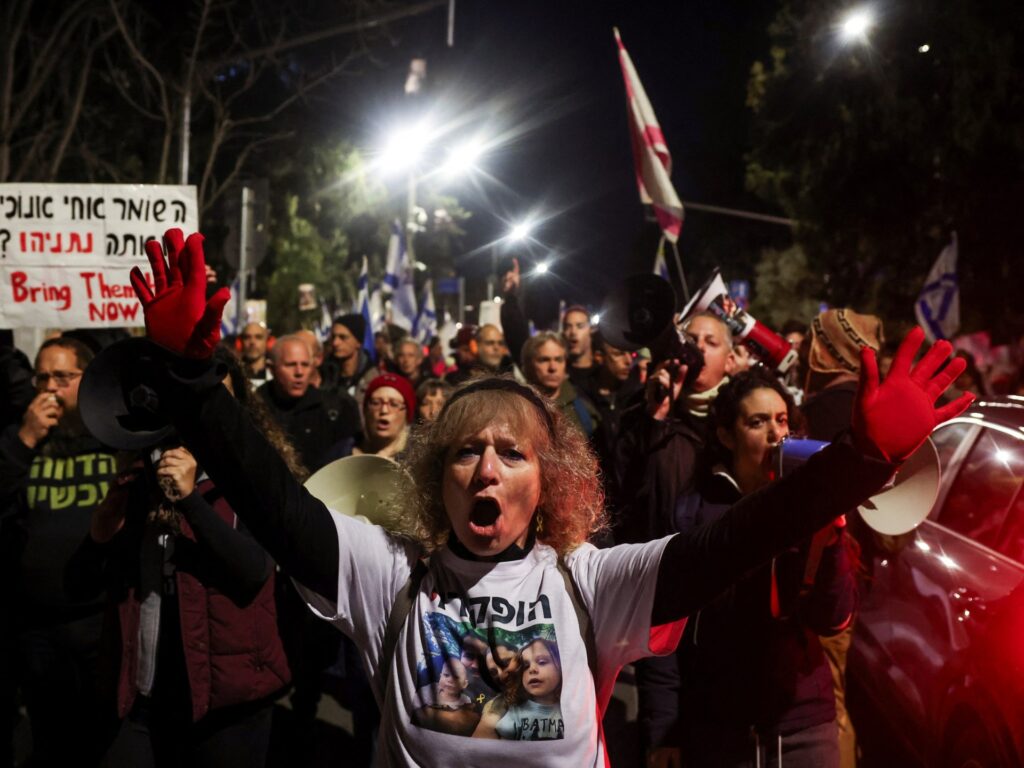
As the Israeli government stalls on the Gaza ceasefire deal agreed between it and the Palestinian group Hamas, delaying progression to phase two of the agreement, protesters gathered outside of Prime Minister Benjamin Netanyahu’s residence on Sunday night. Yes, they were angry at his decision to unilaterally extend phase one of the deal, and frustrated at his delays in fully implementing the agreement, brokered in January. But their banners and slogans had no references to the suffering of Palestinian civilians in Gaza, after Israel on Sunday blocked the entry of humanitarian aid into the enclave. Instead, the focus was on the Israeli captives left behind in Gaza as Netanyahu drags his feet, seemingly focused on finding a way to avoid ending the war. The Israeli government’s actions on Sunday seemed to point in the direction of an end to the ceasefire and a resumption of all-out war on Gaza, even as the captives remain there. Although phase one of the ceasefire expired on Saturday, the agreement had stipulated that the terms of the truce – including the flow of humanitarian aid into Gaza – would continue while negotiations for phase two continued. Advertisement However, Israel announced on Sunday the emergence of a “Witkoff plan” – referring to United States Middle East envoy Steve Witkoff – that would see half of the captives released immediately and the other half after an agreement on a permanent ceasefire, essentially throwing away the original ceasefire deal. Israel used the opportunity of the deal – which neither the US nor Witkoff himself have confirmed the existence of – to reinstate its blockade of Gaza, sending food prices skyrocketing there. The United Nations Children’s Fund (UNICEF) warned that the aid blockade carried “devastating consequences” for children and families in Gaza battered by 16 months of war. Collective punishment is prohibited under the Geneva Conventions, Professor Gerry Simpson of the London School of Economics told Al Jazeera, irrespective of who was enforcing it. “The fact that it is being phrased as a form of punishment suggests a certain disregard for the laws of war, but that disregard does not render these laws null or unimportant,” he said. In addition to the suspension of aid, the Israeli government is also mulling approval of a bill that would allow it to call up 400,000 of its reserve soldiers in anticipation of renewed conflict in Gaza. In the wake of the October 7, 2023 attack on Israel, 300,000 reserve soldiers were called up, the largest mobilisation in Israel’s history at the time. Angry families While Israeli public anger towards Netanyahu over the current breakdown in negotiations is not yet widespread, former ambassador and consul general of Israel in New York, Alon Pinkas, told Al Jazeera that it was likely to grow if the impasse continued, until it became “clear that he’s [Netanyahu] looking for a pretext to break the ceasefire and thus condemn hostages to death”. Advertisement The fate of the 251 or so captives taken prisoner during the October 7 attack has represented a throughline in Israeli public criticism of its prime minister. However, recent weeks – where images of captives returning to their families have dominated the media – have in turn elevated the voices of their families, who are often critical of Netanyahu. Those protesting outside of Netanyahu’s residence on Sunday night, led by the families of the captives, made it clear that they felt the prime minister was to blame for the impasse in completing the ceasefire agreement. At a press conference held by a number of the captives’ families earlier the same day, Lishay Miran-Lavi, whose husband Omri Miran remains in Gaza, rejected the claims by some members of Israel’s cabinet, including Netanyahu, that no agreement is possible while Hamas remains in existence, telling reporters, “Hostages immediately, Hamas afterwards”. “Netanyahu knows he doesn’t have a monopoly over the narrative right now,” Israeli political analyst Ori Goldberg said, “so there’s a risk that, with this delay, he could find himself under increased fire from the hostages’ families, which have a lot of public sympathy”. Goldberg suggested that this, among other factors tied directly to Netanyahu’s political survival, may limit how long the current impasse can continue. Bad faith Scepticism over Netanyahu’s commitment to the ceasefire agreement is not new. Since its inception, the prime minister has hinted at his willingness to break the agreement in order to placate its critics, while also using the ceasefire’s existence to reassure the captives’ families and their supporters. Advertisement In January, Netanyahu signalled his intention to break the agreement when negotiating with his hardline Finance Minister Bezalel Smotrich to remain in the cabinet and not join fellow far-right National Security Minister Itamar Ben Gvir in resigning his post over the prospect of reaching a ceasefire deal with Hamas. As part of his deal with Smotrich, Netanyahu was reported to have assured the finance minister that the ceasefire was temporary and that military operations in Gaza would resume aimed at dismantling Hamas’s military and governing capabilities once the “temporary” truce was over. Negotiations on a permanent ceasefire were slated to be included in the second stage. “People don’t really trust Netanyahu,” analyst Nimrod Flashenberg said from Tel Aviv. “A lot of the public doubted that the ceasefire would hold from the start, but we really don’t know what will happen next. A lot of that depends upon the [US President Donald] Trump administration.” For many observers, everything from the delay in progressing to the second stage of the ceasefire deal to the ambiguity over who suggested its suspension was typical of a prime minister who had profited from sowing confusion among his critics for years. “This is what he does,” Goldberg said. “It’s what everyone in Israel expects of him. Politically, there’s no reason for it. He has no political rivals; he has the settlers on [his] side. It’s just what he does.” “For Netanyahu, these byzantine schemes are essential to keeping the Israeli ship of state on course,” he
UK says several Ukraine truce options on table after France floats plan
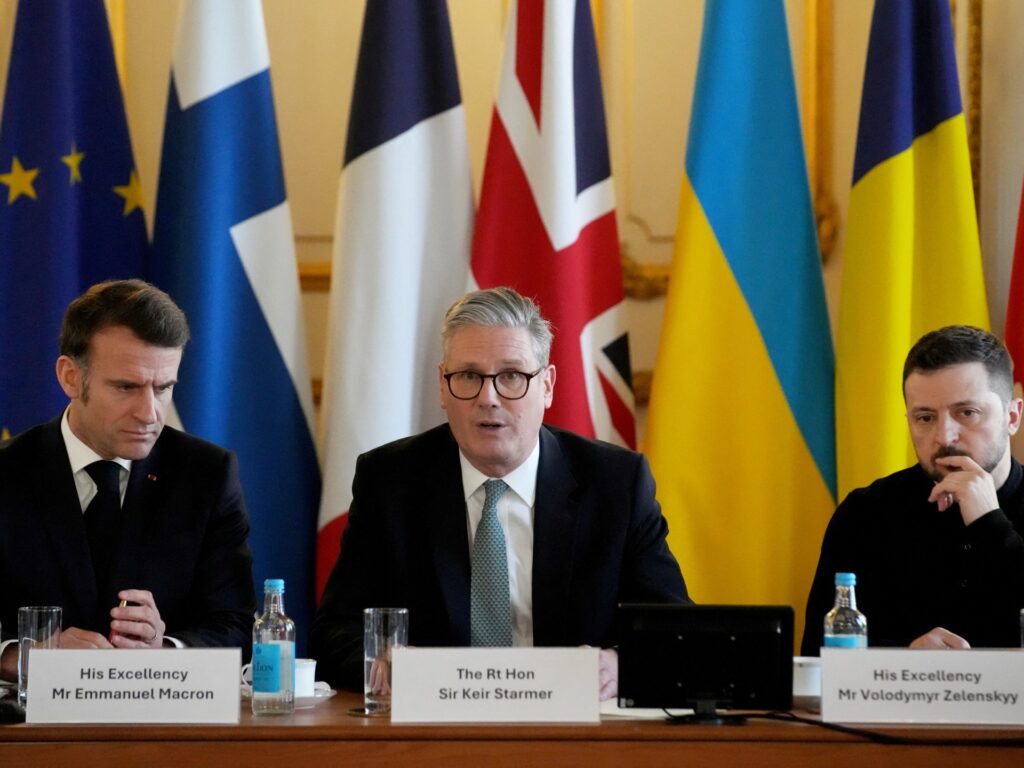
The United Kingdom has said there are several proposals for a potential Ukraine ceasefire after French President Emmanuel Macron proposed a limited initial one-month truce, as Kyiv reiterated its need for security guarantees as part of any agreement. European countries, led by the UK and France, are looking at options for a proposal to halt Russia’s war on Ukraine after last week’s Oval Office rupture between US President Donald Trump and Ukrainian President Volodymyr Zelenskyy. British Prime Minister Keir Starmer hosted a summit of European leaders in London on Sunday and said they had agreed to draw up a Ukraine peace plan to present to the US. In an interview given on his way to the summit, Macron raised the possibility of a one-month ceasefire, although so far there has been no public endorsement from other allies. “Such a truce on air, sea and energy infrastructure would allow us to determine whether Russian President Vladimir Putin is acting in good faith when he commits to a truce,” French Foreign Minister Jean-Noel Barrot said of Macron’s proposal. Advertisement “And that’s when real peace negotiations could start.” Starmer’s spokesperson on Monday said there are “clearly a number of options” on the table. “I’m just not getting into a running commentary on the options,” he added. UK Defence Minister Luke Pollard told Times Radio that no agreement has been made on “what a truce looks like”. “But we are working with France and European allies for a lasting peace,” Pollard said. Asked if he was aware of the plan raised by Macron, Zelenskyy said: “I’m aware of everything.” In comments on Monday, Zelenskyy accused Russia of not being serious about peace and said tough security guarantees were the only way to end more than three years of conflict in Ukraine. He called for “effective security guarantees that will make it impossible for Russian aggression to return” after predicting that Moscow would break any deal. “Anyone who wants to negotiate does not deliberately hit people with ballistic missiles,” he said in his statement. Russia, which launched a full-scale invasion in February 2022, dismissed the Ukraine leader’s comments, accusing him of not wanting peace, echoing US criticisms after Zelenskyy was shouted down in the White House last week. “What happened at the White House on Friday, of course, demonstrated how difficult it will be to reach a settlement trajectory around Ukraine,” Kremlin spokesperson Dmitry Peskov said. “The Kyiv regime and Zelenskyy do not want peace. They want the war to continue. It is very important that someone forces Zelenskyy himself to change his position. Someone has to make Zelenskyy want peace. If the Europeans can do it, they should be honoured and praised.” Advertisement European countries are adjusting to what some leaders describe as the biggest policy reversal since World War II from Washington – especially after Friday’s bust-up, when Zelenskyy left the White House abruptly after a dressing down in front of cameras by Trump and US Vice President JD Vance. The Ukrainian leader had been in Washington to sign a deal to give the United States access to Ukrainian minerals, but left without signing it. Speaking to Fox News, US National Security Advisor Mike Waltz said Zelenskyy should apologise. “What we need to hear from President Zelenskiy is that he has regret for what happened, he’s ready to sign this minerals deal and that he’s ready to engage in peace talks,” Waltz said. “I don’t think that’s too much to ask. We’ll see what happens in the next 48 hours, but we are certainly looking to move forward in a positive way.” European leaders have agreed they must spend more on defence to show Trump the continent can protect itself. The European Union is due to hold an emergency summit on Thursday. Reporting from the Ukrainian capital Kyiv, Al Jazeera’s Charles Stratford said that Ukrainians are bracing for uncertain times ahead. “They would have been buoyed by the level of support expressed by European leaders in London yesterday, but they are also aware there are a whole lot of hurdles yet that need to be overcome before we see anything real and concrete in terms of stopping the fighting in Ukraine,” Stratford said. “It’s all key on whether the US will agree to security guarantees both around this plan that Europe has and with respect to the minerals deal as well,” he added. Advertisement Adblock test (Why?)
RFK Jr, noted vaccine sceptic, backs measles jab amid deadly US outbreak
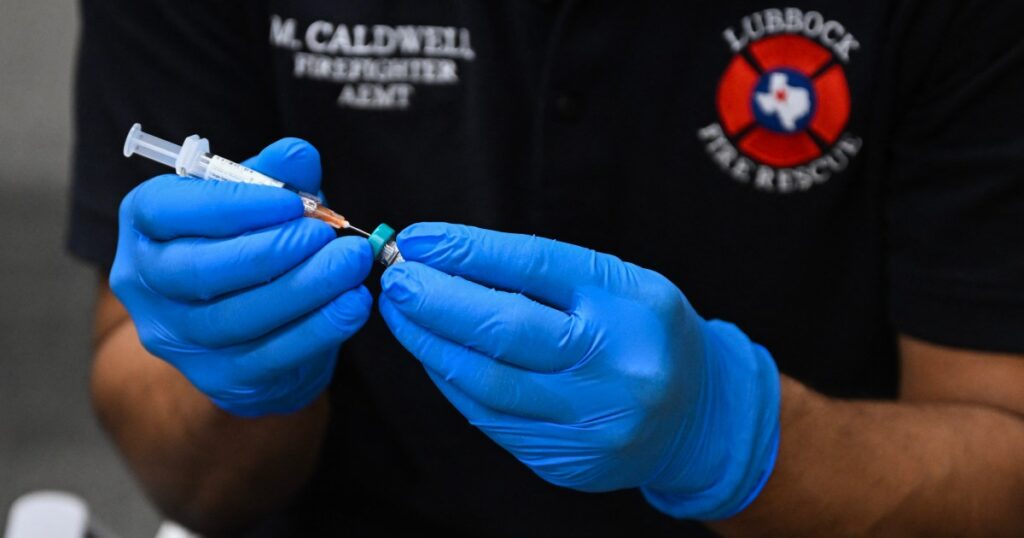
US health secretary says he is ‘deeply concerned’ about outbreak in Texas. Robert F Kennedy Jr, the top health official in the United States who is known for his scepticism of vaccines, has backed the measles jab amid a deadly outbreak of the infectious disease in Texas. In an opinion piece published by Fox News on Sunday, Kennedy said he was “deeply concerned” about the spread of the disease despite earlier suggesting that it was “not unusual”. “Vaccines not only protect individual children from measles, but also contribute to community immunity, protecting those who are unable to be vaccinated due to medical reasons,” Kennedy wrote, though he said the decision to vaccinate is “a personal one”. The US secretary of health and human services said that before the introduction of the MMR vaccine, “virtually every child” in the US contracted measles. “For example, in the United States, from 1953 to 1962, on average there were 530,217 confirmed cases and 440 deaths, a case fatality rate of 1 in 1,205 cases,” he wrote. US authorities last month reported the first measles death in the country in a decade after an unvaccinated school-aged child was hospitalised with the disease in northwest Texas. Advertisement As of Friday, 146 cases had been identified in the state since late January, according to the Texas Department of State Health Services. Health officials have said the cases have been concentrated in a community of Mennonites, a Christian sect that arose out of the radical factions of the 16th-century Reformation. Kennedy, who has promoted scientifically discredited research linking vaccines to autism, attracted criticism last month when he appeared to downplay the outbreak by pointing out there had been several outbreaks already this year. Measles can be highly dangerous for people who are not vaccinated, including young infants who are not typically eligible for immunisation. About one in five unvaccinated individuals in the US who gets measles is hospitalised, while about one out of every 20 children with the disease gets pneumonia, according to the Centers for Disease Control and Prevention. Adblock test (Why?)
Israeli-Palestinian film No Other Land wins Oscar for best documentary

The collaboration between Israeli and Palestinian filmmakers triumphed over Porcelain War, Sugarcane, Black Box Diaries and Soundtrack to a Coup d’Etat. No Other Land, a film about Palestinians fighting to protect their homes from demolition by Israel’s military, has won the Oscar for Best Documentary Feature. The collaboration between Israeli and Palestinian filmmakers triumphed on Sunday over Porcelain War, Sugarcane, Black Box Diaries and Soundtrack to a Coup d’Etat. The film, produced between 2019 and 2023, follows activist Basel Adra as he risks arrest to document the destruction of his hometown, Masafer Yatta, which Israeli soldiers are tearing down to use as a military training zone, at the southern edge of the West Bank. Adra’s pleas fall on deaf ears until he befriends a Jewish-Israeli journalist, Yuval Abraham, who helps him amplify his story. Accepting the award, Adra said No Other Land reflects the harsh reality Palestinians have been enduring for decades. “About two months ago, I became a father, and my hope to my daughter that she will not have to live the same life I’m living now, always fearing settlers, violence, home demolitions and forcible displacements that my community is living and tasting every day under Israeli occupation,” said Adra. Advertisement He also called on the world to “take serious actions to stop the injustice and to stop the ethnic cleansing of the Palestinian people”. #Oscars2025 🇵🇸 @basel_adra: “We call on the world to take serious actions to stop the injustice and to stop the ethnic cleansing of the Palestinian people.” #NoOtherLand pic.twitter.com/2yVfryoAWC — State of Palestine (@Palestine_UN) March 3, 2025 ‘Together, our voices are stronger’ Abraham said they made the film because together, their voices were stronger. “We see each other: The atrocious destruction of Gaza and its people which must end. Israeli hostages, brutally taken in the crime of October 7th, which must be freed,” he said. Abraham criticised the Israeli regime that destroys Adra’s life, and said there is a different path, a “political solution without ethnic supremacy, with national rights for both of our people”. But the United States’ foreign policy is helping block that path, he said. “Can’t you see that we’re intertwined – that my people can be truly safe if Basel’s people are truly free and safe? There is another way. It’s not too late for life for the living. There is no other way,” he added. The film has struggled to find a distributor in the US, so its makers arranged for it to have a one-week run at the Lincoln Center in November in order to qualify for tonight’s Oscars. The Oscar on Sunday is the latest high-profile honour that No Other Land has gained. It also won the audience award and documentary film award at the Berlin International Film Festival in February 2024, as well as the New York Film Critics Circle award for Best Non-Fiction Film. Advertisement The film is heavily reliant on camcorder footage from Adra’s personal archive. He captures Israeli soldiers bulldozing the village school and filling water wells with cement to prevent people from rebuilding. It shows residents banding together after Adra films an Israeli soldier shooting a local man who is protesting the demolition of his home. The man becomes paralysed, and his mother struggles to take care of him while living in a cave. .@yuval_abraham: When I look at @basel_adra I see my brother, but we are unequal. We live in a regime where I am free under civilian law and Basel is under military laws that destroy his life and he cannot control, there is a different path…the foreign policy in 🇺🇸 is helping… pic.twitter.com/iWSLN5bs27 — Assal Rad (@AssalRad) March 3, 2025 More than 500,000 settlers live in the occupied West Bank, which is home to about three million Palestinians. The settlers have Israeli citizenship while Palestinians live under military rule with the Palestinian Authority administering population centres. Major human rights groups have described the situation as apartheid, an allegation rejected by the Israeli government, which views the West Bank as the historical and biblical heartland of the Jewish people and is opposed to Palestinian statehood. Adblock test (Why?)
In post-war Lebanon, Hezbollah grapples with new relationship to the state
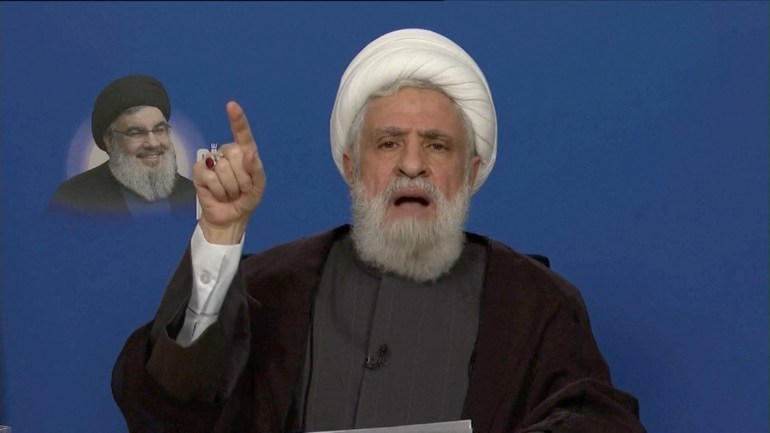
Beirut, Lebanon – Hezbollah rallied thousands of its supporters for the funeral of its longtime leader Hassan Nasrallah, who was killed in an Israeli air strike in September. The funeral on February 23 was an opportunity for the Lebanese group to send a message: Despite the losses it has experienced in the past several months, it is still strong and should not be underestimated. But analysts told Al Jazeera the show of strength does not make up for the impact of Israel’s war against Hezbollah, which saw much of the group’s top leadership killed and a significant portion of its military arsenal reportedly destroyed. When a ceasefire was finally announced on November 27, Hezbollah was left battered and exhausted. Hezbollah leader Naim Qassem has ‘lent a hand’ to the new government, one analyst close to the group says [Manar TV via Reuters] The ceasefire stated that Hezbollah would retreat north of the Litani River and away from Lebanon’s border with Israel while Israeli forces would leave southern Lebanon and a newly empowered Lebanese military would control the south. Advertisement Days later, Hezbollah lost one of its most crucial allies, the Syrian regime of Bashar al-Assad, which fell in a lightning opposition offensive. It now finds itself at a crossroads. Hezbollah weakened “Hezbollah is in a difficult position,” Imad Salamey, a senior Middle East policy adviser and associate professor of political science and international affairs at Lebanese American University, told Al Jazeera, adding that the group is “facing its weakest moment in decades”. Before September, Hezbollah was the most influential political actor in Lebanon and reportedly one of the world’s most heavily armed nonstate actors. It was formed to repel an Israeli invasion in the 1980s, held out against a major confrontation with Israel in 2006 and built its arsenal and manpower up since then. It has often been described as a “state within a state” and also provides key services to its predominantly Shia Muslim supporters – a community historically overlooked and underserved by the Lebanese state. A day after Hamas’s attacks on southern Israel and Israel’s launch of a genocidal war on Gaza in October 2023, Hezbollah entered the fray, engaging Israel along the border to pressure it to stop attacking Gaza. Its intervention was much anticipated, given that Hezbollah’s position has long been in support of Palestine and against Israel. In January, Joseph Aoun, right, was elected president, and Nawaf Salam, left, was chosen to be prime minister of Lebanon [Handout/Lebanese Presidency Press Office via Reuters] The conflict escalated in September when Hezbollah pagers and walkie-talkies exploded in attacks blamed on Israel. Israel also launched a day of air strikes across Lebanon on September 23 that killed at least 558 people, mostly civilians. The air attacks continued, and four days later, Nasrallah was killed. Many of Hezbollah’s military and religious leaders have also been killed since, including Nasrallah’s successor Hashem Safieddine in early October. Advertisement Israel destroyed infrastructure and homes across Lebanon, targeting parts of the country where Shia Muslims – Hezbollah’s support base – live, such as southern and eastern Lebanon and Beirut’s southern suburbs. It invaded Lebanon in October, particularly devastating the south, where it wiped out entire villages. Hezbollah was left militarily weakened and unable to now fight back against Israel in the same way it used to. “[New Hezbollah Secretary-General Naim] Qassem has inherited a weaker Hezbollah from his predecessor Nasrallah, and it will be interesting to see if he’d be as smart of a navigator given that so much of Nasrallah’s success was based on the party’s ability to project power,” Elia Ayoub, a Lebanese researcher and author of the Hauntologies newsletter, told Al Jazeera. “Whether or not they decide to adopt a completely different methodology or not is what we’ll see in the coming months.” A new political system and leveraging anger The other sources of Hezbollah’s strength have been the support it receives from Iran, both material through Syria and financial, manifested in the social support systems it ran and in its political representation and influence. However, as international attention increased on Lebanon after the ceasefire, its parliament was encouraged to select a new president and prime minister in early January, ending two years of government paralysis. For the first time since 2008, Hezbollah and its sister Shia party, Amal, were not able to nominate every Shia granted a ministerial portfolio in the new cabinet. Advertisement “Hezbollah no longer has the financial means, open Iranian backing or clear military options to resist these changes,” Salamey said. To make the best of the situation, Hezbollah has tried to leverage what it can, Karim Safieddine, a Lebanese political writer and doctoral student in sociology at Pittsburgh University, told Al Jazeera. “Hezbollah’s goal today is multifold,” Safieddine said. “[They want to] develop the resentment of the Shia community in the pursuit of consolidating control over it, find a way to navigate the fact that it’s facing extreme financial challenges – using international support to the government is one way but also while locating credit – [and] continue to justify holding arms in the name of state weakness and continued Israeli violations.” Thousands of people attend the funerals for Nasrallah and Safieddine at the Sports City Stadium in Beirut [Hassan Ammar/AP] While many displaced Lebanese started to return to the south after the ceasefire, Israel used the cessation of Hezbollah attacks to continue occupying many villages and enter others for the first time. The Lebanese government accused Israel of violating the terms of the ceasefire by not withdrawing from southern Lebanon and not stopping its attacks on people and villages. On February 18, Israel announced it would continue occupying at least five key points in Lebanon, but now, the Lebanese army is responsible for security in the south, not Hezbollah – and some have criticised the army for failing to liberate the land and properly protect the people of the south. Advertisement Cash-strapped Hezbollah has promised to pay for reconstruction and has already begun
Trump’s attempt to topple Zelenskyy through elections could be catastrophic
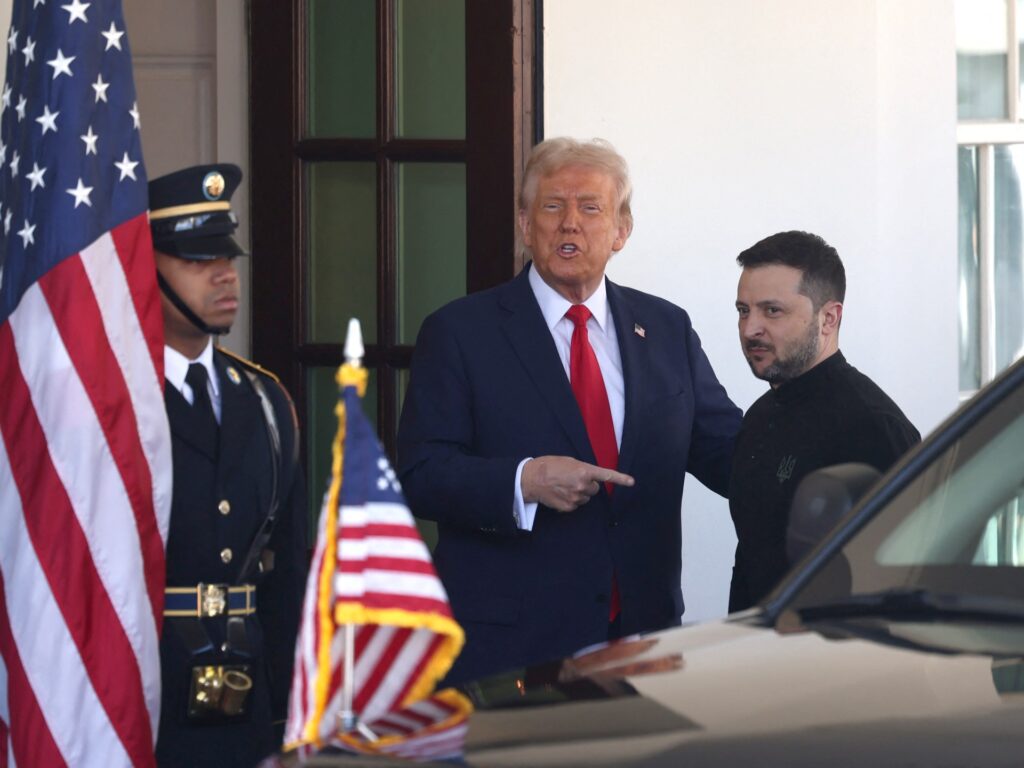
On February 28, Ukrainian President Volodymyr Zelenskyy held a long-awaited meeting with US President Donald Trump in an attempt to persuade him to continue US support for Ukraine. The encounter was likely not what the Ukrainian head of state had expected. Trump and US Vice President JD Vance chastised Zelenskyy in front of TV cameras for being “disrespectful” and for refusing to embrace their initiative for a ceasefire with Russia. It is evident that Zelenskyy will not make a return to Washington during Trump’s presidency. It is also evident that US pressure on Ukraine will significantly escalate in the following weeks and months, as Trump presses Kyiv to make significant concessions to Russia in return for peace. Even before the showdown at the White House, the Trump administration was questioning Zelenskyy’s legitimacy and pushing for presidential elections to be held. Holding a rushed election with the sole purpose of eliminating the incumbent, however, could spell disaster for the country. Advertisement Before Russia’s full-scale invasion of Ukraine, approval ratings for Zelenskyy’s presidency were as low as 28 percent and 11 percent for his party. Russia’s full-scale invasion sent Ukrainians rallying behind the president and his popularity reached record highs. However, over the past two years, his approval ratings have been on a consistent decline. According to polls, trust in Zelenskyy fell from 54 percent in April 2024 to 49 percent in January – not as low as Trump has claimed, but a far cry from his 90 percent rating in May 2022. Multiple factors have contributed to Zelenskyy’s declining popularity, including rampant corruption under his administration and the growing fatigue from the ongoing war. The Ukrainian president – well aware of his vulnerability – has made clear that he is not comfortable with competition. For him, the stakes are high because if he were to lose a re-election bid, he could face prosecution for corruption or various forms of retribution from his rivals. The polls are already showing that if elections were to be held immediately, he would lose. A formidable challenger to Zelenskyy has already emerged: Valerii Zaluzhnyi, a four-star general who served as commander-in-chief of Ukraine’s armed forces until February 2024. Polls show that Zaluzhnyi – if he were to run in a presidential vote – would defeat Zelenskyy. Public trust in him is among the highest and stood at 72 percent in January. Although Zaluzhnyi was dismissed by the president on the heels of the failed Ukrainian counteroffensive in 2023, there have been speculations that his popularity in Ukraine may have also been a factor. The general was sent abroad to serve as the Ukrainian ambassador to the United Kingdom – a position he still occupies. Advertisement So far, Zaluzhnyi has not declared an intention to run, although there are no guarantees he would not change his mind. If he stays out, other military figures, such as Kyrylo Budanov, may step in. Budanov, Ukraine’s intelligence chief, has a public trust rating of 62 percent. He recently disappeared from the public eye after a year of high-profile media appearances. Rumours have spread that Zelenskyy’s office planned to remove him, resulting in his sudden retreat. But he may well reappear once the campaign begins. Boxing champion Oleksandr Usyk could become a potential dark horse. In a country where a former comedian became president, a victorious athlete doesn’t seem like an unlikely contender. Although he has not made any political ambitions public, he has started appearing in polls and his rating currently stands at 60 percent. Then there is former President Petro Poroshenko, who has low approval ratings, but remains a dangerous rival to Zelenskyy. Since 2019, more than 130 criminal cases have been launched against him – including one accusing him of treason for approving a coal-supplying scheme from the Russian-occupied Donbas region. Poroshenko is an outspoken critic of Zelenskyy and is not hiding his political ambitions. He has travelled to the US and met with Trump’s team. In February, when he tried to go to the Munich Security Conference, he was not allowed. He now faces state-imposed sanctions on “national security grounds”, which include an asset freeze. The message of the sanctions is clear: Poroshenko will be eliminated from the presidential race before it even begins. In this context of perceived political persecution, other potential challengers have not come forward, being too afraid to run. Advertisement There has been growing concern over Zelenskyy’s handling of opposition figures, but so far, no strong public rebuke has emerged from his allies. After the confrontation at the White House, European leaders expressed support for him. This has given Zelenskyy a temporary boost at home, but it is unclear how long it could hold. Apart from the bitter political rivalries and retribution, the Ukrainian political scene is also marked by continuing divisions within society. The war has intensified emotions and split the country right down the middle, creating a volatile situation. The ultranationalists not only hold sway among certain parts of the population but also are empowered as active participants in the war. There is also still a portion of society that leans pro-Russian and does not want the conflict to continue. If an election is imposed from abroad in this volatile situation, it could prove more catastrophic than Russia’s invasion or the loss of Ukraine’s industrial heartlands. The danger isn’t just that a third of the population would be unable to vote and the election’s legitimacy may be in question. The real threat is that the vote could ignite a fight of all against all before a single ballot is cast. An incumbent who fears losing a re-election bid and political rivals who are hellbent on regaining relevance may resort to exploiting societal divisions. The military and security agencies could be forced to act, which adds to a potentially explosive mix. If presidential elections can dangerously polarise societies at peace – as we have seen in the United States – they can do much worse in times of war. A rushed
India avalanche rescue operation ends as eighth and final body found
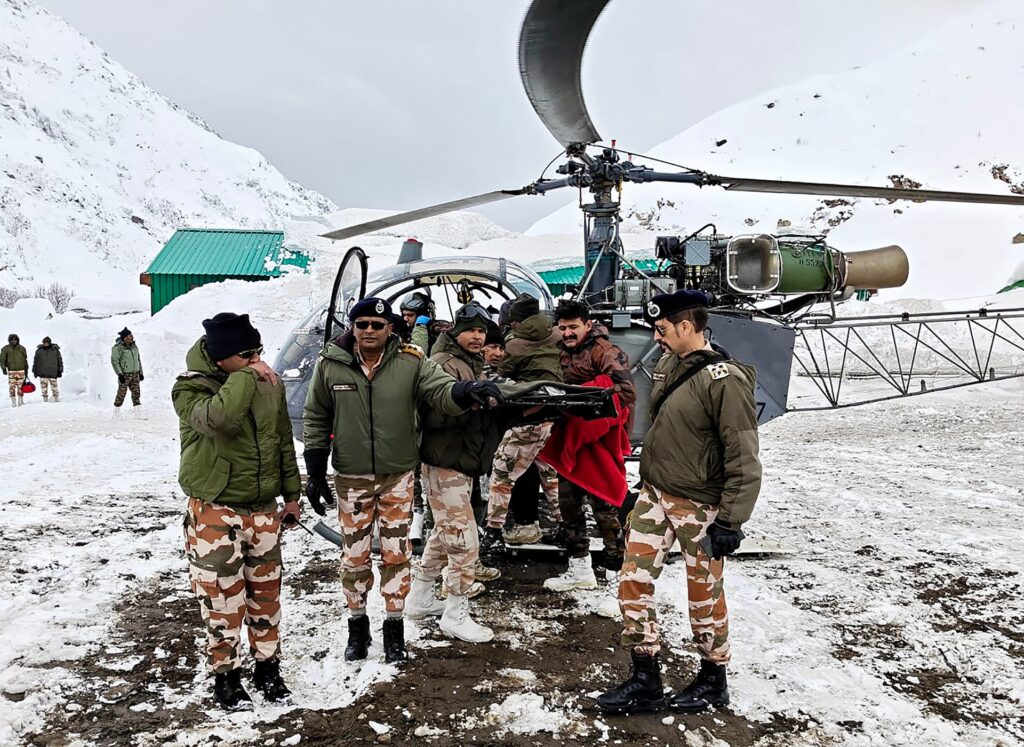
More than 50 workers submerged under snow and debris after an avalanche hit a construction camp in Uttarakhand state. Rescuers recovered the eighth and final body from the site of an avalanche in a remote area of northern India, the army has said, marking the end of a marathon operation in subzero temperatures. More than 50 workers were submerged under snow and debris after the avalanche hit a construction camp on Friday near Mana village on the border with Tibet in the Himalayan state of Uttarakhand. Authorities had revised down the number of workers on site at the time of the avalanche from 55 to 54 after one worker, previously believed to be buried, was found to have safely made his way home before the avalanche hit. By Saturday, rescuers had managed to pull out 50 people, but four later succumbed to their injuries, according to an Indian army statement. By Sunday, rescue teams had recovered the remaining bodies, the army said, adding that they had used a drone-based detection system and a rescue dog to assist in its search operations. Many of those trapped were migrant labourers working on a highway expansion project covering a 50km (31-mile) stretch from Mana, the last Indian village before the China border, to Mana Pass. Advertisement They were living on site in steel containers considered stronger than tents and capable of withstanding harsh weather. As the ground beneath them shook, the container that construction worker Anil and his colleagues were in began to slide down. “At first we did not understand what was happening, but when we looked out of the window of the containers, we saw piles of snow all around,” Anil, 20, told the AFP news agency. He said that the roofs of the containers began bending inwards. “The way we were engulfed in snow, we had no hope of surviving,” he said, adding that being alive felt “like a dream”. His colleague Vipan Kumar thought “this was the end” when he found himself unable to move as he struggled for air under the thick layer of snow. “I heard a loud roar, like thunder … before I could react, everything went dark,” he told the Times of India newspaper. The ecologically fragile Himalayan region, increasingly affected by global warming, is prone to avalanches and flash floods. In 2021, nearly 100 people died in Uttarakhand when a huge chunk of a glacier fell into a river, triggering flash floods. Devastating monsoon floods and landslides in 2013 killed 6,000 people and led to calls for a review of development projects in the state. In 2022, an avalanche also killed 27 trainee mountaineers in Uttarakhand, while a glacier that burst in 2021 triggered a flash flood and left more than 200 people dead. Adblock test (Why?)
US firm Firefly achieves its first moon landing with Blue Ghost spacecraft

Firefly says it is the first private company to make a ‘fully successful’ soft landing on the moon. Firefly Aerospace, a United States-based private space company, has successfully landed its Blue Ghost spacecraft on the moon for a two-week research mission amid a race between a handful of private firms. The touchdown took place at 3:35am US East Coast time (08:35 GMT) on Sunday in the Mare Crisium region, a prominent lunar basin visible from Earth. Firefly becomes the second private firm to achieve a moon landing with the company declaring itself the first to make a “fully successful” soft landing. Houston-based Intuitive Machines had a lopsided hard landing last year with its Odysseus lunar lander, which came out mostly intact but many of its onboard instruments were damaged. The Firefly mission is part of NASA’s Commercial Lunar Payload Services programme, which seeks to leverage private industry to support the agency’s return to the moon. Blue Ghost carried 10 scientific and technological payloads, including NASA instruments designed to study lunar dust, radiation and surface materials. Advertisement Key instruments on board will measure the moon’s internal heat flow and prevent lunar dust accumulation on equipment and include a retroreflector for laser-ranging experiments. The spacecraft was launched on board a SpaceX Falcon 9 rocket from Florida’s Kennedy Space Center on January 15. Firefly plans to follow up with two additional Blue Ghost missions in 2026 and 2028, both of which are expected to deliver more scientific payloads and support NASA’s long-term lunar objectives. Acting NASA Administrator Janet Petro said at Firefly’s landing event on Sunday that the moon remains part of the US goal to “dominate” space. The success underscores the growing role of private companies in space exploration as NASA and other agencies increasingly rely on commercial partners to achieve scientific and technological breakthroughs. A host of other countries are also advancing their own lunar efforts, including China with its robotic Chang’e programme and plans to put Chinese astronauts on the moon’s surface by 2030. Adblock test (Why?)