

‘My children, my children’: The Gaza family killed minutes before ceasefire
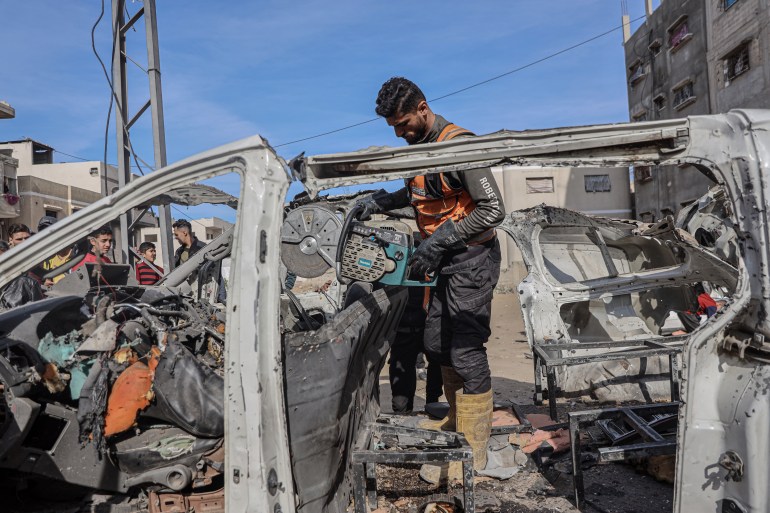
Khan Younis, Gaza Strip, Palestine – The ceasefire in Gaza was supposed to start at 8.30am (06:30 GMT). The al-Qidra family had endured 15 months of Israeli attacks. They had been displaced more than once and were living in a tent. Their relatives had been among the more than 46,900 Palestinians killed by Israel. But the al-Qidras had survived. And they wanted to go home. Ahmed al-Qidra packed his seven children onto a donkey cart and headed to eastern Khan Younis. It was finally safe to travel – the bombing should have stopped. But the family did not know that the ceasefire between Israel and Hamas had been delayed. They did not know that, even in those additional few hours, Israeli aircraft were still flying over the skies of Gaza, ready to drop their bombs. The explosion was loud. Ahmed’s wife Hanan heard it. She had stayed behind at a relative’s home in the centre of the city, organising their belongings, planning on joining her husband and children a few hours later. “The blast felt like it hit my heart,” Hanan said. She instinctively knew that something had happened to her children, whom she had only just said goodbye to. Advertisement “My children, my children!” she screamed. The cart had been hit. Hanan’s eldest son, 16-year-old Adly, was dead. So was her youngest, six-year-old Sama, the baby of the family. Yasmin, 12, explained that a four-wheel drive was in front of the cart carrying people celebrating the ceasefire. Perhaps that was the reason the missile hit. “I saw Sama and Adly lying on the ground, and my father bleeding and unconscious on the cart,” Yasmin said. She pulled her eight-year-old sister Aseel out before a second missile hit the spot where they had been. Eleven-year-old Mohammed also survived. But Ahmed, Hanan’s partner in life, was pronounced dead in the hospital. The vehicle travelling ahead of the al-Qidras’ donkey cart may have been targeted in the Israeli air attack [Abdelhakim Abu Riash/Al Jazeera] ‘My children were my world’ Sitting on the edge of her injured daughter Iman’s hospital bed in Khan Younis’s Nasser Hospital, Hanan was still shell-shocked. “Where was the ceasefire?” she asked. In their excitement to finally return to whatever was left of their home, the family had missed Israeli Prime Minister Benjamin Netanyahu declaring that the Palestinian group Hamas had not sent over the names of the three Israeli captives who would be released on Sunday as part of the ceasefire deal. They had not seen Hamas explain that there were technical reasons for the delay, and that the names would be provided, as they eventually were. They would not know that in the three-hour delay before the ceasefire eventually began, three members of their family would be killed. They were among the 19 Palestinians killed by Israel in those last few hours, according to Gaza’s Civil Defence. Hanan al-Qidra has to take care of her remaining children on her own after her husband Ahmed was killed in the Israeli attack in Khan Younis on January 19 [Abdelhakim Abu Riash/Al Jazeera] Hanan broke down in tears. She would now have to face life without her husband and without two of her children. The loss of Sama, “the last of the bunch” as she described her with the Arabic saying, was particularly hard. Advertisement “Sama was my youngest and the most spoiled. She’d get angry whenever I talked about having another child.” Adly had been her “pillar of support”. Her children were her world. “We endured this entire war, facing the harshest conditions of displacement and bombardment,” Hanan said. “My children dealt with hunger, a lack of food and basic necessities.” “We survived more than a year of this war, only for them to be killed in its last minutes. How can this happen?” A day of joy had been turned into a nightmare. The family had celebrated the end of the war the night before. “Hasn’t the Israeli army had enough of our blood and the atrocities they committed for 15 months?” Hanan asked. Then, she thought of her future. With her husband and two of her children ripped away from her, and with tears coming down her face, she asked: “What’s left?” Adblock test (Why?)
Captives released by Hamas as part of Gaza ceasefire arrive back in Israel

NewsFeed Three Israeli captives have been returned to Israel from Gaza after Hamas released them as part of the ceasefire agreement. Romi Gonen, Emily Damari and Doron Steinbrecher have reunited with their families and are described by Israeli doctors as being in a stable medical condition. Published On 19 Jan 202519 Jan 2025 Adblock test (Why?)
Video: Why was the start of the Gaza ceasefire delayed?
[unable to retrieve full-text content] Palestinians in Gaza are celebrating as a ceasefire has come into effect, after being delayed for more than two hours.
Which foreign leaders are attending Trump’s inauguration – and who isn’t?
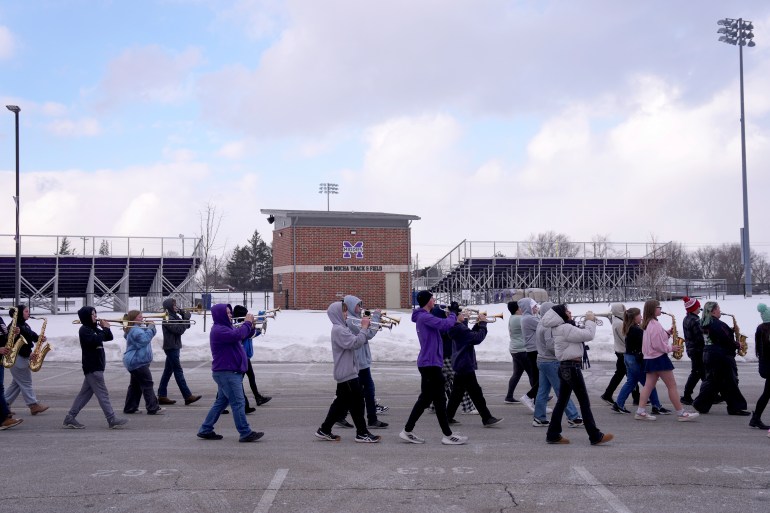
EXPLAINER In a break from tradition, US President-elect Donald Trump has invited world leaders and heads of far-right parties – coronation style. United States President-elect Donald Trump will be sworn into office for a second term on Monday, January 20 – this time as the 47th US president. Both Trump and Vice President-elect JD Vance are set to take the oath of office and begin a new administration amid a long day of celebrations that will include musical performances and a parade. However, unlike traditional inaugurations of US presidents, this one will include a host of foreign leaders, including Trump’s close allies and even some of his rivals. At least seven sitting heads of state and two former leaders have been invited. According to Reuters, an estimated 500,000 guests are expected in total. Here’s a breakdown of who’s in, who’s not invited, and why this guest list is so different from the norm: Students in the Middletown High School band practise on Tuesday, January 14, 2025, in Middletown, Ohio, the hometown of Vice President-elect JD Vance. The band is set to participate in the inauguration on January 20 [Kareem Elgazzar/AP] What’s different about this inauguration? President-elect Trump is breaking with US tradition for this event. Usually, presidential inaugurations are a domestic affair: the president and vice president take the oath with US officials, past heads of state and other American VIPs present on the steps of the US Capitol building. The public is allowed to watch from the surrounding grounds. However, this event, which will be accompanied by an inaugural speech, a parade, musical performances and balls, will also be an international affair. Close to a dozen world leaders, most of them conservative and right wing, have been invited. Foreign leaders usually do not attend the US presidential inauguration; rather, diplomats such as country ambassadors to the US, or foreign ministers, act as representatives. Who is invited? Several heads of state, notably right-wing or populist leaders allied with Trump, have been invited, but so have some of his rivals. Notably, they are: Advertisement Argentina’s President Javier Milei: Milei has confirmed his attendance. Trump once hailed the far-right leader as a man who can “make Argentina great again” and, in December, welcomed Milei at his Mar-a-Lago residence in Florida. Chinese President Xi Jinping: Trump invited Xi to the ceremony in December, a move that his spokespeople say signals his readiness to interact with his Chinese counterpart, even amid a looming trade war. Xi will not attend, however, Vice President Han Zheng will. Italy’s Prime Minister Giorgia Meloni: Meloni, of the far-right Brothers of Italy party, visited Mar-a-Lago in January. Her office says she is likely to attend if her schedule permits. Hungary’s Prime Minister Viktor Orban: Populist leader Orban is a close Trump ally and has said he believes the president-elect will end Russia’s war on Ukraine. He will not make it due to a state address, according to local media. Indian Prime Minister Narendra Modi: Modi and Trump have shared a “bromance” since the first Trump presidency. Following his election victory in December, Modi was among the first to call and congratulate Trump. While the PM will not attend, Foreign Minister Subrahmanyam Jaishankar will represent him. Ecuador’s President Daniel Noboa: Noboa hailed Trump’s December victory a victory for Latin America, too. His office confirmed he will pause a re-election campaign to travel to Washington for the inauguration. El Salvador’s President Nayib Bukele: Bukele’s office has not confirmed his attendance yet. Trump’s son, Donald Trump Jr, is friends with Bukele, and in July 2024, attended his inauguration in San Salvador. Former Brazilian president Jair Bolsonaro: the far-right politician nicknamed the “Trump of the Tropics” has been invited, but will not attend because he is banned from travelling. His passport was confiscated by the country’s Supreme Court amid several investigations, including alleged attempts to overturn the results of the 2022 general election, which he lost. Former Polish Prime Minister Mateusz Morawieck, who recently became leader of the right-wing European Conservatives and Reformists party in the EU parliament, will also attend. Who is not invited? UK Prime Minister Keir Starmer has not been invited, his office confirmed on Thursday. However, the far-right politician, Nigel Farage of the Reform UK party, is invited and will be present. European Commission head Ursula von der Leyen, and much of the European Union and members of NATO (the North Atlantic Treaty Organisation), which have largely centrist governments, have been ignored. Germany’s President Olaf Scholz, who leads the EU’s largest economy, has also been snubbed. An invitation has, however, been extended to Alice Weidel, leader of the far-right Alternative for Germany party (AfD), who will be represented by co-leader Tino Chrupalla. Santiago Abascal, who leads the Spanish right-wing Vox Party, and Andre Ventura of Portugal’s populist Chega party, will also be there. French President Emmanuel Macron was not invited, although Macron and Trump have friendly relations. Instead, French far-right politician Eric Zemmour of the Reconquest party will be present. Workers construct parade seating at Freedom Plaza along Pennsylvania Avenue, Washington, DC, on Tuesday, January 14, 2025, ahead of the upcoming inauguration of President-elect Donald Trump [Jon Elswick/AP] Which other countries have similarly packed swearing-in ceremonies? Different countries have different traditions but, typically, inaugurations are a domestic affair although they may include leaders from neighbouring countries. In India, swearing-in ceremonies are also becoming more extravagant, however. Last July, India’s President Narendra Modi had a long guest list for his third inauguration ceremony which hosted 9,000 guests. They included several heads of state from neighbouring Indian Ocean countries, including Sri Lanka’s Ranil Wickremesinghe and the now-ousted Bangladeshi president, Sheikh Hasina. Advertisement Similarly, Turkey’s President Recep Tayyip Erdogan, also sworn in for a third consecutive term in June 2023, hosted 34 world leaders for his lavish celebrations. They included South African President Cyril Ramaphosa, Venezuela’s President Nicolas Maduro, and Prime Minister Viktor Orban of Hungary. Adblock test (Why?)
ASEAN tells Myanmar military rulers peace should be priority, not election
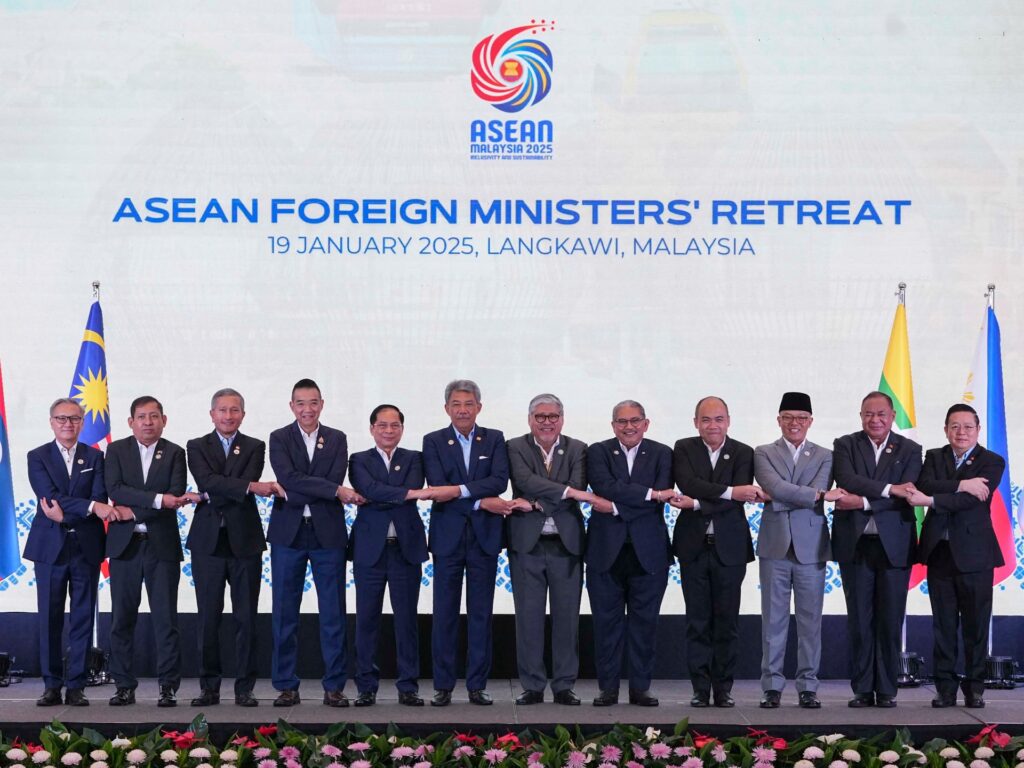
Myanmar has been in turmoil since early 2021 when its military overthrew the elected civilian government of Nobel laureate Aung San Suu Kyi. Southeast Asian nations have told Myanmar’s military government its plan to hold an election amid an escalating civil war should not be its priority, urging it to start dialogue and end hostilities immediately. The foreign ministers of the Association of Southeast Asian Nations (ASEAN) on Sunday called on the warring sides in member nation Myanmar to stop the fighting and told its representative to allow unhindered humanitarian access, host Malaysia’s foreign minister said. “Malaysia wants to know what Myanmar has in mind,” Mohamad Hasan told a news conference after a ministerial retreat on the island of Langkawi. Hasan said Myanmar – represented by a low-level official from the Ministry of Foreign Affairs after its military leaders were barred from formal ASEAN meetings – briefed the gathering about plans for a general election this year. But the bloc wants Myanmar’s government to ensure peace before any polls are held, he said. “We said the election has to be inclusive. The election cannot be in isolation, it has to involve all stakeholders,” he said. “We told them the election is not our priority. Our priority is to stop the violence.” Advertisement Myanmar has been in turmoil since early 2021 when its military overthrew the elected civilian government of Nobel laureate Aung San Suu Kyi, triggering pro-democracy protests that morphed into a widening armed rebellion that has taken over swaths of the country. Despite being battered on multiple fronts, its economy in tatters and dozens of political parties banned, the military government plans to hold an election this year, which critics have widely derided as a sham to keep the generals in power through proxies. Malaysia, chair of the 10-member bloc this year, announced the appointment of former diplomat Othman Hashim as special envoy on the crisis in Myanmar, where the United Nations says humanitarian needs are at “alarming levels”, with nearly 20 million people – more than a third of the population – needing help. Mohamad said Hashim would visit Myanmar “soon” to convince all sides in Myanmar to implement ASEAN’s five-point peace plan, which has made no progress since it was unveiled months after the coup. Regional tensions on the agenda Hasan said the meeting also discussed the likely implications of the second term of incoming US President Donald Trump on the region amid its rivalry with China. He said the ministers raised concerns that competition between the two superpowers may increase regional tensions. He said ASEAN ministers stressed the urgency to bolster regional unity and make economic integration a top priority amid the global uncertainties. Tensions in the South China Sea, one of the world’s vital shipping lanes with about $3 trillion of annual ship-borne trade, were also high on the agenda following violent confrontations in the waters last year. Advertisement Vietnam and Malaysia have also protested over the conduct of Chinese vessels in their exclusive economic zones, which Beijing says are operating lawfully in its waters. China claims sovereignty over most of the South China Sea. But ASEAN members Vietnam, the Philippines, Malaysia and Brunei, along with Taiwan, have also overlapping claims. China and ASEAN have committed to drafting a code of conduct for the South China Sea, but talks have moved at a snail’s pace. Mohamad said the ministers welcomed progress so far, but “highlighted the need to continue the momentum to expedite the code of conduct”. The foreign minister of the Philippines, a key United States ally, told the Reuters news agency on Saturday it was time to start negotiating thorny “milestone issues” for the code, including its scope, whether it can be legally binding and its effect on third-party states. Hasan said the ministers called for accelerated negotiations between ASEAN and China on a code of conduct in the waterway. “We stressed that the South China Sea must remain peaceful and stable,” he said. Adblock test (Why?)
South Korea’s impeached president, Yoon Suk Yeol, formally arrested
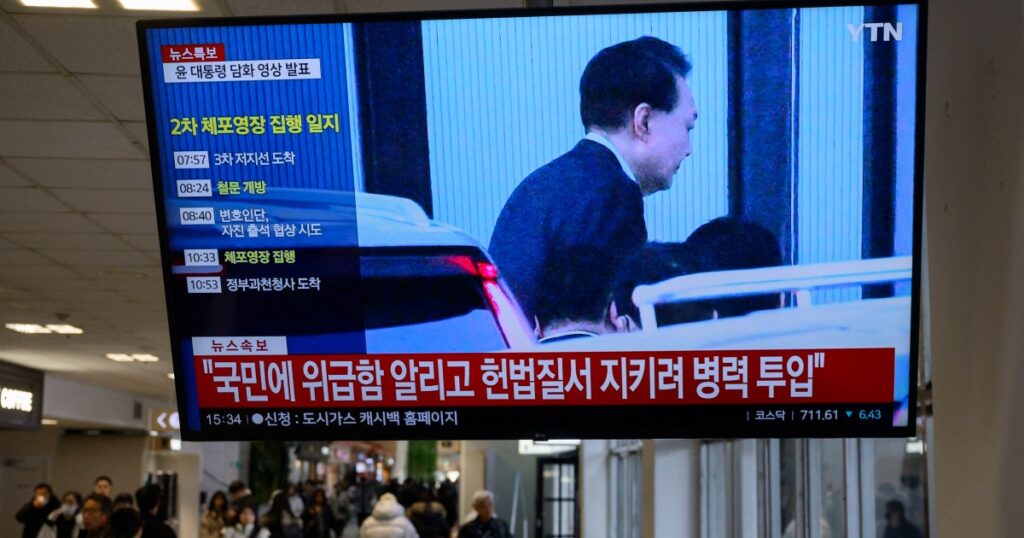
A court in Seoul grants request for an arrest warrant, saying there was ‘concern’ that Yoon could ‘destroy evidence’. A court in South Korea has approved the formal arrest of President Yoon Suk Yeol over his decision to declare martial law last month. The Seoul Western District Court on Sunday granted law enforcement’s request for an arrest warrant for Yoon following an hourslong deliberation, saying there was “concern” that Yoon could “destroy evidence”. Last Wednesday, Yoon became the first sitting South Korean president to be arrested. South Korean investigators probing Yoon for alleged insurrection asked a Seoul court on Friday to extend his detention after he refused to be questioned. Yoon and his lawyers on Saturday appeared before the court’s judge during a hearing and argued for his release. His arrest could mark the beginning of an extended period in custody for him, lasting months or more. He faces potential rebellion charges linked to his declaration of martial law on December 3, which set off the country’s most serious political crisis since its democratization in the late 1980s. The Corruption Investigation Office for High-Ranking Officials, which is leading a joint investigation with police and the military, can now extend his detention to 20 days, during which they will transfer the case to public prosecutors for indictment. Advertisement Yoon’s lawyers could also file a petition to challenge the court’s arrest warrant. Adblock test (Why?)
Israel must withdraw from Lebanon by January 26 deadline: President Aoun
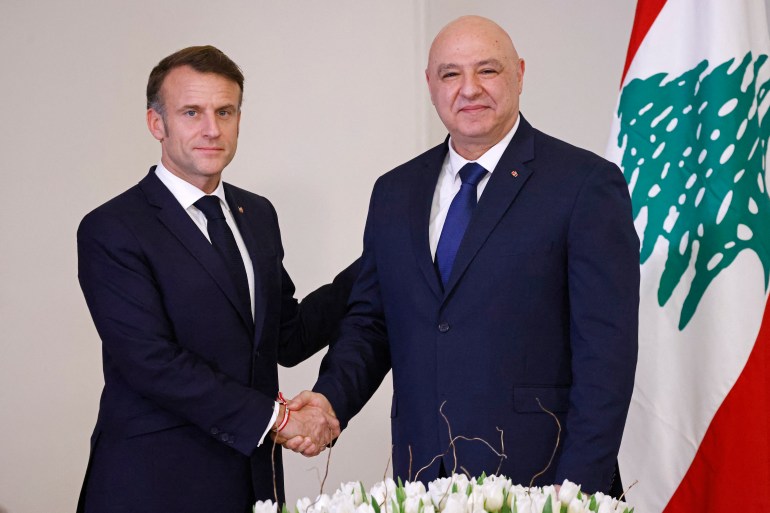
Lebanon’s new president’s comments come after the UN chief called on Israel to end its ‘occupation’ of southern Lebanon. Lebanon’s new president has demanded that Israel must withdraw from his country’s south by the January 26 deadline agreed in last year’s Israel-Hezbollah ceasefire as he met the United Nations chief visiting the country devastated by war. “The continued Israeli violations on land and in the air, especially in terms of blowing up houses and destroying border villages, completely contradicts what was stated in the ceasefire agreement and is considered a continuation of the violation of Lebanese sovereignty and the will of the international community,” President Joseph Aoun’s office said on Saturday after his meeting with Antonio Guterres in Beirut. Guterres has said he will “exert utmost efforts” to ensure the “secure” withdrawal of the forces within the January 26 deadline set by the agreement reached on November 27. Guterres said a “more hopeful future” awaited Lebanon under Aoun’s leadership in which the country could become stable and a hub in the Middle East. Aoun was selected in January after an agreement between political parties in Lebanon ended a two-year power vacuum that was further destabilising the country as it faced Israeli attacks and a turbulent economy. Advertisement The president, who is the former army chief, has also emphasised his support for the UN Interim Force in Lebanon (UNIFIL), who are tasked with securing the southern part of the country as part of Resolution 1701, which ended the 2006 war between Israel and Hezbollah. The message delivered by Guterres in Lebanon was one of support for the new president and new Prime Minister Nawaf Salam, said Al Jazeera’s Zeina Khodr, reporting from Beirut. “What Guterres is saying is that the international community will stand by them and help them in their recovery efforts. Lebanon has had a difficult few years. The economy has all but collapsed, the state is nearly bankrupt, there’s a financial crisis and the currency has lost much of its value.” As part of the ceasefire, Hezbollah is supposed to retreat beyond the Litani River, which lies some 30 kilometres (20 miles) from the border with Israel, and dismantle any remaining military infrastructure. UN peacekeepers have found more than 100 weapons caches belonging “to Hezbollah or other armed groups” in southern Lebanon, Guterres said on Friday, calling on Israel to stop its “occupation” in the area. The Lebanese army has been gradually deploying in further areas in the south along with UN peacekeepers, as Israeli military troops have gradually withdrawn. Franch President Emmanuel Macron, left, shakes hands with his Lebanese counterpart Joseph Aoun at the presidential palace in Baabda on January 17, 2025 [Ludovic Marin/AFP] French President Emmanuel Macron, who was on a visit to Beirut on Friday, said the total Israeli withdrawal from the area must be “accelerated” and the Lebanese army strengthened. Advertisement As the UN’s Guterres pledged more international support to Lebanon during his visit, the United States announced on Saturday that it will provide more than $117m to the country. The US Department of State said in a statement that the funds will be given as part of “new, expanded security assistance” for both the Lebanese army and security forces in line with implementing UN Security Council Resolution 1701. The Lebanese army, the UN and France have accused Israel of repeated “violations” of the ceasefire, as it has launched many attacks in its stated attempts to “enforce” the agreement. Hezbollah leader Naim Qassem said in a televised speech on Saturday that the Israeli military has violated the agreement “hundreds” of times. “We have been patient with the violations to give a chance to the Lebanese state responsible for this agreement, along with the international sponsors, but I call on you not to test our patience,” he said. Adblock test (Why?)
Trump admin to launch immigration raids on day one amid deportation push
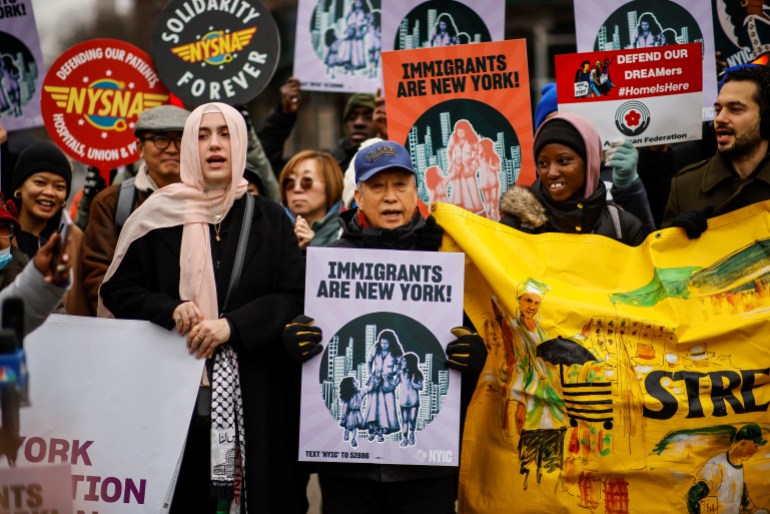
Several large cities are reportedly expected to be hit by Trump’s immigration authorities shortly after inauguration. Donald Trump’s top border official has said the new Republican administration will launch large operations to detain and deport undocumented immigrants beginning on the day of the United States President-elect’s inauguration on Tuesday. The incoming administration’s so-called “border czar”, Tom Homan, told Fox News on Saturday that he would not categorise the expected actions as “raids”. “There are going to be targeted enforcement operations,” he said, adding that Chicago would be among cities that will see raids shortly after Trump takes office for a second four-year term. Homan also suggested the Trump administration would target city jails in so-called sanctuary cities that house a large number of migrants. He said the government wants to “arrest a bad guy in the safety and security of a county jail”. Homan, a former acting director of US Immigration and Customs Enforcement (ICE), said the agency was planning operations carefully and would know which homes to hit. Amid reports by US media that Chicago could be hit as early as Tuesday by hundreds of border agents and that New York and Miami could also be targets, he did not comment on the exact timing of the operation or elaborate further. People take part in a rally against Trump’s policy of immigration in New York City, January 18, 2025 [Eduardo Munoz/Reuters] Homan’s latest comments come a day after he said, “We’re gonna take the handcuffs off ICE and let them go arrest criminal aliens.” He had also said there would be a “big raid across the country”. Advertisement Just like during his first presidential campaign, Trump has pledged to crack down on undocumented immigrants in his second run. But there have been disagreements on some aspects among Republicans, including surrounding the issue of the H-1B visas. Trump has pledged he would launch “the largest domestic deportation operation in American history” to quickly remove people without saying exactly how many will be affected. The president-elect has said he would reinstate a programme to make tens of thousands of migrants seeking asylum to await their hearings in Mexico, reinstate a controversial travel ban on Muslim-majority countries from his first term, and end birthright citizenship for US-born children of some noncitizens. Trump’s officials have been considering how to withhold funds from sanctuary cities that refuse to participate in deportations, even for local authorities who have maintained that they do not have the resources to implement his plan, or are concerned about adverse effects on their communities. Immigrant rights groups have been bracing for the crackdowns promised by the incoming administration, with some US media reporting “self-deportations” by people who have chosen not to wait for Trump to forcibly remove them. Meanwhile, thousands of people gathered in Washington, DC on Saturday to protest Trump’s inauguration, as activists for women’s rights, racial justice and other causes rallied against incoming policies they say will threaten their constitutional rights during the Republican’s second term. Advertisement Some in the crowd wore the pink hats that marked the much larger protest against Trump’s first inauguration in 2017. They wound through downtown amid a light rain, past the White House and towards the Lincoln Memorial along the National Mall for the “People’s March.” Protests against Trump’s inauguration are smaller this time, in part because the US women’s rights movement seems more fractured, according to many activists, after Trump defeated Democratic Vice President Kamala Harris in November. Adblock test (Why?)
Four killed in Russian drone and missile attack on Ukraine’s Kyiv
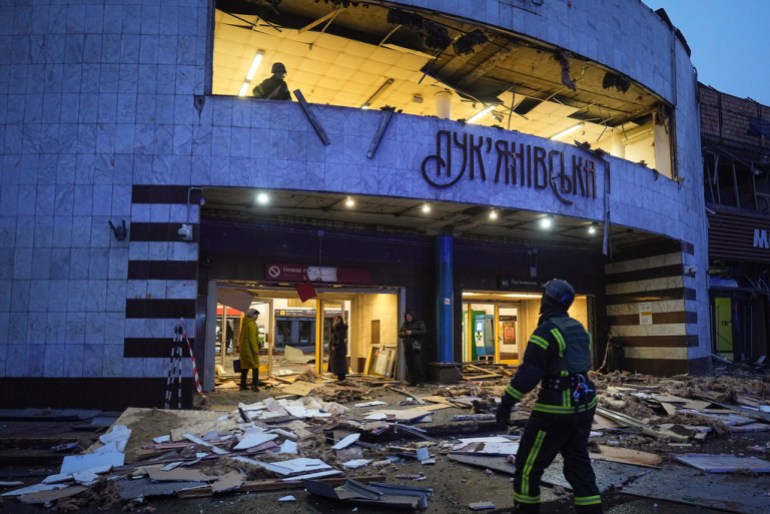
Dawn raid on busy Shevchenkivskyi district also damaged water pipeline and forced closure of metro station. At least four people have been killed in a Russian drone and missile attack on the Ukrainian capital. Timur Tkachenko, head of Kyiv’s military administration, said the attack at dawn on Saturday took place in the city’s centrally located Shevchenkivskyi district. “Stay in shelters,” said Kyiv Mayor Vitali Klitschko, in a post on Telegram on Saturday morning. He had warned of a “ballistic missile threat” against the capital hours earlier and said air defences were in operation around the city. Windows were shattered in Shevchenkivskyi district, including those at the entrance of the Lukianivska metro station, which was closed down, according to the mayor. Shevchenkivskyi area is a busy part of Kyiv with universities, bars and restaurants. Also on Saturday, Russian forces “attacked the centre” of Zaporizhzhia, injuring two people, according to local governor Ivan Fedorov. An administrative building of an industrial facility was partially damaged, he said. Firefighters work at the site of the damaged Lukianivska metro station after a Russian missile attack on Kyiv [Efrem Lukatsky/AP Photo] Reporting from Kyiv, Al Jazeera’s Jonah Hull said explosions were heard at about 6am (04:00 GMT), “reverberating amid a volley of anti-aircraft fire, with air alerts suggesting both ballistic missile and drone threats”. Advertisement He said that smoke was seen coming out of a residential building. Later that morning, the Ukrainian Air Force reported that it had destroyed 24 drones and two ballistic missiles that were launched as part of the same attack. Ukrainian counterattacks The rare strike on the heart of the Ukrainian capital comes in the middle of intensified Ukrainian aerial attacks on Russian energy and military facilities in recent months. Ukraine’s army has hit several Russian oil depots recently, including two major strikes on a facility near a military airfield in Russia’s Saratov region that triggered days-long blazes. Late on Friday, a Ukrainian drone attack on Lyudinovo in Russia’s Kaluga region sparked a fire at an industrial site, according to regional governor Vladislav Shapsha. Video posted on unofficial Russian social media sites showed firefighting vehicles speeding off in the direction of a large blaze at what they said was an oil storage depot in the city. No casualties were reported. Adblock test (Why?)
What is ‘Dreams on a Pillow’, the Palestinian game about the Nakba?

Can a video game make you feel the weight of history? That’s the ambitious goal of a new pseudo-3D stealth adventure game called “Dreams on a Pillow”, launched by Palestinian game developers. The game is inspired by the events of the 1948 Nakba or “catastrophe”, referring to the ethnic cleansing of 750,000 Palestinians from their homes located in what is now the state of Israel. It is slated to be released in 2026. [embedded content] So what do we know about the game that is launched at a time when Palestinians are hoping this week’s ceasefire deal between Hamas and Israel for Gaza, where more than 46,000 people have been killed in the 15-month-long Israeli bombardment of the strip, will actually hold? Who is behind the game and what is its goal? The game is the brainchild of Rasheed Abueideh, a developer based in the Israeli-occupied West Bank. “We are trying to make this game a masterpiece,” Abueideh, the game’s director and designer, told Al Jazeera. His last game, Liyla and the Shadows of War, based on the 2014 Israeli offensive in Gaza, was a huge hit. Advertisement “It’s a heavy story. And we want to inject all of these pieces of information through a gameplay that resonates with the players,” he said. Abueideh, who is based in Nablus in the West Bank, says he would like the world to understand that the Israeli war on Gaza is a direct result of previous events and decisions beyond the event of October 7, 2023. Concept art shows images from the new game based on the Nakba [Courtesy of Dreams on a Pillow] The game, he says, is also an attempt to highlight and share the rich history of Palestine. Despite his past success, he has struggled to get funding from conventional sources. So he crowdsourced on LaunchGood, a global crowdfunding platform focused on supporting Muslim communities worldwide. Dreams on a Pillow reached its funding goal of $194,800 on January 7. At the time of writing, the video game project has raised $218,272. The current funding for the game is enough to start development and should cover costs for the first year including salaries, outsourcing and asset creation. According to Abueideh, LaunchGood emerged as one of the few viable options for fundraising efforts, as many mainstream crowdfunding platforms refused to help. Palestine-related content often faces heightened scrutiny and, in some cases, outright prohibition. The censorship or even the shadow banning of pro-Palestine content has been well documented. In May 2023, a YouTube video made by Palestinian officials, which was meant to be presented at a United Nations Human Rights Council meeting, was removed from the platform. The platform has been accused of violating the digital rights of Palestinians. Advertisement Investigations by rights organisations and media outlets have revealed the removal and suppression of pro-Palestinian content from social media platforms such Instagram and Facebook. Netflix removed nearly all 32 films about Palestine on its platform. The streaming giant attributed the removal of the films to the expiration of three-year licensing agreements. However, this sudden deletion prompted an outcry from human rights groups and individuals across social media platforms, according to broadcaster TRT World. Why is @Netflix purging so many of its films and content regarding Palestinians and Palestine? Look at all of the Palestinian stories that are “leaving soon.” Israel is already trying to erase the Palestinians of Gaza and the West Bank. Why is @Netflix erasing Palestinian… pic.twitter.com/rXEmcVqvJ8 — Sunjeev Bery (@Sunjeev_Bery) October 13, 2024 What’s the story behind Dreams on a Pillow? The central theme of the game is based on Palestinian folklore around the legend of Omm, a young mother who flees the 1948 Israeli massacre in Tantura, a Palestinian town now part of Israel. While escaping through other Palestinian villages and refugee camps on her way to Lebanon, she witnessed events that unfolded in these communities and cities along the way. According to Abueideh, this journey serves as a lens through which we observe the broader historical context and personal experiences of displacement during this tumultuous period. Omm’s husband falls victim to Israeli invaders. Frantically, she rushes home to save her newborn child. In her haste and terror, she flees the town, only to discover later that she had mistakenly grabbed a pillow instead of her baby. Advertisement The story’s conclusion varies significantly depending on the storyteller and audience. In most renditions, the mother descends into madness. Other versions depict either her murder or her successful evasion of Israeli patrols and military units, leading to her escape from her homeland – a place she might not see again. In a recent Ask Me Anything (AMA) live on Reddit, Abueideh states why Omm was chosen: “The young mother’s experiences highlight how devastating the Nakba was, particularly the psychological impact it had on her. This adds a deeper layer to understanding what happened, shedding light on the emotional and mental toll that is often overlooked when discussing the crimes committed,” explained Abueideh. Zionist militias committed more than 70 massacres that resulted in the killing of more than 15,000 Palestinians leading up to the creation of Israel in 1948. Concept art for the game which is set in historic Palestine [Courtesy of Dreams on a Pillow] What was the theme of Liyla and the Shadows of War? In 2016, Abueideh’s small team of developers in Palestine released Liyla and the Shadows of War for PC and mobile platforms, which was based on Israel’s 2014 Gaza offensive. The Israeli military operation, named Operation Protective Edge, resulted in the killing of 2,300 Palestinians and 73 Israelis. According to Abueideh, Liyla and the Shadows of War was quite successful receiving millions of downloads and was awarded first place for Excellence in Storyboarding for the International Mobile Gaming Awards for Middle East North Africa. Advertisement The game was built around a Palestinian family’s harrowing experience during Israel’s military campaign in Gaza, as they fought to stay alive amid the conflict and destruction. “We followed a