

Al Jazeera reporter in Gaza removes protective gear
[unable to retrieve full-text content] Al Jazeera journalist Anas al-Sharif greeted the announcement of a Gaza ceasefire deal by taking off his press gear.
Bollywood star Saif Ali Khan stabbed in ‘attempted burglary’ at Mumbai home

Khan is currently in surgery after receiving six stab wounds as police search for suspect. Bollywood actor Saif Ali Khan has been stabbed after an intruder invaded his home in Mumbai. Khan, 54, was taken to a nearby hospital in Mumbai at about 3:30am (22:00 GMT on Wednesday) with six injuries, two deeper than the rest and one close to his spine, ANI news agency said, quoting the hospital’s chief operating officer. Khan’s public representatives also confirmed the incident, calling it an “attempted burglary”, adding that “the rest of the family is doing fine”. Later on Thursday, senior police officer Gedam Dixit told Reuters news agency that the actor was out of danger. “He [Khan[ is being treated … and is out of danger,” said Dixit. A female employee at their home was also attacked and was being treated, police said. It’s scary to think of an intruder walking into an apartment and stabbing the resident! Many questions about how this can happen but first all our prayers with #SaifAliKhan and his family. — Saba Naqvi (@_sabanaqvi) January 16, 2025 Khan lives in an apartment in the western Mumbai suburb of Bandra, along with his wife Kareena Kapoor-Khan, who is also an actor, and their two children. Advertisement According to news outlet NDTV, the police were still searching for the suspect and have launched an investigation into the attack. Khan is among the country’s most bankable actors, having featured in more than 70 films and television series, in some also as a producer. He is the son of former India cricket captain Mansur Ali Khan Pataudi and actress Sharmila Tagore. ‘So unsafe’ Messages of solidarity and prayers poured across social media including from fans, politicians and Khan’s Bollywood colleagues. “Shocked and saddened to hear about the attack on Saif sir. Wishing and praying for his speedy recovery and good health,” actor Nandamuri Taraka Rama Rao Jr, also known as NTR Jr, posted on X. Celebrities, opposition leaders and other public figures also called for tougher security. “If such high-profile people with… security can be attacked in their homes, what could happen to common citizens?” Clyde Crasto, spokesperson of the Sharad Pawar-led Nationalist Congress Party, said on social media. Actor and filmmaker Pooja Bhatt also called for a greater police presence in the suburb, home to many in the film industry. “The city, and especially the queen of the suburbs, have never felt so unsafe before,” she posted on X, using a popular description for the trendy area. Adblock test (Why?)
What Palestinians are hoping for after Gaza ceasefire
[unable to retrieve full-text content] We spoke to Palestinians in Gaza about their hopes for after the ceasefire agreement takes effect.
The human toll of Israel’s war on Gaza – by the numbers
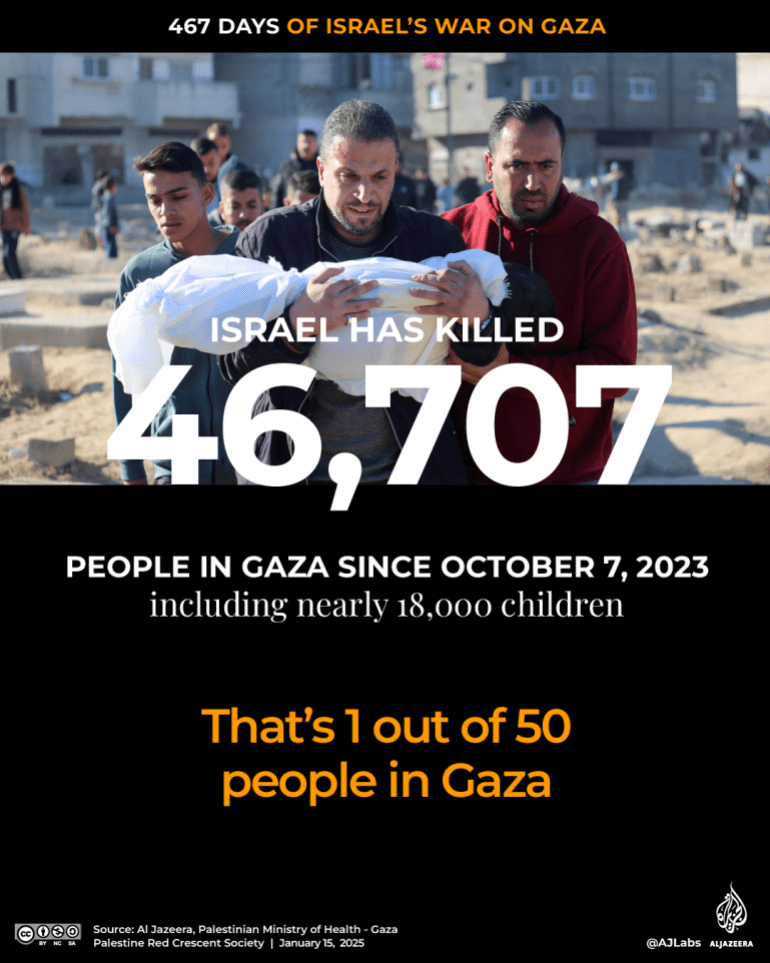
It has been 467 days since Israel began its war against Palestinians in Gaza. That’s more than 15 months of daily bombardments, death, injuries, displacement and starvation. The Israeli onslaught began on October 7, 2023, after attacks on southern Israel led by the Palestinian group Hamas. More than 1,100 people were killed in the attacks, and about 240 were taken captive. Many of the captives were either freed in a prisoner exchange in November 2023 or were killed during subsequent Israeli attacks. Israel began a brutal onslaught with air raids after the attacks and further tightened its blockade on the enclave, which has been in place since 2007. 46,707 Palestinians killed In the past 15 months, at least 46,707 people in Gaza have been killed, which includes about 18,000 children. The death toll means that one out of every 50 people has been killed in Gaza. Many analysts and rights groups believe the real number killed is far higher. Despite global condemnations and pleas from international organisations and rights groups, Israel has continued a collective punishment campaign on the besieged enclave, where half of the population is under the age of 18. In doing so, Israel has wiped out multiple generations of families from the civil registry. Advertisement More than 100,000 people injured At least 110,265 people have been injured in Gaza as a result of the war. That’s one in 20 people. According to the World Health Organization, nearly a quarter of the injured, an estimated 22,500 people, have life-altering injuries that require but are not receiving rehabilitation. Severe limb injuries are the main type of injury needing rehabilitation. According to UNRWA, the United Nations agency for Palestinian refugees, every day 10 children lose one or both legs with operations and amputations conducted with little or no anaesthesia due to Israel’s blockade. The Palestinian Ministry of Health stated that by the end of 2024 there had been at least 4,500 amputations. In addition to the confirmed casualties, thousands of people are feared buried under the rubble. With few tools to remove the rubble and rescue those trapped beneath concrete, volunteers and Palestinian Civil Defence workers rely on their bare hands. There is no way to know how many people have perished under the rubble. An estimated 85,000 tonnes of explosives have been dropped on Gaza, according to the Environmental Quality Authority of Palestine. Experts predicted it could take more than a decade to clear the debris left by the bombing, which totals more than 42 million tonnes, according to the UN Development Programme. On top of the work of clearing the rubble is the risk of dealing with unexploded bombs. Palestinians inspect the rubble of destroyed buildings after an Israeli air strike on Kamal Adwan Hospital in Beit Lahiya in the Gaza Strip on December 29, 2024 [Khalil Ramzi Alkahlut/Anadolu] Gaza is starving Under the Rome Statute, a treaty that established the International Criminal Court, intentionally starving a population is a war crime when committed during an armed conflict. Advertisement An investigation by Al Jazeera’s Fault Lines found that Israel has systematically denied aid and water to starving people in Gaza. [embedded content] In January, the United Nations humanitarian agency stated that efforts to supply aid in Gaza are at a “breaking point”. Israel restricts aid deliveries and has carried out attacks on aid workers, creating a starving people heavily reliant on external help. [embedded content] At least eight babies have also died of hypothermia as Palestinians in Gaza struggle to survive in shelters inadequate for winter weather. Nearly 1.9 million people in Gaza are internally displaced, of which nearly 80 percent are living in makeshift shelters without adequate clothing or protection from the cold. UN agencies estimated that nearly half a million are in flood-prone areas. Authorities in Gaza said about 110,000 of the 135,000 tents being used as shelters in the Gaza Strip are worn out and not fit for use. Adblock test (Why?)
Biden says US, Israeli pressure on Hamas led to Gaza ceasefire
[unable to retrieve full-text content] US President Joe Biden says the Israel-Hamas ceasefire deal is the agreement the US introduced in spring 2024.
‘Staying alive was luck’: Joy and despair as Gaza ceasefire nears
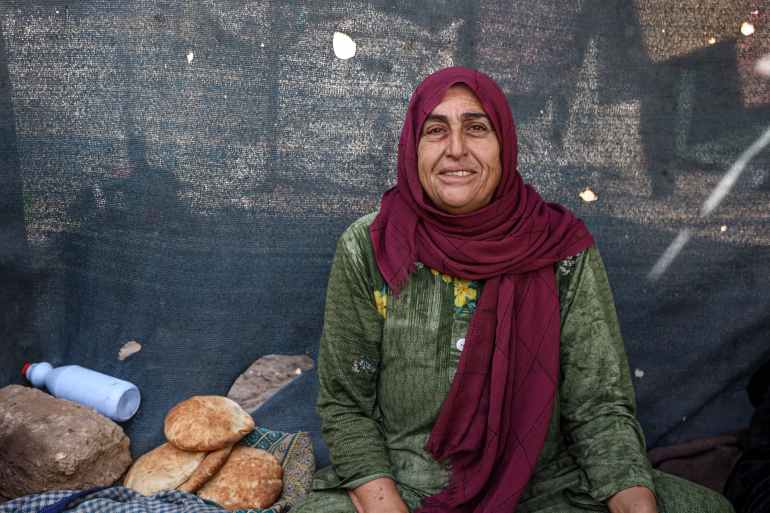
Deir el-Balah, Gaza and Beirut, Lebanon – In the Gaza Strip, many Palestinians are celebrating, hoping that the a devastating 15-month war is finally over. Israel and Hamas have agreed to a ceasefire proposal, according to Qatar and the United States, which would involve a captive and prisoner swap, and the return of Palestinians to their homes across Gaza. Israel says a few issues remain, while Hamas has announced its acceptance. In Gaza, the joy for Palestinians comes tempered with grief, having lived through the death of so many of their loved ones, in an Israeli war that rights groups and United Nations experts have described as a “genocide”. Several Palestinians told Al Jazeera they plan to return to their towns and villages the moment they get the opportunity to, having been displaced by Israeli attacks and so-called “evacuation orders”. “As soon as there is a ceasefire, I will return and kiss my land in Beit Hanoon in north Gaza,” said Umm Mohamed, a 66-year-old woman who lost two of her 10 children when an Israeli bomb fell on her home in December 2023. Advertisement “What I realised in this war is that your home, your homeland and your children are all you have,” she told Al Jazeera. Umm Mohamed [Abdelhakim Abu Riash/Al Jazeera] Israel’s war on Gaza has killed more than 46,500 Palestinians and wounded more than 100,000. It began after a Hamas-led attack on southern Israel on October 7, 2023, in which 1,139 people were killed and about 250 were taken captive. During Israel’s offensive on Gaza, it systematically bombed schools, hospitals and displacement camps, destroying nearly all basic services and structures that sustain life, according to UN experts and rights groups. In September 2024, the United Nations Satellite Center found that 66 percent of all structures in the Gaza Strip were damaged or destroyed by Israeli attacks. Israel also tightened its existing siege on Gaza at the start of the war, causing mass starvation and a breakdown in public order. Now that an end to the misery appears to be tantalisingly close, Palestinians are struggling to process everything – and everyone – they lost in the war. “I have mixed feelings … but I pray to God that we can return to our normal lives without feeling insecure,” said Mohamed Abu Rai, a 47-year-old medic, from his office in Deir el-Balah. Memory and grief Palestinians reflected on loved ones they lost to Israeli attacks before the now-expected ceasefire. Lubna Rayyes, who was the principal of the International American elementary school in Gaza City, said she lost one of her colleagues, Bilal Abu Saaman, who was rescuing people from the rubble when he was bombed. Advertisement Rayyes said she frequently calls Abu Saaman’s widow and asks about his young children. “He was a great and very kind teacher. When he died, it really affected me and it still hurts until now,” Rayyes told Al Jazeera via phone from Cairo, Egypt, where she has been living with her husband and three children since last year. “Bilal was really one of the best people in the world,” she added. Rayyes also spoke about her family home, which was burned to ashes by Israeli soldiers who lit it on fire. “There is nothing left from the house,” she said, sighing. “There are no more family photos, or any sort of memories [we retrieved]. It’s all gone.” Abu Rai also lost his house, but like Rayyes, he said the memory of deceased colleagues and friends brings him the most grief. He believes the real number of casualties far surpasses the official toll and he still cannot quite understand how he survived during the last 15 months. “Staying alive in Gaza was always just a matter of luck,” he said. Stay or go? While many Palestinians are looking forward to returning and rebuilding their communities, others can’t imagine staying in the besieged enclave any longer. Mahmoud Saada, 52, said he doesn’t believe there will be a lasting solution to the Israeli-Palestinian conflict despite the anticipated ceasefire. He says he will take his young children and leave Gaza as soon as the crossing to Egypt opens. “I swear to God I won’t return to Gaza. I’m so tired and fed up,” he said from Deir el-Balah, where he sleeps with his family inside a small crowded tent. Advertisement “I want to leave Gaza and just go anywhere else,” he told Al Jazeera. Mahmoud Saada [Abdelhakim Abu Riash/Al Jazeera] Abu Rai also said that he can’t imagine staying in Gaza now that everything is completely destroyed. He believes most survivors are deeply traumatised and simply can’t fathom rebuilding their communities and lives again, especially since Gaza has already struggled to recover from numerous previous wars with Israel. At the moment, he suspects many people are trying to find a way out, at least for the time being. “There has been so much destruction and we are starting from zero, again. Always rebuilding our communities steals so much time from our lives. Each day we lose, we don’t get back,” he told Al Jazeera. Abu Rai, Rayyes and Umm Mohamed all agree, however, that Palestinians will miss Gaza if they leave, making the move hard for many. In the end, they believe most people will stay or return to Gaza, if they can. “We need to go back eventually, you know?” Rayyes told Al Jazeera. “There really is no place like home.” Adblock test (Why?)
India’s disappearing camels: How a law to save them is wiping them out
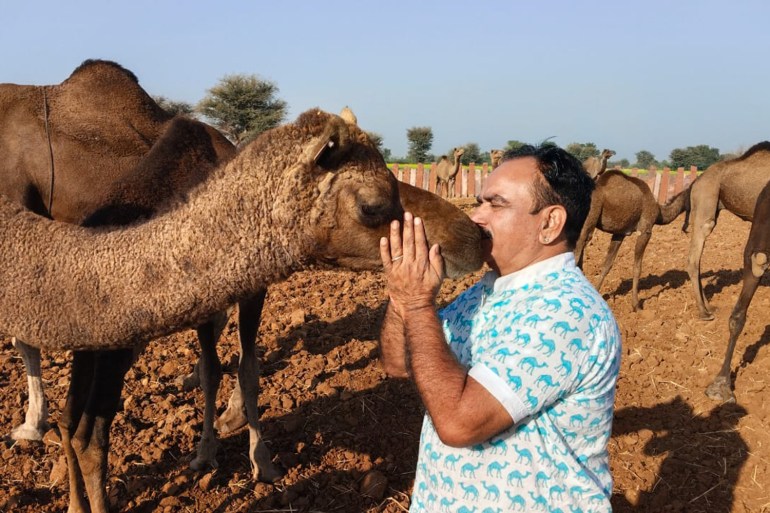
Rajasthan, India – Jeetu Singh’s camel stands calm, munching the leaves of a Khejri tree in the Jaisalmer district of India’s desert state of Rajasthan. Her calf occasionally suckles on her mother’s breasts. While the newborn is the latest addition to Singh’s herd, sadness is palpable on his face. His otherwise sparkling eyes have turned gloomy, gawping at the grazing camels. When Jeetu, 65, was a teenager, his family had more than 200 camels. Today, that number has gone down to 25. “Rearing camels was no less than a competitive affair when we were children,” he tells Al Jazeera. “I used to think my camels should be more beautiful than those reared by my peers.” He would groom them, apply mustard oil to their bodies, trim their brown and blackish hair, and decorate them with colourful beads from head to tail. The camels would then adorn the landscape with the festooned frieze of symmetry they form while walking in herds as the “ships of the desert”. “All that is memory now,” he says. “I only keep camels now because I am attached to them. Otherwise, there is no financial benefit from them.” Conservationist Hanuwant Singh Sadri kisses a camel in Pali district, Rajasthan [Amir Malik/Al Jazeera] Across the world, the camel population rose from nearly 13 million in the 1960s to more than 35 million now, according to the Food and Agriculture Organization (FAO) of the United Nations, which declared 2024 as the International Year of Camelids to highlight the key role the animal plays in the lives of millions of households in more than 90 countries. Advertisement But their numbers are on a drastic decline in India – from nearly a million camels in 1961 to just approximately 200,000 today. And the fall has been particularly sharp in recent years. The livestock census conducted by India’s federal government in 2007 revealed that Rajasthan, one of a few Indian states where camels are reared, had about 420,000 camels. In 2012, they reduced to about 325,000, while in 2019, their population dipped further to a little more than 210,000 – a 35 percent downfall in seven years. That decline in Rajasthan’s camel population is being felt across the vast state – India’s largest by area. Some 330km (205 miles) from Jeetu’s home lies the Anji Ki Dhani village. In the 1990s, the hamlet was home to more than 7,000 camels. “Only 200 of them are present now; the rest are extinct,” says Hanuwant Singh Sadri, a camel conservationist for more than three decades. And in the Barmer district’s Dandi village, Bhanwarlal Chaudhary has lost nearly 150 of his camels since the beginning of the 2000s. He is left with just 30 now. As the 45-year-old walks with his herd, a camel leans towards him and kisses him. “Camels are connected to the language of our survival, our cultural heritage and our everyday life,” Chaudhary said. “Without them, our language, our being has no meaning at all.” Chaudhary with his herd in Dandi village of the Barmer district, Rajasthan [Amir Malik/Al Jazeera] 2015 law the biggest blow Camel-keepers and experts cite various reasons for the dwindling number of camels in India. Tractors have replaced their need on farms, while cars and trucks have taken over the roads to transport goods. Advertisement Camels have also struggled because of the shrinking grazing lands. Since they cannot be stall-fed like cows or pigs, camels must be left for grazing in open areas – like Jeetu’s camel eating the leaves of the Khejri tree. “That open set-up is hardly available now,” Sadri says. But the biggest blow came in 2015, when the Rajasthan government under the Hindu majoritarian Bharatiya Janata Party (BJP) passed the Rajasthan Camel (Prohibition of Slaughter and Regulation of Temporary Migration or Export) Act. The law prohibits the transport, illegal possession and slaughtering of camels. “Even decorating them could amount to causing them hurt, as the definition of causing them harm is loosely worded,” Chaudhary tells Al Jazeera. Punishment under the law ranges from a prison term between six months and five years, and penalties between 3,000 rupees ($35) and 20,000 rupees ($235). Unlike all other laws – where the accused is innocent until proven guilty – this law flips conventional jurisprudence. “The burden to prove innocence rests with the person prosecuted under this act,” it reads. The dark and light brown camels stand together in water in Pokhran. Called khadeen, the waterbody is a lifeline for both people and animals in the area [Radheshyam Pemani Bishnoi/Al Jazeera] With the enforcement of the act, the camel market was outlawed – and so were camel breeders if they intended to sell their animals. Buyers suddenly became “smugglers” under the law. The act was crafted on the assumption that the slaughter of camels was behind the decline in their population in Rajasthan. It banned camel transport to other states, says Chaudhary, thinking it would serve three purposes: the camel population would increase, the livelihood of the breeders would increase and the camel slaughter would stop. Advertisement “Well, it missed its first two targets,” Chaudhary says. ‘Suddenly, there were no buyers’ Sumit Dookia, an ecologist from Rajasthan who teaches at a university in New Delhi, has a question for the government over the law. “Why is it that the camel population is still shrinking,” he asks, if a law meant to revive their numbers is in force? Chaudhary has the answer. “We rear animals to sustain our lives,” he says, adding that without a market or a fair price, keeping such huge animals is not an easy task. “The law locked horns with our traditional system where we used to take our male camels to Pushkar, Nagore or Tilwara – three of the biggest fairs for camels,” adds Sadri. Sadri says the breeders used to get good money for their camels in those fairs. “Before the law was passed, our camels were sold from 40,000 ($466) to 80,000 rupees ($932),” he says. “But as soon as
Olympic champion Zheng ousted as Australian Open 2025 delivers first shock

Zheng exits after second round loss to unseeded Siegemund as former champions Sabalenka and Osaka battle through. Zheng Qinwen has become the first big name to exit the women’s draw at the Australian Open after the Olympic champion was stunned by Laura Siegemund while top seed Aryna Sabalenka made heavy weather of her second-round match before going through. Jessica Pegula, who lost to Sabalenka in last year’s US Open final, safely advanced while Tokyo Olympics champion Belinda Bencic moved on after a brief spell of rain delayed proceedings on the outer courts on the fourth day. China’s Zheng had been bidding to emulate compatriot Li Na’s 2014 triumph at Melbourne Park but her hopes evaporated at John Cain Arena, where unseeded German Siegemund pulled off a stunning 7-6(3), 6-3 victory. The fifth seed left the court looking like she was about to burst into tears while world number 97 Siegemund was beaming from ear to ear after a famous win. “I knew I just had to play more than my best tennis – you have nothing to lose so I told myself to swing free,” Siegemund said on court. “She’s an amazing player, she’s one of the best players now. But I know I can play and I wanted to make it a tough fight.” Advertisement Zheng said it was just not her day. “I had a lot of chances to break her in the first set, but you know in that moment maybe my concentration wasn’t there,” the 22-year-old said. “At the same time, I felt she was playing really good. It’s tennis, nothing more.” Defending champion Aryna Sabalenka had to dig deep against Jessica Bouzas Maneiro during their second-round match, January 15, 2025 [William West/AFP] Sabalenka is bidding to become the first woman to win three straight titles at Melbourne Park since Martina Hingis, from 1997 to 1999, and while the Belarusian beat Jessica Bouzas Maneiro 6-3, 7-5, she did not have it all her own way. After easing through the first two games of the match on Rod Laver Arena, Sabalenka twice swapped breaks with the world number 54 before taking control for a 5-2 lead and closing out the opening set on serve. The three-time Grand Slam champion’s serve came under intense pressure in the next set and she found herself trailing 4-1 as an inspired Bouzas Maneiro began hitting stinging winners on both sides of the court. Sabalenka found a spark from somewhere and fought back from 5-2 to level at 5-5 and fired a backhand winner to break again in the next game before wrapping up the contest to extend her win streak at the hardcourt major to 16. “She played incredible tennis today and it was a really tough one,” Sabalenka said. “I mean, I expected this tennis from her, so I’m really glad that I was able to win this match. “In the second set … I wasn’t rushing too much after 5-2, I was like, ‘OK, whatever, we just leave this second set and we move on. And yeah, I was able to turn it around. “I’m super happy with the win in straight sets, especially against someone like her, who makes you work for every point.” American seventh seed Pegula beat Belgian Elise Mertens 6-4, 6-2 on Margaret Court Arena while Bencic beat Suzan Lamens 6-1, 7-6(3) after Olga Danilovic stunned 25th seed Liudmila Samsonova 6-1, 6-2. Advertisement Former world number one Osaka, the 2019 and 2021 champion in Australia but now unseeded, stormed back to defeat 20th seed Karolina Muchova 1-6, 6-1, 6-3. Naomi Osaka celebrates after beating Karolina Muchova, January 15, 2025 [Paul Crock/AFP] Adblock test (Why?)
TikTok users in US flock to ‘China’s Instagram’ ahead of ban

Taipei, Taiwan – As a TikTok ban looms in the United States, young Americans are flocking to the Chinese social media platform Xiaohongshu as “TikTok refugees” in search of a similar experience. The app has risen to the top spot on the iOS and Google Play stores in the US in recent days as users prepare for TikTok to be banned on national security grounds from Sunday unless Chinese parent company ByteDance divests its ownership. Chinese lifestyle app Lemon8, which is also owned by ByteDance, has ranked as the second most downloaded app. Xiaohongshu, which has been described as China’s answer to Instagram, allows users to post photos, videos and text and is known for its female-heavy user base. While boasting about 300 million monthly active users, Xiaohongshu’s reach is smaller than that of other popular apps in China, such as Sina Weibo and WeChat, which claim 1.2 billion-plus users. A surge in new users, some of them describing themselves as “TikTok refugees,” is now flooding the app’s “Discover” page with videos seeking tips on how to use “RedNote,” the app’s new nickname in the US. Advertisement “Hello. I don’t know what’s happening any more. Americans are coming here. So sorry if y’all hate us. I promise we’ll do our best,” a female user calling herself “Star404” said in a short-form video posted on Tuesday. “Don’t even worry, we’re going to do so great. This is so much better than TikTok. Just not Meta. Instagram reels, I can kind of dig. Facebook and YouTube shorts, no shot. Never happening,” she said. The irony of many users moving from one Chinese-owned app to another has not been lost on observers like Ryan Broderick, the author of Garbage Day, a newsletter that covers the internet. “It’s definitely funny that American teenagers are protesting the looming TikTok ban by using a much more culturally Chinese app,” Broderick told Al Jazeera. “At the moment, RedNote doesn’t seem to be siloing Chinese content or requiring users to have a Chinese phone number, so it’s turned into a sort of fun cultural chaos on the app, an experience that never really even happened on TikTok,” he said. The post by “Star404” racked up more than 4,000 comments in 24 hours, mostly from Chinese users welcoming her to the platform or joking about language challenges. Another user, “Fern,” expressed her gratitude to the flood of Chinese followers that came her way after joining the platform. “We need to talk about you guys blowing up my video about moving to Rednote to 50,000 new followers in less than 24 hours. You guys are insane,” she said. “But thank you so much for all the support, I really appreciate it.” Advertisement While amusing to many Chinese Xiaohongshu users, the surge in American users has reportedly put the app’s owner in an awkward spot. Chinese media outlet PConline on Tuesday reported that Xiaohongshu employees have been instructed to “not discuss, not promote, and not share” news about their new US user base, citing sources within the company. “This wave of traffic has become the sword of Damocles hanging over Xiaohongshu’s head. In fact, for Xiaohongshu, which inexplicably received this traffic, the risks far outweigh the opportunities,” the report said. Those potential risks include regulatory complications. Chinese social media platforms typically require users to register with a Chinese phone number, while content is subject to government censorship. For this reason, Chinese tech companies often create domestic and foreign versions of their apps, said Yiwen Lu, a researcher at ChinaTalk, a newsletter and podcast focusing on Chinese technology. TikTok is an international version of Douyin, while Lemon8 was specifically designed by ByteDance for the foreign market. For now, Chinese and American users are seeing the same content on Xiaohongshu. However, some users have reminded their American counterparts that the app comes with its own set of rules. “Friendly reminder: On Chinese social media platforms, please do not mention sensitive topics such as politics, religion, and drugs!!! Please adhere to the One China policy and reject pornography, gambling, and drugs,” one user wrote under Star404’s post. Advertisement “[You] can say everything here, except the history [of China] from 1949-2025,” another user said. ChinaTalk’s Lu said that American users will have a hard time replicating their TikTok experience on the app – especially when it comes to monetising content. “The monetisation models vary greatly – XHS positions itself as a shopping platform, with most creators earning revenue through paid partnerships. This difference makes it challenging for creators to fully transition their work and income streams to XHS in the short term,” Lu told Al Jazeera. Livestream shopping, a hugely popular form of e-commerce in China, has taken off on Xiahongshu in recent months. In the US, many TikTok users still shop through links to Amazon or the shopping platform LTK, short for “Like to Know.” Lu and Broderick both expressed doubt that the influx of US users would last due to differences between the platforms and the fact many users had joined as an act of protest. Still, the migration to Xiaohongshu should serve as a warning to the US government and Big Tech, Broderick said. “It’s a funny way to hopefully make US politicians realize that Chinese apps are coming for the US whether they like it or not,” he said. “And, similarly, it’s a good way of letting Silicon Valley know that their products are stagnating and no amount of federal bans are going to make young people excited about Meta products again.” Adblock test (Why?)
Brazil expresses concern over Meta’s changes to content moderation

Brazilian attorney general says that Meta’s move to loosen curbs on hate speech may put it at odds with country’s laws. Brazilian authorities have expressed “serious concern” over a recent announcement by the social media giant Meta that they will ease their policies restricting incendiary speech and fact-checking. In a statement on Tuesday, the Brazilian attorney general’s office (AGU) said that it would ask for more information from Meta, adding that the policy change may not comply with Brazilian law. “Some aspects contained in the Meta document cause serious concern. The changes now reported by Meta, are not in line with Brazilian legislation and are not sufficient to protect the fundamental rights of citizens,” the office said in a statement. Last week, Meta, which owns platforms like Facebook and Instagram, scrapped a third-party fact-checking programme, on the basis that it had become a “tool to censor”. The company also indicated it would loosen curbs on rhetoric that could be seen as hostile to groups such as immigrants and LGBTQ people. “We’re getting rid of a number of restrictions on topics like immigration, gender identity and gender that are the subject of frequent political discourse and debate,” Meta said in a statement. “It’s not right that things can be said on TV or the floor of Congress, but not on our platforms.” Advertisement The shift away from fact-checking came within weeks of United States President-elect Donald Trump taking office on January 20. Trump has repeatedly criticised social media platforms as biased. Meta has said in a subsequent letter that the fact-checking changes will only apply within the US and changes to community standards are “limited” to hate speech policy. “AGU and other ministries understand that the current terms of use, as well as the changes now informed by Meta, do not fit with Brazil’s legislation and are not sufficient to protect fundamental rights,” Brazil’s attorney general’s office said. Brazil has become a flashpoint for debate over freedom of expression and the responsibility of social media giants to restrict hate speech and the spread of false claims on their platforms. Government authorities there previously clashed with powerful tech mogul Elon Musk and his social media company X, formerly known as Twitter, over questions of content moderation. Brazilian President Luiz Inacio Lula da Silva also signed a bill on Monday banning the use of smartphones at school. That policy is not related to content moderation and follows a global trend of restrictions on the use of phones in academic settings by young children. A survey released in October by Brazilian pollster Datafolha found that nearly two-thirds of respondents were in favour of such restrictions. “We cannot allow humanism to be replaced by algorithms,” Lula said in a closed ceremony at the presidential palace in the capital, Brasilia. Advertisement Adblock test (Why?)