

Egyptian activist al-Qaradawi’s family appeal to Lebanese PM for release
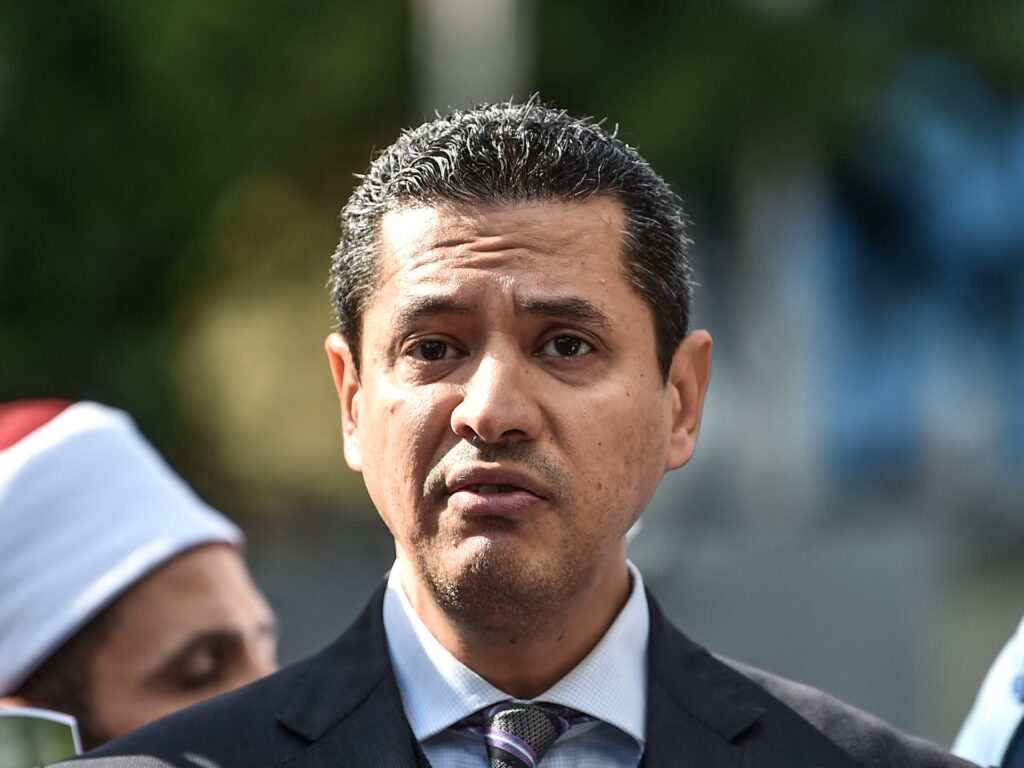
Al-Qaradawi’s family seeks Lebanese PM’s intervention to prevent his deportation to Egypt, fearing risks to his life. The family of Egyptian opposition activist Abdul Rahman al-Qaradawi has called on Lebanese authorities to immediately release him, as fears grow that he will be deported to Egypt, where he is wanted by the law. Al-Qaradawi’s family members issued a press release on Sunday saying that they had sent a letter to Lebanese Prime Minister Najib Mikati asking him to intervene in the case of the Egyptian poet and writer, who is also a Turkish citizen and lives with his family in Istanbul. “As a family, we trust in the wisdom of the Lebanese leadership and the dignified people of Lebanon,” the press release said. “Lebanon has always been a symbol of the defence of freedoms, and we appeal to the Lebanese prime minister, in the name of justice and humanity, to intervene immediately to release him and ensure his safe return to his family and three daughters who are waiting for him in Istanbul.” Al-Qaradawi, the son of the late spiritual leader of the Muslim Brotherhood Yusuf al-Qaradawi, was arrested on December 28 due to an Egyptian arrest warrant, a Lebanese judicial official quoted by the AFP news agency and the family said. He was detained at the Masnaa border crossing after he entered Lebanon from Syria. Advertisement Al-Qaradawi had been sentenced by an Egyptian court in absentia to five years in prison on charges of “opposing the state and inciting terrorism”, the official said. The family said the ruling was a response to an article published by al-Qaradawi in 2012, and warned that Lebanon would be endangering al-Qaradawi’s life if it extradited him to Egypt. “His extradition to any country that demands him endangers his life, especially considering the record of human rights violations in those countries,” the press release issued on behalf of al-Qaradawi’s family said. Al-Qaradawi’s lawyer in Lebanon, Mohammed Sablouh, had previously said that his client could be tortured if he was handed over to Egypt, which is accused by human rights organisations such as Amnesty International of repressing political dissidents and committing crimes including torture “with impunity”. Al-Qaradawi’s family’s letter is part of a campaign urging his release and return to Turkey. The 53-year-old was a longtime opponent of Egyptian President Hosni Mubarak, who was overthrown in the country’s 2011 revolution. The activist has also become a vocal critic of Egypt’s current leader, President Abdel Fattah el-Sisi, who came to power after a bloody coup in 2013 against elected President Mohamed Morsi, who later died in prison. Adblock test (Why?)
Fernandes and Amorim upset with United after impressive draw at Liverpool

Frustrated footballer Bruno Fernandes said if Manchester United can perform at Anfield, they must “do it everywhere” after the crisis-hit side secured a 2-2 draw against Premier League leaders Liverpool on Sunday. Cody Gakpo cancelled out Lisandro Martinez’s shock opener for United on Sunday before Mohamed Salah put Liverpool ahead from the penalty spot, but Amad Diallo scored a late equaliser. United finished the match the stronger, and defender Harry Maguire spurned a last-kick chance to win the game by firing over the bar from Joshua Zirkzee’s squared pass. The point for Liverpool takes them six clear of second-placed Arsenal with a game in hand. United are way down in 13th place, but at least they have ended their four-game losing run. “We have been criticised, and fairly,” United captain Fernandes told Sky Sports. “Our position in the table says it all. We have lost too many points. Even today, we can’t be happy with a point. We need the points and we could’ve won the game at the end, but it’s a fair result. Both teams played good football. Advertisement “I’m pretty upset. If we show this level at Liverpool, first in the league, why can’t we do this everywhere? It frustrates me. Also, finally I did a proper performance. We said we need much more from ourselves to get more from this season.” Harry Maguire missed the chance to win the match for Manchester United in the final minutes of Sunday’s game [Carl Recine/Getty Images] The midfielder said next week’s FA Cup tie at Arsenal would be tough for the holders but “we want to get to the final again”. “We know how tough it is to play against Liverpool,” he said. “Today, we put in a real effort to the game. Playing with some passion and heart is what is going to give you something from the game. You have to put in effort and that’s why we took something from today. “It can’t stop here. We have to bring this frustration to the next game to understand this has to be the level. If we can do it at Anfield, we have to do it everywhere.” 👆 @LFC are six points clear of Arsenal after today’s draw with Man Utd! #LIVMUN | #FestiveFixtures pic.twitter.com/uTOw1Tq3Si — Premier League (@premierleague) January 5, 2025 Liverpool skipper Virgil van Dijk said it could have been worse for his team if Maguire had converted a late chance. “I’m definitely disappointed with dropping points at home but it is what is and we have to move on and we will,” he said. “We found the 2-1 and then it is about trying to manage the game and keep the ball for longer than three and four passes. We lost the ball too easily at times and then we were more open than we should have been. We’re not perfect. We’re still learning and we have to learn from this as well.” Advertisement The defender said Liverpool had not underestimated United, despite their rivals’ troubles this season. “That’s all the media, media talk,” he said. “It’s nothing to do with us. We prepared for a very tough game like we have seen today. We didn’t think any of that.” Manchester United’s Matthijs de Ligt concedes a penalty ahead of Liverpool’s second goal [Phil Noble/Reuters] United manager Ruben Amorim has endured a wretched start to his time in charge at Old Trafford, with the club slipping to six defeats in September, culminating in the four-match losing streak. “We are in a difficult moment,” Amorim told Sky Sports. “If you play against Liverpool every day, we will recover positions like that. But if you play against any opponent, we will need to do it. We have proven we can do it. The way we were really competitive – that is what we must be going forward. “It’s not just the players, all the staff in the club. I’m happy for the performance, not for the results. But I’m really mad for the other games,” Amorim continued after United slipped to that fourth straight defeat, and sixth in the month of December, against Newcastle on Monday. A look at @ManUtd‘s average positions from their two latest matches 🔎 What stands out to you? 📊 @Oracle | #LIVMUN pic.twitter.com/UG07jqgHCo — Premier League (@premierleague) January 5, 2025 “Of course, we are going to improve in training, but it is the way we faced the game, not from the training,” he continued. “You can ask any fan – the way we fight, the way we kick, the way we fight for the ball. It’s so clear. Advertisement “Today I feel the players really wanted it. The important thing is not to relax tomorrow and return to the same performances. I will do everything to make the players understand, they have to suffer in a game. I am really trying on the basics and we have to move on. “Congratulations on the performance, but not the result. Everyone will say the players did everything right, so I am allowed to be upset [with them for the other results] today.” Amad Diallo impressed once again for Manchester United and scored his side’s second goal [Carl Recine/Getty Images] Adblock test (Why?)
Palestinian man mourns his mother outside morgue in Gaza
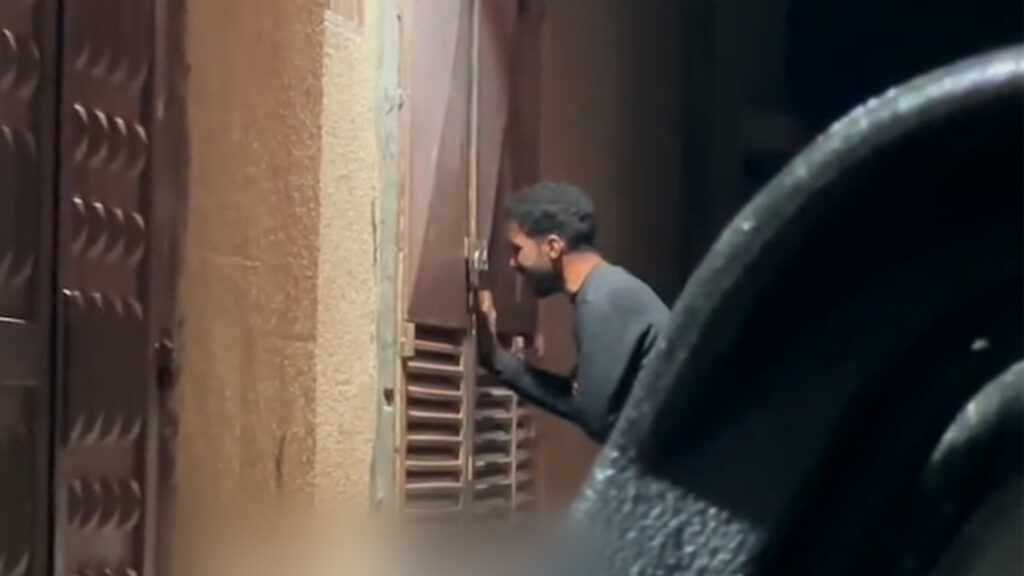
NewsFeed A Palestinian man was seen crying outside the door of the Al-Aqsa Martyrs Hospital’s morgue in Deir el-Balah, pleading for an answer from his mother who was killed in an Israeli attack on Gaza. Published On 5 Jan 20255 Jan 2025 Adblock test (Why?)
Syria to resume international flights from Damascus airport next week
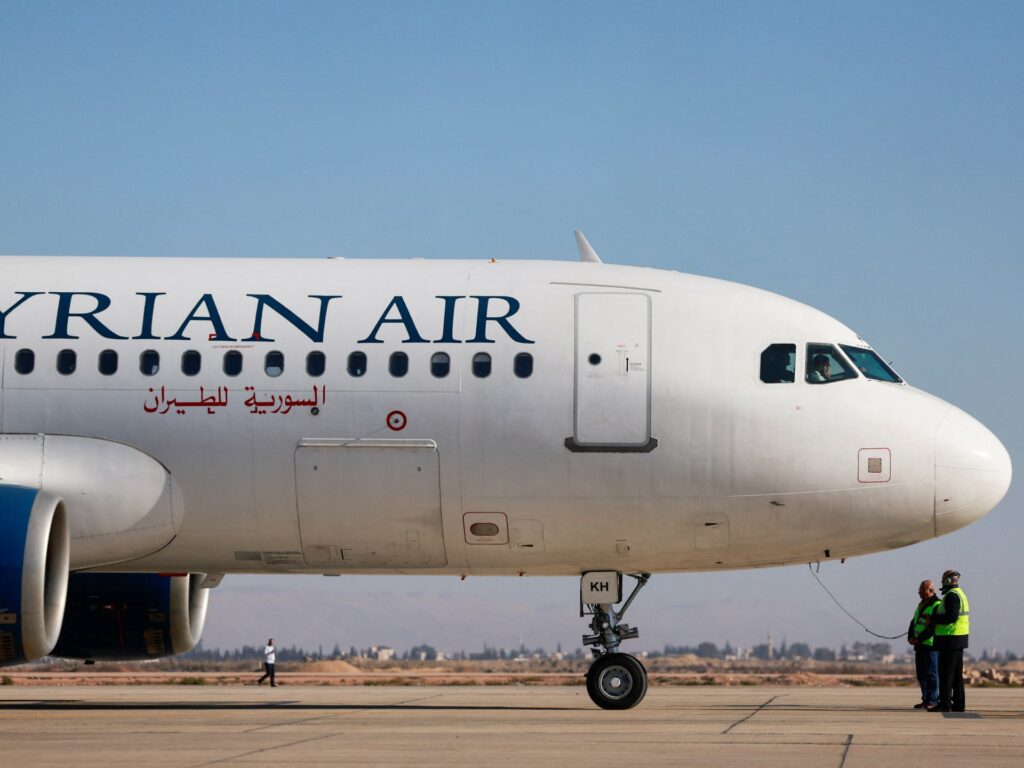
Airport authority says flights will resume on January 7 as Qatar Airways set to begin flights to Damascus after 13 years. Syria’s Damascus airport will resume international flights on Tuesday for the first time since Bashar al-Assad was overthrown last month by armed opposition fighters. No flights had taken off or landed since pro-Assad forces abandoned the airport in the Syrian capital on December 8 after the opposition fighters marched on the city following a lightning offensive that began on November 27. “We announce we will start receiving international flights to and from Damascus International Airport” from Tuesday, state news agency SANA said on Saturday, quoting Ashhad al-Salibi, who heads the General Authority of Civil Aviation and Air Transport. “We reassure Arab and international airlines that we have begun the phase of rehabilitating the Aleppo and Damascus airports with our partners’ help, so that they can welcome flights from all over the world,” he said. Al Jazeera’s Hashim Ahelbarra, reporting from Damascus, said the announcement has a “significant political and economic implication” for the war-torn nation. Advertisement “The new administration has been in touch with key regional players, particularly Qatar, on the need to help them rehabilitate their airport in Damascus to be in line with international safety standards,” he said. “They want to send a message that life is back to normal in Syria and to allow hundreds of thousands of Syrians who live abroad to come back home. And also, it’s a message to the international community that the new administration, which is in control, and despite the situation across the country, they are managing to ensure safety standards across Syria.” International aid planes and foreign diplomatic delegations have already been landing in Syria. Domestic flights resumed on December 18, when a flight from Damascus left for Aleppo, according to the AFP news agency. Syrian Airlines will resume flights from Damascus to Dubai, in the United Arab Emirates, starting on Tuesday, an employee told AFP, requesting anonymity because they were not authorised to speak to the media. On Thursday, Qatar Airways announced it would resume flights to the Syrian capital after nearly 13 years, starting with three weekly flights from Tuesday. Adblock test (Why?)
Australia beat India to reclaim Border-Gavaskar Trophy and enter WTC final
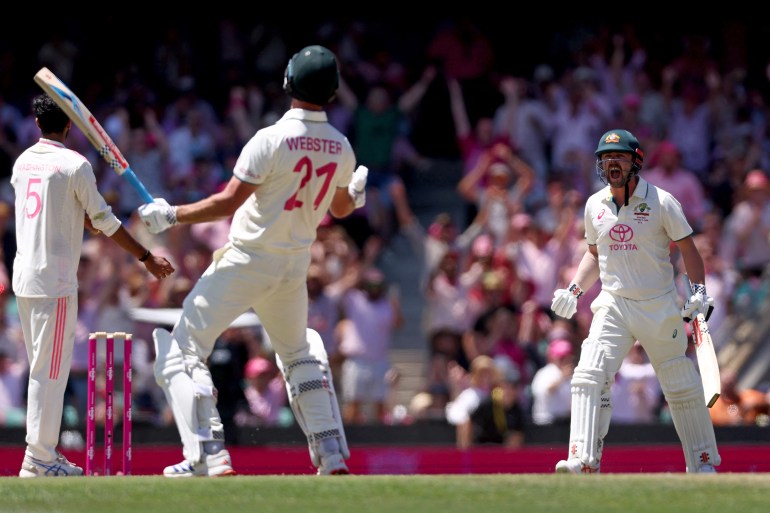
Australia have beaten India by six wickets in the fifth Test of their five-match series and won back the Border-Gavaskar Trophy for the first time in a decade. The hosts held their nerve to chase down their victory target of 162 after lunch on the third day of the final Test in Sydney on Sunday, prompting wild celebrations from their camp as they also sealed a spot in the World Test Championship final against South Africa at Lord’s in June. Travis Head, who was 34 not out, and debutant Beau Webster, unbeaten on 39, got their team over the line to end the series on a high. “It’s unreal, it’s been an amazing series,” Australia skipper Pat Cummins said shortly after the win. “It felt like it was kind of seesawing throughout the whole series so to finish it 3-1, to hold the trophy, is an amazing feeling,” he added. “I’m immensely proud, I absolutely love playing with these guys and it’s been a lot of fun along the way as well.” India captain Jasprit Bumrah was unable to bowl in Australia’s second innings because of a back issue but his fellow pace bowlers Prasidh Krishna and Mohammed Siraj kept the match on a knife edge by removing four top-order Australian batters. Advertisement The match had been played on fast forward over the first two days with 15 wickets falling on Saturday, and Australia removed four more in the first hour on Sunday morning to dismiss India for 157. The track retained some spice, and Krishna stood up in Bumrah’s stead and sent back opener Sam Konstas for 22, Marnus Labuschagne for six and Steve Smith for four before lunch. Smith trudged off, head bowed, on 9,999 career runs, and was followed soon after the break by Usman Khawaja, who was caught behind off Siraj for 41 to leave Australia on 104-4. The end of a topsy-turvy Test, where the momentum had shifted by the over, came almost as an anti-climax for another big crowd bathing in the sunshine at Sydney Cricket Ground. Head and Webster got the job done with an unbroken fifth-wicket stand of 58, the latter continuing his nerveless debut by clubbing the winning runs with a straight four. Travis Head (R) and teammate Beau Webster celebrate after winning the match on day three of the fifth Test at the Sydney Cricket Ground [David Gray/AFP] “It was a little frustrating but sometimes you have to respect your body,” said Bumrah, who was named Player of the Series for his 32 wickets over the five matches. “It was a great series. The whole series was well-fought and we were still in the match today. Our young players will take a lot of learnings for the future.” The bulk of the Australian side has been together for years and beating India remained an elusive goal for many of them. Only Smith, Nathan Lyon and Mitchell Starc were part of the squad that played in the last series win over their rivals a decade ago. Advertisement It was Cummins’ 20th win as captain. “It is one that a few of us didn’t have. The boys have had their eye on it and it has lived up to the hype. “We’ve spent a lot of time together as a group over the years, so we knew we weren’t at our best at Perth. “But it was never as bad as it seems. So you stick tight and double down on what makes us a really good side.” Australia handed out three debuts during the series – opener Nathan McSweeney who was axed after the first three Tests, the man who replaced him, Sam Konstas, and all-rounder Beau Webster in the fifth Test. They also heavily relied on stalwarts such as Smith, Starc and Head. “Always nice to have a squad,” said Cummins. “The three debutants in this series fitted in well. They contributed at different times. “There were some key moments when our mainstays really stood up. You need to do that to beat a side like India.” Ready to defend their World Test Championship mace 👊 Australia qualify for the #WTC25 Final at Lord’s 🏏 More 👉 https://t.co/EanY9jFouE pic.twitter.com/xcpTrBOsB8 — ICC (@ICC) January 5, 2025 Adblock test (Why?)
Silence on Israel’s massacres of journalists is dangerous to all
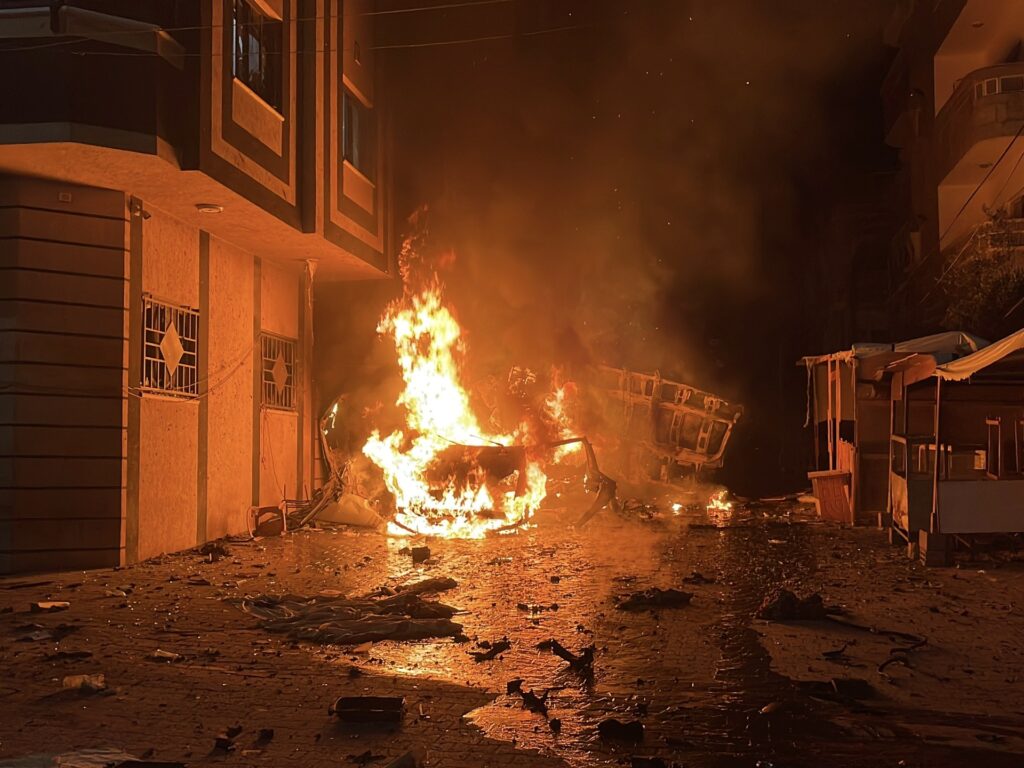
A December 26 press statement by the Israeli army attempted to justify a war crime. It unabashedly admitted that the military incinerated five Palestinian journalists in a clearly marked press vehicle outside al-Awda Hospital in the Nuseirat refugee camp, central Gaza Strip. The five victims were Ibrahim Sheikh Ali, Faisal Abu al-Qumsan, Mohammed al-Ladaa, Fadi Hassouna, and Ayman al-Gedi. Ayman had arrived at the hospital with his wife who was about to give birth to their first baby; he was visiting his colleagues in the vehicle when it was struck. His baby boy was born several hours later and now carries the name of his father who was not allowed to live long enough to celebrate his birth. The Israeli army statement claimed that the five Palestinians were “operatives posing as journalists” and that they disseminated “combat propaganda” because they worked for Al-Quds Al-Youm TV, affiliated with the Palestinian Islamic Jihad movement. The Israeli army made no claims that they were actually carrying weapons or involved in any armed action. Advertisement Many Western publications quoted the Israeli army statement as if it was an objective position and not propaganda whitewashing a war crime. They failed to clarify to their audiences that attacking journalists, including journalists who may be accused of promoting “propaganda”, is a war crime; all journalists are protected under international humanitarian law, regardless of whether armies like their reporting or not. The Geneva Conventions Article 79 of the Additional Protocol states that all journalists “engaged in dangerous professional missions in armed conflict areas shall be considered civilians … [and] shall be protected […] and without prejudice to the right of war correspondents accredited to the armed forces”. Completely disregarding these provisions of international law, the Israeli army has gone on a killing spree of Palestinian journalists over the past 15 months. According to the Gaza Government Media Office, 201 have been killed in Gaza since October 7, 2023. Other counts put the number at 217. According to the New York-based Committee to Protect Journalists (CPJ), some 138 Palestinian journalists were killed in Gaza and the occupied West Bank between October 7, 2023 and December 31, 2024. The organisation counted the five victims of the Israeli army’s attack on December 26 in the tally. The Paris-based Reporters Without Borders described the Israeli killing of journalists as “an unprecedented bloodbath” and Palestine as “the most dangerous country for journalists”. CPJ has also listed Israel as one of the top “jailers of journalists”. Advertisement Israel not only refuses to recognise any Palestinian media worker as being protected, but it also bars foreign journalists from entering Gaza. It has been truly disturbing that the international media has done little to protest this ban. Except for one petition signed by 60 media outlets over the summer, the international media has not followed up consistently on such demands over 15 months. If a major media organisation is not given access to a particular location, an indication of this ban is frequently attached to news reports as a form of protest. However, in the case of Gaza, Israel is given a pass, especially by mainstream Western media, with the Israeli press releases regularly passed on as facts. This complacency has allowed Israel to control the narrative and propagate its claim that this is a defensive war carried out by “the most moral army” in the world within the parameters of international law. While United Nations experts, some Israeli NGOs like B’Tselem, and every major international rights organisation have denounced Israel’s actions, the legacy media continues to give it the benefit of the doubt. In the rare cases where Western outlets have investigated Israeli claims, as The New York Times did recently, the findings overwhelmingly repeat reports that Arab and some left-wing Israeli media had made months before, outlining grave crimes being committed. One of the reasons why we have gotten to the point where Israel, the self-proclaimed “only democracy in the Middle East”, massacres journalists with impunity is because it was never held accountable for its gradual intensification of violence against media workers all these years. Advertisement The 2022 assassination of Palestinian-American reporter Shireen Abu Akleh in Jenin is a case in point. While there was coverage and investigative work done by Western media outlets on her murder, Israel was still allowed to get off the hook with the claim that it was the doing of a “bad apple” and the soldier responsible would be held to account. He wasn’t. What our foreign colleagues should understand is that Israel’s push to normalise the mass killing of journalists threatens not just Palestinian media workers. If such abhorrent behaviour in war zones is normalised, then no journalist, no matter what passport they carry, would be safe. It is time the international media community stop making excuses for Israel and call its actions what they are: war crimes. It is time journalists around the world stand in solidarity with their Palestinian colleagues and demand accountability for those who have massacred them. It is time they demand action from their governments that results in direct sanctions on Israel. The views expressed in this article are the author’s own and do not necessarily reflect Al Jazeera’s editorial stance. Adblock test (Why?)
Biden notifies US Congress of planned $8bn arms sales to Israel: Reports
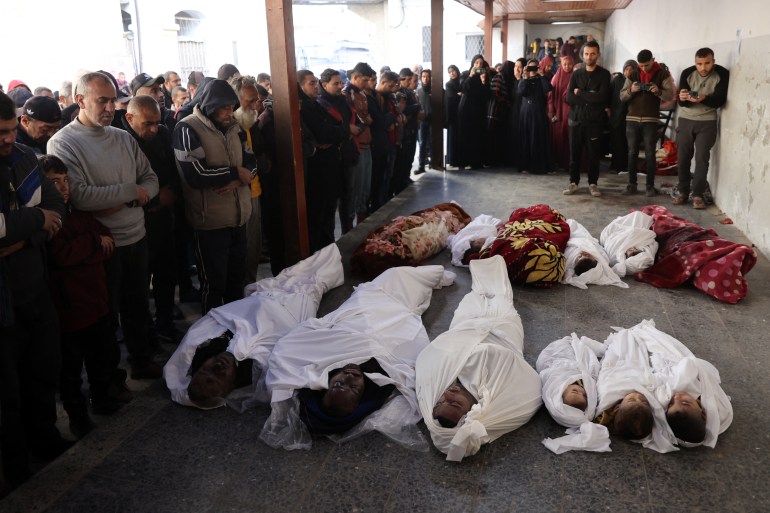
The administration of outgoing United States President Joe Biden has notified Congress of a planned $8bn arms sale to Israel, according to US media reports, as the ally continues its devastating war on Gaza. The Department of State sent the foreign affairs committees of the House and the Senate the notification on Friday, US media reported on Saturday, citing unnamed officials. The weapons will include 500-pound (226kg) warheads, precision-guided munitions, artillery shells, missiles for jets and attack helicopters, and bomb fuses, along with air-to-air missiles to intercept projectiles, the reports said. Some production and delivery of the munitions can be fulfilled through existing US stock, but the majority is expected to be delivered to Israel over a longer period, according to the US outlets. In August, Washington approved a separate package worth $20bn, which included jets, military vehicles, bombs and missiles. In November, the Biden administration approved another $680m arms package to Israel, including small-diameter bombs and precision-guidance kits. Advertisement After the US president last year briefly paused the supply of a single shipment of 2,000-pound (907kg) bombs that have caused widespread destruction across Gaza, Israeli Prime Minister Benjamin Netanyahu publicly blasted him. Biden has consistently emphasised his commitment to the US ally and its “self-defence” despite mounting criticism over the killing of Palestinian civilians in Gaza. Al Jazeera’s Alan Fisher, reporting from Washington, DC, said the sale was likely to be approved by Congress. “We’ve already heard from Mike Johnson, the new Speaker in the House, who said one of his priorities is to make sure Israel, their friend and ally, feels supported by the US. To block it, you’d need two-thirds votes in both houses, and that’s simply not going to happen,” he said. “The weapons are continuing to be sent to Israel even though a number of Democratic lawmakers have expressed their concerns that the US continues to provide weapons when the Israeli military does not do enough to combat the humanitarian crisis in Gaza,” he added. In addition to warning over the humanitarian situation in Gaza, rights groups have accused Israel of carrying out “acts of genocide” in its war, and Israel has been ordered by the International Court of Justice to take steps to prevent genocide from occurring in the Palestinian territory. A UN commission of inquiry has accused Israel of carrying out a policy to destroy the healthcare system in Gaza, where some 90 percent of the population has been displaced. Advertisement Israel escalates attacks Israel has intensified its attacks on Gaza in recent days, killing more than 100 people, according to Palestinian health authorities. The Israeli military on Friday ordered the forced evacuation of staff and patients from two hospitals in northern Gaza under threat of attack, days after its forces stormed the Kamal Adwan Hospital and detained its director. At least 11 people from the same family were killed in the Shujayea neighbourhood in northern Gaza on Saturday. “At about 2am [00:00 GMT] we were woken up by the sound of a huge explosion,” said Ahmed Ayyan, a neighbour of the al-Ghoula family, adding 14 or 15 people were staying in the house. “Most of them were women and children, they were all civilians. There is no one there who shot missiles or is from the resistance.” Since Israel launched its war on Gaza in October 2023, at least 45,717 people have been killed and 108,856 others have been wounded, according to Palestinian health authorities. The surge of Israeli attacks on Gaza in recent days comes as the Israeli government and Hamas authorised representatives to travel to Qatar for talks on a potential ceasefire and captive and prisoner exchange. Palestinians recite a prayer over the bodies of members of the al-Ghoula family at the al-Ahli Arab Hospital after an Israeli attack on their home in the Shujayea neighbourhood of Gaza City, January 4, 2025 [Omar Al-Qattaa/AFP] Adblock test (Why?)
Russia promises retaliation after saying Ukraine fired US-supplied missiles
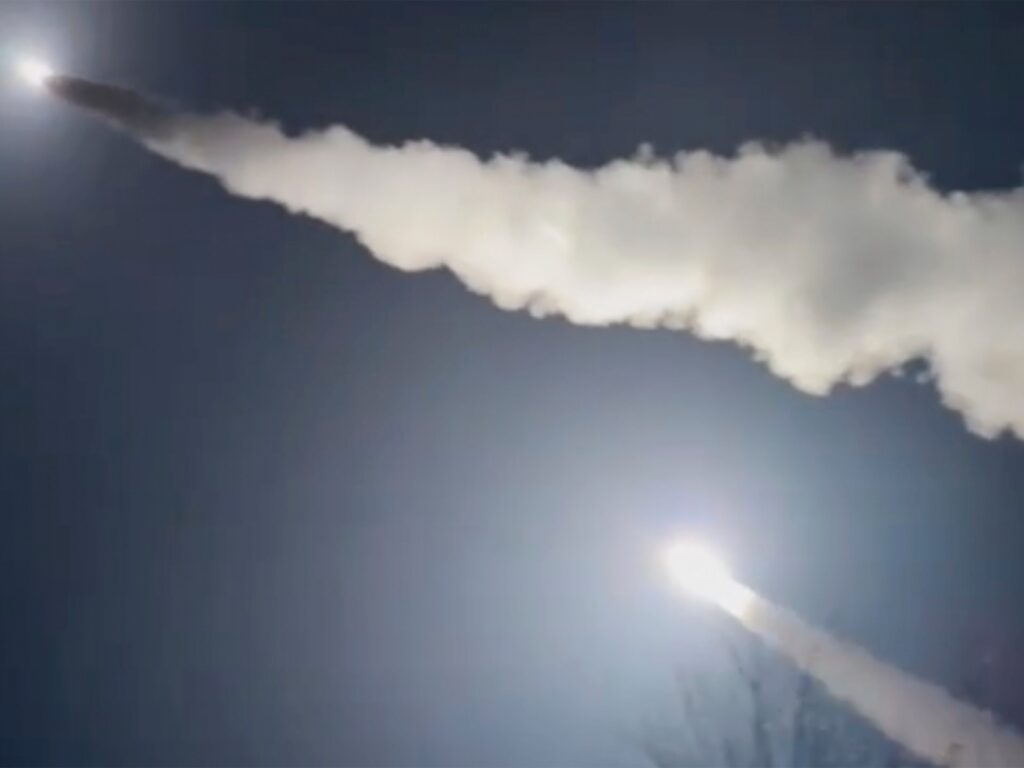
Outgoing US President Joe Biden has authorised Kyiv to use the long-range weapons against Russia. Russia has pledged to retaliate after it claimed to have shot down eight US-supplied ATACMS missiles fired by Ukraine at its border region of Belgorod. “On January 3, an attempt was made from Ukrainian territory to launch a missile attack against the Belgorod region using US-made ATACMS operational-tactical missiles,” the Russian Ministry of Defence said on Saturday. “These actions by the Kyiv regime, which is supported by Western curators, will be met with retaliation,” it added, saying all the missiles were shot down. The ministry said earlier that air defences downed eight ATACMS missiles in total, without saying when or where. Officials in Ukraine have not yet responded to the accusation. The Army Tactical Missile System (ATACMS) has a range of 300km (190 miles) and was first developed in the 1980s. Outgoing US President Joe Biden had authorised Kyiv to use long-range weapons against Russia last year, in a move the Kremlin denounced as a grave escalation of the nearly three-year conflict. Biden is expected to announce additional security assistance for Ukraine in the coming days, according to White House spokesperson John Kirby. Advertisement US President-elect Donald Trump said in an interview last month he was “very vehemently” opposed to Ukraine using the arms, which he said were “escalating” the conflict. Besides military support from the US, Kyiv will also reportedly receive its first French Mirage 2000-5F multirole fighters this month, according to French magazine Avions Legendaires. Russian President Vladimir Putin threatened last year to strike central Kyiv with a hypersonic ballistic missile if Ukraine continued hitting Russian territory with long-range Western weapons. Both Kyiv and Moscow have accused each other of fatal attacks on civilians since the year began. A Russian attack on a village in Ukraine’s northeast Kharkiv region earlier on Saturday killed a 74-year-old man, regional Governor Oleg Synegubov said. At least three people, including two children, were wounded in a Russian attack on the Sumy region of northeastern Ukraine on Saturday, local authorities said. Sumy borders Russia’s Kursk region and has been regularly shelled by Russian forces for months. Russian forces also launched attacks near the Ukrainian city of Pokrovsk in an effort to bypass it from the south and cut off supply routes to Ukraine’s troops, the Ukrainian military said on Saturday. Ukrainian President Volodymyr Zelenskyy noted that Russia had launched 300 attack drones and 20 missiles at Ukrainian targets in the first three days of 2025, but said a large amount was shot down by Kyiv’s forces. “Such Russian terror, which continues with unrelenting intensity, requires both us and all our partners not to reduce efforts in strengthening our air defence shield and all its systemic components – from Patriot systems to mobile fire groups,” Zelenskyy said on his social media platforms. Advertisement US Secretary of State Antony Blinken will embark on his final trip in office this weekend, travelling to South Korea, Japan, and France. At meetings in Paris, he is expected to discuss European security and Russia’s war in Ukraine with French officials, showcasing the Biden administration’s final outreach towards Kyiv before the Trump government takes over. Adblock test (Why?)
Medical victims: Indian visa curbs amid Bangladesh tensions hurt patients
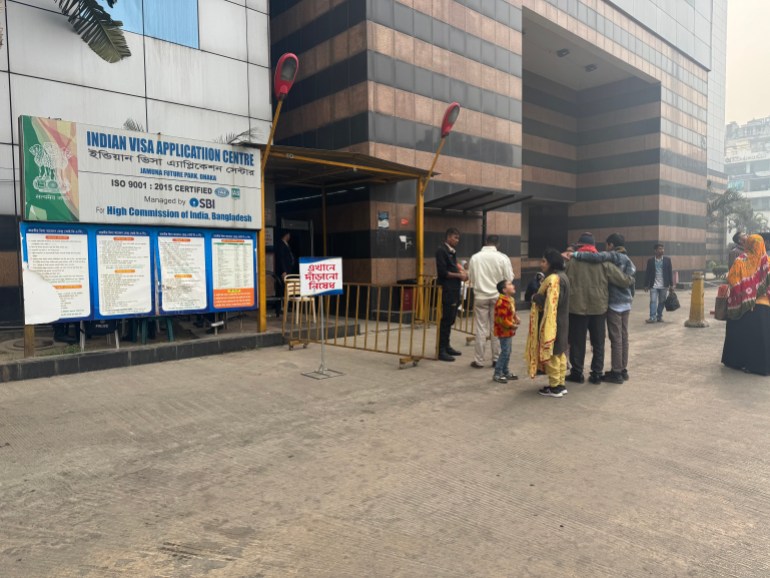
Dhaka, Bangladesh – Khadiza Khatun’s life took a devastating turn in September when doctors at Dhaka Medical College Hospital informed her that her 37-year-old husband, Mohammad Nuri Alam, urgently needed a liver transplant – a procedure unavailable in Bangladesh. After careful research, they decided to go to India’s Asian Institute of Gastroenterology in Hyderabad, a trusted destination for many Bangladeshi patients. But three months later, they are yet to secure visas for the trip. Amid escalating tensions between India and Bangladesh since the August ouster of Sheikh Hasina, an ally of New Delhi’s, from Dhaka, Indian authorities have significantly scaled back visa operations in Bangladesh. The result: Khadiza and her husband have already missed two hospital appointments, on November 20 and December 20, and are unsure about whether they’ll be able to get to India in time for January 10, the next date the medical facility in Hyderabad has given them. “We’ve tried everything since October – approaching travel agencies, seeking help from friends in government,” she told Al Jazeera. “India remains our only hope.” Advertisement Faced with unaffordable treatment options in Thailand and other countries, Khadiza is left watching her husband’s health deteriorate while relying on daily symptomatic treatment in Dhaka hospitals – hoping that the new year will bring her the visas her husband and she desperately need. “I feel helpless, running between hospitals without a solution,” said the mother of two. Khadiza’s struggle reflects a larger crisis affecting thousands of Bangladeshi patients, who rely on India’s affordable healthcare, because of the visa restrictions introduced by the Indian authorities. The Indian visa centre, on its website, says that it is only “offering limited appointment slots for Bangladesh nationals requiring urgent medical and student visas” and is “currently processing only a limited number of visas of emergency and humanitarian nature”. According to an Indian visa centre official in Bangladesh, daily online visa slots across five Indian visa centres in Bangladesh, including Dhaka, have “plummeted to around 500” from over 7,000 since the onset of the protests in July that led to Hasina’s removal from office. For many Bangladeshis, like Khadiza, the real likelihood of getting visas feels even slimmer. The usually bustling premises of the Indian visa centre in Dhaka, Bangladesh, had very few applicants on January 1, 2025 [Moudud Ahmmed Sujan/Al Jazeera] The slide in ties India-Bangladesh relations have deteriorated since Hasina fled the country for New Delhi on August 5 after a weeks-long student-led protest against her increasingly authoritarian rule. Advertisement India has since sheltered Hasina, straining ties – the interim Bangladesh government of Nobel laureate, Muhammad Yunus, last week sent New Delhi a diplomatic note seeking her extradition. Meanwhile, the Indian government has told Bangladesh it is concerned about a spate of attacks against Bangladeshi Hindus. Dhaka, on its part, insists that most attacks have been political in nature – against perceived supporters of Sheikh Hasina – rather than religious in their character. Bangladesh has also accused Indian media channels of exaggerating the scale of violence against Hindus. These tensions between the two governments have also impacted visa issuances. On August 26, a protest broke out at the Indian visa centre in Dhaka over processing delays, after the authority resumed “limited operations” in protest-hit Bangladesh on August 13. Across the border, a Bangladeshi diplomatic mission in the northeast Indian city of Agartala was attacked by a mob in early December, prompting a strong protest from Dhaka. On January 1, the usually bustling premises of the Indian visa centre in Dhaka appeared nearly deserted. Only a few applicants were waiting to submit their documents. Most applicants received calls to submit their visa applications and fees at the visa centre after manually providing a copy to the Indian High Commission in Dhaka days earlier. However, Khadiza, who followed the same process a month ago, was unsuccessful. A visa centre official told Al Jazeera that the high commission has begun accepting more emergency applications, though online submission options remain limited. Some Bangladeshis, who delayed their travel to India for treatment as they waited for tensions to ease, are now stuck with expired visas. “My and my wife’s visas were valid until December 10, but we didn’t travel then due to tensions over Bangladesh-related issues in India,” said 40-year-old Shariful Islam, from Joypurhat in northwestern Bangladesh. Advertisement Islam suffers from a lung disease. He and five other family members – each with their own health issues, including his wife and father – have for the past four years been travelling regularly to the eastern Indian city of Kolkata and the southern city of Vellore for medical treatment. In a rural area of Joypurhat, Ridowan Hossain, who runs a visa support agency, has meanwhile been struggling to secure visa appointment slots for patients, including a cancer patient urgently seeking treatment in India. Over 10 days, he repeatedly attempted to complete the online application process but consistently faced failures at the payment stage, he said. When he called a helpline, he said he was just told to try again. “I process over 300 Indian visas annually, but I haven’t been able to process a single one since July,” he said. Now, many Bangladeshi patients are seeking alternative treatment options in Thailand, Malaysia, Singapore and Turkiye. Mazadul Noyon, manager of Suea Noi Fit & Fly, a Bangkok-based medical and tour operator agency, told Al Jazeera that inquiries from Bangladesh have doubled compared to before August. “Although around 80 percent of patients consider Thailand after failing to secure an Indian visa, most abandon the idea upon learning of the 10-15 times higher costs in Thailand,” he said. For example, the initial treatment cost for Khadiza’s husband – covering diagnosis, medicine, consultation, and related expenses – along with travel and accommodation, would range from US$1,000 to US$2,000 in India, compared to at least US$10,000 to US$15,000 in Thailand. Advertisement For a cardiac ring implant, costs in Thailand range from $5,000 to $20,000 – depending on the hospital, excluding travel and accommodation. In India, $2,000
Myanmar’s military regime to free thousands of prisoners in amnesty
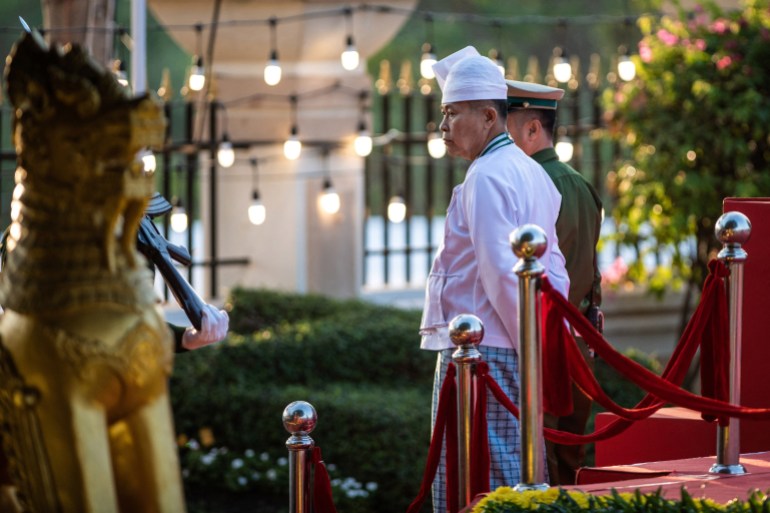
Myanmar’s military rulers announced an amnesty for 5,864 prisoners to mark Independence Day, state media reports. Myanmar’s military rulers will release 5,864 prisoners, including 180 foreigners, under an amnesty to mark the country’s 77 years of independence from British colonial rule, state media said. The military said on Saturday that it had ordered the release “on humanitarian and compassionate grounds” and would commute the life sentences of 144 people to 15 years, according to state-run MRTV television. Details were not provided of what the prisoners had been convicted of and the nationalities of the foreign detainees, who were set to be deported on release, were not known. The Associated Press news agency said the foreigners to be released could include four Thai fishermen who were arrested by Myanmar’s navy in late November after patrol boats opened fire on Thai fishing vessels in waters close to their maritime border in the Andaman Sea. Thailand’s prime minister has said she expects the four to be released on Independence Day. Myanmar regularly grants amnesty to thousands of people to commemorate holidays or Buddhist festivals. Last year the military government announced the release of more than 9,000 prisoners to mark independence. A similar release took place in October 2021. Advertisement Among those still imprisoned is the country’s former leader, Nobel laureate Aung San Suu Kyi. The 79-year-old is serving a 27-year sentence tied to 14 criminal charges brought against her by the military, ranging from incitement and election fraud to corruption. She denies all the charges. This year’s Independence Day ceremony was held in Myanmar’s capital Naypyidaw and involved 500 representatives from the government and military. A speech by Myanmar’s military chief Senior General Min Aung Hlaing – who was not present at the event – was delivered by deputy prime minister and army general, Soe Win. Soe Win, deputy commander-in-chief of Myanmar’s Defence Services, leaves after a ceremony to mark Myanmar’s 77th Independence Day in Naypyidaw on January 4, 2025 [AFP] In the speech, he called on ethnic minority armed groups, that have been fighting military rule for the last four years, to put down their weapons and “resolve the political issue through peaceful means”. Myanmar has been in turmoil since early 2021, when the military overthrew an elected civilian government and violently suppressed pro-democracy protests, leading to a nationwide armed rebellion that has made strong gains against the military on the battlefield. Two weeks ago a rebel group known as the Arakan Army captured a major regional command in the country’s west, the second to fall to the armed resistance movement in five months. The group also recently took control of a 271km (168 mile) stretch of the border with Bangladesh when it captured the town of Maungdaw. Advertisement Adblock test (Why?)