

UN envoy warns Syria’s war ‘has not ended yet’ as US says truce extended
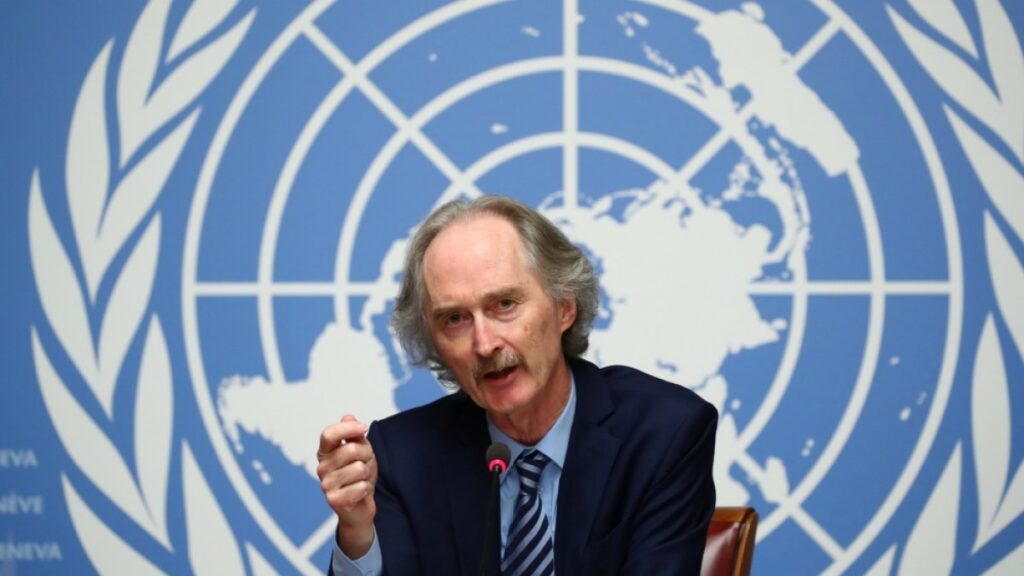
The United Nations special envoy for Syria has warned that the war “has not ended yet” despite the removal of President Bashar al-Assad by opposition fighters, highlighting clashes between Turkish-backed armed groups and Kurdish fighters in the north of the country. “There have been significant hostilities in the last two weeks, before a ceasefire was brokered,” Geir Pedersen told the UN Security Council in New York on Tuesday, warning that a military escalation could be “catastrophic”. The remarks come after the Syrian National Army (SNA), a group of fighters backed by Turkiye, has battled with the Kurdish-led Syrian Democratic Forces (SDF) in the wake of al-Assad’s removal. The SDF is the main ally in a United States-led coalition against ISIS (ISIL). It is spearheaded by the People’s Protection Units (YPG), which Ankara sees as an extension of the Kurdistan Workers’ Party (PKK) armed group that it outlaws and that has fought the Turkish state for 40 years. Last week, SNA fighters seized the northern city of Manbij from the SDF, which then headed east of the Euphrates River as a US-mediated ceasefire came into effect. Advertisement Shortly after Pederson addressed the UN Security Council, a US State Department spokesman said the ceasefire in northern Syria had been extended until the end of this week. “We continue to engage with the SDF, with Turkey about a path forward,” State Department spokesperson Matthew Miller said, adding it was not in the interest of any party to see increased conflict in Syria. “We don’t want to see any party take advantage of the current unstable situation to advance their own narrow interests at the expense of the broader Syrian national interest.” Netanyahu visits Golan Pedersen also called on the UN’s Security Council to ensure that Israel “cease all settlement activity in the occupied Syrian Golan”. Pedersen noted Israel has conducted more than 350 strikes on Syria following the departure of the former regime, including a major strike on Tartous. “Such attacks place a battered civilian population at further risk and undermine the prospects of an orderly political transition,” he said. The UN envoy warned against plans announced by Israel’s cabinet to expand settlements inside the Golan, occupied by Israel since 1967 and annexed in 1981. On Tuesday, Israeli Prime Minister Benjamin Netanyahu held a security briefing inside the UN-patrolled buffer zone in the Golan Heights that Israel seized earlier this month. “Israel must cease all settlement activities in the occupied Syrian Golan, which are illegal. Attacks on Syria’s sovereignty and territorial integrity must stop,” said Pedersen. Advertisement Rob Geist Pinfold, a professor of peace and security at Durham University, told Al Jazeera that “Israel is looking to launch as many strikes [as possible] while it still has the freedom to do so.” He suggested that “Israel is adding to the instability [due to their] fear power vacuums and ungoverned spaces on their borders.” Geist Pinfold also said that the “international community’s response has certainly been lacklustre so far.” Sanctions Pederson also called for “broad support” to end the Western-backed sanctions imposed on Syria in order to allow for reconstruction in the war-ravaged country. “Concrete movement on an inclusive political transition will be key in ensuring Syria receives the economic support it needs,” Pedersen said. “The needs are immense and could only be addressed with broad support, including a smooth end to sanctions, appropriate action on designations, too, and full reconstruction.” Western countries are wrestling with their approach to Hayat Tahrir al-Sham (HTS), which spearheaded the takeover of Damascus, and is a former al-Qaeda affiliate. Despite moderating its rhetoric in recent months, HTS has been designated as a “terrorist” group by many Western governments. Adblock test (Why?)
“Euphoria” in Syria could quickly turn to “frustration”
[unable to retrieve full-text content] Mohamad Elmasry talks about the challenges Syrians face that could easily disrupt the current mood.
“Wheels of justice now turning” for Syrian torture victims
[unable to retrieve full-text content] Roger Lu Phillips talks about what the new Syrian government will have to do to bring justice to Assad regime’s victims.
Chief of Russian nuclear protection forces killed in Moscow bomb blast
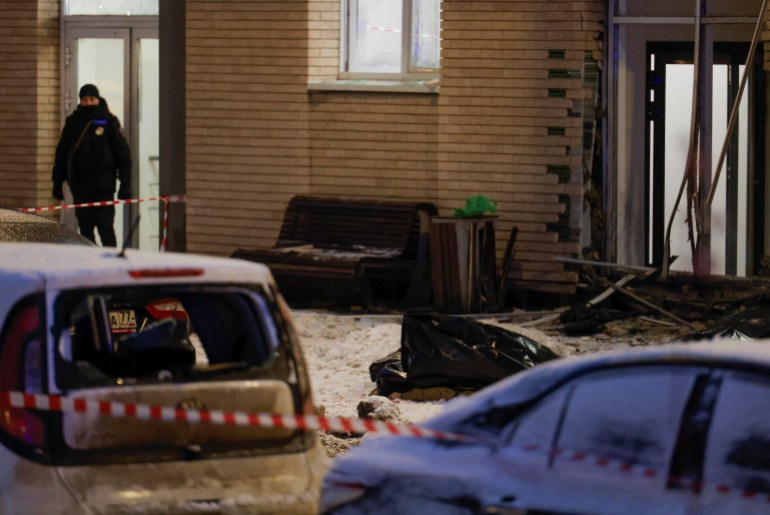
DEVELOPING STORYDEVELOPING STORY, Chief of Russia’s Troops of Radiological, Chemical and Biological Defence killed outside an apartment building. A bomb hidden in an electric scooter has killed a senior general in charge of nuclear protection forces in Moscow, Russia’s investigative committee said. Lieutenant General Igor Kirillov, who was chief of the Troops of Radiological, Chemical and Biological Defence, was killed on Tuesday outside an apartment building on Ryazansky Prospekt. “Igor Kirillov, the head of the radiation, chemical and biological protection forces of the armed forces of the Russian Federation, and his assistant were killed,” the investigative committee said. According to a law enforcement official, the explosive device “had a capacity of some 300 grams in TNT equivalent”, Russian outlet Tass news agency reported. Photographs posted on Russian Telegram channels showed a shattered entrance to a building littered with rubble and two bodies lying in the blood-stained snow. Reuters news agency footage from the scene showed a police cordon. A criminal case has been opened. Rubble and litter can be seen outside the building where the explosion took place [Maxim Shemetov/Reuters] Russia’s radioactive, chemical and biological defence troops are special forces who operate under conditions of radioactive, chemical and biological contamination. Advertisement On Monday, Ukrainian prosecutors charged Kirillov in absentia with the alleged use of banned chemical weapons in Ukraine, the Security Service of Ukraine said, according to the Kyiv Independent. Russia denies those accusations. In October, the United Kingdom sanctioned Kirillov and the nuclear protection forces for using riot control agents and multiple reports of the use of the toxic choking agent chloropicrin on the battlefield. Ukraine’s Security Service, the SBU, said that they had recorded more than 4,800 uses of chemical weapons on the battlefield since February 2022, particularly K-1 combat grenades. During the almost 3-year operation, Russia has made small but steady territorial gains to the nearly one-fifth of Ukraine it already controls. Adblock test (Why?)
Cyclone Chido: What to know about storm that devastated France’s Mayotte
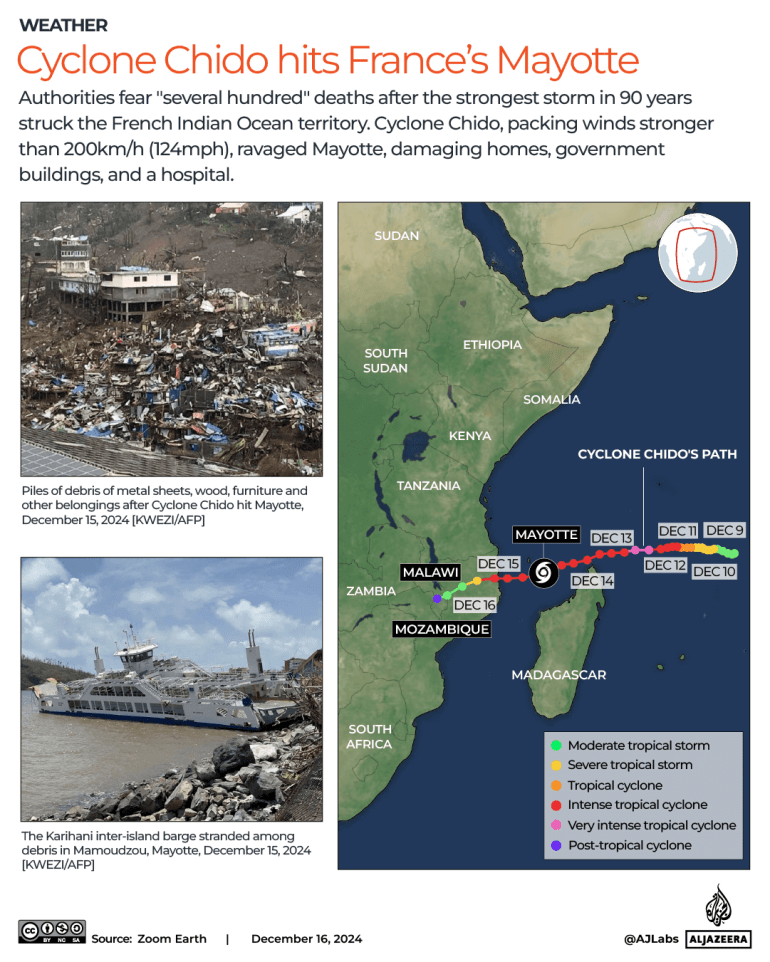
Cyclone Chido has become the worst storm to impact the French overseas territory of Mayotte in the Indian Ocean in 90 years. Here is more about the destruction caused by Chido and what may come next: What is Cyclone Chido? Chido developed from a tropical depression in the southeastern Indian Ocean basin from December 7 to 8. A tropical depression is an area of low pressure over an ocean accompanied by circular wind flow produced by thunderstorms. Tropical depressions have maximum sustained wind speeds of 61km/h (38mph) or less. A tropical depression can intensify and become a tropical storm if wind speeds are from 62km/h (39mph) to 119km/h (74mph). Anything above that is considered a tropical cyclone. The terminology can be slightly confusing. Tropical cyclones are called hurricanes when they occur in the Atlantic Ocean, Gulf of Mexico, Caribbean Sea and northeastern Pacific Ocean and are called typhoons when they occur in the western Pacific Ocean. And when they occur in the South Pacific and the Indian Ocean, they are referred to as cyclones. Advertisement Chido intensified into a cyclone and hit Mayotte, an archipelago home to 320,000 people off the east coast of Africa. While Mayotte lies in the Indian Ocean, it is an overseas department of France and is directly ruled from Paris. However, it is France’s poorest region, and an estimated third of the population live in shanty towns. The cyclone has also impacted surrounding nations in southeastern Africa, bringing heavy rainfall and damaging houses in Madagascar, Mozambique and the Comoros Islands before weakening. According to an early estimate, at least three people have died in Mozambique, local officials told the AFP news agency. When and where did Chido make landfall? Chido hit Mayotte on Saturday morning with wind speeds exceeding 220km/h (137mph). It made landfall as a tropical storm in Mozambique on Sunday morning. Chido was incredibly powerful. It was equivalent to a Category 4 hurricane at the time of landfall in Mayotte, making it the second strongest type of storm on the Saffir-Simpson scale. According to the National Hurricane Center in the United States, Category 4 storms, which have wind speeds ranging from 209km/h to 251km/h (130mph to 156mph) cause “catastrophic damage”. They can destroy well-built homes, uproot trees and down power poles, leading to power outages. (Al Jazeera) How many people have been killed by Chido in Mayotte? According to France’s Interministerial Crisis Management Operational Centre (COGIC), the official death toll in Mayotte as a result of Chido is 19 people. Advertisement However, it is feared that Chido has actually killed hundreds of people. The French Ministry of Interior has said “it will be difficult to account for all victims” and a conclusive number of those affected by Chido has not been determined yet. Determining the death toll could take “days and days”, Interior Minister Bruno Retailleau told French media. Retailleau arrived in Mayotte’s capital, Mamoudzou, on Monday. France has sent medical and military personnel to Mayotte on ships and military aircraft. Rescue workers, including reinforcements from France, are digging through debris to try to find survivors of the cyclone. “I think there will certainly be several hundreds. Maybe we will reach a thousand, even several thousands,” senior local French official Francois-Xavier Bieuville told the local media channel Mayotte la 1ere on Sunday. The uncertainty is partly due to the large number of undocumented migrants in Mayotte – more than 100,000, according to French authorities. Additionally, a French Interior Ministry official said determining the death toll would be complicated because “Mayotte is a Muslim land where the dead are buried within 24 hours.” Many of Mayotte’s migrants come from the neighbouring Comoros Islands and East African countries such as Somalia. They are attracted by better economic opportunities that come with Mayotte’s status as a department of France. How badly damaged is Mayotte’s infrastructure? According to COGIC, 830 people have been injured, including 24 with severe injuries. Additionally, 100,000 people have been moved to 70 emergency shelters. Critical infrastructure in Mayotte has been damaged, including roads, water treatment plants and electrical transmission lines. “The health system is seriously affected, and access to care has been seriously degraded,” outgoing French Health Minister Genevieve Darrieussecq said on Sunday. Advertisement The control tower of Mayotte’s main airport, Dzaoudzi–Pamandzi, also sustained damage. This has made rescue operations difficult because only military aircraft can now fly into Mayotte. According to the internet monitoring group NetBlocks on Monday, Mayotte has been offline almost entirely for more than 36 hours. COGIC reported 15,000 people have experienced power outages. Impoverished communities have been hit hardest by the cyclone. Mayotte’s shanty towns, where most homes are built with sheet metal, were not constructed to withstand the power of a cyclone, and many of the dead are believed to have been living in these areas. Damage to infrastructure has left some communities in Mayotte without food and water since Saturday, said Salama Ramia, a senator representing Mayotte in the French Senate. Mayotte is the poorest French overseas territory and is also believed to be the poorest European Union territory. Three out of four people in the island nation live below the poverty line. For years, Mayotte has struggled with water shortages, drought and underinvestment. Where is Chido now? As of 09:00 GMT on Monday, Chido had weakened to a remnant low, or a post-tropical cyclone, slightly south of the Balaka township in Malawi. It had a speed of 45km/h (28mph). What’s next? According to ReliefWeb, Chido is expected to dissipate near Zimbabwe on Tuesday. Cyclones typically form in the southwestern Indian Ocean from November to April. An average of 12 cyclones form per year. In 2019, Cyclone Idai killed more than 1,300 people in countries including Malawi, Mozambique and Zimbabwe. In 2023, Cyclone Freddy caused storms for a month, killing more than 1,000 people in East Africa. Freddy remained a tropical cyclone for 36 days, and the World Meteorological Organization declared it the longest lasting tropical cyclone on record. Advertisement Scientists warn that cyclones are
Canada finance minister resigns as PM Trudeau grapples with new Trump term
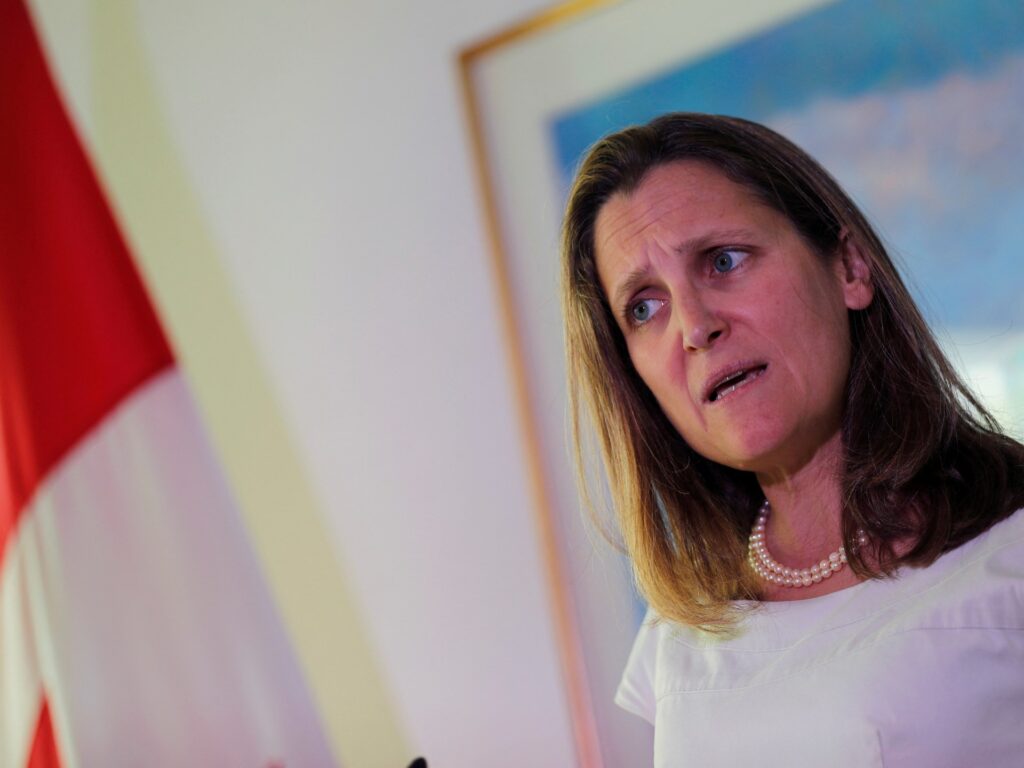
Canada’s Finance Minister Chrystia Freeland has resigned in a blow to Prime Minister Justin Trudeau, who is facing declining approval ratings and opposition from within his own party, as well as the prospect of a trade war with the United States. In her resignation letter, which was posted on X on Monday, Freeland revealed that Trudeau had informed her last week that he no longer wanted her to serve in the role and would instead offer her another cabinet position. “Upon reflection, I have concluded that the only honest and viable path is for me to resign from the cabinet,” Freeland wrote. “For the past number of weeks, you and I have found ourselves at odds about the best path forward for Canada,” she continued. Trudeau did not immediately respond to the resignation, which comes just days after he met with Canada’s provincial leaders to outline his plans to respond to threats of a trade war with US President-elect Donald Trump, who takes office on January 20. Trump has vowed to impose 25 percent tariffs on goods from Canada and Mexico if the neighbouring countries do not stop what he called an “invasion” of undocumented migrants and drugs. Advertisement The Trudeau government has reportedly been developing plans to invest in increased border security and monitoring in response, but has faced mounting pressure to take a harder line on Trump. The government was set to further present details of the border plan to the Parliament of Canada on Monday, in an economic update that was to be delivered by Freeland. A former journalist, Freeland also served as deputy prime minister since 2019. In her resignation letter, she said she disagreed with how the government was approaching policy towards its southern neighbour. “Our country today faces a grave challenge,” she said, describing Trump’s threat as “aggressive economic nationalism”. “We need to take that threat extremely seriously,” she continued. “That means keeping our fiscal powder dry today, so we have the reserves we may need for a coming tariff war. That means eschewing costly political gimmicks, which we can ill afford and which make Canadians doubt that we recognise the gravity of the moment.” In another blow to Trudeau, Housing Minister Sean Fraser also announced on Monday that he would not seek re-election. Looming elections The updates come as Trudeau’s Liberal Party has been preparing for elections which must be held before the end of October next year. Trudeau has said he plans to stay at the party’s helm. Because Liberals do not hold an outright majority, if the allied New Democratic Party were to pull its support, this would trigger a new election at any time. Advertisement Meanwhile, Trump’s victory has driven home concerns that Canada could be subject to global anti-incumbency trends that could see the Conservative Party, led by populist Pierre Poilievre, take power for the first time since 2015. After nearly a decade in power, Trudeau in September saw his approval rating dip to just 33 percent. He has continued to face criticism over high consumer and housing costs, the legacy of his government’s response to the COVID-19 pandemic, and most recently, his handling of Trump. The US president-elect and his allies have further helped to colour public perception with their regular ridiculing of Trudeau. Most recently, Trump referred to the prime minister as the “governor” of a “great state”. That came shortly after Trudeau, who had visited Trump’s Mar-a-Lago estate in Florida, the US last month in an effort to mend ties, said that Canada would “respond to unfair tariffs in a number of ways”. Trudeau’s government had previously enacted retaliatory tariffs after Trump imposed tariffs on Canadian steel and aluminium during his first term. The tariffs were eventually lifted by both countries. Adblock test (Why?)
Israeli strike kills Palestinian grandfather Khaled Nabhan
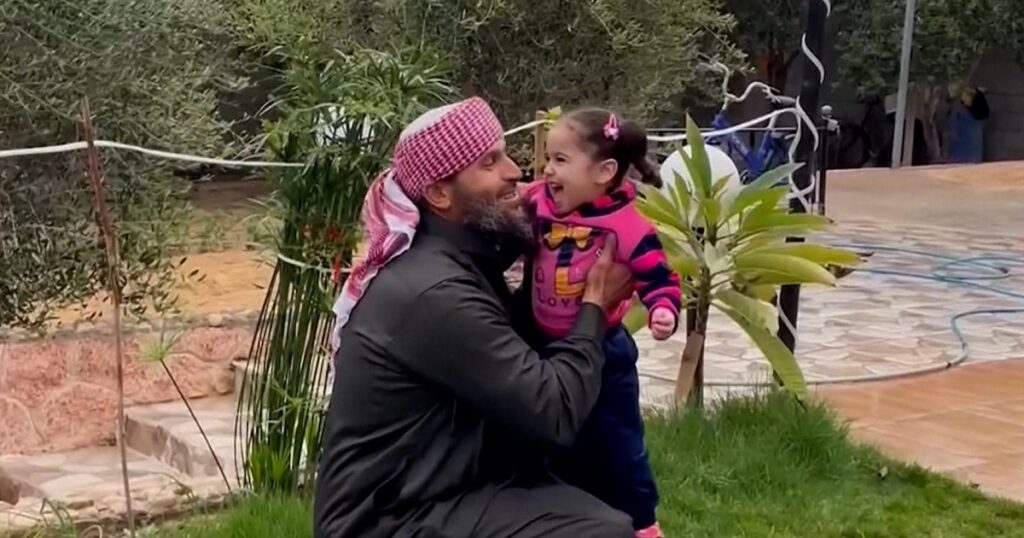
NewsFeed An Israeli strike killed Khaled Nabhan, a Palestinian grandfather known for his emotional goodbye to his 3-year-old granddaughter who was killed in an Israeli attack in November of 2023. Published On 16 Dec 202416 Dec 2024 Adblock test (Why?)
Palestinian journalist, Gaza Civil Defence workers killed in Israeli strike
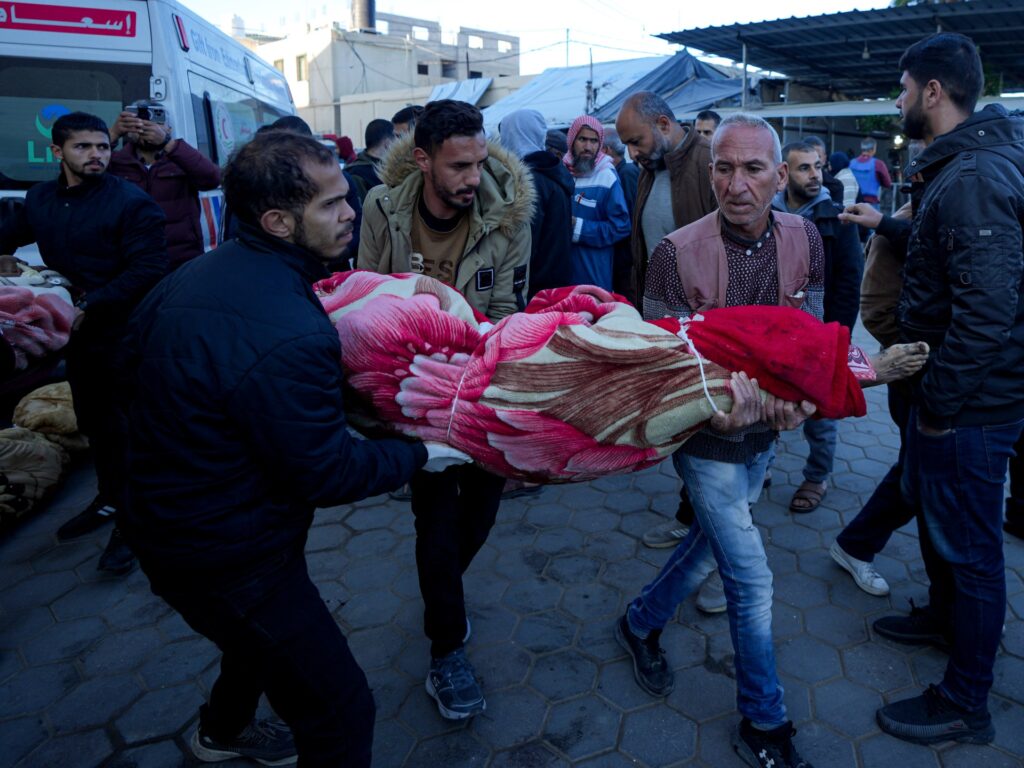
An Israeli air strike has killed Palestinian journalist Ahmed Al-Louh and five Palestinian Civil Defence workers in central Gaza’s Nuseirat camp. Al-Louh, who worked as a cameraman for Al Jazeera alongside other media outlets, was killed on Sunday in the strike on the Civil Defence post in the central Gaza camp, according to medics and local journalists. The attack occurred as Israeli military strikes across the Gaza Strip killed at least 28 Palestinians on Sunday, medics said. Allouh is the third journalist killed in Gaza in the last 24 hours. Al Jazeera Arabic reported that Al-louh was working while killed, wearing a press vest and helmet. He was taken to Al-Aqsa Martyrs Hospital in Gaza’s city of Deir el-Balah. Al Jazeera Media Network condemned Al-Louh’s killing, and called on human rights and media organisations “to condemn the Israeli Occupation’s systematic killing of journalists in cold blood, the evasion of responsibilities under international humanitarian law, and to bring the perpetrators of this heinous crime to justice”. Advertisement “We urge relevant international legal institutions to take practical and urgent measures to hold the Israeli authorities and all those who are responsible accountable for their heinous crimes and to adopt mechanisms to put an end to the targeting and killing of journalists,” the network added. Al-Louh had been covering Israel’s war on Gaza when it first began in October 2023, embedded with the Gaza Strip’s Palestinian Civil Defence teams, Al Jazeera’s Hind Khoudary said. “It’s another heartbreaking day for Palestinians, Civil Defence teams, journalists. We [have been] wondering, how many times are we going to continue reporting on the killing[s] of our colleagues and beloved ones?” Khoudary said, reporting from Deir el-Balah. Gaza’s media office said the head of the civil emergency service in Nuseirat, Nedal Abu Hjayyer, was also killed in Sunday’s attack. “The civil emergency headquarters in Nuseirat camp was hit during the crews’ presence. They work around the clock to serve the people,” said Zaki Emadeldeen from the civil emergency service to reporters at the hospital. “The civil emergency service is a humanitarian service and not political. They work in war and peace times for the service of the people,” he said, adding that the place was hit directly by an Israeli air strike. The Israeli military said they were looking into the attack. Several other Palestinian journalists were killed this past week, with 195 killed in Gaza since Israel’s war began, Khoudary said. Advertisement Al Jazeera’s Hani Mahmoud said earlier on Sunday that Palestinian journalist Mohammed Jabr al-Qrinawi was killed along with his wife and children in an Israeli air attack that targeted their home in Bureij refugee camp, in central Gaza, late on Saturday. Earlier on Saturday, Al Mashhad Media said its journalist Mohammed Balousha was killed in an Israeli attack in Gaza. Several Al Jazeera journalists have been killed since the start of Israel’s war on Gaza, including Ismail al-Ghoul, Rami al-Rifi, Samer Abudaqa and Hamza Dahdouh. Also on Sunday, an air strike hit people protecting aid trucks west of Gaza City. Medics said several were killed or wounded but exact figures were unavailable as of yet. Residents also said at least 11 people were killed in three separate Israeli air strikes in Gaza City. Nine were killed in the towns of Beit Lahiya, Beit Hanoon and Jabalia camp when clusters of houses were bombed or set ablaze, and two were killed by drone fire in Rafah. Earlier on Sunday, at least 15 Palestinians were killed after Israeli forces stormed Khalil Oweida School in Beit Hanoon, sources told Al Jazeera. Several other Israeli attacks earlier on Sunday killed Palestinians near Kamal Adwan Hospital in northern Gaza; and in Shujayea, in Khan Younis. According to Gaza’s Health Ministry, at least 44,976 Palestinians have been killed by Israeli forces since October 7, 2023. Adblock test (Why?)
Israel approves plan to surge settler population in occupied Golan Heights
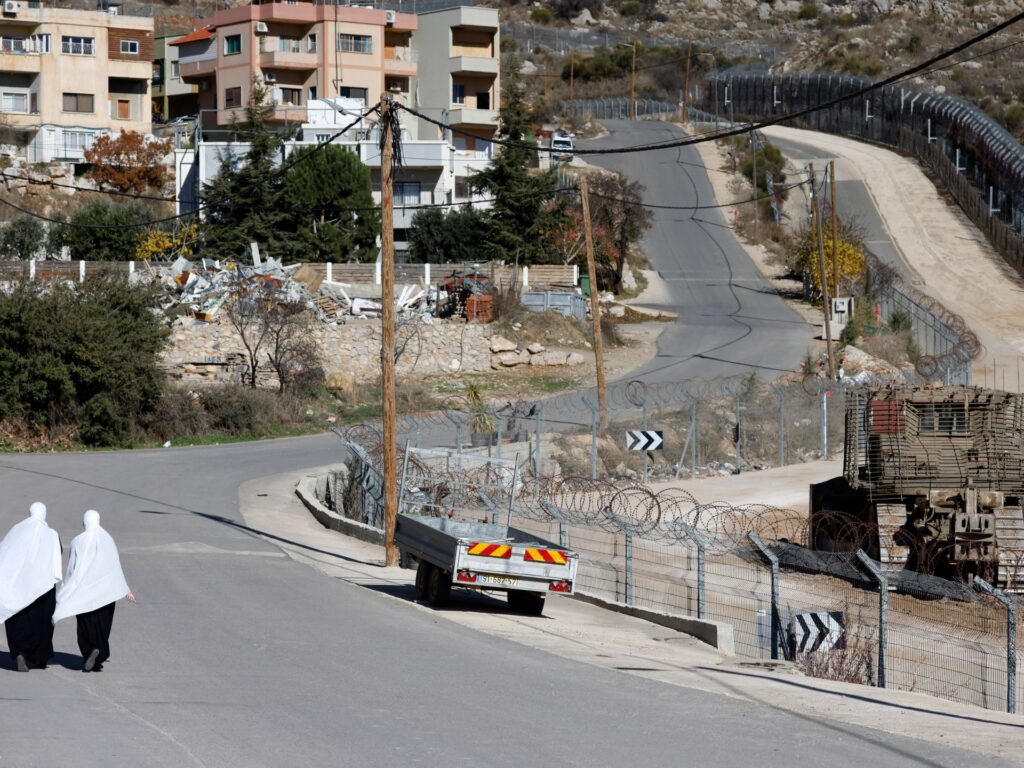
Move comes days after rebel groups toppled Syrian leader Bashar al-Assad, weeks before Donald Trump becomes US president again. Israel’s government has approved a plan to increase the number of settlers in the illegally occupied Golan Heights, days after seizing more Syrian territory following the toppling of Syria’s longtime leader Bashar al-Assad. Israeli Prime Minister Benjamin Netanyahu’s office said the government had “unanimously approved” the “demographic development” of the occupied territory, which would seek to double the Israeli population there. The new plan is only for the portion of the Golan Heights that Israel has occupied since 1967. In 1981, Israel’s Knesset moved to impose Israeli law over the territory, in an effective annexation. The plan does not relate to the portion of Syrian land seized by Israel in the wake of al-Assad’s toppling a week ago. The seized area, which had been demilitarised as part of an agreement reached after the 1973 war, also includes Mount Hermon overlooking the Syrian capital Damascus. In a statement, Netanyahu praised the plan, which provides more than 40 million shekels ($11m) to increase the settler population. Advertisement There are about 31,000 Israeli settlers spread across dozens of illegal settlements in the Golan Heights already. They live alongside minority groups, including the Druze, who predominantly identify as Syrian. “Strengthening the Golan is strengthening the State of Israel, and it is especially important at this time,” Netanyahu said. “We will continue to hold onto it, cause it to blossom, and settle in it.” Reporting from Amman, Jordan, Al Jazeera’s Nour Odeh said the approval comes at what Israel views as an “opportune moment”. While Israeli occupation of the Golan Heights is illegal under international law, during his first term in office, from 2017 to 2021, US President-elect Donald Trump made the United States the first country in the world to officially recognise Israeli sovereignty over the area. Trump is set to retake office again on January 20 after winning the US presidential election in November. “Netanyahu is using this moment to announce more settlement activity in order to entrench that occupation and make it permanent,” Odeh said. “Much like he’s doing in the occupied West Bank: land grab, settlements, permanent occupation.” Meanwhile, Netanyahu’s office said he had discussed the situation in Syria during a phone call with Trump on Saturday. He also discussed efforts to reach a ceasefire agreement in Gaza. Despite Israel launching hundreds of strikes on Syrian sites since opposition groups led by Hayat Tahrir al-Sham (HTS) overthrew al-Assad and moved to create a transitional government, Netanyahu said: “We have no interest in conflict with Syria.” Advertisement He said the attacks were to “thwart the potential threats from Syria and to prevent the takeover of terrorist elements near our border”. On Sunday, Saudi Arabia was among the first to condemn Israel’s new plan to increase the number of settlers, while accusing Israeli leaders of seeking to sabotage Syria’s fledgling transition. Adblock test (Why?)
Burkina Faso, Mali and Niger agree to grace period in ECOWAS withdrawal

The Economic Community of West African States hopes to use this time to convince the three nations to stay in the bloc. Burkina Faso, Mali and Niger will have a six-month grace period following their exit from the Economic Community of West African States (ECOWAS), scheduled for January 29, a year after the countries announced their intentions to leave. The decision, reached at a summit of West Africa’s main political and economic group this weekend in the Nigerian capital Abuja, was seen as a last-ditch effort to dissuade the three countries from leaving, a move the bloc has thus far been unable to halt. Burkina Faso, Mali, and Niger reaffirmed that their decision to leave is “irreversible”. The three countries, located in the insurgency-torn central Sahel region, have formed their own group called the Alliance of Sahel States (AES). The new effective departure date has now been extended to July 29, although January 29 will still be the official withdrawal date. The bloc hopes to use the six-month transition period to convince the countries to return. On Saturday, the three nations stated that their territories would remain visa-free for all ECOWAS citizens post-exit. This move has alleviated concerns that their departure could threaten free trade and movement for the 400 million people living across the region. Advertisement Among those who attended the summit was Senegal’s President Bassirou Diomaye Faye, who has served as a mediator between the 15-member bloc and the three countries set to leave. The Senegalese president, who was appointed to lead negotiations in July, said he was “making progress” in talks with the three countries and added that there was no reason for them not to maintain relations amid ongoing security concerns in the region, where al-Qaeda and ISIL (ISIS) have gained ground. The withdrawal of Burkina Faso, Mali and Niger from ECOWAS would mark the culmination of a tumultuous period for the Sahel, where a series of coups since 2020 has brought military authorities to power. The new governments have fostered closer ties with Russia at the expense of their former colonial ruler, France, and other one-time allies from the region and beyond. Adblock test (Why?)